Afghanistan is on the brink of a starvation crisis, with more than half its population – some 22.8 million people – projected to face acute food insecurity this winter, according to a study co-led by the United Nations World Food Program and its Food and Agriculture Organization.
Nearly 19 million Afghans, or 45% of the population, are experiencing “high levels of food insecurity,” according to the Integrated Food Security Phase Classification (IPC) report. That number is expected to jump to 22.8 million between November and March unless immediate action is taken.
“It’s terrifying. I think it confirms our worst fears,” said Richard Trenchard, the FAO’s representative in Afghanistan. “What we’re seeing here is a dramatic worsening of the humanitarian situation across Afghanistan.”
The IPC uses a five-level ranking system to classify food insecurity, with 1 being “minimal” and 5 constituting “famine.” In the case of Afghanistan, nearly half the population is either experiencing “crisis” (level 3) or “emergency” (level 4) food insecurity. The United Nations determines the ranking by assessing markers such as access to food and the impact of malnutrition, especially among children.
Crisis-level insecurity means that people are short of food and households are starting to skip meals, but that they still have ways to cope, usually by selling belongings or seeking extra work. When a family or individual reaches the emergency level, those options are exhausted, Trenchard said.
“Children are a particular concern because they’re affected at the time but we also know the consequences of hunger on a child can affect them the rest of their lives,” he said.
Afghanistan’s economy has declined sharply in recent moths, in large part because of the evaporation of international aid when the Taliban returned to power in August, a liquidity crisis in which banks have run out of cash and people are unable to buy basic necessities. In addition, remittances from Afghans abroad have declined because of the coronavirus pandemic.
The problems began before the Taliban takeover. Some 665,000 people were internally displaced because of conflict between January and September, the United Nations found.
Also, an acute drought that started in late 2020 led to reduced snow in the mountains, hurting farmers who depend on snowmelt for their crops and livestock. About 70% of the population lives in rural areas.
The La Niña weather pattern this winter is likely to extend drought conditions into early next year.
For Trenchard, who has responded to humanitarian crises in Somalia, Syria and Sudan’s Darfur, Afghanistan’s food insecurity crisis stands out for the speed with which it has unfolded and its national scope, including in urban areas – a situation that could continue to devolve without more aid and an upturn in the economy.
“Afghanistan’s people are incredibly resilient. They will find a way through this, but at the moment they need that assistance,” Trenchard said.
Vaccination will not be required for children under age 18 to travel to the United States once officials lift a ban on international visitors, but they will have to show proof of a negative coronavirus test before boarding a flight, according to rules outlined Monday by the Biden administration.
With roughly two weeks to go before the United States lifts a travel ban on visitors from 33 countries, federal health officials offered more specifics for travelers and airlines before restrictions are lifted Nov. 8. While vaccination won’t be required for children, most non-U. S. citizens and nonimmigrants arriving by air will have to show both proof of vaccination and proof of a negative coronavirus test taken at least three days before departure.
“With science and public health as our guide, the United States has developed a new international air travel system that both enhances the safety of Americans here at home and enhances the safety of international air travel,” the White House said in a statement.
Federal health officials said the exception was made for children because many do not have access or are not yet eligible for the vaccine. However, children must still be tested before traveling to the U.S. Those traveling with vaccinated adults must be tested within the previous three days, while those traveling with unvaccinated adults or who are traveling alone must show proof of a negative test taken one day before their flight.
The new rules don’t require U.S. citizens and legal permanent residents to be vaccinated but do outline different testing requirements depending on their vaccine status. Those who have been vaccinated must show proof of a negative test taken at least three days before their departure. Those who are unvaccinated must show proof of a test taken one day before their departure.
It will be up to airlines to verify a person’s vaccination and testing status, officials said. Many airlines already have systems that allow travelers to upload proof of a negative test and vaccine status. In addition, international visitors will have to provide information for how they can be reached in the U.S. for contact-tracing efforts.
“These are strict safety protocols that follow the science and public health to advance the safety of Americans here at home and the safety of international air travel,” a senior White House official said in a briefing with reporters.
The Biden administration announced in September it was replacing the travel ban on international visitors with a system that would rely on vaccination, testing and contact tracing for visitors wishing to come to the United States.
The announcement was welcomed by the travel industry, which has been pushing the administration for more than a year to lift the travel ban on travelers from 33 countries. With the ban in place, industry representatives feared the United States was losing ground to Europe, which began to ease travel restrictions for Americans this summer. Canada opened its borders on Aug. 9 to visitors from the United States who had been vaccinated.
Kevin M. Burke, president of the Airlines Council International – North America, said the new protocols will help the nation safely and securely reopen its borders.
“We appreciate the Biden administration’s commitment to working with industry on these complex challenges and we look forward to our ongoing work as the November 8 reopen date nears,” he said in a statement.
Since the announcement in September, the administration has slowly been laying the groundwork for lifting the ban. That included the Centers for Disease Control and Prevention deciding which vaccines would be accepted, specifying that travelers must have received those with full or emergency approval from the Food and Drug Administration or the World Health Organization.
In January, President Donald Trump announced a plan to end the travel ban, saying it was unnecessary because of his administration’s policy that required international travelers to provide proof of a negative test before boarding U.S.-bound flights. But within days of taking office, the Biden administration reinstated the ban and added South Africa, and later India, to the list, citing the need to control the spread of variants.
In June, the White House formed working groups to help determine when to lift rules that banned international visitors from certain countries.
Under the restrictions, most foreign nationals who have been in the United Kingdom, several European Union countries, Brazil and China in the previous 14 days are not permitted to enter the United States. India was added to the list in May.
The White House also announced this month it was easing pandemic-related restrictions on overland border crossings from Canada and Mexico. Officials said Monday they would release additional information about requirements that those coming to the United States via land borders must follow.
The updated policy offers limited exceptions for individuals enrolled in certain coronavirus vaccine clinical trials and those who shouldn’t take the vaccine for medical reasons. Those who need to travel for emergency or humanitarian reasons and have a letter issued by the U.S. government verifying their need to travel also may be exempted.
In addition, those with non-tourist visas coming to the United States from countries where there is low vaccine availability as determined by the CDC may be allowed to travel to the United States. Those who receive exemptions but intend to stay for more than 60 days may be required to become vaccinated once in the U.S.
NAIROBI – Sudans military on Monday detained the prime minister, dissolved the government and declared a state of emergency, in what could be the end of a democratic transition propelled by the millions of Sudanese who marched in the streets for the overthrow of longtime dictator Omar Hassan al-Bashir more than two years ago.
The Biden administration will suspend $700 million in bilateral assistance to Sudan in response to the military’s takeover, the State Department said Monday. Speaking to reporters in Washington, State Department spokesman Ned Price called for the military to release civilian leaders, restore civilian control, and refrain from using violence, including live ammunition, against protesters.
“We are watching very closely to see how the military responds, to do everything we can to see to it that the military respects the right of peaceful assembly and ultimately to see to it that the military respects the aspirations of the Sudanese people to restore the country’s path to democracy,” Price said. “Our entire relationship with this entity in Sudan will be evaluated in light of what has transpired unless Sudan is returned to the transitional path.”
The coup comes just days after the U.S. envoy to the region met with Sudan’s military leaders and warned them that American support – which aims to prop up an economic renewal after decades of sanctions – was conditional on sticking to an agreement that would see power put squarely in civilian hands this year.
Sudan’s top military commander and head of state, Lt. Gen. Abdel Fattah al-Burhan, appeared on state television about noon local time to announce the new measures, but he did not specifically address the arrests of Prime Minister Abdalla Hamdok and other members of the government. He also did not mention a target date for a transition to full civilian control of the government. He said the military was still committed to democratic elections by mid-2023.
As news of the military’s action spread around Khartoum, crowds gathered in the streets in protest – just days after the capital witnessed the biggest pro-democracy demonstrations since 2019, when Bashir was toppled by a wave of popular discontent. Locals described security forces out in droves using batons and live ammunition to scatter protesters, who uploaded videos of the chaos despite Internet services being disrupted.
“Everyone is on the streets. People are feeling like this is a major determining moment for our future,” said Asma Ismail, 35, a pro-democracy activist who spoke by phone from Khartoum. “Two and a half years of progress could disappear. It could all have been in vain.”
Local news channels reported the closing of roads and bridges connecting Khartoum with the rest of Sudan by large contingents of security forces, as well as the suspension of flights at the airport. A prominent doctors association said in a statement posted to Twitter that two people had died of gunshot wounds and more than 80 were injured.
Since Bashir’s ousting, the country has been governed by a civilian-military transitional council, and tensions over power-sharing have repeatedly threatened to boil over into outright confrontation. Divisions within the military have also contributed to the instability. Last month, pro-Bashir elements in the army attempted a coup but were thwarted.
The civilian side of the government, led by former economist Hamdok, had recently set a Nov. 17 deadline for a full transition to civilian power.
In a statement posted on the Facebook page of Sudan’s civilian-run Information Ministry, Hamdok was quoted as calling on the Sudanese people to peacefully “occupy the streets to defend their revolution.” A separate post said Hamdok had been arrested and transferred to an unknown location. His whereabouts remained unclear Monday afternoon.
The United States, European Union and United Nations all issued statements calling for the immediate release of civilian leaders and their restoration in the government, and the African Union suspended Sudan’s membership. Saudi Arabia, a close ally, expressed concern in a statement but did not call Monday’s events a coup or military takeover.
“The kingdom calls for the importance of self-control, calm and de-escalation, and preserving all that was achieved from political and economic gains,” the Saudi Foreign Ministry’s statement read.
Washington’s special envoy to the Horn of Africa region, Jeffrey Feltman, met on Saturday with Hamdok and Sudan’s two most powerful military figures, Burhan, and Mohamed Hamdan Dagalo, better known as Hemedti, a former warlord who now commands a powerful paramilitary unit called the Rapid Support Forces.
Feltman had used the meeting to warn that U.S. support for Sudan was tied to its transition toward elections and civilian rule, which military leaders have agreed to while pushing for a longer transition period.
On Monday, Feltman’s office said in a tweet: “The US is deeply alarmed at reports of a military take-over of the transitional government. This would contravene the Constitutional Declaration and the democratic aspirations of the Sudanese people and is utterly unacceptable. As we have said repeatedly, any changes to the transitional government by force puts at risk U.S. assistance.”
Price, the State Department spokesman, on Monday suggested that while U.S. economic aid was paused, U.S. humanitarian aid to Sudan would continue. “Our humanitarian commitment to the people of Sudan will not change,” he said, without providing details.
Price said the United States had not been in touch with Hamdok and did not get advance notice from military officials about their takeover.
The Sudanese Congress Party, which is part of Hamdok’s coalition of civilian stakeholders in the transitional government, posted numerous videos to its social media accounts of protesters gathering Monday in symbolically important places in Khartoum, including in front of the military headquarters, the focus of the vast protests in 2019 in the months before and after Bashir’s eventual unseating by his military commanders.
The protesters reprised a central slogan of the 2019 revolution as they marched up Africa Avenue past the airport and toward the center of the city: “Freedom, peace and justice, the revolution belongs to the people.”
The prime minister’s political coalition, largely made up of groups that supported Bashir’s overthrow, had made progress with Western governments in normalizing Sudan’s diplomatic and economic relations with the rest of the world after decades of sanctions. Sudan was taken off the United States’ state sponsors of terrorism list last year and had begun engaging with Western lending institutions to clear enormous debt arrears and secure loans to stabilize the country’s inflation-rocked economy.
The military’s role in Sudan’s transitional government was presented to civilian leaders in 2019 as a largely honorary one, but Burhan and others have figured prominently in the country’s domestic and foreign policy since then, and they accused Hamdok of trying to monopolize control.
Over the past half-century, Sudan has been rocked by coups and wars, creating an intricate and shifting web of alliances and rivalries. In 2011, following a decades-long civil war, the country was split in two after largely non-Muslim southerners voted to secede and create the new country of South Sudan. A particularly brutal conflict in the western region of Darfur, along the border with Chad, still simmers and has displaced hundreds of thousands of people this year alone, according to the United Nations.
Militia leaders from Darfur who once fought Burhan and Hemedti have now sided with them in an alliance that has made supporters of the civilian government, especially among displaced communities in Darfur, deeply uncomfortable. Pro-democracy demonstrators have also alleged that Sudanese military leaders still maintain close ties with Bashir’s inner circle despite claiming to be vanguards of the movement that ousted him.
A particularly sore point has emerged over Bashir’s outstanding warrant from the International Criminal Court in The Hague on charges of genocide and crimes against humanity, relating to atrocities in Darfur carried out by state security forces between 2003 and 2008. The civilian government has approved measures to hand Bashir over to the court from a Sudanese jail, but the military has blocked the move. Burhan, Hemedti and other prominent military and paramilitary figures served in Darfur under Bashir, but there are no outstanding cases against them.
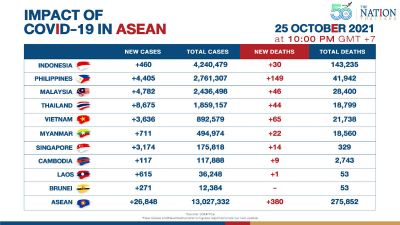
The number of Covid-19 cases crossed 13.02 million across Southeast Asia, with 26,848 new cases reported on Monday (October 25), lower than Sunday’s tally at 30,022. New deaths are at 380, decreasing from Sunday’s number of 441. Total Covid-19 deaths in Asean are now at 275,852.
Indonesia’s President Joko Widodo said the country will reopen in selected areas provided that they have over 70 per cent vaccination rate against Covid-19. Indonesia will also gradually ease up travel restrictions for foreign visitors who have been fully vaccinated and tested negative. The country reported 460 new cases and 30 deaths on Monday, bringing cumulative cases to 4,240,479 patients and total 143,235 deaths.
Meanwhile, Health authorities in Laos have launched a new enhanced Covid-19 vaccination certificate with a QR Code that will allow for greater authenticity and digital verification. The QR code on the Covid-19 vaccination certificate will ensure that the certificates are authentic and can be more easily monitored, as well as being of greater use when traveling abroad. Personal data, as well as the vaccine information of the recipients, will be recorded in the Covid-19 vaccine database before the QR code is created and printed on the back of the vaccination certificate.
In the early summer, with less than five months to go before a critical United Nations climate conference in Scotland, John Kerry told President Joe Biden that he wouldnt achieve his goal of tackling climate change, a key administration priority, unless the U.S.-China relationship improved.
Kerry, a former secretary of state and Biden’s envoy for climate, had been traveling the globe trying to secure commitments on carbon-emission reductions among allies and adversaries in the hope of keeping global temperature increases at or below 1.5 degrees Celsius, a level that scientists say could stave off the worst effects of climate change.
But his discussions with Chinese counterpart Xie Zhenhua were lagging as Beijing insisted that cooperation on climate would not commence amid strained relations over human rights, Hong Kong, Taiwan, trade and a range of other issues.
Now, with less than a week before leaders of nearly 200 countries arrive in Glasgow for the U.N. summit known as COP26, expectations for a major breakthrough are dim: Chinese President Xi Jinping will not attend in person, and Washington and Beijing face domestic political constraints on their international climate ambitions.
The desire to make progress on climate change has led to tensions among Biden’s top aides over how to manage Washington’s competing priorities with Beijing.
Kerry has repeatedly pushed for direct diplomacy between Biden and Xi, believing that an improved bilateral relationship can produce better outcomes in Scotland. White House aides, including national security adviser Jake Sullivan, are more skeptical that the United States alone can coax China into reducing emissions. Just as Washington would be averse to overhauling its energy policies on the basis of foreign pressure, so too would Beijing.
“They’re going to make their decisions based on their national interest,” said a senior administration official, who, like others, spoke on the condition of anonymity to discuss sensitive matters.
The standoff with China, the world’s largest carbon emitter and home to half the world’s coal-fired power plants, has presented a significant challenge for the Biden administration, which has identified both climate change as an “existential threat” and China as “the biggest geopolitical test of the 21st century.”
The United States is pressing China to set more ambitious commitments for when it will peak its carbon emissions and offer specifics about Xi’s promise to stop financing coal-fired power plants abroad. Absent those actions, global temperature increases are expected to surpass 2 degrees Celsius in the coming years, resulting in a rise of extreme weather events, hurricanes, droughts, forest fires, loss of biodiversity, and food and water scarcity.
As it presses its climate initiatives, the Biden administration is also demanding that Beijing stop threatening Taiwan, cease its crackdown on freedoms in Hong Kong, end its campaign of mass detention and sterilization of ethnic minorities in Xinjiang, and address a range of other grievances related to trade and cybersecurity.
Managing these priorities is Sullivan, who has ruled out accommodating China to make gains on climate.
“We are not in the business of trading cooperation with China on climate change as a favor that Beijing is doing for the United States,” Sullivan said at a security conference this spring, a message he repeated in a meeting with his Chinese counterpart in Zurich earlier this month.
The hard line has pleased the East Asia divisions at the State Department and Pentagon as well as China hawks on Capitol Hill who have cheered Biden’s continuation of Trump-era tariffs, imposition of new sanctions on Beijing and use of the word “genocide” to describe Beijing’s actions in Xinjiang.
But the tensions between the two nations have worried liberal lawmakers and climate activists concerned that poor relations between the world’s two biggest polluters will translate into an unproductive climate conference at a time of existential peril.
“U.S. collaboration with China on climate is fundamental due to China’s major role in emitting carbon dioxide but also as a leading producer of the green technologies required for decarbonization,” said a draft of a letter to Biden that Democratic Reps. Raúl Grijalva of Arizona, chair of the Natural Resources Committee, and Judy Chu of California, chair of the Congressional Asian Pacific American Caucus, are organizing. “Simply put, there is no conceivable way to address the climate crisis without substantially strengthening communication and collaboration between our nations.”
Climate watchers view the policies of Beijing and Washington as limited by domestic political constraints.
“Glasgow will be one of the most difficult COPs in history,” said Shuo Li, a senior global policy adviser at Greenpeace.
“I hope it doesn’t go as bad, but it already bears some resemblance to Copenhagen,” he said, referencing a 2009 climate conference many view as a failure.
In Washington, the most potent aspect of Biden’s climate agenda, a $150 billion program to replace the nation’s coal- and gas-fired power plants with solar, nuclear and wind energy, has been dropped due to opposition from Sen. Joe Manchin, a coal-friendly Democrat from West Virginia. The program was designed to show foreign leaders that the United States is taking the steps necessary to meet its goals of cutting emissions by 50% from 2005 levels in the next four years.
In China, a chronic electricity shortage reverberating across factories and industries this month is raising doubts about whether it will be willing to take coal-fired plants offline as it tries to meet its massive energy needs.
The Biden administration rejects the notion that it’s traveling to Scotland empty-handed, noting its ambitious emissions target and pledge to double U.S. financial support for developing countries to adopt clean-energy technologies.
But many world leaders may see those commitments as merely words on a page rather than concrete action.
A potential disappointment in Glasgow is something Kerry has tried desperately to avoid. Since early summer, he began advocating for a phone call between Biden and Xi in the hopes of finding common ground on climate ahead of COP26, viewing the tense relationship as a major problem.
Sullivan disagreed, sensing that such a call was premature, said senior administration officials.
Instead, contacts between the United States and China proceeded at a lower level through the summer, with Deputy Secretary of State Wendy Sherman traveling to Tianjin in July, and Kerry traveling to the same city to meet officials last month.
Before Sherman’s visit, Chinese officials refused to confirm her counterpart would see her until just before Sherman’s arrival in a move widely seen as disrespectful. The Chinese spent much of the meeting complaining bitterly about U.S. behavior, said officials familiar with the matter. On Kerry’s visit, they again ruled out any progress on climate while the United States continued to criticize China on human rights and other issues.
The disappointing meetings ended up uniting Biden’s team behind the need to connect the two presidents.
“The importance of a call between the leaders became clear after a number of meetings at the sub-leader level that were not constructive,” said a second senior administration official. “There was unanimity in the administration at this point that we were not getting anywhere in the bilateral relationship at that level and we were concerned that Beijing was not being responsible in its management of the competition.”
“Due to the centralization of power in Xi’s hands, we assessed that we needed to engage at the top to move the ball forward,” the official added.
So on Sept. 9, the two presidents held a 90-minute call in which Biden broached the idea of a meeting with Xi, said officials familiar with the discussion. Xi made clear that an in-person meeting was off the table, but U.S. and Chinese officials remained in touch. After Sullivan traveled to Zurich for a six-hour meeting with Chinese foreign policy adviser Yang Jiechi last month, the two presidents agreed to hold a virtual summit by year’s end.
Officials insist Kerry and Sullivan are in line on an overall strategy and differences are mostly tactical.
“Kerry’s job is to advocate for policies that will yield improvement on climate. He is seized with the mission,” said Danny Russel, a former career diplomat who has worked with both Kerry and Sullivan. “It’s a different set of variables for the national security adviser. From Jake’s perspective, there is a whole universe of factors to consider.”
White House officials believe what will move China on climate is the sense that it is the diplomatic outlier as the United States encourages countries such as Indonesia, Australia and India to reduce emissions.
They do not believe “if we’re nicer to China, they’ll do more for us on climate or anything else,” said the first senior administration official.
Advocates for Kerry say his actions have been in line with this viewpoint, first traveling to the capitals of U.S. allies and partners in Europe and elsewhere to drum up support for emissions reductions.
But Kerry’s focus on climate coordination has made him a target of Republicans in Congress, who view him as a phantom presence behind any less-than-confrontational move with China the Biden administration makes.
“It’s time to fire John Kerry,” Republican Sen. Marco Rubio of Florida said in a news release last month.
Rubio and other Republicans accuse Kerry of single-handedly stalling the Uyghur Forced Labor Act, a bill designed to ban products made with forced labor in Xinjiang.
U.S. officials say the administration remains staunchly opposed to forced labor, but there is concern across the executive branch that the bill could effectively ban all polysilicon from Xinjiang, the material inside most of the world’s solar panels, a critical tool in transitioning away from a carbon economy.
“Our goal is to figure out how best to lift up workers’ rights and meet our climate commitments,” said the first senior administration official.
In meetings on Capitol Hill, Kerry’s deputy, Jonathan Pershing, has told lawmakers that the U.S. government will need more time, five to 10 years, to move the global supply chain for solar panels away from Xinjiang, according to notes taken from a meeting with him and provided to The Washington Post. Pershing said the administration wants flexibility in the legislation to manage a transition.
Investigators from the U.S. attorneys office met with officials of the Metropolitan Museum of Art earlier this month to discuss whether relics in the famed museums collection had been stolen from ancient sites in Cambodia.
Museum officials said that “new information” about some pieces in their collection spurred them to reach out to officials in the Southern District of New York. They declined to describe what facts precipitated the meeting, which occurred about two weeks ago.
The Washington Post and the International Consortium of Investigative Journalists reported three weeks ago that the Met holds 12 pieces once owned or brokered by Douglas Latchford, a man prosecutors said was involved in decades of trafficking in looted artifacts. Another seven pieces at the Met came to the museum through his associates.
The reporting revealed that Latchford had created two offshore trusts that held relics. Those trusts were exposed in the Pandora Papers, a trove of more than 11.9 million financial records obtained by the International Consortium of Investigative Journalists (ICIJ) and shared with news organizations, including The Post.
In total, according to the investigation, 10 museums around the world were holding at least 43 relics that had passed through the hands of Latchford or those of his associates.
The Met’s move to meet with investigators comes as the Denver Art Museum is preparing to return four pieces to Cambodia that also had been cited in the Pandora Papers.
“Recently, in light of new information on some pieces in our collection, we reached out to the US Attorney’s office – to volunteer that we are happy to cooperate with any inquiry,” the Met said in a statement Sunday. “The Met also has a long and well documented history of responding to claims regarding works of art, restituting objects where appropriate, being transparent about the provenance of works in the collection, and supporting further research and scholarship by sharing all known ownership history.”
Bradley Gordon, an attorney representing the Cambodian government, said that the Met has not contacted government officials there regarding the pieces.
“The amazing thing is that these museums say they’re researching [the relics’ origins] but they have not contacted us,” Gordon said. “How can they say they’re researching when they aren’t calling the country of origin?”
The Met reached out to U.S. authorities after ICIJ and The Post sent the museum detailed questions about pieces linked to Latchford, Gordon said.
Officials with the U.S. attorney’s office in the Southern District of New York declined to comment Monday.
Cambodian investigators have been researching pieces they believe were looted during decades of war and tumult in the country beginning in the 1970s, when thieves ravaged the treasures of the ancient Khmer Empire. Today, scholars say, many valuable pieces sit in prestigious private collections and museums around the world.
Phoeurng Sackona, Cambodia’s Minister of Culture and Fine Arts, said she was surprised to learn that the Met had acquired so many Khmer relics during periods of war and tumult in Cambodia. “The Cambodian government never gave permission for our national treasures to be trafficked to the United States,” she said. “Today, we wish for the Metropolitan Museum to act as a moral and just leader in the global museum community and to return our precious looted antiquities to our people.”
In 2013, the Met returned two pieces to Cambodia, and the museum says that it has conducted research to determine whether other pieces in its collection have been acquired legally.
But critics say the Met, like other museums, has been reluctant to investigate Cambodian pieces that likely have been looted.
Tess Davis, the executive director of the Antiquities Coalition, an organization that campaigns against the trafficking of cultural artifacts, criticized the museum for not responding more thoroughly after a Latchford associate was indicted in 2016 and Latchford himself was indicted three years later.
“The Met owed it to Cambodia – and itself – to do a full and public accounting of its Khmer collection then. That didn’t happen,” Davis said. “There has still been no full and public accounting from the Met. It’s never too late to do the right thing, but what is the Met waiting for at this point?”
The Met collection, for example, has a sandstone statue of a figure called a Harihara.
The information published by the museum says the piece came from southern Cambodia and describes its style as “pre-Angkor period.” A very similar piece is described in the Latchford indictment – same religious figure, same dealer, same period, same location.
According to the indictment, Latchford had consigned the Harihara to a dealer who helped him sell looted art in 1974. The museum bought its Harihara from the same dealer three years later.
In a written statement last month, a spokeswoman for the Met said it was “unknown” whether the Harihara in its collection is the same as the Harihara that prosecutors say was looted. Latchford died before trial.
In recent years, the Cambodians have assembled a team of archaeologists and art experts in an effort to recover their looted national heritage. One of the people who has been critical to repatriation efforts is a former looter from Latchford’s network known as the “Lion,” who has been helping archaeologists excavate temples from which he had stolen relics. Lion is also essential in trying to recover fragments that might help ensure their return.
The group has begun to compile a list of treasures that the team believes were looted. According to the records, there are 45 relics in the Met’s collection that are highly significant culturally, and which the team members believe were looted. The “Lion” said that he recognized 33 of the relics as pieces he had stolen himself, and another 11 that he or others in his network had stolen versions of, according to Cambodian officials.
Gordon, the lawyer representing the Cambodians, said that his team recently sent the list of 45 relics to the U.S. attorney’s office. The Cambodian government wants all of the objects returned.
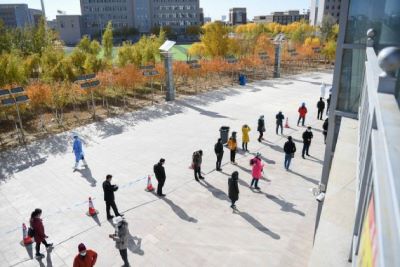
Ejina Banner, a county in north Chinas Inner Mongolia Autonomous Region, reported 12 new locally transmitted confirmed COVID-19 cases from 12 p.m. to 6:30 p.m. Sunday, according to the local health commission.
Ejina Banner has confirmed a total of 43 COVID-19 cases so far in the latest wave of infections, all of whom have been sent to designated hospitals for treatment.
As of 10 a.m. Sunday, 621 close contacts as well as 436 second close contacts have been placed under medical observation, while an epidemiological investigation is underway.
“The aggressive position of NATO has never been a secret,” Peskov said.
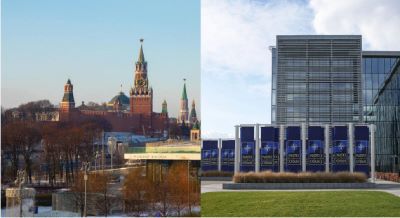
Russia isn’t wrong for halting official dialogue with the North Atlantic Treaty Organization (NATO) given its aggressiveness, Kremlin Spokesman Dmitry Peskov said Sunday.
“The aggressive position of NATO has never been a secret. This is a bloc that was created against our country. No peace-loving statements, no camouflage of this aggressive orientation can hide its true purpose,” Peskov told a Russian TV program.
“Nothing terrible will happen if we simply abandoned these relations against the background of the aggravation of its aggressiveness, against the background of such declarations that its main task is to restrain us,” he said.
Commenting on Ukraine’s attempt to join NATO, Peskov said it is impossible for Russia to prevent it, but Moscow will do everything necessary to minimize the consequences in the event of Ukraine’s admission.
On Monday, Moscow announced that it was suspending its Permanent Mission to NATO, the NATO Military Liaison Mission and the NATO Information Office in Moscow, in retaliation for the alliance’s “unfriendly actions,” including the expulsion of Russian diplomats earlier this month.
Water supplies can be adversely affected during the active burning of a wildfire and for years afterwards, according to U.S. Environmental Protection Agency.
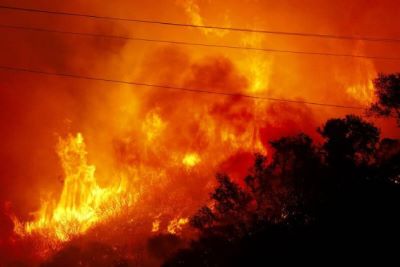
One year after the most destructive wildfire in U.S. Colorado history torched 208,913 acres (845.4 square kilometers), biologists were lamenting the slow recovery of the nearby water system.
“As feared, recent surveys of the river showed thousands of fish were killed as a result of the fire and its lasting impact,” CBS 4 Denver reported Saturday.
“The runoff events we shot this summer, post fire, have had a detrimental impact on the fishery,” aquatic biologist Kyle Battige told the Denver station.
The survey was conducted one year after the Cameron Peak Fire, the Centennial State’s worst fire on record, by Colorado Parks and Wildlife (CPW). It also engulfed some 461 structures, consumed millions of dollars of resources and took thousands of fire fighters to contain.
Despite widespread drought conditions throughout U.S. West, Colorado has seen significant precipitation this fall, and “since the rain on the burn scar caused flooding in the Poudre Canyon in July of this year,” that resulted in several deaths, wildlife officers with CPW have been monitoring “the detrimental impact the blaze had on fish in the Poudre River,” CBS reported.
A flash flood swept through the canyon on July 26, where three people died and one was missing after being swept away by flooding and mudslides, according to the website of the Colorado Public Radio.
Battige surveyed the burn-scarred region and river drainage in July, one day after the deadly flash flood, and told Kiowa County Press, “a loss of fish has been observed and we will continue to monitor the situation.”
Senior CPW aquatic biologist Jeff Spohn also told the media, “we will hold off on fish population impact comments until we can collect standardize data.”
The results of this week’s survey were called “shocking” by CBS 4.
The cause of the Cameron Peak Fire is still under investigation. It burned for 62 days beginning Aug. 13, 2020, and on Oct. 18 became the first wildfire in Colorado history to burn more than 200,000 acres,” according to Inciweb, an interstate incident information system.
The fire, controlled on Jan. 12, 2021, destroyed a total of 461 structures and required 549 water pump, 110 miles of bulldozer trails, and 232 miles of road work to contain the blaze in northern Colorado not far from the Wyoming border.
According to the United States Environmental Protection Agency (EPA), the authority started new researches for the impact of wildfires on water supply, including drinking, irrigation, fishing and recreation, two years ago.
Water supplies can be adversely affected during the active burning of a wildfire and for years afterwards, the EPA said, noting the impacts on the western states is more significant, because 65 percent of fresh water supply in the region originates from forested watersheds, which, depending on conditions, can be highly susceptible to forest fires.
During active burning, ash and contaminants associated with ash settle on streams, lakes and water reservoirs. Vegetation that holds soil in place and retains water is burned away. In the aftermath of a large wildfire, rainstorms flush vast quantities of ash, sediment, nutrients and contaminants into streams, rivers, and downstream reservoirs.
The absence of vegetation in the watershed can create conditions conducive to erosion and even flooding, and naturally occurring and anthropogenic substances can impact drinking water quality, discolor recreational waters, and may potentially contribute to harmful algal blooms, the EPA’s research said.
According to the latest data released by the National Interagency Fire Center, as of Oct. 20, a total 47,884 wildfires occurred in the United States this year and had scorched 6,515,883 acres (26,368.8 square kilometers) of land.
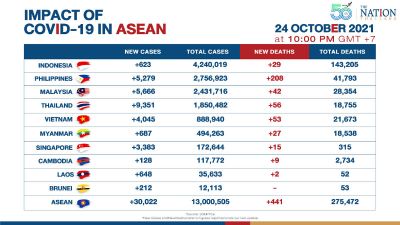
The number of Covid-19 cases crossed 13 million across Southeast Asia, with 30,022 new cases reported on Sunday (October 24), lower than Saturday’s tally at 31,057. New deaths are at 441, increasing from Saturday’s number of 355. Total Covid-19 deaths in Asean are now at 275,472.
Cambodia lifted its 15-month flight ban from Malaysia, Philippines and Indonesia on Saturday as the country continues its roadmap towards living with Covid-19. The lifting of the ban came after Prime Minister Hun Sen had earlier called for a review on the temporary ban as several Asean countries had relaxed or lifted quarantine requirements to kick start their economies, and the travel and hospitality industry.
Meanwhile, Singapore’s Ministry of Health announced that the Sinovac-CoronaVac Covid-19 vaccine will be included in the country’s national vaccination programme as a three-dose regime. The move aims to let those who are unable to take mRNA vaccines due to medical reasons to receive three doses of the Sinovac vaccine instead. Those who started with mRNA vaccines but developed allergies of severe adverse reactions after the first dose should follow up with two doses of Sinovac.
Furthermore, starting from January next year, unvaccinated people in Singapore and those without negative test results will not be allowed to enter workplaces or office buildings.