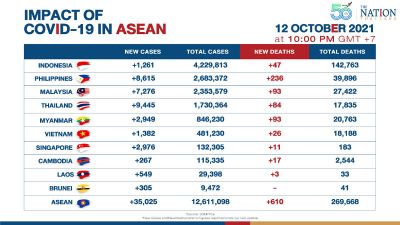
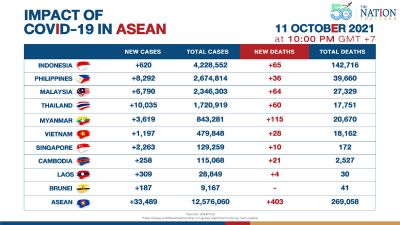
The number of Covid-19 cases crossed 12.61 million across Southeast Asia, with 35,025 new cases reported on Tuesday (October 12), higher than Monday’s tally at 33,489. New deaths are at 610, increasing from Monday’s number of 403. Total Covid-19 deaths in Asean are now at 269,668.
Indonesia announced on Tuesday that foreign visitors to Bali Island must have been fully vaccinated against Covid-19 for at least 14 days prior to arrival. They are also required to have valid Covid-19 treatment insurance covering at least US$100,000 and to pay for their hotel accommodation for the quarantine period in advance. Visitors from up to 18 countries have been approved to enter the island, although the list is yet to be announced.
Meanwhile, Malaysian government announced that the Covid-19 situation in the country is improving due to the declining trend in average daily cases, the number of clusters and hospital utilisation capacity, while the country registers a high vaccination rate. These factors prove that Malaysia and the people are ready to enter the endemic phase. The country reported 7,276 new cases and 93 deaths on Tuesday, bringing cumulative cases to 2,353,579 patients and total 27,422 deaths.
“If we do not act and help Afghans weather this storm, and do it soon, not only they but all the world will pay a heavy price,” UN Secretary-General Antonio Guterres warned.
UN Secretary-General Antonio Guterres on Monday called for the injection of liquidity to keep the Afghan economy afloat.
In addition to humanitarian aid, the international community needs to act to prevent the economic collapse of Afghanistan, he told reporters.
ADVERTISEMENT
Even before the Taliban takeover in August, Afghanistan’s fragile economy, which has been kept afloat by foreign aid over the past 20 years, suffered from the impact of drought and COVID-19. Right now, with assets frozen and development aid paused, the economy is breaking down. Banks are closing, and essential services, such as health care, have been suspended in many places, he noted.
United Nations Secretary-General Antonio Guterres addresses the Security Council meeting on Ethiopia at the UN headquarters in New York, Oct. 6, 2021. (Loey Felipe/UN Photo/Handout via Xinhua)
“We need to find ways to make the economy breathe again. And this can be done without violating international laws or compromising principles. We must seek ways to create the conditions that would allow Afghan professionals and civil servants to continue working to serve the Afghan population,” he said.
“I urge the world to take action and inject liquidity into the Afghan economy to avoid collapse,” Guterres said.
This is a make-or-break moment, warned Guterres. “If we do not act and help Afghans weather this storm, and do it soon, not only they but all the world will pay a heavy price.”
Afghan currency exchange dealers wait for customers in Kabul, capital of Afghanistan, Sept. 4, 2021. (Photo by Saifurahman Safi/Xinhua)
Without food, without jobs, without their rights protected, more and more Afghans will flee their homes in search of a better life. The flow of illicit drugs, criminal and terrorist networks will also likely increase. This will not only badly affect Afghanistan itself, but also the region and the rest of the world, he warned.
Guterres said the issue of injecting liquidity should be treated independently of other issues, such as the questions of recognition or nonrecognition of a government in Afghanistan, the question related to sanctions, and the questions related to frozen assets.
“There are many questions of these that, obviously, the international community will be discussing with the Taliban and that will require that the Taliban abide by a number of important aspects, be it related to human rights and the rights of women and girls, in particular, be it in relation to the question of terrorism, be it … the inclusivity of the government,” he said.
Independently of those measures, there are forums to inject cash inside the economy through different entities, through nongovernmental organizations (NGOs), through UN agencies to allow for the people to receive assistance, he said. “And this is what we have been asking.”
Afghan girls pose for photos in Kabul, capital of Afghanistan, Sept. 15, 2021. (Photo by Saifurahman Safi/Xinhua)
There is a need to find ways — on the basis of respect for international law and principles — to inject liquidity for the economy not to collapse and for the people not to suffer tremendously, he said. “The Afghan people cannot suffer a collective punishment because the Taliban misbehave.”
The diplomatic recognition of the Taliban and the injection of liquidity are completely different things, said Guterres.
The World Bank can create a trust fund and that trust fund can pay directly to Afghan people in need. The UN Development Programme has a trust fund that can pay directly to people in need or organizations in need. And there are many NGOs operating in Afghanistan, he said.
“So, we need to inject cash in the economy. I’m not saying that I’m asking the international community to give money to the Taliban or to the present authorities. No. We need to inject cash in the economy. We need to make the economy breathe. We need to allow people to survive. That is our concern.”
While the international community has consensus on humanitarian aid, things in relation to the injection of liquidity into the Afghan economy are moving too slowly, said Guterres.
The main responsibility for finding a way back from the abyss lies with those that are now in charge in Afghanistan, he said.
Since their takeover, the Taliban have — at various times — promised Afghan citizens, including women, children, minority communities, former government employees, that they would protect their rights. Central to those promises was the possibility of women to move, work and enjoy their basic rights, and for girls to have effective access to all levels of education, the same as boys, he said.
“Gender equality has always been an absolute priority for me. … I am particularly alarmed to see promises made to Afghan women and girls by the Taliban being broken,” said Guterres. “Broken promises lead to broken dreams for the women and girls of Afghanistan.”
Women and girls need to be the center of attention. Their ability to learn, work, own assets, and live with rights and dignity will define progress. Eighty percent of Afghanistan’s economy is informal, with a preponderant role of women. Without them, there is no way the Afghan economy and society will recover, he said. “I strongly appeal to the Taliban to keep their promises to women and girls and fulfill their obligations under international human rights and humanitarian law.”
The United Nations is permanently engaging with the Taliban on the safety and security of its staff, humanitarian assistance and unhindered access for all, including female staff, and human rights with particular focus on women and girls’ rights, he said.
The humanitarians have been acting with the cooperation of the Taliban, who have progressively granted access to the areas requested and provided security when needed. The number of incidents during humanitarian operations has been in constant decline, he noted.
The United Nations is engaging with the Taliban and progress is being made, said Guterres.
He gave an example of the UN engagement with the Taliban for its female staff to have full and unimpeded work in relation to humanitarian aid.
“Now, we have been engaging the Taliban province by province, day by day. And the result of that effort, in the month of September, is the following: we managed to reach full agreement with the Taliban on this freedom in six provinces, against three in the beginning of the month; we have partial agreement in 20, instead of 16 in the beginning of the month; we have no agreement in four, against six in the beginning of the month; and there are four in which we have not yet had the possibility to engage, against eight in the beginning of the month.”
“This is daily work, area by area, fighting for the rights of each woman, sometimes one by one. But this is our engagement to our staff and to the women and girls in Afghanistan in general,” he said. “We might have difficulties. We might fail here and there. But one thing I can promise: we will not give up.”
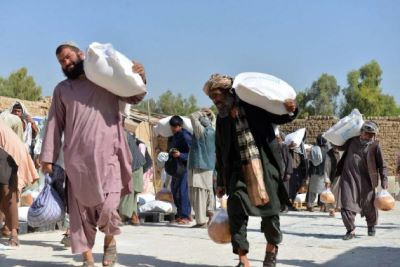
The humanitarian crisis is growing in Afghanistan, with at least 18 million people — half of the country’s population — needing help. UN agencies and humanitarian NGOs in Afghanistan are in a race against time to deliver life-saving aid to crisis-affected people and pre-position supplies ahead of winter, he said.
Despite financial shortfalls, logistical challenges, and an increasingly complex geopolitical situation, the United Nations is undertaking a massive humanitarian operation in the country.
In September alone, more than 3.8 million people received food assistance; 21,000 children and 10,000 women received treatment for acute malnutrition; 32,000 people received non-food items, including blankets and warm clothes for winter; 10,000 children were reached with community-based education activities; 450,000 people were reached with primary and secondary health care; 160,000 farmers and herders were provided with livelihoods support; 12,000 people received emergency psycho-social and mental health support; 186,000 drought-affected people received water; and 150,000 people received hygiene promotion and hygiene kits, he said.
An Afghan man delivers bananas in Kabul, capital of Afghanistan, Sept. 15, 2021. (Photo by Saifurahman Safi/Xinhua)
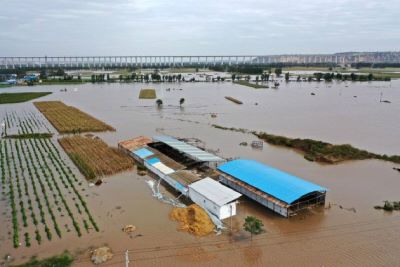
North Chinas Shanxi Province had lowered its emergency response for floods to Level IV from Level III at 6 p.m. Monday, said the provincial flood control and drought relief headquarters.
China has a four-tier flood-control emergency response system, with Level I being the most severe.
The flood situation in the province has been stabilized. The water levels of small and medium-sized rivers have fallen below the warning mark, said the headquarters.
ADVERTISEMENT
The headquarters require that related departments closely monitor the flood situation and strictly implement all measures to ensure the safety of people’s lives and property.
Located on the eastern end of the Loess Plateau, Shanxi is usually dry. However, the average precipitation of the province reached 119.5 mm from 8 p.m. on Oct. 2 to 8 a.m. on Oct. 7 this year, three times the normal average rainfall for October in previous years, said the provincial meteorological bureau.
New Zealand Prime Minister Jacinda Ardern extended a lockdown in Auckland and pushed back plans to reopen schools in the nations largest city as its coronavirus outbreak continues to spread.
Auckland will remain at Alert Level 3, under which most people are required to stay at home, for at least another week, Ardern told a news conference Monday in Wellington. That means the city will be in lockdown for at least nine weeks. Similar restrictions in the neighboring Waikato and Northland regions have been extended until at least midnight on Oct. 14, Ardern said.
“New Zealand is at one of the trickiest and most challenging moments in the Covid-19 pandemic so far,” she said. “However, there is a clear path forward over the coming months in which New Zealanders should be able to move to living with fewer restrictions and more freedoms as a result of higher levels of vaccination.”
ADVERTISEMENT
Ardern has conceded that even New Zealand’s strict lockdown measures are unlikely to beat the delta strain of Covid-19 but said they need to remain in place until enough people are vaccinated. The government has announced a “National Day of Action” on Oct. 16 to boost vaccination so that it can begin to gradually ease restrictions while the virus is still circulating in the community.
About 57% of eligible people aged 12 and over are fully vaccinated, while around 82% have had at least one dose.
Delta “has spread through communities that are harder for us to reach,” Ardern said. “This has made getting to zero cases in Auckland very tough. Regardless, throughout this outbreak we have maintained our approach — test, contract trace, isolate. We are continuing to try and stamp out the virus wherever we find it. We will keep doing that.”
Despite the government announcing a lockdown after just one case was detected in mid-August, the total number of cases in the current outbreak has risen to 1,622. Health authorities reported a further 35 new cases earlier Monday after recording 60 new infections on Sunday.
Auckland schools won’t reopen on Oct. 18 as initially planned, with further advice to be provided next week. The government today also made vaccination mandatory for large parts of the health and education workforces.
“In coming weeks I’ll outline the framework for our next steps as vaccination rates lift,” Ardern said. “We remain in a very strong position to make the transition from lockdown restrictions to the individual armor of vaccines while maintaining our world leading position on case numbers, hospitalizations and deaths, as well as delivering a strong economy and low unemployment.”
Two dozen additional countries have signed up for a global methane pledge, vowing to cut emissions of the potent greenhouse gas by 30 percent by 2030.
At a virtual ministerial meeting hosted in Brussels on Monday, the European Union’s top climate negotiator, Frans Timmermans, and the White House special envoy for climate, John F. Kerry, announced the new signatories and stressed the importance of slashing methane.
The pledge is now backed by nine of the world’s top 20 methane-emitting countries, and accounts for 60 percent of the global economy, the organizers said.
ADVERTISEMENT
But with just a month left before a crucial climate summit to be held in Scotland, some of the world’s biggest methane emitters – including Russia, China, India and Brazil – have still not signed on.
Three nations named on Tuesday – France, Germany and tiny Malta – were already committed to the pledge, thanks to their membership in the E.U. bloc. The most significant new additions were Canada, the Central African Republic, Nigeria and Pakistan. Some of the other countries mentioned – including Costa Rica, Jordan and Liberia – have only a small role in the global methane emissions picture.
Still, the U.S. and E.U. negotiators hailed the progress. In all now, 34 countries have now signed the pledge.
The call to reduce methane emissions by 2030 was pushed by President Joe Biden at the White House last month. Methane is not as long-lived in the atmosphere as carbon dioxide, the main greenhouse gas, but it is more than 80 times more powerful over a 20-year period. The heat-trapping gas is produced by coal mining, the oil and gas industry and agriculture and livestock.
Scientists forecast that future global warming could be reduced by 0.2 Celsius (0.36 degrees Fahrenheit) by the 2040s if countries take up the challenge to cut methane now. Timmermans and Kerry called the bid “the single most effective strategy to reduce near-term global warming and keep the goal of limiting warming to 1.5 degrees Celsius within reach.”
“If the world is serious about keeping the climate safe, it’s got to get serious about cutting methane,” said Durwood Zaelke, president of the Institute for Governance & Sustainable Development. “The Methane Pledge is a good start.”
The new 24 supporters are Canada, Central African Republic, Republic of Congo, Costa Rica, Côte d’Ivoire, Democratic Republic of the Congo, Federated States of Micronesia, France, Germany, Guatemala, Guinea, Israel, Japan, Jordan, Kyrgyz Republic, Liberia, Malta, Morocco, Nigeria, Pakistan, Philippines, Rwanda, Sweden, and Togo.
These countries join the earlier signatories, including the United States, European Union, Argentina, Ghana, Indonesia, Iraq, Italy, Mexico and Britain.
Kerry said he hoped to have more than 100 countries pledged to cut methane by the United Nations COP26 climate summit in Glasgow next month. In addition to the new methane pledges by nations, more than 20 philanthropies on Monday announced plans to spend $200 million to support implementation of the global methane goals.
“Momentum is building for a methane moment at Glasgow,” said Fred Krupp, president of the Environmental Defense Fund. “Cutting methane pollution is the fastest opportunity we have to help avert our most acute climate risks, including crop loss, wildfires, extreme weather and rising sea levels.”
SYDNEY – On a rainy Monday morning, John Church sat near the door of the Corner Pub holding a pint with the affection of a new father.
“Icouldn’t wait to get my first draft beer,” the 65-year-old retired wool packer said as he sank his mustache into the glass of Victoria Bitter.
But this beer wasn’t his first. That had been five hours and four pubs ago, when he lined up before dawn outside another bar for a taste of Sydney’s newfound freedoms.
ADVERTISEMENT
For the first time in 106 days, pubs swung open their doors for vaccinated patrons on Monday. Barbers broke out their clippers, cafes dusted off their china and gyms cranked up the classic rock. Sydney was alive again.
Soaked with rain, relief and alcohol, the reopening marked the easing of one of the world’s toughest lockdowns. And few parts of the city had endured more than Church’s, one of a dozen areas put under a curfew barring people from venturing out at night.
“I’ve been locked up for three months like a prisoner,” he said, as he drank with a friend. “I just needed to talk to people.”
Since an outbreak of the delta variant began in June, Sydney’s 5 million residents have been barred from traveling more than a few miles from home. Friends and family members have been unable to visit one another, let alone pop down to the pub.
The loss of freedom was a shock for a beer-swigging, jet-setting city that had largely dodged the pandemic because of Australia’s once-successful “covid zero” approach.
Now, Sydney’s reopening poses another shock, as soaring vaccination rates have enabled Australia’s largest city to become the first to ease lockdown despite the ongoing outbreak.
“We want to lead Australia out of this pandemic,” New South Wales Premier Dominic Perrottet said on Sunday from – where else – a pub.
“It’s been 100 days of blood, sweat, and no beers,” he added, moments after spraying suds on his face while ceremonially tapping the first keg of Australia’s post-covid-zero era.
Sydney’s reopening has been powered by a surge in vaccinations. When the outbreak began in June, Australia’s sluggish vaccination rollout went into hyper drive. In just over three months, Australia’s inoculation rate went from single digits to rivaling that of the United States.
In New South Wales, the ramp-up in vaccinations has bent the pandemic’s curve downward and empowered officials to ease restrictions for vaccinated people, after the state fully inoculated 70 percent of people 16 and older.
By Monday, the tally had neared 75 percent. More than 90 percent had received at least one dose.
Sydney had had its shots. Now it was time for the chaser.
As of Monday, the fully vaccinated can visit pubs, restaurants, gyms, movie theaters, shops, hairdressers, nail salons and places of worship, although under reduced capacity. They can travel anywhere in the city and host up to 10 fully vaccinated adults at home.
Restrictions will ease further when double doses hit 80 percent later this month. But unvaccinated people will largely be left out until Dec. 1.
Other states and territories are due to follow, starting with the capital, Canberra, and then Victoria, which hit a national record of 1,965 new cases on Saturday – roughly four times the number in New South Wales.
Sydney’s staged reopening is far from the raucous “Freedom Day” celebrations seen in Britain, said Catherine Bennett, an epidemiologist at Deakin University in Melbourne.
“That’s always been the plan, to ease out rather than fling open the doors,” she said. But even a phased approach has proved divisive in a country where covid zero became an article of faith for many.
“There are people who think we shouldn’t come out of lockdown, there are people who think we should have been out of it ages ago, and then there are a lot of people caught in the middle,” Bennett said.
Adding to the division is the uneven way the pandemic unfolded across Sydney. In the wealthy east, where the outbreak began but cases remained low and beaches have been crowded for weeks, some bars opened their doors at midnight.
But in the working-class west, which bore the brunt of infections and deaths, the mood ahead of Monday was one of relief, said Elfa Moraitakis, CEO of multicultural services organization SydWest. Residents felt targeted by curfews, extra restrictions and heavy policing.
“There is a feeling that we are finally free as human beings,” she said.
In Church’s area of Liverpool, one of 12 that endured curfew, city councilor Nathan Hagarty said frustrations had been building.
“There was this police mentality from the government . . . they sent in helicopters, they sent in the army,” he said. “People were very angry and upset.”
Hagarty hoped easing the lockdown would “let some of the steam out.”
Perrottet has acknowledged the lockdown hit western Sydney hardest, and said Sunday he didn’t want to see “a tale of two cities.”
But in Blacktown, another curfew-hit area where playgrounds were closed at one point to keep young people away, some worry reopening will be policed differently as well.
“There is always one rule for the west and another rule for the east,” said Mayor Chagai, a basketball coach and South Sudanese community leader. He said he and others had to push the state to provide sufficient vaccinations for Blacktown, a rapidly growing area that is home to more than 400,000 people.
The vaccination rates in Blacktown, Liverpool and other hard-hit western areas are now on par with the east. But the pride is mixed with fear.
Whenever Nahreen Kaae thinks of the lockdown lifting, she sees her husband’s sunken face and blue-tinged lips. The couple had just received their first vaccine dose when their eldest son brought the virus home from his job as a carpenter. Within days the family of four was sick. One morning, Kaae made her husband tea but he wouldn’t drink it. When she called his name, he could only move his eyes.
As an ambulance took away the previously healthy 52-year-old, Kaae thought to herself, He’s not going to come back, and collapsed on her front lawn.
Her husband spent nine days in intensive care but survived, though he and Kaae are still recovering. Kaae and her son are back at work but terrified of bringing the virus home.
“To be honest I’m scared to go out,” she said. “I just feeling like life is not going to go back to normal.”
As they ate lunch at a busy indoor mall in Liverpool, Mark and Rosemary Dickens felt things were going back to normal. The middle-aged couple had both battled cancer in the last year. They were expecting their first grandchild in a few weeks.
“You can’t live life without any risk at all,” Rosemary said as shoppers streamed past.
At the Corner Pub a few blocks away, Church was looking forward to visiting his daughter. But not before a few more beers with his friends.
“Come over here and sit,” he beckoned to a regular who gave her name only as Debbie.
“Churchie, have a heart attack,” she answered, taking a seat nearby instead.
The number of Covid-19 cases crossed 12.57 million across Southeast Asia, with 33,489 new cases reported on Monday (October 12), lower than Sunday’s tally at 39,996. New deaths are at 403, decreasing from Sunday’s number of 492. Total Covid-19 deaths in Asean are now at 269,058.
Cambodia has started administering 3rd jab of Covid-19 vaccine to general public in 11 out of 14 districts of Phnom Penh since Monday. Eligible candidate must have already received the second jab at least four months while the vaccine provided will be Sinovac. People in the rest three districts will get the booster shot from October 30 onward.
Meanwhile, Myanmar will start giving Covid-19 vaccine to students aged over 12 years old within this week. There are about 1 million students in middle and high school levels that will attend face to face classrooms in the next academic year. The country reported 3,619 new cases and 115 deaths on Monday, bringing cumulative cases to 843,281 patients and total 20,670 deaths.
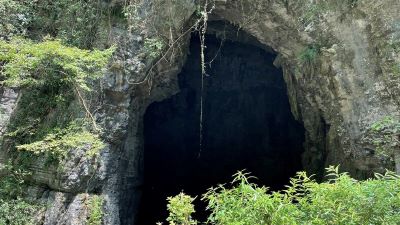
ENSHI, China – Hundreds of caves are spread throughout the mountains of Enshi prefecture, an agricultural corner of Chinas Hubei province. The most majestic, Tenglong, or “flying dragon,” is one of Chinas largest karst cave systems, spanning 37 miles of passages that contain numerous bats.
Nearby are small farms that collectively housed hundreds of thousands of wild mammals such as civets, ferret badgers and raccoon dogs before the pandemic, farm licenses show – animals that scientists say can be intermediate hosts for viruses to cross over from bats to humans.
The World Health Organization has requested access to China’s wildlife farming areas such as Enshi, calling it a key step in the search for the origins of the coronavirus. Beijing has denied the requests.
ADVERTISEMENT
The Washington Post made a rare trip in September to Enshi, six hours’ drive west of Wuhan, where the coronavirus was first detected.
A reporter observed human traffic into Enshi caves, including domestic tourism, spelunking and villagers replacing a drinking water pump inside a cave. Defunct wildlife farms sat as close as one mile from the entrances.
Scientists briefed on The Post’s reporting said it documents a plausible pathway for how a coronavirus could have spread from bats to other animals, then to Wuhan’s markets.
Asked if bats, farmed animals and local residents were tested for the coronavirus in Enshi, a spokesperson for the Chinese Embassy in Washington said they could not verify the specific situation at the moment, and said China banned the trade and consumption of wild animals in February 2020. Enshi’s forestry bureau did not respond to faxed questions; two officials declined interview requests in person.
Western Hubei is home to at least seven types of horseshoe bats, according to the Xishuangbanna Tropical Botanical Garden, a research institute under the Chinese Academy of Sciences. One type, Rhinolophus affinis, has been found farther southin China carrying a virus 96 percent identical to SARS-CoV-2.
In the rolling land near the caves, Enshi officials for years promoted wildlife farming to alleviate poverty. Enshi accounted for 17 percent of Hubei wildlife farms shut down in the pandemic, official announcements show. Authorities estimated that the 290 shuttered Enshi farms had 450,000 to 780,000 animals.
China’s government and the WHO say the likeliest origin of the pandemic is natural transmission through wildlife. Yet little progress has been made in establishing a definitive natural pathway from a bat to a Wuhan market – or for any competing theory, for that matter – because of the Chinese government’s refusal to grant scientists access.
“We really need to find out more about what viruses are circulating in those bats” in the Enshi caves, said Michael Worobey, an evolutionary biologist at the University of Arizona. “That kind of proximity of farmed animals and bats that could be carrying coronaviruses is exactly the kind of thing we worry about.”
Marc Eloit, head of pathogen discovery at the Pasteur Institute in Paris, agrees that much more sampling needs to be done in China, and specifically in these karst areas.
Eloit said he “would be very interested” to obtain samples from bats and caves in Enshi, adding that gathering bat guano could be a start.
Beijing has been less than eager to find answers in Hubei, as it touts its own theory that the virus may have originated overseas. One foreign scientist who worked for years with the Wuhan Institute of Virology, and who spoke on the condition of anonymity to discuss sensitive matters, said the institute’s field research in bat caves has been suspended since the pandemic began.
But Chinese authorities had Enshi in their sights before the threat of covid-19 was known.
A clampdown on Enshi’s wildlife trade at wet markets began on Dec. 23, 2019, according to state media, eight days before China publicly acknowledged the new virus. The head start in Enshi doesn’t mean officials found something amiss: It could have been preventive, as rumors emerged of market vendors falling mysteriously ill in Wuhan. But it means evidence on Enshi’s wildlife trade was erased before the world was aware of the existence of a novel coronavirus.
Since then, Beijing has rebuffed international calls for more details on supply chains of live wildlife leading to Wuhan markets, even as local officials shut down wildlife farms – possibly coming across some of the information the WHO seeks. U.S. intelligence agencies told President Biden in August that the virus was not a biological weapon, but that natural transmission and a lab-related accident were possible origins.
During the trip to Enshi, a reporter was followed by men in several cars who did not identify themselves, but who would subsequently talk to interviewees. None of the farm operators would say whether the animals had been tested for SARS-CoV-2 before being disposed of or released.
The Lichuan Juyuanxiang Special Breeding Cooperative in Enshi illustrates the difficulties that the WHO would have in finding fresh evidence, even if granted access. A two-story, concrete structure where the animals were previously kept now stands empty, vines creeping up the side.
“They were released back into the woods,” said a man surnamed Yang at the Lichuan Juyuanxiang farm, which called itself Hubei’s largest civet farm. “The government wouldn’t allow us to raise them anymore.”
Visits to nearly a dozen other former wildlife farms in the area yielded similar stories. Owners were either not home, denied raising animals listed on business registrations, or said they stopped farming before the outbreak.
Yang, who identified himself as the farm owner’s uncle, said they had over 1,000 civets at the time of the outbreak, and that the farm was closed down by May 2020. His nephew, owner Yang Ancui, declined to talk when reached by phone.
Aside from civets, the farm – which sat downhill from a large cave – was licensed for breeding porcupines and wild boars.
Scientists say SARS-CoV-2 probably originated in bats. How it got from a bat to a human is unclear, with debate over two prevailing theories.
According to the natural-transmission theory, the virus could have been passed directly to a human who wandered into a cave – perhaps a villager, a hunter or a scientist. It also could have been transmitted first to an intermediate host like a civet, for instance, if the civet drank water contaminated with bat feces.
A second theory posits that the outbreak could have stemmed from a lab accident; China’s most advanced coronavirus research lab is based in Wuhan. A separate team at the Wuhan Center for Disease Control and Prevention is known to have searched bat caves in Hubei for new diseases in 2019. Chinese officials have denied a lab accident occurred.
Edward Holmes, a virologist and evolutionary biologist at the University of Sydney, said that, to his knowledge, bat sampling had been done by scientists near to but not inside Enshi, and that no coronaviruses were detected, but he added that the sample sizes were too small.
“I’m certain that SARS-CoV-2-like viruses will be found in China in places where you find Rhinolophus bats,” Holmes said.
Some scientists are pushing for a more vigorous search for an intermediate host, which, if found, would be strong evidence for natural transmission. Other coronaviruses like SARS and MERS were carried by intermediate hosts: civets and camels, respectively. Wuhan markets with early outbreaks had sold live wild animals.
A person with knowledge of the Wuhan market supply chains, who spoke on the condition of anonymity to protect his contacts, told The Post that live animals sold at markets in Wuhan were sourced from Hubei, particularly Enshi and Xianning prefectures, as well as from Hunan and Jiangxi provinces.
Chinese authorities have deflected questions about the presence of live wild animals at Wuhan markets before the outbreak. A Scientific Reports study in June that catalogued illegal sales of live wildlife at the markets has not been covered by China’s state-run media. The two Chinese authors did not respond to requests for comment about what they knew about those supply chains.
International team members from the joint WHO-China study on coronavirus origins released in March have said they believe live wildlife was removed from Wuhan markets before the official Jan. 1, 2020, closure of the Huanan market, an early infection hot spot. Details in the WHO-China study pertaining to wildlife supply chains at that market focused on chilled and frozen meat products left behind when stall operators cleared out, not on live animals traded there in preceding months.
Wildlife captively bred in Enshi before the pandemic included potential intermediate hosts such as palm civets, raccoon dogs, porcupines, wild boars, hedgehogs, rodents, ferret badgers, ocelots, muntjac deer and flying squirrels, official business registries show.
Huang Shuang, a chicken vendor at Yuanmengzhuang market in Enshi city, recalled live wildlife being sold in late 2019. “The rules are really strict now, so you don’t see any more wild animals,” he said. “There were some around here before, not a lot, but you could find some.”
On Dec. 23, 2019 – eight days before Wuhan announced a mysterious pneumonia – the Enshi forestry bureau ordered a halt of live wildlife sales at wet markets in the prefecture, the state-run Hubei Daily reported in February 2020.
In January 2020, a month before China banned the trade and consumption of wild animals nationwide, the Enshi forestry bureau announced that a goal for the year was rectifying wildlife breeding and strengthening monitoring for wild animal epidemics.
At least six wet markets in Enshi city were closed by March 2020.
An Enshi forestry bureau report in September of this year recounted enforcement steps including wildlife farm shutdowns and cash rewards for tips on violations.
Some online notices about local wildlife farming became inaccessible after The Post approached Enshi authorities.
Humans have long encountered bats at Tenglong Cave, according to local residents and news reports. As early as 1988, the Belgian-Chinese Karst and Caves Association reported “intensive utilisation” of the cave by local residents, including digging out bat dung for fertilizer.
Tourists and adventurers continue to visit. At the entrance to Tenglong’s lower cave, where the Qing River surges toward the Yangtze River, local spelunkers geared up on a recent day, fastening helmets, snaking ropes over their shoulders, packing waterproof bags.
A mile down the road sits Changyan Farm, a small operation with blue and silver corrugated metal roofs that had been licensed to raise civets, porcupines and wild boar. The deserted farm and dilapidated house across the road showed no signs of recent use. A restaurant and hotel behind the property was closed and the caretaker declined to discuss the farm.
“The forestry officials came by early around the Lunar New Year [2020],” said a neighbor, who would not give her name out of fear of official retribution. “They closed everything down on that farm. I’m not sure what animals they had at the time or what they did with them.”

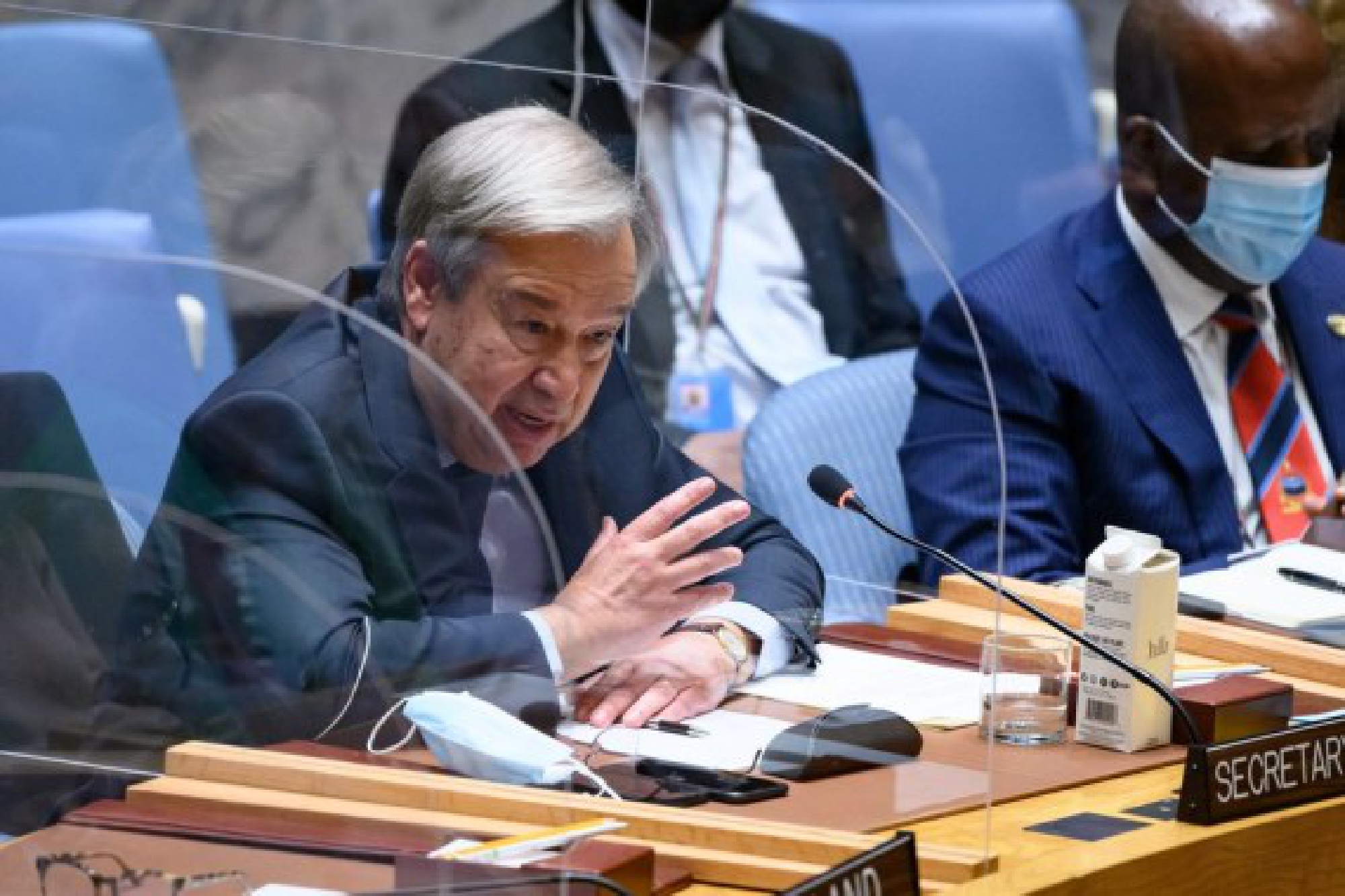 United Nations Secretary-General Antonio Guterres addresses the Security Council meeting on Ethiopia at the UN headquarters in New York, Oct. 6, 2021. (Loey Felipe/UN Photo/Handout via Xinhua)
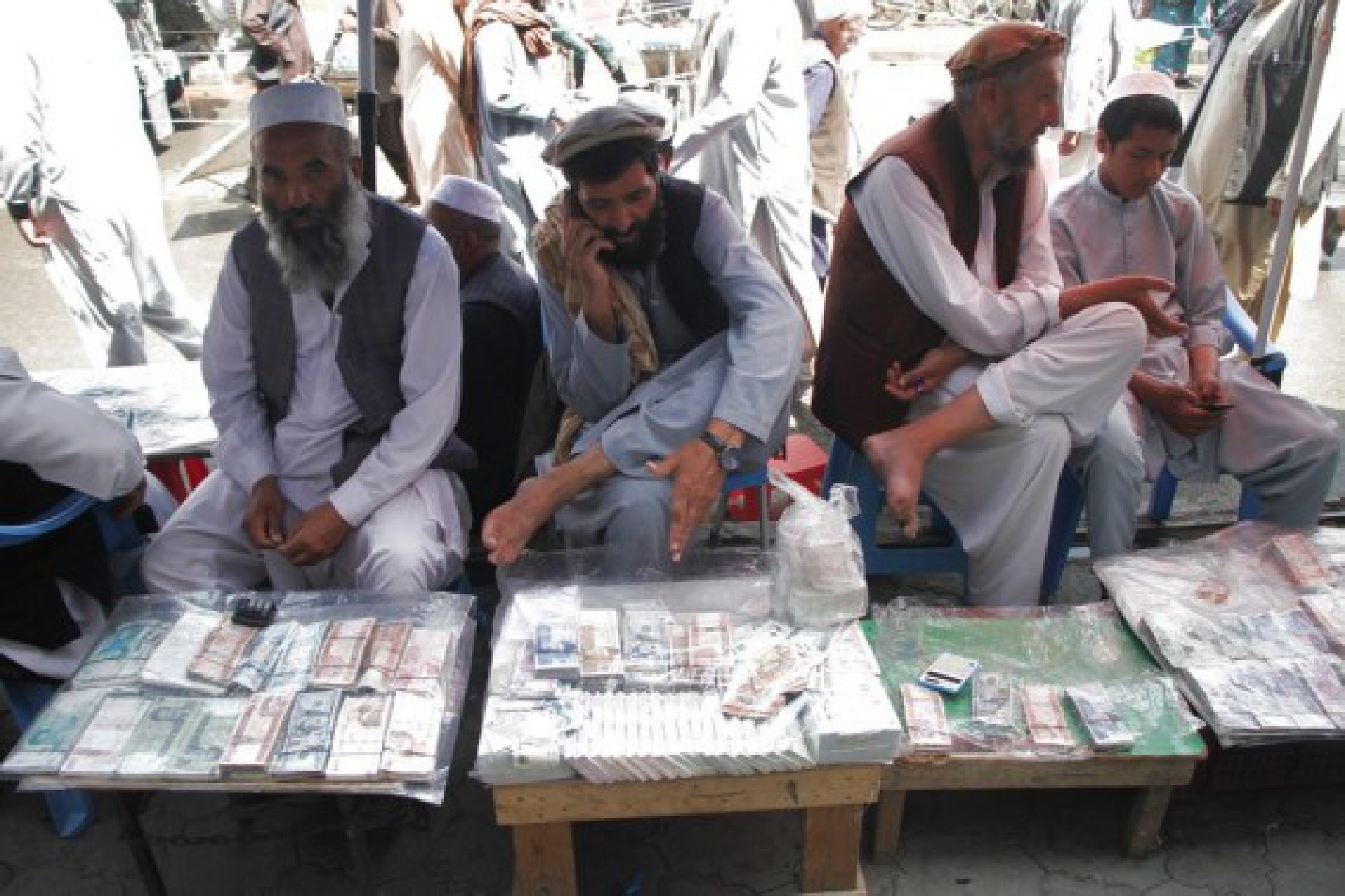 Afghan currency exchange dealers wait for customers in Kabul, capital of Afghanistan, Sept. 4, 2021. (Photo by Saifurahman Safi/Xinhua)
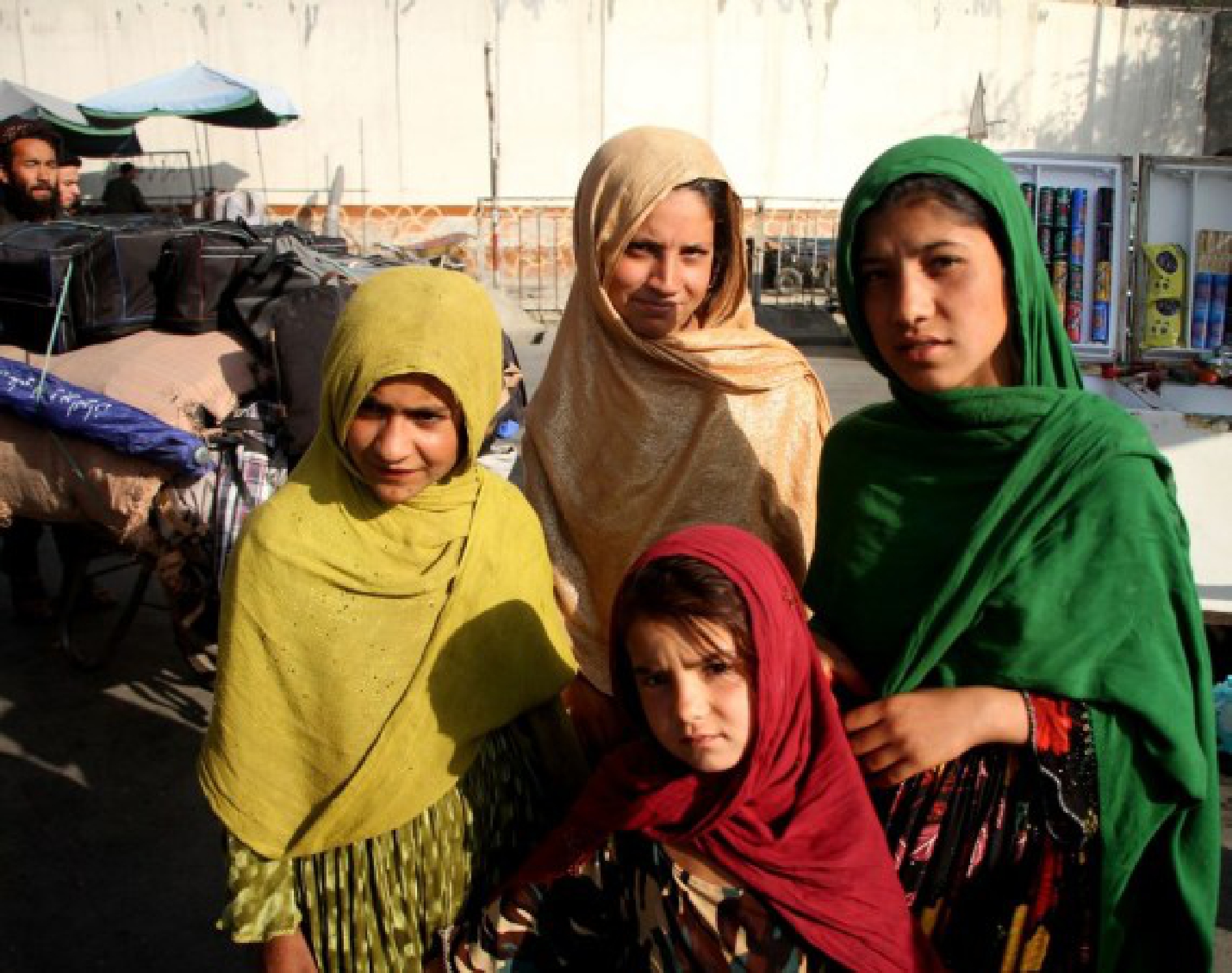 Afghan girls pose for photos in Kabul, capital of Afghanistan, Sept. 15, 2021. (Photo by Saifurahman Safi/Xinhua)
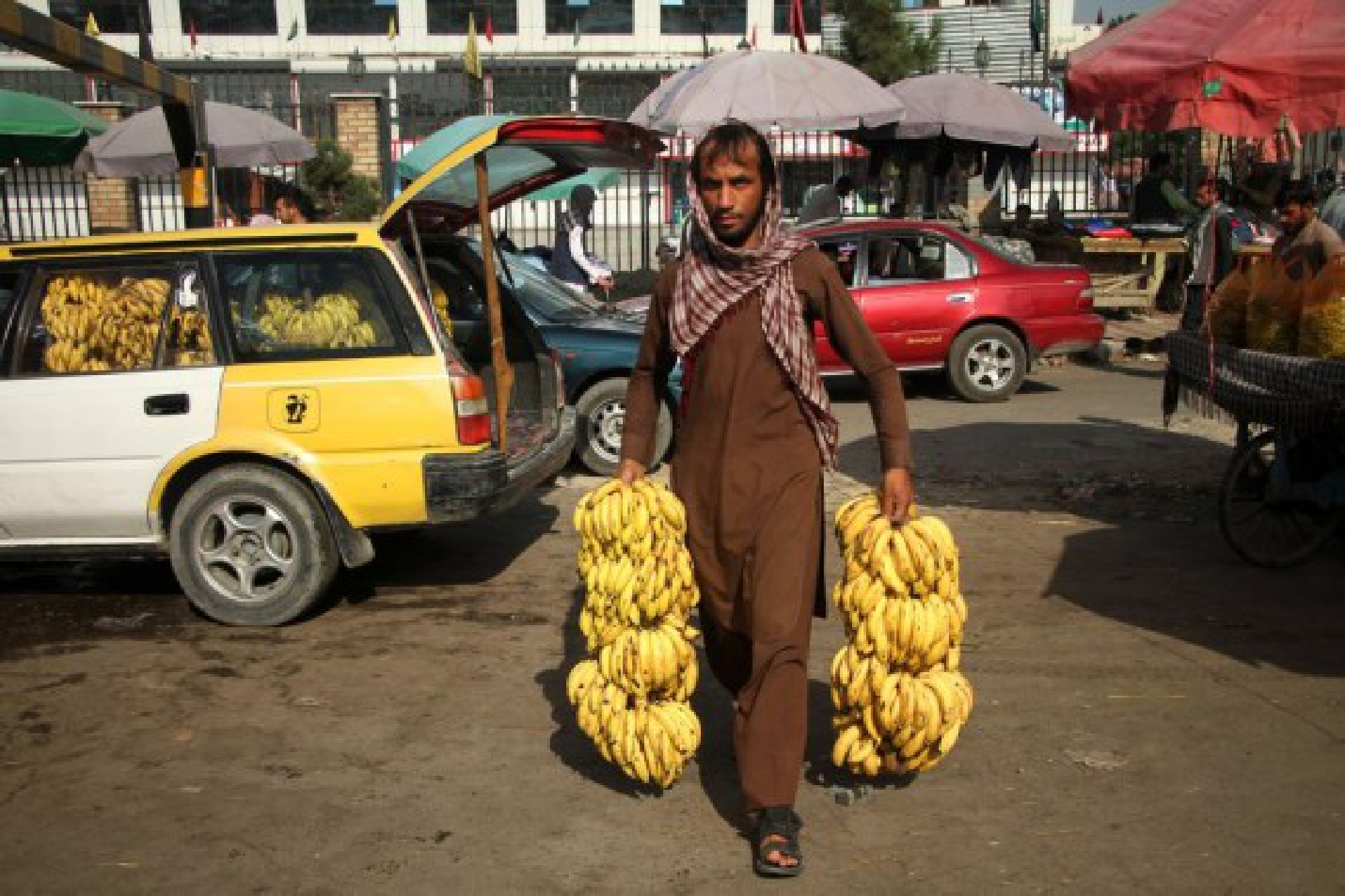 An Afghan man delivers bananas in Kabul, capital of Afghanistan, Sept. 15, 2021. (Photo by Saifurahman Safi/Xinhua)

 Xiaohongshu หนึ่งในบริษัทที่ทางการจีนเพ่งเล็ง จ่อทำ IPO ตลาดหุ้นฮ่องกง หลังพับแผนจดทะเบียนในสหรัฐ
