“The contract values reflect that the contracted company will benefit from the subsequent sale of scrap steel, iron, and non-ferrous metal ores,” said a spokesman for the Naval Sea Systems Command.
The U.S. Navy has sold two former aircraft carriers, USS Kitty Hawk and USS John F. Kennedy, to a Texas shipbreaking company for one cent each, the Naval Sea Systems Command said on Tuesday.
“The contract values reflect that the contracted company will benefit from the subsequent sale of scrap steel, iron, and non-ferrous metal ores,” said Alan Baribeau, a spokesman for the Naval Sea Systems Command.
ADVERTISEMENT
Both warships are aging and defunct. For the Kitty Hawk, that likely means a tug boat tow from Bremerton, Washington, around the tip of South America; for the John F. Kennedy, a sailing from the Philadelphia Navy Yard, according to a USA Today report.
The contract with International Shipbreaking Limited in Brownsville, Texas, for the tow, remediation, dismantling and recycling of the storied warships makes imminent their departures from the Navy’s mothball fleet, said the report.
No timetable has been established for either ship’s departure and dismantling, said the report.
WASHINGTON – Facebook whistleblower Frances Haugen on Tuesday told lawmakers that the company systematically and repeatedly prioritized profits over the safety of its users, painting a detailed picture of an organization where hunger to grow governed decisions, with little concern for the impact on society.
Her Senate committee testimony – based on her experience working for the company’s civic integrity division and thousands of documents she took with her before leaving in May – sought to highlight what she called a structure of incentivization, created by Facebook’s leadership and implemented throughout the company. By directing resources away from important safety programs and encouraging platform tweaks to fuel growth, these performance metrics dictated operations, Haugen said, a design that encouraged political divisions, mental health harms and even violence.
She pointed to Facebook chief executive Mark Zuckerberg as the enforcer of this system, arguing that he controls the most important decisions made at the company.
ADVERTISEMENT
“Until the incentives change, Facebook will not change. Left alone, Facebook will continue to make choices that go against the common good, our common good,” she said.
The hearing signaled the start of a new crisis for Facebook in Washington, galvanizing lawmakers from both parties around regulatory efforts to tamp down on what they say is a wide-ranging set of the societal ills prompted by the social media giant. Repeatedly, senators compared the company to Big Tobacco, purveyors of products that are addictive and profitable but ultimately bad. The Tobacco industry was ultimately contained by landmark regulation, an action lawmakers promised to replicate.
“I think the time has come for action, and I think you are the catalyst for that action,” Sen. Amy Klobuchar, D-Minn., told Haugen during the hearing.
The Senate panel hearing was Haugen’s first public appearance after she revealed herself Sunday evening as the source of thousands of pages of internal company research, leaked to the Securities and Exchange Commission and the Wall Street Journal. Throughout, Haugen gave a detailed account of the ways that Facebook employees are incentivized to turn a blind eye from the problems its services were causing, coupling her own experiences at the company with data from the internal Facebook documents she took with her.
Already revelations from the documents have intensified concerns on Capitol Hill about Facebook’s influence, particularly on children’s and teens’ mental health, a topic expected to be the key focus of the hearing. But Haugen and lawmakers covered huge swaths of ground, touching on national security risks, the spread of misinformation and the deadly mob attack on the Capitol on Jan. 6.
As she was speaking, Facebook’s representatives tweeted and emailed talking points rebutting Haugen’s testimony. One of their main points: Haugen didn’t work on many of the issues, including teenagers and child safety, that were covered in the documents that she downloaded. Lena Pietsch, Facebook director of policy communications, said Haugen clarified her testimony at least six times to point out that she had not worked on the subject matter in question.
“We don’t agree with her characterization of the many issues she testified about,” Pietsch said in a statement.
Haugen brought specific examples from her time at the company. Because of understaffing, she recognized a pattern where there was “implicit discouragement” from building rigorous systems to detect problematic content, she said. Haugen saw this play out in her work on counterespionage, where her team could only handle about a third of the cases they were made aware of. If Facebook had invested in building a detector, they knew they would have many more cases.
Sen. Marsha Blackburn, R-Tenn., raised concerns about Facebook executive Antigone Davis’s testimony to Congress last week that Facebook had removed 600,000 accounts in a three-month period of children younger than 13. Haugen said that there are probably far more children on the platform, and that the company has ways to determine people’s ages.
“Facebook could do substantially more to detect more of those children, and they should have to publish for Congress those processes . . . they could be much more effective than probably what they’re doing,” Haugen said.
She also said that she provided documents to Congress that show Zuckerberg knew the company could have intervened to prevent the spread of hate speech and misinformation in at-risk countries, but he did not, because it would have negatively affected “meaningful social interaction,” a key metric Facebook uses to measure communications between family and friends. Haugen said the company tied the metric to employees’ bonuses and chose not to make changes that could cost Facebook money.
“People stay or leave the company based on what they get paid, and if you hurt MSI, a bunch of people aren’t going to get their bonuses,” Haugen said.
During congressional testimony and on other occasions, Zuckerberg has insisted that the company does not reward employees based on how much time people spend on the platform. But on Monday, Facebook representatives declined to answer whether rewards or other incentives for employees were tied to the performance of the algorithm.
Engagement-based ranking, which Facebook uses to prioritize posts in people’s feeds that are more likely to elicit reactions – and therefore, clicks – also concerned Haugen. The downside is the recommendation of divisive or harmful content. That has led to Facebook’s algorithms causing teens to be exposed to more anorexia content, encouraging rifts within families, and fueling ethnic violence in Ethiopia, she told lawmakers.
Facebook could shift to posts being ranked in other ways, such as chronologically, and still remain profitable, she said. That argument resonated with lawmakers.
“This company could be vastly profitable but so much safer,” Sen. Richard Blumenthal, D-Conn., said during a news conference after the hearing. “They’ve just chosen the greediest path. . . . If they took a little bit less money but emphasized Facebook in the way they apply algorithms, they could help save lives.”
Facebook has long said that it made the change to its news feed algorithm to prioritize what types of interaction people found most valuable, and the shift was made in the context of a bigger prioritization of friends, family and groups over news publishers. News outlets, including The Washington Post, reported at the time that engagement among younger U.S. users was slowing, and Facebook was interested in finding ways to boost time spent on the platform.
Today, the company says its news feed algorithm takes in more than 10,000 data points when deciding what content to show people, and some of those data points include promoting trustworthy publishers and demoting those that are known to publish clickbait. But engagement – or the amount of likes, clicks, views and shares that a post generates – is still one of the most heavily weighted parts of the algorithm, executives have said.
The wide-ranging revelations marked a stark departure from dozens of other Capitol Hill technology hearings, where lawmakers have grilled company executives. These leaders largely gave non-answers, in contrast to the open and frank information that Haugen delivered on Tuesday.
Haugen’s call for regulation of Facebook was expansive and ambitious. She asked lawmakers to “break out of previous regulatory frames.” She warned lawmakers that some of the most widely debated proposals, including privacy protections or tweaks to Section 230, a decades-old law that protects companies from lawsuits over what users post, would be insufficient.
She proposed changing Section 230 to make Facebook responsible for “the consequences of their intentional ranking decisions.”
Gaining such expansive oversight of Facebook’s closed design will be an uphill battle for lawmakers, who have publicly called for regulation of social media for years but have been unable to pass bipartisan proposals that would force greater transparency. Tuesday’s hearing crystallized that while lawmakers are collectively outraged over Haugen’s allegations, there is little consensus about exactly what kind of legislation they might advance. Lawmakers name-dropped individual bills that they have introduced during the hearing, including proposals that would address children’s online privacy and bills that would increase transparency around tech companies’ algorithms.
Lawmakers from both parties have become increasingly motivated to pass stronger competition laws, and some bills would probably result in a breakup of Facebook’s existing business. But Haugen warned lawmakers against breaking up the company, arguing that it needs all the profitability it can get to properly police itself, especially in areas such as Africa where Facebook-owned services are the primary way people access the Internet.
“If you split Facebook and Instagram apart, it’s likely that most advertising dollars will go to Instagram and Facebook will continue to be this Frankenstein that is endangering lives around the world,” she said. “Only now there won’t be money to fund it.”
The revelations amount to perhaps the most significant crisis in Facebook’s history, one in a slew of such scandals over the years, but Zuckerberg has not publicly commented on them. Blumenthal said the Facebook chief needs to testify before the committee about Haugen’s revelations.
“No apology, no admissions, no acknowledgment, nothing to see here, we are going to deflect it and go sailing,” said Blumenthal, referencing the CEO’s frequent social media photos of his activities on the water.
This will probably not be Haugen’s last appearance on Capitol Hill. She told lawmakers that Facebook’s consistent understaffing of counterespionage staff is a national security concern, and that she is talking about it with members of Congress. Rep. Adam Schiff, D-Calif., a member of the select committee to investigate the Jan. 6 riot, said that committee would need to hear from her about Facebook’s role in the violence at the Capitol.
Blumenthal also called for both the Securities and Exchange Commission and the Federal Trade Commission to investigate Haugen’s revelations. Haugen’s lawyers have made at least eight complaints to the SEC, which has broad oversight of financial markets and the power to bring charges against companies that mislead investors.
Blumenthal is hopeful that Haugen’s decision to speak will inspire other tech workers who wish to expose similar concerns.
“I think there are other truth-tellers in the tech world who want to go forward, and I think you are leading by example,” he said. Haugen is “showing them that there’s a path to make this industry more responsible and more caring about kids and about the nature of our public discourse.”
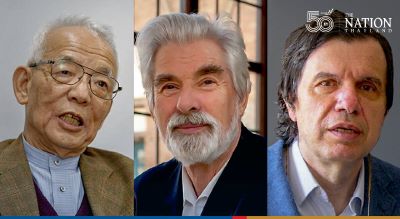
The Nobel Prize in physics was awarded Tuesday to scientists Syukuro Manabe of the United States and Klaus Hasselmann of Germany for laying the foundation of our knowledge of the Earths climate and how humanity influences it, including by reliably predicting global warming.
Giorgio Parisi, a theoretical physicist at the Sapienza University of Rome, also shared the prize for describing fluctuating physical systems and disorder on scales from atoms to planets.
The three scientists were honored “for groundbreaking contributions to our understanding of complex physical systems,” Göran Hansson, secretary general of the Royal Swedish Academy of Sciences, told reporters in Stockholm. They made accurate predictions for phenomena as chaotic as weather and climate. “The notion of global warming is resting on solid science,” Hansson said.
ADVERTISEMENT
Manabe, a meteorologist at Princeton University who was born in Shingu, Japan, has modeled Earth’s climate since the 1960s. He demonstrated how increased levels of carbon dioxide in the atmosphere will lead to increased temperatures at the surface of the Earth.
When the Nobel committee called him early Tuesday to tell him he’d won, Manabe was “gobsmacked,” according to Yale University physicist John Wettlaufer. “He said, ‘But I’m just a climatologist.’ And I think that’s the point . . . He really did construct the models from which all future climate models were built.”
In one such model, Manabe examined the interplay between solar radiation on the planet’s surface and the vertical movement of air due to convection. That model, of a 25-mile-high column of air, required hundreds of computing hours to test what happened with different levels of gases, the Nobel committee said.
The work led to a crucial finding: “If you double the carbon dioxide in the Earth’s atmosphere, the surface temperature would increase by 2 degrees Celsius,” Wettlaufer said.
Manabe’s model confirmed the key role carbon dioxide plays in heating the planet – essential for showing how human industry, which releases this and other greenhouse gases, drives climate change. A U.N. report published in September warned that by the end of the century, the planet could heat by 2.7 degrees Celsius, or 4.9 Fahrenheit, if large nations do not make more robust efforts to curb emissions, as The Washington Post reported last month.
Manabe enthusiastically led the charge to simulate how climate operates, his colleagues said. “He built numerical models of the climate system not just to answer questions about the future evolution of climate, but because he wanted to understand how the climate system works,” Rutgers University climate scientist Anthony J. Broccoli told The Washington Post.
At a Princeton news conference Tuesday afternoon, Manabe said it was a “great surprise and honor” to be selected for this prize. He added: “I never imagined that this thing I began to study has such huge consequences. I was doing it just because of my curiosity.”
Ronald Stouffer, a climate scientist who worked with Manabe at the National Oceanic and Atmospheric Administration’s Geophysical Fluid Dynamics Laboratory, said Manabe is the “father of climate modeling,” driven to simulate aspects of global warming before anyone else.
In addition to his influential carbon dioxide model, Manabe and his colleagues predicted how an influx of fresh water into the sea from melting polar ice would alter ocean circulation, slowing the global conveyor belt that influences continental temperatures and coastal sea levels. He also showed that warming can shape tropical storms.
“One of the things that stands out about Suki’s work is that almost all of it has been confirmed by 50 years of climate research,” said Stouffer, calling Manabe by his nickname. “He didn’t have too many false steps along the way.”
Awarding the physics prize to a meteorologist is unusual. “I was shocked. I had often thought about, and talked to people, whether Suki would win a Nobel Prize in physics – I thought it was reserved for physicists,” Stouffer said.
Hasselmann, an oceanographer at the Max Planck Institute for Meteorology in Hamburg, linked weather with climate about a decade after Manabe developed his model. Hasselmann showed how weather, which works on a time scale of days, influences ocean climate over a time scale of years.
“I’m very happy that they put the attention on the climate problem, which is really important,” Hasselmann said in an interview for the Nobel’s website. “We’ve been warning about climate change for about 50 years or so; it’s just that people are not willing to accept the fact that they have to act now” to prevent the worst effects of climate change.
Parisi, meanwhile, has studied a material called spin glass, in which a bed of copper atoms is randomly sprinkled with iron atoms. The iron atoms act similar to a magnet, except that in spin glass, the magnetic pairs point in different, rather than the same, directions.
A long-standing question in theoretical physics was to determine why the pairs pointed the way they did. Parisi solved this by finding a hidden structure in replicated spin glass systems, a method that became a “cornerstone of the theory of complex systems,” according to the Nobel brief.
Parisi said his approach can be used to explain environmental variation, such as the 100,000-year cycle of ice sheets forming glaciers and then collapsing.
The prize’s two halves are connected by a shared theme of disorder and fluctuation, said Nobel committee for physics chair Thors Hans Hansson, a theoretical physicist at Stockholm University. The natural world has hidden structures, he said, that can be understood if analyzed carefully, as this trio did.
Compared to the preindustrial age, Earth is now 1 degree Celsius warmer. That uptick has already exacerbated drought, flooding, hurricanes and wildfires. “It’s clear that for the future generation we have to act now, in a very fast way,” Parisi said when reached by phone during the Nobel conference.
Manabe acknowledged that trying to understand and respond to climate change can be daunting. “But it’s much easier than understanding current politics,” he said.
The three scientists will split a prize of 10 million Swedish kronor, or about $1.14 million, with half to Parisi and a fourth each to Hasselmann and Manabe.
Two decades ago, Jaime Aleman was looking to re-establish Panamas reputation as a stable business center following the U.S.s 1989 invasion.
So, the Duke-educated attorney brought together heads of the country’s top law firms to back legislation inspired by Liechtenstein’s friendly rules on private foundations. The story, as told by Aleman in his autobiography, “Honesty is Priceless,” was the beginning of an offshore-entity boom, in which world leaders, celebrities and more used hundreds of thousands of shell companies in Panama to hide their assets and take advantage of accounting and tax loopholes.
Now, his law firm — Aleman, Cordero, Galindo & Lee, or Alcogal — is at the center of an investigation by the International Consortium of Investigative Journalists for creating thousands of offshore companies that stashed money in tax havens for politicians and public figures. In sheer size, the leak of those financial records, known as the Pandora Papers, eclipses that of the Panama Papers in 2016.
ADVERTISEMENT
“Over the past three decades, Alcogal has become a magnet for the rich and powerful from Latin America and beyond seeking to hide wealth offshore,” the report said. “The firm acted as corporate middleman for more than 160 politicians and public officials.”
The law firm’s clients included Jordanian King Abdullah II, former presidents of Panama, the president of Ecuador and a presidential candidate in Honduras, according to the report. Almost half of the politicians whose names appear in the leaked records and nearly 2 million of the 11.9 million documents in the Pandora Papers were tied to Alcogal. In total, ICIJ tallied 14,000 entities in Belize, the British Virgin Islands, Panama and other tax havens created with Alcogal’s support as part of efforts to hide money away from public scrutiny for some 15,000 clients over 25 years.
Alcogal said in a letter to ICIJ that company incorporation is only one aspect of its legal services and that it operates in “full compliance with all applicable requirements in every jurisdiction in which we operate.” The firm “performs enhanced due diligence on a client who is determined to be a high-risk customer, regardless of the nature of the relationship or service,” it said. Alcogal didn’t reply to a request for additional comment.
Co-founded in the 1980s by Aleman, a former Panamanian ambassador to Washington, D.C., the firm worked with figures from some of the biggest corruption cases in recent history, including the so-called Carwash scandal that involved Brazil construction giant Odebrecht, the report said.
The report found that Alcogal set up more than 200 shell companies in Panama and other jurisdictions for Banca Privada d’Andorra, a bank based in a European principality between France and Spain, which the U.S. government blacklisted in 2015 for being a “primary money laundering concern.”
Alcogal is just one player in a larger industry. Aleman, 71, said in his autobiography that he helped create Panama’s law on private foundations along with other firms, including Mossack Fonseca, which was at the center of the Panama Papers. That firm closed in 2018 after it faced raids and arrests as part of the Carwash scandal.
Aleman’s book also mentions Morgan & Morgan, as well as Icaza, Gonzalez-Ruiz & Aleman and Arias, Fabrega & Fabrega as part of the group that shaped Panama’s foundation law in the 1990s. But they aren’t necessarily the biggest players in the space. Those Panamanian firms are not in the top ranks of Chambers and Partner’s list of the global offshore law firms, which includes Maples and Walkers in the Cayman Islands, Harneys in the British Virgin Islands, Mourant in Jersey and Appleby in Bermuda.
That may be why Panama feels like it’s being picked on. Former president Ricardo Martinelli, who was named in the ICIJ report because of Alcogal shell companies linked to two of his sons, tweeted that the ICIJ report aimed to “destroy the country.” His sons were held in Guatemala last year after facing U.S. indictments for their alleged roles in the bribery case involving Odebrecht.
Juan Carlos Varela, another former Panamanian head of state, was also named in the report for two companies that Alcogal registered in 2000 and 2001 in the British Virgin Islands, owned by him, family members and other associates.
Varela said in a statement on Twitter that he was transparent by declaring the shareholding as he became president in 2014, and as he left office in 2019.
Panamanian authorities have also recommended that Varela be charged in the corruption case of Brazilian builder Odebrecht, after Varela admitted in 2017 that during his vice presidential campaign, he received donations from the construction firm. But Varela has denied that the money was a bribe, and told ICIJ that the campaign donations were made in accordance with the law and were reported to electoral authorities.
A statement from the Panamanian president’s office says the government is working to “counter negative repercussions” of the leak.
“It’s our duty to defend the interests of the nation and fight so that the name of the country isn’t associated with activities that we repudiate,” said President Laurentino Cortizo Cohen.
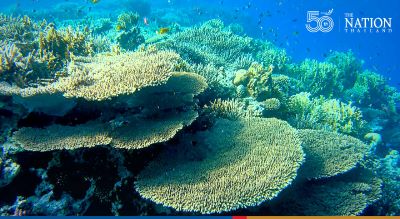
Climate change is wiping out coral reefs and will kill more if oceans keep getting warmer, researchers warned on Tuesday in a new study that spanned much of the globe.
The world already lost 14% of its coral between 2009 and 2018 – or what amounts to more than all the coral now living in Australia’s reefs – scientists with the Global Coral Reef Monitoring Network found.
They blamed rising sea surface temperatures: While local factors like too much fishing, pollution and construction on the coast play a role, coral bleaching has done the most harm.
ADVERTISEMENT
That’s what happens when the water becomes so warm that corals evict the algae which they shelter in return for food. The corals turn white if their colorful partners stay away for too long, and over time, they can starve to death.
A severe case of this in 1998, the first mass global bleaching event, killed 8% of the world’s coral alone, the report said.
Data from over 40 years and 73 countries fed the analysis, with backing from the United Nations, which described it as the most sweeping of its kind so far. It highlights damage in reefs in South Asia, Australia, the Pacific and other regions.
Still, with Tuesday’s warnings came some hope: The underwater ecosystems have bounced back in the past when they faced less pressure. This means the world can still rescue many if it steps in fast enough to curb emissions, according to the researchers.
In popular tropical destinations, from Hawaii to Thailand, local nonprofits and biologists have been working through the pandemic to restore reefs, with some calling on tourists to help.
“We are running out of time: we can reverse losses, but we have to act now,” said Inger Andersen, the head of the United Nations Environment Program, in a statement on the new report.
The findings have come out a week before world leaders meet to explore ways to protect ecosystems under a new agreement on biodiversity targets.
In the broad but stark research, the authors join a growing chorus of calls for governments to act quickly on climate change after a summer of floods, fires and record heat.
The decline of coral reefs threatens millions of people who rely on them for food, jobs and protection. They are also behind $2.7 trillion a year in goods and services, including $36 billion in tourism, the new report estimated.
Around the world, the reefs are home to 25% of all marine animals and plants, help limit flooding for 500 million residents, and are a source of fish for many more.
LONDON – The British government on Tuesday announced an independent inquiry into “systemic failures” by police after a serving London Metropolitan Police officer used his official documents to “arrest” a young woman before raping and murdering her.
Last week, Wayne Couzens, 48, was sentenced to life in prison without parole in the killing of Sarah Everard, a 33-year-old marketing executive. Couzens used his police-issued handcuffs to restrain Everard and falsely arrest her on the pretext that she had violated pandemic restrictions.
The case shocked Britain and has deeply dented public confidence in police.
ADVERTISEMENT
Home Secretary Priti Patel said at the annual Conservative Party conference Tuesday that “recent tragic events” had exposed “unimaginable failures in policing.”
“It is abhorrent that a serving police officer was able to abuse his position of power, authority and trust to commit such a horrific crime,” she said. “The public have a right to know what systematic failures enabled his continued employment as a police officer.”
The Home Office said the inquiry will first examine Couzens’s behavior in the lead-up to the murder and then address police issues such as vetting procedures and workplace conduct.
The inquiry is nonstatutory, meaning it lacks the legal authority to compel witnesses, but the government said it could be upgraded into a statutory one.
Questions have been raised about whether police missed warning signs about Couzens. He has been linked to a WhatsApp group with five police officers that allegedly shared misogynistic and racist material. He was also connected to incidents of alleged indecent exposure, including one in Kent in 2015 and another at a London McDonald’s three days before Everard’s abduction.
Couzens joined the Metropolitan Police in 2018 and worked as a parliamentary and diplomatic protection officer, serving in Parliament and the U.S. Embassy. The Met acknowledged that mistakes may have been made in his vetting but said he would have been hired regardless after detectives who investigated the 2015 incident decided against further action.
Prime Minister Boris Johnson told the BBC on Tuesday that the public outrage over Everard’s murder was a symptom of a “wider frustration that people feel.”
When asked about calls for misogyny to be deemed a hate crime, Johnson said it would be better to enforce existing laws.
Prosecutions and convictions of rape in Britain are at record lows.
Russias latest space mission had some unusual passengers – an actress and a film director who are set to make the worlds first feature-length movie shot in space.
ASoyuz rocket carrying actress Yulia Peresild and film maker Klim Shipenko, as well as cosmonaut Anton Shkaplerov, lifted off just before 5 a.m. Eastern time from a launch facility in Baikonur, Kazakhstan.
It docked at the International Space Station “after just two orbits around the earth,” Russia’s space agency Roscosmos said in a tweet shortly after 8:00 Eastern time. “Welcome to the ISS!”
ADVERTISEMENT
The passengers will spend about 12 days at the ISS, shooting about 35 minutes of the film, which has the working title “The Challenge.” Peresild will play a doctor who has to race to save the life of a crew member in space, according to the space agency’s website for the project.
Peresild, who was chosen from thousands of applicants for the role, has previously described the project as “a miracle, an incredible chance.”
Training for the film was “psychologically, physically and morally hard,” she told a news conference on Monday, in quotes carried by the Associated Press. Meanwhile, Shipenko lost 33 pounds while preparing for the flight, Roscosmos said.
Two Russian cosmonauts who are already on the ISS – Oleg Novitskiy and Pyotr Dubrov – are also expected to feature in the film, with Novitskiy set to return to Earth with Peresild, Shipenko and Shkaplerov later this month.
Russia announced its cosmic moviemaking ambitions last year, shortly after NASA said it would work with Tom Cruise on a film on the ISS.
Russia and the United States have long competed to make space history, with Russia sending the first human into space in 1962, and the United States’ Apollo 11 landing humans on the moon in 1969.
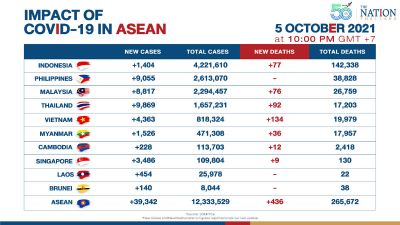
The number of Covid-19 cases crossed 12.33 million across Southeast Asia, with 39,342 new cases reported on Tuesday (October 5), lower than Monday’s tally at 39,566. New deaths are at 436, decreasing from Monday’s number of 566. Total Covid-19 deaths in Asean are now at 265,672.
Indonesia’s Bali Island will be reopened for tourists from selected countries including China, Japan, South Korea, New Zealand, Qatar and United Arab Emirates via the Ngurah Rai International Airport from October 14 onward. Foreign visitors from said countries will have to undergo a 8-day quarantine before they can move around freely on the island. Indonesia reported 1,404 new cases and 77 deaths on Tuesday, bringing cumulative cases in the country to 4,221,610 and total 142,338 deaths.
Meanwhile, Cambodia’s Phnom Penh announced a mandatory facemask rule for all passengers of vehicles that are passing through the city’s entrances to curb the Covid-19 outbreak. The rule applies to taxi, public buses, private cars and motorcycles, whereas violators will be fined from 200,000 to a million riel or Bt1,653 to Bt8,265.
SIOUX FALLS, S.D. – Across from a Holiday Inn, in a red-brick building with a welcome sign that reads “The Heart of America,” a little-known financial firm set up shop seven years ago and extended an invitation to the worlds elite.
Trident Trust promised to protect the fortunes and privacy of its new customers by relying on the laws of a state that had become a global destination for wealth. The company called it “The South Dakota Advantage.”
Among those who answered the call: a Colombian textile magnate caught in a scheme to launder the proceeds of an international drug ring, an orange juice mogul who settled with authorities in Brazil for allegedly colluding to underpay local farmers, and family members of the former president of a sugar producer in the Dominican Republic that has been accused of exploiting laborers and forcibly evicting families from their homes.
ADVERTISEMENT
– – –
The U.S. government has long condemned prominent offshore financial centers, where liberal rules and guarantees of discretion have drawn oligarchs, business tycoons and politicians.
But a burgeoning American trust industry is increasingly sheltering the assets of international millionaires and billionaires by promising levels of protection and secrecy that rival or surpass those offered in overseas tax havens. That shield, which is near-absolute, has insulated the industry from meaningful oversight and allowed it to forge new footholds in U.S. states.
The Washington Post and the International Consortium of Investigative Journalists (ICIJ) gained an unprecedented look into the money flowing into trusts in the United States by examining a trove of more than 11.9 million confidential documents maintained by trust and corporate services providers around the world.
The records, known as the Pandora Papers, expose how foreign political and corporate leaders or their family members moved money and other assets from long-established tax havens to U.S. trust companies.
The investigation identified 206 U.S.-based trusts, linked to 41 countries, holding combined assets worth more than $1 billion. Nearly 30 of the trusts held assets connected to people or companies accused of fraud, bribery or human rights abuses in some of the world’s most vulnerable communities.
The cache of confidential files, obtained by the ICIJ and shared with more than 150 media partners, describes only some of the trusts in the United States but is the most significant set of records ever made public from inside America’s trust industry.
– – –
The trust documents come mostly from the Sioux Falls office of Trident Trust, a global provider of offshore services. In a written statement, Trident said it is committed to compliance with all applicable regulations and routinely cooperates with authorities. The company declined to answer questions about its clients.
Other states competing to lure wealth include Alaska, Delaware, Nevada and New Hampshire. In South Dakota, assets in trusts more than quadrupled over the past decade to $360 billion. One of the largest trust companies in the state, the South Dakota Trust Co., boasts a roster of international clients from 54 countries.
The industry’s rapid expansion was led by a group of trust company insiders, who year after year pitched legislative proposals that were highly appealing to customers in the United States and abroad: protecting trusts from creditors, from taxing authorities, from foreign governments.
With little opposition, state legislators turned the proposals into laws – dozens since the late 1990s.
“Nobody understands any of them,” Gene Abdallah, Republican chairman of South Dakota’s Senate Judiciary Committee, quipped at a legislative session in 2007. He died in 2019.
Bret Afdahl, director of the South Dakota Division of Banking, said that trust companies are required to confirm the identities of all customers and that foreign clients and assets receive additional scrutiny. The state seeks to audit trust companies at least once every two years and can penalize firms that do not meet standards, he said.
Critics say the oversight is limited, regulations are vague and trust secrecy is nearly impossible to breach.
“My concern is that … we become like Switzerland or Panama,” said former Democratic South Dakota state senator Craig Kennedy, one of a handful of lawmakers who questioned the growing industry. “I don’t know who the beneficiaries are, what kind of assets are being managed. People use banking and trust laws for inappropriate purposes. I can’t say that’s happening in South Dakota. But I don’t know.”
Like banks, trust companies are prohibited from knowingly accepting money generated by criminal activity. There is no evidence in the Pandora Papers documents that any of the foreigners with trusts in the United States sheltered criminal proceeds.
Financial experts, however, say the U.S. trust industry should look beyond convictions – investigating and turning away clients whose wealth was amassed amid credible accusations of crimes or human rights abuses or through ties to corrupt regimes.
“It has become abundantly clear that our national interests are really dependent on keeping that kind of money out even if it’s not a financial crime,” said Josh Rudolph, a member of the National Security Council staff in the Obama and Trump administrations. “We fortify thugs and crooks, fail to uphold our values and fuel popular resentment against America.”
With little transparency in the industry, it’s nearly impossible to determine whose money is being managed by trust companies. While regulators in the past two decades focused on the banking industry’s roster of questionable customers, they largely left trust companies alone, free to grow client lists with customer-friendly offers that include tax protection for generations.
The Pandora Papers records do not provide much detail on what the trust companies knew about their clients when the trusts were established or what steps may have been taken to scrutinize the transactions.
In every case identified by The Post and the ICIJ, details about criminal charges or other allegations were accessible through public records, media accounts, court documents and government reports. Most were posted on the Internet at the time.
– – –
Guillermo Lasso, the newly elected president of Ecuador, transferred assets to new trusts at Trident in Sioux Falls in 2017 amid international media reports that questioned his interests in a bank in Panama. He said he has complied with Ecuadoran law on offshore activities.
Human rights advocates had for many years publicly protested the mistreatment of sugar workers at Central Romana Corp. in the Dominican Republic when family members of the company’s former president finalized several trusts at Trident in Sioux Falls in 2019. The trusts contained shares of Central Romana and personal wealth worth $14 million, the records show.
Carlos Morales Troncoso led the massive sugar operation for about eight years and remained one of the industry’s most vocal supporters after he became the Dominican Republic’s vice president and, later, ambassador to the United States and foreign minister.
Morales died in 2014. His four daughters, who are trust beneficiaries and dual U.S. citizens, did not respond to questions about why the shares and other assets were moved to South Dakota from a trust company in the Bahamas. Through an attorney, they said they have never been involved in Central Romana operations, which have continued to draw international rebuke.
In 2016, the company sent armed guards and bulldozers to evict 60 families from makeshift houses built on the dusty edge of a sugar plantation in El Seibo, one of the poorest and most remote corners of the Dominican Republic. Human rights advocates and representatives of the United Nations have criticized the operation.
Yeidi Sierra, then 5, was sleeping in house No. 10, with a dirt floor, no running water or electricity, and a tin roof fashioned from scraps. As the houses fell, she grabbed a single black sandal and fled into the rain, watching the guards from under a mango tree where she once said her prayers and shared rice and beans with neighbors.
When there was nothing left but a twisted pile of metal, she discovered that her other shoe had been lost under the rubble.
“It was the only pair I had,” she recently recalled.
In a statement to The Post and the ICIJ, Central Romana said it created more than 20,000 jobs, built more than 5,000 homes and donated land for housing projects and other facilities. The company said it works closely with a labor union to address wages and working conditions and denied that it illegally evicted the families, arguing that the company has long defended its property from “illegal land invasion.”
Advocates for the evicted families say the houses were built on a service road not used in more than half a century, that the land had no clear owner and that the forced removal – no matter who owns the property – violated international human rights standards.
“It’s blood and death and sugar,” said local friar Miguel Ángel Gullón Pérez.
– – –
In 1995, while fishing for king salmon on Alaska’s Kenai Peninsula, New York lawyer Jonathan Blattmachr sketched out an idea that would position the United States to compete with the world’s tax havens: insulating the assets of trusts from taxes and creditors.
Millions of Americans legally use trusts to manage wealth – money, property, companies, art – by entrusting a person or entity to hold and use the assets for trust beneficiaries, such as children or grandchildren.
Anglo-American jurisprudence for centuries limited the duration of trusts, but South Dakota helped lead the movement to change that in the 1980s, creating trusts that could be passed down for generations with little or nothing in tax obligations.
Blattmachr, an early proponent, recalled telling a trust officer in Delaware about the idea before the state created “dynasty trusts” in 1995.
After the change in Delaware, he said, “the business started flowing like lava out of a volcano.”
Fishing with his brother in Alaska 25 years ago, Blattmachr proposed a second sweeping change in the law. He wanted to protect trusts from the claims of future creditors, a practice already in place in offshore financial centers such as the Cook Islands and Belize.
Within months, Alaska lawmakers overwhelmingly approved legislation drafted by Blattmachr, his brother and others.
“We were having an economically hard time in Alaska,” former state representative Al Vezey, a Republican who sponsored the bill, said in an interview. “A barrel of oil was worth less than one red salmon. As a legislature, we were scratching our heads about how to give our state a boost.”
High-level officials raised concerns, according to correspondence maintained in the state archive.
– – –
“The underlying policy question is whether or not we, as a state, want to endorse a system that can make it easier for a person to avoid payment of legitimate debts,” the deputy commerce commissioner wrote at the time. “Personally, I don’t think that’s a good idea.”
Then-Gov. Tony Knowles, a Democrat, agreed, saying parts of the legislation were more liberal than laws in Bermuda and the Cayman Islands. The bill, the governor noted, would potentially harm spouses and children by blocking support payments.
Knowles vetoed the legislation. One year later, the state legislature tried again, passing a similar measure.
“Make no mistake about one thing: This bill is aimed at one type of trust that the out-of-state lawyer who is behind this bill wants to create for his wealthy clients,” Lawrence Waggoner, a University of Michigan law professor and noted trust scholar, wrote to the state. “This is perhaps the most pernicious bill that I have seen.”
This time, the governor signed the measure, saying lawmakers had addressed his concerns.
“After vetoing an original trust bill because of lack of protection for spouses and children, I signed a corrected version the following year,” Knowles said in an interview with The Post and the ICIJ. “It had broad public and business and legislative support. I have not heard of any abuse of this bill in Alaska for the last 25 years.”
The groundbreaking law spurred other states – locked in competition to grow the industry – to advance trust legislation that would draw customers from around the world.
“This subject for me is about as exciting as watching paint dry, but I understand the position that our state holds in the trust business,” Republican South Dakota state Sen. Craig Tieszen said during one 2016 legislative hearing.
The architects of the industry benefited from the changes.
In 1997, before the new trust law was enacted in Alaska, Jonathan Blattmachr, his brother and others helped launch one of the most prominent trust companies in the state. Now called Peak Trust Co., the firm has since expanded to Nevada.
Blattmachr said he gave his shares of the company to his brother and sister-in-law early on and no longer has an ownership stake in the firm. His brother, Douglas, declined to comment.
In New Hampshire, business leader Paul Montrone successfully helped advocate for landmark trust legislation in 2006. A year earlier, a newly formed limited liability company managed by his son had commissioned a study that found the industry could add as many as 2,100 jobs and produce as much as $3.7 million in annual revenue for the state.
Montrone went on in 2007 to co-found Perspecta Trust, which advertised wealth strategies to “ultra-high net worth individuals and families around the world.”
A study prepared for the New Hampshire Trust Council and shared with lawmakers in 2019 reported that an estimated 225 to 275 people were working in the state’s trust industry. “Negligible,” the state’s banking commissioner, Gerald Little, said of the financial benefit to the state in an email to a lawmaker.
In a written statement, Montrone said he wanted to help boost New Hampshire’s economy “by making it a world-class trust jurisdiction” and that after Perspecta Trust merged last year with another firm, he stepped away from any official role.
Glenn Perlow, the company’s general counsel and president of the state’s Trust Council, said the industry now oversees $600 billion in assets.
“The modernization of New Hampshire’s trust laws has had a meaningful, positive impact on our state’s economy, bringing new job opportunities at above-average wages and the economic activity they generate,” he said.
In South Dakota, attorney Pierce H. McDowell III in 2002 co-founded the South Dakota Trust Co., located in a Sioux Falls office building near an ax-throwing social club.
McDowell was a founding member of a working group known as the Governor’s Task Force on Trust Administration Review and Reform, which routinely proposed laws to advance the state’s trust industry.
McDowell declined to comment on his role, referring to a company statement that noted, “South Dakota has worked very hard to build a robust financial sector that includes the state’s bank and trust companies … an industry that provides many benefits (jobs, general tax revenue, supervision fees, and philanthropy).”
– – –
While the industry prospered, Christopher Pallanck went to court.
In 2017, the single father of two learned he would no longer receive child-support payments from Trident in Sioux Falls, which oversaw a trust for his ex-wife, Cleopatra Cameron. The oil heiress struggled for years with addiction, and a California court in 2010 had awarded Pallanck full custody of their young children and later ordered Cameron to pay $8,500 a month in support, according to court records and interviews.
Pallanck, in court records, said the trust’s assets exceeded $8 million.
The trust was originally established in California, where creditors can place demands on trust assets. In 2012, Cameron moved the trust to South Dakota and, in 2016, to Trident.
Trident and a New Mexico firm acting as trust protector opted to end child-support payments, records show.
In sealed court documents, obtained by The Post and the ICIJ, Trident argued that South Dakota law prevented the payments and that Pallanck was “not a good steward of his children’s finances.” The trust provides $1,500 a month for general expenses, Pallanck said.
In 2019, after he went to court to enforce the California child-support order, the South Dakota Supreme Court sided with Trident. “Our Legislature has placed formidable barriers between creditor claims and trust funds,” the court wrote in a unanimous opinion.
Pallanck, who works at a telecommunications laboratory, recalled telling his children, then 12 and 14, about the decision in their two-bedroom rental apartment in Santa Barbara, where he sleeps on a single bed in the living room.
“Not only was there the emotional and physical abandonment, but now there was also the financial aspect of it,” he said. “The trust and their mom make it very difficult for these kids to know they are loved.”
The Santa Barbara district attorney’s office last year filed criminal charges against Cameron for failing to provide support. She pleaded not guilty; prosecutors ultimately dropped the case.
In an interview, Cameron said that she always intended to provide for her children but that she and Trident Trust did not believe Pallanck could manage the money. She said she opted to move the trust to South Dakota because of “all the privacy laws” and to avoid paying taxes in California.
“There’s never not been child support for my kids,” Cameron said. “After Trident … started looking into everything, they were like, ‘What in the world? We’re not going to give him another dollar.’ I can’t fault them for that. … It was very refreshing.”
Trident declined to answer questions about the case, saying it does not discuss its clients with the media.
Pallanck, 50, said there is little more he can do except to focus on his son and daughter.
“What do they do when no one is looking? They cry,” he said.
– – –
Trident, whose owners have not been publicly disclosed, drew business not only from Americans like Cameron but also from customers around the world.
Trident opened its Sioux Falls office in 2014, advertising services for clients from the United States and the “international high net worth community.”
Among its first clients: José “Pepe” Douer Ambar, a clothing magnate in Colombia who had a trust with $100 million in assets at Trident’s office in the British Virgin Islands.
Douer had a well-publicized past: He agreed to forfeit $20 million to the U.S. government in 2004 after a global investigation uncovered a vast enterprise to sell drugs in the United States and launder the proceeds. According to U.S. investigators, drug traffickers sold U.S. dollars to middlemen brokers, who swapped the money for pesos with businessmen in Colombia, including Douer.
To avoid prosecution, Douer settled with the U.S. government. He died last year.
When the South Dakota trusts were established, a Google search for the words “Douer Ambar” and “Colombia” yielded a U.S. government summary of the case, as well as a story by the BBC with the headline “Colombian Drugs Cash Ring Broken.”
His family declined to comment. In 2013, records in the Pandora Papers show, Douer’s lawyer told Trident in the British Virgin Islands that his client’s involvement in the criminal case was an “unfortunate experience” brought on by a broker whom Douer had trusted. The records do not make clear whether Trident in Sioux Falls was made aware of the correspondence.
In 2016, Trident took on a new client: Federico Kong Vielman, a member of one of the most prominent families in Guatemala. Kong Vielman’s trust held $13.5 million in assets, generated in part from an inheritance and his family firm’s sale of household products, the Pandora Papers documents show.
In 2014, two years before the trust was established, the U.S. government filed a complaint against Guatemala, alleging that the country had breached its free-trade agreement by failing to enforce labor laws. Among the cited examples: a palm oil company owned by the Kong Vielman family, where workers said they were paid about half the minimum wage and were required to handle chemicals without protective equipment.
In 2015, the U.S. Environmental Protection Agency named the company and two others in an investigation of toxic pollutants in the Pasión River, which winds through the country’s northern lowlands and provides food and water to nearby communities.
A Guatemalan court suspended the operations of another company after the incident but took no action against the company owned by the Kong Vielman family.
Kong Vielman did not respond to requests for comment. In a written statement, the palm oil company said that it did not pollute the river and that the labor complaint was resolved by an arbitration panel. Kong Vielman, the company said, has no role in the operation. In corporate records from 2010, he was listed as the company’s secretary.
In 2018, Trident also set up a trust for Horst Happel in Brazil, who two years earlier was among orange juice producers and individuals who settled a massive case with Brazil’s antitrust agency. Happel and others paid a total of $88 million to the Brazilian government for allegedly colluding to underpay local farmers.
The orange juice executive had been accused of wrongdoing before. In 1991, he agreed to pay $255,000 to the U.S. government to settle allegations that he had violated limits on orange juice futures trading.
For nearly three decades, the leaked records show, Happel maintained a trust in Jersey, a well-known tax haven in the English Channel that in recent years has faced international pressure to require trust providers to collect and share more information about their customers.
Happel did not respond to requests for comment.
The documents do not include details on what Trident might have known at the time about the clients or their sources of wealth, and Trident did not respond to inquiries about specific cases.
“Each of Trident’s trust and corporate services businesses is regulated in the jurisdiction in which it operates and is fully committed to compliance with all applicable regulations,” the company said in a statement. “Trident routinely cooperates with any competent authority which requests information.”
International clients also turned to other trust companies, including one a few blocks from Trident’s office in Sioux Falls.
In 2012, the family of brothers William and Roberto Isaias created three trusts through the South Dakota Trust Co. Months earlier, the brothers had been convicted in absentia in Ecuador of embezzling government bailout money from their failed bank.
The trusts owned several shell companies in the British Virgin Islands. One held a family inheritance valued at $5 million to $10 million, the documents show.
The New York Times, the Miami Herald and others have written about the brothers, who have lived in South Florida for years despite an extradition request from Ecuador. They were briefly detained by U.S. immigration authorities in 2019.
In May, a court in Ecuador reversed the 2012 conviction. Oscar Ayerve, president of a group of bank creditors, posted on Twitter that his members were “outraged.”
“Many died without getting their money back 14 years of tireless struggle,” he tweeted.
Through their lawyer, the brothers said they were honest stewards of the bank’s money and “victims of unprecedented political persecution by Ecuador’s corrupt authoritarian regime.” The brothers did not respond to questions about the South Dakota trusts.
The South Dakota Trust Co., in a statement, said the company “does not and will not comment nor provide any information concerning past, current or potential clients.” The company said its review process for clients is “thorough, comprehensive, continuous and exceeds minimum requirements,” with clients screened for legal or regulatory concerns, as well as criminal activities.
– – –
Industry leaders say trust companies work hard to scrutinize clients because due-diligence lapses create reputational risk.
“No bank or trust company wants to be accused of aiding or abetting even a past civil rights violator or human rights violator,” said Jonathan Blattmachr, who helped grow the industry in Alaska.
Former prosecutors and other financial-crimes experts, however, say far more oversight is needed.
For years, legislative reform has focused on banks and shell companies, which drew headlines after the 9/11 attacks for enabling terrorists, drug traffickers, arms smugglers and others to move money in and out of the United States.
Trusts have been around for hundreds of years. They’re widely used by the middle class as well as the wealthy. They can be complex legal instruments with a limited paper trail and strict secrecy rules, and can be difficult to understand even for experienced lawmakers or investigators.
The widely lauded Corporate Transparency Act, enacted in January, requires some categories of businesses to disclose the names of their owners to a database managed by the federal government. Those who create and receive payments from trusts, however, are not mentioned in the law. Experts say they are hopeful that new regulations, expected next year, will add trust clients to the list.
Other countries, including many in the European Union, already require trusts to report their creators, trustees and beneficiaries to a centralized registry.
Federal regulations are also limited. New requirements by FinCEN, the Treasury Department’s financial crime watchdog, now mandate that trust companies better identify and monitor clients, but they also largely allow the companies to decide how much scrutiny is needed.
Prosecutors point to another enforcement gap: Under the 1986 Money Laundering Control Act, the government can pursue money-laundering cases against foreigners with assets in the United States, but only if the assets were generated from the proceeds of one of six categories of crimes, such as arms or drug trafficking.
The law leaves out hundreds of other offenses, including smuggling, child labor abuses, wildlife trafficking, the theft of antiquities, counterfeiting and tax evasion. In other countries, money-laundering statutes cover all crimes.
“I recently talked to someone about the proceeds of the deforestation of the Amazon rainforest,” said Stefan Cassella, a former deputy chief of the asset forfeiture and money-laundering section at the Justice Department. “How about if we found the proceeds in the United States? Would that be subject to a money-laundering offense? No – because that’s not on the list. … We’re always one step behind the bad guys in trying to get these laws updated.”
A Justice Department spokesperson said prosecutors have other ways to address criminal conduct, such as bringing charges for wire and mail fraud, transporting stolen property or bank fraud.
– – –
Central Romana is the largest sugar producer in the Dominican Republic. While ownership of the operation has changed over the years, the company’s website describes “100 years of uninterrupted work.”
By the time Morales became president of the operation in 1974 through what was then Gulf and Western Industries, allegations of evictions and human rights abuses had mounted for decades.
In 1979, the Anti-Slavery Society for the Protection of Human Rights reported to the United Nations that Haitian immigrants were “purchased” by the company and two others, forced to live in squalor and paid paltry wages.
In 1984, a new company, Central Romana Corp., acquired the sugar operation. Morales left in 1986 to become vice president of the Dominican Republic.
He went on to become ambassador to the United States and, later, foreign minister of the Dominican Republic. He was an “important” Central Romana shareholder, according to the Dominican Embassy in Washington.
Morales eventually became one of the most prominent representatives of the country’s sugar industry. In 2006, after a delegation of U.S. lawmakers demanded an investigation into the use of Haitian migrants who worked in the sugar-cane fields, Morales said the Dominican Republic wanted no foreign interference in its affairs, according to a media report at the time.
In 2012, he criticized a well-known Roman Catholic priest who had reported to the United States that the country’s sugar-cane workers were subjected to harsh and inhumane treatment. The priest, Morales said, was unfairly “denigrating” the sugar industry.
That same year, a report by a Massachusetts-based nonprofit chronicled alleged labor abuses among several of the largest sugar producers in the Dominican Republic, including Central Romana. Laborers worked 12-hour days and many lived in company housing without electricity and potable water, the report found.
In its statement to The Post and the ICIJ, Central Romana said that some rural areas in the Dominican Republic are not on the government’s electrical grid and that potable water is provided.
“We strive to advance each year and continue to invest in all of our processes, including health and industrial safety, labor aspects, environmental compliances and social responsibility programs,” the company said.
After the 2016 evictions, which occurred two years after Morales died, the Geneva-based nonprofit Dominicans for Justice and Peace contacted the United Nations. Two U.N. experts, including the special rapporteur on the right to adequate housing, called on the Dominican government to intervene.
“We … express our concern due to the apparent inability of the State to protect and ensure the rights of people … and to deal with illegal eviction and the use of force carried out by agents of a private company,” they wrote in a letter.
In January 2020, the evicted families sued Central Romana and the West Palm Beach-based Fanjul Corp., a company shareholder, in federal court in Florida. A judge recently dismissed the case, finding that the plaintiffs did not sufficiently show that Central Romana was acting as an agent of Fanjul. The families have appealed.
Fanjul referred questions to Central Romana, which said the evictions were proper.
“Our company would not and has never engaged in the eviction of people that have the right to live on or legally own the land they possess,” the company said.
The Morales family finalized the transfer of the trusts to South Dakota in 2019 shortly after the Bahamas, where the family previously held their trusts, passed sweeping legislation requiring companies and certain trusts to declare ownership to a centralized government register.
Industry leaders at the time complained that the register would deter potential clients.
“The winners of these new double standards are the U.S. States of Delaware, Alaska, and South Dakota,” wrote one Bahamian attorney.
In May, workers far removed from the political and business circles of the Dominican Republic labored in unrelenting heat in the sugar-cane fields. On one of Central Romana’s fields in El Seibo, 67-year-old Jean Clairmont swung a machete at the thick stalks of cane.
He’s been doing the same work for 21 years, swinging and cutting and hauling from sunrise until dark in sweat-soaked shirts and rubber boots. This year, he said, the company gave him a hat for the first time, with “CR” in red, white and blue. Clairmont said he was grateful because hats cost about 500 Dominican pesos and he earns about 1,000 a week, or just under $18.
“Whatever they give to us, we have to take it, but that doesn’t mean it is enough,” he said.
On the site of the 2016 evictions, Yeidi Sierra and her mother searched for the spot where their house once stood. Standing in the high grass, they pointed to the number 10, still visible on a mangled tree in faded white paint.
Yeidi, now 10, walked along an old fence line, studying the mountains in the distance.
The girl who was born on an island but has rarely seen the sea lost nearly everything in the raid, including the gas lamps and candles her family had used for light. She did not return to school for a month because her father, a day laborer, could not afford new shoes to replace the single black sandal she had lost in the commotion.
“My friends, I couldn’t see them,” said Yeidi, who wants to become a teacher.
Under a tree, Yeidi and her mother spotted a rusting box spring, left behind on the night of the evictions. Yeidi crouched low. She pulled at sticks and leaves, near a concrete road marker bearing the letters “CR.”
There, in the shadows of the sugar-cane field and nearly hidden beneath the brush, she let out a soft cry.
A staff member feeds a giraffe at the Bangladesh National Zoo in Dhaka, capital of Bangladesh, on Oct. 3, 2021, the eve of World Animal Day. (Xinhua)
ADVERTISEMENT
People visit the Bangladesh National Zoo in Dhaka, capital of Bangladesh, on Oct. 3, 2021, the eve of World Animal Day. (Xinhua)
A staff member feeds hippopotamuses at the Bangladesh National Zoo in Dhaka, capital of Bangladesh, on Oct. 3, 2021, the eve of World Animal Day. (Xinhua)
A staff member feeds hippos at the Bangladesh National Zoo in Dhaka, capital of Bangladesh, on Oct. 3, 2021, the eve of World Animal Day. (Xinhua)
Hippos are seen at the Bangladesh National Zoo in Dhaka, capital of Bangladesh, on Oct. 3, 2021, the eve of World Animal Day. (Xinhua)
People visit the Bangladesh National Zoo in Dhaka, capital of Bangladesh, on Oct. 3, 2021, the eve of World Animal Day. (Xinhua)
A staff member feeds an elephant at the Bangladesh National Zoo in Dhaka, capital of Bangladesh, on Oct. 3, 2021, the eve of World Animal Day. (Xinhua)
Monkeys are seen at the Bangladesh National Zoo in Dhaka, capital of Bangladesh, on Oct. 3, 2021, the eve of World Animal Day. (Xinhua)
Birds are seen at the Bangladesh National Zoo in Dhaka, capital of Bangladesh, on Oct. 3, 2021, the eve of World Animal Day. (Xinhua)
Deer are seen at the Bangladesh National Zoo in Dhaka, capital of Bangladesh, on Oct. 3, 2021, the eve of World Animal Day. (Xinhua)
Zebras are seen at the Bangladesh National Zoo in Dhaka, capital of Bangladesh, on Oct. 3, 2021, the eve of World Animal Day. (Xinhua)
Royal Bengal tigers are seen at the Bangladesh National Zoo in Dhaka, capital of Bangladesh, on Oct. 3, 2021, the eve of World Animal Day. (Xinhua)
A baby tiger plays with a staff member at the Bangladesh National Zoo in Dhaka, capital of Bangladesh, on Oct. 3, 2021, the eve of World Animal Day. (Xinhua)








 A staff member feeds a giraffe at the Bangladesh National Zoo in Dhaka, capital of Bangladesh, on Oct. 3, 2021, the eve of World Animal Day. (Xinhua)
 People visit the Bangladesh National Zoo in Dhaka, capital of Bangladesh, on Oct. 3, 2021, the eve of World Animal Day. (Xinhua)
 A staff member feeds hippopotamuses at the Bangladesh National Zoo in Dhaka, capital of Bangladesh, on Oct. 3, 2021, the eve of World Animal Day. (Xinhua)
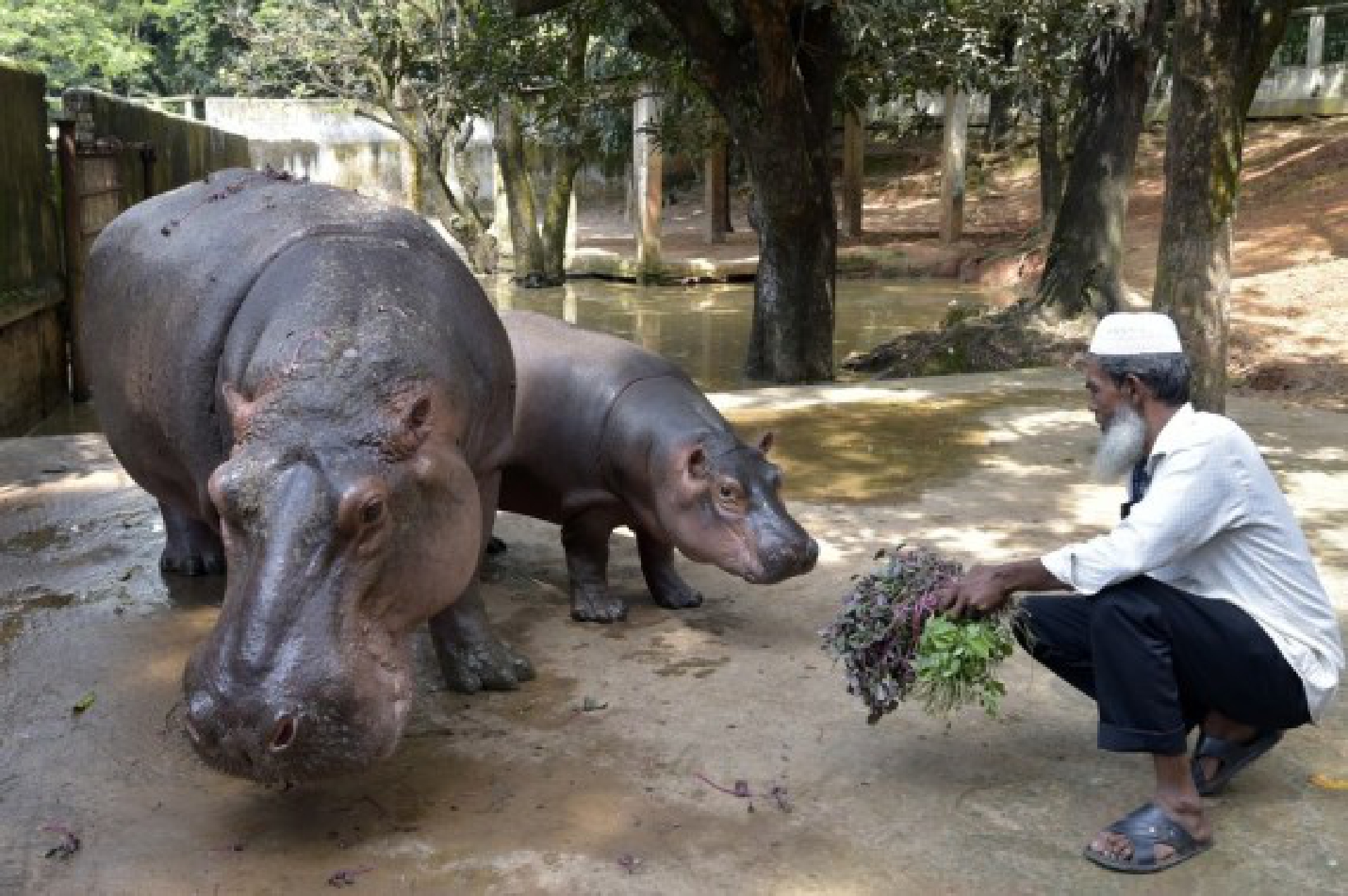 A staff member feeds hippos at the Bangladesh National Zoo in Dhaka, capital of Bangladesh, on Oct. 3, 2021, the eve of World Animal Day. (Xinhua)
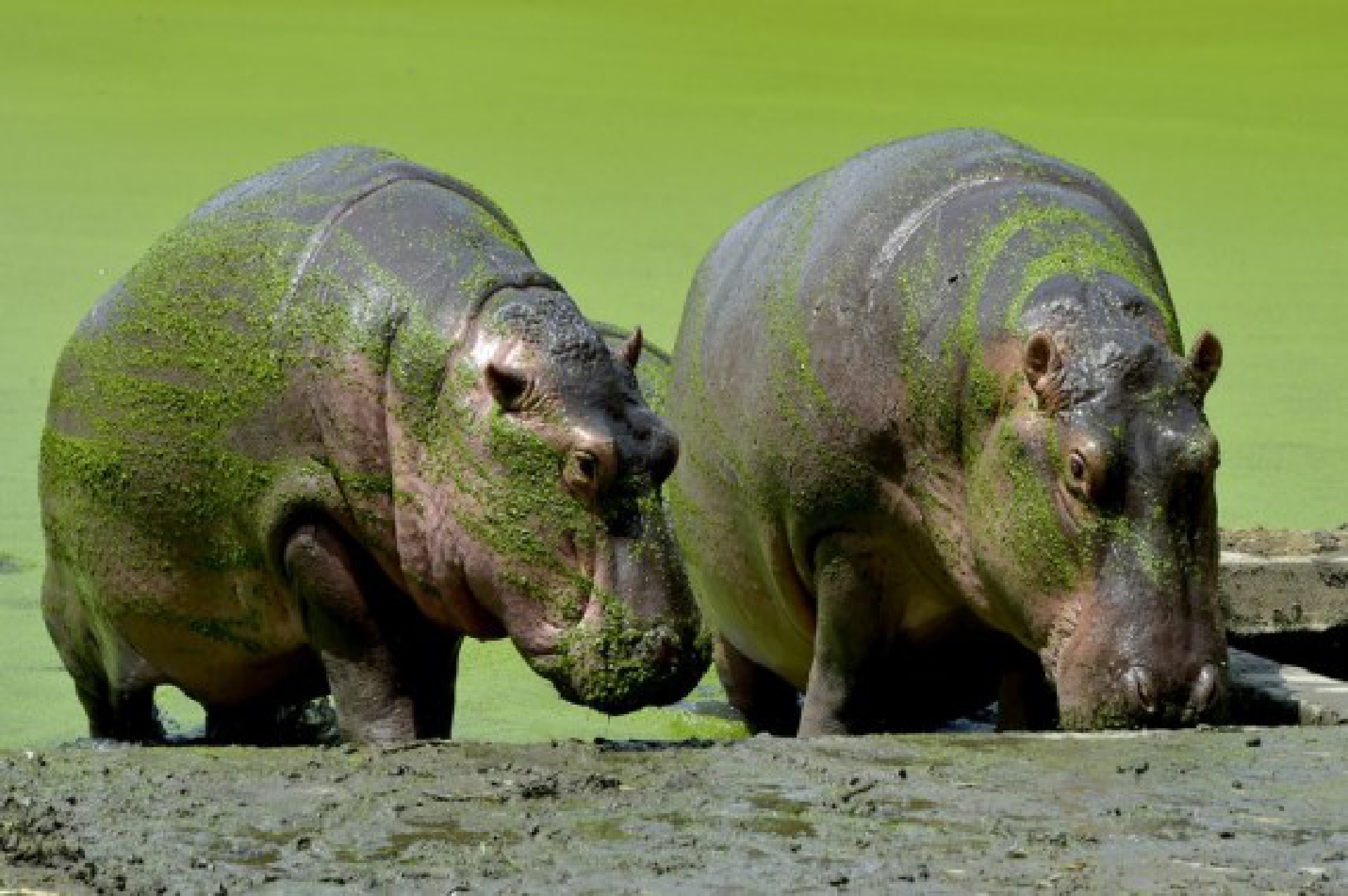 Hippos are seen at the Bangladesh National Zoo in Dhaka, capital of Bangladesh, on Oct. 3, 2021, the eve of World Animal Day. (Xinhua)
 People visit the Bangladesh National Zoo in Dhaka, capital of Bangladesh, on Oct. 3, 2021, the eve of World Animal Day. (Xinhua)
 A staff member feeds an elephant at the Bangladesh National Zoo in Dhaka, capital of Bangladesh, on Oct. 3, 2021, the eve of World Animal Day. (Xinhua)
 Monkeys are seen at the Bangladesh National Zoo in Dhaka, capital of Bangladesh, on Oct. 3, 2021, the eve of World Animal Day. (Xinhua)
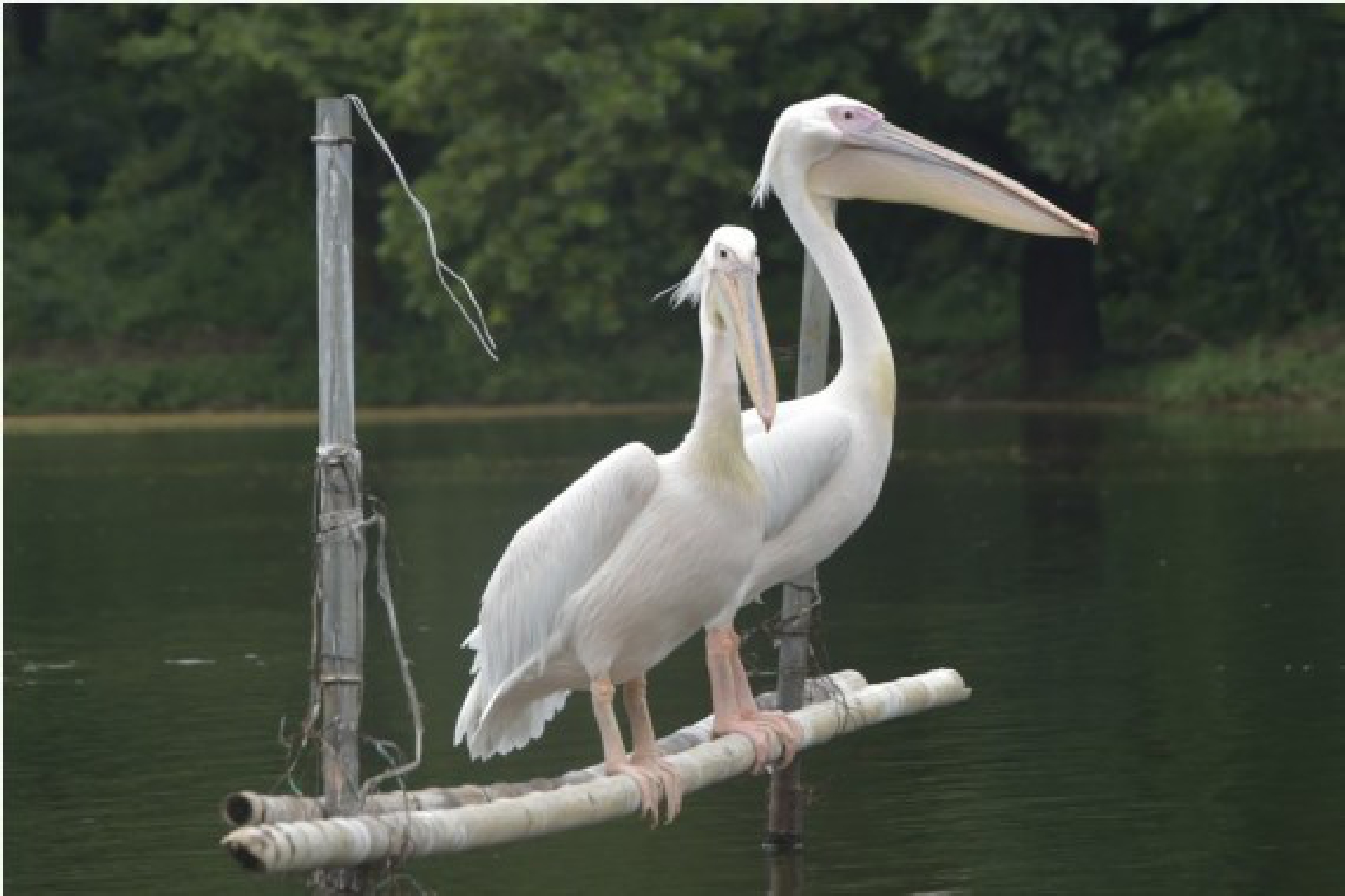 Birds are seen at the Bangladesh National Zoo in Dhaka, capital of Bangladesh, on Oct. 3, 2021, the eve of World Animal Day. (Xinhua)
 Deer are seen at the Bangladesh National Zoo in Dhaka, capital of Bangladesh, on Oct. 3, 2021, the eve of World Animal Day. (Xinhua)
 Zebras are seen at the Bangladesh National Zoo in Dhaka, capital of Bangladesh, on Oct. 3, 2021, the eve of World Animal Day. (Xinhua)
 Royal Bengal tigers are seen at the Bangladesh National Zoo in Dhaka, capital of Bangladesh, on Oct. 3, 2021, the eve of World Animal Day. (Xinhua)
 A baby tiger plays with a staff member at the Bangladesh National Zoo in Dhaka, capital of Bangladesh, on Oct. 3, 2021, the eve of World Animal Day. (Xinhua)
