บริษัท Moderna ผู้พัฒนาวัคซีนต้านโควิด-19 รายใหญ่ของสหรัฐกล่าวว่าโรงงานผลิตวัคซีนในต่างประเทศกำลังเผชิญกับความล่าช้าในการทดสอบในห้องปฏิบัติการซึ่งจะส่งผลให้การส่งมอบวัคซีนในหลายประเทศล่าช้ากว่ากำหนด
Moderna ระบุว่าขณะนี้ปัญหาดังกล่าวได้รับการแก้ไขแล้ว แต่เนื่องจากทางบริษัทมีสินค้าสำรองไม่เพียงพอ จึงอาจส่งผลให้การส่งมอบวัคซีนในช่วง 2 ถึง 4 สัปดาห์นี้ล่าช้ากว่ากำหนด
บริษัทออกมาแถลงหลังจากที่กระทรวงสาธารณสุขของเกาหลีใต้กล่าวว่า Moderna เลื่อนกำหนดการจัดส่งวัคซีนจากปลายเดือนกรกฎาคมเป็นต้นเดือนสิงหาคมโดยให้เหตุผลว่าเกิดปัญหาด้านการผลิตวัคซีน
อย่างไรก็ตาม Moderna ยืนยันว่ากำลังดำเนินการเพื่อให้สามารถส่งมอบวัคซีนได้อย่างรวดเร็วที่สุดและมีผลกระทบน้อยที่สุด โดยไม่ได้ให้รายละเอียดว่าความล่าช้าครั้งนี้จะส่งผลกระทบต่อประเทศใดบ้าง
Texas voters brush aside Trump endorsement and name Jake Ellzey the winner in a House special election in Texas
Voters in North Texas rebuked former president Donald Trump on Tuesday, electing state Rep. Jake Ellzey to a vacant seat in Congress after Trump endorsed a rival Republican candidate.
Ellzey, a Navy veteran who ran on border security and stopping the Democrats’ congressional agenda, defeated Susan Wright, the widow of Rep. Ron Wright, whose death this year after contracting the coronavirus created a vacancy in Texas’s 6th Congressional District. Although Ellzey did not criticize Trump during the campaign, his allies suggested that the former president made a mistake by endorsing a first-time candidate who struggled to raise money and held few campaign events.
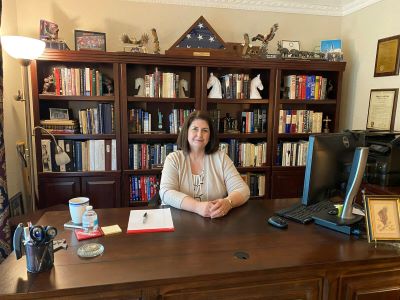
Susan Wright, a candidate for Texas’s 6th District, at her home office earlier this year in Arlington, Texas.
Washington Post photo by David Weigel.
Ellzey declared victory two hours after the polls closed, shortly before the Associated Press projected him as the winner. He told supporters that voters wanted “a positive outlook, a Reagan Republican outlook for the future of our country” despite a blizzard of negative ads.
Trump had sought to give Wright an election-eve boost during a telerally.
“I know her well,” the former president said of Wright. “She will be as tough as anyone in Congress.”
Trump told supporters that Wright would fully oppose President Joe Biden’s agenda and blamed his successor for higher gas prices and increased border apprehensions. He did not mention Ellzey, who was making his second run for the seat – he lost to Ron Wright in 2018 – and had raised nearly three times as much money as Susan Wright.
ADVERTISEMENTx
Wright closed her campaign by reminding voters that she was Trump’s choice. “I look forward to working on your ‘America First’ agenda in Congress,” Wright told Trump on Monday’s call.
Wright finished first in the May 1 all-party primary, with 19% of the vote to Ellzey’s nearly 14%. Yet early voting for the runoff found soft turnout in the most suburban part of the district, which stretches from the Dallas and Fort Worth metroplex into smaller towns in more conservative areas, which helpedEllzey.
Both the Club for Growth and a Trump-linked PAC had been airing ads on Wright’s behalf. Wright had been less visible than her outside allies, making few public appearances during the 12-week runoff.
“She’s run a terrible campaign,” said former congressman Joe Barton, who represented the seat before Ron Wright and endorsed Ellzey in the runoff. “Jake Ellzey is a good person. He voted for Trump. There is no reason for a conservative group to go after him like this. He’s the real deal.”
A first-time candidate who had worked with her late husband behind the scenes, Wright declined to debate Ellzey and was absent from the sort of conservative media outlets that Trump-aligned candidates use to reach national audiences.
Requests for comment from Wright and her campaign were not answered.
“You’re outraising her by a lot of money,” Newsmax host and former Trump White House press secretary Sean Spicer told Ellzey on Friday, noting that Wright had turned down Newsmax’s interview requests. “You wanted to debate and she wouldn’t do it.”
Ellzey confirmed that, adding that Wright had appeared with him at forums where questions were provided in advance, questioning whether his opponent was ready for the pressures of Congress.
Wright and Ellzey had no significant policy differences, which helped turn Trump’s endorsement into the race’s defining issue. The Club for Growth, which had spent heavily against Ellzey during his 2018 run, blitzed voters with TV and mail advertisements, while Ellzey was often in Austin for special sessions, scheduling campaign events around them.
“Having the opportunity for the voters to see what my conservative values are on issues is more of an advantage than a disadvantage,” he said in a statement to The Washington Post.
Pro-Wright materials touted her pledge never to raise taxes; anti-Ellzey material attacked him for missing some votes in Austin, for backing a change to the state’s car tax and for having donors – like the Club itself – who had attacked Trump in 2016. Ellzey’s campaign focused more on his military biography, largely ignoring Wright, and emphasized Ellzey’s support of Trump.
“The good people in this district [are] worried about a border that is a humanitarian and national security disaster, a military that is a national security disaster, more worried about being ‘woke’ than being effective, and a budget that’s not balanced,” Ellzey told Newsmax on Friday.
Internal polling released by Wright’s campaign last week put her ahead of Ellzey, though the first-time candidate had lost ground since its first polling in June. Democrats were locked out of the runoff, and neither Republican has campaigned for their votes.
Both Ellzey and Wright said there were legitimate questions about the 2020 election, and both suggested they would vote consistently with Republican leadership. But Trump’s endorsement had an effect. Jana Lynne Sanchez, the Democrat who placed third in the primary, said that “most” of her friends, if they were voting at all, were casting anti-Wright protest votes.
“Democrats have two choices: Stay home or vote against Trump,” Sanchez said.
Turnout in the early-voting period was light, with fewer than 8,500 ballots cast, and just 1 in 5 coming from Democrats. Voting was also lighter in Tarrant County, the district’s biggest population center, where municipal elections had helped primary turnout.
While Wright largely disappeared during the runoff, Ellzey held rallies where his supporters vented their irritation at the PAC ads. After stumping for Ellzey, former governor Rick Perry told the Dallas Morning News that the former president “had been fed a bill of goods” about the race, and said he had told Trump so.
Katie Ledecky, in defeat and victory, shows what Olympic resilience looks like
TOKYO – It is easy on days like Wednesday, as Katie Ledecky prepared to tackle more championship meters in a single day than any female swimmer in Olympic history, to forget she is a human being who bleeds and grieves and every once in a while climbs out of the pool without a medal.
Olympic swimming is oppressively hard, just as Olympic gymnastics and any other Olympic sports are, and in the roughly 70 minutes Ledecky was afforded between her finals in the 200-meter freestyle and 1,500-meter freestyle, in addition to preparing her body for the back half of that unprecedented double, she would have to wrap her mind around the first finals race in her international career in which she was shut out of the medal stand.
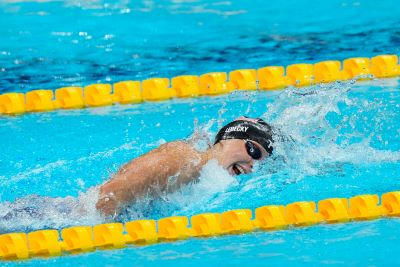
Katie Ledecky dominated the first Olympic women’s 1,500-meter final, winning by more than four seconds at Tokyo Aquatics Centre. American teammate Erica Sullivan won silver.
Washington Post photo by Toni L. Sandys
Perhaps it made her gold medal in the 1,500 free – the sixth of her career but first of these Tokyo Olympics – that much sweeter. Those things aren’t handed out like candy, despite the fantasy Ledecky and a few others in her rarefied atmosphere may have scripted over the years. On Wednesday, she earned the living hell out it.
After finishing a disappointing fifth in the 200 free final in a time of 1 minute 55.21 seconds – the gold going to Australian freestyle phenom Ariarne Titmus (1:53.50), silver to Siobhan Haughey of Hong Kong (1:53.92), bronze to Canada’s Penny Oleksiak (1:54.70) – Ledecky returned to the starting blocks at Tokyo Aquatic Centre and took her disappointment out on the water in Lane 4.
When she touched the wall at the end of the 1,500, her gold medal secured with a time of 15:37.34 – with American teammate Erica Sullivan second, at 15:41.41, Ledecky sobbed as she hung on the lane line, barely able to pick herself up and make her way out of the pool. She looked exhausted, spent.
The 200 free result was a shocker in that Ledecky, while a decided underdog to Titmus, was expected to press her Australian rival to the last wall. Instead, she never quite fired, turning at the halfway point in fifth place and never summoning a finishing kick. Her final 50 split of 29.66 was more than a half-second off the 29.12 she closed with in the 400 free two nights earlier, when she took the silver behind Titmus’s gold.
ADVERTISEMENTx
It was the 36th final (individual races plus relays) of Ledecky’s international championship career – counting world championships, Pan-Pacific championships and Olympics – and it was the first time she did not earn a medal. Her time was slower than the one she posted at Olympic trials a month earlier (1:55.11), and slower than what she posted at a TYR Pro Swim Series meet in Mission Viejo, Calif. in April (1:54.40). It was also about a second and a half off her winning time in Rio 2016 (1:53.73).
In 2016, when she swam the 200, she didn’t have the added stress of the 1,500 on the same day. It certainly complicated the picture, forcing Ledecky to do a modified warm-down after her 200 and do her best to rest her legs. Ledecky had pulled off the same 200/1,500 double in the evening prelims session Monday evening, which followed her 400 free final that same morning.
The 1,500 seemed literally designed for Ledecky – added to the Olympic program this year, after previously being a men’s-only event, largely because Ledecky had made it essential viewing at world championships over the years. In the prelims, where she paced the field by six seconds, her mark was also, by default, an Olympic record.
Wednesday’s final of the 1,500 brought the familiar (if still disorienting) image of Ledecky nearly lapping opponents, swimming east when they were going west. The 800 and 1,500 are races Ledecky completely reinvented, attacking them with a sprinter’s mentality, but the world is catching up. Her two most recent world championships in the 1,500, in 2015 and 2017, came by a combined 45 seconds. On Wednesday, she won by a little more than four.
Mental health is having a much-welcomed moment in the discourse around elite athletics, sparked most vividly by U.S. gymnast Simone Biles’s withdrawing from the team competition Tuesday night. In swimming, two of the top Olympians in history, Michael Phelps and Missy Franklin have spoken eloquently about their struggles.
Swimmers get no escape from the pressures, if only because you are defined by the cold, hard numbers on the scoreboard: You are what the clock says you are. In swimmer shorthand, sometimes they say, “She goes a 58” – translation: Her best time in some-or-other race is 58 seconds – but sometimes they’ll simply say, “She’s a 58.” Her time is her identity.
Ledecky has certainly known the Tyranny of Times. For the past four-plus years, she has struggled to match her times from Rio, two of which – the 400 free and 800 free – were world records. She tried to tune out the noise, but sometimes it would sneak past her defenses. She knew people questioned whether, now in her mid-20s, she could still match the times she went at 19.
“Yeah, people doubt me,” she said in a moment of self-reflection on Monday, after winning gold in the 400 free with a time that was her fastest since Rio. “People will doubt anyone [who] swims like I did in Rio and then doesn’t get as close [to that again] as people would expect. But yeah, I’ve had to overcome a little bit of that self-doubt. And really, between [U.S. Olympic] trials and today, I did everything I could to eliminate all that from my head and really believe in myself. I felt so good coming into this meet.”
Ledecky suffered through the pandemic like anyone else, isolated clear across the country from her close-knit family, barred from her regular practice pool, reduced to training in the backyard pool of a friend of a friend for a time. She has said little about how dark things got, but it was clear the extra stresses took their toll, and equally clear a return to some semblance of normalcy in her training helped her mental state.
Coming into the Tokyo meet, she said she was “very much at peace with the work I’d put in to get to this point. I felt good going into it, felt confident, felt like I believed in myself. And I think that’s the biggest win of all.”
By the end of Wednesday morning’s session, Ledecky’s odometer at this Olympics sat at a staggering 4,400 meters of racing – more than any woman has ever tackled at a single Olympics, if only because none before this included the grueling 1,500 free – and she still has at least 1,800 to go, including relays.
Not a single one of those 1,800 would be easy, and none of the results were to be taken for granted.

 บริษัทผู้วัคซีนยอมรับว่าเกิดความล่าช้าในการผลิตจากโรงงานนอกสหรัฐ ซึ่งจะส่งผลให้บางประเทศไม่ได้รับวัคซีนตามกำหนด
 CDC สหรัฐเตือน Covid-19 กลายพันธุ์อีกไม่กี่ครั้งก็อาจจะหลบเลี่ยงภูมิคุ้มกันจากวัคซีนได้
 ขณะที่ไทยและเพื่อนบ้านอาเซียนยังสั่งวัคซีนจากจีนเข้ามาพร้อมๆ กับวัคซีนตะวันตกที่เน้นเทคโนโลยีใหม่ แต่จีนก็มีวัคซีน mRNA แต่ทำไมจีนจึงยังไม่ใช้มัน?
 ขณะที่การเแข่งขันโอลิมปิกก็กลายเป็นคลัสเตอร์ใหม่ที่ทำให้โตเกียวยิ่งเจอสถานการณ์ที่หนักขึ้น
 อีกหนึ่งประเทศที่ทดลองฉีดไขว้วัคซีนข้ามแบรนด์และประเภท ซึ่งหนึ่งในนั้นคือประเทศไทยด้วย
 ปัจจุบันเดนมาร์กจัดการฉีดวัคซีนป้องกันโรคโควิด-19 ทั่วประเทศโดยใช้วัคซีนหลายยี่ห้อ อาทิ ไฟเซอร์-ไบออนเทค และโมเดอร์นา
 มันไม่มช่ปรากฏการณ์ตามธรรมชาติ แต่ผลมาจากความมักง่ายของมนุษย์ แม้จะสวยงาม แต่ก็เป็นความน่าเศร้าใจในด้านสิ่งแวดล้อม


 การศึกษาพบแอนติบอดีจากการฉีด Sinovac จางหายไปหลังจากผ่านไปประมาณ 6 เดือน แต่บูสเตอร์ (Booster) ช่วยได้