Asean Covid cases fall sharply amid improvement in Indonesia
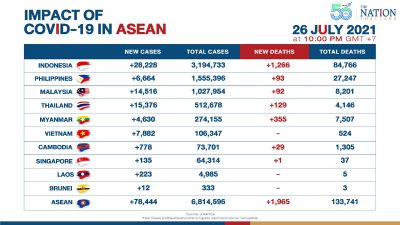
Southeast Asia saw another day of sharp decline in new Covid-19 cases on Monday, but deaths hit a single-day high, collated data showed.
Asean reported 78,444 new cases on Monday, lower than Sunday’s 90,178, while 2,376 people died, increasing from Sunday’s 1,965.
The number of Covid-19 cases in the region since the outbreak crossed 6.81 million, with 133,741 deaths.
Indonesia reported 28,228 new cases, the lowest in weeks, and 1,487 deaths on Monday, bringing cumulative cases in the country to 3,194,733 patients and total deaths to 84,766 deaths.
Indonesian President Joko Widodo announced the extension of lockdown to August 2 to contain the virus but promised to gradually relax disease control measures for some activities and businesses, including markets, outdoor restaurants (with some restrictions), beauty salons, laundry, and auto repair shops.
Vietnam reported 7,882 new cases and 154 deaths on Monday, bringing cumulative cases in the country to 106,647 and the death toll to 524.
From July 26 until further notice, Ho Chi Minh City will impose curfew from 8pm to 6am. Officials requested all residents to remain at home except when seeking medical care, working in essential industries, or purchasing essential goods.
South Africa unveils post-riot relief, eases virus lockdown
South African President Cyril Ramaphosa unveiled a new relief package to help businesses and individuals recover from a week of deadly riots and coronavirus curbs, as he eased lockdown restrictions amid slowing infections.
The measures include reinstating a monthly welfare grant of $24 (350 rand) for the poor until the end of March, a $27 million (400 million rand) state contribution to a humanitarian relief fund and support for uninsured businesses, Ramaphosa said Sunday in a televised speech. The government will also expand an employment tax incentive, and give companies an additional three months to pay taxes collected from their workers, he said.
The imposition of stop-start curbs since the pandemic hit in March last year has shuttered thousands of businesses and added to already rampant unemployment. The economy shrank 7% last year, the most in a century.
The nation’s misery was compounded by protests that erupted in two provinces after former President Jacob Zuma was jailed this month on contempt-of-court charges and morphed into a week-long looting spree in which thousands of businesses and street traders were targeted. At least 330 people died in the unrest, which the South African Property Owners Association estimates cost the country about $3.4 billion (50 billion rand) in lost output and placed 150,000 jobs at risk.
“We have a duty to support those affected by this violence,” Ramaphosa said. “Many small and medium-sized businesses, formal and informal, have lost everything and will not be able to rebuild on their own. We will not abandon them.”
ADVERTISEMENTx
The president moved the country to an adjusted virus alert level 3, from alert level 4, after a third wave of Covid-19 cases peaked and the government’s vaccination program gathered pace.
Alcohol sales, which have been banned for the past four weeks, will now be permitted at retail outlets from 10 a.m. to 6 p.m. Monday to Thursday, and at restaurants and bars up to 8 p.m. A moratorium on leisure travel in some areas was revoked, while gatherings of as many as 50 people will be allowed indoors and as many as 100 outdoors. A curfew will be imposed from 10 p.m. to 4 a.m.
An average of about 12,000 new Covid-19 cases were detected daily in South Africa last week, a 20% decline on the week before, although the situation varied widely from area to area. Infections continued to climb in the Western Cape, KwaZulu-Natal and Northern Cape provinces.
“Infections remain high and we must continue to exercise caution at all times,” Ramaphosa said.
The country has issued more than 6.3 million vaccines so far, and will have enough shots to last until the end of the year, with 31 million doses from Johnson & Johnson and Pfizer expected to arrive within in the next three months. Inoculations will be available to all over the age of 18 from Sept. 1, the president said.
Published : July 27, 2021
By : Syndication Washington Post, Bloomberg · S’thembile Cele
Tokyo Olympics has 16 more virus cases, including three athletes
Japanese Olympics organizers reported sixteen more coronavirus cases, including three infections among athletes, as the spectator-free Tokyo games continued under tight restrictions.
Those who tested positive included contractors and employees of Tokyo 2020, according to a statement on the organizer’s website, as well as eight others connected to the Games whose exact roles weren’t made clear. Six of the total are residents of Japan, though the statement didn’t identify the nationalities of the athletes or the events they were scheduled to compete in.
Only one of those affected was staying in the Olympic Village. The new figures bring to 148 the total number of reported infections connected with the event.
The Japanese government and organizers have tried to overcome public unease over the games by pledging to make them “safe and secure.” Tokyo Governor Yuriko Koike and Prime Minister Yoshihide Suga met on Sunday to discuss the situation and agreed the Games were going “very smoothly,” Kyodo News reported.
A poll published by the Nikkei newspaper on Monday found that 37% of respondents said the decision to hold the event without spectators was appropriate, while 28% said some spectators or full crowds should have been allowed. A further 31% said the event should have been postponed again or canceled outright.
Many residents of Japan had opposed the staging of the games amid the pandemic, fearing that the arrival of tens of thousands of athletes and others from around the world could make for a superspreader event. While Monday marks the fifth straight day of infections in double figures, with a record 19 reported on Friday, the total so far is relatively small as a percentage of the number of attendees. Just 0.02% of tests in the three days to Sunday returned a positive result.
Nevertheless, some experts remain uneasy about the effect of the games on the spread of the virus as the more infectious delta variant becomes more dominant.
“It’s best to assume our experience and knowledge up to now don’t apply to the delta variant,” said Norio Sugaya, an infectious-disease expert and visiting professor at Keio University’s school of medicine. “There’s considerable doubt about how effective the current system of ‘bubbles’ will be against the delta variant.”
ADVERTISEMENTx
International Olympic Committee spokesman Mark Adams said that while it was impossible to make the event “zero-risk,” the participants made up “the most-tested community in the world.”
The unprecedented Olympics is taking place amid a virus state of emergency in Tokyo, under which bars and restaurants are being urged to stop serving alcohol and to close by 8 p.m. Case numbers in the capital rose to 1,763 on Sunday, though the number of serious cases fell by two to 72.
Published : July 27, 2021
By : Syndication Washington Post, Bloomberg · Isabel Reynolds
WTO summer holiday from vaccine-equity talks draws calls for action
An urgent global effort to rebalance the inequity between rich, vaccinated nations and poor nations sliding further into pandemic misery is colliding with an immovable calendar conflict: the European summer holiday.
Next week World Trade Organization delegates are planning to depart Geneva for their August break and, in doing so, pause their fractious debate over a proposal to waive intellectual-property protections for covid-19 shots until the second week of September.
Before they leave, members will adopt a report that acknowledges they’ve made scant headway on the proposal aimed at making doses more widely available, which the world’s top health expert says is critical to ending a “moral failure.”
“With so many lives on the line, profits and patents must come second,” World Health Organization Director General Tedros Adhanom Ghebreyesus said during a virtual summit last week.
WTO Director General Ngozi Okonjo-Iweala previously urged ambassadors to shorten their usual six-week summer holiday to focus on pressing issues like the waiver. Nevertheless, members aren’t planning to reconsider the matter until the week of Sept. 6, according to officials familiar with the planning.
“August doesn’t matter in Geneva; it doesn’t matter if people are dying around the world,” said Shailly Gupta, a spokesperson at Médecins Sans Frontières. “We hope members will move at a faster pace.”
Disagreement persists on the fundamental question of whether a waiver is the “appropriate and most effective way” to address the shortage of vaccines, according to a draft status report produced by Dagfinn Sørli, the chairman of WTO council on Trade-Related Aspects of Intellectual Property Rights, or TRIPS.
That split could sink prospects for an ambitious vaccine waiver because WTO decisions must be taken on the basis of consensus — which means any of the 164 members can veto a final agreement for any reason.
“The WTO’s response to covid is the most critical issue before our organization right now,” WTO spokesman Keith Rockwell said a phone interview. “Millions have died and lives are at stake. Finding a pragmatic outcome by December is essential.”
ADVERTISEMENTx
Proponents of the waiver had hoped to conclude their negotiations by the end of July and are now criticizing the European Union and other developed nations for sandbagging the talks.
The European Commission, which opposes a WTO TRIPS waiver, has proposed a series of measures that it argues will create greater legal certainty for nations to leverage existing trade tools in order to expand their production capacities.
“The EU is not interested,” Gupta said. “Switzerland, Norway and the United Kingdom are not engaging. They’re saying: ‘This or that won’t work; the waiver won’t work.’ There is no intention of engaging.”
A spokesman for the EU mission in Geneva declined to comment.
Critics counter that the proposal from Brussels is a distraction to redirect focus from India and South Africa’s earlier waiver proposal and to prevent members from engaging in more detailed negotiations.
ADVERTISEMENT
“The EU’s actions are incredibly cynical and dangerous,” said Lori Wallach, the founder of Public Citizen’s Global Trade Watch. “They have submitted a paper that basically conflicts with the text-based negotiations by saying ‘We don’t want a waiver.'”
The U.S., meanwhile, has taken a back seat in the process and enthusiasm about Washington’s engagement on the issue has begun to wane in the three months since Trade Representative Katherine Tai announced American support for a waiver.
Though Tai’s surprise announcement briefly knocked shares of Moderna Inc., Pfizer Inc., and BioNTech SE, the stocks quickly rebounded and all are now trading at or near their highest levels of the year.
“People feel that message from Ambassador Tai is not playing out on the ground or being implemented in a meaningful way,” said Thiru Balasubramaniam a managing director at Knowledge Ecology International in Europe.
“U.S. support for waiving intellectual property protections for coronavirus vaccines provided important momentum for the WTO process,” U.S. Trade Representative spokesman Adam Hodge said via email. “We remain deeply engaged in discussions towards finding consensus while the Biden-Harris Administration continues to ramp up our efforts to donate doses and expand the manufacturing and equitable distribution of vaccines around the world.”
ADVERTISEMENT
Most nations producing the vaccines oppose a blanket waiver to the WTO’s intellectual property rules because they say it would harm innovation, do little to expand access to vaccines and may even backfire.
Specifically, opponents to the waiver say it would create a chaotic patchwork of laws, unravel existing industry partnerships, lead to a supply crunch for scarce vaccine inputs and inject even more uncertainty into already complex arrangements.
There’s also the possibility that an IP waiver could result in the production of counterfeit and substandard medicines, which could increase vaccine hesitancy that’s already pervasive in even the world’s wealthiest nations.
“Everybody knows IP isn’t the problem and there is no quick fix to vaccinating the world with the latest technology,” said Robert Grant, a senior director at the U.S. Chamber of Commerce. “Most governments know this but due to the political sensitivities they won’t say it publicly.”
Indeed, the waiver debate is a politically explosive issue for nations with high vaccination rates because they don’t want to be seen as standing in the way of getting life-saving drugs to poor nations whose citizens are suffering at disproportionate rates.
To date, 75% of vaccines have been administered in just 10 countries and only 1% of people in low-income countries have received at least one dose, according to WHO statistics.
Drug manufacturers say they are working every day to address the real bottlenecks and are on track to deliver 11 billion vaccines by year-end — enough to inoculate the world’s entire adult population.
While diplomats go on holiday, the process of getting the vaccines out there hasn’t stopped, said a spokeswoman for the International Federation of Pharmaceutical Manufacturers and Associations.
Published : July 27, 2021
By : Syndication Washington Post, Bloomberg · Bryce Baschuk
FDA asks Pfizer, Moderna to test their vaccines in more children to help rule out safety issues
Federal regulators have requested that vaccine companies expand their trials to test coronavirus shots in several thousand school-aged children before seeking authorization – a move intended to assess whether a rare inflammation of the heart muscle that has been seen in young adults shortly after vaccination is more common in younger age groups.
The changes to ongoing pediatric trials run by Moderna and Pfizer and its German partner, BioNTech, could delay the availability of the vaccines to children between 5 and 11 beyond the hoped-for timeline of early fall, although it is unclear by how much. As the country faces a surge fueled largely by cases in unvaccinated people and the school year approaches, pediatricians and families have impatiently awaited shots of protection.
At a CNN town hall meeting last week, President Biden said that children under 12 might have access to a vaccine “soon,” but the regulatory decision to increase the trial size will mean recruiting and vaccinating many more children.
A federal official who spoke on the condition of anonymity predicted that authorization of a coronavirus vaccine for children 5 through 11 might come by late October or early November. The government is not expecting it will be a big problem to enroll more children because so many parents are eager to get their children vaccinated, the official said.
Ray Jordan, a spokesman for Moderna, said that the company was “actively discussing a proposal” with federal regulators to expand its trial, but had not settled on final numbers yet. He predicted that authorization could occur in “winter 2021/early 2022.”
“The objective is to enroll a larger safety database which increases the likelihood of detecting rarer events,” Jordan said in an email. The original trial included nearly 7,000 children from 6 months to 12 years old.
ADVERTISEMENTx
Jerica Pitts, a spokeswoman for Pfizer, said that the company hasn’t yet made any updates to its trial design or its timeline, which was originally predicted to report results in September for children ages 5 to 11, with results for children ages 2 to 5 expected to follow shortly and for children as young as 6 months in October or November.
Pfizer originally designed its trial to include 4,500 children from 6 months to 12 years old. Two-thirds would receive the vaccine, and the rest would receive a placebo.
At a Food and Drug Administration advisory committee meeting last month, several experts said that they would expect the pediatric trials to be larger, although there was no consensus on a number.
The FDA wants to be particularly careful about the possibility of children developing myocarditis, or heart inflammation, after receiving a coronavirus vaccine. Adolescents who receive the vaccines are more likely to develop myocarditis than adults – though the risk remains small – and officials want to increase the chances that the trials will indicate whether there is increased incidence of heart inflammation in children.
Myocarditis and pericarditis, inflammation of the heart or surrounding tissue, has rarely occurred after vaccination with both vaccines and is considered by the Centers for Disease Control and Prevention “likely” associated with the shots. The most common symptom is chest pain. The CDC said in June that there had been more than 1,200 cases of heart inflammation out of about 300 million mRNA doses administered in the United States at that time and the cases were more frequent in young males. The risks of covid-19 are greater than the rare risk from vaccination and people typically recover, the CDC said.
The FDA is likely to require two months of follow-up data for the 5-to-11 age group, as it did for adults and adolescents. For children under 5, the agency might require four to six months of follow-up data, meaning vaccines are unlikely to be available for several months for infants and young children.
FDA spokeswoman Abigail Capobianco said in an email that while the agency couldn’t comment on specific interactions with companies, “we do generally work with sponsors to ensure the number of participants in clinical trials are of adequate size to detect safety signals.”
David Benkeser, a statistician who works on clinical trials at Emory University’s Rollins School of Public Health, said that increasing the trial size would be helpful to identify any potential safety signals.
“In terms of timelines, it will definitely push timelines back,” Benkeser said in an email, noting that how much of a delay will occur depends on how fast the trials are recruiting participants. But after that, it would likely take about four to five weeks to deliver shots to participants and then two weeks to measure their immune responses.
The agency has not decided what it will require for trials for children under 5. The decisions will partly will depend on whether the data for the older children is clear and does not indicate any safety problems, said a federal official, who spoke on the condition of anonymity because they were not authorized to speak publicly.
The official also emphasized that an urgent administration priority is granting the Pfizer vaccine full approval – perhaps by the end of the summer.
The individual said that a full approval could mean an additional 25 million people would end up getting vaccinated – 5 million who might not have accepted the vaccine until final approval and an additional 20 million who might be covered by mandates issued by colleges, universities and the military.
Published : July 27, 2021
By : The Washington Post · Laurie McGinley, Carolyn Y. Johnson, Yasmeen Abutaleb
บทความจาก The New York Times ระบุว่าในบรรดาการแข่งขันกีฬาโอลิมปิกทั้งหมด เทควันโดอาจเป็นความหวังในการคว้าเหรียญของหลายประเทศ และเป็นกีฬาที่สร้างโอกาสให้แก่ประเทศต่างๆ โดยเฉพาะประเทศห่างไกล
The New York Times ยังได้กล่าวถึงประเทศไทยในการคว้าเหรียญทองจากกีฬาเทควันโดในการแข่งขันครั้งนี้ โดย “เทนนิส” พาณิภัค วงศ์พัฒนกิจ นักกีฬาเทควันโดประเภทหญิง รุ่นน้ำหนัก 49 กิโลกรัม ซึ่งคว้าเหรียญทองประวัติศาสตร์โอลิมปิกเทควันโดของไทย หลังจากที่คว้าเหรียญทองแดงที่ริโอในปี 2016




 ผู้จัดการแข่งขันกีฬาโอลิมปิก โตเกียว 2020 เผยพบผู้ป่วยโควิด 127 คนนับตั้งแต่วันที่ 1 ก.ค.
 ชาวเน็ตจีนถล่มซื้อสินค้า ‘เออร์เก’ หลังแบรนด์ทุ่ม 50 ล้านหยวนช่วยน้ำท่วม กลายเป็นมหกรรมช่วยแบรนด์รักชาติครั้งใหญ่
 เปิดคลิป พายุทรายซัดถล่ม ‘ตุนหวง’ เมืองทะเลทรายของจีนน่าสะพรึงกลัวราวกับวันโลกาวินาศ
 สื่อนอกมอง เทควันโดเป็นกีฬาที่สร้างโอกาสให้แก่ประเทศต่างๆ รวมถึงพื้นที่ห่างไกล เนื่องจากไม่ต้องใช้อุปกรณ์ราคาแพงหรือพื้นที่กว้างขวาง
 วงใน Amazon เผยบริษัทเตรียมรับ Bitcoin และเปิดตัวเหรียญของตัวเองภายในปีหน้า
