UK studying Covid-19 strain first found in Thailand as over 100 patients test positive
Britain is on alert for a new Covid-19 strain first detected in Thailand.
Reports said that more than 100 cases of the new strain, VUI-21MAY-02 (C.36.3), were detected in the UK.
The variant was first detected in Thailand in people who had travelled from Egypt.
Public Health England said the variant was under investigation since May 24 “on the basis of the mutation profile and increased importation from a widening international area”.
British authorities said they had managed to contain its spread through the test and trace process.
Asean hits 10-day high in new Covid-19 cases and deaths
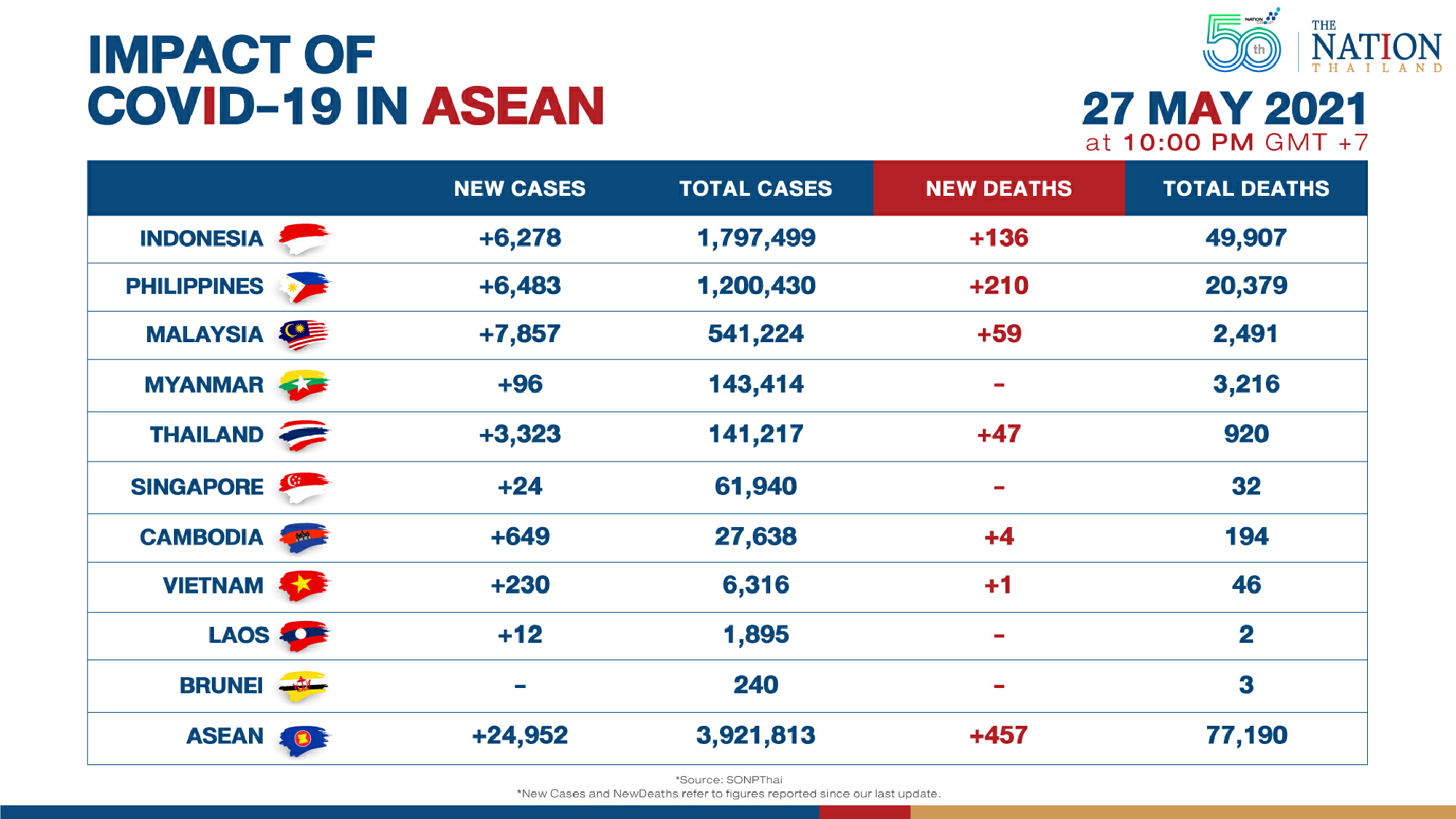
Asean reported the highest number of Covid-19 cases and fatalities in 10 days on Thursday.
Southeast Asia saw 24,952 new cases on Thursday, higher than Wednesday’s 21,229, while 457 people died, up from Wednesday’s 406.
The number of Covid-19 cases in the region crossed 3.92 million while 77,190 people have died.
Malaysia reported a new high of 7,857 infections and 59 deaths on Thursday, bringing cumulative cases in the country to 541,224 and total deaths to 2,491. Nearly 40 per cent of new cases, or 2,675 patients, are from Selangor while 561 are from Kuala Lumpur.
Malaysia’s Ministry of Public Health said that most of the new cases were those aged 20-40 years residing in several states in the northern part of the country.
The Indonesian government, meanwhile, has confirmed that the AstraZeneca vaccine is safe and effective against Covid-19 after it was suspended since May 16 following the death of a 22- year-old man after getting a jab.
The government statement clarified that there was no connection between the vaccine and the severe reaction in the deceased recipient.
Indonesia had received 450,000 doses of AstraZeneca vaccine in April as part of the 3.85 million doses under the Covax programme of the World Health Organization.
Olympic Games could create an Olympic strain, warns head of Japan Doctors Union
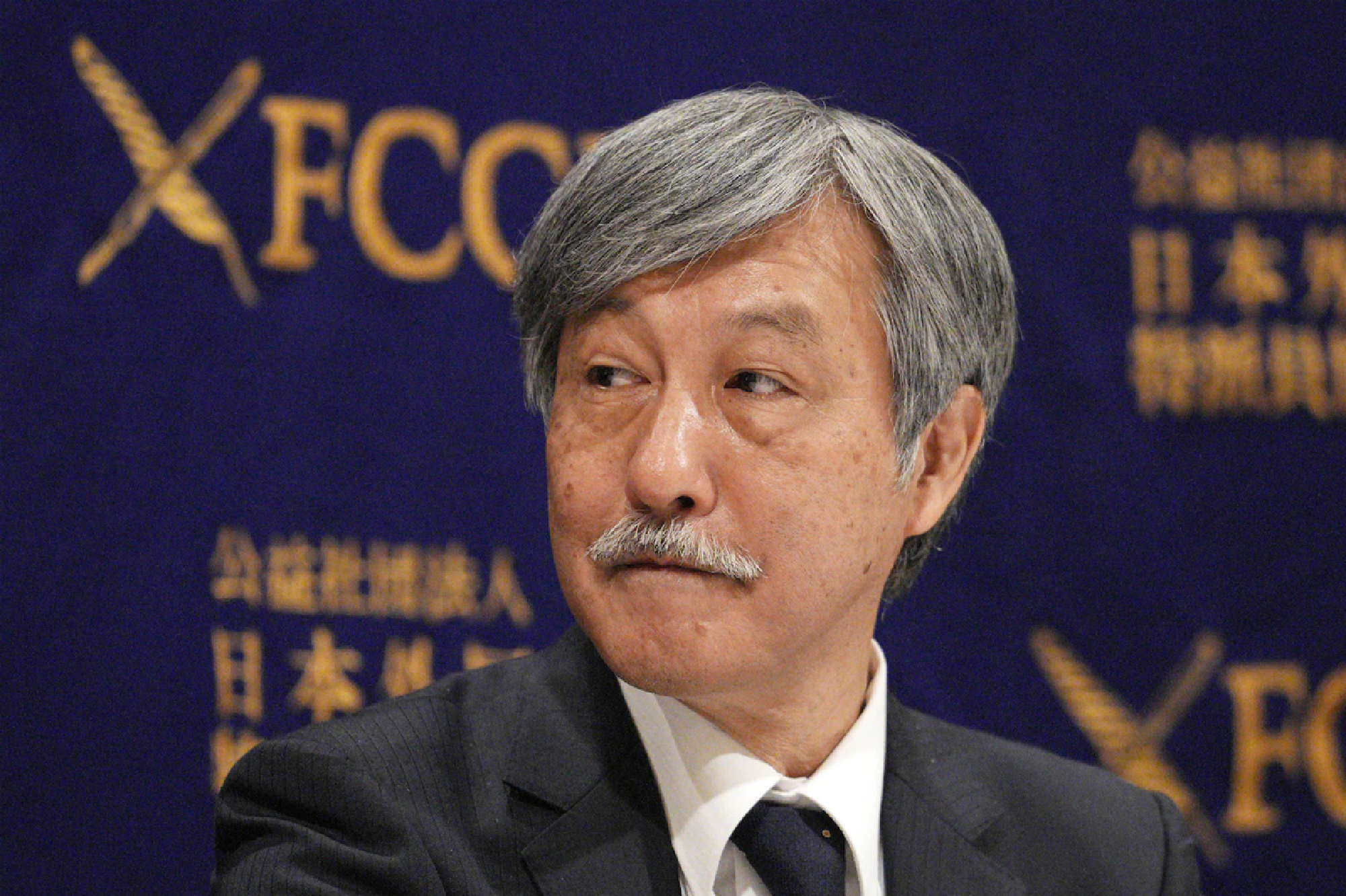
The chairman of the Japan Doctors Union, a lead critic of the holding of the Olympic Games amid the pandemic, warned Thursday that an “Olympic strain” of the coronavirus could emerge if the sports event goes forward.
Naoto Ueyama has repeatedly sounded the alarm about the Japanese government and International Olympic Committee’s decision to hold the Tokyo Olympics in July despite rising cases in the country and an increasingly burdened health-care system.
“It is dangerous to hold the Olympics here in Tokyo this July,” he warned in a news conference, saying that with people coming into Japan from over 200 nations around the world, “all of the different mutant strains of the virus that exist in different places will be concentrated and gathered here in Tokyo.”
Ueyama said that “a Tokyo Olympic strain of the virus” could develop as a result.
Japan has one of the slowest coronavirus vaccine rollouts among developed countries, with only 2.3 percent of a population of 125 million fully vaccinated.
With overwhelmed hospitals and an inevitable extension of the state of emergency expected just eight weeks before the Games, the medical community has been vocal in their opposition.
The Tokyo Medical Practitioners Association, representing 6,000 primary care doctors, posted an open letter addressed to Prime Minister Yoshihide Suga earlier this month, stating, “We strongly request that the authorities convince the IOC that holding the Olympics is difficult and obtain its decision to cancel the Games.”
With Tokyo’s intense heat and humidity expected for the Olympic months putting even more strain on the medical system, the association warned of a system collapse. As doctors and nurses are already exhausted, the letter added, “there is absolutely no extra manpower or facility for treatment.”
Japan’s insistence that the Olympics take place despite the potential health risks has increasingly become a source of controversy. Polling has shown that most people in Japan do not feel that the event should take place this summer, and one of Japan’s most widely read newspapers, Asahi Shimbun, called for the event to be canceled in a Wednesday editorial.
“Distrust and backlash against the reckless national government, Tokyo government and stakeholders in the Olympics are nothing but escalating,” the editorial said.
The prestigious New England Journal of Medicine also weighed in this week. “We believe the IOC’s determination to proceed with the Olympic Games is not informed by the best scientific evidence,” a commentary authored by multiple public health experts stated.
Last month, the British Medical Journal urged Olympic organizers to reconsider, noting that vaccines are still not widely available in many lower-income nations and “huge uncertainty remains about the trajectory of the pandemic.”
Both the Japanese government and International Olympic Committee have maintained that they are following all protocols recommended by the World Health Organization, such as requiring rigorous testing and social distancing. Spectators will not be allowed to travel from overseas to attend the event, and the government has not yet announced if Japanese citizens will be permitted to be in the stands.
Published : May 28, 2021
By : The Washington Post · Julia Mio Inuma, Antonia Noori Farzan
As US calls for focus on covid origins, China repeats speculation about U.S. military base
China reacted angrily to the Biden administrations calls for a harder investigation into the origins of the coronavirus pandemic, by accusing the United States of hypocrisy and suggesting it needed to open its own biological laboratories to international inspection.
Speaking at a media briefing in Beijing, Ministry of Foreign Affairs spokesman Zhao Lijian said that President Joe Biden’s call for more scrutiny of the still-disputed origins of coronavirus was politically motivated and showed that the United States “does not care about facts and truth, nor is it interested in serious scientific origin tracing.”
Zhao, one of the country’s most notoriously hawkish diplomats, referenced a U.S. military location that has been baselessly linked to the coronavirus outbreak by Chinese media.
Describing Fort Detrick in Frederick, Md., as “full of suspicion,” Zhao said the United States needed to open it up to international scrutiny. “There are more than 200 U.S. biological laboratories scattered around the world. How many secrets are there?” he said.
Fort Detrick hosts elements of the country’s biological defense program. While trying to deflect criticism of their handling of the coronavirus outbreak, Chinese officials have repeatedly responded by calling for the U.S. base to be opened to international inspectors.
In his remarks, Zhao also mentioned the faulty intelligence about weapons of mass destruction that led to the invasion of Iraq in 2003 and implied U.S. intelligence services were linked to a chemical weapons attack by the Assad regime against rebels in Syria.
Biden on Wednesday ordered U.S. intelligence agencies to “redouble their efforts” in examining the chain of events that led to the global pandemic.
While noting that there was no “definitive conclusion,” the president said that some members of the intelligence community “lean” toward the belief that the coronavirus could have emerged from a laboratory incident.
The Trump administration had previously suggested without evidence that the virus may have originated from the Wuhan Institute of Virology, which boasts the highest level of biosecurity clearance. The virus that has gone on to kill at least 3.48 million people worldwide was first detected in the city in central China.
Many scientists believe the coronavirus probably jumped to humans through an intermediate animal host, and a joint report released by China and the World Health Organization in March said it was “extremely unlikely” that the coronavirus leaked from a lab.
But the report was widely criticized, and WHO chief Tedros Adhanom Ghebreyesus also said that data had been withheld from his investigators, who were given only highly restricted access to Chinese resources.
There has been increasing pressure recently to not discard the lab theory and to investigate the origins of the virus more thoroughly. Wall Street Journal reports, including one highlighting how several Wuhan lab employees became sick in fall 2019 with covid-19-like symptoms, have added to that.
From the early days of the pandemic, some Chinese news outlets have pushed speculation that there was a foreign link to the outbreak in Wuhan, noting that the city hosted the World Military Games in October 2019.
Last March 12, Zhao tweeted: “It might be [the] US army who brought the epidemic to Wuhan.”
Chinese officials have also pushed a theory that the virus could have been imported into Wuhan from outside the country, possibly on frozen food.
Though the WHO-backed report into the virus’s origins released in March said that theory deserved further investigation, most experts have said there is not strong evidence for the idea that the virus began anywhere other than China.
Published : May 28, 2021
By : The Washington Post · Katerina Ang, Adam Taylor
Ohio reveals first winners of its vaccine lottery, doles out $1 million check and full-ride scholarship
It was a million-dollar idea: Give every Ohio resident who gets a coronavirus vaccine a chance to win a seven-figure check.
That audacious scheme to boost the state’s inoculation rate became reality Wednesday evening, when the first winners of the “Vax-a-Million” drawings were announced on live TV. Gov. Mike DeWine, a Republican, has won national acclaim – and drawn local blowback – since unveiling the plan, which will award $1 million to five vaccinated adults and a full-ride scholarship to Ohio public colleges to five vaccinated teenagers.
The first broadcast lasted just 60 seconds, but changed the lives of the two winners: Abbigail Bugenske, who lives near Cincinnati, won the $1 million draw; and Joseph Costello, a resident of the Dayton area, took home the scholarship.
“I can’t believe it,” Karen Bugenske, Abbigail’s grandmother, told The Washington Post after the announcement. She had no idea her granddaughter had won – until reporters began calling.”I kept saying, ‘Stop, this is a scam,'” she said. “It’s, what, a million? No, you don’t mean a million, you mean a thousand. … Wow, this is unbelievable.”
The lottery is part of a nationwide effort to encourage hesitant Americans to get their shots, a project that has taken on more urgency with the pace of vaccination slowing across the country and more states lifting their pandemic-era restrictions. About half the U.S. population has received at least one dose, but the average number of shots administered per day has fallen about 36% in the past month to 1.75 million.
In Ohio, 45% of residents have received at least one dose, a metric that slightly lags behind the nation overall. But officials insist the state would be in a worse place without DeWine’s high-profile giveaway initiative. Five days after its rollout, the Ohio Department of Health said the campaign had driven a 28% increase in the vaccination rate of those 16 and older.
However, in the past week, the state’s overall vaccination rate has fallen by about 2%.
But DeWine has called the plan a success, citing especially high increases in vaccine uptake among some of the youngest eligible Ohioans.
“We’re more than happy with the results,” he said at a news conference this week. “This was just so important to our future as a state, our immediate future and our long-term future. Having more people vaccinated really allows us to get back to normal.”
It’s unclear whether Bugenske or Costello, who could not be reached for comment directly, sought vaccines because of the lottery. But Bugenske, an engineer and recent college graduate, urged her grandmother – who is in her 70s and lives in Michigan – to get the shot as soon as she became eligible.
“She encouraged me all the time to get it,” said Karen Bugenske, who added that she had never been opposed to the vaccine, but “wasn’t in any hurry for it.”
“I would’ve gotten it,” she said, “but they wanted me to get it yesterday.”
In the end, she got both her Moderna shots and called her granddaughter with the good news.The Biden administration has applauded Ohio’s lottery.
At a Tuesday briefing, the White House’s senior adviser on the coronavirus response, Andy Slavitt, singled out the program and its champion.
“Ohio Gov. Mike DeWine has unlocked a secret: People do care about getting vaccinated, but it turns out they also have other things they care about,” he said.
In the weeks since West Virginia announced it would give $100 savings bonds to young people who get inoculated, the government-sponsored incentives have flowed like complimentary booze. In New Jersey and the District of Columbia, officials have offered a novel twist on the dive bar favorite, “beer and a shot” combo: a free drink with every vaccine shot.
In Memphis, the vaccinated could win a new car, and at a southern Illinois shooting and recreation complex, anyone who gets a shot at a mobile vaccination unit will receive 100 free targets of trap, skeet or sporting clays. Other states, such as Maryland and Oregon, have launched lotteries of their own. The Treasury Department has said states are allowed to use federal coronavirus relief funds for lotteries or other incentive programs.
“People may say all of this is frivolous,” Slavitt said. “I say anything that ends the pandemic, it’s time for us to pull out.”
Ohio will announce its first two winners at 7:29 p.m. Wednesday, the first of five pairs who will be chosen every week through June 23. DeWine said that nearly 2.8 million state residents had registered for the lottery, a little more than half of Ohioans who have received at least one shot and are eligible. The state lottery agency conducted the inaugural drawing on Monday using a random number generator and spent the following two days verifying the winners.
The campaign and DeWine himself have won plaudits from the editorial boards of two of the state’s largest newspapers. The Toledo Blade called it “a bold and smart choice.”
“It’s shocking and quirky and quite likely to be the one thing he’s most remembered for,” the paper’s editorial said.
And the Columbus Dispatch said it “might just be a genius move.”
But state lawmakers on both sides of the aisle have criticized the governor and have characterized the lottery as a cheesy waste of public funds.
The Ohio House’s top Democrat, Minority Leader Emilia Strong Sykes, said that “using millions of dollars in relief funds in a drawing is a grave misuse of money that could be going to respond to this ongoing crisis.”
State Rep. Jena Powell (R), who has been critical of DeWine’s pandemic policies, drafted legislation that would halt the lottery, which she has called “frivolous” and a “PR stunt.”
At his Monday news conference, DeWine rattled off the numbers of people who enrolled in the giveaway before arriving at a data point that he said shows something else the state has gained from the Vax-a-Million lottery: an estimated $15 million in free media mentions.
Purported bomb threat Belarus cited in plane interception was sent after flight diverted, email provider says
An email cited by Belarusian authorities containing a purported in-flight bomb threat was sent after a plane was diverted to Minsk with a prominent Belarus opposition journalist aboard, Swiss email provider ProtonMail said Thursday, further challenging the Belarusian regimes version of events.
The interception of the Ryanair flight Sunday traveling from Athens to Vilnius, Lithuania, has prompted international condemnation and new sanctions from the European Union, which has dismissed Belarus’s bomb scare explanation for forcing the diversion of the plane.
European leaders and oppositions activists have said the entire incident was orchestrated by Belarusian President Alexander Lukashenko to arrest 26-year-old Roman Protasevich, a journalist on board who had been in self-exile but now faces 15 years in prison in Belarus.
ProtonMail’s statement further undercut Belarusian claims it alerted the cockpit crew after receiving the emailed bomb threat from the Palestinian militant group Hamas.
ProtonMail said the email containing the alleged bomb threat was sent 24 minutes after the Ryanair flight crew was ordered by Belarusian air traffic control to land in Minsk, despite the plane being much closer to Vilnius’s airport at the time,
“We haven’t seen credible evidence that the Belarusian claims are true,” ProtonMail, a Swiss privacy-focused provider said in a statement. “We will support European authorities in their investigations upon receiving a legal request.”
A European intelligence official shared a copy of the email with The Washington Post.
The Daily Beat and the Dossier Center, a nonprofit organization run by the self-exiled Russian businessman Mikhail Khodorkovsky, first reported that the email was sent after the plane was told to reroute to Minsk.
“We, Hamas soldiers,” it reads, “demand that Israel cease fire in the Gaza Strip. We demand that the European Union abandon its support for Israel in this war. We know that the participants of Delphi Economic Forum are returning home on May 23 via flight FR4978. A bomb has been planted onto this aircraft. If you don’t meet our demands the bomb will explode on May 23 over Vilnius.”
Germany to expand coronavirus vaccination efforts to children
Germany plans to expand covid-19 inoculations to children aged 12 and older starting June 7 as Europes largest economy seeks a way out of the pandemic.
Chancellor Angela Merkel emphasized that immunizations for children would be voluntary and wouldn’t impact school participation. The vaccine made by Pfizer and BioNTech would likely be approved for this age group in the coming days, she said Thursday after a meeting with leaders of Germany’s 16 states.
“We will be able to make every citizen including children a vaccination offer by the end of the summer,” Merkel said. She added that a digital European vaccination certificate would be ready by early July.
Germany has begun easing lockdown measures amid falling infections. The country on Thursday reported 41 cases per 100,000 people over the previous seven days, the lowest rate in more than seven months.
After a sluggish start, Germany’s vaccination effort has accelerated. About 42% of the population has received at least one shot, with about 16% fully inoculated, according to the German Health Ministry.
The European Medicines Agency seeks to conclude its review of the Covid-19 vaccine made by Pfizer and BioNTech in children ages 12 to 15 years this month. The U.S. has already approved the two-dose jab for that age group.
Published : May 28, 2021
By : Syndication Washington Post, Bloomberg · Arne Delfs

 ผู้ผลิตวัคซีนรายใหญ่ของโลกในอินเดียระงับการส่งออกวัคซีนเพื่อสำรองใช้ในประเทศ กระทบโครงการ COVAX และประเทศกำลังพัฒนาที่กำลังเฝ้ารอวัคซีนอย่างหนัก และอาจสะเทือนไปทั้งโลก
 จีนชี้รัฐบาลไบเดนสืบต้นตอโควิดมีนัยทางการเมือง พร้อมเรียกร้องสหรัฐเปิดห้องแล็บด้วยเช่นกัน
 เบื้องต้นทางการอังกฤษพบผู้ติด Covid-19 สายพันธุ์ไทยแล้วอย่างน้อย 109 ราย