Debris from Chinese space rocket booster reenters Earth’s atmosphere over Indian Ocean near Maldives, China reports
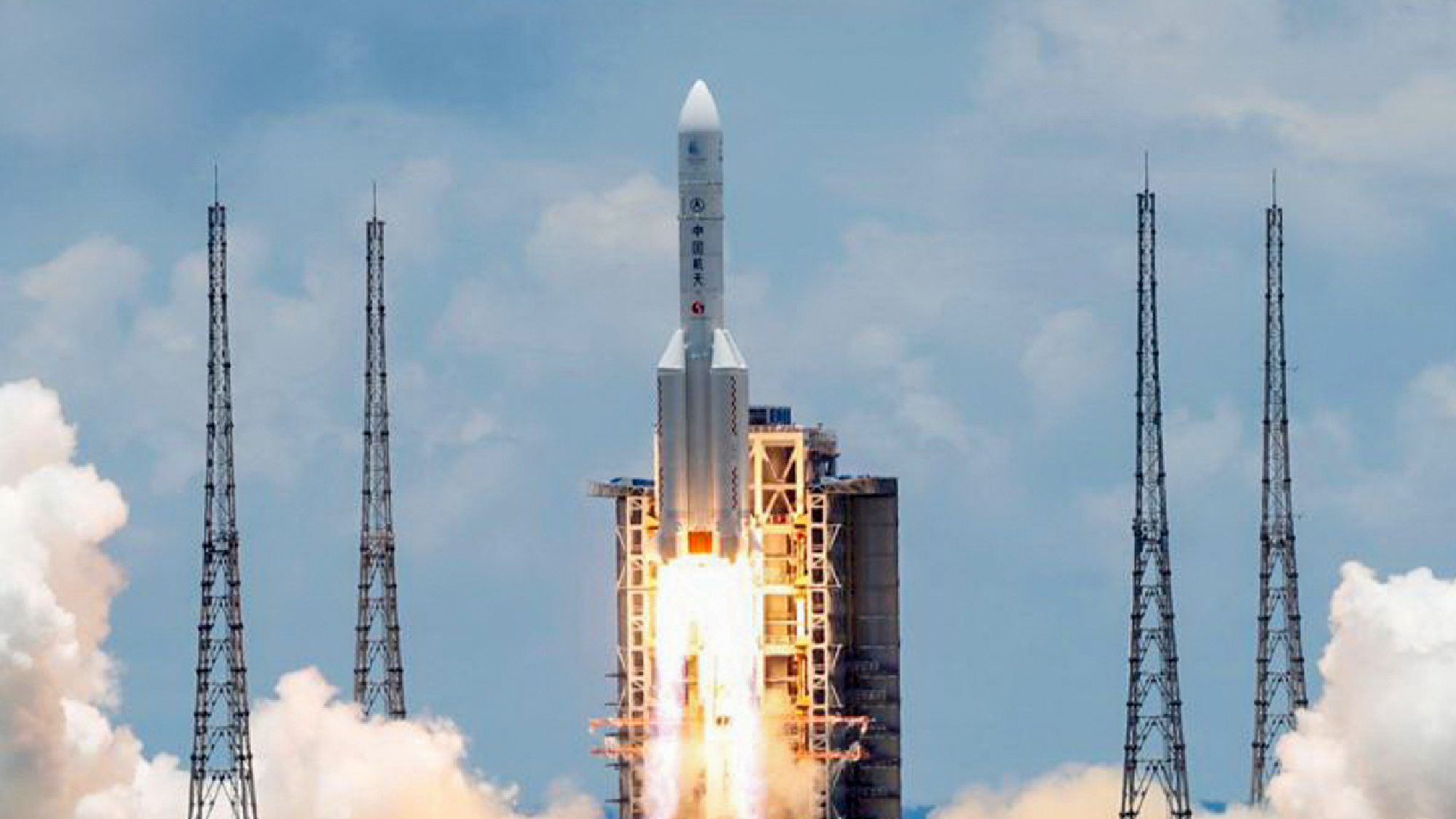
The hulk of the Chinese Long March rocket reentered Earth’s atmosphere around 10:30 p.m. Eastern time and some debris landed in the Indian Ocean near the Maldives, China’s Manned Space Engineering Office reported late Saturday night, ending days of international speculation. There were no immediate reports of damage from falling debris.
Videos on social media showed the 22-ton rocket, which had been drifting uncontrolled in low orbit for days, blazing a trail of light over Oman as it burned up during descent.
“The vast majority of components was ablated and destroyed during reentry into the atmosphere,” the Chinese agency said, putting the “landing” site at 72.47 degrees east, 2.65 degrees, a location in the ocean southwest of the Maldivian capital Malé.
The U.S. Space Command’s Space Track Project said in a tweet: “Everyone else following the #LongMarch5B reentry can relax. The rocket is down.”
At around 100 feet tall and weighing about 22 metric tons, the rocket stage is one of the largest objects to ever reenter the Earth’s atmosphere on an uncontrolled trajectory
The rocket’s reentry had prompted international concern about where it might land. Scientists said the risk to humans was astronomically low, but it was not impossible for it to land in a populated area.
The European Space Agency predicted a “risk zone” that encompassed much of the world, including nearly all of the Americas, all of Africa and Australia, parts of Asia and European countries such as Italy and Greece.
China has been criticized for its handling of the rocket booster, which was launched into space on April 29 to ferry the first module of the Tianhe space station. China did not make the necessary preparations for a controlled reentry, which would have slowed the rocket enough to enter the Earth’s atmosphere over a predetermined remote area or ocean, thus reducing the chance of debris affecting populated regions.
Astrophysicists described China’s decision as potentially hazardous corner-cutting. “There’s clearly a significant chance that it’s going to come down on land,” Jonathan McDowell, an astrophysicist at the Harvard-Smithsonian Center for Astrophysics, told CNN on Saturday.
China’s state media, however, has reacted angrily to the international scrutiny, saying its launch was being unfairly maligned. State media slammed U.S. media outlets for covering China’s “out-of-control space junk,” in contrast with the SpaceX wreckage.
Chinese Foreign Ministry spokesman Wang Wenbin defended the plan as “standard international practice,” saying at a news conference this week that “China is always committed to the peaceful use of outer space,” according to state media.
“China is ready to work with all relevant parties to make joint efforts for the peaceful use of outer space and safeguarding space security,” Wang said.
The size of the rocket made its reentry more unpredictable than others. Most satellites and other man-made objects are small enough to burn up in the atmosphere. But the Long March booster is much larger, which raised concern that pieces could survive and hit the ground.
The rocket’s tumbling motion as it passed through the mesosphere, an outer layer of the Earth’s atmosphere, has also made calculations of its speed tricky to project.
Space has been a point of national pride for China, which is expected to run the only operational space station after the retirement of the International Space Station in the next four years. The country, which has spoken of putting people back on the moon, has completed a flurry of successful lunar and Mars missions in recent years.
But China’s burgeoning space program has contributed to the growing problem of space debris. The Secure World Foundation, a think tank, said that China in 2007 “created a cloud of more than 3,000 pieces of space debris” after the country shot down a dead satellite with a missile.
During the first flight of the Long March 5B rocket last year, the booster passed over populated portions of Earth before pieces of debris landed in Africa. Jim Bridenstine, the NASA administrator at the time, slammed the Chinese space agency for the booster’s return, saying the event “could have been extremely dangerous.”
Matthew Cappucci and Christian Davenport contributed to this report.
Published : May 09, 2021
By : The Washington Post, Timothy Bella and Gerry Shih
Palestinians and Israeli police clash in Jerusalem over planned Arab evictions
JERUSALEM – More than 200 protesters were injured in clashes with police in Jerusalems Old City late Friday as tensions flared over the planned evictions of several Palestinian families from a nearby Arab neighborhood, according to emergency agencies.
More than a dozen police officers received minor injuries, police said. None of the injuries were reportedly life-threatening.
Video from the plaza surrounding the al-Aqsa Mosque showed officers in riot gear deploying stun grenades against a crowd of Palestinians throwing bottles and rocks. The fighting erupted after evening prayers on the final Friday of Ramadan, the Muslim holy month. More than 70,000 worshipers had gathered during the day at the mosque, one of Islam’s holiest sites and the location of frequent clashes between Palestinians and Israeli police who control access to compound.
A police spokesman said officers had entered the complex after some in the crowd began throwing objects. Protesters blamed police for escalating the situation, according to media reports and social media.
“The Israeli occupation will pay the price for its aggression and appalling infringement of the Muslims’ right to perform prayers at the mosque,” Hamas, the governing militant group in the Gaza Strip, said in a statement Saturday.
The group called for protests in Gaza Saturday and police said they expected gatherings in Israel and the West Bank as well. Officials said the potential for further clashes was high in coming days. Sunday will mark another Muslim holy day expected to draw large crowds of worshipers and the beginning of Jerusalem Day, which marks the takeover of the Old City by Israel in 1967.
The clashes followed weeks of building tensions in the city.
Police and protesters faced-off over several nights at the beginning of Ramadan when young Palestinians gathered at the Old City’s Damascus Gate. Militants fired dozens of rockets from Gaza in solidarity, which fell without causing injury. Those clashes eased when police removed restrictive fencing from the site at the behest of city leaders.
But anger has swelled in recent days over a long-running dispute in the Arab neighborhood of Sheikh Jarrah, where dozens of Palestinians in six households face eviction in favor of Jewish Israelis who claim several properties as rightfully theirs. While the legal battle goes back more than a decade, the Israeli Supreme Court is expected to rule definitively on the matter Monday and the standoff has galvanized both sides.
Israel characterizes the dispute as a technical property fight while Palestinians and Israeli human rights groups say it is part of a systematic and growing effort to create Jewish enclaves within the Arab neighborhoods of East Jerusalem. It is just one of several eviction fights being waged around the city.
Dozen of Palestinian activists have been gathering daily in Sheikh Jarrah over the past week, occasionally clashing with police and Jewish counter protesters.
Itmar Ben-Gvir, a parliament member and the provocative leader of far-right party with roots in the banned Kahanist movement, set up a temporary “office” under an awning near the standoff. He removed it after pleas from security officials, and reportedly from the office of his ally, Prime Minister Benjamin Netanyahu.
Following Friday’s clashes, U.S. officials called on Israeli and Palestinian leaders to “de-escalate tensions and bring a halt to the violence.”
“We are also deeply concerned about the potential eviction of Palestinian families in Sheikh Jarrah and Silwan neighborhoods of Jerusalem, many of whom have lived in their homes for generations,” the State Department said in a statement Saturday. “As we have consistently said, it is critical to avoid steps that exacerbate tensions or take us farther away from peace. This includes evictions in East Jerusalem, settlement activity, home demolitions, and acts of terrorism.”
Palestinian Authority President Mahmoud Abbas said Israel was to blame for the flaring tensions in Jerusalem, which both Israelis and Palestinians claim as their capital.
“We hold the Israeli occupation government absolutely responsible for what is happening in the holy city in terms of dangerous developments, vicious aggression, and what may result from it,” Abbas said in a televised address Saturday.
Palestinian analysts said anger in Arab neighborhoods was heightened by Abbas’s own decision last week to cancel parliamentary and presidential elections – the first in 15 years – that had been planned for the spring. Abbas blamed Israel for refusing to facilitate voting by eligible Palestinians in East Jerusalem. But polling showed his faction faring poorly against several rivals.
World awaits Chinese rocket to reenter the atmosphere, not knowing where it will land
A large Chinese rocket booster is plunging back to Earth and expected to reenter the atmosphere sometime this weekend, prompting international concern over where it may land.
The Long March-5B rocket is projected to reenter the Earth’s atmosphere at about 18,000 mph between 11 p.m. Saturday and 5:30 a.m. Sunday Eastern, according to space agencies and experts. At around 100 feet tall and about 22 metric tons, the rocket stage is set to become one of the largest objects to ever reenter the Earth’s atmosphere on an uncontrolled trajectory.
Where the rocket will land remains unclear. Scientists have said the risk to humans is astronomically low, but it is not impossible for it to land in a populated area. The Aerospace Corporation, a nonprofit largely financed by the U.S. government, predicted Saturday that it would splash down in the Atlantic Ocean, with the closest countries being Portugal and Spain.
But the rocket could reenter at anywhere between 41.5 degrees north latitude and 41.5 degrees south latitude, meaning major cities like New York could be hit with debris. The European Space Agency has predicted a “risk zone” that encompasses much of the world, including nearly all of the Americas, all of Africa and Australia, parts of Asia and the European countries like Italy and Greece.
China has been criticized for its handling of the rocket booster, which was launched into space on April 29 to ferry the first module of the Tianhe space station. China did not make the necessary preparations for a controlled reentry, which would have slowed the rocket enough to enter Earth’s atmosphere over a predetermined remote area or ocean, thus reducing the chance of debris impacting populated regions.
Astrophysicists have described China’s decision as potentially hazardous corner-cutting. “There’s clearly a significant chance that it’s going to come down on land,” Jonathan McDowell, an astrophysicist at the Harvard-Smithsonian Center for Astrophysics, told CNN on Saturday.
China’s state media, however, has reacted angrily to the international scrutiny, saying its launch was being unfairly maligned. State media slammed U.S. media outlets for covering China’s “out-of-control space junk” in contrast to the SpaceX wreckage.
Chinese Foreign Ministry spokesman Wang Wenbin defended the plan as “standard international practice,” saying at a news conference this week that “China is always committed to the peaceful use of outer space,” according to state media.
“China is ready to work with all relevant parties to make joint efforts for the peaceful use of outer space and safeguarding space security,” Wang said.
The size of the rocket makes its reentry more unpredictable than others. Most satellites and other man-made objects are small enough to burn up in the atmosphere. But the Long March booster is much larger, raising concern that pieces could survive and hit the ground.
The rocket’s tumbling motion as it passes through the mesosphere, an outer layer of Earth’s atmosphere, has also made calculations of its speed tricky to project.
Space has been a point of national pride for China, which is expected to run the only operational space station after the retirement of the International Space Station in the next four years. The country, which has spoken of putting people back on the moon, has completed a flurry of successful lunar and Mars missions in recent years.
But China’s growing space program has contributed to the growing problem of space debris. The Secure World Foundation, a think tank, said that China in 2007 “created a cloud of more than 3,000 pieces of space debris” after the country shot down a dead satellite with a missile.
During the first flight of the Long March 5B rocket last year, the booster passed over populated portions of Earth before pieces of debris landed in Africa. Jim Bridenstine, the NASA administrator at the time, slammed the Chinese space agency for the booster’s return, saying the event “could have been extremely dangerous.”
Biden wants to move energy offshore, but choppy seas are ahead
DORCHESTER, N.J. – In his three decades servicing oil platforms in the Gulf of Mexico, boat captain Keith Piper rode out all manner of storms and gales. Still, he had never faced the elements that tested him last winter at a wind farm off the coast of Rhode Island. Subzero temperatures. Snow. A noreaster blowing 70 miles per hour. Coffee sloshing in the pot and his 500-ton liftboat – propped above the waves on four hydraulic legs – vibrating from the force of the wind.
Given the rock-hard bottom of the continental shelf, unlike the Gulf’s forgiving sands, any mistake setting the boat legs down and the impact on board would feel like being slammed head first into concrete. “It shakes everything and breaks everything,” he said.
These are the discoveries being made at the dawn of America’s offshore wind industry. Up and down the East Coast, developers and government agencies are preparing for the massively complex and costly challenge of placing thousands of wind turbines taller than the Washington Monument miles out into the Atlantic. The Biden administration has set a goal that industry players call highly ambitious, if not unrealistic: to produce 30,000 megawatts of electricity from offshore wind farms by 2030, enough to power 10 million homes. Meeting this goal is one of the few available paths for President Joe Biden to reduce the country’s reliance on fossil fuels and fight climate change.
The obstacles ahead are staggering. The United States is decades behind Europe and Asia in developing offshore wind. Only seven offshore turbines are running – the five in Rhode Island, plus two in Virginia – and together the projects produce just 42 megawatts of electricity. China alone installed more than 3,000 new megawatts of offshore wind energy last year, more than half the world’s total.
Far larger efforts are on the horizon, though. Vineyard Wind, the first large-scale U.S. offshore wind farm, is expected to receive its final federal permit from the Interior Department within days. It calls for 62 turbines generating 800 megawatts just more than a dozen miles southeast of Martha’s Vineyard, Mass. Fourteen other projects from North Carolina to Maine are in other stages of permitting that, under a disdainful President Donald Trump, became a seemingly endless process.
“The Achilles’ heel of the industry has been the federal permitting process,” said David Hardy, chief executive of Ørsted Offshore North America, the U.S. offshoot of the Danish energy giant that has been involved in both existing American projects and has applications pending for several more. “It was, to be blunt, stalled under the Trump administration.”
Hardy is encouraged by Biden’s interest. A recent call with offshore industry leaders included four Cabinet members as well as White House climate adviser Gina McCarthy, with administration officials vowing to provide federal loans and accelerate permitting, he said. The Bureau of Ocean Energy Management has committed to processing the 14 pending proposals by 2025.
“We’re taking an all-of-government approach to ensure that we are successful in developing offshore wind,” bureau director Amanda Lefton said in an interview.
The aggressive timetable will require a massive new industry, with steep investments in new ports, boats, factories, and upgrades to electrical grids. The first U.S.-built vessel capable of installing the offshore turbines is being completed in Texas at a cost of $500 million. Until more ships are ready, projects in this country must rely on boats from Europe, an exchange complicated by the continent’s own demand for wind energy and maritime trade laws here.
There are other hurdles, too, particularly intense opposition from some coastal communities and commercial fishermen. Even when that’s overcome, construction can only move forward during certain months because of bad weather and the threat to migratory patterns of the North Atlantic right whale, a critically endangered species.
It all makes offshore wind farms – multibillion-dollar infrastructure projects – a still-risky proposition, according to developers and others in the industry.
“Everybody’s sticking their toe in the water right now,” said Piper, the boat captain who’s now based in Dorchester for that very reason. “But nobody wants to stick their whole foot in yet.”
– – –
Bill White leaned into a brisk breeze as he crossed the vast and largely empty expanse of compacted gravel at the edge of Buzzards Bay. There is wind here but so far little else.
Yet two years from now, he envisions 500 workers – electricians and engineers, longshoremen and seafarers, all tiny specks next to turbine blades longer than a football field, nose cones called nacelles that are large enough to hold elevators and 3.5-million-pound steel columns known as monopiles, which get hammered deep into the seafloor.
It is White’s job to make Vineyard Wind a reality, and this lot at the Marine Commerce Terminal in New Bedford, Mass., a historic whaling community, is where it will happen. The site is the first port in the country built specifically to withstand the turbine components’ crushing weights. Other facilities are being developed in New York, Connecticut, Rhode Island and Maryland. In New Jersey, a $250 million factory will be completed in two years and begin building the monopiles that anchor wind turbines in place. Siemens Gamesa is considering a future factory in Virginia to make turbine blades.
“These will be some of the biggest construction projects our country has seen,” said White, vice president of offshore wind for Avangrid Renewables, one of two companies leading Vineyard Wind. “This will be a massive mobilization.”
He has long envisioned this future. A veteran of the State Department and the Clinton White House, he spent more than a decade trying to advance offshore wind energy with the state of Massachusetts and then the private sector. He lived through Cape Wind, a proposed project off the coast of Nantucket, Mass., that was defeated by lawsuits and well-funded opponents such as the Koch brothers. The first meetings to discuss the location of what would become Vineyard Wind were in 2009.
“It’s been a hell of a long road,” he said.
Thousands of wind turbines are already spinning across the country, but developers see greater potential offshore because of more powerful sustained winds, the proximity to large coastal cities thirsty for electricity and the space for vast activity.
White’s company is a subsidiary of the Spanish energy company Iberdrola. Its partner is Copenhagen Infrastructure Partners out of Denmark. So far, European companies dominate these early efforts to bring offshore wind to the United States. Vineyard Wind’s onshore substation will be built by a Swedish company, its cables by Italian and Belgian firms. General Electric will supply the turbines.
Developing the domestic supply chain and expertise to get U.S. wind farms up and running is one of the big obstacles ahead. When Dominion Energy in Virginia launched its two-turbine pilot 27 miles off the coast of Virginia Beach, the only boats capable of doing the installation work were in Europe. Because of the project’s small scale, it took three rounds of bidding to secure the parts and vessels needed, Dominion senior vice president Mark Mitchell recalled.
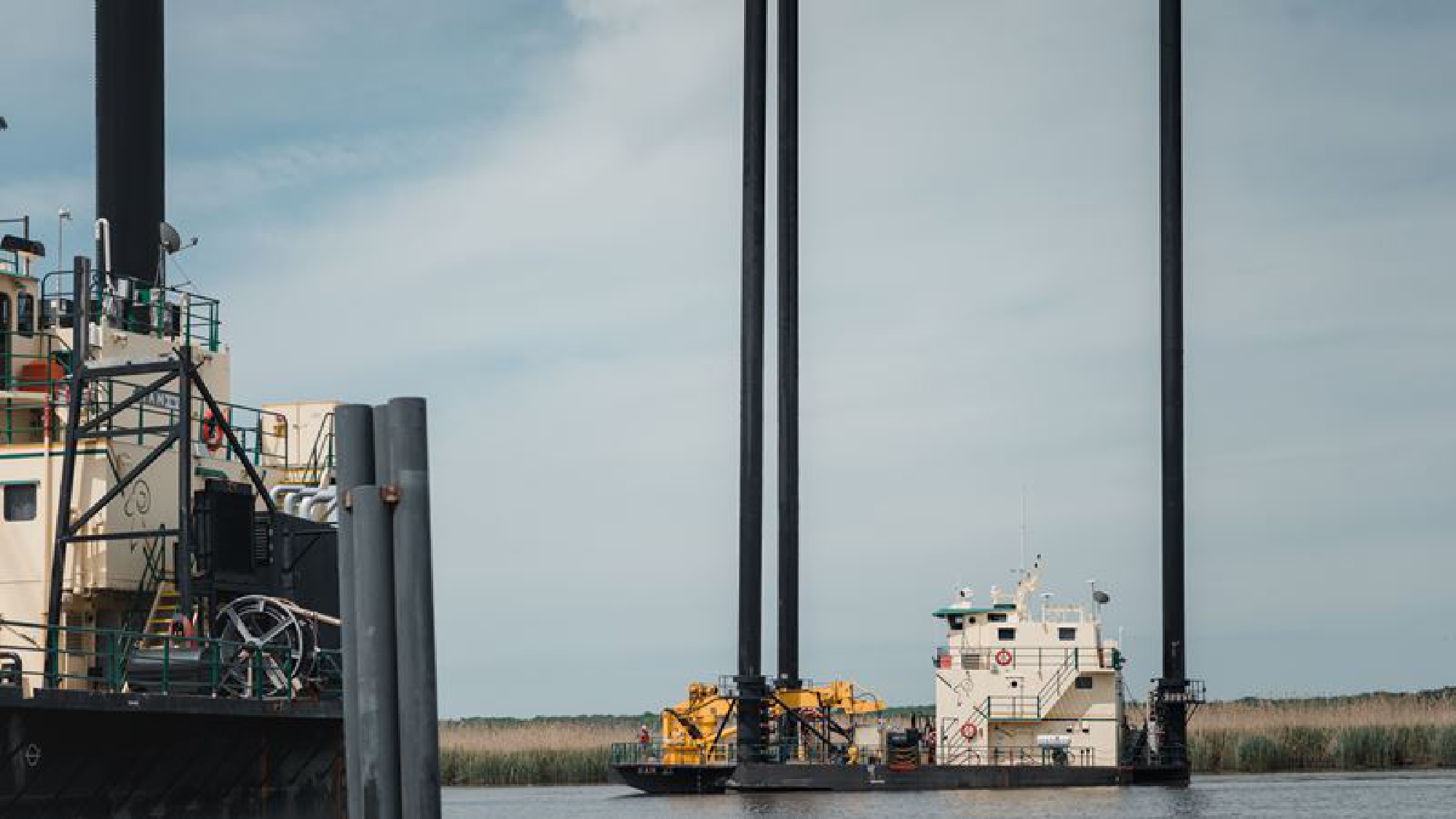
A century-old law made the situation even tougher. The Jones Act says only U.S.-built-and-operated ships can move goods between U.S. ports. To install the Virginia turbines, supplies shipped from Europe were first staged in Canada before being ferried on repeated trips to the construction site. The repeated snags prompted Dominion to invest in the ship now being built in Brownsville, Texas. A jack-up vessel, it will be able to put down legs on the seafloor and then use hydraulic power to lift itself above the waves and create a secure working platform. It is expected to be ready in 2024 for Dominion’s wind farm expansion.
Even after a wind farm goes online, much can go wrong. That was why Piper and his men headed out last October aboard the Ram XV, a vessel that resembles a giant floating platform with 175-foot vertical legs. Its wind-energy niche is drilling and cabling work, and it was dispatched to the Rhode Island wind farm to help bury transmission cables that had become exposed by shifting sands.
The liftboat left the dock in Dorchester, making its way down the Maurice River, into Delaware Bay and then up the New Jersey Coast before turning east. During the four-month assignment, several major storms hit, at times forcing the crew to shelter in the Block Island harbor, Piper recalled. Temperatures plummeted to minus-10 degrees at one point, freezing the boat’s water-making machine. A sewage line had to be thawed with an acetylene torch.
“It was brutal,” said David Morgan of Aries Marine, the oil services company that owns the boat. “Very, very difficult job. Right through the worst time of the year.”
– – –
Those who oppose wind farms find many reasons to do so. The sight of them can be enough to sour a waterfront homeowner’s mood, although the projects in the pipeline are slated for many miles offshore and so turbines will appear tiny, if not invisible, from land.
Environmentalists, who support moving away from fossil fuels to combat climate change, are torn. They worry about risks to birds, fish and marine mammals, particularly the North Atlantic right whale.
Only about 360 of the whales remain, migrating every fall from New England to as far south as Florida. Noise from underwater construction and increased boat traffic is the most serious threat posed by the new crop of wind farms, according to Mark Baumgartner, a marine ecologist at the Woods Hole Oceanographic Institute who uses buoys and underwater gliders to monitor right whale sounds.
“We already have a fairly industrialized ocean, with shipping traffic and fishing activities. Adding these large wind farms with many, many, many turbines is certainly concerning,” he noted.
Wind farm developers have pledged to restrict construction for several months each year to avoid disturbing the whales. Vineyard Wind plans to use compressed air to form an underwater curtain of bubbles to try to dampen construction noise. Vessels involved will have spotters scanning for whales and orders to halt work if they appear.
The Biden administration’s goals will face the determined resistance of commercial fishermen, whose trawl nets and lobster pots ply the same stretches of ocean as several of the areas designated for future wind farms. This is no small business. New Bedford, Mass., with its scallop industry, has been the most lucrative fishing port in the country for the past two decades, taking in more than $430 million in 2018.
Wind farm prep work has already generated conflicts. Large survey vessels, which have a sled that drags below them with cables and sonar, have repeatedly damaged nets and other equipment as they mapped the ocean floor, according to several commercial fishermen.
In August, a survey boat working for Ørsted was about nine miles southwest of the tip of Long Island, close to where 67-year-old Ace Auteri, had laid out rows of fish pots to catch sea bass. “I’m there and he’s trawling, he’s dragging his gear literally 50 feet off my line of gear,” Auteri recounted recently. “I called him on the radio and I told him, ‘Hey, look, you’re way too close to my gear here. You’re going to get into it.’ “
Auteri returned a few days later and found his fish pots gone. Convinced the boat had torn through them, he complained to Ørsted’s liaison to the fishing industry but felt he was getting a runaround. He decided not to file a formal claim, though he estimates he lost $10,000 in gear and lost income from the missing traps. “I could see I wasn’t going to get paid for it.”
An Ørsted spokesman said the company does not comment on such individual situations or claims.
But many commercial fishermen are worried about more than nets and pots. They fear they will lose fishing grounds because it will be dangerous to maneuver among the wind farms, particularly during poor weather and low visibility. When close to turbines, they report persistent problems with their radar navigation systems identifying false objects. They also worry that construction and underwater drilling – and then noises from normal turbine operations – could disturb fish and shellfish populations.
Vincent Carillo, of Montauk, N.Y., who owns a scallop boat called the Nemesis, said that for years he has heard government fisheries regulators talk about the ocean as a public resource.
“And now they just leased it all off to foreign companies,” the 55-year-old Carillo said. “I don’t understand how they can just lease the bottom out like that when for centuries we have been fishing on those grounds.”
Wind farm developers have been negotiating extensively with fishermen, with Ørsted taking hundreds of meetings with them “to understand their concerns and try to adapt to work with their needs,” Hardy said.
Vineyard Wind’s developers have agreed to pay $37.7 million to commercial fishermen in Massachusetts and Rhode Island to compensate them for future losses. They also reduced the size of the project by 60 percent and agreed to place turbines one nautical mile apart.
“This is an unknown to them,” White said of the fishermen. “And we’ve had them at the table, but there’s still a lot of uncertainty.”
He expects legal challenges from opponents if the federal permit is approved. Even so, he feels the wind’s at his back these days, and the future he has long imagined may finally be on the horizon.
“I think it’s coming,” White said. “I think it’s just about here.”
Most police departments in America are small. Thats partly why changing policing is difficult, experts say.
While big-city police tend to get the most attention, the agencies that have been in the spotlight recently for uses of force – fatal shootings of Black men in Brooklyn Center, Minn., and Elizabeth City, N.C., and pepper-spraying a Black and Latino man in Windsor, Va. – are more illustrative of what American law enforcement looks like: small departments in places that rarely make the news.
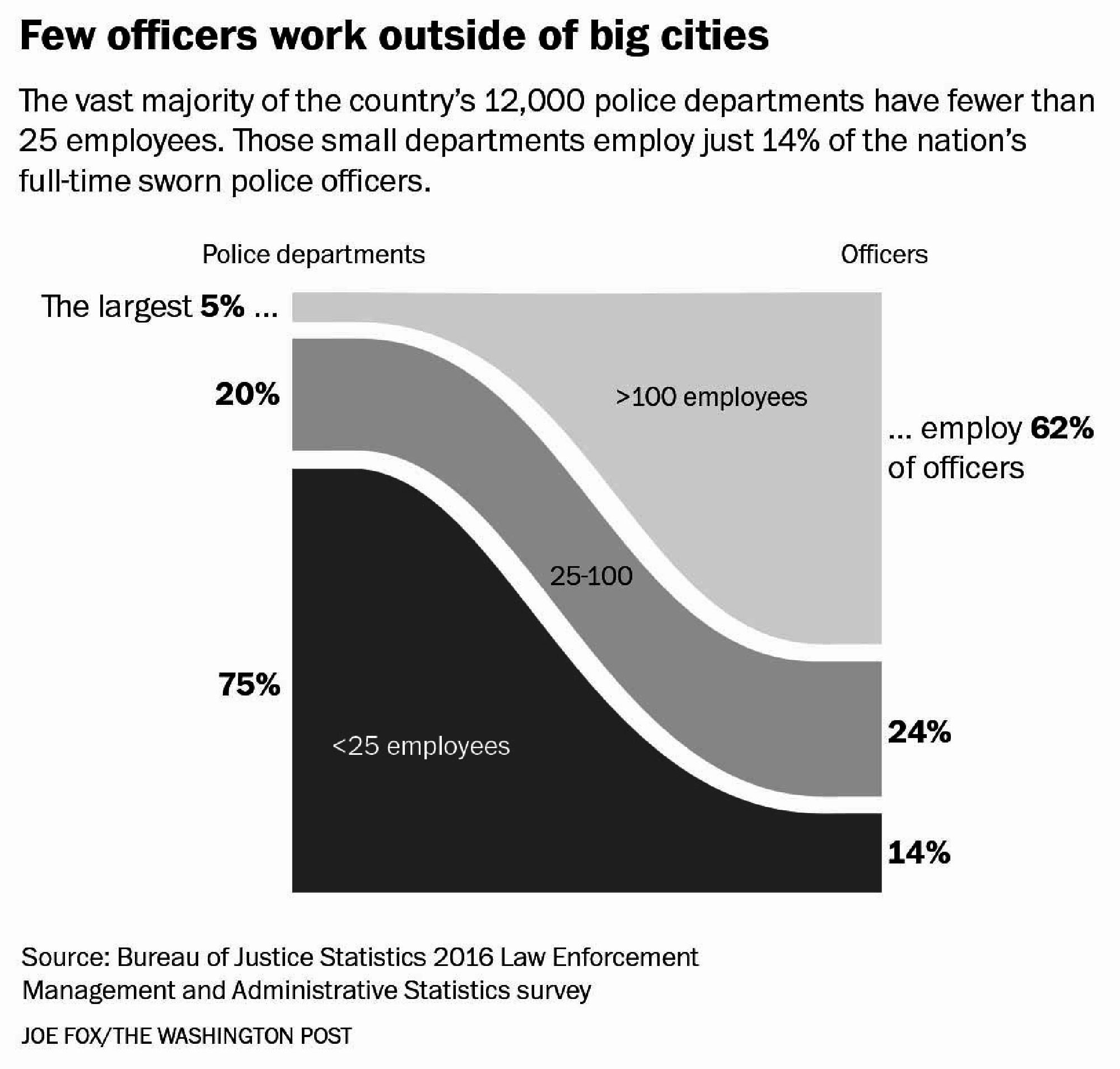
According to a federal survey in 2016, there are more than 12,200 local police departments nationwide, along with another 3,000 sheriff’s offices. And most of those don’t look like the New York Police Department, which employs more officers than Brooklyn Center, in suburban Minneapolis, has residents.
Nearly half of all local police departments have fewer than 10 officers. Three in 4 of the departments have no more than two dozen officers. And 9 in 10 employ fewer than 50 sworn officers. Brooklyn Center, which has 43 officers, and Windsor, which reported a seven-member force, fit comfortably in that majority.
Experts say that while smaller departments have their benefits, including being able to adapt to their communities and hire officers with local ties, these agencies also are typically able to avoid the accountability being sought as part of the national movement to restructure and improve policing. These departments’ often limited resources and the decentralized structure of American law enforcement complicate efforts to mandate widespread training and policy changes, experts say.
“You want to change American policing, figure out how to get to . . . the departments of 50 officers or less,” said Chuck Wexler, executive director of the Police Executive Research Forum, a Washington-based group that works with police departments. “How do you reach them? How do you get to them? . . . That’s what the American people keep wondering.”
Former Charlotte police chief Darrel Stephens said smaller departments will have a harder time diverting officers to training to learn new tactics or practices, since they have fewer officers to put on the streets overall.
“I don’t want to denigrate them, because there’s a lot of good people doing things in the right way for the right reasons,” Stephens said. “But their capacity is just limited.”
But there are also other differences, owing to the remarkably localized nature of American policing.
Policies and practices can vary significantly from department to department. These differences can include how departments approach the use of force as well as the levels of training and specialization involved.
“It’s unlike any other country,” Wexler said. “In places like the United Kingdom, you have a Home Office, you have standards. In Germany or Israel . . . they have a national police. Our policing is completely fragmented, decentralized, with no national standards.”
The smaller departments in the spotlight recently have come from three very different communities, and all involved officers doing what police described as relatively routine police work: traffic stops and serving warrants.
In Brooklyn Center, an officer shot and killed 20-year-old Daunte Wright during a traffic stop; the police chief said the officer, who resigned and was charged with manslaughter, meant to user her Taser, not her service weapon.
Police in Windsor stopped and held Army 2nd Lt. Caron Nazario at gunpoint in December for not having a permanent rear license plate. In video footage that spread widely last month, the officers are heard yelling and berating Nazario and are seen striking and pepper-spraying him before handcuffing him. One of the officers involved was fired amid the public outrage over the footage, recorded by the officers’ body cameras and Nazario’s cellphone.
On April 21, sheriff’s deputies in Elizabeth City shot and killed Andrew Brown Jr. while attempting to serve a felony warrant, officials said, an episode that has spurred intensifying questions, criticism and protests.
These were not the only police departments to have drawn attention recently. Former Minneapolis police officer Derek Chauvin was convicted of murder last month in the death of George Floyd, and police in Chicago and Columbus are under scrutiny after fatal shootings of children. But those departments, all among the country’s largest, are the outliers.
The Pasquotank County Sheriff’s Office in North Carolina, whose officers were involved in the Elizabeth City shooting, for instance, has 55 sworn deputies for a county of more than 39,000 residents. Sheriff’s offices differ from police departments in that police chiefs are usually appointed and sheriffs are typically elected. But the numbers remain pronounced: More than 3 in 4 sheriff’s departments have fewer than 50 officers, according to the federal survey.
While policing has become the subject of protests and fraught national debates, exactly what kinds of departments are charged with keeping citizens safe – including how many there are, the number of officers they employ and their demographic makeup – often gets glossed over.
The 2016 federal survey is the most recent available, according to the Justice Department. A new survey is in the field, but it is unclear when that data will be released, the department said.
The latticework of law enforcement draped across the country doesn’t just include departments of varying sizes, but forces with distinct procedures that often exist side by side in neighboring communities.
That means “the rules of policing change depending on where you are,” said Dennis Kenney, a former Florida police officer and a professor at the John Jay College of Criminal Justice in New York.
“It’s not even county to county,” he said. “It’s city to city. Within a county, you can have one police department that has one set of policies and another that has another set of policies. And certainly the level of training varies greatly.”
Most police departments in America are small. Thats partly why changing policing is difficult, experts say.
Kenney was an officer with the Bartow, Fla., police department in the late 1970s and early 1980s, when it had around 40 officers, he said. Since then, he has consulted with a number of other police agencies, including national departments in Colombia and Thailand.
One key difference in having thousands of police departments, rather than one central force, is how long it takes for changes in training or policies to ripple outward, he said.
“I spent a good amount of time working with the Colombian national police,” Kenney said. “And if you want to make a change in their agency, basically you’ve got a general to convince and it flows downhill from there.”
In the United States, “if you’re trying to do systemwide things or things that involve collaboration, then it’s much more difficult,” he said.
Kenney pointed to community policing, a concept that involves building ties between officers and the communities they patrol, as an example. Advocates of the approach had to sell it to thousands of different agencies, he said.
“Local policing is the most decentralized institution in the United States and the world,” said Stephens, the former Charlotte chief.
“There are pros and cons” to the American system, said Christy Lopez, who oversaw the Justice Department’s investigation into the Ferguson, Mo., police department after 18-year-old Michael Brown was shot and killed by a police officer in 2014.
“It’s a very big country with different challenges in parts of it,” said Lopez, who now teaches law at Georgetown University. “I like the idea we have different agencies that can experiment . . . and be responsive to that particular community. I think there’s value to that.”
But with this diffuse system, much more attention is usually paid to the largest departments, such as those in New York (which has roughly 36,000 police officers), Chicago (more than 12,000 officers) and Los Angeles (about 9,000 officers).
While most individual police departments are small, the majority of officers nationwide work for the biggest forces, patrolling communities where the largest populations live. Departments with at least 100 officers account for 5% of all police agencies nationwide, but they employ more than 6 in 10 full-time officers.
Those officers police communities that also may still have news organizations who can provide scrutiny and coverage.
“The places you hear the most about might not be the worst places,” Lopez said. “They might be the places with the loudest advocacy groups, the most robust media markets or even just they’re better about sharing their information.”
Additionally, policing across the country is still shrouded in opacity in significant ways. The number of people shot and killed by police is tracked by The Washington Post. Other details of uses of force – including how many times police across the country fire their guns and miss, or hit people who survive – remain unknown.
When it comes to smaller police departments, “there’s just no oversight and no accountability, to a very large extent,” Lopez said.
“They’re never going to have a police commission. They’re never going to have a civilian review board,” she said. “They’re never going to have a major media outlet focus on them.”
That, she said, is why there needs to be more transparency built into policing, such as state policies mandating certain details be made public. “So that no matter how small the agency is, there are certain things they’re required to do and certain things we are required to know about them,” Lopez said.
Some experts said it might be good to review whether every police agency is necessary and whether any could be consolidated. Such calls are not new, they said.
“You don’t need to have five or 6,000 or 10,000 officers. Sometimes you get lost in all of that,” said Stephens, who was Charlotte’s second police chief after the city consolidated its police with Mecklenburg County. “An agency of 150 or 200, 250 officers isn’t that large to begin with, but it’s generally in a much better position to provide the full array of services.”
But trying to merge departments could be difficult in some cases, because many politicians are loath to give up an agency operating under their aegis.
“Mayors and city managers and city council people just don’t want to give up control,” said Kenney, the former Florida police officer. “As a result, small cities will maintain very small agencies because they like . . . being able to get a response from the police when they want it.”
Ultimately, he said, “we like localized control over the police.”
To mask or not to mask? With vaccines and new guidelines, the mask-faithful navigate a weird gray area.
When David Díaz went for a recent 5-mile run in Iowa City, he took along a partner he has depended on for more than a year: his face mask.
Díaz, 29, knew he did not have to. He’s fully vaccinated, and recent federal guidance says unmasked, outdoor ex ercise is safe. At first, he wore the mask around his neck. But after passing people one block later, he pulled it up – and then began wondering why. Was he posturing? Was he showing concern for others? Was he worried passersby would view him as an anti-masker? Was he actually being anti-science?
“At what point are you doing more harm than good and letting fear or something rule your life?” Díaz, a data analytics consultant, said days later. “It’s still a thing I’m trying to work through.”
Some Americans never fully embraced face masks, those swaths of fabric that became one of the seminal flash points of the U.S. coronavirus pandemic. But for many across the nation who did, rising vaccination rates and shifting public health advice are forcing a recalibration of a relationship with an accessory that has served as a shield against a deadly pathogen, a security blanket during a crisis, and a symbol – of regard for the common good, liberal politics or belief in science.
Now, after months of advising Americans to wear masks and stay six feet from most others, the Centers for Disease Control and Prevention says vaccinated people can, among other things, gather unmasked indoors and that everyone can exercise outdoors with household members – and with faces bared to the world. Suddenly, in the spring of 2021, donning a mask for a solo stroll outside, where scientists have found scant evidence of transmission, has become the unscientific approach.
“If I know it doesn’t offer me additional protection, it’s okay to wear it anyway – it’s okay to have that kind of cognitive dissonance,” said Zoë McLaren, an associate professor at the University of Maryland at Baltimore County who studies policies to combat infectious diseases. “You want people to understand the actual risks, and then they can choose the level of precaution they want to take.”
McLaren said she thinks the latest CDC guidance, with its traffic-light colored rubric, is scientifically sound, if a bit dense. It’s been criticized by others, including “The Daily Show” host Trevor Noah, who slammed it for being “unreadable” and allowing vaccinated people to do only “two more things without a mask on.” Others complain it is too complicated and it requires people to know whether others are vaccinated.
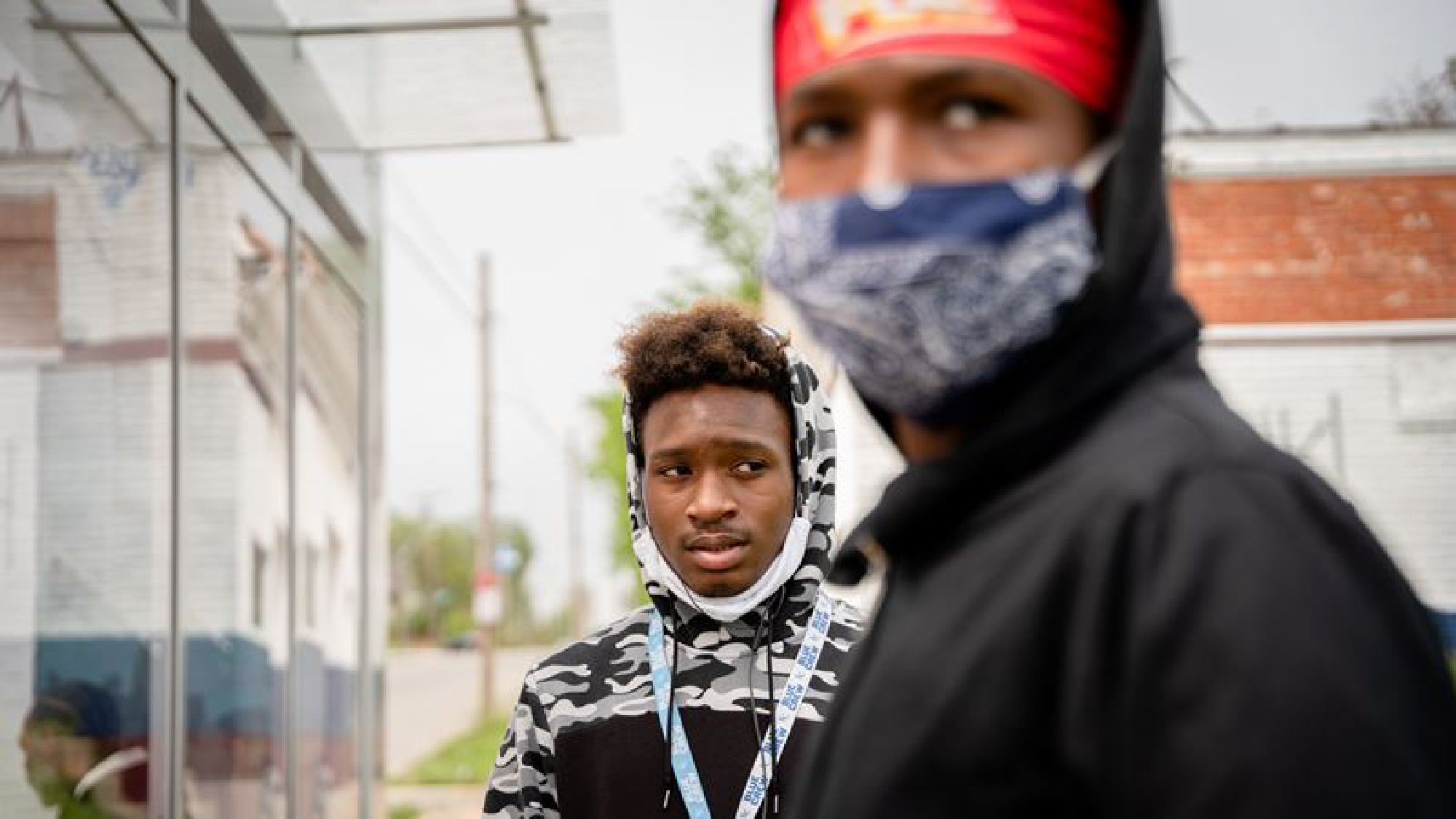
James Clark, vice president of public safety at the Urban League of Metropolitan St. Louis, said people in the north St. Louis areas where he works initially resisted masks, then “got fashionable” with them. But now Clark worries people are misinterpreting the CDC guidance.
“I think [the CDC] should have been a lot more succinct in their messaging because I see people now walking into gas stations without a mask on, and the gas station cashier says, ‘You can’t come in without a mask,’ and then the person says, ‘Well, I thought we didn’t have to wear masks no more?'”
That confusion is common, said Faisal Khan, director of the St. Louis County Department of Public Health.
“People are so fixated on wanting to see their own individual situation represented or explained by those guidelines, and that’s never the purpose of the guidelines,” said Khan, who said his office receives a continual stream of calls and emails with “people screaming at us about why they cannot take their masks off” or questions about “which situation they should be masked in or not.”
At a macro level, mask-wearing in the United States has not been driven by public health advice or mandates, researchers and pollsters say. It is strongly associated with political affiliation. An Ipsos poll released this week found that 57% of Americans said they always wear masks when they leave the house, with Democrats more than twice as likely to do so than Republicans.
But there are signs of a new trend: The poll found that 63% of all vaccinated respondents always wear masks outside their homes, down from 74% in mid-April.
That is “a relatively significant shift,” said Chris Jackson, senior vice president and head of polling at Ipsos. “I do think that is somewhat attributable to CDC’s updated guidelines, and Democrats essentially having some sort of signal that yes, it is okay to change your behavior.”
At a micro level, however, this can feel like an awkward, in-between stage of coronavirus risk assessment. To wear or not to wear is not necessarily a simple question.
In State College, Pa., Nate Whitehill found himself taken aback on a recent evening when he saw a group of college students crossing a street unmasked. Then he had what he called an “epiphany,” remembering the CDC approved, if the students were vaccinated. And yet although he has had his Johnson & Johnson shot, Whitehill said he is figuring out the contours of vaccinated life. He recently went to his first pandemic-era dinner inside a restaurant, but he still wearing his mask outdoors.
“It’s hard to say when it’s going to hit that comfortable point that people can just be outdoors without a mask and not only not worry about covid, but also not have to worry about what the people around you are thinking,” said Whitehill, 31, who works at Pennsylvania State University. “It’s not like you’re going to run up to people and say, ‘I’m vaccinated.'”
To mask or not to mask? With vaccines and new guidelines, the mask-faithful navigate a weird gray area.
Rob Hart, who’s been vaccinated since taking part in the J&J trial last fall, almost wanted to do that the other day. Hart, a novelist, said he still believes in the value of masking in public, in part to signal concern about others’ welfare. But as he emerged from a subway station in Manhattan, he took off his mask to get some fresh air. A man about 20 feet away – his own mask below his chin – promptly yelled at Hart for being uncovered.
“I was kind of speechless for a minute,” Hart said, adding: “This is such a weird gray area, because supposedly if you’re vaccinated and distanced, you don’t have to wear a mask. But how do we know if the people who aren’t wearing masks are vaccinated?”
On a cool but sunny afternoon this week, Roxana Henning, 46, watched as her 9-year-old son, Nathaniel, pumped his legs on a swing at an uncrowded park in the Chicago suburb of South Barrington. A few feet away, a sign warned that the playground was not sanitized and advised visitors to wear masks.
Henning, a part-time cardiovascular nurse who is vaccinated, did not wear one. But she said she planned to in a few days, when she expected to attend an in-person, outdoor church service for the first time in 14 months.
“I don’t have to protect myself, right?” she says. “But I want to protect other people.”
Nathaniel, on the other hand, donned a blue surgical mask.
“It just makes me feel comfortable and a bit safer,” the boy said. “The only time I ever enjoy taking it off is at home.”
Adding to the confusion in some places are local mask ordinances, which may differ from CDC guidance. In Massachusetts, Gov. Charlie Baker, a Republican, recently relaxed the state mask mandate for people outdoors and able to distance. But the Boston suburb of Brookline is keeping its town mandate for now.
At Tatte, a popular cafe on Brookline’s main drag, Beacon Street, Samantha Wong ate pastries with a friend at an outdoor table surrounded by chickadees searching for poppy seeds and crumbs. Wong, a 24-year-old portrait photographer who’s had her first vaccine dose, said she would continue to wear her mask outside even after receiving her second.
“I worry that people taking off their masks outside will lead to everyone not wearing one, and then will lead to people taking them off inside,” she said. “And I’m worried about the variants.” Asked when she might feel comfortable leaving it at home, Wong said: “Maybe fall 2022? Or maybe even spring 2022?”
Brookline resident Kathleen Vandenberg, 46, lives just 20 feet from the Boston border. She is planning to start running again next week – and when she does, she’ll do so in Boston. She has mild asthma, and breathing while running is easier without a mask. But she plans to keep it on her chin – not for anyone’s safety, but to avoid being seen as anti-mask.
Vandenberg, a senior lecturer in rhetoric at Boston University, knows that is a “symbolic and social” choice. But so, she said, is Brookline’s. The town has recorded fewer than 2,300 covid-19 cases since the start of the pandemic and has high vaccination rates.
“All along, we’ve been told to ‘follow the science.’ And the science says that the risk of transmission outside is low, especially if you’ve been vaccinated and keep your distance,” Vandenberg said. “The mask-wearing mandate here seems like it’s more about shame than science,” she said.
Jared Wilkins, lead pastor of Parkcrest Christian Church in Long Beach, Calif., is fairly sanguine about it all. He has started having more one-on-one coffees, outdoor lunches and front-porch visits with congregants. Often, these meetings involve a delicate conversation – about the other person’s vaccination status, whether to sit outside, whether to mask.
“There’s this weird balance that we’re in right now, when we haven’t reached herd immunity, and for people who are vaccinated, the risk is incredibly low,” Wilkins said. “For the next couple of months, it’s just going to be weird, so let’s lean into that weirdness.”
The default has been to mask, said Wilkins, 39, who’s partially vaccinated. But once he’s fully inoculated, he plans to “act vaccinated,” he said, by easing up on the mask – in part to encourage others to get their vaccines. “I’m not going to be reckless, but for us, it’s really important to follow our city and state guidelines and ask, ‘What are we modeling in this moment?'”
Sue McAvoy and Bill Tucker were not thinking much about modeling when they met the other morning for a walk on Atlanta’s BeltLine, a popular trail system built on former rail corridors. Friends since college, the two 65-year-olds, both vaccinated, were simply delighted to have their first in-person meetup since the fall of 2019.
Both said they remain cautious. McAvoy, a retired career adviser and self-described “super-hugger,” said she has taken the opportunity to meet – and hug – several close friends since getting vaccinated, but she still avoids most indoor spaces other than the grocery store.
Tucker, a retired investment banker, misses visiting his local LA Fitness four times a week, as he did regularly before the pandemic. He doesn’t feel safe there, he said. “I do hope that the numbers improve enough that this all ends real soon,” he said.
But on this day, under cloudy spring skies, the old friends were at least together again. And neither wore a mask.



 Most police departments in America are small. Thats partly why changing policing is difficult, experts say.
 To mask or not to mask? With vaccines and new guidelines, the mask-faithful navigate a weird gray area.
 จนถึงตอนนี้ บิล เกตส์ โอนหุ้นในบริษัทต่างๆ ให้ เมลินดา เฟรนช์ เกตส์ แล้วอย่างน้อย 4 แห่ง
 1 ใน 2 ของพลเมืองโลกรายได้ลดลงเพราะ Covid-19 ประชาชนในประเทศรายได้ต่ำกระทบหนักสุด
 ผู้ว่าฯ แบงก์ชาติอังกฤษเตือนนักลงทุนสกุลเงินดิจิทัลให้เตรียมตัวสูญเงินหมดหน้าตัก
 กองทัพเกาหลีใต้ประกาศแผนการปรับเพิ่มค่าอาหารรายวันของทหาร หลังสาธารณชนวิพากษ์วิจารณ์การจัดเตรียมอาหารที่ด้อยคุณภาพให้สมาชิกกองทัพ

