Patrick Mateo, 47, was arrested in Queens, NY for assaulting a 53 y.o. Asian woman waiting in line outside a bakery. She required 10 stitches. In 2020, NYC alone had an 867% increase in Asian hate crime victims compared to the year before. @oliviamunnhttps://t.co/l2hUzcIPHEpic.twitter.com/zEDyYEK3On— Cleavon MD (@Cleavon_MD) February 18, 2021
EXCLUSIVE: This is the gash on the forehead of the 52-year-old Asian woman violently shoved yesterday in Flushing, Queens. She blacked out. Her son tells me she’s out & about today running errands. She refuses to live in fear. Tonight at 11p #StopAsianHateCrimes#ProtectOurElderspic.twitter.com/8kr6T7091w— CeFaan Kim (@CeFaanKim) February 17, 2021
My friend’s mom is a 5’3” 50+ Chinese woman and she was attacked by this guy in Flushing, NY yesterday on Main St and Roosevelt between 2-4pm. She left the hospital with 10 stitches in her head. We’re gonna find this guy. Queens, Internet, please… do your shit. @NYPD109Pctpic.twitter.com/hrB3kchxGH— O M (@oliviamunn) February 17, 2021
แม้จะถูกนำไปเปรียบเทียบกับ Great Firewall ของจีน แต่กำแพงของเวียดนามไม่สูงเท่าของจีน เนื่องจากทางการเวียดนามไม่ได้ปิดกั้นการเข้าถึงเว็บไซต์หรือโซเชียลมีเดียของต่างชาติ
นักวิเคราะห์บางคนเปรียบเทียบกฎหมายความมั่นคงทางไซเบอร์ของเวียดนามกับ Great Firewall ของจีนที่องค์กรด้านประชาธิปไตย Freedom House จัดอันดับให้เป็นประเทศที่ละเมิดเสรีภาพทางอินเทอร์เน็ตมากที่สุดในโลกหลายปีซ้อน โดยพบว่าแม้กำแพงของเวียดนามจะไม่สูงเท่าของจีน เพราะไม่ได้ปิดกั้นเว็บไซต์หรือโซเชียลมีเดียจากต่างประเทศ แต่ดูเหมือนว่าการควบคุมอินเทอร์เน็ตของเวียดนามเจริญรอยตามจีน
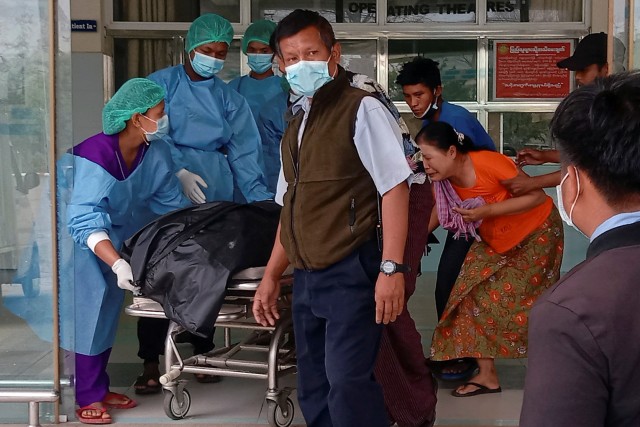
Protester, 20, first fatality in Myanmar junta’s crackdown
InternationalFeb 19. 2021Photo credit: Civil Disobedience Movement on Twitter
By The Nation
A Myanmar hospital has confirmed that a 20-year-old woman shot in the head at an anti-coup protest last week has died, marking the first fatality in the crackdown following the February 1 putsch.
Naypyidaw General hospital said on Friday that Mya Thwe Thwe Khine had succumbed to injuries sustained at a massive rally on February 9. Police used water cannon, rubber bullets and live ammunition to disperse protesters at the rally in the capital Nay Pyi Taw. Video clips circulating online show Mya wearing a helmet as water cannon is fired at her. She then falls to the ground after a bullet penetrated her helmet.
Doctors confirmed that she was shot with a live round despite police claims that only rubber bullets were used on the protesters. Mya was declared brain dead but kept alive on a ventilator for several days. Thursday marked her 20th birthday.
Her sister last week expressed sorrow for the youngest member of the family but vowed that her sacrifice would not be in vain. She called on the whole nation to continue their fight against the military dictatorship that deposed the elected government of Aung San Suu Kyi. Mya has become a symbol of resistance for the protesters, who have unveiled giant banners featuring her image at demonstrations.
Biden immigration agenda takes shape as lawmakers unveil bill
InternationalFeb 19. 2021Applicants for U.S. citizenship listen to a presentation during a naturalization ceremony at the Paramount Theatre in Oakland, Calif., on Feb. 13, 2019. MUST CREDIT: Bloomberg photo by David Paul Morris
By Syndication Washington Post, Bloomberg · Jordan Fabian, Steven T. Dennis
President Joe Biden’s proposed immigration overhaul was introduced in Congress on Thursday, kicking off what will likely be one of his most difficult legislative challenges.
The legislation, known as the U.S. Citizenship Act of 2021, hews closely to the outline that Biden sent to Congress on his first day in office. The proposal includes an eight-year path to citizenship for most of the roughly 11 million immigrants living illegally in the U.S., bolsters the nation’s refugee and asylum systems and calls for additional technology to be used to help secure the southern border.
The citizenship path is not conditional on the implementation of border security measures, which had been a trade-off included in past immigration bills designed to earn Republican support.
Linda Sánchez, D-Calif., sponsored the bill in the House. Robert Menendez, D-N.J., is its chief sponsor in the Senate.
Previous attempts to reform the nation’s immigration system have failed over the past two decades, and Biden’s bill could face an even more daunting path because GOP lawmakers’ opposition to legalizing undocumented immigrants, which they decry as amnesty, hardened during the Trump era.
The White House previously signaled it is open to breaking the package into pieces and presenting them separately to win over at least some Republicans. Biden said in a CNN town hall event on Tuesday that smaller measures could help fix the system “in the meantime.”
Yet his team plans to defer to leaders in the House and Senate on the best path forward, including whether to try to use a procedural maneuver known as budget reconciliation to pass it with only Democratic votes while building support for broader legislation. The Democrats are employing the reconciliation process to pass Biden’s $1.9 trillion coronavirus relief plan.
Menendez said Thursday during a virtual news conference that it’s time to go big on an immigration overhaul after calling former President Donald Trump’s immigration policies “a cornerstone of Trump’s hateful horror show.”
“It’s time to bring all 11 million undocumented out of the shadows,” he said, calling them essential workers who should not be left behind by piecemeal efforts. “We are not going to make concessions out of the gate. We are not going to start with 2 million.”
Menendez said lawmakers won’t know if they can get 60 votes in the Senate until they try, which would be necessary to vote on the bill without using the reconciliation process.
“We will never win an argument we don’t have the courage to make,” he said.
New U.S. citizens wave American flags during a naturalization ceremony at the Evo A. DeConcini U.S. Courthouse in Tucson, Ariz., on Sept. 16, 2016. MUST CREDIT: Bloomberg photo by David Paul Morris
Menendez said some Republicans want portions of the package – like provisions for farmworkers or tech workers – but he made clear he wants a broad path to citizenship in return. It’s possible portions of the package could eventually move separately, including in a second budget reconciliation bill Democrats are planning on later this year, which would not need Republican votes, the senator said.
Menendez said there is a strong argument to be made that some provisions should be eligible because immigration has substantial budget impacts. Senate rules restrict what kinds of provisions can be included in a bill moving through reconciliation.
“We are not foreclosing any pathway,” Menendez said.
Several other bills could serve as vehicles to move parts of the Biden plan.
A bipartisan group of lawmakers has reintroduced the Dream Act, which would offer deportation protections and a citizenship path to immigrants, known as Dreamers, who were brought illegally to the U.S. as children. Democrats have also supported legislation that would offer immediate relief to farmworkers.
Biden’s proposal makes Dreamers, farmworkers and migrants with temporary protected status eligible to apply for permanent legal residence right away, which would allow them to apply for citizenship within three years. That faster path to citizenship is meant to signal that those groups are important, but it doesn’t mean the White House has decided to pursue piecemeal bills to protect them, an administration official said on Wednesday.
Only immigrants who were in the country on or before Jan. 1, 2021 would be eligible for the legalization process.
Rep. Joaquin Castro, D-Texas, is also introducing a bill that would offer permanent legal status to about 5 million undocumented immigrants who have worked in front-line jobs during the coronavirus pandemic, as well as so-called Dreamers and those with temporary protected status.
The Menendez-Sánchez legislation would also expand legal immigration for those seeking employment- and family-based visas by clearing backlogs of those waiting for green cards, lifting per-country visa caps, and exempting spouses and minor children from annual green card quotas.
It also contains provisions designed to please labor unions, which have in the past complained that certain visa programs allow companies to employ lower-paid migrant workers instead of American citizens. The bill would tie green card levels to macroeconomic conditions and establish a commission on workplace conditions composed of union officials, civil rights advocates and others, administration officials said.
Biden has already signed a number of executive actions intended to roll back Trump’s hard-line immigration policies, including reversing a travel ban on some predominantly Muslim nations, allowing certain asylum seekers to begin entering the U.S. while their cases are being processed and beginning the process of winding down Trump’s “public charge” rule, which sought to deny green cards to immigrants who used Medicaid, food stamps, housing vouchers or other forms of government assistance.
The president also ordered construction halted on Trump’s wall at the Mexican border. His proclamation rescinded the national emergency that Trump declared to secure funding for the project.
The administration is facing pressure from business groups to end Trump’s bans on most work visas, which the former president put in place shortly after the pandemic hit the U.S. The White House has put the visa bans under review but has yet to revoke them.
WASHINGTON – The number of new unemployment claims filed last week rose slightly, to 861,000, according to data released by the Labor Department, as the pandemic continues to drain energy from the economy.
That was an increase of about 68,000 from a previous tally, which included an updated jobless claim figure from the previous week.
Another 516,000 claims were filed last week for Pandemic Unemployment Assistance, the program for gig and self-employed workers.
The unemployment claims have fallen sharply from record peaks in the earliest months of the pandemic, but they remain well above the highs from previous economic crises, nearly a year into the pandemic.
“It’s fair to say that with rising caseload, the job market has stalled,” said Augustine Faucher, chief economist of the PNC Financial Services Group. “The job market will get better. With a big jump in retail sales and cases falling significantly and vaccine distribution, the jobs should start to rebound in the spring. But I think things are going to be pretty dicey in the next few months.”
Jobless claims reflect a recovery that has flatlined since the end of the summer, with about 833,000 people filing for unemployment insurance in the past four weeks in adjusted data.
“We have seen claims move higher in January and February this year than November and December in 2020, a slight softening in the job market over the past couple months,” Faucher said. “That coincides with the rise in coronavirus cases. So the short answer is: ignore the weekly fluctuations but pay attention to the underlying trend, and the trend is that the job market is not as good as it was in the fall of 2020.”
The number of continuing claims for unemployment benefits at the end of January was 18.3 million, the Labor Department said. But Faucher cautioned that the numbers are still inflated by data-processing issues and fraudulent claims at state unemployment agencies.
Unemployment insurance continues to drive the discussion about a new stimulus package in Washington, as benefits are set to expire for many in mid-March. President Biden’s $1.9 trillion plan calls for the deadline to be pushed to September, although the latest version of the bill in Congress would extend benefits through August. The weekly unemployment bonus is expected to be raised to $400.
By The Washington Post · Emily Rauhala, Erin Cunningham, Adam Taylor
The White House is throwing its support behind a global push to distribute coronavirus vaccines equitably, pledging $4 billion dollars to a multilateral effort the Trump administration spurned.
At a Group of Seven meeting of leaders of the world’s largest economies on Friday, President Biden will announce an initial $2 billion in funding for GAVI, the Vaccine Alliance, to be used by the Covax Facility, senior administration officials said in a briefing.
The United States will release an additional $2 billion over two years once other donors have made good on their pledges, and will use this week’s G-7 summit to rally other countries to do more.
The money, which was appropriated by a bipartisan congressional vote last year, will give a much-needed boost to a program jointly led by GAVI, the World Health Organization and the Center for Preparedness Innovations.
Thomas Bollyky, director of the global health program at the Council on Foreign Relations, said that the money would be significant for Covax, which has struggled to raise the enough funding since it was announced last year.
“Certainly earlier funds would have been helpful to Covax,” said Bollyky. “But theres not much point in going back to that point. The question is, what can we do now? And this is a signal at least, that the U.S. intends to invest in and bolster Covax as a mechanism to meet the world’s vaccine needs.”
Covax aims to get coronavirus vaccines to low- and middle-income countries that have been cut out of a vaccine race that’s seen rich countries snap up the majority of doses, leaving everyone else to wait.
Although more than 190 countries have agreed to participate, the Trump administration opted out, in part because of the former president’s feud with the WHO. Covax has secured 1.1 billion doses so far, according to data compiled by Duke University’s Global Health Innovation Center.
But so far the initiative has not began deliveries, and it has struggled not just with funding but also competition from wealthy nations who pursued bilateral deals.
“These kinds of political commitments do matter and make a difference,” said Sema Sgaier, an assistant professor of public health at Harvard and co-founder of nonprofit Surgo Ventures, adding that confirmed funding would allow Covax to pursue new deals.
Covax plans to start distributing vaccines in the first half of this year. On Thursday, GAVI announced a memorandum of understanding with Novavax for a 1.1 billion doses of their vaccine, adding to earlier deals with Pfizer, AstraZeneca, Sanofi and Johnson and Johnson.
The White House announcement comes amid growing concern from global health experts that the inequitable distribution of vaccines could prolong the pandemic, not only leaving vulnerable people in developing countries at risk but also raising the possibility of new variants.
United Nations Secretary-General António Guterres slammed the distribution of vaccines as “wildly uneven and unfair” at a Security Council meeting on Wednesday, saying that 10 countries accounted for 75% of all vaccinations to date.
Global vaccine distribution is among the planned topics of discussions for Friday’s G-7 meeting, which is hosted by Britain and will be held remotely. A number of world leaders have made proposals ahead of the closed door meeting.
In remarks published Thursday, French President Emmanuel Macron said the United States and Europe should provide coronavirus vaccines to developing countries by donating up to 5% of the doses they have ordered.
“We are allowing the idea to take hold that hundreds of millions of vaccines are being given in rich countries and that we are not starting in poor countries,” Macron said in an interview with the Financial Times.
While Western-made vaccines are being sold to African nations at “astronomical prices,” he said, those same countries are being offered cheaper Chinese and Russian shots “of uncertain efficacy against new variants of the virus.”
Macron suggested allocating between 4 and 5% of current vaccine supplies in Europe and the United States and transferring them quickly to developing nations “so that people on the ground see it happening.”
High-income countries have so far secured over 4.6 billion doses among them – far more than all middle-income and lower-income countries combined, which had secured 2.5 million, according to Duke University.
Macron said that German Chancellor Angela Merkel supported his plan to donate doses and that he hoped it would find backing from the United States and European allies. It is not clear if other nations would back donations of doses to other countries before the majority of their country has been vaccinated.
By The Washington Post · Timothy Bella, Katie Shepherd, Fenit Nirappil, Frances Stead Sellers
The historic storms and power outages pummeling Texas are shutting down water and heat at hospitals across the state, forcing some facilities to turn patients away and take drastic steps to conserve resources.
Health systems are reporting hundreds of their employees sleeping overnight because of perilous road conditions. Many patients who are ready for discharge are stuck because they have no power at home. And many others are showing up at hospitals in search of a warm place to sleep or to keep lifesaving medical equipment powered.
“For Texas hospitals, this is an emergency on top of a pandemic,” Carrie Williams of the Texas Hospital Association said in an email. “They have been on the front lines now with broken pipes, dwindling supplies and water restrictions.”
Hospitals are going to great lengths to protect their water supplies, including in Austin where staff used trash bags to remove feces from toilets, a nurse told KVUE. A hospital in Houston relied on buckets of rain water from the roof to flush toilets. Elsewhere, staff are cleaning themselves with hand sanitizer instead of soap and water.
Some hospitals said the situation improved Thursday as temperatures warmed and water trucks arrived. But authorities fear more pipes will burst, heating systems will fail and water pressure will plunge at hospitals as temperatures dip below freezing for the next several nights.
In a stretch of Southeast Texas from Houston to Corpus Christi, 45 of roughly 100 hospitals declared an “internal disaster” status Wednesday night to dissuade emergency medical crews from taking patients to them. The area is home to about 8 million people. While Texas is no stranger to hurricane seasons – including Hurricane Harvey, which flooded Houston in 2017 – health care leaders say the strain on hospitals is particularly acute this year with a natural disaster impacting the entire state during a pandemic.
“For me, this is worse than Harvey because of the enormous swath of Texas that this has covered,” said Darrell Pile, chief executive of the Southeast Texas Regional Advisory Council, who oversees preparations for and management of medical crises for the 25-county region. “We have never had this many hospitals impacted simultaneously.”
Some are now moving patients to other facilities for their safety – if they can find anywhere with the ability to take them.
“No one hospital currently has the capacity to accept transport of a large number of patients,” David Huffstutler, CEO of St. David’s HealthCare, which operates four hospitals in the Austin area, said in a statement.
St. David’s hospital in Austin lost water pressure Wednesday, which also meant losing heat because water feeds the boiler. The entire city is under a boil water advisory that could last days. Patients washed their hands with jugs of water and staff emptied toilets with bags as a result. The hospital also transported about 30 of 300 patients elsewhere.
Huffstutler said the hospital restored heat after bringing in water trucks to create a closed-loop warming system. While water trucks were working to recharge water pressure, another Austin facility lost water pressure and a third continues to experience low pressure. Other hospitals in Austin, as well as hospitals in Arlington and San Antonio, also had low water pressure issues.
“One of our biggest challenges has been the inability to discharge patients due to mobility and transportation issues, as well as power and water outages at their homes, and limited access to shelters in the area,” Huffstutler wrote. “Fortunately, so far, we have been able to manage through that, and things should get better over the next couple of days.”
In Houston, which is also under a boil water notice, Mayor Sylvester Turner, a Democrat, pleaded with residents to stop running water to prevent pipes from freezing to help conserve resources for hospitals. Pipes have already burst at multiple Houston Methodist hospitals, and at least two facilities are operating without water
The lack of water forced some quick thinking, said Roberta Schwartz, executive vice president and chief innovation officer at Houston Methodist. She described a swiftly rigged system to sluice rainwater from the roof into a large laundry bin, then used to fill buckets and flush toilets.
Across the seven-hospital system, emergency rooms were inundated with patients who, in addition to typical medical emergencies, slipped on ice, needed batteries for medical appliances and sought dialysis treatments after their usual centers closed. One large emergency room treated nearly twice the usual 110 daily patients.
Ben Saldana, the medical director for the Houston Methodist’s emergency departments, said the threat of coronavirus complicated an already fraught situation. Each patient had to be evaluated to see whether they might be suffering from the virus.
“We were teasing it out,” Saldana said. “Is it also covid?”
Turner, who has already dipped into a water supply bookmarked for irrigating parks, has instructed grocery store chains to send whatever available water they can spare to hospitals. He also said the city parks and recreation department delivered water to hospitals Wednesday night. The Houston Fire Department has separately sent water to at least one facility, Lyndon B. Johnson Hospital.
Rural health care providers with far fewer resources than big-city hospitals faced especially tough challenges trying to deliver care in the storm-battered state.
“We have not had power outages at our clinics like this before that have kept us from seeing patients,” said Lynn Falcone, CEO of Cuero Regional Hospital, a rural system with five clinics based about a hundred miles south of Austin.
The clinics shut down Monday after losing power and water and are not expected to reopen until next Monday. One requires significant repair after burst pipes left two to three inches of water on the floor.
The main 49-bed hospital is still operational with staff sleeping overnight, Falcone said, but has struggled to find others willing to accept patients with more complicated cases. One patient traveled four hours to Laredo because roads were safer. A mother and her newborn stayed an extra night because they lacked water and power at home.
Ari Espinosa, 18 of San Antonio, spent about four hours trying to find a doctor after suffering an allergic reaction Wednesday morning. He had no WiFi or data on his phone to look up options.
He and his mother first drove to a nearby urgent care clinic where the lights were off and parking lot empty. They braved slippery roads with reckless drivers to try another two clinics before regaining connection to the Internet and discovering most were closed. They tried a large hospital where the parking lot was so overrun that staff allowed patients to park illegally.
“It was completely packed, and there were really really sick people,” Espinosa recalled. “Someone was vomiting and moaning in the corner. Some guy walked in and his hand was bleeding all over the place.”
He finally saw a doctor at the fifth facility they tried, capping off a treacherous search.
As routine medical care goes interrupted, ongoing coronavirus vaccine drives have ground to a halt too.
“This is as challenging of a weather situation in our area than I’ve ever seen,” said George Roberts, CEO of the Northeast Texas Public Health District, which canceled vaccinations until next week. “We have a generational weather event associated with a generational pandemic.”
Texas Game Wardens assigned to Cameron county rescued 141 sea turtles from the frigid waters of the Brownsville Ship Channel and surrounding bays. The sea turtles were transported via the PV Murchison, operated by Sgt. Game Warden Duke and B/M Bowers-Vest. pic.twitter.com/LqFBrElTog— Texas Game Warden (@TexasGameWarden) February 17, 2021

 กระแสชังชาวเอเชียในสหรัฐยังรุนแรงต่อเนื่อง โดยในนิวยอร์กมีเหยื่อเอเชียเพิ่มถึง 867% ในปีที่แล้ว
 ประเทศอาเซียนกำลังเดินตามรอยรัฐบาลจีนด้วยการตั้งไฟร์วอลล์สกัดและเฝ้าดูการใช้อินเทอร์เน็ตของคนในประเทศ
 Photo credit: Civil Disobedience Movement on Twitter
 Applicants for U.S. citizenship listen to a presentation during a naturalization ceremony at the Paramount Theatre in Oakland, Calif., on Feb. 13, 2019. MUST CREDIT: Bloomberg photo by David Paul Morris



 สหรัฐจับ 3 แฮกเกอร์เกาหลีเหนือพร้อมขนานนาม ‘โจรปล้นธนาคารชั้นนำของโลก’
 ซีทีสแกนช่วยไขปริศนาการเสียชีวิตของฟาโรห์คนสำคัญที่ปกครองอียิปต์เมื่อราว 3,600 ปีที่แล้ว


 เท็กซัสเร่งช่วยเต่าทะเลหลังเผชิญอากาศหนาวจัดจนขยับตัวไม่ได้เกยตื้นนับพัน

