Pandemic destroyed 225 million jobs worldwide, but billionaires got richer, reports find #SootinClaimon.Com

#SootinClaimon.Com : ขอบคุณแหล่งข้อมูล : หนังสือพิมพ์ The Nation.

Pandemic destroyed 225 million jobs worldwide, but billionaires got richer, reports find

InternationalJan 26. 2021

By The Washington Post · Jennifer Hassan

LONDON – At least 225 million full-time jobs disappeared worldwide last year because of the coronavirus pandemic, according to a report published Monday by the International Labor Organization, losses four times worse than those from the global financial crisis in 2009. But the ultrarich have seen their wealth soar.

According to another report released Monday, by the anti-poverty nonprofit group Oxfam, the combined wealth of the world’s 10 richest men has risen by more than $500 billion since the crisis began – enough to vaccinate the entire planet and then some, according to the organization.

Both sets of findings identify rising inequity as one of the pandemic’s principal outcomes. “Job destruction has disproportionately affected low-paid and low-skilled jobs,” which “points to the risk of an uneven recovery, leading to still greater inequality in the coming years,” the ILO found. That unevenness is already apparent: Global poverty could take 14 times longer to return to pre-pandemic levels than the recovery of the world’s wealthiest, according to Oxfam.

Last year, 8.8% of global working hours were lost, according to the report by the ILO, a U.N. agency. It found “unprecedented disruption” among global labor markets, and that women and young people have felt the worst impact. Globally, women saw 5% employment loss in 2020, as opposed to 3.9% for men.

“In line with the focus of Oxfam’s report on inequality, ILO’s estimates confirm that the crisis has resulted in relatively larger employment and income losses for women and young people, along with the low-paid and low-skilled,” Sher Verick, head of the ILO’s employment strategies for inclusive transformation unit, told The Washington Post. “Certain sectors have been hit harder, such as accommodation and food services.”

Employment loss among people ages 15 to 24 stood at 8.7%. The data “highlights the all too real risk of a lost generation,” according to the report.

Guy Ryder, the director general of the ILO, said during a news briefing that the effect of the pandemic had been greater than not only that of the financial crisis but also that of the Great Depression of the 1930s. Job losses, he said, were likely to continue through 2021 – although he noted that battered economies could begin to rebuild once vaccination efforts start to take effect.

“I am pleased to say that there is some relatively good news in all of this, that we do see tentative signs of recovery,” he said. “These signs are fragile, they are uncertain, and the prospects are notably uneven.”

The Oxfam findings also suggest a slow path to economic recovery: It could take at least a decade for the world’s poorest to recover from the health crisis, while the 1,000 richest people already have made back their losses and the wealthiest 10 have earned more than $500 billion during the pandemic.

Authors of the report said the pandemic could trigger a simultaneous rise in inequality nearly everywhere, for the first time since records began.

“The virus has exposed, fed off and increased existing inequalities of wealth, gender and race,” the report said.

British lawmaker David Lammy of the Labour Party called the Oxfam findings “truly staggering.”

“The wealth of ten of the world’s richest men has increased by more than £400bn during the pandemic – more than enough to vaccinate every person in the world,” he tweeted.

Lawmaker Claudia Webbe, also of the Labour Party, branded Oxfam’s findings “obscene” and called for a wealth tax to be placed on the ultrarich – a proposal that some experts say could be the answer to the United Kingdom’s financial recovery after the government was forced to spend billions of pounds in borrowed money to save jobs and lives during the coronavirus pandemic.

Britain’s Wealth Tax Commission says taxing the rich would be a more equitable solution to helping the country’s recovery as opposed to increasing taxes on goods or incomes, political decisions they argue would damage those who need the money to survive.

“It is morally repugnant to allow the poorest people to continue to pay the price for the crisis, when it is clear that a fair tax on the richest could make such a difference,” Rebecca Gowland, Oxfam’s head of inequality, said last month, the BBC reported.
Biden to reimpose travel ban on European countries, add South Africa in effort to contain coronavirus #SootinClaimon.Com

#SootinClaimon.Com : ขอบคุณแหล่งข้อมูล : หนังสือพิมพ์ The Nation.

Biden to reimpose travel ban on European countries, add South Africa in effort to contain coronavirus

InternationalJan 26. 2021

By The Washington Post · Lori Aratani

WASHINGTON – President Joe Biden on Monday added travelers from South Africa to the list of those barred from entering to the United States – the latest step in an effort to help contain the spread of the coronavirus and fast-moving variants that have surfaced in that country and others in recent weeks.

The move also extends a ban on travelers from Brazil, the United Kingdom, Ireland and 26 other European countries that had been set to expire Tuesday under a proclamation signed by former president Donald Trump shortly before he left office.

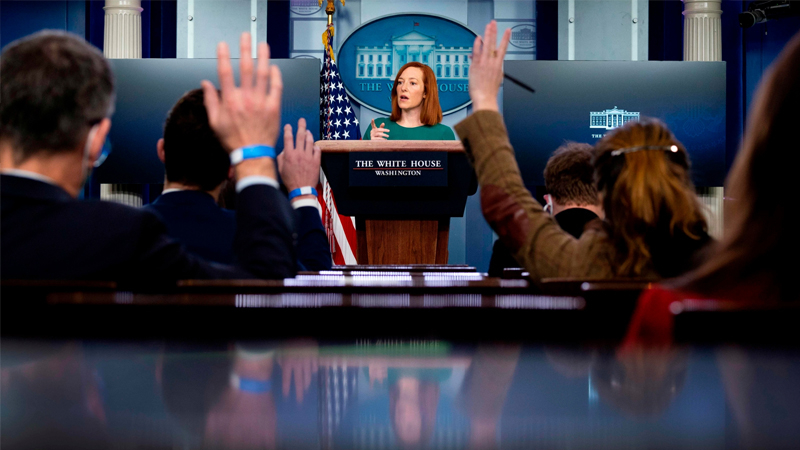
“With the pandemic worsening and more contagious variants spreading, this isn’t the time to be lifting restrictions on international travel,” White House spokeswoman Jen Psaki said during a Monday news conference. She said the move was part of the administration’s “science-driven response” to the coronavirus.

The restrictions on travelers from South Africa are set to take effect Saturday.

In an interview on “CBS This Morning,” Anthony Fauci, the government’s top infectious-disease expert, said extending the ban and including South Africa “clearly will be helpful.” Fauci said it is prudent to restrict travel of non-U. S. citizens.

“We have concern about the mutation that’s in South Africa,” he said. “It is clearly different and more ominous than the one in the U.K.”

While some have questioned the value of travel bans, Fauci said one important difference this time around is that the ban dovetails with a requirement that all international travelers to the U.S. show proof of a negative coronavirus test.

Earlier this month, the Centers for Disease Control and Prevention warned that the variant of the coronavirus first seen in the United Kingdom would become the dominant strain in the U.S. within about two months. The South African variant, however, has not yet been identified in the U.S.

On Monday, Moderna said its vaccine will protect people from both the U.K. and South African variants of the virus. However, the vaccines’ response to the South African variant was slightly diminished, officials said. As a result, the company said it work to develop a new vaccine that can be added to the current two-dose regimen.

The Biden administration is also taking steps to require travelers to quarantine after their arrival in the United States and to be tested a second time. Details on how those measures will be implemented are expected in the coming days.

Restrictions on travelers from 26 countries in Europe have been in place since mid-March, while Brazil was added to the list in May.

Under the ban, most non-U. S. citizens who have been in those countries in the past 14 days are barred from entering the United States. However, some exceptions are in place.

The extension of the ban comes as a new testing requirement for international travelers is set to take effect Tuesday.

Under the requirement announced earlier this month by the Centers for Disease Control and Prevention, all international travelers to the U.S. will be required to show proof of a negative coronavirus test before boarding a flight. PCR and antigen tests will be acceptable.

Those who refuse to be tested will not be allowed to fly. Travelers must be tested within three days before boarding their flights and airlines will be required to review travelers’ documentation.

“As variants of the SARS-CoV-2 virus continue to emerge in countries around the world, there is growing evidence of increased transmissibility of some of these variants, as well as unknown health and vaccine implications,” the CDC said in a statement. “Testing before and after travel is a critical layer to slow the introduction and spread of COVID-19 and emerging variants.”

However, the agency said it would no longer issue waivers to countries with a limited ability to test travelers. The CDC had previously said it would allow carriers to apply for two-week waivers from the requirement.

“With the U.S. already in surge status, the testing requirement for all air passengers will help slow the spread of the virus as we work to vaccinate the American public,” the agency said.

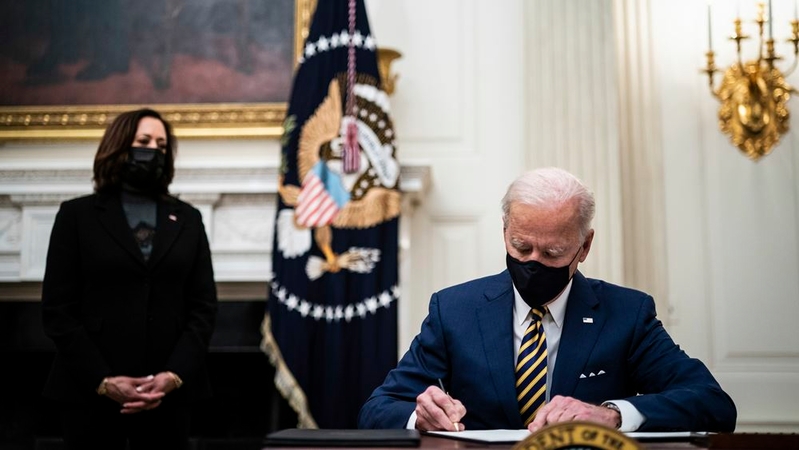
In addition to requiring proof of a negative test, Biden also has directed officials to explore the feasibility of requiring international travelers to quarantine or self-isolate once they arrive in the U.S.

The reinstatement of the ban is a blow to airlines that had hoped testing could replace bans and quarantines. Industry surveys have shown that people are more reluctant to travel if they must quarantine.

Since taking office, Biden has acted quickly to impose rules intended to reduce the spread of the virus as the administration seeks to ramp up efforts to vaccinate as many people as possible.

Last week, he signed an order mandating masks in airports and on many planes, trains, ships and intercity buses. The order followed one the president signed Wednesday, requiring that people wear masks on federal property.

Biden signs order pushing federal government to buy more American-made products #SootinClaimon.Com

#SootinClaimon.Com : ขอบคุณแหล่งข้อมูล : หนังสือพิมพ์ The Nation.

Biden signs order pushing federal government to buy more American-made products

InternationalJan 26. 2021President Joe Biden signs executive orders at the White House on Friday, Jan 22, 2021. MUST CREDIT: Washington Post photo by Jabin BotsfordPresident Joe Biden signs executive orders at the White House on Friday, Jan 22, 2021. MUST CREDIT: Washington Post photo by Jabin Botsford

By The Washington Post · David J. Lynch, Jeff Stein, Ashley Parker

WASHINGTON – President Joe Biden on Monday signed an order aimed at forcing the federal government to buy more goods produced in the United States, a key part of his campaign pledge to revive domestic manufacturing.

President Joe Biden signs executive orders at the White House on Friday, Jan 22, 2021. MUST CREDIT: Washington Post photo by Jabin Botsford

https://www.washingtonpost.com/video/c/embed/50d51baa-5388-4322-bed7-bc0f02244fc5?ptvads=block&playthrough=false

Standing in front of a blue backdrop reading “The Future Will Be Made in America,” the president said he was directing regulators to tighten the definition of American-made products and creating a new position in the Office of Management and Budget to oversee purchases of domestic goods.

The president’s order also will make it harder for federal agencies to issue waivers allowing the government to purchase some products made overseas. Under the new rules, agency officials will be required to justify such choices to the White House.

Biden acknowledged that efforts to promote domestic content have been a familiar part of previous presidents’ agendas. President Donald Trump issued new regulations increasing the share of a product’s components that must be produced domestically to qualify as made-in-the-USA one day before he left office.

“This is different and not the same,” Biden insisted.

The executive order will create a website where American businesses can see what contracts are being awarded to foreign vendors, allowing them to alert the government to the availability of a domestic alternative, Biden said.

The order reflects the shifting consensus in American politics away from free trade and toward direct government intervention to promote U.S. manufacturers, a position Trump embraced. The pandemic has intensified calls for the United States to shore up its domestic manufacturing capabilities, given gaps last year in the medical supply chain that left U.S. medical workers scrambling for personal protective equipment.

“We’re going to make sure that they buy American and are made in America,” Biden said Friday.

The measure drew labor union plaudits, with AFL-CIO President Richard Trumka calling it “a good first step in revitalizing U.S. manufacturing.” But the U.S. Chamber of Commerce said the initiative probably would not bring home lost manufacturing jobs and would boost the cost of government projects.

Turning Biden’s aspirations for reviving domestic manufacturing into reality may be difficult. Trump’s top trade adviser, Peter Navarro, pushed aggressively for similar provisions but was often rebuffed by other officials who argued that his proposals risked backlash from foreign nations as well as higher costs for U.S. taxpayers.

Trump’s last-minute regulations, which take effect Feb. 22, give American companies the edge over foreign rivals even if their products cost 20% to 30% more.

Major U.S. allies oppose such efforts, fearing the loss of lucrative contracts. Canadian Prime Minister Justin Trudeau raised his concerns in a phone call with Biden last week, officials in Ottawa said.

An aggressive Buy America campaign also may complicate Biden’s hopes of securing a united allied front to meet rising Chinese influence.

“The Biden administration is sending a clear signal that it intends to aggressively protect U.S. commercial and trade interests, belying the hopes of U.S. trading partners anticipating a softer touch from the new government,” said Eswar Prasad, a former International Monetary Fund official now teaching at Cornell University. “It is clear that the Biden administration is hardly rushing to usher in a new era of global trade and economic cooperation.”

The administration is determined to move beyond the traditional single-minded focus on price and efficiency in its approach to trade policy.

“As we sort out what globalization is going to look like in the future, we’re headed toward a more thoughtful policy,” said one trade specialist advising the administration, who spoke on the condition of anonymity because the person was not authorized to speak to the press.

The federal government spends as much as $600 billion annually on contracts, but a meaningful portion of that money goes to foreign businesses, said Lori Wallach, a trade expert at Public Citizen, a nonprofit watchdog organization.

It is unclear how much federal contracting money goes abroad, Wallach said. The U.S. Chamber of Commerce says 97% of federal procurement funds go to “U.S. firms.” But that figure includes the foreign subsidiaries of American corporations, meaning the purchases could support workers in Vietnamese or Mexican factories rather than Americans.

Under a World Trade Organization accord on government procurement, the U.S. generally has been more receptive to foreign firms bidding on contracts than other countries have.

In 2010, the most recent year such data is available, the U.S. opened $837 billion in government contract competitions to foreign firms, more than twice the combined figure of the next five countries – the European Union, Japan, South Korea, Norway and Canada, according to the Government Accountability Office.

The U.S. that year allowed foreign companies to bid on about 48% of its $1.7 trillion government procurement market while those five nations put out to bid 16% of their combined $2.4 trillion market.

William Reinsch, a trade specialist at the Center for Strategic and International Studies, said Monday’s White House announcement would have little immediate impact. But by raising domestic content requirements, the administration could affect corporate supply chain decisions.

“This is going to be a long-term play, not a short-term play,” said Reinsch, a Commerce Department official in the Clinton administration.

Biden has the power to reduce the list of 60 countries whose companies are granted waivers from Buy America regulations, meaning their products are treated as if they were made-in-America for purposes of government contracting. Those waivers, which he said Monday have been issued “with impunity,” will be permitted only under “very limited circumstances,” such as to meet national security requirements.

Loopholes in government procurement regulations must be closed before Biden launches other major initiatives, according to Scott Paul, president of the Alliance for American Manufacturing.

“Biden is envisioning this massive new federal investment in infrastructure, in clean energy, in economic recovery, so getting the updated statutes in place ahead of this spending is going to be key to its success,” he said.

Pentagon spending also could be ripe for a greater Buy America focus, according to a trade specialist advising the Biden administration. A 2018 Defense Department study found “a surprising level” on foreign suppliers, including the Chinese and recommended that the government mitigate it by expanding taxpayer investment in low-level defense manufacturers.

Most economists have panned Buy American provisions, saying they raise costs for the U.S. government.

“Neither protectionism nor purposefully raising the cost of the federal government will help the economy grow any faster,” said Adam Ozimek, an economist at the freelancing site Upwork, adding that he had not been briefed on the details of the Biden plan.

Biden likely to halt new fossil fuel leasing on federal lands and waters Wednesday #SootinClaimon.Com

#SootinClaimon.Com : ขอบคุณแหล่งข้อมูล : หนังสือพิมพ์ The Nation.

Biden likely to halt new fossil fuel leasing on federal lands and waters Wednesday

InternationalJan 26. 2021President Joe Biden President Joe Biden

By The Washington Post · Juliet Eilperin, Dino Grandoni

WASHINGTON – President Joe Biden is poised to impose a moratorium on new federal oil, gas and coal leasing Wednesday, according two individuals briefed on the matter who spoke on the condition of anonymity because the plan was still being finalized. The move will deliver on one of Biden’s boldest climate campaign pledges but will encounter stiff resistance from the fossil fuel industry.

The White House has prepared documents that would halt new oil and gas auctions on federal lands and waters for one year, these individuals said, and coal leasing for three years.The moratorium would not affect existing leases, meaning drilling would continue on public land in the West as well as in the Gulf of Mexico.

The memo remains a draft subject to final approval, said one individual close to the White House who spoke on the condition of anonymity because it had not been formally announced. It was unclear whether the new administration will exclude metallurgical coal, which is primarily used to make steel, as opposed to thermal coal, which is basically burned to produce electricity. Metallurgical coal was excluded from an Obama-era coal moratorium on the grounds that steel was required for infrastructure projects.

Biden plans to outline steps Wednesday aimed at curbing greenhouse gas emissions and elevating the role of science in federal decision-making. Asked about the matter, both the White House and the Interior Department declined to comment.

During the campaign, Biden pledged to ban “new oil and gas permitting on public lands and waters,” without specifying exactly what such a ban would entail.

Fossil fuel leasing on federal and tribal lands accounts for nearly a quarter of the country’s annual carbon output. It also generated $11.7 billion in tax revenue for the federal, state, local and tribal governments last year, according to the Interior Department’s Office of Natural Resources Revenue.

Environmentalists say the pause will allow the new administration to assess whether taxpayers are being adequately compensated for the minerals extracted from lands they own.

“By pausing the broken leasing system and halting the giveaways to oil and gas executives, President Biden has an opportunity to meaningfully fix the leasing system for the first time in nearly four decades with solutions that work for the public and which incorporate ambitious conservation, taxpayer fairness, and climate goals,” Jenny Rowland-Shea, senior policy analyst for public lands at the Center for American Progress, a liberal think tank, wrote in an email. “We can make sure our public lands and coasts are preserved, accessible and beneficial to everyone – not abused by oil and gas corporations.”

But oil and gas groups, including the American Petroleum Institute, counter that freezing new leasing will deprive state and local governments, as well as the U.S. Treasury, of needed revenue. Last week, the industry criticized the Interior Department when it dictated that any new leases or permits issued during the next 60 days needed the approval of a top-ranking Biden appointee before they could be finalized.

API President Mike Sommers said that move alone will damage domestic energy producers while benefiting ones abroad.

“Restricting development on federal lands and waters is nothing more than an ‘import more oil’ policy,” Sommers said. “Energy demand will continue to rise – especially as the economy recovers – and we can choose to produce that energy here in the United States or rely on foreign countries hostile to American interests.”

About 22 percent of U.S. oil production and 12 percent of natural gas production takes place on federal lands and waters, according to API.

A moratorium would have contrasting effects on different oil-producing regions, hamstringing drillers in New Mexico, where the federal government controls huge swaths of land, while leaving those producing on state or private land across the border in Texas unscathed.

“It feels a little bit unfair,” said Raye Miller, head of a small, nine-well oil-producing operation called Regeneration Energy in southeastern New Mexico. “We’re very concerned with the direction things are headed.”

But drilling on public lands will continue even with a moratorium on new leasing, since industry operators hold plenty of undeveloped leases in their portfolios. Only about half of the nearly 20,000 applications to drill approved between 2014 and 2019 are actually in use, according to a recent Government Accountability Office report. More than 13 million acres of land leased for oil and gas were not producing during fiscal year 2019.

While the oil and gas lobby gears up for a fight, environmental advocates are sustaining pressure on Biden to keep his commitment to end leasing and permitting on federal acreage. Among them is Oceana, a marine conservation group, which is set to release a report Tuesday detailing how reversing the Trump administration’s plan to open up nearly all U.S. coastal waters to drilling would prevent more than 19 billion tons of greenhouse gas emissions.

So far, activists are pleased with Biden’s quick climate actions. “At this point, I’m excited about the president’s agenda,” said Diane Hoskins, a campaign director at Oceana.

Shutdowns by Democratic governors did not cause the pandemic jobs crisis #SootinClaimon.Com

#SootinClaimon.Com : ขอบคุณแหล่งข้อมูล : หนังสือพิมพ์ The Nation.

Shutdowns by Democratic governors did not cause the pandemic jobs crisis

InternationalJan 26. 2021

By The Washington Post · Andrew Van Dam

The coronavirus pandemic has killed more than 416,000 Americans and recently pulled the U.S. economic recovery into reverse. Some states have shut down again to get a handle on surging caseloads. And critics have blamed those states’ governors, typically Democrats, for job losses.

But pandemic-related economic research shows the shutdowns aren’t killing jobs; the virus is.

In the first outbreaks last spring, people stayed home to avoid contracting the deadly novel coronavirus, regardless of what their governor said.

Indiana University economists Sumedha Gupta, Kosali Simon and Coady Wing reviewed more than 60 pandemic and social-distancing studies for a review article forthcoming in the Brookings Papers on Economic Activity. With the input of those economists and other experts, we’ve reviewed the basic data and some of the strongest research. Four facts emerged from the spring shutdowns.

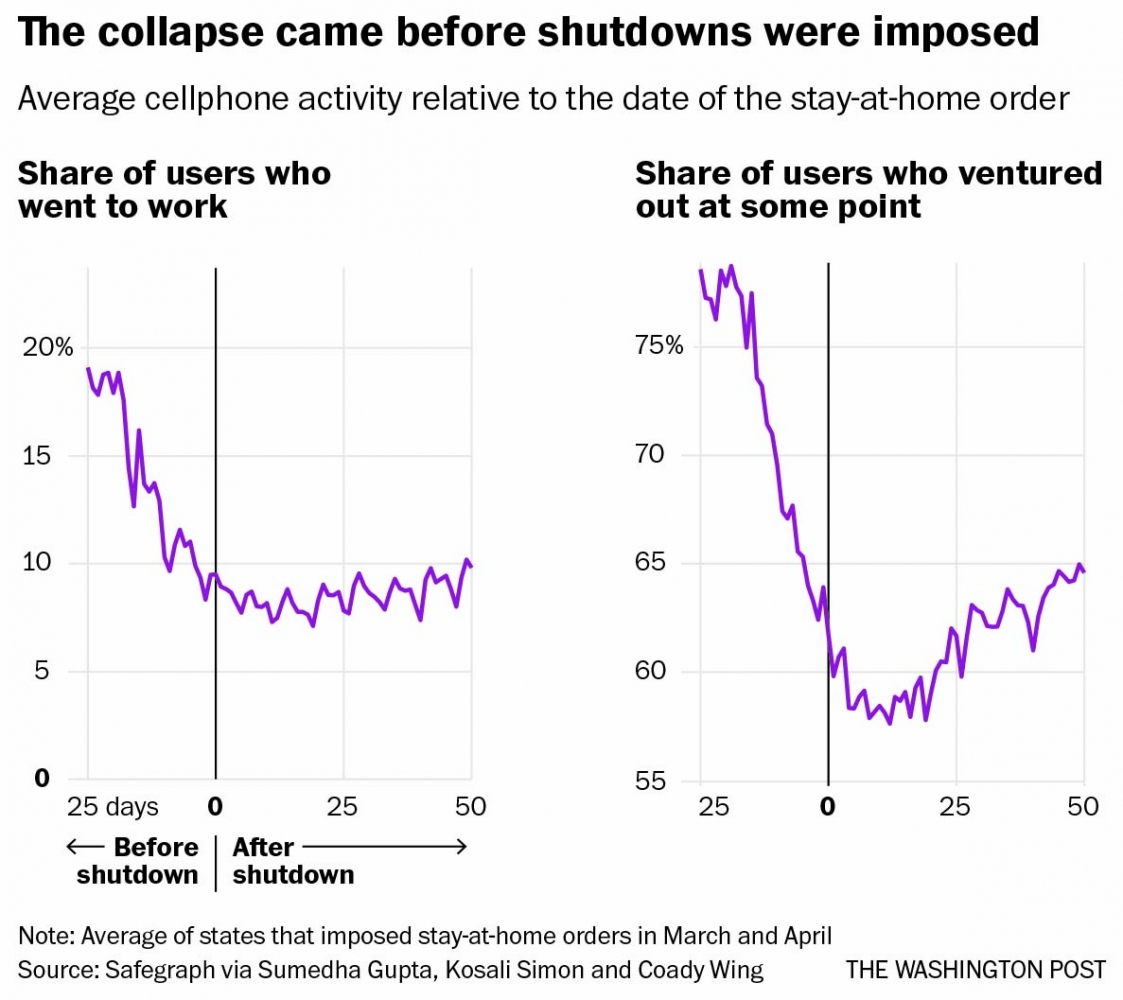
If stay-at-home orders poisoned an otherwise healthy economy, business should have crumpled the moment they kicked in. But cellphone activity data analyzed by Gupta, Simon and Wing show a different trend: People started to stay home well before states imposed shutdowns.

In the chaotic early days of the pandemic, most people didn’t wait for official stay-at-home orders, Simon said. In every state, they stopped going to work around the weekend of March 14, as uncertainty soared, stock markets collapsed and the World Health Organization officially declared the coronavirus outbreak to be a pandemic.

Typically, economic data is measured in months, quarters and years. But when dealing with a pandemic that spreads so fast that it creates an exponential curve of runaway devastation, economists needed to measure changes in a matter of days. To do so, they harnessed a new generation of indicators based on cellphone activity and other alternative data sets from the private sector.

“Most of the economic damage we’ve seen is produced by people’s reaction to the virus,” Wing said. “Social distancing policies mattered, too, but they were layered on top of a major change in personal behavior.”

Business collapsed so quickly in mid-March that it’s tough to disentangle correlation and causation. But several high-profile teams of economists, armed with that high-frequency data and sophisticated statistical methods, arrived at similar conclusions.

In one such study, economists Chad Syverson and Austan Goolsbee of the University of Chicago Booth School of Business used anonymized cellphone tracking data to compare traffic at businesses in shutdown areas with similar businesses in the same metro area (really, commuting zone) that weren’t shut down.

Business fell by more than half (53%) regardless of whether a place shut down, as people everywhere were trying not to leave their homes. In shutdown areas, activity fell another 7%, meaning shutdowns caused less than an eighth of the drop in business.

“If pandemic concern or fear leads both to people staying home and policymakers imposing lockdowns, then the fear is the true driving force,” Syverson said. “Economic declines and lockdowns happen to be correlated because they’re pushed by the same thing, even though one isn’t necessarily causing the other.”

Goolsbee and Syverson found that business activity declined even more in areas with more covid-19 deaths, which emphasizes the role that the fear of the virus played in keeping people at home. (Goolsbee chaired President Barack Obama’s Council of Economic Advisers during the Great Recession before returning to the University of Chicago.)

One other piece of supporting evidence? The economists found that businesses that drew the largest crowds before the pandemic were the same ones that saw the sharpest declines, relative to their size. That indicates consumers were spooked by the virus and sought out stores they knew were likely to have few customers. That trend was especially pronounced in areas with worse coronavirus outbreaks.

If the shutdowns had been the major obstacle to business activity, consumer spending built up during the shutdown period would have been unleashed in a torrent of pent-up demand when the shutdown was lifted.

Instead, Goolsbee and Syverson found, economic activity returned about 5% faster in places that lifted their shutdowns compared with those areas not shut down.

When business didn’t return appreciably faster in areas that lifted their shutdowns, it was clear that shutdowns couldn’t be the primary reason people were staying away from businesses, Goolsbee said.

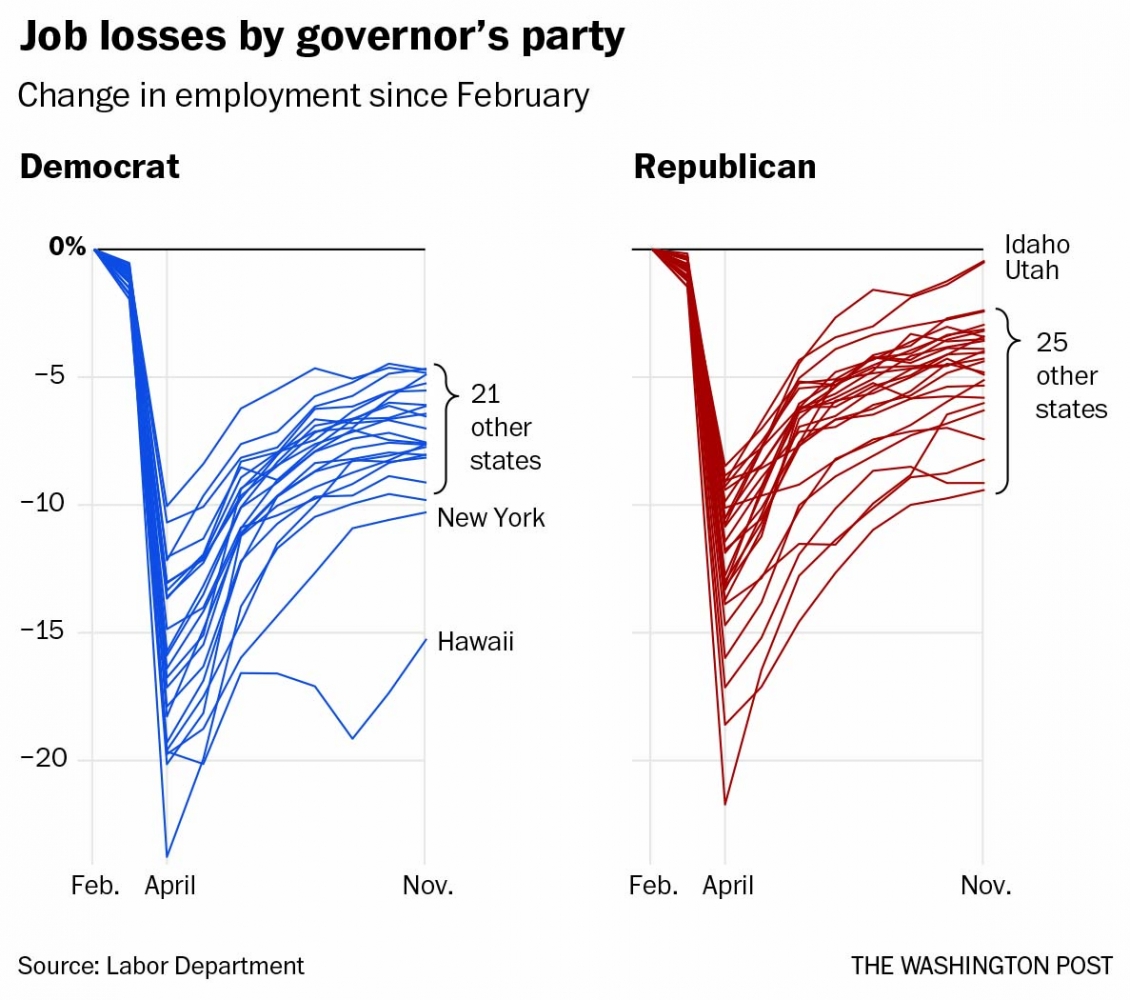
The Washington Post often hears from readers who blame job losses on Democratic governors who have often imposed shutdowns when coronavirus cases surge. If Democrats are really responsible for job losses, we would expect to see employment fall off the cliff in blue states while employment in red states sail on untouched. But even the simplest analysis shows job losses don’t depend solely on the governor’s party. Some red states struggled; some blue states thrived.

Gupta notes that readers are oversimplifying when they equate “Democrat” and “shut down.” A large majority of Republican-led states also shut down. But a trend emerges in the chart below. Red states, on average, have recovered slightly faster than blue states.

Ohio State University economist Bruce Weinberg warns that charts like this can obscure an obvious truth: “The states that have Democratic governors differ in many ways from the states that have Republican governors.”

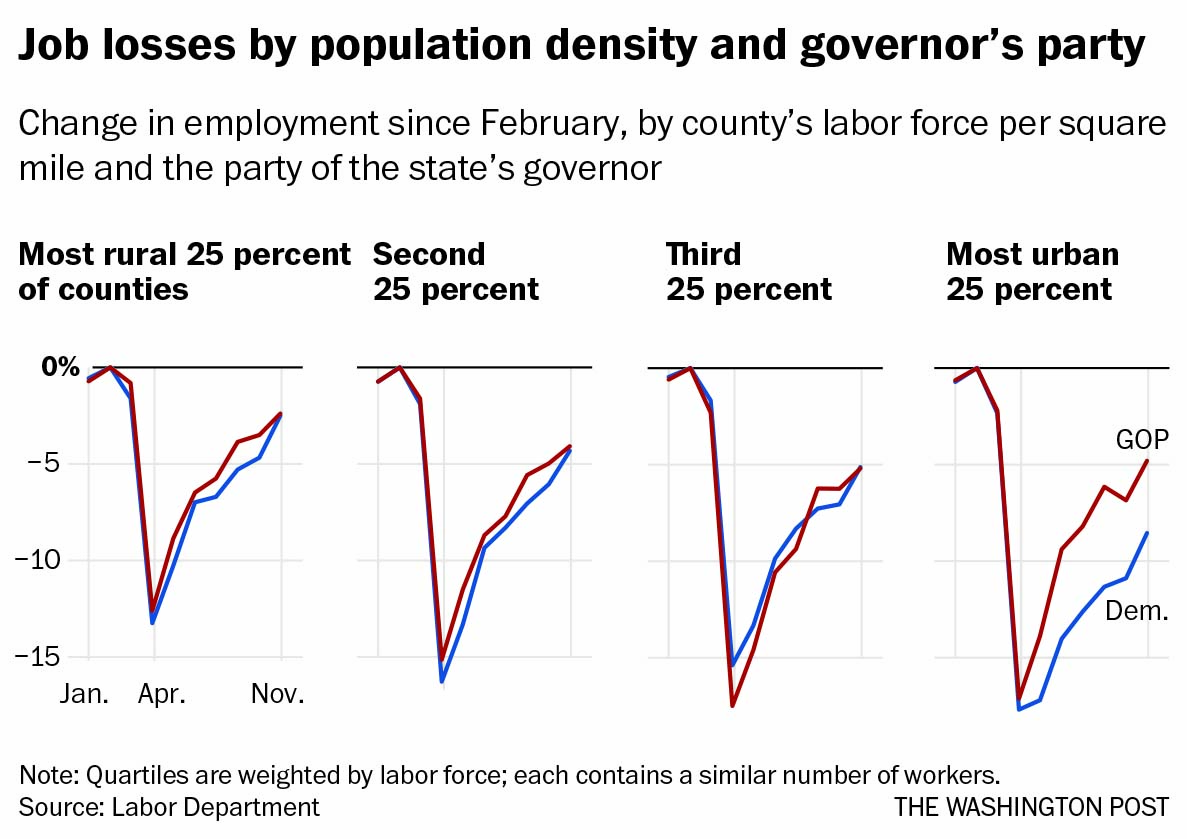
For example, Republican states tend to have lower population density, and states with lower population density have added jobs more rapidly. To tease apart that correlation, compare the jobs recovery in counties of similar population density within red and blue states.

When we looked at job losses by the governor’s party, rural and suburban areas of red and blue states lost jobs and began to recover at almost exactly the same pace, regardless of which party was in charge. It was only the densest counties in states with Republican governors that saw slightly faster recoveries than those with Democratic governors. To take two extreme examples, compare the Ohio county containing Cincinnati, which has seen almost a complete recovery from the crisis under Republican Mike DeWine, to the boroughs of New York City. Under Democrat Andrew Cuomo, the five boroughs are still missing about 1 in 7 jobs lost in the crisis, Labor Department data shows.

Economists are reluctant to attribute the gap entirely to additional rounds of shutdowns in the densest urban areas, such as the counties containing New York City, Los Angeles and Chicago. They caution that some of the largest cities in Democratic-led states were hit harder and faster by the virus, and may host more workers and industries that are vulnerable to the pandemic.

For example, New York City was hit so hard with the coronavirus last spring and it remains so incredibly dense, with tens of thousands of people living in apartment buildings on small city blocks, that even when the shutdown eased, people tended not to go out.

(We’re looking at jobs here – indicators such as the unemployment and labor-force participation rates show a smaller gap between states led by Republican or Democratic governors.)

When we step back, the most striking thing about this data is that, as the first wave of shutdown research would predict, there’s little difference in employment between red and blue states despite some variation in policy. After all, regardless of politics, American states all had one enormous thing in common in 2020: the coronavirus.

Moderna vaccine protects against British and South African variants, company says #SootinClaimon.Com

#SootinClaimon.Com : ขอบคุณแหล่งข้อมูล : หนังสือพิมพ์ The Nation.

Moderna vaccine protects against British and South African variants, company says

InternationalJan 26. 2021

By The Washington Post · Carolyn Y. Johnson

The coronavirus vaccine developed by Moderna triggers an immune response that protected against two variants of the virus first detected in Britain and South Africa in laboratory tests, the company said Monday.

But the reassuring news that vaccine-elicited antibodies remained effective against concerning new variants was tempered by an ominous finding. Those antibodies were less efficient at neutralizing the South African variant in a laboratory dish – a sixfold reduction in response foreshadowed by a small, but mounting body of evidence that has trickled out recently showing that the variant may have the potential to elude parts of the immune response.

As a precaution, Moderna announced it will launch two new studies. The company will test adding a third shot of its current vaccine to boost its two-dose regimen. Scientists have already designed an all-new vaccine specific to the South African variant that could be used as a booster to prime the immune system to the new strain, and plan to test it in the coming months.

“The virus is changing its stripes, and we will change to make sure we can beat the virus where it’s going,” Stephen Hoge, president of Moderna, said in an interview. “The unknown is would we feel it’s necessary to do that, would public health officials want this at that point or would they still be comfortable? What we’re trying to do is create an option.”

The detection of both variants late last year triggered immediate concern, first because of evidence they were spreading far more easily. But many of the mutations in each variant – eight of those found in the British variant and 10 of those in the South African variant – drew special concern because they sit in the spiky proteins that dot the outside of the coronavirus and have been the key target for vaccines and therapeutics. That raised the specter that the current generation of vaccines might be rendered obsolete before they have even been rolled out.

The company’s announcement puts some of those fears to rest, suggesting the vaccines will still work against both variants.

Antibody-containing blood serum taken from people and monkeys who received the vaccine was just as effective at blocking the British variant as the original strain of virus in the study, and remained above the threshold for efficacy for the South African variant, despite the diminution in effectiveness. The work has been submitted to a preprint server, but has not been peer-reviewed and was not available for review before publication.

The company reported a sixfold decrease in the ability of antibodies to block the virus – a drop that Hoge said was concerning but not alarming – underscoring the need to remain vigilant.

The report comes after similar news from Pfizer-BioNTech, which released data last week, also not yet peer-reviewed, showing that antibody-rich blood serum samples from 16 vaccinated people showed that vaccine was equally as effective at blocking the British variant as it was against the original version of the virus that took hold in Wuhan, China, a year ago. That publication did not address the South African variant, which has been of most concern and shares many mutations with a concerning variant detected in Brazil.

Laboratories across the world have been scrambling to study whether vaccines and treatments, particularly monoclonal antibodies, are likely to be as effective against the new variants. So far, such tests have mainly relied on one part of the multifaceted immune response and found evidence the vaccines are likely to be effective – but have underscored the need to track changes in the virus and prepare for the eventuality that, like flu shots, a coronavirus vaccine might need to be updated and administered on a regular basis.

Biden to push Congress on stimulus after senators question cost #SootinClaimon.Com

#SootinClaimon.Com : ขอบคุณแหล่งข้อมูล : หนังสือพิมพ์ The Nation.

Biden to push Congress on stimulus after senators question cost

InternationalJan 25. 2021Senator Mitt Romney, a Republican from Utah, center, departs the Senate Chamber at the U.S. Capitol in Washington, on Jan. 22, 2021. MUST CREDIT: Bloomberg photo by Stefani Reynolds.Senator Mitt Romney, a Republican from Utah, center, departs the Senate Chamber at the U.S. Capitol in Washington, on Jan. 22, 2021. MUST CREDIT: Bloomberg photo by Stefani Reynolds.


By Syndication Washington Post, Bloomberg · Jordan Fabian

President Joe Biden will escalate appeals for Congress to back his top priority, $1.9 trillion in pandemic relief, seeking to overcome Republican opposition to the plan as he enters his first full week in office.

Biden’s top economic adviser, Brian Deese, spent more than an hour on Sunday discussing the proposal with a bipartisan group of lawmakers. Some asked the White House to further justify what would be the second-largest emergency spending measure in U.S. history and expressed interest in a much narrower bill focused on accelerating coronavirus vaccine distribution, according to Senator Angus King of Maine and people familiar with the matter.

Deese and other officials provided details and context in response to the senators’ questions, according to an administration official. Senior White House aides plan to keep talking with lawmakers in both parties this week to hear their concerns but also press for urgent action, the official said.

As the president’s team began its work with key lawmakers, Biden is moving forward with another round of executive actions, following on a series of orders signed soon after he took office. On Monday, he will sign an order directing federal agencies to buy more American-made products and is expected to take other actions on criminal justice, climate, health care and immigration.

The new orders will add to roughly two dozen actions Biden has signed since Inauguration Day in an effort to address the coronavirus pandemic, reverse former President Donald Trump’s agenda and point the nation in a new direction.

While girding for what may be prolonged negotiations with Republicans, Biden received welcome news with the Senate’s decision to delay the start of Trump’s second impeachment trial. The president had urged lawmakers to spend more time filling Cabinet posts and working on his agenda. The Senate this week is expected to take up the nomination of Janet Yellen to lead the Treasury Department, which would fill a key vacancy at a critical moment for the economy.

But agreement has been hard to come by in the 50-50 Senate, where Democratic and Republican leaders have yet to reach a power-sharing deal — much less come to terms on the White House’s stimulus proposal.

Taken together, the developments show the honeymoon period of Biden’s presidency could be coming to a close mere days after he took office. The challenges raise questions about whether Biden can keep his pledge to unify the country while pushing forward with an ambitious policy agenda that addresses thorny issues. Biden’s aides have expressed optimism.

“By and large, we’ve seen a lot of progress on this front,” White House Chief of Staff Ron Klain said on NBC’s “Meet the Press.”

The coming days will also test Biden’s personal relationships with members of Congress, which his team said would help him get big things done in a divided Washington. For now, his lieutenants are taking the lead in trying to build some support for his stimulus and immigration bills.

Deese on Sunday spoke to a bipartisan group of 16 senators, including moderate Republican Senators Mitt Romney, Lisa Murkowski and Susan Collins, all of whom have expressed reservations about the price tag for Biden’s virus relief proposal.

Before the call, Romney described the $1.9 trillion cost “shocking,” considering a $900 billion stimulus Congress passed in late December. Speaking on “Fox News Sunday,” Romney called for targeted relief measures focused on ending the pandemic rather than another major stimulus package.

King, a Maine independent who caucuses with Democrats, said the White House should provide hard figures to show why such a large package is needed on the heels of December’s stimulus law.

“Part of what we’re asking for is more data — where did you get the number?” said King, who participated in Deese’s call.

A Democrat on the call, Senator Mark Warner of Virginia, said that lawmakers need more information on how the last stimulus was used.

“I think that case can be better made when we get more transparency and better numbers about how the last $900 billion – much of which has started to go out – but I think the administration needs to be very transparent about how those dollars have been delivered,” Warner said in an interview on NPR.

Facing pressure from liberals for quick action, the White House has brushed aside the idea of cutting off bipartisan talks by using a maneuver called “budget reconciliation,” which would conceivably allow much of the legislation to pass through the Senate with only Democratic votes. Under normal rules, major legislation often needs 60 votes to pass the Senate, meaning Democrats would need at least 10 Republicans to advance Biden’s relief plan.

Yet Biden’s team has also resisted making changes favored by Republicans, such as reducing the package’s size, breaking it into smaller pieces or removing controversial items like a minimum wage increase.

“We were going to move fast and we’re going to move bipartisan,” Klain said. “I don’t think bipartisanship and speed are enemies of one another. The need is urgent. Americans, both Democrats and Republicans, are dying. Kids’ schools that take care of both Democratic and Republican kids are closed. People are on unemployment. People are in food lines. That’s not a party issue.”

In the meantime, the president plans to spend part of each day next week signing executive actions. Monday’s order will start the process of strengthening requirements for federal agencies to buy U.S.-made goods and services, according to administration officials. It will also tighten standards for how much of a product needs to be manufactured in the U.S. in order to be considered American-made.

Another batch of orders are expected to be aimed at racial justice. Among them are directives to create a federal commission on police reform, limit the transfer of military equipment to police and wind down the use of private prisons.

Biden also plans to sign actions that elevate climate change as a national security and regulatory priority and convene a summit of world leaders on April 22 to discuss the issue.

The president is also expected to rescind a controversial rule blocking U.S. funding for foreign groups that provide abortions, known as the Mexico City policy, and sign an order bolstering Medicaid and Obamacare.

On immigration, Biden plans to sign actions that restore the U.S. asylum and refugee systems that largely ground to a halt under Trump. He’s expected to direct a review of a Trump-era rule that tightened criteria for refusing entry to potential immigrants on the grounds they would become dependent on government assistance. Biden also plans to form a task force to reunite migrant children with guardians separated from them under Trump’s border policies.

Riots explode across Netherlands over covid restrictions #SootinClaimon.Com

#SootinClaimon.Com : ขอบคุณแหล่งข้อมูล : หนังสือพิมพ์ The Nation.

Riots explode across Netherlands over covid restrictions

InternationalJan 25. 2021

By The Washington Post · Erin Cunningham

Dutch rioters who attacked police and destroyed property over the weekend while protesting new coronavirus measures are “criminals,” Prime Minister Mark Rutte said Monday, as law enforcement warned that the violence could last for weeks.

The unrest across the Netherlands, some of the worst in decades, had “nothing to do with protest,” Rutte told reporters outside his office in The Hague, news agencies reported.

“This is criminal violence and we will treat as such,” he said.

Protesters had gathered in defiance of lockdown orders in at least 10 towns and cities Sunday, looting stores and clashing with police after authorities imposed a new nighttime curfew – the first in the Netherlands since World War II.

The curfew, from 9:00 p.m. to 4:30 a.m., tightens an already strict lockdown aimed at curbing coronavirus infections and comes amid fears that a new, more contagious variant, first identified in Britain, will cause a surge in cases.

Bars and restaurants have been closed in the Netherlands since October and schools and shops were shuttered in December. The government has recorded some 944,000 coronavirus infections and more than 13,500 deaths.

On Sunday, police deployed dogs, a water cannon and mounted officers to disperse a demonstration in central Amsterdam, arresting nearly 200 people, the Reuters news agency reported. In the fishing village of Urk Saturday, youth torched a coronavirus testing center and clashed with local media and police.

Some of the worst violence flared in Eindhoven in the south, where rioters threw stones, knives and fireworks at police and damaged the local railway station, Dutch media reported.

A far-right, anti-immigration group, Pegida, had previously called a demonstration in the city and said they would use the protest to burn copies of the Quran. The protest in Amsterdam was also organized by anti-lockdown groups on the messaging app Telegram, according to local media.

“My city is crying, and so am I,” Eindhoven Mayor John Jorritsma told media Sunday night, the Associated Press reported. He called the rioters “the scum of the earth,” adding that he was afraid the country was headed toward “civil war.”

On Monday, a spokesperson for the national police union said that law enforcement was preparing for more unrest.

“I hope it was a one-off,” Koen Simmers said of the unrest this weekend, in an interview with the Dutch program Nieuwsuur. “But I’m afraid it was a harbinger for the coming days and weeks.”

“The police are well prepared,” he said. “But I hope that it is not necessary.”

Mexican President López Obrador tests positive for the coronavirus #SootinClaimon.Com

#SootinClaimon.Com : ขอบคุณแหล่งข้อมูล : หนังสือพิมพ์ The Nation.

Mexican President López Obrador tests positive for the coronavirus

InternationalJan 25. 2021

By The Washington Post · Mary Beth Sheridan, Kevin Sieff

MEXICO CITY – Mexican President Andrés Manuel López Obrador announced Sunday night that he had tested positive for the coronavirus and was experiencing “light” symptoms. He said he would step away from his daily news conferences while being treated for the illness.

López Obrador has frequently minimized the severity of the pandemic, and he has rarely worn a mask, even as covid-19, the illness the novel coronavirus can cause, has claimed nearly 150,000 lives in Mexico. That’s the fourth-highest total in the world, and the 19th-highest as a percentage of the population, according to figures compiled by Johns Hopkins University.

After Mexico’s 70-day shutdown at the beginning of the pandemic, the president resumed his frequent travels through the country. He has been criticized for appearing in selfies with his supporters.

“I am sorry to inform you that I am infected with COVID-19,” the president said in a tweet. “The symptoms are light, but I am getting medical treatment. As always, I am optimistic. We will carry on.”

He added that he would remain in his living quarters at the National Palace and would have a telephone conversation as scheduled on Monday with Russian President Vladimir Putin to discuss shipments to Mexico of the Sputnik vaccine.

At 67, and with hypertension, López Obrador could be at risk of developing complications from the virus. He had a heart attack in 2013. Mexico has administered about 600,000 doses of the Pfizer vaccine, but the president has said he would wait for his shot until after front-line medical personnel and older citizens received theirs.

Mexican authorities on Sunday reported 10,872 more confirmed cases of the novel coronavirus and 530 deaths. The government has tallied more than 1.7 million cases. But the real total is considered higher: A recent government study based on antibody tests estimated that one-quarter of the population of about 126 million people has been infected.

The president has been regularly tested for the virus, and he insists that he keeps strict social-distancing rules in his office.

López Obrador, a folksy icon of the left, took office in December 2018. He has remained popular, with approval ratings of about 60%, despite the mounting death toll from covid-19 and a severe economic crisis linked to the pandemic.

But the president’s decisions to rarely wear a mask in public, and his statements minimizing the pandemic, have frustrated many in Mexico.

“In a country where government and president are often the same thing, and where the president is a continuous presence both in social and traditional media, his minimizing of the pandemic and his refusal to wear a mask have definitely encouraged people to downplay the dangers of this deadly virus,” said Esteban Illades, a prominent Mexican journalist.

“Hopefully, the president’s covid diagnosis will show the general population that not wearing a mask makes it easier to become infected.”

Several cabinet members previously tested positive for the coronavirus. The president was in the state of San Luis Potosí over the weekend and was photographed without a mask.

López Obrador has been in close contact with a range of senior Mexican officials over the weekend, including the secretary of defense and the secretary of foreign relations, along with a number of well-known Mexican business leaders. There is now concern that the virus could spread widely within those circles.

Jaime Rodríguez Calderón, the governor of Nuevo León, met with López Obrador on Saturday and said he would “watch my symptoms so that if any appear, I’ll take a test.”

Carlos Bravo Regidor, a political analyst, said: “It is kind of surprising that [López Obrador] didn’t catch it before, particularly given his reluctance to wear a mask and his insistence on still having plenty of meetings with officials and even traveling, most recently to Guerrero, San Luis Potosí and Nuevo León.”

He noted that many public servants who frequently wear masks take them off in his presence – “probably as a very screwed-up sign of discipline or deference.”

Early in the pandemic, López Obrador was mocked for saying he could ward off the virus with religious amulets. His tone has since become more serious. The Mexico City region went into another shutdown in mid-December as cases soared during a period of holiday parties and shopping.

Critics have assailed the government for its handling of the pandemic, noting that the country has among the lowest percentage of testing of any in the hemisphere. López Obrador has defended his record, noting that Mexico scaled up its hospital capacity considerably and ordered more than 100,000 doses of vaccine.

Contributing to the country’s death toll are many factors, including widespread comorbidities such as obesity and diabetes, and Mexicans’ reluctance to go to the hospital until their cases are advanced. Nearly 60% of the population works in the informal sector, and many have needed to go to work despite the pandemic precautions. López Obrador has been criticized for not approving a major stimulus program to help such people stay home.

The news of the president’s diagnosis ignited an outpouring of good wishes from critics and supporters.

“You’re going to be fine President. I’m sure of that. Your strength, conviction and love for life and for what you represent give us this certainty,” tweeted Claudia Sheinbaum, the mayor of Mexico City, an ally of the president’s. She survived the coronavirus last year.

Thai resident in Japan shares amazing experience with snow sculptures #SootinClaimon.Com

#SootinClaimon.Com : ขอบคุณแหล่งข้อมูล : หนังสือพิมพ์ The Nation.

Thai resident in Japan shares amazing experience with snow sculptures

InternationalJan 25. 2021Photo credit: Hokkaido Diary 北海道ソーグッドPhoto credit: Hokkaido Diary 北海道ソーグッド

By THE NATION

A Thai resident in the small town of Chippubetsu in Hokkaido prefecture shared notes and photographs of this year’s snow festival on her Facebook page “Hokkaido Diary”.

Photo credit: Hokkaido Diary 北海道ソーグッド

Photo credit: Hokkaido Diary 北海道ソーグッド

She said she helped local residents build a snow sculpture of the popular Japanese cartoon character Doraemon, complete with a face mask, and that later she was asked to carve out a Thai version of the message “don’t give up”.

Photo credit: Hokkaido Diary 北海道ソーグッド
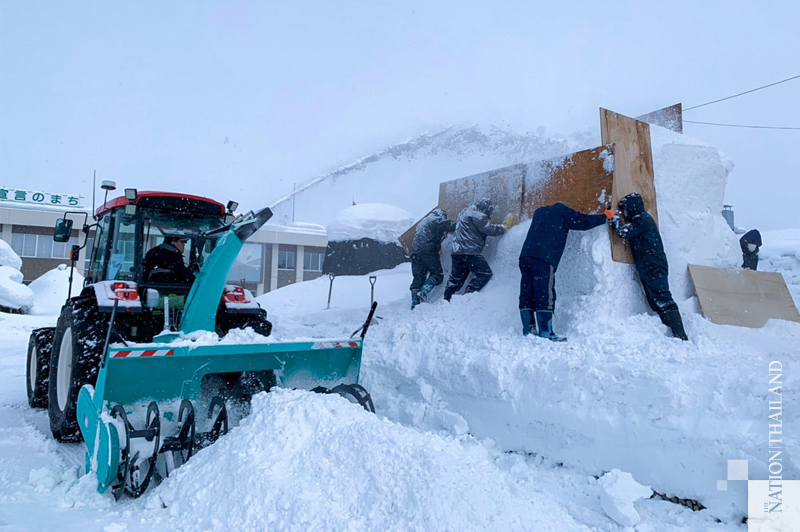
Photo credit: Hokkaido Diary 北海道ソーグッド

The Facebook user said the sculpture took two days of hard work to complete, adding that she was impressed by people’s unity and teamwork. She said even people above the age of 60 gave them a helping hand.

Photo credit: Hokkaido Diary 北海道ソーグッド

Photo credit: Hokkaido Diary 北海道ソーグッド

The sculpture will stand tall outside city hall until February 7, when it will be torn down, she said.

Photo credit: Hokkaido Diary 北海道ソーグッド

Photo credit: Hokkaido Diary 北海道ソーグッド