
New limits on Huawei suppliers coming soon, Commerce’s Ross says #ศาสตร์เกษตรดินปุ๋ย

#ศาสตร์เกษตรดินปุ๋ย : ขอบคุณแหล่งข้อมูล : หนังสือพิมพ์ The Nation

https://www.nationthailand.com/business/30380981?utm_source=category&utm_medium=internal_referral

New limits on Huawei suppliers coming soon, Commerce’s Ross says
Jan 24. 2020
By Syndication Washington Post, Bloomberg · Jenny Leonard, Ian King 

Commerce Secretary Wilbur Ross said new rules are coming soon that will put more limits on U.S. companies supplying China’s telecommunications leader Huawei Technologies Co.

Huawei was blacklisted last year as a security threat by the administration of Trump administration.

That prevented many U.S. companies from selling to the Chinese company. However, some U.S. suppliers worked around the rules to continue sending some crucial electronic components to Huawei.

“They are works in progress that will come out near-term,” Ross said of the new restrictions, during an interview at the World Economic Forum in Davos, Switzerland. A Commerce Department spokesman said the department will make an announcement when it is ready.

Ross said the ultimate U.S. objective is not to cut Huawei off from all American supplies, but instead to protect national security. He added that restrictions on Huawei were not negotiated during phase one of the trade agreement with China. The next step in that broader process isn’t currently active, he said.

“As we stand right here, there’s no particular intent to negotiate it in phase two,” Ross said.

A further clampdown may jeopardize Huawei’s ability to continue making some of its biggest products. Chinese officials have threated retaliation against businesses that stop supporting the country’s largest technology company. Huawei has denied it helps the Chinese government gain illicit access to information and has said its equipment is secure.

Ross earlier said on Bloomberg TV that Huawei has been encouraging U.S. companies to flout the rules which is a “very dangerous practice and in the longer term is not going to be good for them.” The U.S. government is taking a close look at export control mechanisms after seeing how Huawei was able to continue to buy from American companies.

Some U.S. companies have kept selling to Huawei by citing rules that limit the U.S. government’s ability to restrict exports. De minimis provisions exempt certain products if companies can prove the majority of work done to create the items happens outside the U.S. The current threshold effectively kicks in when 75% of the work occurs overseas. The administration is debating raising this to 90%. The rule change is currently with the Office of Management and Budget and could be approved shortly, according to people familiar with the process.

A separate new regulation that governs the direct supply of products is under consideration by the Commerce Department and could make its way through the process in a matter of weeks, according to the people. That rule would apply to products that are designed in the U.S. but manufactured entirely overseas, said the people, who asked not to be identified discussing private deliberations.

Huawei is one of the world’s biggest purchasers of chips. U.S. semiconductor makers have argued that a complete clampdown is counterproductive as many of the parts Huawei needs can be bought from non-U.S. providers. The industry is also concerned that access to the Chinese market as a whole will be curtailed, a development that could hinder investment in research and development. The industry has made these arguments to Trump.
Expanding steel producer BlueScope starts up third facility #ศาสตร์เกษตรดินปุ๋ย

#ศาสตร์เกษตรดินปุ๋ย : ขอบคุณแหล่งข้อมูล : หนังสือพิมพ์ The Nation

https://www.nationthailand.com/business/30380970?utm_source=category&utm_medium=internal_referral

Expanding steel producer BlueScope starts up third facility

Jan 23. 2020
By THE NATION

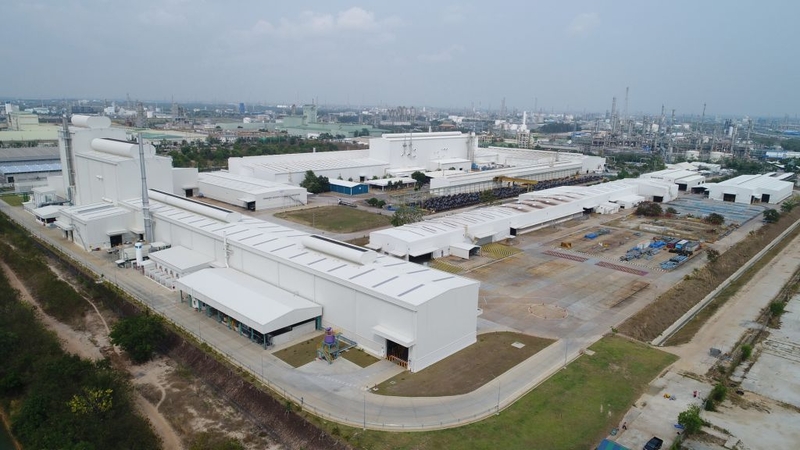
BlueScope, a manufacturer and distributor of high-quality steel, had invested more than Bt4 billion in a third production facility, aimed at expanding the production capacity of metallic coated steel and pre-painted coated steel to 160,000 tonnes a year.

The factory, which was inaugurated on Wednesday (January 22), will cater to the demand of residential projects in Thailand and Asean.

Charlie Elias, CEO of NS BlueScope (Asia and North America), said the third factory of BlueScope is situated at Map Ta Phut industrial estate in Rayong province, the same location as the first and second factories.

The new facility is a joint venture between NS BlueScope (Thailand) Company Limited, Nippon Steel Corporation Limited and Loxley Public Company Limited.

It has an production capacity of 160,000 tonnes per year. When combined with the two existing factories, BlueScope now has a total capacity of 580,000 tonnes per year, making it the largest producer of metallic coated steel and pre-painted coated steel in Asean.

“The new factory is equipped with most advanced production technology and machinery, enabling it to turn out high-quality coated steel items at a speed much faster than other facilities in Thailand and the Asean region. In addition, this factory is run under a environmentally-friendly process. The extended production capacity also adds to employment, in line with the government’s Thailand 4.0 initiative, Elias said.

He also revealed that BlueScope produced 372,000 tonnes of coated steel and pre-painted coated steel products between July 2018 and June 2019. With the opening of the new factory, annual sale is expected to reach 400,000 tonnes in the next 3 years.

BlueScope also plans to expand its shares in other segments, through launches of new product lines to meet specific demands.

INET brings Alibaba cloud services to Thailand #ศาสตร์เกษตรดินปุ๋ย

#ศาสตร์เกษตรดินปุ๋ย : ขอบคุณแหล่งข้อมูล : หนังสือพิมพ์ The Nation

https://www.nationthailand.com/business/30380947?utm_source=category&utm_medium=internal_referral

INET brings Alibaba cloud services to Thailand

Jan 23. 2020
Morragot Kulatumyotin of INET, third right, and Jordy Cao of Alibaba Cloud Intelligence, third left, signed the agreement appointing INET as the first Alibaba Cloud Service provider in Thailand.

Morragot Kulatumyotin of INET, third right, and Jordy Cao of Alibaba Cloud Intelligence, third left, signed the agreement appointing INET as the first Alibaba Cloud Service provider in Thailand.
By THE NATION

ICT services provider Internet Thailand Plc (INET) has formed a distribution partnership with Alibaba Cloud, the data-intelligence backbone of Alibaba Group.

INET’s services include consulting, planning, data management and international-standard cloud services based on its secure infrastructure and data centre.

“INET has been appointed as the first distributor for Alibaba Cloud in Thailand, with products for local resellers and customers in any industry,” said managing director Morragot Kulatumyotin.

“Customers will benefit from INET’s strong platform and specialised service professionals with local expertise as well as from Alibaba Cloud’s leading technology and industrial know-how. Both companies will also provide offline and online training and seminars to help Thai businesses better understand cloud products.”

Jordy Cao, general manager at Alibaba Cloud Intelligence for Malaysia and Thailand, noted a growing demand for scalable, robust and secure public cloud services in Thailand.

“Alibaba Cloud will keep working closely with local partners to provide tailored products and solutions to our customers, to further accelerate cloud adoption in Thailand and support them to win in the digital era.”

FICO changes mean 40 million Americans could soon see lower credit scores #ศาสตร์เกษตรดินปุ๋ย

#ศาสตร์เกษตรดินปุ๋ย : ขอบคุณแหล่งข้อมูล : หนังสือพิมพ์ The Nation

https://www.nationthailand.com/business/30380988?utm_source=category&utm_medium=internal_referral

FICO changes mean 40 million Americans could soon see lower credit scores

Jan 24. 2020
By The Washington Post · Renae Merle 
About 40 million consumers who have fallen behind on their bills or have rising debt levels could see their credit scores fall significantly under changes being made to FICO.

Fair Isaac, which produces the widely used credit score, said the severity of the downward shift for those with the lowest credit scores, 600 or below, would depend on how recently the consumer had fallen behind and by how much.

About 40 million consumers who already have high credit scores, at least 680, could see it rise even further. “Consumers that have been managing their credit well . . . paying bills on time, keeping their balances in check are likely going to see a gain in score,” Dave Shellenberger, vice president of product management scores, said in a statement.

Overall about 110 million people will see their scores swing about 20 points in either direction, according to Fair Isaac. Companies could adopt the new scoring model as soon as this summer, the company said.

The changes come as consumers are accumulating record levels of debt that has worried some economists but has shown no sign of slowing amid a strong economy. Consumers are putting more on their credit cards and taking out more personal loans. Personal loan balances over $30,000 have jumped 15% in the past five years, Experian recently found.

Despite increasing debt loads, delinquency rates have remained relatively low. About 6% of consumers were late on a payment in 2019 compared with 15% in 2009, according to WalletHub.

The changes being implemented by Fair Isaac were first reported by The Wall Street Journal.

Fair Isaac periodically updates its scoring model. In recent years, the changes have generally raised consumers’ scores, increasing the population of people receiving credit card offers and loans.

FICO credit score ranges from a low of 300 to a high of 850. A high score – along with other financial factors – can translate into lower interest rates and more lending options for borrowers. A low score can make it difficult to get a credit card or rent an apartment.

Last year, Fair Isaac said the national average credit score had hit an all-time high of 706 compared with an all-time low of 686 during the Great Recession.

This new model will help reduce defaults, including a potential 9% reduction among new auto loans, Fair Isaac said. New scores, for example, could factor in consumers’ checking and savings account balances over two years rather than just a couple of months. That will give lenders more insight into how people are managing their credit, Fair Isaac said.

“Many lenders want to leverage the most comprehensive data possible to make precise lending decisions,” Jim Wehmann, executive vice president for Scores at FICO, said in a statement.

Stocks edge higher amid virus fallout, oil drops, gold rises #ศาสตร์เกษตรดินปุ๋ย

#ศาสตร์เกษตรดินปุ๋ย : ขอบคุณแหล่งข้อมูล : หนังสือพิมพ์ The Nation

https://www.nationthailand.com/business/30380980?utm_source=category&utm_medium=internal_referral

Stocks edge higher amid virus fallout, oil drops, gold rises

Jan 24. 2020
By Syndication Washington Post, Bloomberg · Claire Ballentine 

U.S. stocks eked out a small advance, dodging the losses that took hold in Europe and Asia, as investors evaluated the risk that a deadly respiratory virus spreading from China could curb global growth. Treasuries climbed, and oil dropped.

Gains for big tech companies overshadowed losses for makers of consumer goods, providing just enough lift to send the Nasdaq Composite Index to a fresh record high. Other markets showed greater concern about the potential fallout, with oil sinking to its lowest level since November on speculation the virus could dent demand. Government bonds and the yen rallied as investors sought out havens.

Earlier, China’s Shanghai Composite Index plunged 2.8% on the last trading day before the Lunar New Year holiday, the biggest drop in eight months, as traders considered the virus’s potential impact on travel and shopping.

While corporate earnings have beaten analysts’ estimates this season amid signals that global growth is picking up, investors are cautious with stocks trading at lofty valuations. Fewer than 20 deaths have been tallied from the Chinese virus, and the World Health Organization opted against calling the outbreak a public health emergency of international concern. But traders are hesitant to take on risk on the chance the outbreak could develop into something like the much more devastating SARS respiratory illness that emerged in China 17 years ago.

“There is concern that this may become a much bigger event,” said Quincy Krosby, chief market strategist for Prudential Financial. “The market is vulnerable to a pullback or a consolidation.”

Elsewhere, emerging-market stocks fell to a two-week low. Mining companies led the Stoxx Europe 600 Index lower. The euro weakened after policy makers held interest rates steady and European Central Bank President Christine Lagarde said officials will look into the potential side effects of negative interest rates.

– – –

Here are some events to watch out for this week:

– Companies including Intel and Procter & Gamble will post results.

– Eurozone PMI data is due Friday.

– The World Economic Forum, the annual gathering of global leaders in politics, business and culture, continues in Davos, Switzerland.

– – –

These are the main moves in markets:

Stocks

– The S&P 500 Index rose 0.1% at the close of trade in New York; the Nasdaq Composite added 0.2%.

– The Stoxx Europe 600 Index fell 0.7%.

– The MSCI Asia Pacific Index dipped 0.8%.

Currencies

– The Bloomberg Dollar Spot Index rose 0.1%.

– The euro fell 0.3%, to $1.1055.

– The British pound fell 0.2%, to $1.3121.

– The Japanese yen gained 0.3%, to 109.49 per dollar.

Bonds

– The yield on 10-year Treasuries dipped four basis points, to 1.73%.

– Germany’s 10-year yield fell five basis points, to -0.31%.

– Britain’s 10-year yield decreased five basis points, to 0.59%.

Commodities

– West Texas Intermediate crude decreased 2%, to $55.59 a barrel.

– Gold rose 0.3%, to $1,562.72 an ounce.

Private sector to help tackle air pollution #ศาสตร์เกษตรดินปุ๋ย

#ศาสตร์เกษตรดินปุ๋ย : ขอบคุณแหล่งข้อมูล : หนังสือพิมพ์ The Nation

https://www.nationthailand.com/business/30380971?utm_source=category&utm_medium=internal_referral

Private sector to help tackle air pollution

Jan 24. 2020
 Kalin Sarasin

Kalin Sarasin
By THE NATION

The private sector will brainstorm on ways to tackle the problem of PM2.5 particulate matter in the next few days, said Kalin Sarasin, chairman of the Thai Chamber of Commerce.

The meeting will map out a plan of actions and propose it to the Joint Standing Committee on Commerce, Industry and Banking on January 29.

The plan will then be submitted to the government.

The chamber will also ask the Natural Resources and Environment Ministry to accelerate passage of the Act on air-quality management.

Pressure on agencies to start investing now so economy can revive #ศาสตร์เกษตรดินปุ๋ย

#ศาสตร์เกษตรดินปุ๋ย : ขอบคุณแหล่งข้อมูล : หนังสือพิมพ์ The Nation

https://www.nationthailand.com/business/30380969?utm_source=category&utm_medium=internal_referral

Pressure on agencies to start investing now so economy can revive

Jan 24. 2020
Deputy Prime Minister Somkid Jatusripitak

Deputy Prime Minister Somkid Jatusripitak
By THE NATION

A government committee tasked with accelerating trade and investment has urged the agencies involved to start pouring money into key projects.

Deputy Prime Minister Somkid Jatusripitak chaired the committee’s first meeting on Thursday (January 23) and said afterward the Finance Ministry had given a progress report on a new tax incentive to help boost the economy.

The incentive, to be presented to the Cabinet on Tuesday, will let private firms deduct 1.5 times the value of imported machinery and capital goods.

Somkid said the measure would go into effect in tandem with other new tax incentives being considered by the Board of Investment, including one designed to encourage major companies to invest in rural areas.

The Transport Ministry was meanwhile urged to speed its investments this year, especially in the western section of the Orange Line mass transit route in Bangkok, from the Thailand Cultural Centre to Bang Khun Non. That also comes before the Cabinet soon.

Somkid pressed relevant parties to hasten development of maintenance, repair and overhaul (MRO) facilities and the “smart city” project in the Eastern Economic Corridor.

The deputy PM said he planned to visit the National Broadcasting and Telecommunications Commission on Monday to discuss the use of 5G technology to drive the economy.

The commission will auction off four 5G spectra on February 16.

The Office of National Water Resources was ordered to expedite the digging of Bt10 billion worth of wells to mitigate the effects of drought.

Somkid urged the Commerce Ministry to hasten completion of plans for Thailand to join the Comprehensive and Progressive Agreement for Trans-Pacific Partnership. That involves establishing a fund to assisted organisations adversely affected by the move, he added.

The ministry also has to swiftly complete negotiations on free-trade agreements with the European Union and Hong Kong.

Govt in disarray over ‘further delay’ to FY2020 budget #ศาสตร์เกษตรดินปุ๋ย

#ศาสตร์เกษตรดินปุ๋ย : ขอบคุณแหล่งข้อมูล : หนังสือพิมพ์ The Nation

https://www.nationthailand.com/business/30380977?utm_source=category&utm_medium=internal_referral

Govt in disarray over ‘further delay’ to FY2020 budget

Jan 24. 2020
Deputy Prime Minister Somkid Jatusripitak

Deputy Prime Minister Somkid Jatusripitak
By The Nation

A possible further delay to the passage of the budget bill for fiscal 2020 into law has sent the government into a panic mode, in fear of severe economic impact.

The government has prepared a contingency plan should the budget bill face further delay due to legal issues, says officials.

Deputy Prime Minister Somkid Jatusripitak on Thursday(January 23) admitted that the government did not know when the Bt3.2-trillion budget bill will become law and how much longer budget disbursement will be delayed after it has already been delayed for four months.

His comment came after House speaker Chuan Leekpai submitted a request to the Constitutional Court, seeking its ruling on the verification of the bill after two Bhumjaithai MPs (Chalong Toedweerapong and Natee Ratchakitprakarn) were accused of casting their vote without being present during the voting process.

The bill’s passage was first delayed amid the political impasse after the general election in March, from its annual implementation in October. The government then expected it to be passed into law in February this year. The Thai fiscal year starts in October and ends in September.

If the budget is put off again, it would delay public spending as a series of procedures have to be completed before budget disbursement could take place, Somkid said.

“The government may have just four months left for public investments, it could derail much of the planned projects. Such problem should have not occurred,” Somkid said in reference to the legal hurdle.

When asked if the government would resort to issuing an emergency decree to jump start public spending, Somkid said it should not do so as the case had been forwarded to the Constitutional Court.

Meanwhile, Director of Budget Bureau Dechapiwat Na Songkhla, said the government might run out of cash by March.

In the event of a delay to the passage of a budget bill, the government is allowed by law to spend in advance 50 per cent of the amount set in the bill.

In the past four months of delay, October to January, the government had  spent Bt1 trillion, leaving it a balance of just Bt500 billion in the absence of the FY2020 budget.

The amount may be enough to cover government expenditure until March before the coffers of state agencies dry up, he warned.

The Budget Bureau will ask Prime Minister Prayut Chan-o-cha and the Cabinet to consider raising advance spending to 75 per cent of the total amount under the 2020-budget bill, he said, adding that it would allow the administration to carry on until May and avoid a potential government shutdown.

To lessen impact from the delay, the government plans to accelerate capital spending of Bt 223.3 billion and current spending items such as state officials’ salary of Bt776.7 billion by the end of March, he added.

Stock investors were also unsettled by the latest development, leading to share sales and a drop in the SET index.

Lagarde heralds yearlong ECB review looking at ‘host of issues’ #ศาสตร์เกษตรดินปุ๋ย

#ศาสตร์เกษตรดินปุ๋ย : ขอบคุณแหล่งข้อมูล : หนังสือพิมพ์ The Nation

https://www.nationthailand.com/business/30380976?utm_source=category&utm_medium=internal_referral

Lagarde heralds yearlong ECB review looking at ‘host of issues’

Jan 23. 2020
Christine Lagarde, president of the European Central Bank (ECB), arrives for the central bank's rate decision news conference in Frankfurt, Germany, on Jan. 23, 2020. MUST CREDIT: Bloomberg photo by Alex Krause.

Christine Lagarde, president of the European Central Bank (ECB), arrives for the central bank’s rate decision news conference in Frankfurt, Germany, on Jan. 23, 2020. MUST CREDIT: Bloomberg photo by Alex Krause.
By Syndication Washington Post, Bloomberg · Paul Gordon

European Central Bank President Christine Lagarde signaled that all options are on the table for the institution’s approach in reviving inflation as she launched the first reappraisal of its monetary policy since 2003.

“We are going to review a whole host of issues,” she told reporters after the Governing Council meeting on Thursday. The exercise will encompass “how we deliver, how we measure, what tools we have and how we communicate.”

Lagarde said the conclusions of the review should be communicated before the end of the year. She stressed that it will involve listening to the views of ordinary people, though differing from the approach of the Federal Reserve’s “Fed Listens” events of last year.

While Lagarde noted signs of a “moderate increase in underlying inflation” — a remark that briefly pushed the euro to a session high — it remains well short of its goal of just under 2%. She also observed that downside risks to the ECB’s economic outlook are “somewhat less pronounced.”

Lagarde said monetary policy must remain highly accommodative, and reiterated that governments with the space to add fiscal stimulus should be prepared to do so.

Her efforts to modernize the ECB include potentially resetting the inflation goal, studying alternative measures of price growth, and assessing its policy tools. She’s benefiting from signs that a deep manufacturing slump in the 19-nation economy is bottoming out before it causes greater harm to the labor market and consumer spending.

That should allow policymakers to focus on the review, which will last most of the year and also tackle issues including financial stability, climate change and communication.

“I would not exclude, preclude or anticipate how we’re going to deliver,” she said, adding that it would be unfair to reveal her own opinions just yet. “I do have my views as do other members. My mission is to harness all the views around.”

The ECB is questioning its methods as globalization, digitalization and demographics challenge long-standing theories that inflation will pick up if you throw enough money at it. Negative interest rates and 2.6 trillion euros ($2.9 trillion) of asset purchases so far resulted in consumer-price growth barely above 1%.

Other economies haven’t fared much better. Japanese inflation has been muted for a generation despite extremely accommodative policy. In the U.S., where fiscal policy has helped a little, the Federal Reserve is also appraising its strategy. Those results are expected to be released this year and may be inspiration for the ECB, which has already said it will take a page out of the Fed’s book by listening to academics and members of civil society.

At the ECB’s meeting, the 500th since the central bank was founded two decades ago, the Governing Council also decided to keep the deposit rate unchanged at -0.5% and the pace of monthly bond buying at 20 billion euros ($22 billion), in line with economists’ expectations.

Policymakers reiterated their pledge that borrowing costs will remain at present or lower levels until the inflation outlook has “robustly” converged with their goal. Quantitative easing will “run for as long as necessary.”

Economic prospects have improved lately. Trade tensions have eased with the signing of a preliminary U.S.-China trade deal, though U.S. President Donald Trump warned this week that threat of car tariffs still looms over the European Union, and confidence among businesses and investors has picked up.

Gauges tracking future output by euro-area factories and orders from abroad suggest the trend may last. Volkswagen AG, the world’s biggest carmaker, saw global vehicle deliveries edg higher last year as it eked out a small gain in China and saw improved results in both Europe and South America.

The IMF’s latest update, released this week on the sidelines of the World Economic Forum in Davos, noted that global risks are “less skewed” negatively.

Jurin’s business delegation achieves Bt2.78 billion sales in two Indian cities #ศาสตร์เกษตรดินปุ๋ย

#ศาสตร์เกษตรดินปุ๋ย : ขอบคุณแหล่งข้อมูล : หนังสือพิมพ์ The Nation

https://www.nationthailand.com/business/30380952?utm_source=category&utm_medium=internal_referral

Jurin’s business delegation achieves Bt2.78 billion sales in two Indian cities

Jan 23. 2020
By The Nation

The Thai Food and Fruits Fiesta event in India clocked up total sales of over Bt2.78 billion, Commerce Minister Jurin Laksanawisit said.

Jurin led a group of 80 entrepreneurs to the southern Indian cities of Bangalore and Hyderabad with support from the Indian government where they conducted business.

He said the Indian government’s housing-for-all policy offered opportunities for sale of Thai rubberwood and construction materials while the ban on plastic supported the export of cassava for biodegradable plastic.

He said Thai foods and fruit got favourable attention from Indian buyers due to certain similarities in the products in the two countries.

At Bangalore, 11,000 cubic metres of rubber worth Bt100 million were sold; cassava sales totalled 3,500 tonnes and were worth Bt72 million; glue powder (1,200 tonnes) worth Bt60 million; products under memorandum of understanding such as furniture, food, chemicals,etc were worth Bt805 million.

In addition, Thai products launched on Bigbasket, an India online grocery store website, are predicted to sell at least Bt50 million in value in the first year.

Jurin added that he had the chance to meet the commerce minister of the Indian state of Telangana. They plan to sign a memorandum of understanding to promote investments in both countries in the future. The value of trade negotiations and business matching in Hyderabad can be summarised as follows: 1280 cubic metres of rubberwood worth Bt17.5 million; 1,280 LCD TVs worth Bt1.5 billion; clothing worth Bt100 million;1,000 tonnes of flour worth of Bt18 million, and logistics services to help exports by Thai small entrepreneurs worth Bt50 million for a total of Bt1.68 billion.

Total sales in the two cities amounted to Bt2.78 billion.