Blessings and spectacular shows on offer at Iconsiam Chinese New Year celebrations #ศาสตร์เกษตรดินปุ๋ย

#ศาสตร์เกษตรดินปุ๋ย : ขอบคุณแหล่งข้อมูล : หนังสือพิมพ์ The Nation

https://www.nationthailand.com/lifestyle/30380950?utm_source=category&utm_medium=internal_referral

Blessings and spectacular shows on offer at Iconsiam Chinese New Year celebrations

Jan 23. 2020
By The Nation

Iconsiam, in collaboration with the Ministry of Culture, the Chinese Opera Association, the China Cultural Center, Citibank, and AirAsia is staging a grand Chinese New Year celebration “The ICONSIAM Eternal Prosperity Chinese New Year 2020”.

The event takes place from January 22-26.

The God of the Green Dragon from the Green Dragon Shrine, one the most respected temples in Guangdong province in China, has exclusively been relocated to Iconsiam for public worship for blessings and good fortune. In addition, the global tourist destination also offers lineups of spectacular performances, including exciting world-acclaimed acrobatic shows from Beijing, topped with duo dragon show and traditional lion dance that comprises four types of lions from the Chinese Opera Association, all complemented by the dazzling panoramic view of the Chao Phraya River.

To mark the Year of the Rat, the riverside celebration started with an auspicious drum show called “The Rhythm of the Golden Year of Rat”. The drum is believed to ward off bad luck and obstacles. Then the excitement hyped up with the roaring sound of firecrackers to welcome the dragons and lions to the scene. The troupe from The National Acrobat of the People’s Republic of China in Beijing also took the stage with awe-inspiring performances. This iconic troupe has won countless national and international awards. Celebrity actress and model Khemanit ‘Pancake’ Jamikorn also joined the blessing finale as the Drummer Angel to lead the lion troupe from four Chinese regions and the duo dragons.

Yupha Taweewattanakitborvorn, deputy permanent secretary for Culture, said: “Representing the Thai government, the Ministry of Culture is very pleased to celebrate the auspicious Chinese New Year with Thai people on the banks of Chao Phraya River. The ‘Iconsiam Eternal Prosperity Chinese New Year 2020’, has been completed with great collaboration between the government and the private sectors to present a phenomenal Chinese New Year celebration, which is a very significant culture and a tradition of the Chinese and Chinese-Thai descendants.

“The celebration also plays a crucial role in enhancing Thailand’s tourism, not only to the Chinese but also visitors from across the globe who visit our country during the Chinese New Year holidays. The longstanding relations between China and Thailand could be traced back to the reign of King Taksin the Great. For generations, trade has paved the way for the rich exchange of culture, traditions and beliefs. Thonburi has been a key historic area where two cultures merged. Klongsan, Tha Din Deang and the Kudeejeen community are the areas dense with Chinese populations.”

Iconsiam also has invited celebrated Thai fortune-teller master Katha Chinabunchorn to mark “The Year of The Rat” with prosperity and good fortune. He travelled to Guangdong province in China for a special ceremony to invite the God of the Green Dragon from the Green Dragon Shrine to Bangkok, to bless Thais and tourists with luck and fortune. Visitors can obtain Chinese talisman said to ward off bad luck and bring auspiciousness, distributed free of charge at 500 pieces per day, five times a day at 11am, 1pm, 3pm, 5pm and 7pm.

Over 10 exciting acrobatic performances from The National Acrobat of the People’s Republic of China in Beijing are open to the public like hoops, black and white fantasy, ball catching, swing high crutches and the 9th Wave. Plus a grand performance of Duo dragons and lion dances that combines traditional lions from four regions — Guangdong, Beijing, Hakka and Hainan. Admission is free.

For further information call 1338 or visit www.iconsiam.com

Frieda Caplan, ‘Kiwi Queen’ who brought a touch of the exotic to the American fruit basket, dies at 96 #ศาสตร์เกษตรดินปุ๋ย

#ศาสตร์เกษตรดินปุ๋ย : ขอบคุณแหล่งข้อมูล : หนังสือพิมพ์ The Nation

https://www.nationthailand.com/lifestyle/30380991?utm_source=category&utm_medium=internal_referral

Frieda Caplan, ‘Kiwi Queen’ who brought a touch of the exotic to the American fruit basket, dies at 96

Jan 24. 2020
Frieda Caplan, shown here in 2003, displays the toma bella, a pepper and tomato hybrid. MUST CREDIT: Photo by Jonathan Alcorn for The Washington Post

Frieda Caplan, shown here in 2003, displays the toma bella, a pepper and tomato hybrid. MUST CREDIT: Photo by Jonathan Alcorn for The Washington Post
By The Washington Post · Emily Langer 

Arriving each morning at 1 a.m., dressed in a skirt and heels and ready for work in the rough-and-tumble of the Los Angeles Wholesale Produce Market, Frieda Caplan stood out – an exotic exception, much like the wares she began selling there in 1962.

Among the many merchants peddling tomatoes, onions and other mainstays of the traditional American dinner table, Caplan was for many years the lone woman. The staples of her stand were not staples at all. Rather, she dealt in rarities – the kiwi when the furry brown fruit was known as a Chinese gooseberry, alfalfa sprouts before they were a favorite of health-food nuts, and avocados before the brunch crowd began eating them on toast.

With her ever-evolving array of offerings, which she sold to specialty shops as well as to chains including Safeway, Whole Foods, Trader Joe’s and Costco, Caplan was credited with whetting the American appetite for dozens of once-rare fruits and vegetables that today are commonplace in groceries, kitchens and restaurants.

Caplan – known to admirers as the “Kiwi Queen” for her role in popularizing the fruit in the United States – died Jan. 18 at her home in Los Alamitos, California. She was 96. Her daughter Karen Caplan, the president and chief executive of Frieda’s Specialty Produce, which is based in Los Alamitos, confirmed her mother’s death but did not cite a specific cause.

Caplan had no experience in produce sales when she entered the trade in the 1950s as a bookkeeper for the wholesale operation run by her husband’s aunt and uncle. She had recently given birth to Karen, her first daughter, and was seeking work that would provide the flexibility necessary to nurse the baby. The early-morning hours of the wholesale fruit-and-vegetable trade suited her perfectly.

As Caplan told the story, she was managing the stand while the owners were on vacation when a client placed a request for a quantity of mushrooms in the neighborhood of 500 pounds. Frantically searching for a supplier able to satisfy such a large order, Caplan personally drove to a mushroom farm to procure them.

Her spunk and grit so impressed the wholesale market landlords that they invited her to open her own stand. She did, in 1962, and it grew into the modern-day company with annual sales of $60 million, according to Karen Caplan.

When she was starting out, mushrooms and pineapple were considered exotic.

“We didn’t have innovative produce departments,” she told the New York Times in 1985. “The mindset of produce merchandisers was potatoes, onions, grapefruit and apples. It was a matter of finding people who were innovative and progressive and getting them together with people who had something to offer.”

Chief among them was Caplan, and chief among her early successes was the kiwifruit – according to a profile of Caplan published last year in The Washington Post, “the first commercial fruit … introduced to the United States since the banana in the 1880s.”

When a client first requested the Chinese gooseberry, six months went by before she could locate one, Caplan told the Los Angeles Times. In an attempt to increase sales, she marketed the item as kiwifruit – a name suggested by a colleague in the supply chain because the fruit, which was grown in New Zealand, looked like the local kiwi bird.

The fruit took time to catch on – 18 years, by Caplan’s count – but today it is scarcely harder to find than a peach or pear. The New York Times once dubbed the kiwi “the Horatio Alger of exotic fruit.”

Other fruits reportedly introduced or popularized by Caplan included spaghetti squash, sugar snap peas, shiitake mushrooms, shallots, habanero peppers, sunchokes, purple potatoes, Meyer lemons, mangoes, passion fruit and star fruit.

“I couldn’t compete with all the boys on the big items,” Caplan told the Pasadena Star-News (California) in 2003, “so I built the business selling things that were different.”

She further distinguished herself from other vendors by packaging and labeling her more unusual offerings, a godsend to head-scratching grocery store clerks as well as to consumers who might not know how to serve jicama, or how to slice into a kiwano. (Late-night television host David Letterman, who once featured Caplan on his show, jokingly pronounced the latter fruit, also know as the horned melon, as “d— near inedible.”) Customers were invited to send away to Frieda’s for recipes; everyone, she said, received a reply.

Caplan stopped selling items when they became standard fare; by then, she reasoned, her work was done. She once received an industry award honoring the Produce Man of the Year. She declined to accept it until it was renamed the Produce Marketer of the Year.

Frieda Rapoport, a daughter of Jewish immigrants from Russia, was born in Los Angeles on Aug. 10, 1923. Her father was a pattern-cutter for a clothing factory, and her mother was a homemaker. She once recalled to USA Today that when she brought home $2 in earnings from her after-school job at a five-and-dime store, her mother exclaimed, “How wonderful. You’ll never be dependent on a man again.”

She studied political science at the University of California at Los Angeles, where she was active in student government and graduated in 1945. In 1951, she married Alfred Caplan, a labor relations consultant. He died in 1998.

As she was growing her business, Caplan once told the Orange County Register, she slept four hours a night. “The opportunity to introduce people to new fruits and vegetables was very exciting,” she said. One fruit she could not enjoy was the kiwi; she was allergic to it.

She was featured in the 2015 documentary “Fear No Fruit” by filmmaker Mark Brian Smith and said that she “never had a problem with the men on the market, at all.”

“Once they got over the fact that I was a woman and they learned they could make money with the items I was selling,” she said, “I had no problems.”

Caplan continued reporting to work into her 90s, long after she sold her business to her daughters in 1990. In addition to her daughter Karen, of Seal Beach, California, survivors include another daughter, Jackie Caplan Wiggins of Long Beach, California, who is the company’s chief operating officer; and four grandchildren.

For all her success stemming from her entrepreneurial spirit, Caplan sought to give credit where she thought credit due, and that was to the fruits and vegetables she sold.

“There have always been exotic food items,” she told the Los Angeles Times in 1972. “We just showcased them, dressed them up and sold them.”

Kunlavut set for first Thailand Masters quarter-finals #ศาสตร์เกษตรดินปุ๋ย

#ศาสตร์เกษตรดินปุ๋ย : ขอบคุณแหล่งข้อมูล : หนังสือพิมพ์ The Nation

https://www.nationthailand.com/sport/30380973?utm_source=category&utm_medium=internal_referral

Kunlavut set for first Thailand Masters quarter-finals

Jan 24. 2020
Kunlavut Vitidsarn

Kunlavut Vitidsarn
By The Nation

Three-time world junior champion Kunlavut Vitidsarn reached his first home World Tour quarter-finals following a 21-11 18-21 21-10 over Soong Joo Ven of Malaysia in the Princess Sirivannavari Thailand Masters at Hua Mark Indoor Stadium on Thursday (January 23).

Ratchanok Intanon

The 18-year-old Thai, the first player in the history to win three World Championship boys’ singles titles, shrugged off a rusty form in the second game to win the men’s singles second round in 59 minutes.

“I tried to change my plan to be more consistent in the final game. My opponent was quite solid, so I had to cut off unforced errors. My attacking game let me down today,” said the teenager in his first ever final eights in a home World Tour event.

Up next for him is fellow countryman Suppanyu Avihingsanon who beat former Thai No 1 Khosit Phetpradab 19-21 21-10 22-20.

“I take one match at a time. I’ve just moved from the junior level and still have a lot to learn,” he added.

On the women’s side, Ratchanok Intanon extended her unbeatable record to 7-0 in two weeks as she crushed Pai Yu Po of Taiwan 21-13 21-14. The world No 5 just won her first title of the year last week in Indonesia. She is the last Thai female remaining in the draw as Busanan Ongbamrungphan and Pornpawee Chochuwong have all crashed out in straight sets.

Suppanyu Avihingsanon 

Suradit on birdie blitz to claim lead #ศาสตร์เกษตรดินปุ๋ย

#ศาสตร์เกษตรดินปุ๋ย : ขอบคุณแหล่งข้อมูล : หนังสือพิมพ์ The Nation

https://www.nationthailand.com/sport/30380972?utm_source=category&utm_medium=internal_referral

Suradit on birdie blitz to claim lead

Jan 24. 2020
Suradit Yongcharoenchai

Suradit Yongcharoenchai
By THE NATION

Nakhon Ratchasima –  Thailand’s Suradit Yongcharoenchai flexed his iron game in sensational fashion with a 11-under-par 60 for a two-shot lead at the opening round of the Boonchu Ruangkit Championship.


The 21-year-old rising star, who came into this event on the back of a memorable 2019 season, continued that rich vein of form with a clean scorecard that included 11 birdies to seize the advantage in a competitive leaderboard.

Malcolm Kokocinski of Sweden and Thailand’s Panuphol Pittayarat did well to keep Suradit firmly in sight, trailing two shots away with matching 62s on the Asian Development Tour (ADT) season opener.

Pattaraphol Khanthacha was among the slew of golfers to fire an eagle, as the Thai and American John Catlin trail Suradit by three shots.

“Today I played with a new iron and everything was good. I hit better on the greens, and my putting game was also strong,” said Pattaraphol, adding the Rancho Charnvee Resort and Country Club aided his game.

“This course is nice to play on. It’s a short course and it’s not difficult.”

Suradit won in Taiwan last October before closing out 2019 with a tied second finish in Thailand.

Beginning the season on home turf, he started off in fiery fashion with six birdies in the opening eight holes.

Suradit maintained that same precision after the turn with another five birdies, including consecutive ones in the final two holes.

Kokocinski said “living in his second home” in Thailand helped him cope with the conditions to start well.

“I am very comfortable in Thailand, I’ve been staying here for five years now. Residing here helps me cope with the weather which can reach 30 degrees. Overall I was feeling good all day to be honest,” said the Swede.

Kokocinski had missed the cut four times in his last five events, and is aiming to start the New Year on the right foot.

“I have been practicing a lot during Christmas and over the New Year. So now it’s about trusting my work and looking forward to seeing it pay off.”

Leading first round scores

60 – Suradit Yongcharoenchai (THA)

62 – Malcolm Kokocinski (SWE), Panuphol Pittayarat (THA)

63 – John Catlin (USA), Pattaraphol Khanthacha (THA)

64 – Prayad Marksaeng (THA)

65 – Weerawit Sakuncharoenrat (THA), Nitithorn Thippong (THA), Sattaya Supupramai (THA), Kwanchai Tannin (THA), Sam Gillis (USA), Sadom Kaewkanjana (THA), Krittin Sunthornnon (THA)

Facebook and PGA TOUR announce global content agreement #ศาสตร์เกษตรดินปุ๋ย

#ศาสตร์เกษตรดินปุ๋ย : ขอบคุณแหล่งข้อมูล : หนังสือพิมพ์ The Nation

https://www.nationthailand.com/sport/30380979?utm_source=category&utm_medium=internal_referral

Facebook and PGA TOUR announce global content agreement

Jan 24. 2020
By THE

Florida – The PGA TOUR today announced an expansive agreement with Facebook to distribute daily highlight packages globally on Facebook Watch in 2020 starting at this week’s Farmers Insurance Open.

The PGA TOUR will publish daily round recaps and player-specific highlights from more than 30 events, including THE PLAYERS Championship and FedExCup Playoffs.

These expanded highlights will feature content from the TOUR’s core telecasts, along with content from PGA TOUR LIVE, the TOUR’s OTT service featuring more than 1,200 hours of exclusive Featured Groups coverage in 2020.

“We’re excited to expand our partnership with Facebook by delivering additional content for our fans,” said Chris Wandell, Vice President Media Business Development at the PGA TOUR. “This is in response to our fans’ appetite for additional coverage packaged in a way that is convenient for them to consume.”

The TOUR will create a robust and timely highlights experience for PGA TOUR fans around the world on Facebook Watch. Fans can stay up to date with the latest highlights by following the PGA TOUR Facebook Page at https://www.facebook.com/PGATour. Content will be posted daily at the completion of each tournament round. As part of the agreement, the TOUR will also engage fans in its Facebook Group, The Gallery, with interactive elements such as Facebook Lives and Facebook Watch Parties.

“We’re thrilled to add PGA TOUR recaps to our growing portfolio of sports highlights on Facebook Watch,” said Sidhant Rao, Facebook Sports League Partnerships.” Through this content, as well as products such as Facebook Groups and Watch Party, the TOUR will be able to engage its fans in exciting new ways this year.”

In 2018, the PGA TOUR and Facebook teamed up to stream live coverage from THE PLAYERS Championship and several other PGA TOUR events leading into the 2018 FedExCup Playoffs.

About Facebook Watch

Facebook Watch is a place to discover and enjoy video on Facebook. Home to a wide range of video – from scripted comedy and drama, to competition and reality series, to individual creators and live sports – Facebook Watch is a destination where content, community and conversation come together. This is a personalized viewing experience, where you can discover new content based on what your friends are watching, and catch up on the shows you follow.

Toshiba develops real-time speech recognition AI #ศาสตร์เกษตรดินปุ๋ย

#ศาสตร์เกษตรดินปุ๋ย : ขอบคุณแหล่งข้อมูล : หนังสือพิมพ์ The Nation

https://www.nationthailand.com/edandtech/30380962?utm_source=category&utm_medium=internal_referral

Toshiba develops real-time speech recognition AI

Jan 23. 2020
By The Nation

As the world approaches an era where more people can live beyond a hundred years, concerns have been raised over the challenge of labour shortages due to low birth rates and an ageing population.

RPA (Robotics Process Automation) — using robots to automate work processes —has been touted as a possible way to solve the issue of labour shortages and, at the same time, increase productivity by transforming the way we work.

It has been introduced in finance and other fields, producing great results in automating document creation and data entry tasks.

Nevertheless, many companies still need to carry out tasks such as recording minutes of meetings and transcribing speeches. While AI and software that automatically converts speech to text are already available on the market, converting speech to text accurately still needs to be done manually.

How can we solve this issue and help create a society that is easy to work in?

Toshiba provides an answer with its newly-developed speech recognition AI.

In an interview, Taira Ashikawa, head of Research and Hiroshi Fujimura, lead researcher of the Toshiba Corporate R&D Centre’s Media AI Laboratory, which developed AI, talked about the history of speech recognition using AI and the breakthroughs they had made during development.

Smooth speech transcription with a fast, easily readable display: Toshiba has a history of working on media intelligence, a field which makes use of human voices and images that have undergone information processing. The foundation the company has cultivated in the field over many years plays a big role in the creation of this voice recognition AI.

Toshiba first began developing AI in 2015. At the time, there was increasing momentum around the world in the field of information accessibility, which aims to create environments that enable people that are deaf and hard of hearing to access and input information. Toshiba has started “Universal Design (UD) Adviser System” since 2007 to enable employees with disabilities to participate in product development. The company believes in promoting diversity and inclusion in the workplace and develops UD-friendly products and services through the years.

“When we interviewed the hearing-impaired people in UD Adviser System, we found out that they wanted to participate in meetings and lectures in real time, and not just read the transcripts provided subsequently. So we tried to provide a function that would automatically display easy-to-read subtitles in real time. To assist the hearing-impaired people in collecting and providing information, we need to do two things: expand information accessibility for the hearing-impaired, and increase productivity. The development of speech recognition AI started from these two points in mind.” Ashikawa said.
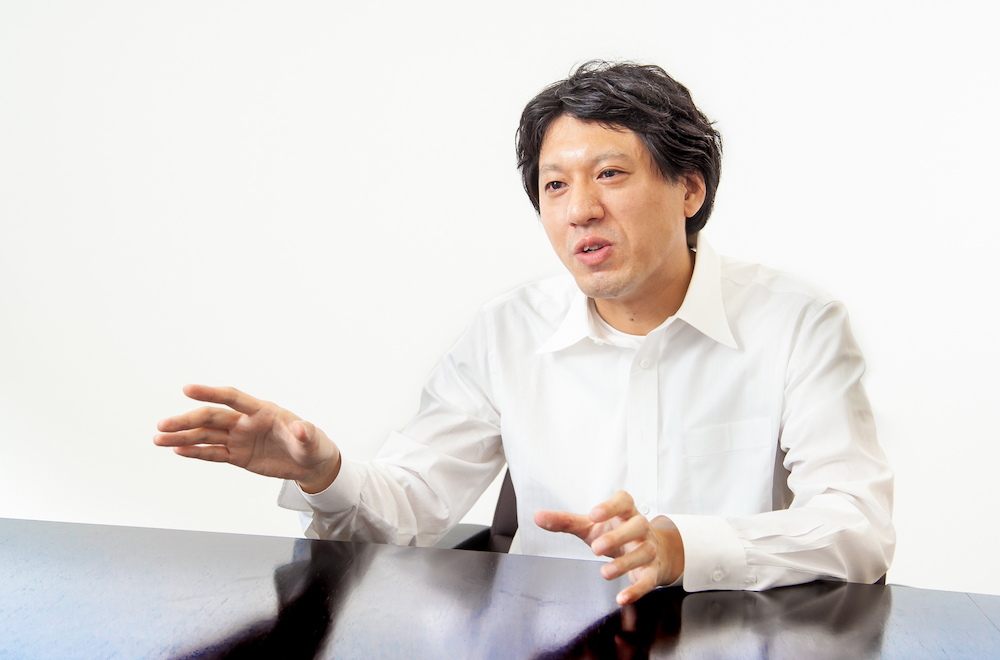
Taira Ashikawa, Head of Research, Media AI Laboratory, Toshiba Corporate R&D Center

Taira Ashikawa, Head of Research, Media AI Laboratory, Toshiba Corporate R&D Center

The technology behind the accuracy in speech recognition: When you describe speech from people’s conversations during meetings and lectures, you will end up with a text that is hard to read. Anyone who has ever transcribed speeches can tell you that. There is a lot of unnecessary content that gets in the way of getting information such as meaningless filler words like “Uh,” and “Umm” and expressions of agreement that add nothing to the content.

The speech recognition AI Toshiba developed is able to recognise speech with high accuracy and detect fillers and hesitation markers as well. This is an essential function when it comes to increasing productivity. Algorithms form the core of AI, and the development team explored a variety of approaches to increase accuracy.

“At first we hit a wall because the level of accuracy of recognition just wouldn’t increase no matter what we did. Our primary goal was to provide users with something that they could use conveniently. By using the increasingly popular model known as LSTM (*1) as well as CTC learning (*2), we tried to teach AI about speech peculiarities such as fillers and hesitation markers that are exclusive to human beings.” Fujimura said.

(*1) LSTM (Long Short-term Memory): one of the developed forms of RNN (Recurrent Neural Network), which has a recursive structure in a hidden layer. It is able to learn long-term dependency relationships which are difficult for conventional RNNs to do.

(*2) CTC (Connectionist Temporal Classification): A method for training RNN to solve problems where sequence lengths differ during input by introducing null characters and adjusting loss functions.
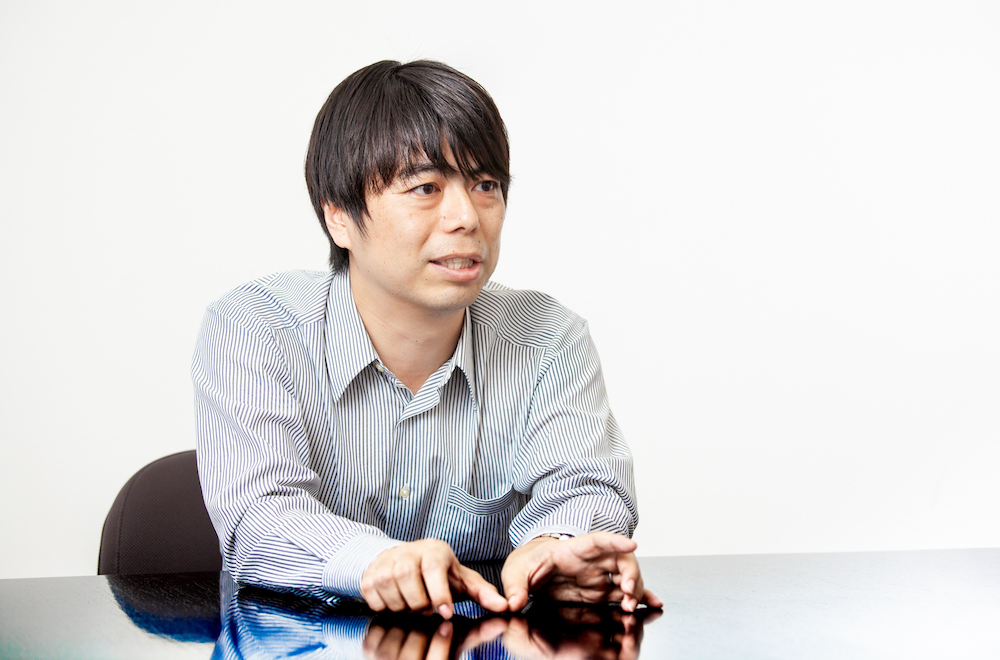
Hiroshi Fujimura, Lead researcher, Media AI Laboratory, Toshiba Corporate R&D Center

Hiroshi Fujimura, Lead researcher, Media AI Laboratory, Toshiba Corporate R&D Center

Up until now, speech recognition has worked by analysing sound wave patterns and parsing them by identifying that this part is “a,” this other part is “i” and so on. However, fillers and hesitation markers have an endless variety of patterns, and it would take a long time to learn about them one by one.

“We used LSTM to capture information such as ‘this is what fillers are like,’ ‘this is what it sounds like when someone hesitates over a word,’ as a statistical model and then used CTC learning to make the AI learn it as a model. Through that, the AI became capable of detecting the countless patterns of fillers and hesitation markers as well,” Fujimura said.

“There is still plenty of room for improvement in development and technology to achieve a fully accurate speech recognition offering. Our speech recognition AI can recognize speech in Japanese, English and Chinese for now. We strive to develop an environment where speakers of different languages will be able to enjoy a smooth conversation with one another. When we develop AI, we dream of taking something like that, which you only see in futuristic science fiction or comic books, and making it a reality”.

This is how the AI evolved into speech recognition AI with superior accuracy. When the development team used lectures as an opportunity for verification testing, the AI achieved an average speech recognition ratio of 85%. That means it was able to recognize the contents of speech above a certain level without editing or advance learning. Now that they have raised the accuracy of the speech recognition, they are considering applying it to the communication AI known as RECAIUS™.

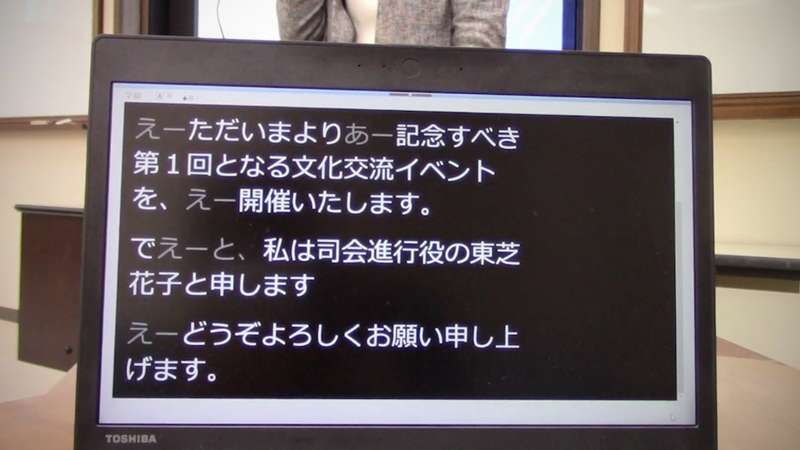
They developed applications where a representative affair is a real-time subtitle display function for the hearing-impaired people. They harness AI to display speech clearly with fillers and hesitation markers reflected in faint, non-obtrusive subtitles. This was a user-friendly specification introduced following detailed discussions with users.

Automatic speech subtitling system (left) and image of displayed subtitles (right)

Automatic speech subtitling system (left) and image of displayed subtitles (right)

“As far as we’re concerned, filler words like “umm” and “uhh” just get in the way. However, what the hearing-impaired people really want is to get as much information as possible. When they read the subtitles while following the movements of the speaker’s lips, they get stressed when fillers and hesitation markers are cut out because they feel that the speaker is saying something that isn’t being reflected in the text,” Ashikawa said.

“So we decided to leave the fillers and hesitation markers in the subtitles but is displayed faintly to make the text easier to read. However, when we record them as transcribed documents, we remove the filler and hesitation markers. That way, we get brief and concise documents.”

AI shows its true worth in manufacturing as well: In March 2019, Toshiba collaborated with Dwango Co Ltd and held a live broadcast of the 81st National Convention of the Information Processing Society of Japan on video website “niconico”. Subtitled videos were distributed online in real time. They are planning to deploy it not only for office tasks but for use in manufacturing settings as well.

“It’s rare to see speech recognition being used as a service in offices today. So it would be ideal for us if users would trust our product and use it, and if it could become something they used in everyday business without being conscious that it’s a speech recognition AI. For example, the words we are speaking right now could become a text polished enough to be used as a business document, with the speakers clearly identified to show who said what. We hope to create a speech recognition AI that is handy and reliable,” Ashikawa said.

“The use of speech recognition hasn’t been applied in manufacturing sites. However there is a need for hands-free voice collection and recording in factories during maintenance and inspections. So I think there’s room for this speech recognition AI to be adopted there as well,” Fujimura said.

We hope to use our knowledge and know-how about manufacturing facilities to seamlessly integrate speech recognition into their operations. We can do that because we have spent a long time developing speech recognition AI and accumulated knowledge about manufacturing and infrastructure settings. ’Why does Toshiba work on speech recognition?’ I think this will provide one of the answers to that fundamental question”.

With the numerous potential applications and benefits, there is no doubt that this speech recognition software will be making its presence increasingly felt in more offices and manufacturing sites in the near future.

Amazon seeks to force Pentagon to halt work on JEDI cloud computing contract #ศาสตร์เกษตรดินปุ๋ย

#ศาสตร์เกษตรดินปุ๋ย : ขอบคุณแหล่งข้อมูล : หนังสือพิมพ์ The Nation

https://www.nationthailand.com/business/30380987?utm_source=category&utm_medium=internal_referral

Amazon seeks to force Pentagon to halt work on JEDI cloud computing contract

Jan 24. 2020
President Trump greets Satya Nadella, chief executive officer of Microsoft, and Jeff Bezos, chief executive officer of Amazon, during an American Technology Council roundtable in 2017. MUST CREDIT: Washington Post photo by Jabin Botsford.

President Trump greets Satya Nadella, chief executive officer of Microsoft, and Jeff Bezos, chief executive officer of Amazon, during an American Technology Council roundtable in 2017. MUST CREDIT: Washington Post photo by Jabin Botsford.
By The Washington Post · Aaron Gregg

WASHINGTON – Amazon Web Services is seeking to force the Pentagon to halt work on a massive cloud-computing contract recently awarded to its biggest competitor, Microsoft, as it pursues allegations that President Donald Trump improperly meddled with defense funds to act on a grudge against Amazon founder Jeff Bezos.

The sealed motion was filed Wednesday as part of a bid protest in the U.S. Court of Federal Claims, which handles disputes over federal contracts.

In a statement, Amazon spokesman Drew Herdener said it is “common practice” to halt contract performance during a bid protest, and emphasized that his company supports the Defense Department’s technology initiatives.

“It’s important that the numerous evaluation errors and blatant political interference that impacted the JEDI award decision be reviewed,” Herdener said in a statement. “AWS is absolutely committed to supporting the DoD’s modernization efforts and to an expeditious legal process that resolves this matter as quickly as possible.”

Defense officials have said in recent weeks that they plan to move forward with the JEDI project despite the bid protest. They have said that the award followed all laws and regulations, and have insisted the decision-making process that led to Microsoft’s win was walled off from presidential influence.

“The Department of Defense will continue to fight to put this urgently-needed capability into the hands of our men and women in uniform as quickly and efficiently as possible,” Rachel VanJohnson, a spokeswoman for Defense Department’s cloud computing program office, said in an email.

“The department remains confident in the JEDI award,” VanJohnson added. “Our team’s duty and sole focus must remain on equipping our warfighters for an increasingly complex and challenging battlefield environment.”

Microsoft spokesman Bill Calder declined to comment.

The Joint Enterprise Defense Infrastructure, known as JEDI, is meant to create a powerful, centralized computing system operated by a single technology company. Last October Microsoft was awarded a contract worth up to $10 billion for the system, jilting Amazon, the cloud-computing market leader.

The award to Microsoft came soon after a high-profile intervention by Trump, who said he was acting on complaints from Amazon’s competitors. At issue in the case is whether the commander in chief’s involvement skewed the competition in Microsoft’s favor.

In its bid protest, Amazon pointed to what it called “unmistakable bias” and “political influence” in the government decision-making process that led to Microsoft’s win.

The company’s case has so far relied primarily on the president’s own public statements, including a February 2016 campaign rally in which he said Amazon would “have problems” if he were elected, citing Bezos’s ownership of The Washington Post.

Amazon’s protest is the fourth legal challenge the JEDI contract has faced; earlier ones caused the project to be delayed for more than a year while officials investigated various allegations against Amazon.

Amazon had long been considered the front-runner for the massive contract; it is the market leader and it remains the only company that can handle top-secret data. Many of Amazon’s advantages stem from a 2013 contract award that made it CIA’s primary cloud provider.

Software giant Oracle, which also wanted the contract but was eliminated in an earlier phase of the competition, protested the award long before bids were even submitted, assuming Amazon to be the front-runner. The company carried out a long-running campaign seeking to paint JEDI as a conspiracy by Amazon to set up a “ten-year DoD cloud monopoly,” as Oracle put it in one lobbying document.

In late July, the president said in a televised news conference that he had received “tremendous complaints” about the contract from Amazon’s competitors, specifically citing Oracle, Microsoft and IBM.

“Some of the greatest companies in the world are complaining about it, having to do with Amazon and the Department of Defense, and I will be asking them to look at it very closely to see what’s going on,” Trump said of the JEDI contract.

Soon afterward, he retweeted a link to a Fox News segment that called the contract the “Bezos Bailout.”

He separately asked Secretary of Defense Mark Esper to reexamine the Pentagon’s approach to the JEDI contract, citing concerns that the contract would go to Amazon, people familiar with the matter told The Post at the time.

Defense officials have said the decision-making process was walled off from the White House and followed all relevant laws and regulations. Dana Deasy, the Department of Defense chief information officer, said in a recent congressional hearing that there was a two-tracked process in which the officials who evaluated bids from Amazon and Microsoft were not in touch with the White House.

“I feel very confident that at no time were team members that actually took the source selection were influenced with any external, including the White House,” Deasy said, referring to an anonymous team of 50 cloud technology experts who evaluated bids.

In statements to the press, Defense Department spokespeople have emphasized that the president did not “order” the Pentagon to make any specific determinationleading up to the Microsoft award.

Goldman Sachs says it won’t take companies public without board diversity #ศาสตร์เกษตรดินปุ๋ย

#ศาสตร์เกษตรดินปุ๋ย : ขอบคุณแหล่งข้อมูล : หนังสือพิมพ์ The Nation

https://www.nationthailand.com/business/30380986?utm_source=category&utm_medium=internal_referral

Goldman Sachs says it won’t take companies public without board diversity

Jan 24. 2020
By The Washington Post · Jena McGregor 
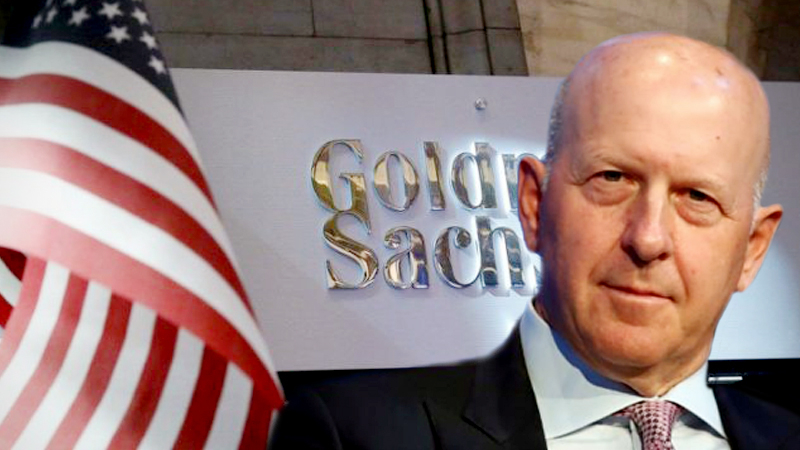
Goldman Sachs chief executive David Solomon said Thursday that the bank, one of the largest underwriters of initial public offerings, would not take companies public in the United States and Europe if they do not have at least one diverse board director, the latest move to push companies to increase the number of women and people of color in corporate boardrooms.

Speaking on CNBC, Solomon said the bank would implement the policy starting this summer and would have a “focus on women.” It plans to increase the number to two by 2021, he said.

“From a governance perspective, diversity on boards is a very, very important issue. We have been very, very focused on it. So we’re trying to find ways to encourage that,” Solomon said, noting that IPOs with a woman on the board had performed “significantly better” than those without. “We realize that this is a small step but a step in a direction of saying, ‘You know what? We think this is right.’ ”

In an email, Goldman spokeswoman Leslie Shribman said the policy will become effective June 30, “as we transition some existing clients to this target.” The policy would count a director as diverse if he or she is from traditionally underrepresented groups, including gender, race, ethnicity, sexual orientation or gender identity, Shribman said. She said the commitment will extend to companies where the bank’s private equity division has a controlling or majority stake.

Goldman Sachs’s 11-member board includes four women. Its lead director, Adebayo Ogunlesi, is black. Lakshmi Mittal, the Indian-born chief executive of ArcelorMittal, is also on the board.

Solomon did not mention any demands for increased diversity of a firm’s executive team. At Goldman Sachs, three of the nine executive officers listed on its website are women.

Goldman’s move comes amid increased investor scrutiny of board membership, with a particular focus on gender, from shareholder activists and institutional investors adding rules to their voting guidelines. BlackRock has said it expects to see at least two female directors on the companies in its portfolio, while State Street has said it plans to vote against nominating committee members on all-male boards.

As of July, no all-male boards were governing companies in the S&P 500 index. At the time, the percentage of women-held board seats in the S&P 500 was nearly 27%, according to data from ISS Analytics, the data arm of the proxy adviser Institutional Shareholder Services. A 2018 report from Deloitte and the Alliance for Board Diversity found that minority directors, male and female, make up 16% of Fortune 500 board seats.

But that figure is much lower among companies nearing initial public offerings. Without referencing the source, Solomon told CNBC that about 60 U.S. and European companies went public in the past two years without any female board members.

George Fleck, an executive recruiter who tracks board changes, said that since April, 18% of seats on IPO boards were held by women. Goldman’s move, Fleck said, “is a public acknowledgment that we need to add more qualified women to public company boards.”

Goldman Sachs has in the past underwritten high-profile IPOs such as Facebook and WeWork that later came under fire for their lack of female directors. In 2012, Facebook went public with no women on the board before adding chief operating officer Sheryl Sandberg. Last year, WeWork parent The We Company drew backlash for its lack of women on the board when it filed its IPO paperwork. It later added Frances Frei, a professor at Harvard University’s business school.

In the CNBC interview, Solomon said WeWork, which was bailed out by Japanese conglomerate SoftBank after a failed IPO, was “one of many data points that have led us over a number of months to talk about this, but . . . it wasn’t in the thought process as we debated it.”

Solomon also said Goldman Sachs would help companies find diverse candidates and put in a more formal process for identifying them. One “constraint” in adding women, he said, has been a “bias” toward putting existing chief executives or chief financial officers on boards. “If you put that hurdle there, then you’re eliminating an enormous number of women with decades of experience.”

Coca-Cola will continue making plastic bottles despite environmental concerns, company says #ศาสตร์เกษตรดินปุ๋ย

#ศาสตร์เกษตรดินปุ๋ย : ขอบคุณแหล่งข้อมูล : หนังสือพิมพ์ The Nation

https://www.nationthailand.com/business/30380985?utm_source=category&utm_medium=internal_referral

Coca-Cola will continue making plastic bottles despite environmental concerns, company says

Jan 24. 2020
By The Washington Post · Lateshia Beachum 
Coca-Cola is shaking off environmentalists’ calls to change its packaging, saying there is too much demand for the plastic bottles.

The soft drink giant’s head of sustainability, Bea Perez, told the BBC that consumers are fans of plastic-packaged drinks because they’re able to reseal their bubbles in lightweight packaging.

Doing away with plastic altogether for glass or aluminum would increase the business’s carbon footprint and weaken sales, she told the news outlet.

“So as we change our bottling infrastructure, move into recycling and innovate, we also have to show the consumer what the opportunities are. They will change with us,” she said.

The company recognizes that packaging waste is a growing problem and that it has a responsibility to help solve the problem, according to a statement from Coca-Cola.

“All packaging has a potential environmental impact, so it’s not as simple as saying one format is better than another,” according to a company representative.

Those statements don’t quite make sense to environmental activists who want the company to do more than committing to making its packaging 100% recyclable by 2025 and to make bottles with an average of 50% recycled material by 2030.

The company had the highest amount of plastic found along coasts, shorelines and parks, according to 2018 Break Free from Plastic study. PepsiCo, home of Coke’s rival, was right behind it, followed by Nestle.

Coca-Cola is holding its crown as the highest plastic-producing company, Break Free From Plastic’s corporate campaign coordinator, Emma Priestland, told The Washington Post.

Companies such as Coca-Cola should be figuring out a way to fix the single-use plastic item economy they created, she said, because that move would benefit their bottom line.

“We see big companies like Coke, PepsiCo, Nestle and Unilever talk about wanting to end plastic pollution, but the [solutions] they put forward rely on individual behavior change, and they rely on recycling,” she said.

A 2017 Sciences Advances study found that 9% of the world’s 6,300 megatons of plastic in 2015 had been recycled while 79% ended up in a landfill or somewhere else in the environment. Researchers said 12% of the plastic was incinerated.

Americans recycle and compost about 35.2% of waste in 2017, according to the latest figures from the United States Environmental Protection Agency. More than half of waste ended up in a landfill.

“We just can’t recycle the amount of plastic being produced,” Priestland said. “We don’t have the infrastructure to deal with quantity.”

Plastic can be recycled a limited number of times before it loses its quality, National Geographic reported, but glass and metal don’t lessen in value.

Recycling only delays the inevitable fate of plastic, Priestland said.

Coca-Cola’s claim that its customers can’t part with plastic bottles shows how out of touch the company is with environmental issues, according to a statement by Greenpeace USA plastics campaigner Kate Melges.

“The solution is for Coca-Cola and other consumer goods giants to fundamentally rethink how they’re bringing products to people, centering systems of reuse and package-free options,” she said. “As long as companies like Coke keep pushing the myth that their bottles are being turned into new bottles over and over again, we are never going to solve the plastic pollution crisis.”

The Coca-Cola company is missing the point of what activists truly desire, Priestland said: no plastic waste.

Norway has found a way to recycle 97% of its plastic bottles through its bottle deposit program, in which consumers are charged less than 50 cents.

Consumers can return the bottles to designated stores with machines that can issue a coupon. They also can received store and gas credit, according to Climate Action.

Plastic-bottle producers also benefit from the program by having their environmental taxes waived if they collectively recycle more than 95% of bottles, according to The Guardian.

About 40 countries have similar programs, the BBC reported. Other countries such as Scotland and England have either made plans to implement similar systems or approved studies to have one in place, according to the outlet.

Coca-Cola has introduced refillable water bottles and package-less solutions through its Dasani PureRefill and Freestyle machines that dispense a variety of flavored water or Coke options.

“Breaking away from plastic is the only way that we are going to solve this problem,” Priestland said.

Ex-Wells Fargo leaders face $59 million in fines , bans from U.S. banking over scandals #ศาสตร์เกษตรดินปุ๋ย

#ศาสตร์เกษตรดินปุ๋ย : ขอบคุณแหล่งข้อมูล : หนังสือพิมพ์ The Nation

https://www.nationthailand.com/business/30380984?utm_source=category&utm_medium=internal_referral

Ex-Wells Fargo leaders face $59 million in fines , bans from U.S. banking over scandals

Jan 24. 2020
A Wells Fargo & Co. bank branch in Rock Island, Ill, on Oct. 11, 2019. MUST CREDIT: Bloomberg photo by Daniel Acker.

A Wells Fargo & Co. bank branch in Rock Island, Ill, on Oct. 11, 2019. MUST CREDIT: Bloomberg photo by Daniel Acker.
By Syndication Washington Post, Bloomberg ·Hannah Levitt · BUSINESS, RETAIL 

A group of former Wells Fargo executives are facing almost $59 million in fines and bans from the U.S. banking industry over their roles in the firm’s scandals as regulators show more appetite to go after individuals.

Former Chief Executive Officer John Stumpf agreed to a $17.5 million penalty and an industry ban, according to an order Thursday from the Office of the Comptroller of the Currency. Carrie Tolstedt, who led Wells Fargo’s community bank for a decade, faces a penalty of as much as $25 million.

“The actions announced by the OCC today reinforce the agency’s expectations that management and employees of national banks and federal savings associations provide fair access to financial services, treat customers fairly and comply with applicable laws and regulations,” Comptroller of the Currency Joseph Otting said in a statement.

Wells Fargo tapped into public and political ire in 2016 with the revelation that bank employees opened millions of potentially fake accounts to meet sales goals. That and a slew of retail-banking issues that subsequently came to light have led to regulatory fallout that’s in many cases unprecedented for a major bank, including a growth cap from the Federal Reserve.

This is the first public step the OCC has taken against former executives related to Wells Fargo’s problems. Regulators received criticism from some corners over the fact that few individuals and no top executives were held accountable for crisis-era missteps that cost the banks billions in fines and penalties.

Regulatory actions against Wells Fargo have also included billions of dollars in fines and legal costs, and an order giving the OCC the right to remove some of the bank’s leaders. The Department of Justice and the Securities and Exchange Commission also have been investigating the lender’s issues.

The OCC and the Fed have both cited a wide-ranging pattern of abuses and lapses at Wells Fargo. The OCC drew scrutiny of its own as the firm’s main regulator throughout the scandals, prompting an internal review at the agency.