Trump signs USMCA deal, revamping North American trade rules #ศาสตร์เกษตรดินปุ๋ย

#ศาสตร์เกษตรดินปุ๋ย : ขอบคุณแหล่งข้อมูล : หนังสือพิมพ์ The Nation

https://www.nationthailand.com/business/30381244?utm_source=category&utm_medium=internal_referral

Trump signs USMCA deal, revamping North American trade rules

Jan 30. 2020
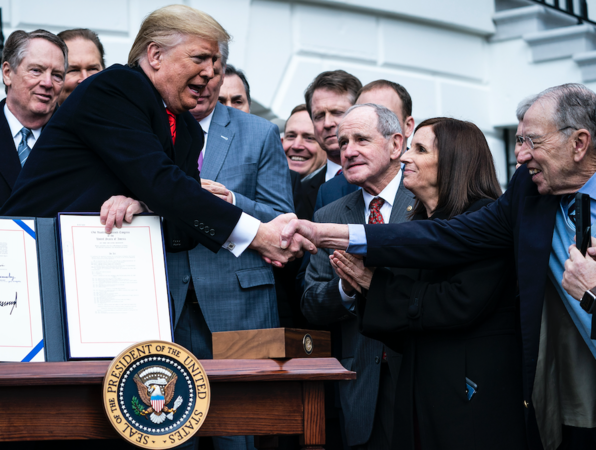
President Donald Trump participates in a signing ceremony for the United States-Mexico-Canada Trade Agreement at the White House on Wednesday, Jan 29, 2020. MUST CREDIT: Washington Post photo by Jabin Botsford
By The Washington Post · Jeff Stein 
WASHINGTON – President Donald Trump signed a revamped trade agreement with Canada and Mexico into law on Wednesday, achieving his pledge to rework the North American Free Trade Agreement even as he contends with the Senate impeachment trial.

The revised treaty, called the U.S.-Mexico-Canada Agreement (USMCA), creates new environmental and labor standards for the countries, while also giving farmers greater access to Canadian markets and ensuring car companies have to use a higher share of parts within North America in their production, among other changes.

Mexico has already ratified the deal, and Canada is expected to formally approve it very soon.

Trump was able to win congressional support for the deal because of substantive changes he made to win support from Democrats and labor unions. But no Democratic lawmakers were present at the signing ceremony. U.S. Trade Representative Robert Lighthizer had told lawmakers he wanted Democrats to be included at the event but was unsuccessful in doing so, according to two people familiar with the talks granted anonymity to share private conversations. A spokesman for USTR did not immediately respond to request to comment.

At the ceremony, Trump hailed the “momentous, historic, and joyous occasion” and said the deal would eliminate outsourcing to keep jobs in America. Vice President Mike Pence and Jared Kushner, an adviser and the president’s son-in-law, were among those in attendance. Dozens of Republican lawmakers also attended.

Trump also called the original NAFTA a “catastrophe” and said revamping the deal was the reason he ran for president and abandoned the “beautiful, simple life of luxury I lived” as a private businessman and celebrity.

“This is a cutting edge, state-of-the-art agreement that protects and defends the people of our country,” Trump said.

Bipartisan majorities in Congress approved the trade deal by wide margins, with the package sailing through the Senate by an 89 to 10 vote margin. Democrats touted a series of changes they helped secure in the pact to beef up its labor and environmental protections in months of talks with Lighthizer.

“This is a celebration of what Democrats were able to secure,” said Rep. Rosa DeLauro, D-Conn., a longtime free trade skeptic who endorsed the deal, in a press call on Wednesday. “We secured positive changes on environmental standards, labor standards, and access to medicine.”

It is unclear if the trade deal will reverse decades of damage to America’s industrial sector. U.S. factory payrolls dropped by close to 6 million after the original 1994 NAFTA and the entrance of China in 2001 to the World Trade Organization. The USMCA is likely to only add 50,000 of these jobs, the International Trade Commission has found.

The agreement also scrapped the original NAFTA’s Investor-State Dispute Settlement system, which gave corporations extensive authority to sue foreign governments forced to comply with business-friendly panels.

“That’s a dramatic change,” said Lori Wallach, a trade expert at Public Citizen, a left-leaning advocacy organization.

The revised North American trade came just weeks after Trump signed a partial trade deal with China, and White House officials have said the hardball tactics that the president has used to extract changes from U.S. trade partners have proven effective.

The North America deal was supported by the AFL-CIO, one of the largest unions in the country, as well as leading business groups such as the U.S. Chamber of Commerce and Business Roundtable. Other union groups, such as International Association of Machinists and Aerospace Workers, opposed it. The United Food and Commercial Workers International Union also criticized the agreement for not including “country-of-origin labeling” intended to ensure food safety and prevent foreign companies from skirting food production standards.

Many of the nation’s leading environmental organizations, including the Sierra Club and the League of Conservation Voters, also blasted the agreement as failing to ignore climate change and helping “corporate polluters.”

The vast majority of the Democratic caucus, as well as most of the leading Democratic presidential candidates, backed the effort. Sen. Bernie Sanders, I-Vt., voted against the package, citing the opposition of environmental groups and the Machinists Union.

Two banks offer grace periods on loan repayment #ศาสตร์เกษตรดินปุ๋ย

#ศาสตร์เกษตรดินปุ๋ย : ขอบคุณแหล่งข้อมูล : หนังสือพิมพ์ The Nation

https://www.nationthailand.com/business/30381238?utm_source=category&utm_medium=internal_referral

Two banks offer grace periods on loan repayment

Jan 29. 2020
Predee Daochai

Predee Daochai
By THE NATION

Kasikornbank (KBank) has offered a 12-month grace period on repayment of the loan principle amount to its existing small and medium-sized enterprises (SMEs) customers in the tourism sector as a measure to ease their financial burden amid impacts from the coronavirus crisis.

The bank is surveying impacts of the virus outbreak on its corporate customers, said president Predee Daochai in a statement on Wednesday (January 29).

Earlier, Siam Commercial Bank (SCB) said it was offering a six-month grace period for repayment of the loan principal amount to existing customers in the hotel business affected by the coronavirus outbreak.

If the crisis prolongs, SCB said it would introduce further measures in support of clients, said president Sarut Ruttanaporn.

Thanawat Phonvichai, president of the University of the Thai Chamber of Commerce, predicted that the problem, if prolonged until March, could cost the Thai tourism industry between Bt80 billion to Bt100 billion this year.

His estimate was based on the usual number of Chinese tourist arrivals in Thailand of around one million a month with average spending of Bt50,000 each.

British reps pack their bags as European Parliament approves Brexit #ศาสตร์เกษตรดินปุ๋ย

#ศาสตร์เกษตรดินปุ๋ย : ขอบคุณแหล่งข้อมูล : หนังสือพิมพ์ The Nation

https://www.nationthailand.com/news/30381283?utm_source=category&utm_medium=internal_referral

British reps pack their bags as European Parliament approves Brexit

Jan 30. 2020
By The Washington Post · Michael Birnbaum · BUSINESS, WORLD, EUROPE

BRUSSELS – Molly Scott Cato’s rail ticket for her final trip back to London is printed and ready on her office desk. Her mementos from her past six years as a member of the European Parliament have been removed from the walls. One of the last things to go in a cardboard box will be her “Brexit: not my cup of tea” mug, which is still serving duty this week.

“It’s a very weird thing, isn’t it? Shutting the whole thing down. Switching off the light,” she said.

She’s bracing for the stroke of midnight as Friday turns to Saturday, when Britain leaves the European Union, and, a bit like Cinderella, she’ll shed her status a lawmaker and turn back into a civilian.

Brexit has involved a rather drawn-out goodbye. Not only have three and a half years passed since Britain voted in favor of a departure, but this week’s formal exit will be followed by an 11-month transition period. Ordinary citizens and businesses won’t see a difference until the end of the year, at the earliest.

But one of the few immediate impacts of Brexit is that Britain’s 73 representatives in the European Parliament will lose their jobs. No longer will they play a role in shaping Europe’s future or setting regulations for its 500 million residents.

The British lawmakers here in the EU capital were each issued 15 cardboard boxes to pack up their offices. The departing lawmakers include people like Scott Cato, who fervently believe in the EU project and describe what they’re experiencing this week “very much like a grieving process.”

“It’s that horrible thing where you wake up in the morning and you forget it, and then you remember,” said Scott Cato, a Green Party lawmaker.

Also leaving, though, are the boisterous Brexiteers, who made up the majority of the U.K. delegation in recent years and have used it as a platform to mock their fellow lawmakers and the EU more broadly.

On Wednesday, they got a final chance to stick their fingers in the eyes of their pro-EU colleagues.

“You all thought it was terribly funny. You stopped laughing in 2016,” said Nigel Farage, who pushed for the Brexit referendum that year.

Farage has been a vocally euroskeptic member of the European Parliament since 1999. Although he has failed repeatedly to win election to the British House of Commons, he has finally triumphed on his core issue, the need to extract Britain from Europe.

“I’m hoping this begins the end of the project. It’s a bad project,” he said Wednesday.

He then pulled out a British flag – a violation of parliamentary rules that no flags sit on lawmakers’ desks – had his microphone cut off and stormed out of the Chamber, along with the rest of his Brexit Party lawmakers.

Elsewhere in Brussels, the British presence is actually expanding. The British Permanent Representation to the European Union – the EU-member equivalent of an embassy – is turning into a “mission” and growing its staff, the better to negotiate with the Europeans now that British diplomats will be excluded from EU meetings. There’s already been plenty of snickering on Twitter that the diplomatic outpost will be retiring its “UKREP” designation and adopting “UKMissEU.”

While British lawmakers have been busy with exit preparations, the rest of the EU has, for the most part, continued business as usual. On Wednesday, before Farage’s dramatics, the European Parliament discussed a proposal to encourage India to protect all of its citizens, including the Muslim ones. Several British lawmakers, including Shaffaq Mohammed, who was born in the Pakistani-administered part of Kashmir, took part in the debate, urging the legislature to vote on the proposal right away, rather than waiting until March, when the British delegation would no longer be present. (The push for an immediate vote failed.)

Only after concluding that debate did European lawmakers vote on the treaty that solidifies Britain’s transition out of the European Union. In the end, the withdrawal agreement was approved, 621 to 49, with 13 abstentions.

Once the result was announced, the lawmakers stood in the Chamber, linked hands and sang “Auld Lang Syne.” Many pro-EU British lawmakers appeared to be weeping. Some waved scarves featuring both the EU and British flags. (Scarves with flags seemed to be within the bounds of parliamentary rules.)

“Fifty years of integration cannot disappear easily,” said European Parliament President David Sassoli, before signing the document that conveyed the legislature’s consent to the split. “It is very hard to say goodbye. It is too final. And that is why, like other colleagues, I say arrivederci.”

As the hours of Britain’s membership dwindled, U.K. lawmakers prepared to mark the occasion in their own ways. In one lawmakers’ office, the assistants this week were applying for unemployment benefits and searching for other jobs. In another, preparations were underway for a rueful party Thursday evening at Place Luxembourg, the plaza outside the European Parliament that is lined with bars.

“People keep giving me their condolences,” said Magid Magid, the British Green party lawmaker planning the party.

Magid, 30, was only elected for the first time in May. But he said he felt he had been able to draw attention to Islamophobia and other European failings during his seven months in the legislature. He is one of three Muslim lawmakers in the body, all of whom are British and will depart on Friday.

Few pro-EU British lawmakers in Brussels plan to mark the actual exit moment in public. Magid said he’d get together with his staff Friday evening and have a final meal with them on Saturday.

Seb Dance, one of the most prominent pro-EU Labour lawmakers in the European Parliament, said he planned to mourn in private.

“I’m just going to end up crying, and someone will see me crying. There’s no point in doing that. I’m not going to mark it,” he said.

So he’ll hand over the keys to his apartment Friday morning, come in to the Parliament for a final day of work, check into a hotel that evening and visit some final Belgian sites over the weekend before heading home to Britain.

His country’s departure, he said, was merely a “sabbatical.”

“We have an organized, very motivated and incredibly depressed but also angry polity, a pro-European base in the U.K. that is huge. Millions, millions of people. And that didn’t exist before,” he said.

Scott Cato was so hopeful that those pro-Europeans in Britain would reverse Brexit that she refused to sign a flexible lease on her Brussels apartment. It was only on the morning of Dec. 13, after pro-Brexit Prime Minister Boris Johnson and his Conservative Party won a resounding election victory, that she emailed her landlord to give notice. She now owes two extra months of rent.

Scott Cato, a former academic, plans to spend Friday among friendly faces at a British university event, talking about Europe’s future, late into the evening.

She said she’s still uncertain what she’ll do next.

Like Dance, she said she doesn’t think Britain’s departure is permanent. People will change their minds, she said, once they feel the economic pain Brexit will unleash.

Desire for renewed membership “does have to play its way out,” she said. “I think 10 years. I mean, I’m 56, so I want to be here when it happens.”

In coronavirus outbreak, China’s leaders scramble to avert a Chernobyl moment #ศาสตร์เกษตรดินปุ๋ย

#ศาสตร์เกษตรดินปุ๋ย : ขอบคุณแหล่งข้อมูล : หนังสือพิมพ์ The Nation

https://www.nationthailand.com/news/30381282?utm_source=category&utm_medium=internal_referral

In coronavirus outbreak, China’s leaders scramble to avert a Chernobyl moment

Jan 30. 2020
File Photo of Xi Jinping

File Photo of Xi Jinping
By The Washington Post · Gerry Shih · WORLD, ASIA-PACIFIC 

BEIJING – As a trade war with the United States accelerated last January, Chinese leader Xi Jinping held a meeting with top Communist Party officials to warn about the surprise emergence of “black swan events” that could destabilize their 70-year rule.

Exactly one year later, an unexpected challenge did emerge – not from the halls of Washington but from market stalls in Wuhan.

While China battles a coronavirus epidemic with potentially far-reaching implications for global public health and the domestic economy, the Communist Party is also scrambling to delicately manage the political risk as citizens fume over how officials bungled the initial response to the outbreak.

“This is the kind of ‘black swan’ moment when the fundamental legitimacy of the party is at stake,” said Kerry Brown, a professor at King’s College London who was first secretary in the British Embassy in Beijing during China’s last major epidemic, the 2002 outbreak of severe acute respiratory syndrome (SARS).

“It’s the moment when the party is supposed to show the merit of its highly controlled, highly coordinated system and its side of the social contract,” Brown said. Instead, “people seem to be getting more and more nervous.”

In recent days, China’s central leaders have appeared to take a bifurcated approach: allow citizens to vent about the failures of local officials in Wuhan – who initially covered up and ignored the coronavirus – while circling protective wagons around Xi, the president who has sought to cultivated an image as a beloved “People’s Leader.”

“Public perception will be shaped by the propaganda machinery, and that machinery is going into overdrive right now to protect Xi’s reputation,” said Steve Tsang, director of the China Institute at SOAS University of London. “They must maintain the myth that he can do no wrong.”

As the crisis snowballs unpredictably this week, party media organs have carefully hedged Xi’s political exposure.

After Xi met World Health Organization chief Tedros Adhanom on Tuesday, Chinese state media initially carried video showing him telling Tedros that he “personally directed” the response to the outbreak. But later, state outlets quoted Xi saying that his administration was “collectively directing” the response.

Xi has been shown once on television, on Lunar New Year’s Day, decisively ordering the formation of an epidemic response team. But he did not name himself the head of that commission.

Chinese officials may fear a political “catastrophe” if the virus were to continue spreading to major cities such as Beijing and Shanghai, said Victor Shih, an expert on Chinese political economy at the University of California, San Diego.

“If Xi was fully confident of a victorious outcome against the disease, why not put himself in charge . . . and reap all of the glories?” Shih said.

Popular faith in Xi, who has pitched his strongman-style as more effective than the decentralized administrations of his predecessors, could “evaporate” if the situation worsened dramatically, Shih added.

As nearly 55 million people adjust to an indefinite quarantine in central China and international airlines begin cutting flights to the country, frustrations have run high.

On Twitter, a service that is inaccessible inside China without the use of special software, Chinese users widely shared video of a Wuhan woman angrily wondering how the party could “build a moderately prosperous society if there were no people left.”

Others flocked to Douban, a Chinese equivalent of IMBD.com, where they left coded reviews about the HBO series “Chernobyl.” Many linked the official ineptitude in present day China and the Soviet Union’s final years and hinted that the Wuhan virus was something of a Chernobyl moment.

“There are so many similarities,” wrote the viewer “jianghai jiyusheng.” “Will there be a show in a few years about the Wuhan pneumonia?”

The Chernobyl nuclear meltdown in 1986 is widely seen as hastening the collapse of the Soviet Union a few years later.

By Tuesday, China’s authorities had seen enough. Censors did not take down the Chernobyl reviews outright but rendered the page invisible to anybody who wasn’t logged in with an account.

For all the public’s frustrations about their government, political observers say, many seem to be rallying around the top leadership. On Wednesday, a state-owned outlet called The Paper released a nationwide opinion survey showing Chinese broadly panning the recent performance of Wuhan and Hubei officials but still retaining a high level of faith in their central leaders in Beijing.

Dali Yang, an expert on China’s politics and governance at the University of Chicago, said the government appeared to be content to let blame pile up on lower officials as long as people did not question the basic legitimacy of the party or its bureaucratic culture. And authorities seemed to even be allowing a rare degree of dissent and debate about government transparency, he said.

“Blaming the locals is a time-honored strategy,” Yang said.

Indeed, China’s Internet this week has been rife with users freely mocking the party chief in Wuhan, the viral epicenter, for tripping over his words about how protective masks can be produced.

And after citizens broadly condemned Wuhan authorities for detaining and silencing doctors who reported the existence of the new virus four weeks ago, China’s highest court stepped in and reprimanded the local police for silencing whistleblowers.

“Rumors stop when information is public,” the usually conservative Supreme People’s Court said Tuesday on social media as it urged Wuhan officials to learn a “profound lesson.”

In a state television interview this week, Wuhan’s mayor, Zhou Xianwang, offered to resign, saying he was willing to take the fall if that would assuage popular anger.

After the crisis subsides, the Communist Party will likely dismiss a number of local officials depending on how bad things become, said Tsang, the SOAS professor.

“They will conclude the problem was not too much concentration of power, but rather not enough concentration of power” at the top, he said. “A few officials will be held accountable. And none of them will be Xi Jinping.”

As coronavirus multiplies, there’s also good news #ศาสตร์เกษตรดินปุ๋ย

#ศาสตร์เกษตรดินปุ๋ย : ขอบคุณแหล่งข้อมูล : หนังสือพิมพ์ The Nation

https://www.nationthailand.com/news/30381278?utm_source=category&utm_medium=internal_referral

As coronavirus multiplies, there’s also good news

Jan 30. 2020
An aerial photo taken on Tuesday shows the construction site of Huoshenshan Hospital in Wuhan, Hubei province. PHOTO BY SHI YI / FOR CHINA DAILY

An aerial photo taken on Tuesday shows the construction site of Huoshenshan Hospital in Wuhan, Hubei province. PHOTO BY SHI YI / FOR CHINA DAILY
By WANG XIAODONG, ZOU SHUO in Beijing, YANG CHENG in Tianjin and LIA ZHU in San Francisco
China Daily/ANN

The number of confirmed cases of the novel coronavirus on the Chinese mainland has exceeded the total number of SARS cases recorded during that outbreak 17 years ago. But there is no need to panic, experts said on Wednesday, even though more cases are expected over the next few days.

The number of confirmed cases of the new coronavirus reached 5,974 on Tuesday — an increase of 1,459 over the day before, including 132 deaths, since the outbreak was first reported late December, according to the National Health Commission on Wednesday.

In addition, the number of suspected cases rose to 9,239.

In Hubei province, the epicenter of the outbreak, 840 new cases were reported on Tuesday, bringing the total number of confirmed cases there to 3,554.

A suspected case was reported on Tuesday in the Tibet autonomous region, which, if confirmed, would mean that every province, autonomous region and municipality on the mainland has acquired the novel coronavirus.

Wednesday’s data mean the new virus has exceeded the spread of SARS in its first month. With SARS — severe acute respiratory syndrome — a total of 5,327 severe cases were reported on the Chinese mainland between the end of 2002 and Aug 16, 2003, including 349 deaths, according to what was then the Ministry of Health.

In addition, cases of infected foreigners on the mainland were first reported in South China’s Guangdong province.

Three foreigners — a Pakistani and two Australians, who all had been in Wuhan recently — have been diagnosed with the coronavirus in Guangdong province as of Wednesday.

Guangzhou released on Wednesday a public letter and details of multilingual service hotlines for foreigners to get help. Wuhan and Tianjin also have provided foreigners with timely consultations and assistance on epidemic prevention and control by opening a 24-hour hotline service.

Zhong Nanshan, a prominent expert in respiratory diseases and a member of the Chinese Academy of Engineering, said the recent novel coronavirus outbreak may hit its peak in a week or 10 days. The outbreak will not last as long as the SARS outbreak — more than five months — in part because of strong measures to contain the outbreak adopted by the central government, he said.

There are still no effective drugs to combat the virus, but researchers and medical staff have been working on several methods, and life-support technologies have improved greatly since SARS, so the death rate will be less, he told Xinhua News Agency.

So far, there has been no official statement about when the epidemic will peak or how long it will last. Gauden Galea, the World Health Organization’s representative in China, said in an earlier interview with China Daily that the WHO is organizing a number of researchers to model the case numbers, but no conclusion has been reached yet.

Zeng Guang, chief epidemiologist at the Chinese Center for Disease Control and Prevention, said that compared with SARS, which involved many critical cases, the recent coronavirus outbreak is less severe. People in a large number of confirmed cases showed mild symptoms, according to a report in Health Times on Wednesday.

However, the new virus is more difficult to control and prevent than SARS. It can jump between humans during incubation, which lasts up to 14 days, he said.

With the lockdown of Wuhan, Hubei province, the presumed source of the outbreak, the number of cases exported from the city will gradually be reduced, and the rise in cases in other parts of China will likewise slow, Zeng said.

Meanwhile, warming weather will also restrain the spread of respiratory diseases and contribute to control and prevention, he said.

Workers bring the pieces together. Work is expected to be done by Feb 3, about seven days after it began. PHOTO BY SHI YI / FOR CHINA DAILY

Workers bring the pieces together. Work is expected to be done by Feb 3, about seven days after it began. PHOTO BY SHI YI / FOR CHINA DAILY

The WHO said in a statement on Tuesday that studies so far indicate that most cases of the virus reported to date have been milder, with about 20 percent of all confirmed cases experiencing severe illness.

China’s National Health Commission will continue to collaborate with the WHO to contain the outbreak, including studying the severity and transmissibility of the virus, it said. In addition, China will share biological material with the WHO to contribute to the development of vaccines.

The WHO will also send international experts to visit China as soon as possible to work with domestic experts to increase understanding of the outbreak and guide global response efforts, it said.

The statement came after a meeting between President Xi Jinping and Tedros Adhanom Ghebreyesus, director-general of the WHO, in Beijing on Tuesday.

“We appreciate the seriousness with which China is taking this outbreak, especially the commitment from top leadership and the transparency they have demonstrated, including sharing data and the genetic sequence of the virus,” the statement said. “The WHO will keep working side-by-side with China and all other countries to protect health and keep people safe.”

“Both the WHO and China noted that the number of cases being reported, including those outside China, is deeply concerning,” the statement said. “Better understanding of the transmissibility and severity of the virus is urgently required to guide other countries on appropriate response measures.”

Walter Ian Lipkin, a professor of epidemiology and director of the Center for Infection and Immunity at Columbia’s Mailman School of Public Health who is known as a leading “virus hunter”, is headed to the epidemic-stricken area in China to assist with efforts to contain the spread of the novel coronavirus, according to Columbia Global Centers in Beijing on Tuesday.

Based on the evidence so far, Lipkin said on Tuesday in an article updated on Columbia University’s website that the novel coronavirus is not expected to spread to the same extent as SARS, which reached 33 countries.

Afghan forces rescue more than 60 hostages from Taliban prison in night raid #ศาสตร์เกษตรดินปุ๋ย

#ศาสตร์เกษตรดินปุ๋ย : ขอบคุณแหล่งข้อมูล : หนังสือพิมพ์ The Nation

https://www.nationthailand.com/news/30381275?utm_source=category&utm_medium=internal_referral

Afghan forces rescue more than 60 hostages from Taliban prison in night raid

Jan 30. 2020
By The Washington Post · Sharif Hassan, Susannah George 
KABUL – Late Tuesday night, four helicopters carrying 50 Afghan special forces commandos touched down just outside a Taliban compound on Afghanistan’s western edge. Intelligence collected by U.S. and Afghan forces indicated the buildings were being used as a prison, holding dozens of Afghan security forces.

The Afghan commandos were launching an attempt to rescue more than 60 hostages held by the Taliban.

“We took positions on the hilltops and sealed off the area,” said Maj. Sayed Rahimullah, the Afghan special forces commando who led the raid. As his men moved down into the compound, he said, they caught the Taliban guards by surprise.

“We didn’t give them enough time to use heavy weaponry. They were firing light weapons as they were fleeing the scene,” he said in an interview Wednesday. As Taliban fighters fled, American aircraft circling above the scene targeted the men with at least four airstrikes, he said.

U.S. and Afghan officials hailed the operation as a major success for Afghanistan’s special forces, who have struggled to regularly conduct operations without close American support.

In all, 62 prisoners were freed from the compound in Bala Murghab, a district of Badghis province heavily contested by Taliban forces. Five Taliban fighters were taken into custody and at least eight were killed, Rahimullah said.

A U.S. defense official confirmed the number of hostages freed and Taliban taken into custody. But the official, who was authorized to disclose details of the operation on the condition of anonymity, said there were no U.S. strikes in the area at that time and that no Taliban fighters were reported killed in the raid.

The operation comes amid an uptick in violence across Afghanistan as peace talks stall. U.S. negotiators are demanding a reduction in violence from the Taliban before formal talks can resume, but in the meantime violence across the country has increased in recent months as both sides seek to gain leverage.

Also overnight Tuesday, a Taliban attack in Kunduz killed six Afghan security forces, according to a senior Afghan official speaking on condition of anonymity because he was not authorized to release death tolls to the media. A local lawmaker from Kunduz, Muhammaddin Hamdard, said 13 Afghan troops were killed.

After the operation in Badghis, acting Afghan defense minister Asadullah Khalid pledged his troops would “increase their efforts to maintain the people’s security,” according to a defense ministry statement.

The commander of the Afghan special forces, Lt. Gen. Farid Ahmadi, said in an interview that the operation showed that his troops are acting with greater independence and “sent a strong message to (the) enemy that anywhere, anytime we can hit you in the heart of your stronghold.”

American support during the raid was limited to intelligence sharing and air support, the U.S. defense official said, describing the operation as complex and “dicey,” because of the presence of such a large number of hostages.

Bill Roggio, an Afghan military analyst and senior fellow at the Foundation for Defense of Democracies, said the raid displayed improvement on the operational level for Afghanistan’s special forces.

“I would say three to four years ago you wouldn’t have seen Afghan special forces conducting missions like that,” he said.

But he said the success of the operation doesn’t address the larger issue of the force’s ability to retake and hold territory. “When it comes to holding districts, generally we’ve seen they’re not too good at that,” he said.

The Pentagon’s December report to Congress on security in Afghanistan said “terrorist and insurgent groups continued to present a formidable challenge to Afghan, U.S. and Coalition forces.”

And while the Afghan special forces are “the most capable force” in Afghanistan’s military, “sustained levels of violence” and security force casualties have resulted in military attrition rates that outpace recruitment and retention, the report said.

Experts debunk fringe theory linking China’s coronavirus to weapons research #ศาสตร์เกษตรดินปุ๋ย

#ศาสตร์เกษตรดินปุ๋ย : ขอบคุณแหล่งข้อมูล : หนังสือพิมพ์ The Nation

https://www.nationthailand.com/news/30381270?utm_source=category&utm_medium=internal_referral

Experts debunk fringe theory linking China’s coronavirus to weapons research

Jan 30. 2020
By The Washington Post · Adam Taylor 
As China attempts to contain the spread of a new coronavirus that has left more than 100 people dead, rumors and disinformation have spread amid the scramble for answers.

Some of the speculation has centered on a virology institute in Wuhan, the city where the outbreak began. One fringe theory holds that the disaster could be the accidental result of biological weapons research.

But in conversations with The Washington Post, experts rejected the idea that the virus could be man-made.

“Based on the virus genome and properties there is no indication whatsoever that it was an engineered virus,” said Richard Ebright, a professor of chemical biology at Rutgers University.

Tim Trevan, a biological safety expert based in Maryland, said most countries had largely abandoned their bioweapons research after years of work proved fruitless.

“The vast majority of new, nasty diseases are zygotic: They come from nature,” he said.

The British newspaper Daily Mail was among the first to suggest the possibility of a link between the newly spreading virus and the Wuhan National Biosafety Laboratory, reporting last week that the lab, which opened in 2014 and is part of the Wuhan Institute of Virology, had been the subject of safety concerns in the past.

A separate article published by the Washington Times, a conservative newspaper in Washington, D.C., took the theories a step further, suggesting the “Coronavirus may have originated in lab linked to China’s biowarfare program” and pointing to the Wuhan Institute of Virology.

The article cited research by Dany Shoham, a former Israeli military intelligence officer, who told The Post he did not want to comment further.

Despite little public evidence, the theory has spread widely on social media, to conspiracy theory websites and in some international news outlets.

The Wuhan National Biosafety Laboratory is a “Cellular Level Biosafety Level 4” facility, which means it has a high level of operational security and is authorized to work on dangerous pathogens, including Ebola.

Those entering the level 4 lab use airlocks and protective suits. Waste, and even air, is heavily filtered and cleaned before leaving the facility.

Milton Leitenberg, an expert on chemical weapons at the University of Maryland, said that he and other analysts around the world had discussed the possibility that weapons development at the Wuhan lab could have led to the coronavirus outbreak in a private email chain but that no one had found convincing evidence to support the theory.

“Of course, if they are doing bioweaponry, it is covert,” Leitenberg said in a phone call, but added that it was unlikely the Chinese government would use such a facility for production or even research and development of bioweapons.

The Wuhan lab is well-known and it is relatively open compared with other Chinese institutes: It has strong ties to the Galveston National Laboratory at the University of Texas Medical Branch and was developed with the aid of French engineers.

“Wuhan Institute of Virology is a world-class research institution that does world-class research in virology and immunology,” Ebright said, noting that one specialty of the facility was researching coronaviruses transmitted by bats.

Trevan, who wrote a 2017 article for Nature that warned of possible risks at the Wuhan facility that was cited by the Daily Mail, said in a phone call to The Post that he was concerned at the time about how to “manage risk in these complex systems when you cannot predict all the ways in which the system could fail.”

A former British diplomat and political adviser to the United Nations, he said that he had not followed affairs at the facility closely since 2017 and was not aware of any specific problems there, but that he doubted the coronavirus outbreak could have come from a weapons program.

An annual State Department report released last year stated that China had engaged “in biological activities with potential dual-use applications.”

Elsa Kania, a fellow at the Center for a New American Security, said that while Chinese officials had expressed public interest in the potential weaponization of biotechnology, a coronavirus would not be a useful weapon.

“Hypothetically, a bioweapon would be designed to be highly targeted in its effects, whereas since its outbreak the coronavirus is already on track to become widespread in China and worldwide,” she said.

Vipin Narang, a professor at the Massachusetts Institute of Technology, wrote in a message on Twitter that a good bioweapon “in theory has high lethality but low, not hi, communicability” and that spreading such ideas would be “incredibly irresponsible.”

After the 2014 Ebola outbreak, fringe news outlets suggested spuriously that the U.S. Department of Defense had manufactured the virus. In the Soviet Union, military labs did look into whether the virus could be used as a weapon but ultimately abandoned those hopes.

The speculation may be linked to uncertainty over where the ongoing novel coronavirus outbreak originated. Some scientists initially suspected that a seafood market in Wuhan may have been the starting point, but a study written by Chinese researchers and published in the Lancet on Friday questioned that analysis.

Late Tuesday, Hu Xijin, editor of the nationalistic Global Times newspaper wrote that a conspiracy theory had emerged in China that the United States was responsible for the outbreak. “Their logic: Why always China?” Hu wrote on Twitter. “But most Chinese don’t believe it.”

Democrats make case for witnesses while moderate Republicans question Trump’s defense #ศาสตร์เกษตรดินปุ๋ย

#ศาสตร์เกษตรดินปุ๋ย : ขอบคุณแหล่งข้อมูล : หนังสือพิมพ์ The Nation

https://www.nationthailand.com/news/30381269?utm_source=category&utm_medium=internal_referral

Democrats make case for witnesses while moderate Republicans question Trump’s defense

Jan 30. 2020
File Photo

File Photo
By The Washington Post · John Wagner, Elise Viebeck 

WASHINGTON – A new phase of President Donald Trump’s historic impeachment trial began Wednesday, with senators posing questions to the House managers and the president’s attorneys about Trump’s conduct toward Ukraine.

Meanwhile, debate continues outside the chamber over whether to call witnesses, including former national security adviser John Bolton. In a closed-door meeting on Tuesday, Senate Majority Leader Mitch McConnell, R-Ky., told colleagues that he doesn’t yet have the votes to block witnesses.

Trump faces charges of abuse of power and obstruction of Congress. The crux of the case for his impeachment is the allegation that he withheld military aid and a White House meeting to pressure Ukraine to investigate Joe Biden and his son. Hunter Biden served on the board of Burisma, a Ukrainian energy company, while his father was vice president. Bolton’s upcoming book – which the White House has moved to rework – is said to detail the White House-Kyiv interaction.

Wednesday’s first Senate question came from GOP Sens. Susan Collins of Maine, Lisa Murkowski of Alaska and Mitt Romney of Utah, the three most likely Republicans to vote to allow witnesses.

They wanted Trump’s counsel to explain how they should consider abuse of power if the president had “had more than one motive for his alleged conduct, such as the pursuit of personal political advantage, rooting out corruption and the promotion of national interests.”

White House Deputy Counsel Patrick Philbin argued that if there were a motive “of the public interest, but also some personal interest,” then it “cannot possibly be the basis for an impeachable offense.”

He continued by arguing that as soon as there’s any evidence of public interest motive, the case fails, because every politician is going to have some personal political interest in mind.

“All elected officials to some extent have in mind how their conduct, how their decisions, their policy decisions will affect the next election. There’s always some personal interest in the electoral outcome of policy,” Philbin said.

Earlier Wednesday, Romney told reporters what he wanted to hear from witnesses, such as Bolton.

“For instance, I’d like to know at the time the president decided not to immediately provide military aid to Ukraine, what was the reason he explained at that point,” Romney said. “In addition, I’d like to know a little later on, was there any effort on the part of the president to communicate to Ukraine that aid was being held up and for what reason. Or was that something they just learned from the media?”

He continued: “So these are questions that would relate to important issues that I’d like to get the answers to.”

In a follow-up to Philbin’s initial argument, Senate Minority Leader Chuck Schumer, D-N.Y. submitted a question about witnesses, asking House managers if there is “any way to render a verdict in this case” without hearing from Bolton, acting White House chief of staff Mick Mulvaney and others.

Rep. Adam Schiff, D-Calif., the lead House impeachment manager, said the “short answer to that question is: No.”

“There’s no way to have a fair trial without witnesses, and when you have a witness who is as plainly relevant as John Bolton, who goes to the heart of the most serious and egregious of the president’s misconduct, who has volunteered to come and testify – to turn him away, to look the other way, I think is deeply at odds with being an impartial juror,” Schiff said.

Philbin fielded the third question, which invited Trump’s team to respond to whatever the House managers just said.

“It’s not just a question of, ‘Well, should we just hear one witness?’ That’s not what the real question is going to be,” he said. “For this institution, the question is: What is the precedent that is going to be set for what is the acceptable way for the House of Representatives to bring an impeachment of a president of the United States to this chamber, and can it be done in a hurried, half-baked partisan fashion?”

Constitutional law professor Alan Dershowitz, a member of Trump’s defense team, said before the Senate convened Wednesday that there should not be witnesses in the impeachment trial.

Dershowitz told reporters that his view on witnesses flows from the larger argument he advanced earlier in the trial – which has been embraced by a number of GOP senators – that the allegations against Trump do not constitute impeachable offenses.

“If there’s no impeachable charges, then it follows that you don’t have witnesses,” Dershowitz said. “It would be as if somebody were indicted for something that weren’t a crime. You don’t call witnesses, you get it dismissed.”

Dershowitz said he hopes to expand on that point in the question-and-answer period the Senate embarked on Wednesday.

Dershowitz also said that his constitutional view is that, “if there are witnesses on one side there have to be witnesses on the other.”

Sen. Joe Manchin, D-W.Va., told MSNBC on Wednesday that Hunter Biden is a relevant witness, a view at odds with fellow Democrats.

“You know, I think so. I really do,” Manchin said during an appearance on MSNBC. “I don’t have a problem there because this is why we are where we are. Now I think that he can clear himself, what I know and what I’ve heard. But being afraid to put anybody that might have pertinent information is wrong no matter if you’re a Democrat or a Republican.”

Other Democrats have argued that Hunter Biden has no direct knowledge of Trump’s conduct toward Ukraine and that his appearance would be designed to hurt his father politically as he seeks the presidency.

“Hunter Biden is not on trial. Joe Biden is not on trial. Donald Trump is on trial,” Sen. Edward Markey, D-Mass., told CNN on Wednesday.

In the first question requesting an answer from both the House managers and Trump’s legal team, Sens. John Kennedy, R-La., John Cornyn, R-Tex., and Marsha Blackburn, R-Tenn., asked both sides why the House did not challenge claims of executive privilege and immunity during the impeachment proceedings.

Speaking for the managers, Rep. Hakeem Jeffries, D-N.Y., said Trump never raised the question of executive privilege and instead relied on a “notion of blanket defiance” or “absolute immunity” without case law or jurisprudence cited to justify it.

Philbin said Trump had “specific rationales” for defying subpoenas and other requests from House investigators. Philbin denied that the president engaged in “blanket defiance.”

Also on Wednesday, House Foreign Affairs Committee Chairman Eliot Engel, D-N.Y., said Bolton told him to look into the removal of former ambassador to Ukraine Marie Yovanovitch during a phone conversation less than a week after Bolton’s departure from the White House.

In a statement, Engel described the conversation publicly for the first time, saying it shows the importance of calling Bolton as a witness during the Senate trial.

Engel also said his phone conversation with Bolton directly contradicts Trump’s claim that Bolton did not say anything about the “Trump-Ukraine scandal” at the time he was fired. Yovanovitch’s removal is a pivotal event in the story of Trump’s unconventional foreign policy toward Ukraine and was considered a victory by his personal attorney Rudy Giuliani.

Engel said he alerted colleagues on the Foreign Affairs, Intelligence and Oversight panels that led the House inquiry into Trump’s dealings with Ukraine and that Bolton’s remark was “one of the reasons we wished to hear from [him], under oath, in a formal setting.”

“Ambassador Bolton has made clear over the last few months that he has more to say on this issue. And now that the President has called his credibility into question, it’s important to set the record straight,” Engel said, urging the Senate to call Bolton as a witness.

The White House moved last week to block the publication of a book from Bolton, saying it contained “TOP SECRET” and classified material that would endanger national security.

The Jan. 23 letter to Charles Cooper, Bolton’s lawyer, said that Bolton’s book contained “significant amounts of classified information” and that Bolton would be breaking his non-disclosure agreement if he published the book.

Several days later, The New York Times reported some of the most explosive aspects of Bolton’s book, including his allegations that Trump told him in August that he was tying Ukrainian investigations to foreign aid.

Ellen Knight, the senior director for records, access and information security management, said the administration would work with Bolton to “revise the manuscript” so he can “tell his story in a manner that protects U.S. national security.”

The letter indicates that Knight and Cooper had also spoken on the telephone the day before.

“The manuscript may not be published or otherwise disclosed without the deletion of this classified information,” it said.

Trump referenced the trial as he recognized Republican senators attending a White House signing ceremony for the new U.S.-Mexico-Canada trade agreement that will replace the North American Free Trade Agreement.

“Maybe I’m being just nice to them because I want their vote,” Trump said as he rattled off the names of senators attending the event on the South Lawn. “Does that make sense? I don’t want to leave anybody out.”

He gestured toward a member of the House and noted that Republicans had already voted unanimously against his impeachment.

“I think I have to mention some senators who are here,” Trump said.

Democrats were conspicuously absent from the ceremony.

As U.S. men lag in job market, their Canadian peers win big #ศาสตร์เกษตรดินปุ๋ย

#ศาสตร์เกษตรดินปุ๋ย : ขอบคุณแหล่งข้อมูล : หนังสือพิมพ์ The Nation

https://www.nationthailand.com/news/30381259?utm_source=category&utm_medium=internal_referral

As U.S. men lag in job market, their Canadian peers win big

Jan 30. 2020
Agnico Eagle employees and contractors disembark a bus as they arrive at the camp for Agnico's Meadowbank mine site in Canada's northern territory of Nunavut on July 31, 2019. MUST CREDIT: Bloomberg photo by Cole Burston.

Agnico Eagle employees and contractors disembark a bus as they arrive at the camp for Agnico’s Meadowbank mine site in Canada’s northern territory of Nunavut on July 31, 2019. MUST CREDIT: Bloomberg photo by Cole Burston.
By Syndication Washington Post,  Bloomberg · Shelly Hagan, Doug Alexander 

Canada’s job market has been firing on all cylinders but it’s been especially strong for men.

More than 193,000 males took new jobs in Canada last year, almost double the number of females, pushing the unemployment rate for men below 6% for the first time since records began in 1976. The figures mark a divergence from the U.S., where women eclipsed men as the majority of jobholders.

The fastest pace of immigration in the Group of Seven is a big factor behind the trend in Canada, spurring a housing boom that’s pushing up demand for everything from plumbers to electricians. A fast-track visa process is also pulling in workers to the male-dominated field of technology, while male immigrants are more likely than women to work outside the home.

Canada notched another solid year of job gains in 2019, with the unemployment rate hovering near a four-decade low of 5.6%. The female unemployment rate dipped even lower than men, reaching a record 4.9% in May but the big job gains have skewed male.

Jared Menkes, executive vice president at Toronto-based Menkes Developments, said finding enough labor is a constant source of angst. Central Toronto posted the fastest-growing population in North America last year with a dozen office buildings and countless condos under construction, along with 25 light rail stations, hospitals and all sorts of infrastructure work.

“We are short actual labor, whether it’s a crane operator, whether it’s drywallers, electricians, plumbers, drivers,” Menkes said. “We’re short truck drivers, architects, consultants.”

To be sure, the headline figures mask stark regional disparities that underscore the difficulties Prime Minister Justin Trudeau is facing. Much of the job creation has been in central Canada while parts of the West struggle with a slump in the energy sector that has gutted thousands of jobs. Many of those may not come back as the world shifts away from fossil fuels and Trudeau’s Liberals push to reduce Canada’s carbon emissions, creating simmering resentment in Alberta.

Ontario, anchored by bustling Toronto, added 133,200 jobs for men in 2019 — sending the unemployment rate to 5.3% for males versus 5.4% for females. In recent years, the province has reinvented itself from a manufacturing hub to a services juggernaut, reclaiming its spot from Alberta as the main source of male employment. That trend accelerated last year when nearly 70% of all new male employment was concentrated in Ontario.

Kris O’Neill, a 24-year-old crane operator, is one worker benefiting from Ontario’s resurgence.

“There’s a lot of opportunity out there, especially for young people who don’t know what they’re doing in life,” said O’Neill, who often works 10 to 18 hours a day helping to build one of Toronto’s highest office towers at CIBC Square, the future headquarters of Canadian Imperial Bank of Commerce. “I don’t think since this job started I’ve worked less than a 60-hour week.”

Just under half the 463,100 net migrants to Canada in the 12 months ended Sept. 30 went to Ontario.

In the U.S., men have been held back by mismatched skills, a drift to early retirement and the opioid crisis. U.S. President Donald Trump has also clamped down on visas for the high-tech sector, a source of jobs growth in Canada.

Male immigrants are more likely to participate in the workforce than women, who often face additional barriers, according to Parisa Mahboubi, a senior policy analyst at C.D. Howe Institute in Toronto.

“Generally, immigrants, either men or women, face various obstacles such as language barriers, lack of Canadian work experience and variable recognition for foreign education and experience,” Mahboubi said. “However, immigrant women face additional barriers related to household responsibilities and lack of affordable childcare, compared to immigrant men.”

The broad-ranging category of “professional, scientific and technical services,” which includes lawyers, public-relations professionals and the burgeoning IT sector, was the largest source of male employment growth in Ontario.

Toronto wasn’t the only Ontario city churning out tech jobs in 2019. Waterloo is home to a university that’s at the forefront of machine learning and autonomous technology as well as the Perimeter Institute for theoretical physics. And Ottawa is the headquarters of tech darling Shopify, which boasts more than 1,000 employees across its two offices in the capital city.

The company announced plans on Tuesday to hire 1,000 employees in Vancouver on the West coast and open its first permanent office there.

Patrick Grieve, a managing director at hireVouch, a Toronto-based tech recruitment agency, said employers can’t find workers fast enough and are prepared to pay up. Salaries range from about C$120,000 ($91,000) for those with three to five years experience to about C$160,000 for more senior workers. Those being wooed by large U.S. companies can earn even more.

“Almost every candidate that we work with gets multiple offers,” he said. “It’s probably the hardest time if you’re an employer, but if you’re looking for an opportunity or looking for a different opportunity then this is certainly the best time.”

Royce Mendes, an economist at Canadian Imperial Bank of Commerce, has doubts the immigration surge will translate into rapid employment in 2020. He points out momentum in hiring cooled in the later part of 2019.

“A growing population actually increases the likelihood that soft demand for labor leads to a rising unemployment rate as there are potentially more working-age citizens that can’t find work,” Mendes wrote in a note.

In the meantime, O’Neill, the crane operator, doesn’t mind putting in all those extra hours on the job even if it means less time with his girlfriend.

“She’s very accepting and understanding, and obviously the paychecks at the end of the week help,” he said. “It’s good for me, too. I’m young.”

Multinational firms scramble to deal with coronavirus fallout in China as economic impact mounts #ศาสตร์เกษตรดินปุ๋ย

#ศาสตร์เกษตรดินปุ๋ย : ขอบคุณแหล่งข้อมูล : หนังสือพิมพ์ The Nation

https://www.nationthailand.com/news/30381257?utm_source=category&utm_medium=internal_referral

Multinational firms scramble to deal with coronavirus fallout in China as economic impact mounts

Jan 30. 2020
By The Washington Post · Rachel Siegel 

A growing number of multi-national companies are moving swiftly to reroute or temporarily close their operations in China as the coronavirus outbreak intensified. The global economic impact of the virus was still difficult to determine, but companies appeared to be pulling back at a much greater frequency on Wednesday out of fear that things will only worsen.

For restaurants, airlines, manufacturers and many others, the outbreak has dealt a sudden blow to the spending habits and daily routines of millions of people in the epicenter of Wuhan, plus major economic centers in Beijing and Shanghai. And the closure of many Chinese businesses, particularly manufacturers, is likely to disrupt supply chains for products that are sold around the world.

The number of confirmed coronavirus cases in China has surpassed those of the 2002-2003 SARS epidemic. And with thousands more cases expected, businesses are grappling with difficult decisions about trying to ride out the outbreak and risk infecting employees or shut down and wait indefinitely for the public health crisis to end.

Starbucks temporarily closed more than half of its stores – a total of over 2,000 locations – in China, it’s second-largest market outside the U.S. And on Wednesday, American Airlines and British Airways reduced direct flights to and from China, joining a growing cluster of international carriers suspending service.

Chinese sales account for about 10 percent of Starbucks’ global revenue, the coffee giant has roughly 4,300 locations on the mainland. Chief executive Kevin Johnson said he had planned to raise the company’s financial forecast for the year on Tuesday but decided not do “due to the dynamic situation unfolding with the coronavirus.” Company shares were down 2.75 percent Monday morning.

McDonald’s, KFC and Apple have also announced closures, with the potential that the virus will affect quarterly performance. Walt Disney Company said it would temporarily close its Disneyland and Disneytown parks in Shanghai.

On Wednesday, American Airlines suspended some flights to China, including routes from Los Angeles to Shanghai and Beijing from Feb. 9 to March 27. British Airways, which runs daily flights from Heathrow Airport to Beijing and Shanghai, also suspended services immediately.

United Airlines said it would temporarily suspend flights to China between Feb. 1 and Feb. 8 because of a “significant decline in demand.” Those changes affect 24 round trips between the United States and Beijing, Hong Kong and Shanghai.

Seoul Air and Indonesia’s Lion Air also suspended all flights to China, and Hong Kong’s Cathay Pacific said it would cut flights to and from China by at least 50 percent through the end of March.

American Airlines, Delta Air Lines and United extended their change fee waivers through the end of February.

CNBC reported that the White House has told airline executives it is considering suspending flights from China, although it has not yet done so.

Meanwhile, the Centers for Disease Control and Prevention said screening for the virus at U.S. airports would be expanded.

As of Wednesday morning local time, the death toll had risen to 132 in China, with 5,974 confirmed cases of infection – a day-over-day increase of more than 1,000. The United Arab Emirates reported the first cases in the Middle East from one family traveling from Wuhan. Infections have also been confirmed in the United States, France, South Korea, Japan, Nepal, Cambodia, Singapore, Vietnam, Taiwan, Canada and Sri Lanka.

U.S. markets held steady early Wednesday morning, but investors are still unsure about the overall threat to the economy from the coronavirus. The markets rebounded Tuesday after Monday’s sell-off brought the Dow and S&P 500 to their steepest drops since October, with the Dow plunging more than 450 points.

Still, analysts worry that China’s economy, which leans heavily on consumer spending, could suffer first and send ripples around the world if the public health crisis persists. If the 2002-2003 spread of SARS, or severe acute respiratory syndrome, is any indication, the United States could be shielded from lasting damage, analysts say.