The Electricity Generating Authority of Thailand (Egat) is in talks with AI and Robotics Ventures Co Ltd (ARV), a subsidiary of PTT Exploration and Production Pcl (PTTEP), to jointly explore a business opportunity in the future, Egat governor Boonyanit Wongrukmit said.
He added that one possible collaboration could be in the use of drones to inspect the conditions of Egat’s vast power transmission lines, which will help it reduce the cost of inspection.
He said that while Egat has demand to use such drone technology, ARV has the knowledge and technology, which will enhance Egat’s efficiency in the transmission line inspection. Both organisations can also team up to provide this service to other state-run electricity authorities.
ARV provides cutting-edge artificial intelligence and robotics solutions for businesses across industries. The application of ARV services and developing technologies ranges across air, sea and land.
In July this year, ARV formed a partnership with Thai Advance Innovation Co Ltd (Thai AI), a subsidiary of Thaicom Plc, on the development of drone technology with focus on agriculture drone to enable advanced smart farming solutions.
Financial experts believe investment outlook is bright for the first half of next year although recent rallies in many markets might make equities look expensive.
Siriporn Suwannagarn, managing director and financial advisory head of banking at Private Banking Group, expressed confidence that the availability of a Covid-19 vaccine, coupled with huge liquidity and new government stimulus packages would make the global economy grow faster next year.
“In the past month, the success in developing a vaccine would be a very good game changer for next year, as the vaccine would help us reopen the economy on a broad-based basis,” she told the Nation.
Many countries in the second half of this year have started to reopen their economies after they shutdown most businesses in the first half due to the coronavirus outbreak.
For the second half, they could not fully reopen all economic sectors, as services sector businesses such as air travel and tourism are still faced with limitations because of the persisting virus threat.
Lately some countries including Thailand have resumed lockdown restrictions in some cities due to a new round of infections.
Some countries such as the United Kingdom and the United States have started mass vaccination, making people hopeful that the spread of the virus would be contained.
“In terms of economic growth, we could see a short-term spike in growth for the first half of next year, and probably a little bit of a slowdown in the second half,” Siriporn said.
She expected the huge liquidity injected by central banks globally would remain next year due to no risk of inflation.
The US Federal Reserve is expected to keep its policy rates low and the US government led by president-elect Joe Biden will continue to support the economy via large fiscal spending, she predicted.
Expecting a bright outlook for next year investors have been very active in stock markets, pushing the index of many markets back to pre-virus levels.
Asked about equities looking expensive now, Siriporn said that investors have to look at specific sectors and stocks, not just look at broad-based valuation (price to earnings of the S&P or of the SET).
Anticipating more economic stimulus packages by the new US government, the US dollar is on a weakening trend. Siriporn suggested that investors also turn their focus to non-US equities, such as Asian stocks and China’s stocks in particular and some European assets.
For fixed income products, investors should look at corporate bonds and high yield bonds, as the government bond yield is too low, she said.
She, however, warned that despite the availability of a vaccine, there are still many challenges and markets are subject to volatility, so investors are recommended to diversify their portfolios.
Meanwhile, KBank Private Banking (KPB) head Jirawat Supornpaibul said that his clients were very lucky as most of them are richer from investments in 2020 which is a challenging year for investment.
“Those who take more risks have more returns, but those who take less risk, might not get better returns,” he said, in summing up the performance of KBank Private Banking doing investment management for wealthy clients this year.
This year, the US, China and Japan markets performed very well while Europe and Thailand did not, he said.
He forecast that equities, especially Asian stocks, would be the focus of investor communities in the first half of next year. His view is shared by many fund managers.
JP Morgan is overweight on Indonesia, South Korea and Thailand, according to CNBC channel.
Jirawat, however, warned that risks were still there and investors have to balance equities with other assets. He suggested that investors also hold onto gold.
Jirawat’s 10 tips to investors for the first half of next year are:
1. Stay invested in global equities
2. Don’t miss Asian equities
3. Capture recovery with cyclical and small/mid-cap
4. Maintain portfolio balance
5. Enhance returns through emerging market high yields
6. Hold onto gold, for now
7. Complement returns through private
assets and hedge funds
8. Position for weakness in the US dollar
9. Strengthen in emerging
currencies
10. Sustainability
In terms of sustainability, Jirawat suggested that investors look at companies which take care of environment issues, and ignore businesses that pollute the world.
Thai experts are worried that Britain’s impending withdrawal from the European Union (EU) could hit Thailand’s trade and investment in the country.
Krungthai Compass research centre’s senior director Phacharaphot Nuntramas said if Britain exits the EU without a deal on January 1, the pound is expected to weaken by about 10 per cent to 1.20 against the US dollar.
This would cause importers and exporters to delay trade in British products, he said.
“However, we believe that Britain and the EU can reach a deal to maintain trade privileges or else extend the negotiation period for up to three months,” he added, citing the far greater urgency of the Covid-19 crisis.
CIMB Thai Bank head of research Amonthep Chawla said the unclear direction of Brexit negotiations had triggered fears of higher product prices and inflation as the pound sterling had weakened sharply.
He also expects to see Brexit negotiations extended for another three months due to the Covid-19 outbreak, adding that the talks would not lead to a global financial crisis.
“However, Thailand should seek to sign a free trade agreement [FTA] with Britain to boost exports,” he said.
Siwat Luangsomboon, deputy managing director of Kasikorn Research, said Britain would face difficulties whether or not the outcome was a no-deal Brexit, as more than half of the country’s exports are to European countries.
Brexit would have no affect on Thailand since 2 per cent of Thai exports go to Britain, he said, adding that Thailand should still sign an FTA with Britain to boost exports.
“Whether or not we see a no-deal Brexit, the result will not impact financial markets because they have already priced in the outcome,” he said.
By The Washington Post · Mike DeBonis, Jeff Stein, Rachel Siegel · NATIONAL, POLITICS, CONGRESS
Senior lawmakers resolved a major standoff late Saturday night, clearing the way for Congress to pass a nearly $1 trillion economic relief package, after Democratic leaders and Sen. Patrick Toomey, R-Pa., struck a compromise over his proposal to rein in the lending powers of the Federal Reserve.
Toomey had created a major impasse last week by demanding new limits on the central bank’s emergency lending authority. His proposal, supported by Republican leadership, threatened the delicate negotiations over the relief package. But after hours of frenzied negotiations and meetings in the Capitol, a compromise between Toomey and Senate Minority Leader Chuck Schumer, D-N.Y., was brokered around 9:30 p.m., aides in both parties said.
The revised language bars the Federal Reserve from creating precise copies of the lending programs created through the $2 trillion Cares Act passed by Congress. It affirmatively shuts down as of Jan. 1 those programs, which were seeded with a $500 billion appropriation by Congress in March. As congressional negotiators have discussed for weeks, the $429 billion in unspent funds will be redirected to other programs in the new $900 billion bill.
Toomey made his original proposal to make sure that the emergency Federal Reserve facilities created by Congress would shut down at the end of the year. Democrats worried that Toomey’s initial proposal went too far in restricting the central bank’s ability to use its long-standing emergency lending authority to respond to future economic calamities.
Republicans believe the new language will still prevent the Fed from pursuing vast new lending programs on its own without permission – and new appropriations – from Congress. At the same time, it gives the incoming administration of President-elect Joe Biden the clear authority to pursue new tools in conjunction with the central bank to confront threats to the economic recovery from the pandemic.
The compromise language was described by three congressional aides familiar with its drafting who were not authorized to comment publicly.
Leaving his office just before midnight Saturday, Schumer declared a deal “very close” and predicted a resolution on Sunday.
“If things continue on this path and nothing gets in the way, we’ll be able to vote tomorrow,” he said.
However, at 12:18 a.m. on Sunday, President Donald Trump tweeted that Congress needs to give “more money in direct payments.” The Washington Post reported last week that White House aides talked Trump out of issuing a public statement demanding stimulus checks as big as $2,000, telling the president such a move could derail negotiations on the broader relief package. His tweet early Sunday signals that the president may not have given up on his demand.
The breakthrough with Toomey came after two days of scrambling that sent tremors across Capitol Hill, as lawmakers realized that a deal badly desired by both sides could fall through at the last minute.
The intensifying dispute had threatened to stymie talks over the relief package that would provide hundreds of billions in emergency aid to the unemployed and small businesses; funding for vaccine distribution and health-care facilities; and another round of stimulus checks to millions of Americans.
The need for such a package has only grown as the virus rampages across the nation and several emergency programs protecting tens of millions of Americans are set to expire in days.
The holidays, looming Senate runoff elections in Georgia and the prospect of a partial government shutdown on Monday are adding to the pressure for negotiators to complete a deal this weekend.
House Speaker Nancy Pelosi, D-Calif., earlier on Saturday called the dispute over Toomey’s proposal “the big thing” holding up an agreement.
Congressional leaders had given themselves until midnight Sunday to close out talks. Trump on Friday night signed a two-day spending bill to keep the government open until midnight Sunday. If no deal is reach on the stimulus package, lawmakers would have to pass another temporary measure before Monday. Otherwise, parts of the federal government would shut down.
The compromise between Toomey and Democratic leaders came together over the course of six frantic hours Saturday afternoon. As senators headed to the floor for a nomination vote shortly before 3 p.m., the dispute was threatening to turn into a partisan inferno.
Toomey had been arguing that the Fed’s programs, initially funded with a $500 billion congressional appropriation under the March relief bill, were of marginal utility earlier in the pandemic and no longer necessary.
Democrats had countered that the Toomey proposal represented an unusual political intervention into the independence of the Fed, limiting emergency lending powers it has possessed since 1932.
“It’s no surprise that Republicans are drawing a line in the sand over their ability to sabotage the economy, and tie the Biden administration’s hands,” Sen. Ron Wyden of Oregon, the ranking Democrat on the finance committee, said in a statement.
As debate intensified on Capitol HIll, former Federal Reserve chair Ben Bernanke weighed in on the dispute in an unusual public statement on Saturday, saying that the central bank’s emergency lending authorities should be at minimum as robust as they were before passage of the Cares Act in March. Bernanke said it was “vital” that the central bank’s ability to “respond promptly to damaging disruptions in credit markets not be circumscribed.” The Fed did not release a public statement Saturday on the matter.
In the late afternoon on the Senate floor, lawmakers met to directly work out the dispute after days of sputtering staff-level talks. Toomey and Sen. Mark Warner, D-Va. – both senior members of the Senate Banking Committee – sat facing each other, flanked by nearly a dozen other senators. After about 10 minutes of sometimes animated discussion, Toomey and several other senators retreated to Schumer’s office.
After a half-hour meeting, Toomey emerged cautiously predicting a deal was possible. After a second meeting with Schumer later in the evening, the two senators traded draft legislation and finally agreed shortly before 9:30 pm, tentatively ending the standoff.
Earlier in the evening Schumer had indicated in a call with Democratic senators that Toomey said he was willing to modify his proposal to reach a compromise and that talks would continue into the night, according to two people on the call spoke on the condition of anonymity. While Schumer said the Senate could vote as soon as Sunday on a final deal, others were cautious that the bill could be written and passed by Congress that quickly.
Lawmakers still have to resolve other issues. Those include eligibility for small-business relief; how to structure unemployment aid; and the criteria for sending out a $600-per-person stimulus check. Pelosi told House Democrats during a call on Saturday that lawmakers remained divided over the amount of money necessary for food assistance, according to a person who spoke on the condition of anonymity to share the speaker’s private remarks.
Many aides close to talks had expressed optimism that these issues could be addressed fairly quickly with the dispute over the Fed resolved. Sen. John Thune of South Dakota, the No. 2 ranking Republican, said earlier Saturday that the “probably more likely scenario” is that negotiations continue into Monday.
“But I think we’re in the homestretch; we’re on the glide path,” Thune said. “I think we’re going to get this done and help out the American people.”
Senate Majority Leader Mitch McConnell, R-Ky., has said lawmakers will not leave Washington for the holidays until a deal is done.
After the compromise was reached between Toomey and Schumer, McConnell’s office released a statement.
“Now that Democrats have agreed to a version of Sen. Toomey’s important language, we can begin closing out the rest of the package to deliver much-needed relief to families, workers, and businesses,” said Doug Andres, spokesman for McConnell.
Likely to run many hundreds of pages, the package is not only expected to carry a nearly $1 trillion virus relief deal but also $1.4 trillion in year-long appropriations for federal agencies; the extension of tens of billions of dollars in expiring tax breaks; a bipartisan energy bill; a long-delayed bipartisan solution to surprise medical billing; and dozens of other potential add-ons that lobbyists and congressional aides are hoping to include in this last legislative vehicle of the year.
Lawmakers will almost certainly be asked to vote on a broad piece of legislation with only hours to review it.
Failure to quickly contain Covid-19 could hit economy hard, ex-dean warns
EconDec 20. 2020Thai authorities place a razor wire fence around Mahachai Market where a largest cluster of Covid-19 infections originated in Samut Sakhon province.
By The Nation
Many businesses and workers may go bankrupt if a new wave of virus infection cannot be contained quickly, an economist has warned.
The second wave of Covid-19 outbreak has so far been limited to some areas, but it is quickly spreading, Anusorn Tamajai, former dean at Rangsit University’s Faculty of Economics, warned. He suggested that the government compensate businesses and workers affected by lockdown restrictions put in place in Samut Sakhon province, west of Bangkok.
The new wave of infections poses challenges for both businesses and the government as they have limited financial resources to deal with it, he said.
New cases of infections in Thailand shot up to 689 on Sunday in six provinces, the highest number of cases on a single-day since the outbreak early this year.
The largest cluster originated from Samut Sakhon where nearly 700 people have tested positive for the virus over the weekend, and most of them are Myanmar nationals who work as labourers in Samut Sakhon in related fishing industries.
The provincial governor has ordered lockdown restrictions for 14 days, from December 19 to January 3.
Anusorn said the government should undertake aggressive testing in key provinces which share a border with Myanmar, or have large numbers of foreign workers, such as Samut Sakhon, Samut Songkram, Samut Prakan, Nakhon Pathom, Ratchaburi, Ranong, Tak, Chiang Mai and Chian Rai. The government also has to ensure adequate medical supplies, he said. People have to wear masks, and public buses on risk routes have to be disinfected.
He said the government has to limit activities for New Year celebrations. He warned that if the government cannot contain the spread of the virus, it would damage the economy much more than when Thailand put the whole country in lockdown in March. Cases of infections may rise 4 to 5 times and it may take twice as long to contain the spread, he said.
He predicted that the Stock Exchange of Thailand Index would plunge sharply next week to below 1,438. The surge of virus cases will also limit the appreciation of the baht which had jumped to a seven-year high on Friday against the US dollar. The US move to place Thailand on a monitoring list of currency manipulators had strengthened the baht.
Gold and commodity prices are expected to rise.
Regarding the impact of the severe floods in the South, he said it would reduce the production of rubber sheets and palm oil by 0.8 to 1 million tonnes, accounting for 0.05 per cent of gross domestic product.
The losses from the floods would not exceed Bt7 billion, he said.
The impact of floods is much smaller than the impact of the coronavirus outbreak, he said.
The Thai government has eased lockdown restrictions since May, allowing many businesses to reopen. However, the country is still effectively closed to foreign tourists.
Margaret Sullivan is The Washington Post’s media columnist.
By The Washington Post · Margaret Sullivan · OPINION, MEDIA, OP-ED
You would think that Adam Ganucheau would be feeling upbeat about the state of local journalism.
After all, Mississippi Today, the nonprofit, all-digital news organization where he is editor in chief, had a triumphant year. Its investigation exposed the state’s system of modern-day debtors’ prisons, where inmates contending with court-ordered fines are forced into low-wage, sometimes dangerous jobs to pay them off, with the state Department of Corrections taking “room and board” fees off the top of their paltry paychecks. The revelations brought a state auditors’ review – and a national award.
It was a model of how journalism can work at this moment: The local reporters collaborated with the Marshall Project, a national nonprofit that covers criminal justice; and the work was republished across the state, including in the Clarion Ledger newspaper.
But when I asked Ganucheau to assess local journalism nationally, he was blunt – and far from positive. “It feels overwhelmingly bleak,” he said.
The 28-year-old journalist elaborated. “I’ve lost a lot of sleep thinking about what Mississippi’s elected officials are getting away with,” he said, “because of how impossible things have become in the shrinking legacy newsrooms across this state.”
With its 14-member newsroom, Mississippi Today is by far the largest in the state, he said. Only 20 years ago, a typical regional newspaper boasted a newsroom staff of at least 100; larger ones, as in Cleveland and Detroit, had 300 journalists or more.
I share his worry.
When I put out a call on Twitter last week, asking for examples of outstanding local journalism of the past year, I was flooded with worthy suggestions of how local journalists held public officials to account, uncovered wrongdoing, stood up for the voiceless.
The Boston Globe investigated how police cover up the crimes of their brethren. The Austin American-Statesman and KVUE dug into the death of Javier Ambler while being arrested by police; and the staff of the Louisville Courier-Journal never let up on the infamous death of Breonna Taylor.
Phil Williams of WTVF, the CBS affiliate in Nashville, uncovered how Tennessee Gov. Bill Lee’s administration has been on an $80 million, no-bid “spending spree” for coronavirus supplies, with some contracts going to politically connected companies.
This watchdog journalism was especially impressive given the troubles of the local-news business. And within the industry itself, there were some hopeful signs: Virginia-based Axios bought a small local news start-up, The Charlotte Agenda, where revenue has soared; there are plans to expand the model into other cities. In Tennessee, the digital Daily Memphian came on strong, competing with Memphis’s 179-year-old Commercial Appealnewspaper: “about as close as a major American city has gotten to a digital news site that can go toe-to-toe with the local daily newspaper,” Harvard’s Nieman Lab wrote. And collaborations such as Spotlight PA and States Newsroom shored up statehouse coverage.
Despite those flickers of good news – and others, like the emergence of the Tiny News Collective that helps people start community news sites – journalism remains in a state of emergency. Increasingly under the control of corporate chains backed by private-equity firm, far too many American newsrooms are hemorrhaging staff.
Fifty-five news outlets have closed for good since the pandemic began – and that’s on top of more than 2,000 newspapers that have folded since 2004. Thousands of local journalists have been fired or furloughed.
“A crisis within a crisis,” as Gabby Miller of the Tow Center for Digital Journalism put it, describing an industry that had already been hit hard by structural change – the precipitous loss of advertising revenue to behemoths like Facebook and Google – before getting walloped by the economic downturn.
Traditional newspapers bore the brunt because their business still depends somewhat on print advertising. And, against the odds, they’re still doing some of the best work.
I spent a lot of this past year fielding questions about the troubled state of local news. My book, “Ghosting the News: Local Journalism and the Crisis of American Democracy,” was published last summer, and because of the pandemic, my real-life book tour was canceled. That had one advantage: I found myself talking, via Zoom, to more far-flung audiences, in “places” from New York City’s Strand Books to Rappahannock County, Va., to Sioux Falls, S.D.
Wherever they were, people pressed me on the same point: OK, you’ve laid out the problem. Now, what’s the solution?
I was forced to give an answer that they found as unsatisfactory as I did: There is no obvious, single fix; there are only pieces of the puzzle that need to be found and fit together – as quickly as possible. Subscribing to your city’s newspaper or supporting your local news website is a necessity, but it’s not enough.
Smart people are working on bigger answers. An initiative from the City University of New York’s journalism school helped bring $10 million in advertising revenue from city agencies to local news outlets. If replicated around the country, the project “could be a game-changer,” Sarah Bartlett, the school’s dean, told me.
The American Journalism Project, the Knight Foundation, the Texas Tribune: All are focused on solutions. And a sweeping antitrust suit against Google could bring relief, if successful, because “the duopoly” – Facebook and Google – have sucked up so much digital advertising revenue.
But all of this takes time. None of it is certain. And meanwhile, the cutbacks and closures keep coming.
Almost miraculously, essential local journalism keeps coming, too. But for how long?
…
Margaret Sullivan is The Washington Post’s media columnist. Previously, she was the New York Times public editor, and the chief editor of the Buffalo News, her hometown paper.
Covid risks a lost generation amid India’s digital divide
InternationalDec 21. 2020A young student attends an online Thunkable Inc. coding class at her home in Mumbai on Oct. 24, 2020. MUST CREDIT: Bloomberg photo by Dhiraj Singh.
By Syndication Washington Post, Bloomberg · Vrishti Beniwal
Dhiru, an Indian teenager who entered 10th grade this year, hasn’t attended even one day of class since the academic year began in April.
The school was closed for months amid the pandemic, but even since it reopened Dhiru’s mother Rekha Devi is afraid to send her son to class. Unlike some schools, Dhiru’s doesn’t offer online instruction — and even if it did, the family doesn’t own a computer or a smartphone to access the internet.
“The school is now saying, ‘Come and attend class,’ but we don’t want to take the risk,” said Rekha Devi, a domestic helper near New Delhi. “Unlike rich people, we don’t have the option of online classes. So we’ve started private tuition for him, but I’m not sure he’ll be able to pass the exams without any schooling this year.”
Plenty of Indians are facing a similar predicament: As many as 80% of Indian students couldn’t access online schooling during the lockdown, and many might not return to classrooms when they reopen, according to a recent study by Oxfam.
That’s just one example of how the pandemic has exacerbated the country’s digital divide — the gap between those with the means and knowledge to benefit from the internet, and those without — worsening already stark levels of inequality and weighing on economic growth. While the divide isn’t unique to India, it’s especially acute in a nation where more than half the population of 1.3 billion people is under 25 years old.
When Prime Minister Narendra Modi announced lockdowns earlier this year, services from banking and schooling to medical consultations and job searches moved online, and in some cases remain there nine months later. Many companies see “work from home” as the new normal.
Before the pandemic, government researchers estimated India’s digital shift could unlock as much as $1 trillion of economic value over five years. But the crisis is spreading those benefits unevenly and widening socio-economic inequalities, with girls suffering more than boys and rural areas more affected than cities.
“The digital divide in India is an ongoing problem and the pandemic has definitely made it worse,” said Sumeysh Srivastava, a New Delhi-based internet-access researcher at Nyaaya, an open-access platform that provides simple and actionable legal information. “The government needs to ensure that all Indians are in position to benefit from digitization, otherwise we’re at risk of creating a new class of digitally poor citizens.”
India has the world’s second-largest pool of internet users, about 600 million, comprising more than 12% of all users globally. Yet half its population lacks internet access, and even if they can get online, only 20% of Indians know how to use digital services, according to government data.
Every 10% increase in India’s internet traffic delivers a 3.1% increase in per-capita gross domestic product, according to a 2018 report by the Indian Council for Research on International Economic Relations. But the benefits of those gains aren’t reaching everyone: Srivastava said government-run digital literacy programs cover 5% or less of the population, are focused only on rural areas and suffer from various design and implementation issues.
“The digital revolution has made services more tradable and enabled India to grow rapidly with a different growth model compared to China,” said Ejaz Ghani, a former economist at the World Bank. “But this is now being restrained by the digital divide.”
The launch of online job portals for laborers and e-passes to move around during the lockdown meant Indians who aren’t digitally literate could have lost out on livelihood opportunities.
The government said last week the pandemic “has necessitated delivery of stable and high-speed broadband internet services to an increasingly large number of subscribers in the country,” and allowed for public Wi-Fi networks to be established. That will create employment, boost small businesses’ income and raise GDP, the government said.
“Reducing the digital divide will be through increased investments in digital infrastructure,” Ghani said. “China has marched way ahead of India and closed the gap with the U.S. on the digital revolution. We have a long way to catch up.”
By The Washington Post · Christopher Rowland, Isaac Stanley-Becker, Jacob Bogage, Abha Bhattarai, Laura Reiley
Companies across America – from Amazon and Uber to railroads and meatpacking plants – are lobbying states and the federal government to prioritize their workers for early immunization against the coronavirus amid limited supplies of the vaccine.
After front-line health-care workers and elderly people in nursing homes and assisted-living centers are immunized, the government within two months or so is expected to begin shipping vaccine to communities across America for those it has designated as essential workers.
A Centers for Disease Control and Prevention vaccine advisory group voted Sunday to recommend that grocery store workers, teachers, day-care staffers, adults over 75 and other front-line workers who cannot work remotely should be the next to get the coronavirus vaccine, followed later by another large batch of essential workers and elderly people. The recommendations guide state authorities in deciding who should have priority to receive limited doses of vaccines made by Pfizer-BioNTech and Moderna.
The two groups of essential workers that the government is prioritizing comprises 87 million people, spanning dozens of industries and including many people of color and many earning low wages. And the task of setting the sequence of vaccinations within that sprawling, disparate population, verifying who is essential, and setting up equitable systems for access is triggering competition. The government’s list is so broad that it weather forecasters and operators of shooting ranges.
Adding to the uncertainty for business leaders is a patchwork process for emergency planning: All 50 states have the power to set their own priorities.
What is clear is that there won’t be enough doses to go around for months. Local officials in each state will have to make tough choices about which essential workers get their shots first.
“It almost feels like a wrestling match out there, where many interests want to make it clear that the people they represent have a lot of essential workers,” said Jonathan Slotkin, chief medical officer of Contigo Health, which leads partnerships between large, national employers and hospital systems. Companies are displaying a “voracious appetite” for vaccines for their workforces, he said.
Police, firefighters, public transit workers and teachers will be at the top of most state lists. But lower down the line, states have divergent views on who should get shots to reduce infections and get local economies back up and running.
Once the vaccine does begin to flow to essential workers, states will be working from the government’s master list of industry categories. State officials have said they will follow these guidelines for the most part, but they are not required to.
Some advocates and policy experts fear the competition for vaccines will favor the wealthiest companies with the strongest lobbying teams in state capitals. That could disadvantage smaller firms.
Individual gig workers who deliver food and vital supplies to households, but who are not as organized, also could get left out of the planning and off vaccination lists, advocates said.
Many delivery drivers are people of color. Members of minority groups are more prone to die of covid-19 because of historical disparities in health care. They also have been shown in polls to place less trust in vaccines because of those disparities, as well as unethical medical experiments on Black people.
“They are in fact bearing an enormous risk, the ones who are delivering to our homes,” said Dania Rajendra, who leads Athena, a coalition of social justice and labor groups that advocates on behalf of workers at Amazon from outside the company, which has 800,000 employees in the United States.
But large employers may be able to improve their place in line by helping embattled state governments, which have been starved of federal financial support to organize vaccination efforts. Companies are offering vaccination sites, logistical help and the ability to identify which workers qualify as essential.
The ride service companies Uber and Lyft, which consider their drivers independent contractors, not employees, are making their size and organization a key part of the appeal for prioritization.
“We believe Lyft can play a significant role in increasing access to the vaccine,” Lyft spokeswoman Julie Wood said. In a letter to all 50 state governors, Uber chief executive Dara Khosrowshahi said of the company’s drivers, “I want to ensure these individuals can receive immunizations quickly, easily and free, and I offer Uber’s assistance to you in making that a reality.”
Drivers themselves are eager to be prioritized. Aziz Bah, who drives for Lyft and Uber in New York and is an organizer for the Independent Drivers Guild, a labor union for drivers, said as ride-share drivers returned to work over the summer, they drove front-line medical workers to hospitals, allowing those workers to avoid mass transit.
“We are actually the front line to those front-line people because they rely on us to get to work,” he said.
The dilemmas are especially stark in lightly populated states like North Dakota, where nearly 60 percent of the population meets a federal classification for essential workers. Stephen Pickard, a former epidemiology field officer for the CDC in North Dakota who has been moderating the state’s vaccination ethics committee, said his email inbox is filling up with requests from organizations seeking to beat one another out for priority. Among them were messages from a railroad company and group homes for the disabled.
A survey by the Kaiser Family Foundation this month found that 30 states were still developing their plans on how to prioritize vaccine after the front-line health care workers and elderly in residential facilities.
“It’s going to get a lot messier,” said Jennifer Kates, senior vice president and director of global health and HIV policy at KFF. “That’s a huge group of people and choices will have to be made.”
Amazon, whose founder and chief executive Jeff Bezos owns The Washington Post, was among the many companies that lobbied to be placed on a master list of essential workers compiled by a division of the Department of Homeland Security earlier this year.
Initially, that list was used to decide what workers could be exempt from lockdown orders as governors and mayors ordered the general public to remain indoors and work from home. Now the list is being used to allocate scarce vaccines, a much more difficult proposition.
The company sent a letter Wednesday to the CDC’s vaccine advisory panel, the Advisory Committee on Immunization Practices, asking that its workers be placed in line “at the earliest appropriate time.”
In response to a question from The Post, Amazon said it would be also be asking state officials to prioritize delivery drivers and contract workers.
“Our view is that our essential workers and those that work outside the house for us at fulfillment centers and Whole Foods stores and as delivery drivers are all part of that essential supply chain that helps tens of millions of other people stay home,” Steve Hartell, Amazon’s vice president of public policy, said in an interview.
Warehouse Workers for Justice, a Chicago-based rights group that is often critical of Amazon’s labor practices, is calling on public officials to give priority to warehouse workers like those at Amazon. The group said warehousing and manufacturing sites account for the second-largest concentration of covid-19 infections in Illinois behind long-term care facilities, but outpacing restaurants, bars, schools and social gatherings. About 85 percent of the state’s 650,000 temporary workers, the group said, are Black and Hispanic.
“We believe there is a correlation to high infections in these workplaces that then spread to Black and brown communities,” Tommy Carden, an organizer for the group, said in a statement. “If we want to address covid-19 transmission in these communities, we need to vaccinate where people work, which includes the temp workers.”
Officials in Midwestern and Great Plains states said they were being lobbied especially hard by railway companies and other transit groups. A spokeswoman for the BNSF Railway Company, the largest freight railroad network in North America, said the company was working with allies in the transportation industry to ensure early access to the vaccine for its employees.
A collection of organizations representing freight, rail, port and waterway infrastructure sent a letter this month to the top members of the Senate Committee on Commerce, Science and Transportation, noting the sacrifices of these workers, who are unable to work from home, while also warning of their critical role in the “continued viability of our domestic supply chain.”
A health official in Texas, speaking on the condition of anonymity because they were not authorized to discuss internal communications, said the state is being lobbied by groups that “run the gamut,” from dentists and optometrists to federal judges and power plant workers.
Corrections officers are seeking priority, the person said, as are convenience store employees. The rice industry is making a pitch for agriculture workers. Someone associated with Southwest Airlines had recently reached out seeking clarity about the place of airline workers. And private schoolteachers were pushing to make sure they were classed together with public employees.
Among finance sector workers, the American Bankers Association is urging the government to prioritize bank tellers and managers who interact with the public.
Floor traders at the New York Stock Exchange, who mingle in the common space, are likely to receive some later level of prioritization, but they want to be sure higher-priority workers facing greater infection risks go first, said Philip Quartuccio, managing director and head of global trading, for investment firm ThinkEquity.
“There’s 500 to 1,000 people on the floor of the exchange,” he said. “I suspect they will be in line at some point before the general population.”
NYSE President Stacey Cunningham said on CNBC on Dec. 11 that financial workers are prepared to wait their turn: “We’re not looking to jump any queue with respect to vaccines.”
After spending months over the spring and summer trying to justify essential worker designations that allowed factory workers to go back on the job, manufacturing industry trade groups say most states now recognize their workforce for priority vaccinations.
“Phase 1B, which includes the term ‘essential workers,’ is a fairly broad bucket,” Robyn Boerstling, the National Association of Manufacturers’ vice president of infrastructure, innovation and human resources, said in an interview. “And we just really wanted to make sure that governors really had the tools and awareness that manufacturing is an essential industry.”
But manufacturers in some states are bracing for a longer wait before their workers receive the injections. Pennsylvania includes the “critical manufacturing” sector in its Phase 1B, but industry representatives there say the state’s playbook is not clear which subsectors that will cover.
“We’re in limbo,” Pennsylvania Manufacturers’ Association President David N. Taylor said. “And I hope that there’s a recognition of the critical role that manufacturing plays in standing up the rest of the economy.”
Michigan, home base for the auto industry, is still wrestling with the question of where to prioritize manufacturing. Ford announced in November that it ordered a dozen ultracold freezers to store coronavirus vaccines for its workforce – among the most aggressive responses by any company. But the automaker said it didn’t actually know when those freezers would be filled.
The freezers, said Ford spokeswoman Kelli Felker, were part of the company’s early effort to explore “how best to provide a vaccination program to our employees, which will vary among our global locations.”
“Our initial emphasis is on essential workers at our manufacturing plants, warehouses, workplace-dependent employees and employees who are required to travel,” Felker said in a statement.
The scramble is twofold for many of the country’s supermarket and grocery chains, which are racing to sign agreements with the federal government to distribute coronavirus vaccines to the public, while also lobbying for their front-line employees to be given priority for those vaccines.
Grocery, warehouse and supply chain workers have been hit hard by covid-19-related deaths and infections during the pandemic. They have risked exposure for as little as a temporary pay bump of $2 an hour and “bonuses” that are disproportionate to the record profits their companies have raked in during the public health crisis. Many food and retail workers do not receive paid sick leave or health insurance.
The United Food and Commercial Workers International Union, which represents 1.3 million employees at chains such as Kroger and Albertsons, is urging the CDC to vaccinate grocery, meatpacking and food processing workers “immediately after health-care workers.”
At least 350 of its members – including 109 grocery employees and 128 meatpacking workers – have died and thousands have been infected by the virus since March, according to the union.
Mark Lauritsen, director of the UFCW’s food processing and meat packing division, toured a Smithfield Foods meat-processing facility in Denison, Iowa, on Tuesday. The plant is the largest employer in Denison, he said, and almost all of the town’s 8,400 residents are connected to it in some way.
“Food supply chain workers didn’t have the luxury of working from home for three months,” Lauritsen said.
“You have to remember what our members went through in March, April and May. It was as deadly as anything in the meatpacking industry’s history,” he said. “Thousands were sick, hundreds died. Members saw their co-workers getting sick.”
Walmart, the country’s largest private employer, is preparing to distribute the vaccines to employees and customers. It is adding freezers and supplying dry ice to its 5,000 pharmacies to make sure they can properly store doses once they arrive, Tom Van Gilder, the company’s chief medical officer, said in a statement.
But, Van Gilder stressed, the company “will not have any say in who can receive the vaccine.” It will defer to states to determine when customers and employees are eligible, he said. Company representatives did not respond to questions about whether Walmart was pushing state and federal officials to give their workers priority.
A blueprint for survival by the National Restaurant Association calls for their prioritizing testing and vaccine distribution for food supply chain employees. The Bureau of Labor Statistics’ November employment report showed that restaurants and bars lost 17,400 jobs last month and are still down over 2.1 million jobs since the start of the pandemic, far more than any other industry.
Nabeel Alamgir, chief executive of digital ordering start-up Lunchbox, says the government recognizes the health value of ghost kitchens – eateries designed for meal delivery only, without dining rooms. They keep people from congregating in restaurants. But the chefs and drivers need to be vaccinated, he said.
“People who work in ghost kitchens and food delivery are in so much contact with people, traveling from building to building,” Alamgir said. “They come to our doorstep and into our homes.”
Some business are not obviously essential to providing basic goods, emergency services, or heat and light, but are essential to the functioning of local economies. Tourism is a prime example. It is not on the government’s list of essential operations, but in Florida, interest is especially keen in a return to normal to restore jobs and tourist revenue.
Two lobbyists in Florida, speaking on the condition of anonymity to offer a candid assessment based on private conversations, said they expect the Florida Restaurant and Lodging Association to push for hotels in particular and said Disney would also exert significant influence.
“They are the Supernova in Tallahassee,” one of the lobbyists said, referring to the Orlando branch of the entertainment complex.
A third lobbyist, who specializes in tourism clients and is close to Disney in Florida, said the company was taking more of a “wait and see” approach, seeking clarity from the state about its plans. A spokeswoman for Disney’s theme park division, Stephanie Corzett, declined to comment.
The theme-park industry has been pummeled by the coronavirus. Disney, the country’s largest operator, lost more than $3 billion from April through September in its typically highly profitable parks division. California’s Disneyland has remained closed through the nine months of the pandemic, while Florida attractions have been open only since the summer, at reduced capacity.
“Vaccines would certainly help Disney with hiring or rehiring – a lot of their cast members are worried about covid and they need to be able to get all their top people back,” said Scott Smith, who teaches hospitality management at the University of South Carolina. “But I don’t see it making much of a difference to their traffic. The biggest reasons people aren’t coming to the parks is because they’re scared of getting covid from other guests, or because they’re cutting back in a recession.”
Smith said that given the financial stakes he believed there would be little backlash if the workers were vaccinated early.
“Unless there’s a real elbowing to the front of the line, I don’t think you would hear more than mild grumbling,” he said. “People in Central Florida understand what Disney means to the economy.”
Ashley Chambers, a spokeswoman for the Florida Restaurant and Lodging Association, said the group has “not specifically sought prioritization of our industry members in Florida as we know the focus right now is on those most vulnerable at at-risk for exposure, including health-care workers and our large senior population.”
One of the Florida lobbyists also said he expected athletic teams to seek special treatment, having seen the National Basketball Association establish a protective bubble to prevent infection in Florida for the end of its regular season and playoffs. Entertainment had considerable purchase in early decision-making about essential infrastructure, when Republican Gov. Ron DeSantis justified his decision to give World Wrestling Entertainment that classification by saying people were “starved for content.”
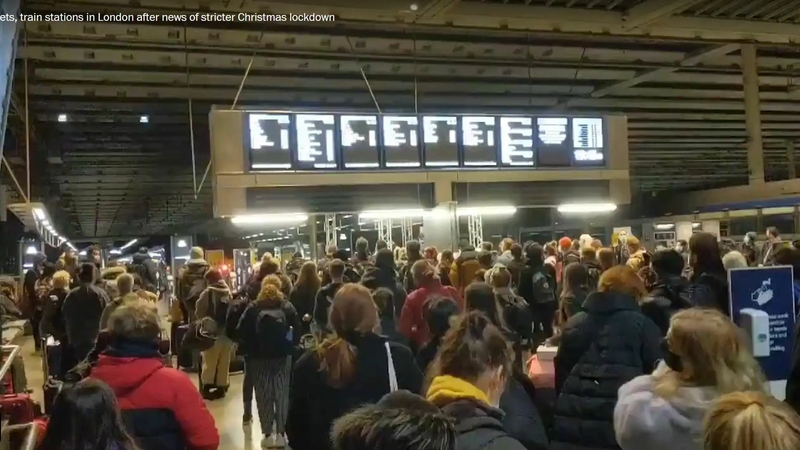
European countries – and some beyond the continent – are restricting travel from the United Kingdom amid mounting fears over an infectious new strain of the novel coronavirus first detected in England.
Austria, Belgium, Italy, Ireland, Germany, France and the Netherlands announced bans Sunday, with others expected to follow. Israel, Turkey and Saudi Arabia have also temporarily suspended flights departing from or arriving in the United Kingdom.
British officials have reported that a mutation of the virus appears to speed its transmission, and they have imposed restrictions on 18 million people in London and across southern England.
British Health Secretary Matt Hancock told the BBC on Sunday that “the new variant is out of control.”
The new strain also has been found in Australia, Denmark and the Netherlands, the BBC reported. Italy’s Health Ministry confirmed Sunday night that scientists had detected the U.K. mutation in a person who returned to Italy from Britain “in the last few days.” The ministry’s statement said that the person and close contacts were in isolation.
Germany planned to ban all air traffic from Britain late Sunday and review the ban on Dec. 31, the German Embassy in London announced. Irish Transport Minister Eamon Ryan said his nation will impose 48-hour restrictions on flights and ferries from Britain starting Monday and review the regulations Tuesday. “There is an exception for goods traffic and essential supply chain workers,” he told Virgin Media News.
Not so in France. That country’s 48-hour travel ban, which was scheduled to start Monday, included nearly all shipments of freight as well, a stricter measure than that imposed during the first wave of travel restrictions in the spring and one that was sure to cause chaos in Britain as trucks destined for France snarled on roads.
The ban is on all travel of people – “including those related to the transport of goods, by road, air, sea or rail from the United Kingdom,” the office of the French prime minister said in a statement. Only unaccompanied freight – truck trailers that are loaded onto ferries without drivers – will be allowed to continue to pass through.
The passage from Britain to France is one of the most important transport corridors in Europe, which means that food and other time-sensitive cargo may end up rotting on the side of British roads in the coming days. In a bit of dark irony, the transportation snarl is exactly what was warned if Britain cuts its last ties with the European Union on Dec. 31 without a trade deal in hand. That “no-deal” Brexit remains a risk, but the chaos may have come a few days early. The French government said that French nationals in Britain hoping to come home for Christmas may still be able to do so once the ban is lifted, and that they should get tested for the coronavirus so they can have a better chance of returning later this week.
The Netherlands was among the first to ban flights from the United Kingdom starting Sunday until at least the end of the year. Dutch health officials raised the alarm after they detected a coronavirus case with the same British strand. Belgium on Sunday ordered a 24-hour ban on flights and trains to and from the United Kingdom.
In Germany, a government spokeswoman confirmed Sunday evening that the country intends to “restrict travel options between Germany and Great Britain, as well as South Africa.”
French President Emmanuel Macron, German Chancellor Angela Merkel, European Commission President Ursula Von der Leyen and European Council President Charles Michel spoke Sunday to discuss “the latest development on virus variant and the measures related to it,” according to an E.U. official. The European Union has scheduled a crisis meeting for Monday morning to discuss the mutation.
Greece issued new rules requiring a seven-day quarantine for travelers from the United Kingdom, rather than the current three-day period, The Associated Press reported. Bulgaria also announced a ban on U.K. travelers through January, Reuters reported.
The new mutation , or variant, has significantly faster transmission rates, though experts said it does not appear to be more lethal or vaccine-resistant.
“While it seems to be more easily transmissible, we do not have evidence yet that this is a more deadly virus to an individual who acquires it,” Vivek Murthy, the Biden administration’s nominee for U.S. surgeon general, told ABC News’ “Meet the Press” on Sunday. “There’s no reason to believe that the vaccines that have been developed will not be effective against this virus, as well.”
He added: “The bottom line is if you’re at home and you’re hearing this news, it does not change what we do in terms of precautions as individuals that can reduce the spread of this virus.”
Cases have spiked in Britain. Public Health England on Sunday announced 35,928 new cases; last Sunday, the figure was 18,447. Health officials said the sharp increase was of serious concern, but it was too early to know whether it was linked to the new variant. As cases mounted, Britain on Saturday announced increased pandemic restrictions, reversing earlier hopes for a more relaxed holiday period.
The news has suddenly left travelers from the United Kingdom scrambling to return home as rules change fast. Israel on Sunday afternoon announced a new ban on passengers from the United Kingdom, Denmark, and South Africa, citing fears of the new strain. In a Twitter post Sunday night, Turkish Health Minister Fahrettin Koca, noting the uptick in British infections because of the mutation, said Turkey was temporarily suspending flights to the United Kingdom. Flights were also being suspended between Turkey and Denmark, the Netherlands and South Africa, he said, but it was not clear whether those suspensions were related to the new virus strain. Saudi Arabia also announced a suspension of international flights for at least the coming week.
Hopes for justice are fading after police killed at least 20 Kenyans while enforcing coronavirus rules
InternationalDec 21. 2020A mural in memory of Yassin Moyo, a 13-year-old boy who was shot by a police officer enforcing a coronavirus curfew in Nairobi. MUST CREDIT: Photo for The Washington Post by Sarah Waiswa
By The Washington Post · Max Bearak, Rael Ombuor
NAIROBI – On the evening of March 27, when the pandemic was new and full of terrifying unknowns, Francis Otieno switched on the news. What he saw is now seared into his mind.
Live video showed police officers beating women who were waiting for a ferry ahead of the first night of a nationwide curfew – imposed out of concern for public health – that hasn’t been lifted since. Otieno has spent all of his 23 years in Nairobi’s ghettos and said he understood the message behind the officers’ blows: We will not hesitate to kill you if you don’t comply.
The night after that, 20 minutes past the 7 p.m. curfew, police caught his 18-year-old brother, Ibrahim Onyango, and beat his face into an unrecognizable pulp. He crawled home and bled to death by morning.
“I called him earlier that night and said, ‘If they can beat women like that, they will kill you, Ibra,’ ” Otieno recalled recently. “That’s the last thing I ever said to him.”
Onyango’s killing was the first of at least 20 by Kenyan police while they enforced curfew and other coronavirus-related rules such as mandatory mask-wearing. The government’s police oversight authority said 20 had been killed. It also documented 73 severe assaults, some sexual in nature.
That count doesn’t include Onyango, whose death was never formally registered because his family sees such little hope in Kenya’s justice system for it to be worth the effort and because of the potential for further retribution. It’s indicative of what human rights groups say is likely a much higher, but hidden, toll.
Others died because of the curfew and accompanying police brutality in indirect ways that also went largely undocumented. Mothers giving birth, for instance, often couldn’t find transport to clinics as taxi drivers feared police beatings.
A spokesman for the police force, Charles Owino, didn’t deny the pandemic-era police killings but said officers weren’t out to do harm, and “if a policeman did such a thing, it’s a simple thing, make a report.”
Even if making a report could be the first step toward justice for his brother, Otieno was unswayed.
“Every day in these streets we see criminals walk free, cops and robbers, even cops who are robbers,” he said. “We want justice. But where would we even start to look for it?”
Francis Otieno stands outside his house in a Nairobi ghetto. MUST CREDIT: Photo for The Washington Post by Sarah Waiswa
Since the inception of Kenya’s police oversight body in 2011, only eight officers have been convicted of crimes, less than 1 percent of the cases it has pursued. According to Amnesty International, more than 740 Kenyans have been killed by police since 2007, including 130 already this year. A national survey in 2018 found that most Kenyans believed the biggest risk to their lives was violence by police.
Most of the pandemic-related killings occurred between late March and May. Only one case has been brought to trial: the killing of Yassin Moyo, a 13-year-old boy who was shot while sitting on his balcony with his mother, allegedly by officer Duncan Ndiema, who was enforcing curfew two days after Onyango died.
Moyo’s age and obvious innocence propelled public outrage, and numerous human rights groups, as well as the government’s police oversight body, took up the case.
But even with support, the trial has barely moved forward. Because of the pandemic, nearly all court sessions happen online, which has added to an already massive backlog of cases. Ndiema is free after paying a bail of around $9,000 – a huge amount for a poorly paid constable – that his lawyer said was paid in part by colleagues and others.
Like Otieno, Yassin’s father, Hussein Moyo Molte, came up in Nairobi’s vast expanse of slums, home to more than 2.5 million people, and knows how the system is stacked against people like him.
“The longer this case takes, the less chance of justice,” he said. “We have 10 witnesses, but with enough time, they will be killed, they will disappear, they will go quiet. That’s how it works: slow it down until the case falls apart.”
Ndiema’s lawyer, Danstan Omari, said he thought the trial would start in 2022 at the earliest.
“Cases from five years ago have not even been given a date. In that time, judges can also be transferred or retire and delay further,” he said in a phone interview.
And even then, Omari said, his defense strategy on Ndiema’s behalf is one that is sure to be hugely time-consuming, and puts the ability to stall or control the outcome of the case more firmly in the police force’s hands.
“Our position is that the bullet that shot the child is a bullet that came from a different police station. We want an inventory of guns from that police station,” he said. “We have demanded the ballistic report, but we have not received it yet.”
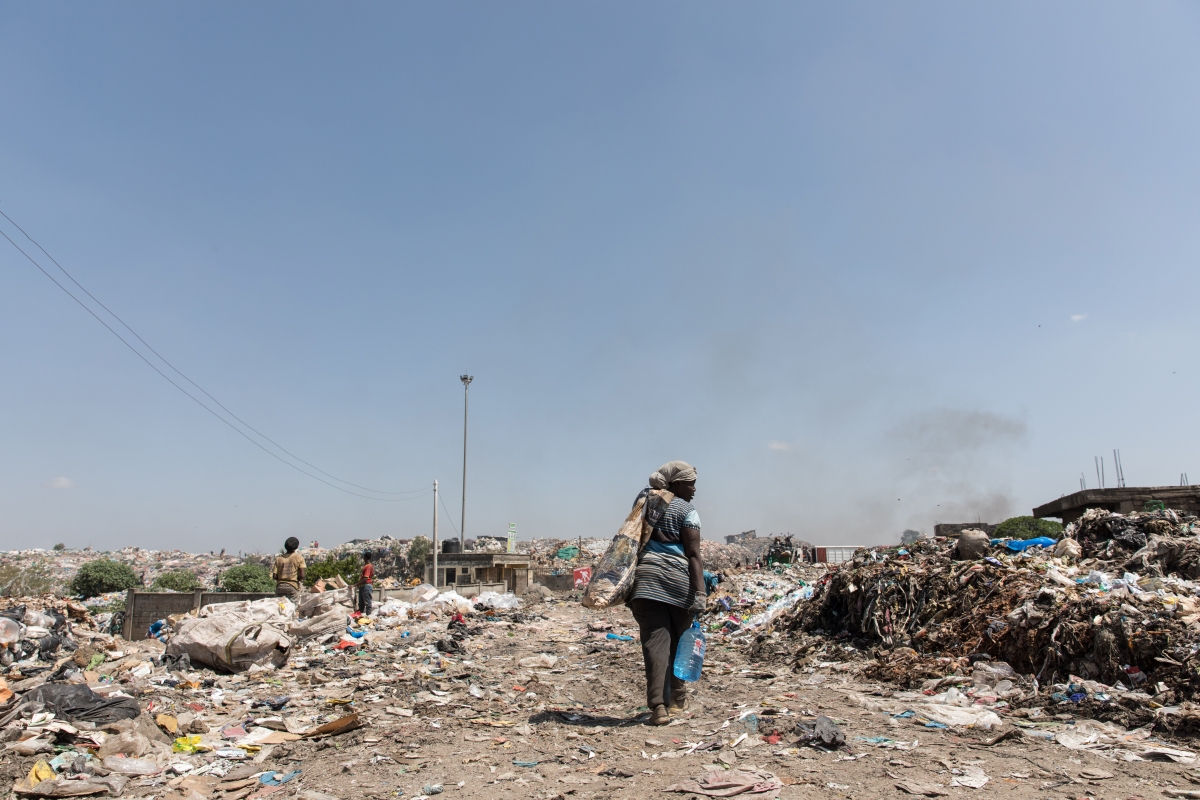
A woman walks through the dump site where Ibrahim Onyango, Francis’s brother, worked before he was killed in March. MUST CREDIT: Photo for The Washington Post by Sarah Waiswa
The lack of closure will prolong Yassin’s family’s pain, which lives right below the surface of an otherwise happy family.
On a recent day at home, Molte sat in his living room, the walls of which Yassin, a flamboyant kid who loved to dress up and strut about, had half-finished decorating with stickers, stars and butterflies. He jovially talked about his and his wife’s business selling shaved ice and little cakes, and played with his son Mukhtar, who is just 2, the youngest of their remaining six children. But at the first mention of Yassin, tears sprang to his eyes.
“Our youngest children still don’t understand,” he said. “They ask me, ‘Daddy, when is Yassin coming home from the hospital?’ “
Their three-story house is haunted by Yassin’s absence – the bunk bed that isn’t shared anymore, the end of the family’s nightly chats on the balcony where he was shot, the older sister who shared his birthday week and never wants to celebrate again.
That Yassin’s case is the best – or only – chance at justice for any of the families of those killed during enforcement of coronavirus restrictions has reinforced a disillusionment among activists working toward police reform. Many said that it bore the hallmarks of other cases that were eventually thrown out.
“What we have is a system that allows the police to investigate themselves,” said Peter Kiama, the director of the Independent Medico-Legal Unit, a collective of doctors and lawyers that support human rights causes. “So the police will execute an individual either in custody or during arrest, and they are the ones to pick up the body, take it to the morgue, and then call the medical experts to examine the body after they have already compromised the scene of crime.”
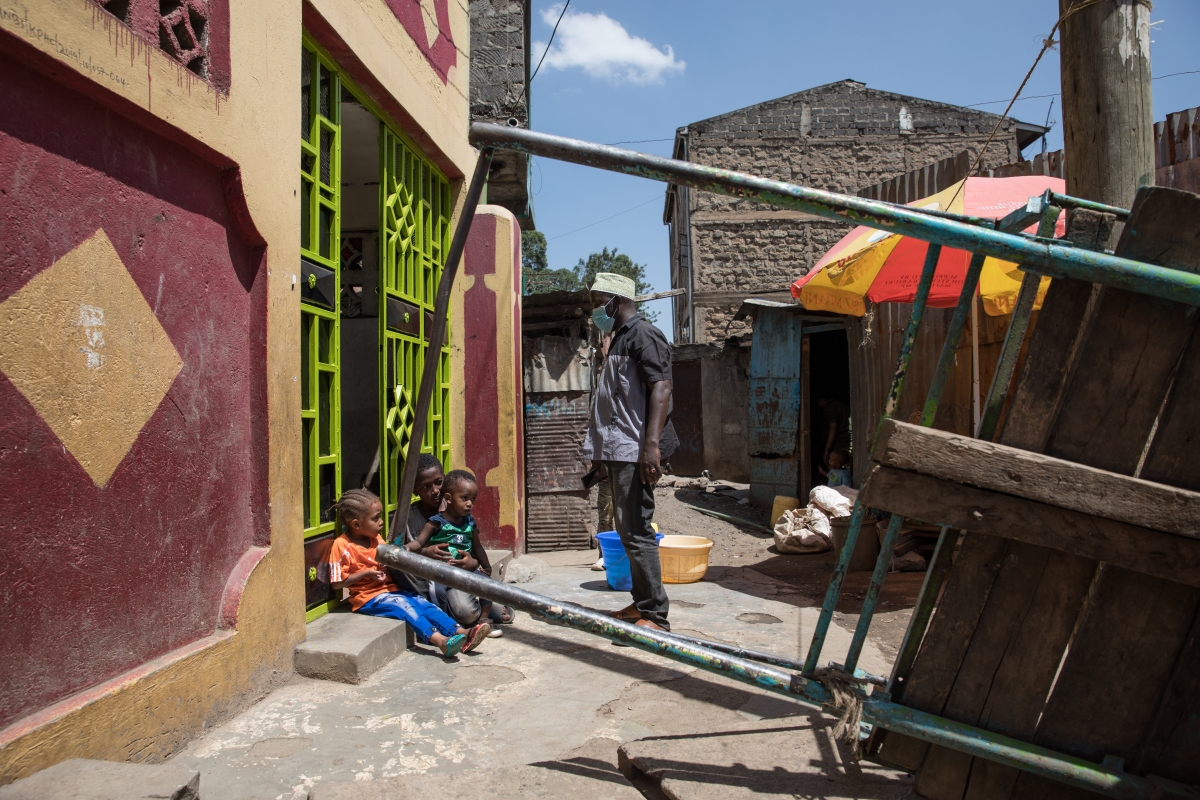
Hussein Moyo Molte talks to his three young children outside their home in Nairobi. MUST CREDIT: Photo for The Washington Post by Sarah Waiswa
In 2017, Kenya passed a law that should have created an independent forensic unit, but Kiama said it was never implemented, and his organization is the only one in the country that provides that service.
Other activists offered long lists of other challenges. No witness protection. No funding for human rights work. No safety for human rights activists who are routinely harassed. No sense of solidarity with the poor from more well-off Kenyans. No political will to reform a police force hollowed out by poor training, poor leadership and poor salaries.
“If you’ve worked a dozen cases and nothing has happened, you get discouraged,” said Gacheke Gachihi, who co-founded the Mathare Social Justice Center, a community outreach organization in one of Nairobi’s biggest slums. Instead of convictions, she said, usually the best outcome is still an unjust one: The officer gets transferred to another post.
“If you transfer them, you transfer impunity,” Kiama said. “What we do in this country is transfer impunity from one place to another, and we postpone dealing with the problem. We are living in denial that we have institutionalized police violence.”
With little recourse, both Otieno and Molte voiced desperation. Otieno, unable to hold back his tears, said his decision to let justice for his brother slip away made him feel “like this life was useless.”
Molte dreamed of taking matters into his own hands.
“But even if I met Duncan Ndiema and killed him myself, it wouldn’t bring Yassin back,” he said, his face again wet with tears.

 Egat governor Boonyanit Wongrukmit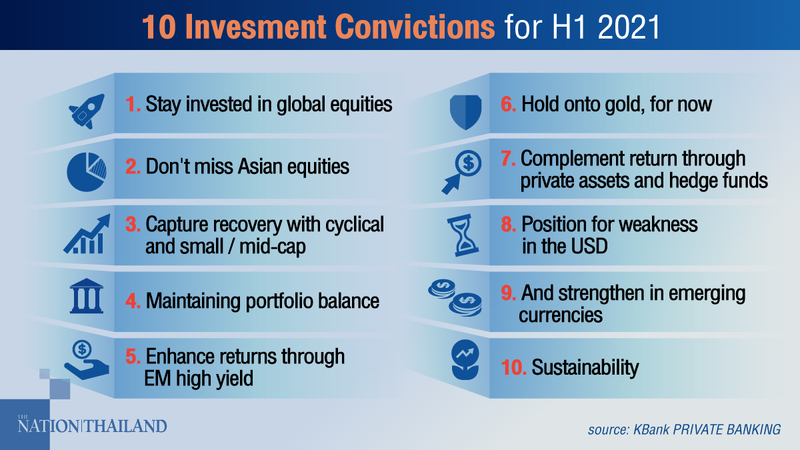


 Thai authorities place a razor wire fence around Mahachai Market where a largest cluster of Covid-19 infections originated in Samut Sakhon province.
 A young student attends an online Thunkable Inc. coding class at her home in Mumbai on Oct. 24, 2020. MUST CREDIT: Bloomberg photo by Dhiraj Singh.
 A mural in memory of Yassin Moyo, a 13-year-old boy who was shot by a police officer enforcing a coronavirus curfew in Nairobi. MUST CREDIT: Photo for The Washington Post by Sarah Waiswa
 SootinClaimon.Com