Trump drove lie that election was stolen, undermining voter trust in outcome #SootinClaimon.Com

#SootinClaimon.Com : ขอบคุณแหล่งข้อมูล : หนังสือพิมพ์ The Nation.

Trump drove lie that election was stolen, undermining voter trust in outcome (nationthailand.com)

Trump drove lie that election was stolen, undermining voter trust in outcome

InternationalDec 21. 2020Supporters of President Donald Trump rally against the election results outside the Georgia Capitol in Atlanta on Saturday, Nov. 7, 2020. MUST CREDIT: Photo for The Washington Post by Kevin D. LilesSupporters of President Donald Trump rally against the election results outside the Georgia Capitol in Atlanta on Saturday, Nov. 7, 2020. MUST CREDIT: Photo for The Washington Post by Kevin D. Liles 

By The Washington Post · Amy Gardner

WASHINGTON – Elena Parent, a Democratic state lawmaker from the Atlanta area, listened incredulously in a small hearing room in early December as a stream of witnesses spun fantastical tales of alleged election fraud before the Georgia Senate’s Judiciary Committee.

A retired Army colonel claimed that the state’s voting machines were controlled by communists from Venezuela. A volunteer lawyer with President Donald Trump’s campaign shared surveillance video that she said showed election workers in Atlanta counting “suitcases” of phony ballots that swung Georgia’s election to former vice president Joe Biden. The president’s personal lawyer Rudy Giuliani told the panel: “Every single vote should be taken away from Biden.”

“Since this has been debunked repeatedly, what evidence can you give to us that counters what our elections officials presented us with only an hour ago?” Parent asked one of the witnesses, her voice rising in exasperation. When she tried to ask a follow-up question, the Republican committee chairman cut her off.

Her questions – and the fact that the claims were misleading, unsubstantiated or just plain false – did little to keep the rumors in check. It did not matter that state and local election officials had explained what was in the video and conducted a hand recount to show that the machines were not rigged. It did not matter that news outlets detailed, over and over, that there was no evidence of widespread fraud. It did not matter that, amid a global pandemic and massive demand for mail ballots, a system under historic strain in fact held up decisively.

To preserve his hold on power, Trump has spent the weeks since Election Day promoting falsehoods about voting problems in Georgia and five other states, successfully persuading tens of millions of his supporters to believe a lie – that the election was stolen from him, and from them.

He has done so by harnessing the power of his position, using his pulpit at the White House and his Twitter feed to let loose a fusillade of conspiracy theories. His assault on the integrity of the election has gotten a hefty assist from pro-Trump media outfits and an assortment of state lawmakers and lawyers who gave oxygen to the debunked allegations – and a majority of congressional Republicans, who called on the Supreme Court to overturn the results in four states.

Trump is continuing to press his case, even now that the electoral college has formally elected Biden. In a meeting with allies on Friday, the president discussed deploying the military to rerun the election and appointing attorney Sidney Powell, whose conspiracy theories about election fraud have been widely discredited, as a special counsel to investigate the outcome.

Along the way, Trump has willfully damaged two bedrocks of American democracy that he has been going after for years: confidence in the media as a source of trusted information and faith in systems of government. It might be one of his lasting legacies.

A Fox News poll released Dec. 11 shows that more than a third of registered voters believe the election was stolen from Trump – a number that rises to 77% among those who voted for Trump. Conversely, 56% of voters believe Trump weakened American democracy by contesting election results in various states, with the number rising to 85% among those who voted for Biden, according to the poll.

Trump’s campaign spokesman Tim Murtaugh declined to answer specific questions about the damage the president has done or the untruths he has embraced.

“President Trump owes it to the 75 million Americans who voted for him – and to those who voted for Joe Biden – to ensure that the election was free, fair and secure,” he said.

Even now that the electoral college has voted, and the GOP’s top leaders have publicly accepted Biden’s victory, both major political parties and the country overall must reckon with the mark Trump has left on American democracy. Biden will start his presidency with nearly half the country believing he is not the legitimate occupant of the White House. Many Americans who voted against Trump and have watched with horror as he has tried to subvert the results are equally disillusioned about the strength of the system, which they fear could have toppled but for the courage of election officials, state Republicans and judges who held the line.

Few anticipate that the mistrust and divisions will fade with the 45th president’s departure from the White House. One reason: The most ardent purveyors of unfounded accusations say they have no plans to back down.

“The fact is that President Trump was reelected by what will be known soon to be a landslide victory unparalleled in this country,” said Lin Wood, a Georgia lawyer and Trump ally who has filed unsuccessful lawsuits on the president’s behalf.

Wood said he spoke to the president in a phone call this month, encouraging him not to concede in what he described as “a battle between good and evil.”

Nathaniel Persily, a professor at Stanford University’s law school and co-director of the Stanford-MIT Healthy Elections Project, said that kind of rhetoric has emboldened some in the country to doubt the results merely because their preferred candidate lost.

“We’re entering a very dangerous phase where a sizable share of the population has no faith in the basic mechanics of the democracy,” Persily said. Millions of voters, he added, now see the fight over who should lead the country as a function of “the willingness to exert power as opposed to playing by fair rules of the game.”
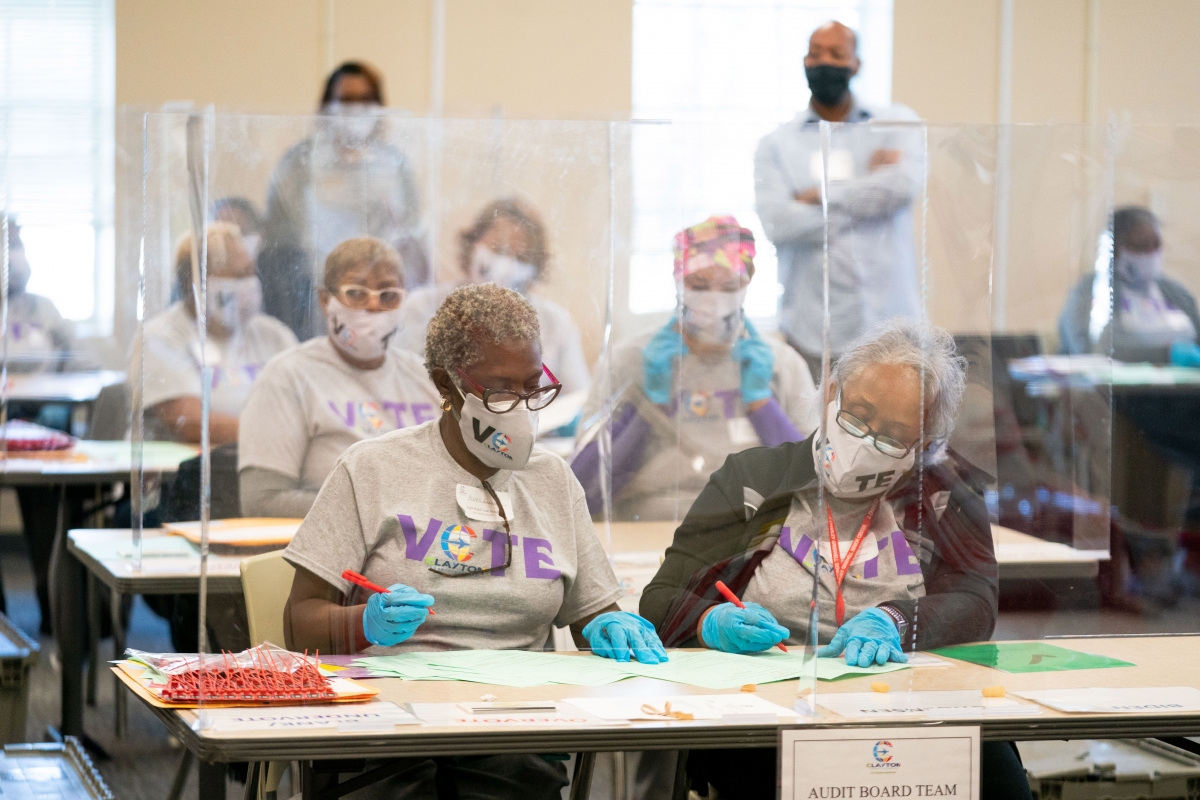
Clayton County, Ga., election workers recount votes by hand on No. 13, 2020. MUST CREDIT: Photo for The Washington Post by Kevin D. Liles

Clayton County, Ga., election workers recount votes by hand on No. 13, 2020. MUST CREDIT: Photo for The Washington Post by Kevin D. Liles

Trump has demonstrated a unique capacity to rally supporters to his war cries, even when they are false or unproven. He gained notoriety nearly a decade ago as the leader of the so-called birther movement, asserting falsely that then-President Barack Obama was not born in the United States.

This year, Trump’s obsession with election fraud has tested his followers anew, and their willingness to go along with him has shown how powerful his hold is on the GOP.

The president’s false claims about voting ramped up in the early days of the coronavirus pandemic, when election officials were gearing up for a historic surge in mail balloting. He got help from a chorus of Republican allies, who echoed and amplified his untruths on the campaign trail, on conservative television and in state capitols in key battlegrounds.

In the days after the election, his rhetoric defied logic as he cited more and more outlandish accusations and echoed unverified Twitter accounts. “They are finding Biden votes all over the place – in Pennsylvania, Wisconsin, and Michigan,” Trump tweeted on Nov. 4, suggesting falsely that ballots still being counted a day after the election were fraudulent. “So bad for our Country!”

On Nov. 30, the president retweeted an account named @Catturd2 that claimed in Arizona, “Truck Loads of Ballots Kept Coming in For 10 Days After Elections Officials Thought They Were Done Counting.”

Many of his increasingly outrageous accusations – blasted out to his 89 million followers on Twitter – came straight from one of his new favorite news sources, One America News.

“Pennsylvania Poll Watcher: USB Drives uploaded to machines, gave Biden thousands of votes,” the president tweeted on Nov. 27.

Dec. 16: “Study: Dominion Machines shifted 2-3% of Trump Votes to Biden. Far more votes than needed to sway election.”

Trump and his allies also claimed to have scores of “affidavits” alleging fraud on a massive scale. But the sworn statements his campaign and his allies submitted in lawsuits contained meaningless observations, such as one complaint in Michigan that a “man of intimidating size” had followed a poll watcher too closely, and another who said a public address system was too loud and therefore “distracting to those of us trying to concentrate.”

Trump and his allies have lost overwhelmingly when they tried to overturn Biden’s victory through the courts, with at least 88 judges across the country ruling against them either on procedural grounds or on the merits in more than 50 cases. The president’s campaign on Sunday said it was filing a new petition with the Supreme Court seeking to overturn the result in Pennsylvania, challenging state voting procedures similar to those that the court has declined to act on.

Even as his accusations have collapsed under scrutiny, they have gained traction among his most ardent supporters.

They have been spurred on by Trump-supporting cable and online news outlets such as OAN and Newsmax, which touted unfounded theories about the Dominion machines, dead people voting and poll workers in Michigan allegedly covering up windows with cardboard to prevent observers from watching the process.

At a rally in Valdosta, Ga., this month for two Republican senators facing a runoff election on Jan. 5, Trump paused his speech and turned to giant screens that played misleading news reports on fraud. Thousands in the crowd watched the videos, rapt.

Trump’s arguments made sense, his supporters said. They could not believe that Biden fared better than Obama had in his races, and they were suspicious that Trump was ahead in some states on Election Day but fell behind as mail ballots were counted – either unaware or untrusting of news reports explaining why that was expected.

“Do you truly believe that Joe Biden got more votes than Barack Obama?” asked Wendy Mick, 53, who traveled from New Jersey to a “Stop the Steal” rally in the District of Columbia on Dec. 12, and said Newsmax and OAN are her new preferred sources for political news. “He never campaigned. There’s no way that Biden got so many votes.”
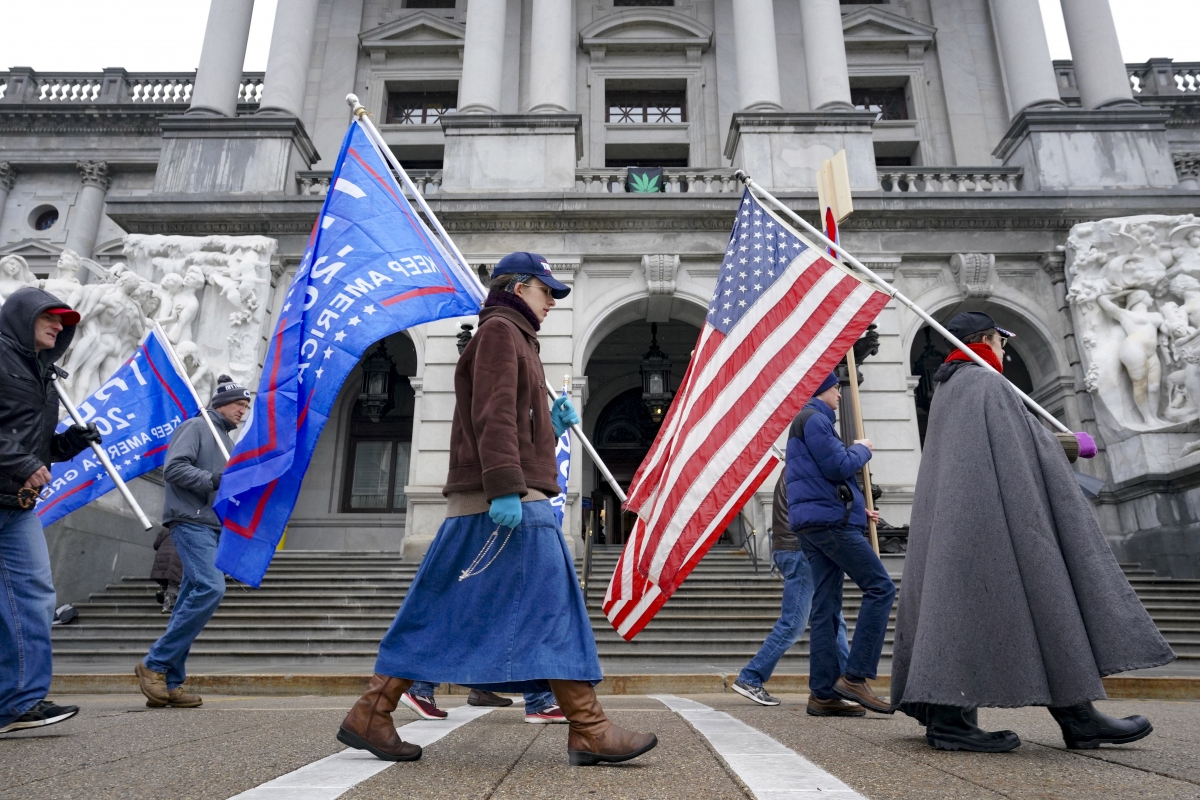
Trump supporters pray and sing during a demonstrations outside the Pennsylvania Capitol in Harrisburg on Monday, Dec. 14, 2020. MUST CREDIT: Washington Post photo by Bonnie Jo Mount

Trump supporters pray and sing during a demonstrations outside the Pennsylvania Capitol in Harrisburg on Monday, Dec. 14, 2020. MUST CREDIT: Washington Post photo by Bonnie Jo Mount

The relative silence of Republican lawmakers in the initial days after the election, in states and on Capitol Hill, quickly gave way to a flood of support for Trump’s posture.

A stock line emerged among Republican leaders who refused to acknowledge Biden’s win: The president has the right to pursue all legal avenues available to him.

But Trump has done more than pursue all legal avenues. He has openly cajoled his supporters to join the fight. And they did.

In Maricopa County, Ariz., home of Phoenix, his supporters lashed out at local election officials, accusing them without evidence of improperly verifying signatures, switching Trump votes to Biden votes on duplicate ballots and keeping observers too far away from ballot-counting to see anything.

In Wisconsin, they claimed that the use of drop boxes for mail ballots was illegal. With most municipal offices closed to the public because of the pandemic, many city clerks set up secure drop boxes not just for ballots but for other city business such as utility bills.

“I had customers dropping off absentee ballots and saying, ‘How are you going to differentiate my ballot from a utility bill?’ and I thought, ‘Wow, you must really think I’m dumb that I can’t differentiate a ballot envelope from a utility bill,’ ” said Lori Stottler, the city clerk in Beloit, Wis., on the Illinois border. “But then I thought, ‘Well, they don’t know what I do.’ And I took a step back and I tried to explain.”

Pennsylvania House Speaker Bryan Cutler’s Facebook page was inundated with demands from constituents that he reverse Biden’s win in the state. Protesters also gathered outside his rural home in Lancaster County on Dec. 5 with bullhorns and signs.

“Petition your governor for a special session!” an organizer shouted toward the Republican lawmaker. “Why haven’t you petitioned him?”

“Do your job!” the crowd chanted back. “Do your job! Do your job!”

Rep. Seth Grove, a Republican lawmaker from York County, Pa., said a conservative activist confronted him at the Capitol in Harrisburg, demanding that the legislature take action to seat Trump’s electors – even though state law does not allow such a move.

Grove said he was stunned when the longtime tea party organizer proclaimed, “You know, the Constitution doesn’t limit government!”

It was a reminder, Grove said, of how much power Trump has amassed over the Republican electorate, to the point that some of his supporters are no longer guided by political principles they have claimed adherence to in the past.

“It shocked me,” Grove recalled. “Shocked me.”

Lawmakers in Arizona and Pennsylvania rebuffed the president’s efforts to stage official hearings to examine potential fraud. But back benchers in both states assembled media spectacles in hotel ballrooms, labeling them hearings but presenting “witnesses” that were not under oath and offering no evidence for their claims.

Republican lawmakers in Michigan and Georgia did hold official hearings, giving Giuliani an additional platform to unspool false claims.

“I know they are under a lot of pressure from their base, from the lies being spun by Trump and his enablers, right-wing media, etc., but it was really disappointing,” said Parent, the Georgia senator. “The hearing was obviously a sham that wasn’t designed to answer any questions about the election.”

Republicans on the committee did not respond to requests for comment.

One witness at the Michigan hearing, Mellissa Carone, gained notoriety for a stream of unfounded accusations, including one claim that she’d seen a van pull up to a Detroit vote-counting center that was meant to bring in meals for election workers but was actually filled with phony ballots. Carone had previously been deemed “simply not credible” by a state judge.

Trump lashed out at those who refused to bend to his will. He called Georgia Secretary of State Brad Raffensperger, a Republican, an “enemy of the people” for not embracing the president’s accusations of fraud. He accused the Michigan secretary of state, Democrat Jocelyn Benson, of “breaking the law” by rigging voting machines.

And he threatened Georgia Gov. Brian Kemp, a Republican, with a primary challenge in 2022 for not helping him reverse the outcome – even though Kemp had explained in a contentious phone call that he did not have the power to do so.

Trump’s rhetoric has spurred some of his supporters to do more than protest.

Raffensperger and his wife began receiving death threats and accepted a state security detail at their home in suburban Atlanta. Protesters trespassed at Benson’s home in Detroit, some armed with bullhorns and some with guns, ignoring neighbors’ pleas to go home because they were scaring children, including Benson’s 4-year-old son.

In Houston, a former police captain was arrested Tuesday after allegedly slamming into an air-conditioning repairman’s truck to thwart what he said was a vast election-fraud scheme. The man, Mark Anthony Aguirre, was paid $250,000 by a right-wing organization to pursue fraud conspiracy theories and believed that the truck contained 750,000 fake ballots, police said.

The truck contained air conditioning parts.

– – –

Vanishingly few national Republicans have been willing to stand up to the false statements, despite privately acknowledging that the election is over. “The future will take care of itself,” Senate Majority Leader Mitch McConnell, R-Ky., told reporters in early December, refusing to acknowledge that Biden had won.

In Pennsylvania, Republican lawmakers who had initially resisted the president’s entreaties wound up signing on to an emergency petition to the Supreme Court that sought to overturn Biden’s win in the state, though they never cited fraud in their filing. They also sent a letter to Congress urging federal lawmakers to reject Pennsylvania’s electoral votes when they convene Jan. 6.

Grove, the GOP lawmaker from Pennsylvania, said he and other Republicans had assumed that the letter would go nowhere. A challenge requires support from a member of both the House and Senate, but Grove and others incorrectly thought they had to be from the state in question, and they knew that Pennsylvania’s two senators, Republican Pat Toomey and Democrat Bob Casey, would not support it.

“We didn’t know that anyone can do it from any state,” Grove said. “That was a surprise.”

Congressional Republicans also began echoing Trump’s claims; 126 of them ultimately signed on to an emergency petition to the Supreme Court seeking to overturn results in four states Biden had won.

“The fraud happened,” said Sen. Rand Paul, R-Ky., at a hearing last week in Washington to examine election irregularities.

Sen. Ron Johnson, R-Wis., who called the hearing despite acknowledging after the electoral college vote that Biden had won a legitimate election, declared at the start of the proceeding: “There was fraud in this election. I don’t have any doubt about that.”

That idea that something went wrong with the vote this year has taken hold among many Americans.

Anna Van Winkle, a retired aesthetician in Savannah, Ga., who voted for Trump, has accepted her candidate’s defeat, but she believes lawmakers must fix the election process to make sure such broad doubt in the outcome cannot happen again.

“My concern is that we don’t go down this road again,” she said. “We had a problem. We had a big problem. And now, going forward, the best way to deal with this is to fix this where somebody like me is not going to wonder, ‘OK, was there fraud here?’ “

Van Winkle was perplexed when she received multiple absentee ballot request forms at her address, and she worries that others willing to commit ballot fraud would have been able to do so by requesting more than one ballot. Although Georgia requires identification to request a ballot online – and signature matching on ballots themselves – Van Winkle does not understand why states do not require mail voters to get their ballots notarized.

Voting-right activists, meanwhile, are concerned that such sentiments will now be cited as an excuse to try to erect new barriers to casting ballots.

GOP lawmakers in Georgia have already floated a proposal to eliminate no-excuses absentee balloting, meaning only those with a qualifying reason such as illness or an overseas assignment could vote by mail. In Texas, lawmakers have filed bills to limit distribution of absentee ballot applications and make it a felony to help voters fill out ballots. Pennsylvania Republicans have discussed tighter identification requirements for mail ballots and signature matches.

Defenders of this year’s elections also recognize the need to shore up public confidence. Sen. Amy Klobuchar, D-Minn., who advocated unsuccessfully for billions of dollars in election aid for states this year, believes Congress must act to curtail misinformation on social media companies, which she said fell short in their civic obligation to restrict false claims on their platforms.

Klobuchar said she was heartened by the Republicans who immediately acknowledged Biden’s win, by those who did so after the electoral college vote and by the dozens of judges across the country, many of them Republican appointees, who roundly rejected the fraud claims of Trump and his allies.

“All of those things mean our democracy is working during a really hard time,” she said.

But there remains the reality that Trump and millions of his supporters still refuse to accept Biden’s win, creating a disturbing precedent, Klobuchar said, in a political system that has prided itself on the peaceful transfer of power and acknowledgment of election results.

“I’m concerned about our democracy in the long run if these civil mores change,” she said, “so people don’t even have to tell the truth about who won.”
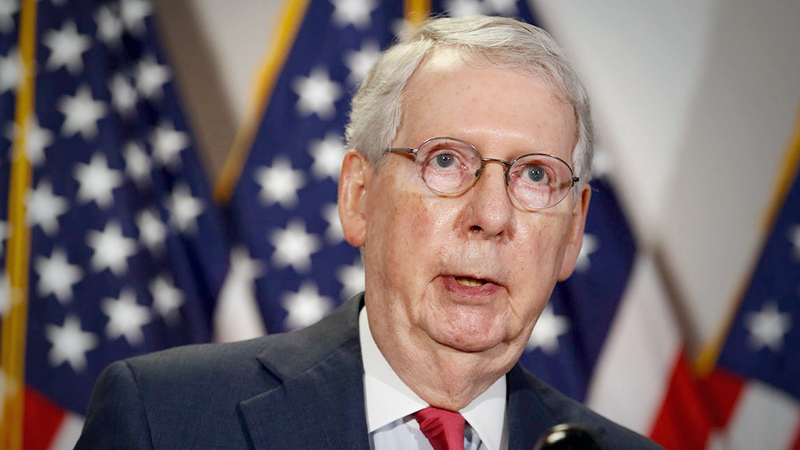
McConnell announces agreement on nearly $900 billion coronavirus relief package #SootinClaimon.Com

#SootinClaimon.Com : ขอบคุณแหล่งข้อมูล : หนังสือพิมพ์ The Nation.

McConnell announces agreement on nearly $900 billion coronavirus relief package (nationthailand.com)

McConnell announces agreement on nearly $900 billion coronavirus relief package

InternationalDec 21. 2020

Mitch McConnell

Mitch McConnell

By The Washington Post · Jeff Stein, Mike DeBonis, Paul Kane

WASHINGTON – Senate Majority Leader Mitch McConnell announced late Sunday night that lawmakers have finalized an approximately $900 billion economic relief package.

“More help is on the way. Moments ago, in consultation with our committees, the four leaders of the Senate and House finalized an agreement for another major rescue package for the American people,” said McConnell, R-Ky.

He said lawmakers only have to “promptly finalize text” and “avoid any last-minute obstacles.”

Lawmakers have for month sought a breakthrough on economic relief legislation.

House Speaker Nancy Pelosi, D-Calif., told her leadership team earlier in the day that she wanted a vote Sunday, according to one person who spoke on the condition of anonymity to share details of the congresswoman’s private comments. Congress has until midnight to pass a temporary stopgap measure to keep the government open.

Negotiators have decided to provide stimulus checks worth $600 per person. The size of that benefit would be reduced for people who earned $75,000 the preceding year, similar to the last round of stimulus checks, according to two people who spoke on the condition of anonymity to share details of private deliberations. The stimulus checks would provide $600 per person, including adults and children, meaning a family of four would receive $2,400 up to a certain income.

Congress would also extend unemployment benefits of up to $300 per week, which could start as early as Dec. 27.

While there’s broad agreement on stimulus checks and unemployment insurance, officials say nothing is final until the bill text is released. That may come as early as Sunday afternoon. Other policy disputes remained outstanding, according to aides close to negotiations, which could push the timeline back again.

House leaders are exploring another stopgap measure that would fund the government while also giving them seven days to file technical corrections to the legislation if necessary. They would still plan on pass the relief package within 24 hours.

At 12:18 a.m. on Sunday, President Donald Trump tweeted that Congress needs to give “more money in direct payments.” The Washington Post reported last week that White House aides talked Trump out of issuing a public statement demanding stimulus checks as big as $2,000 out of fear that he would sink the delicate negotiations.

Congressional lawmakers appeared ready to ignore the president’s demands. People close to negotiations said they did not expect the White House to oppose the package over Trump’s push for larger stimulus payments, though Trump has repeatedly scrambled congressional negotiations with last-minute demands.

Lawmakers have agreed in principle to new stimulus payments. Sens. Bernie Sanders, I-Vt., and Josh Hawley, R-Mo., as well as Trump, have made a push for more generous stimulus checks, but those efforts are unlikely to be successful.

The income criteria for the stimulus checks is expected to reflect that of the first round of stimulus payments sent by the Treasury Department this year. The payment would be smaller for those who earned more than $75,000 in 2019 and disappear altogether for those who earned more than $99,000.

Adult dependents are not expected to qualify for the stimulus payments, people familiar with the negotiations said, despite a push from congressional Democrats. The deal would include stimulus payments for families in which one of the parents is not a citizen.

The deal over extending federal jobless benefits for millions of unemployed Americans at a level of $300 per week would cover up to 11 weeks of unemployment, at least through March 14, aides familiar with the negotiations said. An unemployment benefits program for contract and gig workers, which is also set to expire at the end of the year, would be extended for 11 weeks for those workers.

Negotiators also agreed to extend the deadline for states and cities to use unspent money approved for them by the Cares Act, two people familiar with internal deliberations said. States and cities have until the end of the year to spend billions of dollars before it expires and has to be returned to the federal government. The deal would instead extend that deadline for a full year.

Republicans have successfully opposed Democrats in their demands for hundreds of billions of dollars in state and local aid. Many local governments are experiencing steep declines in tax revenue and have been warning of layoffs. Extending the deadline for using leftover funding from the Cares Act, however, allows Democratic lawmakers to say that they still provided some relief to ailing municipalities.

The bill would extend for one month a moratorium on evictions that is set to expire at the end of the year, two people with knowledge of the matter said. The moratorium would be extended through January, at which point Democrats believe the incoming Biden administration could extend it again. The legislation would also provide about $25 billion in emergency assistance to renters, the people said, though it remained unclear how that money would be disbursed.

Lawmakers had also appeared to resolve a dispute over whether businesses that received Paycheck Protection Program loans, and had them forgiven, will be allowed to deduct the costs covered by those loans on their federal tax returns. Sen. John Thune, R-S.D., the No. 2 ranking Republican senator, said the costs would be deductible under the final agreement.

Other hurdles to a deal remain under discussion, according to the aides close to negotiations. For instance, Pelosi told Democratic lawmakers Saturday that the parties remained divided over how much aid to provide for hungry Americans.

Even if leaders are able to resolve remaining sticking points on Sunday, it may take more time for congressional staff members to draft those agreements into legislative text and prepare the massive bill for votes in the House and the Senate. Lawmakers had also not yet released text of the agreement between senior Democrats and Sen. Pat Toomey, R-Pa., over the central bank, which was a sticking point Saturday.

Lawmakers had hoped to vote this weekend on legislation to fund the government along with the broader relief package. Bill language had not materialized by Sunday morning.

The emerging legislative package is expected to also devote as much as $330 billion in small-business aid and allocate tens of billions of dollars to an array of other critical needs, such as transportation agencies, distressed renters and hungry people.

A compromise proposal this month by Sens. Mitt Romney, R-Utah, and Joe Manchin, D-W.Va., among other centrist lawmakers, would have provided 16 weeks in unemployment benefits instead of the 11 weeks under the current agreement.

The push for an approximately $900 billion relief plan gained new momentum Saturday night as lawmakers resolved a dispute over a Republican plan to rein in the Federal Reserve.

As part of his proposal, Toomey wanted the Fed’s lending programs for businesses and local governments to be cut off at the end of the year, and to ensure that no similar programs could be propped up later.

While Toomey and Republican leadership held firm for much of Saturday, Democrats chastised the plan, saying it stretched far beyond specific programs propped up under the Cares Act. They also said the GOP was undermining the Fed’s ability to fight future crises, and with it, the incoming Biden administration.

Despite hopeful statements from leadership on timing of passing the relief legislation, other lawmakers, including Sen. John Cornyn, R-Texas, have cast doubt that Congress could pass the measure on such an accelerated timetable.

Shipments of second coronavirus vaccine roll out as officials warn about Christmas surge in cases #SootinClaimon.Com

#SootinClaimon.Com : ขอบคุณแหล่งข้อมูล : หนังสือพิมพ์ The Nation.

Shipments of second coronavirus vaccine roll out as officials warn about Christmas surge in cases (nationthailand.com)

Shipments of second coronavirus vaccine roll out as officials warn about Christmas surge in cases

InternationalDec 21. 2020

By The Washington Post · Paulina Firozi

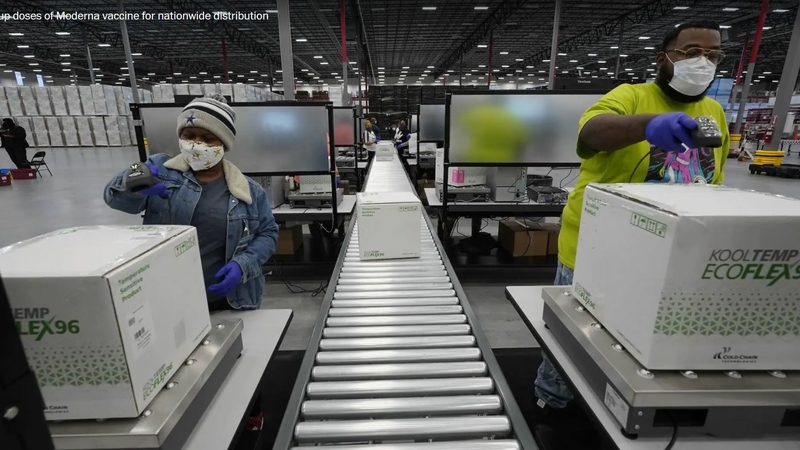
The latest leg of a massive vaccination effort took place in a distribution center in Olive Branch, Miss. There, vials with the nation’s second coronavirus vaccine were loaded into boxes, ready to head out across the country to help states gripped by the surging pandemic.

https://www.washingtonpost.com/video/c/embed/21c3ea3d-2b93-430b-84e7-d31d3f6d1b71?ptvads=block&playthrough=false

Shipments of the second vaccine, developed by Massachusetts biotechnology company Moderna in partnership with the National Institute of Allergy and Infectious Diseases, are set to arrive in states beginning on Monday. The Food and Drug Administration gave emergency authorization to Moderna’s shot Friday, one week after granting emergency authorization to the first vaccine by Pfizer and BioNTech.

The vials will provide another tool in the fight against the pandemic that has killed more than 316,000 people in the United States – a death toll that is precipitously rising, as some states report unnerving numbers and set daily records. The vaccine is another two-shot regimen and will be easier to transport because it can be stored at normal freezer temperatures, while Pfizer’s shots need to be kept at ultracold temperatures

But officials warn the nation is still reeling from infections seeded over Thanksgiving and worry about additional surges that could follow the December holidays.

“Unfortunately, it will get worse,” Moncef Slaoui, chief science adviser to the White House’s effort to develop a vaccine, said in an interview on CNN’s “State of the Union.” “There will be a continuing surge. Exactly what the numbers may be, I don’t know. But, unfortunately, they’re going to be higher than what they are today, most likely.”

But, Slaoui added: “There is light at the end of tunnel.”

He said he expected the first shot of the latest vaccine to be doled out on Monday, as 7.9 million total doses of the Moderna and Pfizer vaccines are set to be shipped this week.

Adm. Brett Giroir, assistant secretary of health and human services, urged Americans to continue to take precautions ahead of the holidays.

“Really, the lives of tens of thousands of Americans depend on what we do. And you know what to do,” he said during an interview on ABC News’s “This Week.” “It’s wearing a mask when you’re in public, physically distancing, washing your hands. If you’re having holiday gatherings, please do them safely. Try to limit them to your immediate household. And if you don’t, wear masks inside, improve the ventilation.”

He said while widespread vaccination will eventually end the pandemic, “we’ve got a lot of work to do, or it’s going to be an even darker winter.”

President-elect Joe Biden and his wife, Jill, will receive the vaccine on Monday. Vice President-elect Kamala Harris and her husband, Doug Emhoff, will get their first vaccine shots the following week. Vice President Mike Pence, as well as numerous congressional leaders, received their shots on Friday.

President Donald Trump has not announced vaccination plans. In a tweet on Dec. 13, he said, “I am not scheduled to take the vaccine, but look forward to doing so at the appropriate time.”

Giroir suggested the president’s vaccination would encourage his supporters to get their shots as well.

“I would encourage the president to get a vaccine for his own health and safety and also to generate more confidence among the people who follow him so closely,” Giroir said.

Surgeon General Jerome Adams, in an interview on CBS News’s “Face the Nation,” cited the antibody treatment Trump received after contracting the coronavirus earlier this year as a reason the president has not yet received a vaccine.

“From a scientific point of view, I will remind people that the president has had covid within the last 90 days,” Adams said. “He received the monoclonal antibodies. And that is actually one scenario where we tell people maybe you should hold off on getting the vaccine, talk to your health provider to find out the right time.”

The White House did not immediately respond to an inquiry about whether the president has made plans to get a coronavirus vaccine.

During his interview on CNN, Slaoui said it is “appropriate” for people who have already been infected with the virus to get vaccinated. “It’s safe,” he said, adding that being infected with the virus “doesn’t induce a very strong immune response and it wanes over time.”

Trump administration officials have eyed a midyear timeline for when a large proportion of the population could be vaccinated. Giroir expressed confidence on Sunday that by June, “anyone in America who wants to have a vaccine will have that opportunity to have a vaccine.”

Biden’s surgeon general pick, Vivek Murthy, who served in the role during the Obama administration, warned a late spring timetable for mass vaccination may be too optimistic.

“If everything goes well, then we may see a circumstance where by late spring, you know, people who are in lower-risk categories can get this vaccine, but that would really require everything to go exactly on schedule,” Murthy said on NBC News’s “Meet the Press.” “I think it’s more realistic to assume that it may be closer to midsummer or early fall when this vaccine makes its way to the general population. So, we want to be optimistic, but we want to be cautious as well.”

Biden nominees mount charm offensive amid tough confirmation landscape #SootinClaimon.Com

#SootinClaimon.Com : ขอบคุณแหล่งข้อมูล : หนังสือพิมพ์ The Nation.

Biden nominees mount charm offensive amid tough confirmation landscape (nationthailand.com)

Biden nominees mount charm offensive amid tough confirmation landscape

InternationalDec 20. 2020President-elect Joe BidenPresident-elect Joe Biden 

By The Washington Post · Amy B Wang · NATIONAL, POLITICS, CONGRESS, WHITE HOUSE 

Janet Yellen, President-elect Joe Biden’s pick for treasury secretary, spoke to three trade and advocacy groups this week about her plans for healing the economy. Health and human services nominee Xavier Becerra appeared on Politico Live to stress his concern about health-care inequities. Linda Thomas-Greenfield, tapped to be U.N. ambassador, met with Republican Sen. Bill Cassidy and won his backing.

And taken together, Biden’s appointees have held more than 100 Zoom meetings with lawmakers, both Democrats and Republicans, in the past week alone. 

This multifaceted charm offensive reflects the transition team’s attempts to smooth the tough confirmation landscape the nominees will soon face in the Senate, a potentially hostile environment exacerbated by a narrow partisan divide and ongoing bitterness from the Trump era, with some Republicans still questioning Biden’s win.

That makes the confirmation battles, set to start well before Inauguration Day, the first real testing ground for post-Trump politics. They will show if Biden can win over Senate Republicans, if Majority Leader Mitch McConnell can stymie Biden, and if individual senators, especially Republicans hoping to run for president in 2024, can attract a following by vocally attacking Biden’s efforts. 

Critical and potentially controversial picks are still expected in coming days, including for attorney general and CIA director. The Biden team’s courtship, meanwhile, is complicated by the covid-19 pandemic, as casual drop-bys in senators’ offices are replaced by far less intimate Zoom introductions and virtual roundtables. But the Biden transition team sees no alternative.

“We will have more of that in the coming weeks,” said Biden spokeswoman Jen Psaki. “It’s important for us to have the nominees and team out there as much as possible so the American people can get to know them even in advance of their confirmations.”

Some of Biden’s picks have quickly attracted resistance, and not just from the right. Some Democrats worry that Lloyd Austin’s recent military career makes him an unsuitable pick for defense secretary. Republicans are protesting Neera Tanden, Biden’s choice as budget director, because of previous tweets slamming GOP politicians. Tom Vilsack, in line to reprise his role as agriculture secretary, faces objections from Black leaders and liberal activists who want a new direction for that department.

And some confirmations could hinge on which party controls the Senate, which will become clear only after the results are finalized in Georgia’s two Senate runoffs on Jan. 5.

Given the crises wracking the country, Biden’s aides say it’s vital that they have key Cabinet secretaries in place on Inauguration Day or soon after – a feat that is not unusual but is far more difficult when the opposing party controls the Senate. Such speed may be a tall order for Republicans, many of whom remain loath to even acknowledge Biden’s win out of loyalty to President Donald Trump, who has refused to concede and continues making baseless claims of voter fraud.

While more Republican lawmakers are calling Biden president-elect since the electoral college formalized his win on Monday, some have twisted themselves into verbal pretzels to avoid using that title, and others suggest they will never accept Biden as the legitimate president. McConnell himself was silent for six weeks after Election Day before acknowledging Biden as the incoming president.

That could delay the scheduling of committee hearings on the nominees.

“What we’re seeing now is Republican senators making it clear that, at least at this stage, they’re not going to hold those hearings,” said Norman Ornstein, a resident scholar at the American Enterprise Institute. “For many, to do so would acknowledge that Biden was president-elect. For others, it will create an obstacle to his getting off to a fast start.”

Biden continues to insist that Republicans ultimately will work with him “for the good of the nation,” especially after “Donald Trump’s shadow fades away,” and in recent weeks, he has embarked on a largely behind-the-scenes effort to re-establish rapport with Senate Republicans. 

So have his nominees. Austin held a virtual roundtable with nearly a dozen military family organizations. When Yellen spoke with trade and advocacy groups, she was joined by her would-be deputy, Wally Adeyemo. Cecilia Rouse, Biden’s pick to chair the Council of Economic Advisers, has met with Black female leaders. 

Surgeon general nominee Vivek Murthy and Sen. Elizabeth Warren, D-Mass., who know each other from Boston, geeked out on data for a solid half-hour and ended their Zoom call by making a post-covid lunch date, according to people familiar with their meeting who spoke on the condition of anonymity to discuss a private session.

Tanden, possibly Biden’s most vulnerable nominee at the moment, has met with senators including Thomas Carper, D-Del., who said afterward he was deeply moved by her childhood story of relying on public food and housing programs after her parents divorced. Carper encouraged Tanden to publicly recount that background more often.

She did so on Thursday, tweeting her memories of being the only student in her public school who used 10-cent vouchers to buy lunch, saying that experience drove her to work in public service. “Since childhood, I’ve understood what government can do to help struggling families get on their feet,” she said.

It is far from clear that such human touches will be enough to sway GOP senators who have balked at what they call Tanden’s hard-hitting partisanship. But stressing the nominees’ personal stories is a central strategy of Biden’s confirmation effort, especially given the president-elect’s historically diverse team.

When he was announced as Biden’s choice for secretary of state, Antony Blinken, for example, spoke of his stepfather being a Holocaust survivor. When Becerra was introduced, he recounted that his father was a construction worker with a sixth-grade education and his mother a clerical worker who arrived from Mexico in her teens.

The Biden nominees are also reaching out to home-state Republicans. Shortly after Pete Buttigieg – the former mayor of South Bend, Ind. – was announced as the transportation secretary nominee, Sen. Todd Young, R-Ind., issued a statement saying that “as a former city leader here in Indiana, Pete understands how critical infrastructure is to growth and opportunity. It will be good to have a Hoosier serving in this capacity.”

Psaki said that many such conversations were “already happening behind the scenes” and that the president-elect’s team plans to pick up the pace after the new year.

“Once we get to January, our hope and expectation is that the dozens of meetings that have already occurred – and the hundreds of engagements that have happened between our staff and the staff on the Hill – will expand and lead into more and more meetings and hearings,” Psaki said.

Confirmation battles are hardly new, especially when different parties control the White House and Senate; in 2017, Democrats used procedural rules to drag their feet on Trump’s initial nominees. Just two of his Cabinet chiefs were approved on his first day in office – Defense Secretary Jim Mattis and Homeland Security Secretary John Kelly – compared with six for Barack Obama and seven for George W. Bush.

“Frankly, Democrats also exercised many more delaying tactics,” said John Fortier, director of governance studies at the Bipartisan Policy Center. Democrats contend that’s because so many of Trump’s picks were unorthodox or unqualified.

Presidents Bill Clinton, Bush and Obama all benefited from their party’s control of the Senate when they took office. Overall, the median time between nomination and a Senate vote (or a candidate’s withdrawal) was between zero and two days for those presidents, according to a Washington Post analysis, compared with 25 for Trump.

Still, virtually every president has suffered at least one failed Cabinet pick.

Clinton’s first choice for attorney general, Zoe Baird, withdrew after it emerged she had paid an undocumented worker as a nanny. Similarly, Bush’s labor secretary nominee Linda Chavez pulled out after reports that she had paid an undocumented immigrant. 

And Obama’s choice to lead the Department of Health and Human Services, former senator Tom Daschle, D-S.D., was felled by tax issues. 

“In most years, there’s usually a holdup or two or three,” Fortier said. “Not everyone is going to make it through.”

Biden, having spent more than three decades in the Senate, is well aware of the pitfalls nominees can face – he chaired the bitter confirmation hearings for Supreme Court Justice Clarence Thomas – and aides suggest he is factoring confirmability into some of his choices. 

Many GOP leaders have praised Yellen, for example, and Katherine Tai, Biden’s choice for U.S. trade representative, also has bipartisan support on Capitol Hill. Conversations about the finalists for attorney general have reportedly shifted toward likelihood of Senate confirmation.

Such considerations will be even more important if Republicans keep control of the Senate, where they currently hold a 52-48 majority. Republican Sens. David Perdue and Kelly Loeffler face runoffs against Democratic challengers Jon Ossoff and Raphael Warnock, respectively, because no candidate received at least 50 percent of the vote on Election Day. 

Even if the Democrats win both runoffs, resulting in a 50-50 Senate, Republicans would control the chamber until at least Jan. 20, when Biden is inaugurated. That’s because the sitting vice president casts tie-breaking votes in the upper chamber.

That means the GOP would dictate the schedule of confirmation hearings and floor votes. “If the Republicans are still in the majority, it’s quite possible that they’ll slow-walk a lot of these nominations and make it extremely difficult for Biden,” Ornstein said.

The pandemic complicates matters further because if even a small number of senators are forced to quarantine, it could affect a nominee’s prospects in unpredictable ways.

The fight brewing over Tanden provides a taste of the battles to come.

CNN has reported that several of her now-deleted tweets targeted Republicans in direct terms. In December 2017, for example, she charged that “the Republican party is gleefully supporting an alleged child molester,” referring to Alabama Senate candidate Roy Moore, who had been accused by several women of sexual misconduct, which he denied. 

Biden and other Democrats have been quick to defend Tanden, arguing that after four years of Trump’s ferocious personal attacks, the GOP has little ground for complaint.

“I’m hoping that the Republicans – when they get through with what I would call their hypocritical, all-of-a-sudden-caring-about-people’s-tweets (phase) – that they will look at her qualifications and her experience and see their way clear to vote for her,” said Sen. Mazie Hirono, D-Hawaii. “I would like her to be able to go through the process of a hearing and they can ask her whatever questions they want to ask her.”

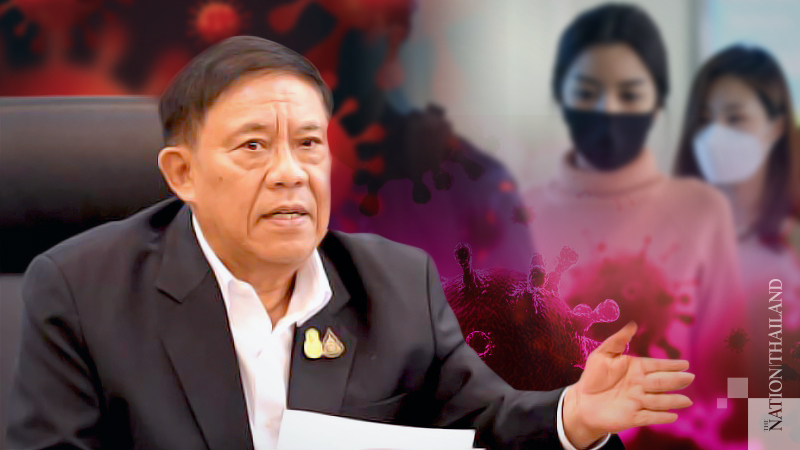
Bangkok announces 10 measures to control Covid-19 transmission #SootinClaimon.Com

#SootinClaimon.Com : ขอบคุณแหล่งข้อมูล : หนังสือพิมพ์ The Nation.

Bangkok announces 10 measures to control Covid-19 transmission (nationthailand.com)

Bangkok announces 10 measures to control Covid-19 transmission

NationalDec 21. 2020

Bangkok governor Asawin Kwanmuang

Bangkok governor Asawin Kwanmuang

By The Nation

The Bangkok Metropolitan Administration (BMA) has announced 10 measures to curb the transmission of Covid-19 and has launched a proactive hunt for migrant workers who may be infected. BMA has also closed three schools that are on the border of Samut Sakhon province.

The new measures ordered by Bangkok governor Asawin Kwanmuang are:

• All schools and preschools in areas close to Samut Sakhon, such as Bang Khunthien, Bang Bon and Nong Khaem districts will be closed for 14 days (December 21 to January 4) with classes being held online.

• Government officials or BMA personnel who commute from Samut Sakhon will need to isolate themselves and work from home.

• No gatherings are allowed for the New Year celebration. If events need to be held, organisers must submit a disease control plan to obtain permission from the BMA health department.

• Screening checkpoints have been set up on Petchkasem, Rama II, Borommaratchachonnani and Liap Khlong Phitthayalongkon roads to monitor migrant workers entering Bangkok.

• Parks can be used for exercise, but not gatherings.

• All migrant workers at construction sites will be screened for Covid-19.

• All 472 fresh markets in Bangkok will be checked for active Covid-19 cases, with a special focus on delivery personnel and middlemen dealing with seafood from Samut Sakhon province.

• Places of worship and religious locations in Bangkok have been asked to refrain from activities until the situation is resolved.

• Schools will help search for parents who are migrant workers to undergo tests for the virus.

• Entertainment establishments, restaurants, hotels, shopping malls as well as pubs and karaoke bars need to strictly screen clients, ensure masks are worn, tables kept apart, customers refrain from dancing and the areas are cleaned regularly according to the Public Health Ministry’s guidelines.

Everybody is required to wear a mask in public as well as track their movements using the Thai Chana application so it will be easier for health officers to detect and investigate cases in case an infection is detected in the area.

BMA tightens scrutiny on routes linking Samut Sakhon and Bangkok #SootinClaimon.Com

#SootinClaimon.Com : ขอบคุณแหล่งข้อมูล : หนังสือพิมพ์ The Nation.

BMA tightens scrutiny on routes linking Samut Sakhon and Bangkok (nationthailand.com)

BMA tightens scrutiny on routes linking Samut Sakhon and Bangkok

NationalDec 21. 2020

By The Nation

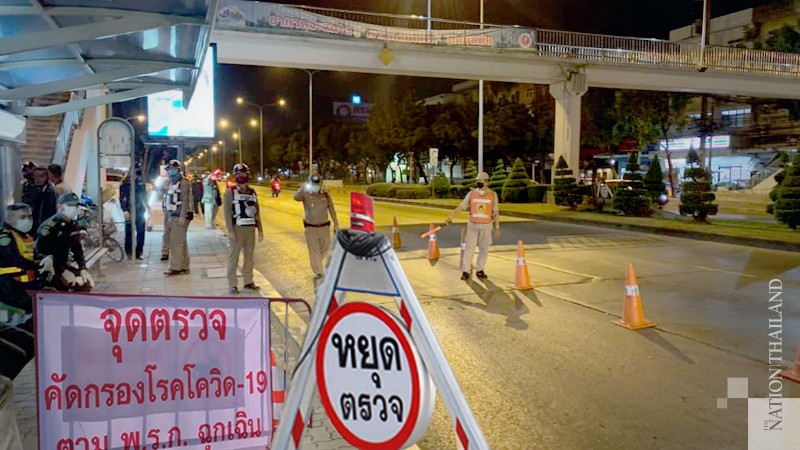
The Bangkok Metropolitan Administration (BMA) has set up Covid-19 screening checkpoints on routes leading to Samut Sakhon province to contain the spread of the virus.

At a checkpoint in front of Southeast Asia University on Petchakasem Road on Monday, Bangkok police chief Pol Lt-General Pakapong Phongpetra said that BMA officials would check the body temperature of all passengers on buses entering the capital.

“Meanwhile, police officers would strictly check the movement of migrant workers to prevent them from sneaking between districts,” he said.

He added that officials had also set up Covid-19 screening checkpoints in front of PTT petrol station on Rama II Road, under the bridge on Phutthamonthon Sai 3 intersection and in front of Khlong Pittaya Longkorn School on Bang Khun Thian-Chai Thale Road.

“The BMA will launch more measures to support officials’ operations,” he added.

Two of three infected family members had visited Samut Sakhon seafood market #SootinClaimon.Com

#SootinClaimon.Com : ขอบคุณแหล่งข้อมูล : หนังสือพิมพ์ The Nation.

Two of three infected family members had visited Samut Sakhon seafood market (nationthailand.com)

Two of three infected family members had visited Samut Sakhon seafood market

NationalDec 21. 2020

By THE NATION

An investigation recently pointed out that two of three new Covid-19 patients in Saraburi province had visited a seafood market in Samut Sakhon province.

The patients included a man, his wife and their daughter. They were found infected at Saraburi Hospital on Sunday evening.

The father and daughter travelled from their hometown and reached Samut Sakhon’s Talay Thai seafood market at 11.30pm on December 14, according to the officially revealed timeline.

They visited the market to purchase seafood products in order to sell in their buffet restaurants. The father and daughter returned home on December 15 at 4am.

On December 16, the mother visited a private hospital in Saraburi as she was ill.

The father and daughter travelled from Saraburi to Talay Thai market again, and reached the place at around 10am They returned home at 4am on December 17.

At 8am that day, the wife visited a pork stall in a fresh market in Saraburi’s Muang district. She went to a branch of their buffet restaurants later in an evening.

On the same day, the daughter and father were slightly ill. They visited local clinics at 5pm and 6pm, respectively.

On December 18, the woman visited a pork stall again, while the man went to Pathum Thani province, to shop at a flea market in Nong Sua district. The daughter stayed at home.

On December 19, the three persons were at home recovering. They decided to visit Saraburi Hospital next day, as their health did not improve.

High-risk persons from these cases consisted of the couple’s son, who lived in the same house, and 21 customers of the buffet restaurant.

Upsurge in Covid-19 cases in Thailand could weaken baht #SootinClaimon.Com

#SootinClaimon.Com : ขอบคุณแหล่งข้อมูล : หนังสือพิมพ์ The Nation.

Upsurge in Covid-19 cases in Thailand could weaken baht (nationthailand.com)

Upsurge in Covid-19 cases in Thailand could weaken baht

NationalDec 21. 2020

By THE NATION

The baht opened at 29.92 to the US dollar on Monday, weakening from 29.82 at close on Friday.

The Thai currency is likely to move between 29.85 and 30.05 on Monday and between 29.75 to 30.25 this week, said Jitipol Puksamatanan, senior director of the chief investment office at SCB Securities.

Jitipol said the baht could weaken to Bt30 per US dollar, from the new Covid-19 cases in Thailand. However, investors’ view of the virus situation was more positive than before, as we were approaching soon the new year and a vaccine was likely to be available soon.

This week, the markets were saturated with news on the Covid-19 situation, as well as lockdowns across the world. However, the coronavirus has not pushed the VIX index to increase from its present level of 21.57 points.

Jitipol advised investors to monitor the meeting of the Thai central bank’s Monetary Policy Committee on Wednesday. He added that the committee would possibly maintain the interest rate at 0.50 per cent.

He added that the Conference Board Consumer Confidence Index in the US was another data to be monitored. If the index falls below 97 points due to the market’s concerns about Covid-19, the dollar would possibly recover in the short term.

In the financial markets, trade was run on the assumption of the dollar tending to weaken and US fiscal policy being relaxed. The price of Bitcoin soared to over $23,000 (Bt690,011) per bitcoin, while the US Ten-Year Treasury yield rose to 0.95 per cent.

Myanmar woman tests positive for Covid-19 in Mae Sot #SootinClaimon.Com

#SootinClaimon.Com : ขอบคุณแหล่งข้อมูล : หนังสือพิมพ์ The Nation.

Myanmar woman tests positive for Covid-19 in Mae Sot (nationthailand.com)

Myanmar woman tests positive for Covid-19 in Mae Sot

NationalDec 21. 2020

By THE NATION

A new Covid-19 patient was found in the Mae Sot district of Tak province.

The patient was identified as a Myanmar woman who worked at a supermarket.

On Sunday evening, officials from Mae Sot Hospital had checked a supermarket on Prasatwithi Road. One of the supermarket’s staffs was found infected with Covid-19. People at risk related to this patient were checked and required to quarantine.

The report said that the infected woman had touched several customers. She was also a store checker and cash receiver. The patient is currently receiving treatment in Mae Sot Hospital.

Upper Thailand gets cooler with strong winds, isolated heavy rains forecast for South #SootinClaimon.Com

#SootinClaimon.Com : ขอบคุณแหล่งข้อมูล : หนังสือพิมพ์ The Nation.

Upper Thailand gets cooler with strong winds, isolated heavy rains forecast for South (nationthailand.com)

Upper Thailand gets cooler with strong winds, isolated heavy rains forecast for South

NationalDec 21. 2020

By THE NATION

Another strong high-pressure system from China covers upper Thailand, bringing temperatures down by 1-3 degrees Celsius with cool to cold weather and strong winds, the Thailand Meteorological Department said on Monday.

The mountaintops remain cold to very cold. People should take care of their health due to the variable weather, the department said.

A strong northeast monsoon prevails over the Gulf and the South. Isolated heavy rain is forecast in the lower South. People in the South should beware of the severe conditions, the department said. Strong winds and waves are likely in the upper Gulf, rising about two metres, 2-3 metres in the lower Gulf and above three metres during thundershowers.

All ships should proceed with caution and small boats in the Gulf should stay ashore until December 23, the department said. Tropical storm “Krovanh” over the middle South China Sea is expected to downgrade on December 23-24.

The forecast for the next 24 hours:

Bangkok Metropolis and its vicinity: Cool with strong winds and a 1-2 degrees Celsius drop in temperature; minimum temperature 18-20°C, maximum 28-30°C; northeasterly winds 10-30 kilometres per hour (kph).

North: Cool to cold and 2-3°C drop in temperature; minimum temperature 13-17°C, maximum 24-32°C; Cold to very cold on mountaintops and frost in some places with minimum temperature 3-14°C; northeasterly winds 10-20kph.
Northeast: Cool to cold with strong winds and 1-3°C drop in temperature; minimum temperature 10-14°C, maximum 24-26°C; cold on the mountaintop with minimum temperature 8-12°C; northeasterly winds 10-30kph.

Central: Cool with strong winds and 1-2°C drop in temperature; minimum temperature 17-18°C, maximum 27-31°C; northeasterly winds 10-30kph.

East: Cool with strong winds and 1-2°C drop in temperature; minimum temperature 16-21°C, maximum 30-33°C; northeasterly winds 20-35kph; waves about two metres high.

South (east coast): Cloudy with scattered thundershowers and isolated heavy rain; minimum temperature 19-24°C, maximum 28-32°C.

Surat Thani northwards: Northeasterly winds 20-35kph; waves about two metres high and above two metres during thundershowers.

Nakhon Si Thammarat southwards: Northeasterly winds 20-40kph; waves 2-3 metres high and above three metres in thundershowers.

South (west coast): Cloudy with isolated thundershowers; minimum temperature 22-24°C, maximum 27-31°C; northeasterly winds 20-35kph; waves about two metres high and above two metres offshore.