Korea to quadruple renewable power by 2034, downsize nuclear, coal #SootinClaimon.Com

#SootinClaimon.Com : ขอบคุณแหล่งข้อมูล : หนังสือพิมพ์ The Nation.

Korea to quadruple renewable power by 2034, downsize nuclear, coal (nationthailand.com)

Korea to quadruple renewable power by 2034, downsize nuclear, coal

Dec 16. 2020President Moon Jae-in speaks at a meeting on South Korea’s aim of going carbon neutral by 2050, at Cheong Wa Dae in Seoul on Nov. 27. (Yonhap)President Moon Jae-in speaks at a meeting on South Korea’s aim of going carbon neutral by 2050, at Cheong Wa Dae in Seoul on Nov. 27. (Yonhap) 

By Kim Byung-wook
The Korea Herald/ANN

Renewable energy will take up nearly 42 percent of South Korea’s power generation capacity by 2034, according to a blueprint for the national energy mix unveiled Tuesday.

The final draft of the Ninth Basic Plan for Electricity Supply and Demand for the years 2020-2034, drawn up and released by the Ministry of Trade, Industry and Energy, reaffirms President Moon Jae-in’s commitment to move away from nuclear power and toward renewables.

While the country’s electricity generation capacity is projected to surge to 185.3 gigawatts by 2034, from 120.5 gigawatts this year, renewables will account for 41.9 percent followed by liquefied natural gas at 31.8 percent and coal at 15.6 percent. Nuclear power is projected to provide 10.4 percent.

That represents a major change in the energy mix, which currently depends on coal.

Last year, coal, LNG and nuclear power were the mainstay of electricity generation in Korea, contributing 40.4 percent, 25.9 percent and 25.6 percent respectively. Renewables made up just 6.5 percent of total electricity production.

The plan will be finalized after a public hearing Dec. 24 and a policy review Dec. 28.

In detail, the plan envisions the shutdown of 30 coal-fired power plants by 2034, which will have reached their operational lifetime limit of 30 years by then. To ensure a stable electricity supply, 24 of the facilities will be turned into liquefied natural gas power plants.

However, the seven coal-fired power plants currently under construction will be built as planned. As a result, the generation capacity of coal-fired plants, which stood at 35.8 gigawatts this year, will shrink to 29 gigawatts by 2034, while that of LNG power plants will increase 59.1 gigawatts from 41.3 gigawatts in the same period.

Meanwhile, the number of nuclear power plants will reach its peak of 26 in 2024 and diminish to 17, as the Moon administration banned the construction of new nuclear plants and the lifetime extension of existing ones.

As a result, the generation capacity of nuclear power plants will be reduced to 19.4 gigawatts by 2034 from this year’s 23.3 gigawatts. The Shin Hanul plants No. 3 and No. 4, whose construction is on hold due to the administration’s nuclear phaseout policy, have been excluded from the plan.

To compensate for the smaller numbers of coal-fired plants and nuclear plants, the government will roll out renewable energy generation facilities with a combined capacity of 77.8 gigawatts by 2034, almost quadruple the current 20.1 gigawatts.

Though the government’s midterm goal was to increase Korea’s capacity for solar and wind power to 29.9 gigawatts by 2025, the target has been adjusted to 42.7 gigawatts, as President Moon Jae-in’s Green New Deal initiative is expected to add an additional 12.8 gigawatts.

In total, Korea’s power generation capacity will surge from 120.5 gigawatts this year to 185.3 gigawatts by 2034. Renewables, LNG, coal and nuclear power will account for 41.9 percent, 31.8 percent, 15.6 percent and 10.4 percent of the total, respectively.

Despite the significant role of renewables, they are expected to account for only 20.8 percent of electricity supply in 2030. Korea will still be dependent on coal, nuclear power and LNG, which will respectively generate 29.9 percent, 23.3 percent and 25 percent of all electricity in the same year.

With total electricity demand expected to rise to 102.5 gigawatts by 2034 from this year’s 89.1 gigawatts, Korea’s transition to green energy will cut 193 million tons of greenhouse gases from projected levels.

To further boost clean energy, the government aims to install more power grids in regions where renewable energy facilities are concentrated, such as Sinan and Yeonggwang counties in South Jeolla Province, and lay out immediate plans to support solar farms that are currently unable to access power grids due to grid shortages.

Singapore to launch segregated lane for business travellers who will not need to be quarantined #SootinClaimon.Com

#SootinClaimon.Com : ขอบคุณแหล่งข้อมูล : หนังสือพิมพ์ The Nation.

Singapore to launch segregated lane for business travellers who will not need to be quarantined (nationthailand.com)

Singapore to launch segregated lane for business travellers who will not need to be quarantined

Dec 16. 2020Those using the lane will be transported from the airport to dedicated facilities where they will stay and work. PHOTO: ST FILEThose using the lane will be transported from the airport to dedicated facilities where they will stay and work. PHOTO: ST FILE 

By Clement Yong
The Straits Times/ANN

SINGAPORE – From the second half of January 2021, short-term business travellers from all countries arriving in Singapore will no longer need to be quarantined, under new segregated travel lane arrangements.

The Ministry of Trade and Industry said on Tuesday (Dec 15) that those who opt to use the lane will be transported from the airport to dedicated facilities where they will stay and work.

There, they can have meetings through floor-to-ceiling air-tight glass panels with local businessmen, as well as with other foreign businessmen with safe distancing measures in place.

Regular testing will be conducted throughout the duration of their stay – for instance on alternate days – in addition to tests before departure from their home countries and upon arrival here.

They will also have to move within their pre-declared travel group of up to five people to reduce the risk of mass transmission.

The segregated travel lane is distinct from existing reciprocal green lane arrangements, which apply only to selected countries but allow those on essential business here to move about around Singapore more freely.

The segregated travel lane restricts movement, but lets in business, official and high economic value travellers from all countries, as long as their stay is 14 days or shorter.

The lane is expected to increase traffic at Changi Airport, where about 15 per cent of travellers pre-Covid-19 entered the country for business-related reasons.

It should also have knock-on effects on the hospitality sector, which could cater food and provide accommodation for the travellers once they are given approval.

Trade and Industry Minister Chan Chun Sing, on a tour of Connect @ Changi, one of the facilities that will be used to house travellers in the segregated travel lane, said the new measures will make Singapore more relevant as a business hub amid the unpredictability of Covid-19.

“Global business travel has been severely affected by the need for quarantine measures… Different countries will continue to have different risk profiles and we should not let this hinder business meetings,” he said.

“Dedicated facilities can allow Singaporeans to meet (business) travellers from elsewhere. They can also allow (business) travellers from elsewhere to meet each other.”

An artist’s impression of Connect@ Changi’s courtyard. PHOTO: CONNECT@ CHANGI

Based on patterns established last year, roughly nine in 10 of business travellers to Singapore stayed in the country for five days or fewer, hinting at the demand for such expedited, business-specific travel arrangements.

A huge chunk of these travellers are currently not covered by reciprocal green lane arrangements, and have to undergo quarantine before being able to meet their local partners face to face.

Temasek senior managing director Alan Thompson, who was among those helming the Connect @ Changi project, said local employees of multinational companies might not have had a chance to meet their regional heads in person for more than year.

Facilities like Connect @ Changi, which will take in its first guests in February next year, provide businessmen with that opportunity while minimising physical contact.

Connect @ Changi is a four-star facility currently being built at Singapore Expo and Max Atria, about a five-minute drive from Changi Airport.

When fully constructed in mid-2021, more than 1,300 guest rooms and about 340 meeting rooms will be available for booking, with each night costing travellers between $390 and $430 if they are staying for a duration shorter than three days.

Meeting rooms can fit between four and 22 people, and are meant for meetings rather than larger-scale conferences or events. PHOTO: LIANHE ZAOBAO

Meeting rooms can fit between four and 22 people, and are meant for meetings rather than larger-scale conferences or events.

Mr Wong Heang Fine, group chief executive officer of Surbana Jurong, which built Connect @ Changi, said the facility can be quickly repurposed within weeks for other uses post-Covid-19, as it is constructed from pre-fabricated modules.

Connect @ Changi said the facility will create 800 jobs in Singapore in construction and the maintenance and provision of services within the facility.

Mr Chan said MTI will study the demand for the segregated travel lane to assess the number of dedicated facilities needed, and could broaden the use of the lane for medical or family-visiting uses.

Facility operators interested in serving as a segregated facility can submit their proposals through the Singapore Tourism Board by the end of the year.

Hong Kong CE warns fourth wave could well take a serious turn #SootinClaimon.Com

#SootinClaimon.Com : ขอบคุณแหล่งข้อมูล : หนังสือพิมพ์ The Nation.

Hong Kong CE warns fourth wave could well take a serious turn (nationthailand.com)

Hong Kong CE warns fourth wave could well take a serious turn

Dec 16. 2020Chief Executive Carrie Lam Cheng Yuet-ngor meets the press at Central Government Offices in Hong Kong on Dec 15, 2020. (CALVIN NG / CHINA DAILY)Chief Executive Carrie Lam Cheng Yuet-ngor meets the press at Central Government Offices in Hong Kong on Dec 15, 2020. (CALVIN NG / CHINA DAILY) 
By Wang Zhan
China Daily/ANN

HONG KONG – Hong Kong’s Chief Executive Carrie Lam Cheng Yuet-ngor warned that the city’s “still-serious” fourth wave of COVID-19 outbreak could yet take a turn for the worse although daily infection numbers hadn’t risen exponentially in recent days. 

Speaking to reporters ahead of a customary meeting of her Executive Council on Tuesday, Lam appealed to residents not to drop their guards and stay at home as much as they could during the upcoming holiday season.

Lam said her government planned to apply to the Legislative Council for a fourth tranche of anti-epidemic funding before the Christmas holidays in order to help businesses affected by the COVID-19 curbs. 

The city recorded more than 600 cases during each of the past three weeks, although the number has slightly dropped recently. Hong Kong logged 82 new COVID-19 infections on Monday, including 37 untraceable local cases, second only to 41 cases of an unknown origin recorded on Sunday.

The Hong Kong government announced on Friday that the first batch comprising 1 million shots of coronavirus vaccines, developed by Beijing-based Sinovac Biotech, will be shipped to Hong Kong next month at the earliest. 

Lam criticized people who were trying to stigmatize or politicize the purchase and eventual use of vaccines, iterating that vaccine procurement had been done scientifically and that the process had been vetted by medical experts.

Asia-Pacific region sees 81 million jobs lost #SootinClaimon.Com

#SootinClaimon.Com : ขอบคุณแหล่งข้อมูล : หนังสือพิมพ์ The Nation.

Asia-Pacific region sees 81 million jobs lost (nationthailand.com)

Asia-Pacific region sees 81 million jobs lost

Dec 16. 2020

By DIYANA PFORDTEN
The Star/ANN

PETALING JAYA: A total of 81 million jobs are estimated to have been lost in Asia-Pacific countries in 2020 due to the Covid-19 pandemic, says the International Labour Organisation (ILO).

In its report Asia–Pacific Employment and Social Outlook 2020: Navigating the crisis towards a human-centred future of work released yesterday, the organisation said the pandemic hit workers in various way, with many forced into shorter working hours amid a shrinking job growth market.

In the report, it said it was “estimated that employment in the Asia and the Pacific region in 2020 will drop by 4.2% to 1.839 billion persons from the pre-crisis estimate of 1.920 billion employed”.

By extrapolating, this would imply “an expected jobs gap of 81 million across the region”.

“The impact of the crisis has been far-reaching, with underemployment surging as millions of workers are asked to work reduced hours or no hours at all, ” it said.

Working hours in the Asia and the Pacific were reduced by an estimated 15.2% in the second quarter of 2020, and by 10.7% in the third quarter of the year, compared to before the pandemic, said ILO.

“Working-hour losses are also influenced by the millions of persons moving outside the labour force or into unemployment as job creation in the region collapsed, ” it said, noting that the regional unemployment rate could increase by 5.2% to 5.7% in 2020, compared to 4.4% in 2019.

ILO assistant director-general and regional director for Asia and the Pacific, Chihoko Asada Miyakawa, said inadequate social security coverage and institutional capacity in many countries had become a challenge to companies and workers needing to bounce back.

“The situation has also exacerbated when a large number of workers remains in the informal economy.

“These pre-crisis weaknesses have left far too many exposed to the pain of economic insecurity when the pandemic hit and inflicted its toll on working hours and jobs, ” she said.

The report revealed that the crisis also saw a larger impact of the decline of working hours and employment on female workers.

“Young people have also been especially affected by working-hour and job losses. The youth share in the overall employment loss was 3 to 18 times higher than their share in total employment, ” it said.

Senior economist at the ILO Regional Office for Asia and the Pacific and lead author of the report, Sara Elder, said that young workers are likely to find it difficult to compete for new jobs as unemployment increases.

“When they do find work, it may well be a job that does not match their aspirations.

“Millions of women have also paid a high price and it could take years for those who have exited the labour force to return to full employment, ” she said.

With fewer paid hours of work, the report revealed that median incomes are shrinking and working poverty levels increasing.

“Labour income is estimated to have dipped by as much as 10% in the Asia–Pacific region in the first three quarters of 2020, equivalent to a three per cent loss in gross domestic product.

“In absolute numbers, preliminary estimates in the report find an additional 22 to 25 million persons could fall into working poverty, which would push up the total number of working poor (those living on less than US$1.90, RM7.70 a day) in the Asia–Pacific region to between 94 and 98 million in 2020, ” it said.

However, Elder added that government efforts had helped companies retain workers, albeit with reduced hours, which had prevented wider job losses.

“Given the mounting evidence that social protection and employment policies save jobs and incomes, the hope is that the crisis brings about a more permanent and increased investment in elements needed to boost resilience and promote a more people-centred future of work, ” she said.

Dtac promises to compensate customers affected by system crash #SootinClaimon.Com

#SootinClaimon.Com : ขอบคุณแหล่งข้อมูล : หนังสือพิมพ์ The Nation.

Dtac promises to compensate customers affected by system crash (nationthailand.com)

Dtac promises to compensate customers affected by system crash

CorporateDec 16. 2020

By The Nation

Total Access Communication (Dtac) has announced that it will compensate consumers affected by the interruption of some services on Wednesday morning.

The services that experienced problems included the 1678 call centre, the Dtac application, one-time password (OTP) verification, online payment and top-up services.

All services had returned to normal at press time.

Investors greet Kerry Express IPO with vast oversubscription #SootinClaimon.Com

#SootinClaimon.Com : ขอบคุณแหล่งข้อมูล : หนังสือพิมพ์ The Nation.

Investors greet Kerry Express IPO with vast oversubscription (nationthailand.com)

Investors greet Kerry Express IPO with vast oversubscription

CorporateDec 16. 2020

By The Nation

Kerry Express, Thailand’s leading parcel delivery brand, has announced an initial public offering of 300 million shares at Bt28 per share, the highest price for IPO offering in this range.

The shares are expected to start trading on the Stock Exchange of Thailand on December 24 under the ticker symbol “KEX”.

Kerry Express had received very strong investor interest with more than 23 times oversubscription from institutional investors and approximately 10 times oversubscription from cornerstone investors.

Proceeds from the offering will be used for the expansion of Kerry Express’s delivery network as well as to enhance its operational efficiency by developing IT systems, repaying debts and increasing working capital for business operations.

SCB Securities and Maybank Kim Eng Securities (Thailand) are the company’s joint lead underwriters and joint bookrunners.

The two financial companies said the outcome reflects investors’ confidence in Kerry Express as the market leader in express parcel delivery.

Citigroup and Credit Suisse led the international sales of the IPO as joint bookrunners.

Nation Broadcasting Corp announces fresh TV broadcasting formula, business strategy for 2021, introduces 8 new anchors #SootinClaimon.Com

#SootinClaimon.Com : ขอบคุณแหล่งข้อมูล : หนังสือพิมพ์ The Nation.

Nation Broadcasting Corp announces fresh TV broadcasting formula, business strategy for 2021, introduces 8 new anchors (nationthailand.com)

Nation Broadcasting Corp announces fresh TV broadcasting formula, business strategy for 2021, introduces 8 new anchors

CorporateDec 16. 2020

By THE NATIONNation Broadcasting Corporation Plc (NBC), the operator of Nation TV Channel 22, organised “Nation TV Open House” on Tuesday to announce its business strategy for 2021 and its new broadcasting schedule as well as introduce eight new news anchors.

“Next year will be Nation Group’s 50th anniversary. Nation TV will embark on its 21 years in the business with steady steps, thanks to a strong financial record and business revenue,” said Shine Bunnag, chairman of the executive committee at Nation Multimedia Group Plc, NBC’s parent company,

“The DNA of Nation TV means it will continue to run with a professional and socially responsible team of journalists, serving as a watchdog for society and protecting the three institutes of the nation, religion and the monarchy, as we always have,” he added.

NBC chief executive officer Adisak Limparungpatanakij said that next year Nation TV would continue to produce news and content of international standards to preserve its status as a “professional media institute” at the regional level.

“We will continue to be open to criticism and opinions of news consumers, focusing on delivering quality news and knowledge via every digital platform to every corner of society,” he said.

Adisak also revealed that in 2021, programmes on Nation TV would consist of both news and variety shows in order to expand its viewer base to cover all ages.

“News and informative programmes will be the main content of Nation TV at a minimum 14 hours a day,” he said. “Fifty per cent of news will focus on politics and public policies, while 40 per cent will cover economy, business, technology and foreign affairs, and the rest will be entertainment, art and culture,” he explained.

“Next year, Nation TV’s broadcasting schedule will be based on the 4-4-6 formula, with the first four hours of the day (6-10am) focusing on news variety shows. The next four hours will cover news updates nationwide and economic news. The last, 6-hour period (5pm until 11pm) will be ‘golden hour news’ that comprise news summaries and analyses by experienced news professionals,” he added.

Nation TV also introduced eight new anchors: Phiphu Phumkaewkla (Ta), Orakarn Jiwakiat (Kwang), Orarin Yamokkul (Orn), Chawan Chansub (Games), Krongboon Srisapphakit (Gift), Lalita Mangsungnern (Prince), Charnchai Pratheepwatthanawong (Dao) and Chip Jitniyom.

GSB offers saving packages, loans at Bitec Money Expo #SootinClaimon.Com

#SootinClaimon.Com : ขอบคุณแหล่งข้อมูล : หนังสือพิมพ์ The Nation.

GSB offers saving packages, loans at Bitec Money Expo (nationthailand.com)

GSB offers saving packages, loans at Bitec Money Expo

CorporateDec 15. 2020

By The Nation

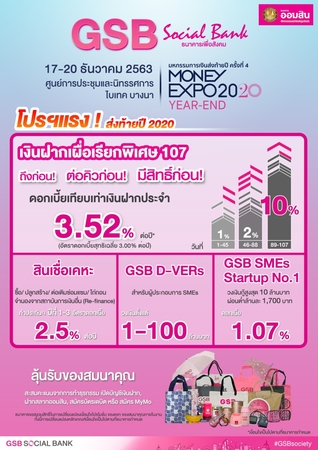
Government Savings Bank (GSB) will offer various loan and savings packages to visitors at the year-ending Money Expo 2020, said president Vitai Ratanakorn.

The fair runs from this Thursday to Sunday (December 17-20) at the Bangkok International Trade & Exhibition Centre (Bitec).

A highlight is the “107 deposit” account, which boasts average annual interest of 3.52 per cent for a fixed deposit of 107 days on savings between Bt10,000 and Bt500,000. Seven-hundred accounts will be offered to savers aged 15 and above who have a GSB debit card and mobile app MyMo. Savers can also open the account at any GSB branch from December 17-27.

GSB will also offer mortgage loans at the expo. Borrowers who also take out life insurance will receive a fixed interest rate of 2.5 per cent for the first three years and MRR-1.5 per cent year from the fourth year (GSB’s current MRR is 6.245 per cent).

Meanwhile GSB SMEs Startup No 1 loans of up to Bt10 million will be available for businesses launched in the last three years. Borrowers who also sign up for life insurance and offer collateral worth over 50 per cent of the loan will be charged annual interest of 1.07 per cent in the first year and MOR/MRR + 1.50 per cent per year after that.

Also offered are “GSB D-VERs” short-term and long-term loans of Bt1 million-Bt100 million for companies to boost revolving funds or invest in assets.

Loans of Bt1 million to Bt20 million which are backed by full collateral and a life insurance subscription carry interest of 3.99 per cent in the first year, 4.99 per cent in the second year and MOR/MLR+0.75 per cent after that (GSB MOR rate is 5.995 per cent and MLR 6.15 per cent). If the collateral is 30 per cent of the loan, the rate is MOR/MLR+1.25 per cent.

Loans of Bt20 million-Bt100 million backed by a life insurance subscription and full collateral carry 4 per cent annual interest in the first two years and MOR/MLR+0.75 per cent for the following years. If the collateral is 30 per cent or over, the rate is MOR/MLR+1 per cent.

SET Index rises #SootinClaimon.Com

#SootinClaimon.Com : ขอบคุณแหล่งข้อมูล : หนังสือพิมพ์ The Nation.

SET Index rises (nationthailand.com)

SET Index rises

EconDec 16. 2020

By The Nation

The Stock Exchange of Thailand (SET) Index rose by 7.13 points, or 0.48 per cent, to 1,484.34 in the morning session on Wednesday.

The top 10 stocks with the highest trade value in the morning session were CPAll, Banpu, PTTGC, KBank, BAM, PTT, SCC, AOT, IVL and IRPC.

The SET Index closed at 1,477.21 on Tuesday, up 1.08 points, or 0.07 per cent. The volume of total transactions was Bt91.74 billion, with an index high of 1,478.61 points and a low of 1,459.97.

Gold price extends gains amid hopes of fresh US stimulus package #SootinClaimon.Com

#SootinClaimon.Com : ขอบคุณแหล่งข้อมูล : หนังสือพิมพ์ The Nation.

Gold price extends gains amid hopes of fresh US stimulus package (nationthailand.com)

Gold price extends gains amid hopes of fresh US stimulus package

EconDec 16. 2020

By The Nation

The price of gold rose by Bt100 per baht weight in morning trade on Wednesday after surging by Bt200 per baht weight at close on Tuesday, the Gold Traders Association reported.

As of 9.29am, the buying price of a gold bar was Bt26,250 per baht weight and selling price Bt26,350 while gold ornaments cost Bt25,772 and Bt26,850, respectively.

At close on Tuesday, the buying price of a gold bar was Bt26,150 per baht weight and selling price Bt26,250 while gold ornaments cost Bt25,681.04 and Bt26,750, respectively.

The spot gold price moved to US$1,855 (Bt55,716) per ounce in the morning, while the Comex (Commodity Exchange) gold price to be delivered in February surged by $23.20 to $1,855.30 per ounce on Tuesday, thanks to hopes that the US Congress would approve a new economic stimulus package soon.

Besides, the market is keeping an eye on the US Federal Reserve’s monetary policy meeting to see whether the central bank will continue to ease its monetary policy or not.

The Hong Kong gold price meanwhile rose by HK$90 to $17,120 (Bt66,333) per tael, the Chinese Gold and Silver Exchange Society reported.