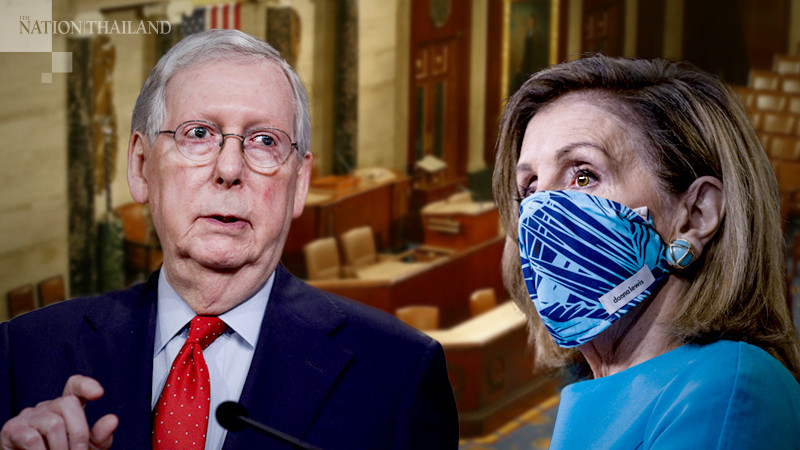
U.S. stocks climb, bonds fall on stimulus bets #SootinClaimon.Com

#SootinClaimon.Com : ขอบคุณแหล่งข้อมูล : หนังสือพิมพ์ The Nation.

U.S. stocks climb, bonds fall on stimulus bets (nationthailand.com)

U.S. stocks climb, bonds fall on stimulus bets

EconDec 16. 2020

By Syndication Washington Post, Bloomberg · Anchalee Worrachate, Vildana Hajric

U.S. stocks halted a four-day losing streak as Congress moved toward a federal spending package that would boost the economy. Treasuries retreated.

The S&P 500 rebounded from its longest slide since September. Senate Majority Leader Mitch McConnell, R-Ky., said he will keep lawmakers in Washington until a deal gets done. The 10-year Treasury yield moved above 0.90% as the Federal Reserve began its two-day meeting. The dollar weakened for a second day. Oil advanced with gold.

Wall Street is growing increasingly confident that Democratic and Republican lawmakers will clinch a bill based on a $748 billion bipartisan proposal that would inject cash directly into the economy as prior benefits begin to expire at the end of the year. The vaccine rollout continues in the U.S. without any major disruptions so far.

“The markets really locked into the optimism trade and it’s been heavily discounting bad news and focusing on good news,” said Olivia Engel, chief investment officer of active quantitative equity at State Street Global Advisors. “I’m not surprised the market chose to focus more on the good news even as lockdown announcements are coming.”

Bristol-Myers Squibb climbed after Goldman Sachs Group added the drugmaker to its conviction buy list. In Europe, Volkswagen rallied 5% after the German carmaker’s board eased internal corporate tensions by backing CEO Herbert Diess. Trading was mixed in other markets. Asian stocks fell the most in two weeks.

While investors are pricing in optimism about the start of vaccine shots, there’s also ongoing concern over whether a stimulus bill from a bipartisan group of lawmakers will gain traction. The virus continued to rage in the U.S., threatening tighter restrictions across the nation. New York City Mayor Bill de Blasio, a Democrat, warned that people should be prepared for a full shutdown. European governments are also tightening measures.

“Stimulus remains a key focus for the market, as it is the necessary bridge to expansive vaccinations,” said Lindsey Bell, chief investment strategist for Ally Invest. “Market participants would like to see a deal sooner rather than later given the expectation for economic data to slow near term. In the absence of a deal, turbulence could pick up.”

In Europe, the pound rose and credit markets strengthened as Brexit negotiators pushed to reach a final trade deal. After a weekend of intense diplomatic activity, Michel Barnier, who leads the E.U. team, said he can see a path to a deal – if the two sides can resolve what he called their significant differences.

– – –

Here are some key events coming up:

– The Federal Reserve meets again Wednesday, with markets widely expecting fresh guidance on its continued asset purchases.

– Policy decisions from the Bank of England and central banks in Mexico, Switzerland and Indonesia are due Thursday. Japan and Russia announce decisions Friday.

These are the main moves in markets:

Stocks

– The S&P 500 Index climbed 1.3% as of 4 p.m. in New York.

– The Stoxx Europe 600 Index increased 0.3%.

– The MSCI Asia Pacific Index decreased 0.3%.

– The MSCI Emerging Market Index was little changed.

Currencies

– The Bloomberg Dollar Spot Index dipped 0.5%.

– The euro rose 0.1%, to $1.2159.

– The British pound climbed 0.9%, to $1.3443.

– The Japanese yen strengthened 0.4%, to 103.64 per dollar.

Bonds

– The yield on 10-year Treasuries climbed two basis points, to 0.91%.

– The yield on two-year Treasuries rose less than one basis point, to 0.12%.

– Germany’s 10-year yield fell three basis points, to -0.61%.

Commodities

– West Texas Intermediate crude increased 1.3%, to $47.28 a barrel

– Gold futures strengthened 1.4%, to $1,858.30 an ounce.

Egat to import 1.9m tonnes of LNG next year, expand into EV sector #SootinClaimon.Com

#SootinClaimon.Com : ขอบคุณแหล่งข้อมูล : หนังสือพิมพ์ The Nation.

Egat to import 1.9m tonnes of LNG next year, expand into EV sector (nationthailand.com)

Egat to import 1.9m tonnes of LNG next year, expand into EV sector

EconDec 16. 2020Egat governor Boonyanit WongrukmitEgat governor Boonyanit Wongrukmit 

By The Nation

The Electricity Generating Authority of Thailand (Egat) aims to import 1.9 million tonnes of liquefied natural gas (LNG) next year, followed by 1.8 million tonnes per year in 2022 and 2023, said new Egat governor Boonyanit Wongrukmit.

Boonyanit took office on December 4.

The state agency will also ask the Cabinet early next year to approve its plan to call bids for the procurement of a floating storage and regasification unit (FSRU) in the Gulf of Thailand, he added.

It is also seeking opportunities to invest in upstream LNG businesses in the next three to five years. Egat is expanding into the emerging electric vehicle (EV) sector, targeting installation of 31 EV charging stations next year.

The state agency forecasts power demand in Thailand will edge up 4 per cent next year from the estimated 3 per cent year-on-year decline this year.

IEAT, TOT to roll out 5G technology in 14 industrial estates #SootinClaimon.Com

#SootinClaimon.Com : ขอบคุณแหล่งข้อมูล : หนังสือพิมพ์ The Nation.

IEAT, TOT to roll out 5G technology in 14 industrial estates (nationthailand.com)

IEAT, TOT to roll out 5G technology in 14 industrial estates

EconDec 16. 2020IEAT governor Somchint PiloukIEAT governor Somchint Pilouk 

By The Nation

The Industrial Estate Authority of Thailand (IEAT) is partnering up with state-run TOT to install 5G broadband technology system in 14 industrial estates under its management nationwide, IEAT governor Somchint Pilouk said.

The project is expected to be ready in three years. The first phase will focus on industrial estates in the Eastern Economic Corridor.

The IEAT and TOT will workout details of the project and how much the 5G system rollout will cost in each estate. IEAT has adopted many technological systems to enhance business operations in its estates.

Thaksin urges voters to back Pheu Thai’s man in Chiang Mai election #SootinClaimon.Com

#SootinClaimon.Com : ขอบคุณแหล่งข้อมูล : หนังสือพิมพ์ The Nation.

Thaksin urges voters to back Pheu Thai’s man in Chiang Mai election (nationthailand.com)

Thaksin urges voters to back Pheu Thai’s man in Chiang Mai election

PoliticsDec 16. 2020former PM Thaksin Shinawatraformer PM Thaksin Shinawatra 

By The Nation

Fugitive former PM Thaksin Shinawatra on Wednesday urged Chiang Mai residents to vote for the Pheu Thai candidate in Sunday’s local election, triggering claims from his opponents that the move violates the Constitution.

In a Facebook video posted on Wednesday, Thaksin said Pichai Lertpongadisorn had visited him in Dubai before deciding to enter the election for Chiang Mai Provincial Administrative Organisation (PAO) president.

Thaksin said he wanted Chiang Mai residents to enjoy the same quality of life as when he was prime minister, adding that he missed Thailand.

“As someone who was born in Chiang Mai, I would like to support [Pichai] because he will to put all his effort into working for the province. Hence, I would like to ask Chiang Mai people to vote for Pichai on December 20,” he said.

The former PM said he would never forget the people of Chiang Mai and that he believes they miss him, too.

Responding to the video, lawyer and social activist Srisuwan Janya submitted a petition to the Election Commission asking it to investigate whether the move violated Section 28 and 29 of the Constitution’s organic law on political parties.

Sections 28 and 29 prohibit outsiders who are not members of a party from controlling or directing the party’s activities, directly or indirectly.

“Thaksin’s move to invite Chiang Mai people to vote for Pheu Thai’s candidate in the PAO election shows a connection between him and the party which violates the abovementioned law. [This means] the Constitutional Court can rule for Pheu Thai to be dissolved,” said Srisuwan, who heads a group called the Association to Protect of the Constitution.

Hopes for a ‘normal’ Christmas fade as pandemic rages in Europe and North America #SootinClaimon.Com

#SootinClaimon.Com : ขอบคุณแหล่งข้อมูล : หนังสือพิมพ์ The Nation.

Hopes for a ‘normal’ Christmas fade as pandemic rages in Europe and North America (nationthailand.com)

Hopes for a ‘normal’ Christmas fade as pandemic rages in Europe and North America

InternationalDec 16. 2020

By The Washington Post · Adam Taylor

When governments in Europe announced new shutdowns amid surging coronavirus cases last month, some world leaders floated a tantalizing light at the end of the tunnel.

“I have no doubt that people will be able to have as normal a Christmas as possible,” British Prime Minister Boris Johnson said during a news conference Nov. 5, as he announced a four-week lockdown.

The reassurance, after a tough year when many families had already spent special occasions in isolation, served as motivation to put up with short-term restrictions.

But with coronavirus cases surging again as the holiday season approaches, and vaccine rollouts in stages too early to make a dent, hope for a Christmas miracle has come to look like a mirage.

In Germany, where officials spent weeks deciding whether to offer a Christmas reprieve from restrictions, Chancellor Angela Merkel announced Sunday that the country would return to strict measures like those it had imposed at the start of the pandemic.

The Dutch government announced Monday that it would install its toughest restrictions yet over the holiday season, through Jan 19. “We realize just how far-reaching this decision is,” Prime Minister Mark Rutte said in an evening address to the nation. “This has been a year of sadness and mourning for many.”

The Italian media has speculated that a similar lockdown is impending, while other European countries, including Greece, have imposed measures ahead of Christmas.

Last week in the United States, California announced its restrictions would run through the holiday.

Many global health experts have welcomed the restrictions and shutdowns. “The festive season is a time to relax and celebrate,” World Health Organization head Tedros Adhanom Ghebreyesus said Friday, but it “can very quickly turn to sadness.”

Putting a damper on Christmas can be a tough decision. In Canada, Manitoba Premier Brian Pallister grew emotional when he announced that strict rules for the province would continue over the holiday season. “I’m the guy who is stealing Christmas to keep you safe,” he said, his voice breaking.

Even restrictive measures might not be enough to keep the rate of transmission down over the holidays. On Tuesday, researchers from Imperial College London released a study suggesting that infections increased in London during the final weeks of the nationwide lockdown Johnson announced in November.

Johnson hasn’t entirely reversed his Christmas pledge, but his government on Monday announced large parts of the country, including most of London, would be placed under the highest level of virus restrictions this week.

Britain’s holiday plan – which calls for people to form a “Christmas bubble” of friends and family they wish to socialize with between Dec. 23 and 27 – will remain in place. But some politicians and experts argue it will come at a high cost.

“Letting down our guard for five days over Christmas could be very dangerous indeed,” Tobias Ellwood, a former British defense secretary, said in Parliament on Monday as he asked the government to review the Christmas bubble rules.

Health experts have been concerned for months about Christmas – especially extended, indoor, intergenerational celebrations that often involve travel. Christmas and Hanukkah are widely celebrated in Europe and the Americas, where the virus has hit hard.

Evidence from Thanksgiving celebrations in the United States and Canada show such gatherings can worsen the spread of the virus. Since the U.S. holiday, new daily confirmed cases have skyrocketed and the seven-day average is above 200,000.

Anthony Fauci, director of the National Institute of Allergy and Infectious Diseases, said in a television interview last week that the Christmas season may be worse than Thanksgiving for the spread the virus, as it lasts longer, running through New Year’s.

The middle of January “could be a really dark time for us,” Fauci told CNN last Tuesday.

Germany announced 16,362 new cases on Monday, marking another substantial increase in an outbreak that has led to 21,975 deaths. In the Netherlands, coronavirus cases surged to 9,884 on Sunday – the highest figure seen since late October.

Although daily cases in Britain haven’t reached the level of their November peak, Health Secretary Matt Hancock said Monday that the government had identified a new variant of the virus and that it “may be associated with the faster spread in the south of England.”

Some governments have been able to flatten the curve, allowing a degree of normality over the Christmas period. France announced this weekend that it would relax rules for people in long-term care over the holidays.

But for many, this will be a Christmas like no other. In Belgium, where new cases declined steeply after a strict lockdown last month, residents are still advised to host their Christmas parties outside and allow only one guest to use the bathroom.

The restrictions are not limited to North America and Europe. In Brazil and Russia, two hotbeds of the pandemic with large Christian populations, some regional governments have banned Christmas festivities.

Moscow Mayor Sergei Sobyanin said in early November that Christmas festivities, which usually take place on New Year’s Eve in the Russian Orthodox Church, were canceled, as it was “obvious that mass events will not be held.”

FDA approves first rapid over-the-counter home coronavirus test #SootinClaimon.Com

#SootinClaimon.Com : ขอบคุณแหล่งข้อมูล : หนังสือพิมพ์ The Nation.

FDA approves first rapid over-the-counter home coronavirus test (nationthailand.com)

FDA approves first rapid over-the-counter home coronavirus test

InternationalDec 16. 2020

By The Washington Post · William Wan

WASHINGTON – The Food and Drug Administration on Tuesday authorized the first rapid coronavirus test that can be taken at home without prescription and that yields immediate results.

The test could be a vital tool in the country’s fight against the virus, especially in the months before most Americans are vaccinated. Unlike previous home tests, this version does not require samples to be sent to a lab and can be taken without doctors’ orders by anyone older than 2.

The test, developed by Australian company Ellume, is one of several developments for coronavirus testing.

After months of failures, long lines and continued shortages, the country’s testing capacity is expected to increase rapidly in the coming two to three months, reaching many times its current levels, experts said. That reflects new technologies coming online and long-standing investments to ramp up production that are coming to fruition.

The FDA allowed the test under an emergency use authorization. The newly approved home test will cost about $30, and the first batches will be shipped the first week of January, according to Ellume.

“It’s a big deal, and a huge step for efforts to take back control from the virus,” said Mara Aspinall, a biomedical diagnostics professor at Arizona State University.

But given the pent-up demand for such a test, she said, there remain questions about how much of a difference it would make unless available in large quantities and also how to prevent people and companies from hoarding such a test by buying in bulk.

In an interview, Ellume chief executive Sean Parsons said supply initially will be limited to 100,000, with plans to increase manufacturing to 1 million by mid-2021. Parsons said his company will be announcing a partnership with a major retailer – such as Walgreens, CVS or Walmart – to sell the test and create policies that would prevent hoarding by consumers. He said Ellume is in talks to supply the tests in the future directly to companies and universities.

The test uses a nasal swab to collect a sample and produces results within minutes of using a plastic device similar to a home pregnancy test.

One critical feature of the new home tests: the ability to capture and report test results.

For months, at least two dozen companies have been trying to develop home tests, most of them rapid antigen tests that detect proteins on the surface of the virus. Because labs are not involved in such tests, there was no clear way to report the results. Without that data, experts warned that the country would be flying blind as it navigates the later stages of the pandemic.

Ellume’s test requires users to download an app on their smartphone to see their test result. That app automatically sends data by Zip code to the cloud – ensuring that regional health officials can learn about positive results while keeping the data confidential, the company said.

“Today’s authorization is a major milestone in diagnostic testing for COVID-19,” FDA Commissioner Stephen Hahn said in a statement. “As we continue to authorize additional tests for home use, we are helping expand Americans’ access to testing, reducing the burden on laboratories and test supplies.”

While experts hailed the new test as a long-awaited development, many also worried that people may view the use of such tests as tacit permission to disregard precautions such as wearing masks or maintaining distance. They note that some rapid tests have been 90% to 97% accurate in detecting the virus, and that detection often depends on when people take the test.

Experts also caution that while people can take the test one day and get a negative result, they can acquire the virus the next day.

Last month, the FDA approved another single-use home test kit, but it required a prescription from a doctor. That test, developed by California biotechnology company Lucira Health, was expected to sell for less than $50, company officials said.

In coming weeks, more new tests are expected to be approved. Experts said that with increasing capacity, a growing need exists for state and federal officials to come up with a national strategy for how to deploy the tests more effectively and to provide federal funding for regular, dedicated mass testing in schools, hard-hit nursing homes and among essential workers.

Spending, stimulus talks advance in Congress as Pelosi and McConnell huddle #SootinClaimon.Com

#SootinClaimon.Com : ขอบคุณแหล่งข้อมูล : หนังสือพิมพ์ The Nation.

Spending, stimulus talks advance in Congress as Pelosi and McConnell huddle (nationthailand.com)

Spending, stimulus talks advance in Congress as Pelosi and McConnell huddle

InternationalDec 16. 2020

By The Washington Post · Mike DeBonis, Tony Romm, Seung Min Kim, Jeff Stein

WASHINGTON – Congressional negotiations on spending and economic relief picked up speed on Tuesday as top lawmakers met for an hour in the afternoon and then planned to reconvene in the evening, a sign that negotiations are reaching a critical stage.

House Speaker Nancy Pelosi, D-Calif., hosted the three other most senior congressional leaders – Senate Majority Leader Mitch McConnell, R-Ky.; Senate Minority Leader Chuck Schumer, D-N.Y.; and House Minority Leader Kevin McCarthy, R-Calif. – in her office.

“We’re not leaving here without a covid package. It’s not going to happen,” McConnell said at his news conference Tuesday before the first gathering. “We’re going to stay here, no matter how long it takes.”

The first meeting adjourned about 5 p.m. Eastern time, and the second meeting was set to begin at 7:30 p.m. Lawmakers face a Friday night deadline to pass legislation before a government shutdown, and they are trying to assemble an economic relief package to provide jobless aid and small-business assistance.

The meetings represent the first time in months leaders have met in person to hash out a broad bipartisan deal that could include hundreds of billions in spending in coronavirus relief. Talks remained fluid, and it is unclear whether a second round of $1,200 stimulus checks would be included in the final agreement. Similarly, lawmakers continued to wrangle over whether to include aid for state and local governments in a stimulus deal.

Pelosi and Treasury Secretary Steven Mnuchin also spoke for more than an hour about the spending legislation and a potential pandemic-relief package at about noon Tuesday, according to Drew Hammill, a Pelosi spokesman, illustrating how the Trump administration is involved in this stage of the negotiations.

Previous efforts to reach a compromise have failed since the spring. President-elect Joe Biden has urged lawmakers to reach a deal during the lame duck session of Congress, and Democrats have signaled in recent weeks that they are more open to a smaller-scale package than they were before the election.

Two main items were on the Tuesday afternoon agenda. First, lawmakers are trying to finalize a $1.3 trillion spending accord that will keep the government open past Friday through September 2021. Second, lawmakers are trying to pin down a coronavirus relief deal that would extend numerous expiring aid programs and provide new funding to accelerate and expand distribution of the new coronavirus vaccines.

The renewed momentum behind a deal comes as senior Democratic lawmakers indicate a greater willingness to compromise and a forceful push by a bipartisan group of lawmakers pass a relief bill before Christmas recess.

Lawmakers also face intense pressure to approve new relief with multiple critical emergency programs set to expire by the end of the year, including jobless benefits for 12 million Americans and rental protections for as many 30 million Americans.

On Monday, a bipartisan group spearheaded by Sens. Mitt Romney, R-Utah, and Joe Manchin, D-W.Va., released a $748 billion proposal that would devote hundreds of billions of dollars to unemployed Americans and small business relief, as well as tens of billions of dollars for transportation, education, vaccine distribution, and other needs. The group released a second bill consisting of a liability shield offering businesses immunity from lawsuits and about $160 billion in state and local aid – the two provisions that have most sharply divided lawmakers for months.

The bipartisan group’s proposal would extend the expiring unemployment benefits and eviction moratorium for one month. It would not extend a federal paid sick leave benefit currently being used by tens of millions of Americans.

The legislation also excludes another round of $1,200 stimulus checks although that measure is supported by the White House and numerous congressional Democrats. On an internal Republican call on Monday, Romney said the checks would cost $300 billion to include and that the additional borrowing had already made “people on both sides nervous,” according to two people familiar with the exchange.

Romney had pushed the stimulus checks and more money for vaccines in the bipartisan group’s negotiations in exchange for dropping state aid and the liability shield, but was rebuffed, two people familiar with the internal deliberations said.

White House press secretary Kayleigh McEnany said Tuesday that Trump would support direct payments as part of a package but would not say if they represented a red-line demand for the administration.

“We are hopeful there is a deal there that the president then can look at and support,” she said.

Pelosi and Schumer first backed a $908 billion bill released by the group earlier this month as the starting point for negotiations, although it was significantly smaller than what Democrats had pushed. In recent days, both House Majority Leader Steny Hoyer, D-Md., and Senate Whip Dick Durbin, D-Ill. – the second highest-ranking Democrats in the House and Senate – publicly suggested they would approve a relief package even without the state and local funding component Democrats have demanded for months.

Pelosi continued to advocate for state and local aid during a phone call with Mnuchin on Monday, Hammill said. The White House also included $160 billion in state and local aid in its latest relief proposal. But people close to negotiations believe state and local aid appears likely to fall by the wayside as lawmakers move closer to a final agreement. Although several Senate Republicans support providing state and local aid, McConnell has made clear that he would not back legislation that includes only state and local funding and not the liability shield.

Lawmakers have so far proven unable to reach a compromise on the liability shield, with Manchin representing the only Democrat to back sweeping legal protections from coronavirus-related lawsuits.

On Monday, Durbin backed a $748 billion bipartisan relief package spearheaded by a group of moderate lawmakers that excludes both the state and local aid funding and the liability shield. Hoyer on CNN on Sunday acknowledged Democrats would not “get everything we want” and suggested disbursing emergency aid was more important than holding firm on state and local funding.

“I want to be clear: I’m not giving up on funding for states and localities. This funding is essential in our fight against the pandemic and for our economic recovery,” Durbin said in a statement. “While the fight continues over these issues, we must provide some emergency relief for the American people before we go home for the holidays. I support the $748 billion bipartisan package.”

Lawmakers have little time to act. Trump on Friday signed into law a one-week spending measure that gave lawmakers until this Friday to reach a more comprehensive agreement in order to avoid a government shutdown. If lawmakers have not hammered out all of their issues, they could be forced to seek another short-term spending measure, which could push further negotiations into next week.

How an ‘atmospheric river’ spoiled Monday’s total solar eclipse in Chile #SootinClaimon.Com

#SootinClaimon.Com : ขอบคุณแหล่งข้อมูล : หนังสือพิมพ์ The Nation.

How an ‘atmospheric river’ spoiled Monday’s total solar eclipse in Chile (nationthailand.com)

How an ‘atmospheric river’ spoiled Monday’s total solar eclipse in Chile

InternationalDec 16. 2020A shot of Monday's solar eclipse during partiality, about 12 minutes before totality. Clouds and rain arrived during totality. MUST CREDIT: Washington Post photo by Matthew Cappucci.A shot of Monday’s solar eclipse during partiality, about 12 minutes before totality. Clouds and rain arrived during totality. MUST CREDIT: Washington Post photo by Matthew Cappucci. 

By The Washington Post · Matthew Cappucci

TALCA, Chile – Astronomers and skywatchers alike had looked forward to Monday, Dec. 14, for years – a total solar eclipse would darken a swath of Chile and Argentina, the moon blotting out the sun for just over two minutes as the sun’s breathtaking atmosphere emerged to the naked eye.

Unfortunately for many, myself included, the long-awaited celestial spectacle largely flopped. Chile, one of two countries fortunate enough to be crossed by the narrow swath of totality, was socked in beneath cloud cover thanks to a soggy “atmospheric river.”

While some in Argentina were treated to the indescribable elegance and beauty of the solar corona promenading outward from behind the moon, the only thing visible in Chile was a brief night-like darkening of the ambient overcast.

For those of us who had spent months of planning, forked out thousands of dollars and devised a detailed itinerary in accordance with the latest evolving health guidance from the U.S. and Chilean governments, it marked a hefty letdown that seemed consistent with the running theme of 2020.

Total solar eclipses are arguably the most serene, otherworldly and scientifically spiritual scenes visible on our planet. They happen once every year and a half or so, but the thin sliver of real estate they visit often carves out a track in remote or inaccessible areas. Umbraphiles, or those infatuated with basking in the moon’s shadow, go to great lengths to put themselves in position for each solar eclipse they can.

I caught the eclipse bug in 2017, when my friend and meteorologist colleague, Dan Satterfield, and I drove to the vast emptiness of the Nebraska Sandhills and set up shop, not knowing what to expect. When the sky faded to twilight and the delicate, luminous solar corona, or atmosphere, appeared, we vowed to never miss another one.

On July 2 last year, we traveled to La Serena, Chile, where we rendezvoused with the sun’s corona one again, perched atop a mountain for the 2 minutes 32 seconds of splendor.

Dan and I knew we’d be back in South America for Monday’s total solar eclipse, and we had tossed around the idea of flying to Chile and crossing into Argentina, where the weather prospects were historically favored to be better. Our tickets were booked in early 2020. Then a global pandemic ensued, and we were forced to cancel.

But in late November, the Chilean government announced it would reopen to international travelers, allowing tourists to enter without quarantine after Dec. 7 as long as they presented proof of a negative coronavirus test. Dan and I rebooked our tickets and scrambled to plot an itinerary. Unfortunately, Dan later learned he wouldn’t be able to make the trip, but I decided to still give it a go. I spent weeks crafting a plan and four backup plans, meticulously studying all government health protocols.

Things were looking good until 48 hours before my trip. That’s when evolving health guidance meant that, one by one, the dominoes of my itinerary toppled. After making 19 adjustments and hastily rebooking and revising, I hopped on the one American Airlines flight to Chile and crossed my fingers.

The continued closure of Argentina meant that I would be at the mercy of the weather in Chile. I’d only have 92 miles west to east to position myself, and any errant weather systems could easily sock in that entire region beneath a veil of clouds. By late last week, I was in the path of totality – but Monday’s weather wasn’t looking promising.

Models simulated an atmospheric river – a slender, juicy conveyor belt of deep atmospheric moisture – aimed at the coast. It became apparent that the feature would target the 56-mile-wide path of totality on Monday, aligning perfectly to ruin the show for most. My only hope was that drying in its wake would overspread the extreme southwest extremity of the path of totality in time for the show.

In the end, I awoke at 4:30 a.m., drove an extra four hours and agonized futilely over the forecast – only for sunshine to emerge 10 minutes after totality. The same fate was shared by hundreds of thousands of Chileans who were unable to see beyond thick low clouds that blotted out the show.

During past eclipses, I had spent my time frantically taking photos of the dynamic solar corona. But this time, I knew any efforts would be in vain. Five minutes before totality, I accepted that the weather was hopeless. I tossed aside my camera, stood there with my eyes open, and waited.

Two minutes before totality, animals went silent. I was situated next to a farm, and I watched sheep return from feeding to settle in for the night. The birds, previously chatty, quieted. The brisk wind went nearly calm.

That’s when night descended. At first, it was like a giant thunderstorm had crossed in front of the sun, but the light kept fading. Within 30 seconds, the landscape was thrust into a dusky slumber, the sky overhead transforming beneath an overcast azure. Along the southern horizon, daylight was visible to my south outside the zone of totality.

In the end, the sullied show paled in comparison to what I had witnessed in years prior. As meteorologists, we forecast the weather, but that doesn’t make us immune to its caprice. In this case, the deck was stacked against skywatchers, and those of us in Chile took an inevitable loss.

Across the border in Argentina, most of the path was equally cloudy. A few lucky gaps in the overcast did appear, however, and Argentines in the right place at the right time were treated to the sight of a lifetime.

E.U. proposes sweeping new rules for online business that could force fundamental changes for digital giants #SootinClaimon.Com

#SootinClaimon.Com : ขอบคุณแหล่งข้อมูล : หนังสือพิมพ์ The Nation.

E.U. proposes sweeping new rules for online business that could force fundamental changes for digital giants (nationthailand.com)

E.U. proposes sweeping new rules for online business that could force fundamental changes for digital giants

InternationalDec 16. 2020European Commission Vice President Margrethe VestagerEuropean Commission Vice President Margrethe Vestager 

By The Washington Post · Michael Birnbaum

The European Union on Tuesday unveiled sweeping new rules for online businesses that could potentially force fundamental changes in the business practices of digital giants such as Google, Facebook, Apple and Amazon.

The new rules would overhaul the basic legal framework through which companies conduct their digital business in the vast, wealthy E.U. market, requiring platforms to police content far more aggressively and banning them from using their vast stores of data to unfairly overtake their competitors.

If enacted – a process that could take years – the rules would touch every company that conducts business on the internet within the 27-nation European Union, from the smallest to the gargantuan. But the very biggest companies, almost all of them American, would be subject to particularly aggressive rules.

Violations could be punished with fines of up to 10% of their global business turnover – in the case of Amazon, that would mean up to $28 billion. And repeated violations could be punished with an order to break up businesses.

The E.U.’s Digital Services Act and the Digital Markets Act together construct a European vision for rules of acceptable business behavior in the digital world that is far different from those in place today.

The proposals can be compared to the “first-ever traffic light that brought order in the streets,” said European Commission Vice President Margrethe Vestager, a Danish politician who has pursued aggressive regulation during her six years as the E.U.’s digital enforcer.

“We have such an increase in online traffic that we need to create rules to bring order into chaos,” she said as she announced the draft legislation.

Tuesday’s proposals are part of a trifecta of European initiatives that take aim at digital giants and could pose challenges for President-elect Joe Biden, who has promised a fresh U.S. effort to regulate the digital world but may want to move in a different direction than Europe.

Already, policymakers are trying to sort out the implications of a July ruling by Europe’s highest court that may force U.S. companies to overhaul how they handle the data of E.U. customers. And the E.U. is seeking to impose a new tax on digital businesses that could unsettle Washington, though E.U. policymakers say they hope to do so in cooperation with the White House and not in opposition to it.

Digital issues have “an opportunity to be an irritant. I’ve suggested that we should start off with a truce to give peace a chance,” said Anthony Gardner, a former U.S. ambassador to the European Union who advised the Biden campaign. He said that both taxation and the data privacy issues had the potential to be a “grenade.”

All three E.U. initiatives are the subject of a furious transatlantic lobbying effort, as companies and advocates seek to shape the digital world for years to come.

The proposals unveiled Tuesday would make major online platforms legally responsible for the content users post on their services, requiring companies to police abuse, misinformation and other legal violations far more actively than they do now. The goal is to empower E.U. countries to counter illegal content online. Vestager mentioned “terrorist propaganda” as one example.

Companies that allow other businesses to sell services through their platforms would have to allow equal access to their rivals rather than prioritize their own products. Apple could need to allow other companies to use the payment technology built into its iPhones, instead of locking it to Apple Pay. Amazon would need to give equal treatment to third-party sellers, for example by not defaulting on its product pages to items that it sells itself. Nor would it be allowed to use the data it gathers about popular third-party products to make decisions about which items it sells under its own AmazonBasics label. (Amazon chief executive Jeff Bezos also owns The Washington Post.)

And digital giants would have to make more of their algorithms transparent, to allow independent scrutiny of their business practices.

In all, it’s more proactive than the E.U.’s previous tech regulation, which tended to punish anti-competitive behavior that has already taken place, too late to help smaller companies that have been locked out of markets.

U.S. tech companies had mixed reactions on Tuesday.

“We are concerned that they appear to specifically target a handful of companies and make it harder to develop new products to support small businesses in Europe,” said Karan Bhatia, Google’s vice president of government affairs and public policy, in a statement. “We will continue to advocate for new rules that support innovation, increase responsibility and promote economic recovery to the benefit of European consumers and businesses.”

The proposals are “on the right track to help preserve what is good about the internet,” tweeted Facebook’s head of E.U. affairs, Aura Salla. “We welcome harmonised EU rules on harmful and illegal content online.”

Apple declined to comment. An Amazon spokesman pointed to a recent statement that it was concerned about “ensuring the same rules apply to all companies.”

Although the rules as drafted would have particular impact on the U.S. tech giants, other companies that operate solely within Europe would have to revisit their business practices. Policymakers are also hoping to regulate Chinese businesses as they expand their presence within the E.U.

Vestager said U.S. skepticism toward tech giants had grown in recent years to the point where she no longer worried about a transatlantic clash over regulation.

When she visited Washington not long after she took office six years ago, it was “a completely different world. They were kind of, ‘What are you doing in Europe?” she said.

Now, she said, “the debate will be very different than if we had tabled this five years ago.”

In one sign of that shifting sentiment, the U.S. government and 48 attorneys general filed a landmark antitrust lawsuit against Facebook last week, setting the stage for its possible breakup. Also on Tuesday, Britain unveiled its own proposal for digital regulations, the Online Harms bill.

But conflicts could arise on a range of issues. U.S. companies could be roped into enforcing European laws on free speech that tend to be far narrower than in the United States, for instance. American lawmakers who think digital giants should pay far more taxes still sometimes bristle when other countries try to tax U.S. companies. And the data privacy issues may force costly changes on U.S. companies to overhaul how they handle their European customers’ information.

The confluence of thorny topics could force Biden into a confrontation with Europe, even though both he and European leaders have said they want to reconcile after four years of President Donald Trump.

“Let’s face it. The biggest five companies in the world of tech are American, so if Europe steps in, even with many reasons to do so, that could lead to a deterioration of relations and a tax and trade war,” said Paul Tang, a Dutch member of the European Parliament who works on digital regulation issues and favors tighter rules.

The European Commission this month proposed a transatlantic council to discuss digital trade issues with the new administration.

Because they are moving faster than the United States, some European policymakers hope their standards will become the world’s.

“Since the global market is adopting our standards, if we push forward, we’ll be the first ones crafting the rules,” said Eline Chivot, a senior policy analyst at the Center for Data Innovation, a Brussels think tank, describing some of the European thinking on the area. “Everyone will follow our lead.”

Already, the E.U. has forced significant changes in behavior with a 2018 legal measure on data privacy that gives European users much more control over how their data is used, stored and sold by companies.

“The E.U. at some point has woken up to the fact that all of this digital stuff is of great strategic importance,” said Christopher Kuner, a law professor and director of the Brussels Privacy Hub, a research center at the Free University of Brussels. “The E.U. has no military clout, but where it does have a lot of clout is regulatory areas.”

But skeptics of Europe’s digital efforts say ambitious regulation is sometimes not backed by aggressive enforcement.

Vestager has sought huge fines against some of the biggest tech companies. But her efforts at times have been batted down by courts.

And Tuesday’s proposals were punctuated by an announcement that the very first fine for a violation of the data privacy rules was issued, more than two years after they went into effect. Ireland’s data regulator issued a $550,000 fine against Twitter for breaking data privacy rules – a drop in the bucket for a company that reported $936 million in revenue in the third quarter of 2020 alone.

The new rules “won’t curb the market power of big tech companies,” Tang said. He said he wished the proposals were more stringent.

“It’s absolutely going to be a change in the way we deal with data and in how we find an architecture for the Internet,” he said. “And it’s not going to be the end of the discussion.”


Lockdown winners drive Europe’s IPO market to surpass 2019 #SootinClaimon.Com

#SootinClaimon.Com : ขอบคุณแหล่งข้อมูล : หนังสือพิมพ์ The Nation.

Lockdown winners drive Europe’s IPO market to surpass 2019 (nationthailand.com)

Lockdown winners drive Europe’s IPO market to surpass 2019

InternationalDec 16. 2020

By Syndication Washington Post, Bloomberg · Swetha Gopinath

The European market for initial public offerings raised more money than in 2019, defying the coronavirus crisis and nail-biting Brexit negotiations this year, led by companies that benefited from pandemic-induced lockdowns.

European exchanges hosted 161 IPOs and counting, worth a combined $28.3 billion, surpassing the $26.7 billion raised over 136 listings in 2019, according to data compiled by Bloomberg. This remains only a fraction of global issuance, blown out of the water by the 893 deals worth $134.3 billion in the Asia Pacific region and the record-busting $174.1 billion raised in 483 U.S. deals.

While Norway saw the most deals, London accounted for more than a third of Europe’s proceeds, with 33 deals worth $11.3 billion, up a fifth from last year’s poor showing. This includes international issuers, like Kazakhstan’s digital retail bank Kaspi.kz and two billion-dollar listings by Chinese companies, though the biggest debut came from online shopping emporium THG Holdings Ltd., a rare sizable domestic float.

Next year may bring more home turf listings, as even the possibility of a rocky exit from the European Union isn’t curtailing excitement. “What we are starting to see in 2021 is that the U.K. proportion of the pipeline is looking stronger than usual,” said Charlie Walker, head of equity and fixed income primary markets at the London Stock Exchange.

This, despite the poor relative performance of U.K. stock markets. The FTSE 100 index is down 13% in 2020, more than double the 5.6% dip in the Stoxx Europe 600, while the more domestically oriented FTSE 250 benchmark has slumped 9.8%. And the British economy is facing its worst recession in centuries.

Still, with the Brexit roller-coaster ride started in 2016 getting close to an end, London’s prospects seem brighter. “For next year, there is the expectation that there won’t be those sorts of markers in the calendar that create volatility,” Walker said.

And some big names are already waiting in the wings. U.K. food-delivery startup Deliveroo is said to be exploring a listing in London next year, after stuck-at-home customers turned to its app to order takeout meals, while cybersecurity company Darktrace Ltd. is said to have hired banks for an IPO in the City.

There is no doubt the U.K. could do with more new stocks to beef up its fast-shrinking market. Even the government has taken note, launching a review of listing rules in November, looking for ways to boost London’s appeal to tech and innovative firms and strengthen its standing as a global financial center.

While London has attracted most of the money, it is not the busiest venue, with Oslo clinching that title this year. Norway’s IPO market thundered out of relative obscurity, snagging a record 34 deals, nearly six times as many as in 2019, the data show. And at least three more are set to add to the tally before the year is up.

The surging activity on Oslo’s growth market, digitization of the IPO process during the pandemic and the prevalence of cornerstone investors, previously more common in Swedish deals, all came together to lead to the boom in listings, said Magnus Kvinge, head of equity capital markets for Norway at ABG Sundal Collier.

Sweden came in third after London, winning 29 IPOs worth $2.6 billion. “Since our markets are primarily driven by growth companies and tech, many have benefited from a high interest in investing in these sectors at this stage” given the acceleration of digitization during the pandemic, said Adam Kostyal, head of European listings at Nasdaq Inc.

Other fringe markets stormed up the regional league table, with Warsaw bagging a top five finish thanks to its largest listing on record: Allegro.eu’s October float. Poland’s IPO market has burst to life, with everything from gaming companies, boosted by lockdown-fueled frenzy for digital distraction, to online retailers selling bikes and clothes lining up to list.

Not every country was able to outshine last year’s performance, however. Italy’s fall from grace is particularly acute. Only last year, it was Europe’s most active venue with 35 IPOs worth $2.9 billion. That has since whittled down to a $745 million market.

Traditional behemoth Germany only scraped together $1.3 billion, less than a third of 2019’s proceeds, while France recorded even bigger losses. After previously bringing in deals worth $3.2 billion, Paris has hosted less than $600 million of new floats this year. Half of that came from a blank-check firm listed by French billionaire Xavier Niel and two other partners last week.

Yet, next year is looking better, with some substantial deals in the works. French cloud-computing provider OVH Groupe is said to be preparing a potential IPO for early 2021, while pharmaceuticals giant Sanofi and utility Engie are said to be exploring options for some units, which could result in listings. Meanwhile, private equity backers are said to mull listings for German cybersecurity firm Utimaco and enterprise software developer SUSE.

“We have a really healthy IPO pipeline, probably stronger than we have seen since the disruption caused by Brexit issues several years ago,” said Rob Leach, European head of equity capital markets at Jefferies.