
Russian hackers compromise Microsoft customer data through third party #SootinClaimon.Com

#SootinClaimon.Com : ขอบคุณแหล่งข้อมูล : หนังสือพิมพ์ The Nation.

Russian hackers compromise Microsoft customer data through third party

InternationalDec 26. 2020

By The Washington Post, Ellen Nakashima

WASHINGTON – Russian government hackers have compromised Microsoft cloud customers and stolen emails from at least one private-sector company, according to people familiar with the matter, a worrying development in Moscow’s ongoing cyberespionage campaign targeting numerous U.S. agencies and corporate computer networks.

The intrusions appear to have occurred via a Microsoft corporate partner that handles cloud-access services, those familiar with the matter said. They did not identify the partner or the company known to have had emails stolen. Like others, these people spoke on the condition of anonymity to discuss what remains a highly sensitive subject.

Microsoft hasn’t publicly commented on the intrusions. On Thursday, an executive with the tech giant sought to downplay the issue’s significance.

“Our investigation of recent attacks has found incidents involving abuse of credentials to gain access, which can come in several forms,” Jeff Jones, Microsoft’s senior director for communications, said. “We have still not identified any vulnerabilities or compromise of Microsoft product or cloud services.”

The troubling revelation comes several days after Microsoft’s president, Brad Smith, said the Fortune 500 company had not seen any customers breached through its services, including the vaunted Azure cloud platform used by governments, major corporations and universities worldwide.

“I think we can give you a blanket answer that affirmatively states, no, we are not aware of any customers being attacked through Microsoft’s cloud services or any of our other services, for that matter, by this hacker,” Smith told The Washington Post on Dec. 17.

Yet two days earlier, Microsoft notified the cybersecurity firm CrowdStrike of an issue with a third-party reseller that handles licensing for its Azure customers, according to a blog post CrowdStrike published Wednesday. In its post, CrowdStrike alerted customers that Microsoft had detected unusual behavior in CrowdStrike’s Azure account and that “there was an attempt to read email, which failed.” CrowdStrike does not use Microsoft’s email service. It did not link the tactic to Russia.

People familiar with the previously undisclosed email theft said it does not exploit any Microsoft vulnerability. The company itself was not hacked – only one of its partners, they said.

Nevertheless, the troubling development raises concerns about the extent of Microsoft’s disclosure obligations, cybersecurity experts said.

“If it’s true that a cloud service provider customer’s data has been exfiltrated and is in the hands of some threat actor, that’s a very serious situation,” said John Reed Stark, who runs a consulting firm and is former chief of the Securities and Exchange Commission’s Office of Internet Enforcement. “It should raise all sorts of alerts within that cloud provider that could trigger a litany of notification, remediation and disclosure requirements – both national and international.”

In a blog post last week, Microsoft stated it was notifying “more than 40 customers” that they had been breached. Some of them were compromised through the third party, people familiar with the matter said.

Specifically, the adversary hacked the reseller, stealing credentials that can be used to gain broad access to its customers’ Azure accounts. Once inside a particular customer’s account, the adversary had the ability to read – and steal – emails, among other information.

Microsoft began alerting private-sector clients to the issue last week. Jones said the company also informed the U.S. government last week “that some reseller partners were affected.” However, two individuals familiar with the matter said the government was not notified.

Microsoft itself has not publicly announced the reseller hack. By contrast, when the cybersecurity firm FireEye learned it had been breached through a software update, it disclosed the information. That software patch, from a company called SolarWinds, has been the path through which the Russians have compromised at least five major federal agencies in a major ongoing campaign that has U.S. officials working through the holidays.

SolarWinds has acknowledged the hack, calling it “very sophisticated.”

Microsoft’s Jones characterized the reseller issue as “a variation on what we’ve been seeing and not a major new vector.” He said: “Abuse of credentials has been a common theme that’s been reported as part of the tools, techniques and practices for this actor.”

Jones declined to answer questions about when the firm discovered the reseller compromise, how many customers the reseller has, how many were breached and whether the reseller was alerting its customers.

“We have various agreements with people, and we won’t share specific information about our engagement with specific partners or customers,” he said.

The fact that the hackers breached a Microsoft partner may not absolve the firm of legal liability, experts said. When hackers stole more than 100 million credit card applications last year from a major bank’s cloud, which was provided by Amazon Web Services, customers sued the bank and AWS. In September, a federal judge denied Amazon’s motion to dismiss, saying its “negligent conduct” probably “made the attack possible.”

Said Stark: “Just because a cloud provider denies liability does not necessarily mean the provider is off the hook.”

(Amazon chief executive Jeff Bezos owns The Post.)

The investigation has now become the top priority for Gen. Paul Nakasone, who heads both the National Security Agency and the military’s U.S. Cyber Command. Developing a coherent, unified picture of the extent of the breaches has been difficult because neither the NSA nor the Department of Homeland Security nor the FBI has the legal or jurisdictional authority to know where all the compromises are.

Nakasone’s challenge, as one U.S. official put it, is “he’s expected to know how all the dots are connected, but he doesn’t know how many dots there are or where they all are.”

Some of that inability is caused by federal contracting rules to protect agency privacy, Microsoft’s Smith said. In his interview last week, he said the company was the first to alert several federal agencies to the breaches that had taken place through the SolarWinds update. But, he said, the company was barred by federal contract from sharing that information outside of the agency affected.

“In many instances, because of the confidentiality restrictions that are placed on us by federal contracts, we would have to go to the government and say, ‘We have found another federal agency. We can’t tell you who they are. . . . But we are asking them to call you,” he said.

U.S. government and private-sector sources now say the total number of victims – of agencies and companies that have seen data stolen – is likely to be at most in the low hundreds, not in the thousands as previously feared. But even one major agency hack is significant.

Several years ago, Chinese government hackers compromised the Office of Personnel Management, exposing the records of more than 22 million federal workers and their families.

Then as now, the breaches were seen as acts of espionage. There was no evidence of network disruption or destruction, or of efforts to use the stolen goods in, say, an operation to interfere in an election or run a disinformation campaign.

The Russian effort is not an act of war, U.S. officials say.

“I want a throat to choke on this thing – I’m angry that they got us, but the reality is the Russians pulled off a highly targeted, complex and probably expensive cyber intrusion that was a sophisticated espionage operation,” said Rep. Jim Langevin (D-R.I.), a member of the House Armed Services Committee who co-chairs the Congressional Cybersecurity Caucus.

The breaches are akin to the Russians placing moles in multiple places in high levels of the government, Langevin said, adding that the U.S. government should respond as it would to a physical espionage campaign. “We could expel diplomats or suspected spies, or perhaps impose sanctions,” he said. “But we also want to be careful that we don’t destabilize the Internet or our own espionage operations.”
As Biden zeroes in on attorney general pick, some worry one contender is too moderate on criminal justice issues #SootinClaimon.Com

#SootinClaimon.Com : ขอบคุณแหล่งข้อมูล : หนังสือพิมพ์ The Nation.

As Biden zeroes in on attorney general pick, some worry one contender is too moderate on criminal justice issues

InternationalDec 26. 2020Joe BidenJoe Biden

By The Washington Post, Matt Zapotosky, Ann E. Marimow

WASHINGTON – As President-elect Joe Biden seeks to find an attorney general who can restore public faith in the Justice Department as an independent law enforcement institution while boosting internal morale, federal appeals court judge Merrick Garland has consistently found himself on the short list.

To some legal observers, Garland is an ideal candidate. A former federal prosecutor and Justice Department official who oversaw the case against the Oklahoma City bomber, Garland has the kind of Justice Department experience and credibility many have sought. Famously snubbed by a Republican Senate, which refused to consider his nomination by President Obama to serve on the Supreme Court, he still enjoys a reputation as a unifying, moderating force on the influential U.S. Court of Appeals for the D.C. Circuit, and is seen as being easily confirmable.

But as Garland draws increasingly serious consideration, some defense attorneys and criminal justice reform advocates say they worry Garland’s record on the bench shows he is too deferential to the government and law enforcement – and perhaps would not be as aggressive about implementing the kind of dramatic changes for which they had hoped.

“It’s certainly a safe choice,” said Kevin Ring, the president of FAMM, a criminal justice advocacy group. “It’s not an inspired choice.”

Garland is among three people, all former federal prosecutors, who remain under consideration by Biden for the attorney general job, according to people familiar with the discussions. The others are Sen. Doug Jones, D-Ala., who lost his reelection bid, and former deputy attorney general Sally Yates.

People familiar with the matter said Biden is not expected to make a selection this week, and that it is possible when he reveals his decision, he will also announce picks for deputy attorney general, associate attorney general and solicitor general. These people spoke on the condition of anonymity to discuss internal deliberations.

A Biden spokesman declined to comment, as did all those under consideration or their representatives.

Legal observers say all those under consideration are qualified for the position, though all also have their detractors. Civil rights leaders had pushed Biden to appoint a Black attorney general. All those under consideration are White.

Yates is a longtime Justice Department veteran with an extensive background in implementing criminal justice reform during the Obama administration. She ordered the closure of Justice Department private prisons, and has won plaudits from civil rights leaders. But she also played a role in the FBI’s investigation of President Trump’s campaign, and some Senate Republicans already have said they would likely oppose her nomination – suggesting her confirmation could be a bruising battle.

As a U.S. attorney in Alabama in the Clinton administration, Jones famously prosecuted members of the Ku Klux Klan who bombed a Black church in Birmingham in 1963, killing four girls. As a lawmaker, he co-sponsored the bipartisan criminal justice reform First Step Act. But some civil rights leaders have privately expressed concern to Biden’s inner circle that the Birmingham case, by itself, does not demonstrate the kind of track record on civil rights and criminal justice reform they would like to see.

Whoever Biden picks will have to restore morale inside a beleaguered federal agency, while trying to institute the left-leaning reforms Biden promised on the campaign trail. Biden’s selection will likely face significant pressure to reverse Attorney General Jeff Sessions’s aggressive charging policy – which called for prosecutors to bring the most serious charges they could prove against defendants – and restore the policy that existed under Attorney General Eric Holder, which urged prosecutors to charge certain cases in such a way that would avoid mandatory minimum penalties.

While the Sessions policy faced significant external criticism, the Holder policy was not embraced by federal prosecutors, and some would likely oppose its return. Criminal justice reform advocates, too, said they would like to see even more dramatic action to end mandatory minimum sentencing.

“That’s incredibly important, and they could go further than the Holder memo, but they should at least go that far,” said Ring, who himself was convicted and sentenced to 20 months in prison in a public corruption case involving lobbyist Jack Abramoff.

Garland’s judicial record first came under scrutiny in 2016, when Obama nominated him for a vacant spot on the Supreme Court.

A Congressional Research Service analysis found that Garland “tended to afford deference to law enforcement officers’ reactions in the field, with an eye toward protecting officers’ safety,” upholding police searches of vehicles that came under challenge. In one opinion, Garland noted that “appellate judges do not second-guess a street officer’s assessment about the order in which he should secure potential threats.”

One D.C. criminal defense attorney, speaking on the condition of anonymity because they could have to practice in front of Garland or his colleagues, said that while Garland’s “integrity is unquestioned,” he was on the “wrong side” of criminal justice reform.

“There’s never a word a police officer or an FBI agent or a government prosecutor ever says that he questions,” the attorney said. “He’s an enabler of the war on drugs and dismantling civil liberties in favor of police power, and that’s looking really bad right now.”

That view is not universal. The ACLU has a policy of not endorsing any nominees, but national legal director David Cole said of Garland: “I don’t see any real basis for concern from his judicial rulings that he wouldn’t be an attorney general committed to equal justice for all and criminal justice reform.” All federal appeals court judges, Cole said, generally side with the government.

Justin Driver, a former Garland clerk who is now a professor at Yale Law School, noted that Garland is not universally deferential to law enforcement or the government, and added that, “His experience as a judge makes him well qualified to be the face of the sentencing reform issues that are on the top of minds for many people.”

District of Columbia Attorney Greg Smith, who has argued in front of Garland, said, “I do think he’s not the most lenient guy on the bench. He’s not necessarily the easiest sell for my clients. But I have invariably felt like he gave me a fair shake, and that he was eminently fair and a decent person to boot.”

While Garland often sided with the U.S. on cases emanating out of the military prison at Guantanomo Bay, he once rejected a military tribunal’s decision that a person in custody was an “enemy combatant.”

He also has consistently sided with the majority when it comes to checking executive power. He was part of the 7-2 majority in two legal battles this summer between President Trump and Congress. The full court affirmed Congress’s oversight powers and the House’s long-standing right to compel government officials to testify and produce documents. In the second case, the majority said lawmakers were not barred from going to court to challenge the Trump administration to block the diversion of billions of dollars to build the president’s signature southern border wall.

In August, Garland was again in the majority that allowed a judge to scrutinize the Justice Department’s decision to drop the criminal case against Trump’s former national security adviser Michael Flynn.

Erin Murphy, another former Garland clerk who is now a professor at New York University School of Law, said while Garland was not likely to support radical reforms, he also would not be resistant to practical changes.

“I don’t think he’s someone who’s just going to say, ‘Let’s take all the money out of our policing budget and re-route it to social services,” Murphy said. “I do think he’s going to say, ‘Hey, this program is working over here, so let’s see if we can replicate it, or scale it.'”

The Congressional Research Service analysis noted Garland’s rulings on constitutional criminal procedure tended to be narrow, and the vast majority of his opinions “have involved relatively straightforward applications of Supreme Court or circuit precedent, or adherence to the uniform approaches of sister circuits.”

“There’s not really an opportunity for a judge to tell you how he feels about policy,” said Jamie Gorelick, a former deputy attorney general who worked with Garland in the Justice Department. “When we worked together, he understood the challenges of being in law enforcement, particularly when you have to make decisions on the spur of the moment, but he also was a very aggressive enforcer of civil rights.”

Rachel Barkow, a professor at New York University School of Law and the author of “Prisoners of Politics: Breaking the Cycle of Mass Incarceration,” said what while Garland is “certainly smart and honorable and decent,” it was “hard to see him way out front on criminal justice reforms,” based on his record.

“I’m not sure that would be a top priority for someone like him, but you never know. I’m always willing to have people surprise me in good ways,” Barkow said.

Barkow said she is also concerned with Garland being nominated as attorney general for another reason: doing so would vacate his seat on the important D.C. Circuit, which might be asked to consider legal challenges to Biden administration policies. Many Democrats have worried that if Republicans retain the Senate majority, they would refuse to allow Biden to fill the seat, tilting the court’s balance to the right.

“Unless you really thought that Merrick Garland was uniquely the only person who could take that job, I don’t know why you would even consider it and leave that seat vacant,” Barkow said.

Ring noted that all of those under consideration were former federal prosecutors, and the short list included “no one who I think people who care about criminal justice reform are ecstatic about.”

Michael Waldman, president of the Brennan Center for Justice at NYU School of Law, said Jones led a task force that recommended way prosecutors could reduce crime while at the same time reducing mass incarceration.

“Jones led a real breakthrough in criminal justice reform in giving a law enforcement voice saying we can have a system that doesn’t incarcterate so many people,” Waldman said.

Barkow praised Yates’s record on civil rights cases and examining problems with policing, though she said she was disappointed that a clemency initiative Yates managed under President Barack Obama did not go far enough. Yates’s supporters argue that, to the extent the clemency initiative was not progressive enough, that was due to Obama’s preference for granting clemency after individual reviews of cases, rather than doing so for broad categories of offenders.

“We did over 1,700 commutations of largely drug defendants, and I think – and the president thought – this is a criticism basically not really of Sally but of the president’s program,” said former White House counsel W. Neil Eggleston.

Yates also has worked on criminal justice reform after leaving government, serving on the advisory board of the Council on Criminal Justice think tank.

Adam Gelb, the president of that group, said that while prosecutors had generally “been among the loudest and strongest resisting changes to sentencing and corrections policy,” that was not his experience with Yates. Gelb said she pushed one of the organization’s task forces to recommend the elimination of mandatory minimum sentences for federal drug crimes.

“Her experience has made her deeply sensitive to the problems,” Gelb said.

Cole, of the ACLU, said that while all of those under consideration to be attorney general were federal prosecutors, that was typical for attorneys general, who command the nation’s law enforcement apparatus.

“I think, right now, whoever is the attorney general in a Democratic administration is going to be committed to criminal justice reform, because that is such a central concern of the Democratic party and the Biden administration,” Cole said. “I don’t think there’d be a huge amount of difference in terms of the reforms that would be put in place between Doug Jones, Merrick Garland or Sally Yates.”

Universities, cities and states are testing wastewater for the virus #SootinClaimon.Com

#SootinClaimon.Com : ขอบคุณแหล่งข้อมูล : หนังสือพิมพ์ The Nation.

Universities, cities and states are testing wastewater for the virus

InternationalDec 26. 2020 Allan Matovu-Barigye collects untreated wastewater at the Ballenger-McKinney treatment facility in Frederick, Md., on Dec. 18. Twice a week, samples are collected and sent to a lab in Rockville to be screened for the coronavirus. 
Washington Post photo by Katherine Frey Allan Matovu-Barigye collects untreated wastewater at the Ballenger-McKinney treatment facility in Frederick, Md., on Dec. 18. Twice a week, samples are collected and sent to a lab in Rockville to be screened for the coronavirus. Washington Post photo by Katherine Frey

By The Washington Post, Ovetta Wiggins

Students were just settling in on the campus of Mount St. Mary’s University in Western Maryland when researchers wearing protective gear began scooping up weekly samples from the pipes outside their dorms.

Before long, scientists, working with the local health team, had made a discovery from the toilet water: shed particles of SARS-CoV-2, the novel coronavirus.

Without a single student getting a nose swab, public health officials knew that a student at the small, private university – potentially more than one – was carrying the virus. They just had to identify them.

Administrators quickly tested 221 students. Ten were positive. Nine had never shown symptoms and weren’t aware they were sick.

“It could have become quite a spreading event,” said Donna Klinger, a spokeswoman for the university. The coronavirus-positive students were put in isolation, and the college decided to increase its wastewater sampling to twice a week.

Mount St. Mary’s is one of a growing number of colleges and universities across the country that are testing wastewater to monitor and attack the spread of the coronavirus.

Now state and local governments are starting to follow suit, with Maryland launching a statewide wastewater testing program that will focus on nursing homes, prisons and low-income housing developments.

The District is joining a new federal initiative to identify coronavirus hot spots through wastewater testing. The initiative, run by the U.S. Department of Health and Human Services, will compile data from individual waterwater treatment plans and systems.

“It’s an unintrusive way to study what is circulating in the community,” said Rita Colwell, a microbiologist and president of CosmosID, a Rockville-based firm that will analyze Maryland’s specimens.

CosmosID has been testing collections from as far as California and Maine for months. In the greater Washington region, the company has worked on collections in Frederick County, including at Mount St. Mary’s. The University of Virginia also has used wastewater sampling as a tool to detect the novel coronavirus.

Maryland began a two-month pilot program in July, testing samples from five wastewater treatment plants in Baltimore, Montgomery, Prince George’s, Allegany and Wicomico counties. The program gave state public health officials an early sense of areas where community spread of the virus might be high.

Last month, Gov. Larry Hogan (R) announced the state will spend $1 million for the Maryland Department of the Environment to launch its statewide effort.

Jay Apperson, a spokesman for the agency, said the program began in mid-December in coordination with the Baltimore City housing authority. The state ultimately intends to have 50 testing sites across the state.

State environmental secretary Ben Grumbles said wastewater testing does not replace clinical testing but can be a great predictor of where the virus is and how rampantly it is spreading, detecting its presence in people who may never show symptoms. The tool allows the state to t screen congregate settings for the virus without asking people to line up to take tests.

Researchers across the country and around the world have tested wastewater to study everything from polio to cholera and, more recently, opioids and heroin. Since the pandemic began this spring, scientists have learned that the ribonucleic acid, or RNA, of the coronavirus, which causes covid-19, can be detected in feces, and that infected individuals shed particles in their stool soon after being infected.

BioBot, a Boston-based wastewater epidemiology firm, was the first company in the United States to try this approach. Its scientists began working with MIT and the Harvard School of Public Health in February, collecting samples from wastewater treatment plants in Boston. Today the company is analyzing water from to 400 communities across 42 states, including Stafford County in Virginia, Miami-Dade County in Florida and Chattanooga, Tenn.

“Individuals who contract [coronavirus], they are shedding the virus in stool within days of infection,” said Newsha Ghaeli, the co-founder and president of Biobot.

Barbara A. Brookmyer, the health officer in Frederick County, said there are a lot of questions about wastewater testing, particularly of large sewage plants.

“This is still in the early stages of understanding everything from the sample collection up through and including interpretation of what the data means,” she said. “There is nothing in a textbook right now that says if you take a look at a wastewater treatment plant that serves 30,000 people and you see this many copies of this gene particle, then that is equivalent to X number of people who are in Day 1 of infection, X number of people in Day 2 of infection, X number of people who are still shedding virus.”

When the county initially started collecting samples, said Mark Schweitzer, the director of the Frederick County Division of Water and Sewer Utilities, he found “a lot of difficulty matching up the wastewater collection system area with the case data.”

He said there were a number of variables that affect the collection, including rainwater and the time it takes for the waste to reach the treatment facility.

Now the county is doing more targeted testing of congregate facilities, Schweitzer said.

“It’s one of the tools in the toolbox,” said Manoj Dadlani, the CEO of CosmosID. “It can’t solve everything, but it’s a useful tool in terms of decisions, in terms of policy and ramping up testing.”

Pelosi sets up showdown on Trump’s $2,000 checks after GOP balks #SootinClaimon.Com

#SootinClaimon.Com : ขอบคุณแหล่งข้อมูล : หนังสือพิมพ์ The Nation.

Pelosi sets up showdown on Trump’s $2,000 checks after GOP balks

InternationalDec 26. 2020House Speaker Nancy Pelosi, D-Calif., talks at a news conference on Sunday, Dec. 20, 2020. Bloomberg photo by Ting ShenHouse Speaker Nancy Pelosi, D-Calif., talks at a news conference on Sunday, Dec. 20, 2020. Bloomberg photo by Ting Shen

By Syndication Washington Post, Billy House

A surprise scuffle over pandemic relief is set to run up against a crucial federal funding deadline next week as Democrats side with President Donald Trump in his demand for $2,000 payments to most Americans and Republicans take up his criticism of government spending.

House Speaker Nancy Pelosi, D-Calif., is planning a full floor vote Monday on pandemic aid that includes the $2,000 payments that Trump says he wants, replacing the $600 in the original legislation. Republicans blocked Majority Leader Steny Hoyer’s attempt to make that switch Thursday.

“House and Senate Democrats have repeatedly fought for bigger checks for the American people, which House and Senate Republicans have repeatedly rejected – first, during our negotiations when they said that they would not go above $600 and now, with this act of callousness on the Floor,” Pelosi said in a statement Thursday.

The standoff over stimulus payments comes after months of intense negotiations yielded a compromise to inject $900 billion into the U.S. economy – including forgivable loans for small businesses, supplemental unemployment benefits, support for renters facing eviction and funds for vaccine distribution. Those measures were combined with $1.4 trillion in annual government spending, and now the entire package is in limbo.

Trump has not explicitly said he would veto the legislation, which Congress finished processing Thursday after it passed both chambers Monday. The White House did not respond to requests for comment. The bill has been flown to Florida, where Trump is spending Christmas at his private Mar-a-Lago club, according to a person familiar with the matter.

Trump played a Christmas Day round of golf at his private club in West Palm Beach with Sen. Lindsey Graham, R-S.C., an ally of the president who has urged him to sign the measure.

If the president does not do so by Monday night, the government – now operating under temporary funding – would begin a partial shutdown starting Tuesday. The House may attempt to pass another stopgap funding measure on Monday if Trump has not acted.

The president tweeted a video Tuesday criticizing the $2.3 trillion bill. His call for $2,000 payments, which most Republicans rejected as too costly, surprised GOP lawmakers.

“Republicans in Congress and the White House can’t agree on what they want,” Hoyer, D-Md., told reporters Thursday at the Capitol. “Surely, the president of the United States, whether he is in Mar-a-Lago or someplace else, ought to empathize with the suffering and apprehension and deep angst people are feeling this Christmas Eve.”

Sen. Roy Blunt of Missouri, a member of the GOP leadership, said there were not enough Republican votes in the Senate to pass the $2,000 payments.

“I hope the president looks at this again and reaches that conclusion that the best thing to do is to sign the bill,” Blunt told reporters.

The House will reconvene Monday to vote on the Cash Act, a bill introduced by Ways and Means Chairman Richard Neal, D-Mass., to increase stimulus checks to $2,000. Democrats will have a video conference call before the vote to discuss Congress’s pandemic response, according to a person briefed on the plan.

Republicans on Thursday tried to seek unanimous consent on a measure to examine taxpayer money spent on foreign aid, but Democrats blocked that move. In his complaint Tuesday about Congress’s combined virus aid and government spending bill, Trump criticized federal resources spent on international programs, even though such spending was included in his budget and was allocated as part of the bipartisan appropriations process.

Trump’s conflict with Congress further escalated this week with his veto Wednesday of the National Defense Authorization Act, which passed both chambers by large bipartisan support this month. The House plans to vote to override Trump’s veto Monday, with the Senate following suit Tuesday. It would be the first time Congress overrules Trump.

U.S. to require negative coronavirus test for all airline passengers from U.K. #SootinClaimon.Com

#SootinClaimon.Com : ขอบคุณแหล่งข้อมูล : หนังสือพิมพ์ The Nation.

U.S. to require negative coronavirus test for all airline passengers from U.K.

InternationalDec 26. 2020

By The Washington Post, Paulina Firozi and Michael Laris

Vaccinations for the coronavirus continued on Christmas Day, as authorities worried that that holiday gatherings will further spread infection and the federal government said anyone bound for the U.S. from the United Kingdom must first test negative for the virus.

Suzanne Czerniak, a diagnostic radiology resident at Yale New Haven Hospital in Connecticut, got her first coronavirus vaccine dose on Christmas afternoon.

She said she brought homemade cookies to the health-care staff working on the holiday to administer vaccinations, and the one who gave her a shot was sporting a holiday sweater.

“It’s the best Christmas present,” she said. “When I got the email that I was eligible and I needed to schedule the first shot, I cried. I cried when I got home, too.”

New York Gov. Andrew Cuomo, a Democrat, this week called on hospitals and nursing home operators to work over the holidays to vaccinate people.

In a Christmas message, Pope Francis called for equal distribution of coronvirus vaccines, “especially for the most vulnerable and needy,” across national boundaries. Rich countries have bought up billions of potential doses, which could leave some poor countries without sufficient supplies for years.

In Britain, Queen Elizabeth II’s televised Christmas remarks highlighted everyday acts of empathy and kindness. “Let the light of Christmas, the spirit of selflessness, love and, above all, hope, guide us in the times ahead,” she said.

On Friday, the Centers for Disease Control and Prevention signed an order that mandates American citizens and others flying from the United Kingdom must be tested for the coronavirus, a move U.S. officials hope will thwart a new faster-spreading variant of the virus.

The requirement, which takes effect Monday, could affect tens of thousands of travelers per month but stops short of an outright ban, as dozens of other nations, including Canada, have done.

The decision follows President Donald Trump’s order in March barring entry to the United States by many foreign nationals who had been in the U.K. in the past 14 days. “This additional testing requirement will fortify our protection of the American public to improve their health and safety and ensure responsible international travel,” the CDC said in a statement.

Passengers must get a viral test – meaning one that detects current infections – within three days of their flight, the CDC said. Travelers are required to provide airlines written documentation of the results. PCR or antigen tests are both considered acceptable.

Officials in Washington took action after some state officials had loudly called for federal intervention.

In New York, Cuomo had said the United States should follow the lead of other countries and “halt travel until we know what we’re talking about and we know the facts.”

On Friday, he tweeted calling the CDC’s decision a “Christmas wish answered.”

Mark Jarrett, chief quality officer for New York’s Northwell Health, said the provider took a pause on vaccinations Christmas Day but will be “back in full swing,” starting on Saturday.

“We are going to be continuing vaccinations tomorrow, Sunday, all next week,” he said. “We did not do vaccines today, since it’s a holiday a lot of staff likes off. They’ve been working so hard and we do have resurgence going on. We felt that on both the human side and staffing side we wouldn’t do it, but we are back in full swing tomorrow.”

Jahan Fahimi, an emergency physician at UCSF Health in San Francisco, said the start of vaccinations have been a morale booster for weary health-care workers.

“Nobody is exhaling quite yet. Many of us gave gotten the first shot of the vaccine, we know we’re starting to develop a small amount of immunity, but nobody has enough immunity quite yet to feel completely at ease,” Fahimi said. “We’re still playing by the same set of rules, which is masking and all the PPE we buried ourselves under on a daily basis when we’re working.”

He urged people to continue to take precautions, stay home and avoid travel through the holidays, including New Year’s.

“I’m hopeful that if we can do the right thing now, we’ll be on the downslope sooner,” he said.

The Transportation Security Agency announced this week that it screened 1,191,123 individuals at airport checkpoints across the country on Wednesday, more than any day since March 16.

“A lot of us are nervous about that and what that’s going to mean,” said Stephen C. Dorner, an emergency physician at Massachusetts General Hospital. “But it’s going to take a little while to see what happens, since hospitalization rates lag behind infection rates.”

British officials have been alarmed at the swift spread of the new variant and are also concerned about an even faster-spreading mutation identified in South Africa. Researchers say there is no evidence either variant of the coronavirus is more deadly, and they are optimistic existing vaccines will combat them effectively. It is also possible the vaccines could quickly be updated if changes are needed, they said.

“Viruses constantly change through mutation, and preliminary analysis in the UK suggests that this new variant may be up to 70% more transmissible than previously circulating variants,” the CDC said.

Experts said the variants could already be working their way, undetected, through American communities, where coronavirus testing and the sequencing to track variants is less far-reaching than in many other countries.

The CDC notes on its website that a negative test result means a person was probably not infected when their sample was taken. But it could also mean “your sample was collected too early in your infection” and you could still become sick.

Given the uncontrolled spread of the coronavirus across the United States, there has been some debate among U.S. officials about whether banning flights made sense. Federal officials ultimately decided testing was the better approach. More than 328,000 people have died of the coronavirus in the United States.

Canada has banned flights from the U.K. until Jan. 6, “so we can prevent this new variant of covid-19 from spreading in Canada,” Prime Minister Justin Trudeau said.

According to the latest figures from the U.S. Bureau of Transportation Statistics and aviation data firm Cirium, more than 13,600 passengers flew directly from the U.K. to the United States in June.

That figure has continued to climb, and Airlines for America, the industry advocacy group, said total passengers arriving from London’s Heathrow Airport topped 30,000 in November.

Drew Harris, a population health analyst, said the new variant is a cause for caution, but much remains unknown.

Harris said the administration’s partial travel ban from March, which remains in effect, was “very porous.”

“There’s no sense of having a travel ban if you allow American citizens,” permanent residents and other exceptions, said Harris, who recently retired from Thomas Jefferson University in Philadelphia. He said testing is a useful step.

“If people are coming in, then it’s important they be tested to determine if they’re bringing the new strain in with them,” Harris said. “As bad as things are in the United States, they could get worse if we had a faster spreading virus. But we don’t know that just yet.”

11 Myanmar migrants arrested in Narathiwat while crossing over from Malaysia #SootinClaimon.Com

#SootinClaimon.Com : ขอบคุณแหล่งข้อมูล : หนังสือพิมพ์ The Nation.

11 Myanmar migrants arrested in Narathiwat while crossing over from Malaysia

NationalDec 26. 2020

By THE NATION

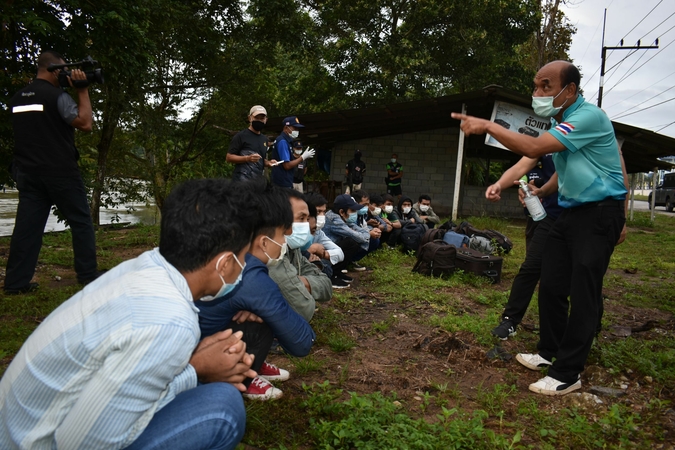
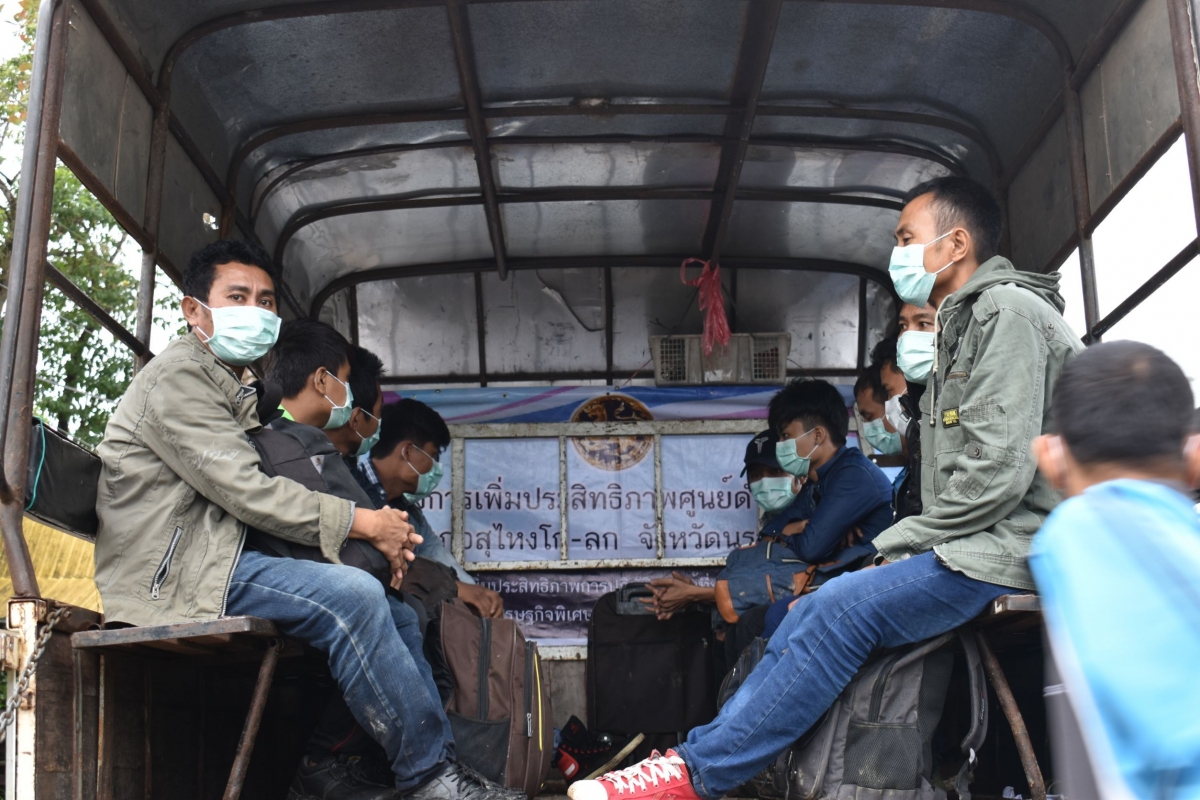
The district chief of Sungai Kolok district in Narathiwat province on Friday announced the arrest of 11 male migrants from Myanmar while they were trying to enter Thailand by crossing a river in Pasemat subdistrict that serves as a border with Malaysia.

“The migrants were disembarking from a ferry when officials confronted them before making the arrests. However, the ferry boat driver fled immediately,” district chief Rungreung Thimabutr said.

“Officials then brought the 11 migrants to Sungai Kolok Police Station for Covid-19 screening and interrogation. None of them has proper documents. They used to work on fishing boats in Malaysia and tried to enter Thailand to find jobs,” he said.

Preliminary screening showed that the 11 migrants have normal temperature. They are still detained in isolation until more detailed tests clear them of Covid-19 infection.

Rungreung added that in the past few months, officials had arrested several illegal migrants trying to enter Thailand via natural channels in Sungai Kolok district.

“Most of them were from Kelantan state in Malaysia and were either trying to escape the escalating Covid-19 situation in Malaysia or trying to find jobs,” he said.

“The agency in Malaysia that facilitated their entry would keep their passports to avoid authorities tracing back to them in case the migrants were arrested. We suspect that they could be international human trafficking rings.”

Famous Nonthaburi temple to serve as Covid-19 quarantine centre until Jan 8 #SootinClaimon.Com

#SootinClaimon.Com : ขอบคุณแหล่งข้อมูล : หนังสือพิมพ์ The Nation.

Famous Nonthaburi temple to serve as Covid-19 quarantine centre until Jan 8

NationalDec 26. 2020

By THE NATION

Nonthaburi provincial authorities on Friday ordered Wat Boromracha Kanchanapisek Anusorn, also known as Wat Leng Noei Yi 2, a famous Chinese Buddhist temple located in Bangbuathong district, to be closed temporarily from December 25 until January 8.

“Officials will use the temple’s premises as quarantine location for persons suspected of contracting Covid-19 but are yet to show symptoms,” province officials said on the Facebook page of Nonthaburi Covid-19 Information Centre on Friday evening.

Two new Covid-19 cases have been recently reported in Nonthaburi — both are Myanmar national female workers at the temple aged 54 and 46 years.

After the cases were found, 113 monks and staff of the temple were quarantined within the temple.

Health officials are tracing their travel history and testing people who might have had close contact with the patients.

PM’s Office staff who had tested positive for Covid-19 cleared of infection #SootinClaimon.Com

#SootinClaimon.Com : ขอบคุณแหล่งข้อมูล : หนังสือพิมพ์ The Nation.

PM’s Office staff who had tested positive for Covid-19 cleared of infection

NationalDec 26. 2020

By THE NATION

Six officials in the Prime Minister’s Office at Government House who had earlier tested positive for Covid-19 via rapid test were ruled as not infected after swab test, a senior official said.

Government House had performed random screening of its 700 staff on Friday afternoon. The six positive results came from the first batch of 350 staff whose saliva was tested with rapid test kits. The second batch will be tested on Monday.

“The six staffers were ruled as carrying no risk, but were told to work from home for the peace of mind of their colleagues,” Nuttreeya Thaweewong, director at Office of Spokesman, Secretariat of the Prime Minister, said on Friday evening.

Related Story: Government House on alert after 6 officials test positive

Temperature goes up in upper Thailand, isolated heavy rain forecast for the South #SootinClaimon.Com

#SootinClaimon.Com : ขอบคุณแหล่งข้อมูล : หนังสือพิมพ์ The Nation.

Temperature goes up in upper Thailand, isolated heavy rain forecast for the South

NationalDec 26. 2020

By THE NATION

The Thailand Meteorological Department said on Saturday that the high-pressure system over upper Thailand is weakening, causing the temperature to rise by 1-3 degrees Celsius with possible morning fog.

Cool to cold weather continues in the North and the Northeast, while mountaintops remain cold to very cold with frost in some place. Motorists in upper Thailand should proceed with caution due to poor visibility, the department said

Meanwhile, the weak northeast monsoon prevailing over the Gulf and the South, will bring isolated heavy rain to the areas.

The weather forecast for the next 24 hours:

North: Cold to cool weather with light fog in the morning; minimum temperature 10-21 degrees Celsius, maximum 27-34°C; temperature on hilltops likely to drop to 4-12°C with frost in some areas.

Northeast: Cool weather with light fog in the morning; minimum temperature 17-22°C, maximum 30-31°C; temperature on hilltops is likely to drop to 10-15°C.

Central: Partly cloudy with light fog in the morning; minimum temperature 23-24°C, maximum 31-34°C.

East: Partly cloudy with light fog in the morning; minimum temperature 23-25°C, maximum 31-34°C; waves 1-2 metres high and two metres off shore.

South (east coast): Mostly cloudy with thundershowers in 40 per cent of the areas and isolated heavy rain; minimum temperature 23-25°C, maximum 26-30°C; waves 1-2 metres high and two metres during thundershowers.

South (west coast): Mostly cloudy with thundershowers in 20 per cent of the areas; minimum temperature 21-24°C, maximum 28-30°C; waves a metre high and 1-2 metres during thundershowers.

Bangkok and surrounding areas: Light fog in the morning; minimum temperature 23-25°C, maximum 30-34°C.

Time for Prayut and his allies to reflect on national security, amid Covid surge and prolonged political conflict #SootinClaimon.Com

#SootinClaimon.Com : ขอบคุณแหล่งข้อมูล : หนังสือพิมพ์ The Nation.

Time for Prayut and his allies to reflect on national security, amid Covid surge and prolonged political conflict

NationalDec 26. 2020Police erected a barrier of razor wire and shipping containers to prevent a rally at the Crown Property Bureau, so protesters switched their focus to the Siam Commercial Bank headquarters on November 25.Police erected a barrier of razor wire and shipping containers to prevent a rally at the Crown Property Bureau, so protesters switched their focus to the Siam Commercial Bank headquarters on November 25.

By Wichit Chaitrong
The Nation/ Analysis

Flooding and Covid-19 have exposed serious flaws in national security under the government of PM Prayut Chan-o-cha this year.

The deep faults in national security strategy are highlighted by the mismanagement of tax funds and the handling of youth-led protesters under Prayut’s leadership.

The prime minister is again under fire after Covid infections spiked over last weekend. Migrant workers from Myanmar, especially illegal immigrants, are the suspected source of the outbreak, which centred on a Samut Sakhon seafood market and saw cases jump by over 500 last Saturday.

Observers have criticised the government’s failure to monitor migrant workers and crack down on migrant-trafficking gangs at the border, despite setting up the Centre for Covid-19 Situation Administration (CCSA).

Social activist Sombat Boonngamanong noted the government had redirected border patrol police to counter pro-democracy rallies in Bangkok.

Instead of using them to prevent illegal entry by migrants from Covid-ravaged neighbouring countries, the government has deployed border police to keep an eye on protesters during major street rallies in the last few months.

Bangkok police in November and December also barricaded roads with razor wire and shipping containers, in a move ridiculed as overkill by observers.

Some pointed out that the razor wire barriers could be used more productively at borders to prevent virus-infected smugglers sneaking into the country.

The excessive response to peaceful student-led protests that began in July eventually turned violent when the government imposed an emergency decree and police fired water cannon and teargas to clear the gatherings. Royalist counter-protests were also mobilised against the pro-democracy movement, leading to violent clashes.

In a desperate bid to crush protests calling for Prayut to step down, a new Constitution and monarchy reform, police have lately applied the draconian lese majeste law against dozens of protesters, including a 16-year-old child.

The United Nations High Commission for Human Rights criticised the government for using Section 112 – which carries jail sentences of up to 15 years – against demonstrators exercising their internationally recognised right to protest peacefully.

The government defended its actions as “protecting national security”. However, the Covid-19 surge suggests Prayut’s administration has a warped view of national security priorities that has weakened Thailand by shifting human and financial resources to counter protesters rather than the virus. If Prayut and his inner-circle were genuinely focused on the nation’s security, they would have allocated more personnel and budget to combating Covid-19 instead of wasting human and financial resources on countering peaceful protests. More evidence of misplaced priorities came with the Bt54 million in tax money spent by the Royal Thai Air Force to renovate a toilet on its VVIP jet-liner.

The government also fared badly in efforts to combat severe flooding which hit almost 1 million people in the South this year. Prayut’s administration prioritised combat of a different sort, spending billions on military hardware including a submarine, despite the absence of threats – marine or otherwise – from foreign powers. The budget choices were more proof of misplaced national security priorities among Prayut and his military top brass.

Academics duly called on the government to abandon a national security strategy rooted in the military-establishment alliance.

Surachart Bamrungsuk, a political science professor at Chulalongkorn University, urged the government to cancel its 20-year national strategy – a legacy of the post-coup junta – warning the plan would quickly be rendered obsolete by the fast-changing global and local landscape. He observed that the national strategy was a political tool designed to entrench the military’s role in government following the March 2019 general election. Hence it was not capable of addressing the country’s current problems, he added. 

The impact of Covid-19 had severely damaged the country’s economy and competitiveness. The unforeseen crisis had rendered the 20-year national strategy worthless, Surachart wrote in a comment piece headlined “Is the 20-year National Strategy relevant post-Covid 19?” published by the Nation Thailand in April.

Meanwhile Thailand is officially becoming an ageing society. Protecting national security now means finding ways to boost productivity of the younger generation, since they are the ones who will have to pay off the huge public debt built up by this generation. The youngsters will need to shoulder the growing burden of caring for the aged. The priority now is to upgrade the quality of education to support this young generation. There is also an urgent need to strengthen key institutions, especially the political and judicial systems that mediate conflicts in society. However, the government has ignored this need, instead exploiting those institutions as weapons to combat younger generations and their demands for national reform and genuine democracy.

Prayut and his Cabinet have branded pro-democracy protesters as youthful troublemakers. The reality is that many in the older generation back their calls for national reform. Former prime minister Anand Panyarachun has expressed support for amendment of the lese majeste law. Business leader Banyong Pongpanich has backed monarchy reform, suggesting that Thailand should return to the benchmark set by King Rama IX. The previous monarch did not take control of two Army regiments in Bangkok, nor did he have direct control over the Crown Property Bureau.

It has become obvious that the youth-led democracy movement wants “rule of law” as the solid ground on which Thailand can develop in the 21st century. This is the priority that all stakeholders in the country can agree on. The youth are already determined to achieve it in their lifetime, but the current government has rewarded their efforts with charges of sedition and lese majeste. Unfortunately, Prayut and his old alliance are still at a loss over the true identity of national security. The New Year is the right time for them and the whole country to reflect on this issue.