Myanmar arrests two more journalists as post-coup media crackdown continues
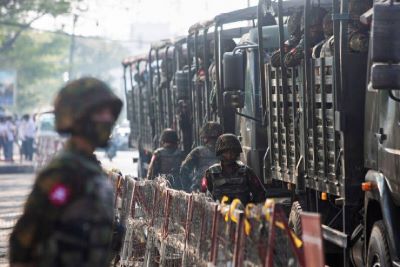
YANGON (REUTERS) – Myanmars military government has arrested two more local journalists, the army-owned television reported on Saturday (Aug 21), in the latest in a sweeping crackdown on the media since a Feb 1 coup.
Mr Sithu Aung Myint, a columnist for news site Frontier Myanmar and a commentator with Voice of America radio, and Ms Htet Htet Khine, a freelance who has worked for the BBC Burmese service, were arrested on Aug 15, Myawaddy TV reported.
Mr Sithu Aung Myint was charged with sedition and spreading false information in social media posts that Myawaddy said were critical of the junta and urged people to join strikes and back outlawed opposition movements.
Ms Htet Htet Khine was accused of harbouring Mr Sithu Aung Myint, a wanted criminal suspect, and for working for and supporting a shadow National Unity Government.
Reporters Without Borders (RSF) said on Saturday that the pair were being held “incommunicado” and their detention was unlawful.
“We strongly condemn the arbitrary conditions of their detention, which reflect the brutality with which the military junta treats journalists,” said Daniel Bastard, head of RSF’s Asia-Pacific desk.
ADVERTISEMENTx
Myanmar remains fraught with instability and opposition to army rule, under which more than 1,000 people have been killed, according to an activist group that has tracked killings by security forces.
The military, which has revoked the licenses of many news outlets, says it respects the role of media but will not tolerate the reporting of news it believes to be false or likely to create public unrest.
A report by the Committee to Protect Journalists last month said Myanmar’s rulers had effectively criminalised independent journalism.
Human Rights Watch said the army government, which has arrested 98 journalists since the coup, should stop prosecuting media staff. Of those arrested, 46 remained in custody as of the end of July.
The joke going around in diplomatic circles in New Delhi is that the Taliban takeover of Afghanistan was much smoother than the change of guard at the White House after Joe Biden won the presidential elections in the worlds biggest democracy.
It is a deceptive calm that preceded and followed the ultra-conservative group’s seizing the levers of power in Kabul on August 15. What lies behind the smoothness and calm is the danger of a radical ideology that has serious security and geostrategic implications not just for India, but for South Asia as well. It is nothing more than a geographical indicator that Afghanistan is a member of the South Asian Association for Regional Cooperation (SAARC) given the dysfunctional nature of the forum.
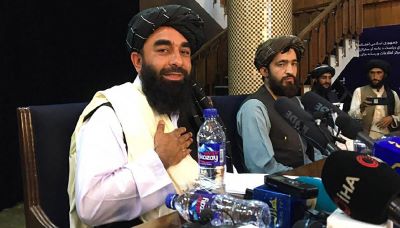
As the second coming of the Taliban to power—the first time was in 1996 with horrific consequences for Afghanistan—plays out, one of its first announcements was to establish an Islamic Emirate. New Delhi seems to be reworking its Afghan policy. On August 18 and 19, Prime Minister Narendra Modi deliberated with his top cabinet colleagues and National Security Adviser on the developments in Afghanistan and the way forward for India. Clearly, India does not have many options as the rise of the Taliban has clearly led to a new power shift and set off jockeying for influence by regional powers like China, Russia, Turkey and Afghanistan’s next door eastern neighbour Pakistan. This is an area of great concern for India, according to strategic affairs experts.
ADVERTISEMENTx
The Taliban regime in Afghanistan of the 1990s was recognised by Saudi Arabia, Pakistan and the UAE. Russia and China had not recognised the Taliban then but they are now falling head over heels to embrace the group. This is a big change from 1996. China, with its deep pocket, is not only looking at making investments in the Afghan economy, but also taking its Belt and Road Initiative to that country to complement its project already going on in Pakistan. China is particularly keen on tapping the deposits of copper, iron ore and lithium which is important for the electric vehicles of the future. There could be a quid pro quo between China’s financial muscle to help out the Afghan economy, heavily dependent on foreign aid, and mineral mining rights.
The assessment in the strategic establishment in New Delhi is that Pakistan, which has for decades invested heavily in the Taliban by supplying it with funds, weapons and intelligence, is in the driver’s seat on matters relating to Afghanistan and will now try to whittle down India’s role in the economic development of that country. Pakistan is looking to benefit from a friendly regime in Kabul to take advantage of Afghanistan’s extremely strategic location as a transit hub linking South Asia with Central Asia and beyond. So, India’s challenges today are quite different and complicated. Will India finally reconcile itself with recognising the Taliban?
After being so closely tied to the governments in Afghanistan over the last two decades, India, which did not recognise the Taliban in 1996, is in no hurry to recognise the new dispensation in Kabul this time around. How India reworks its Afghan policy will depend a lot on a number of variables. Will India go with the western democracies and other Asian countries it has strong relations with based on shared values of democracy, fight against terror and a rule-based international order? Indian Foreign Minister S Jaishankar’s recent visit to the US and Qatar is aimed at, among other things, to ascertain the thinking in Washington and the influential Gulf country about the future of Afghanistan. As part of the same exercise, a team of Indian officials led by Deputy National Security Adviser Pankaj Saran was in Moscow this week meeting Russian National Security Adviser Nikolai Patrushev.
Right now, India is waiting to see the contours of the new power structure and the character of a new government that is expected to emerge in Afghanistan. Senior Taliban leader Amir Khan Motaqi has already held talks with former President Hamid Karzai and senior leader Abdullah Abdullah. India is also keeping a close watch if the talks on the future government could include non-Talibans in view of the ethnic diversity of Afghanistan—Pashtuns, Tajiks, Uzbeks and Hazaras. What India is looking at with keenness is can Afghanistan come up with a system that can preserve the gains of the last two decades. After its military prowess shown in the speed with which it captured Afghanistan this time, the Taliban is under no obligation to share power with anyone else. Buoyed by its military victory, the Taliban will try to dictate terms from a position of strength.
Some strategic affairs experts in India rue that New Delhi should not have hesitated to reach out to the Taliban, a policy that sees India squeezed out of the big picture of international power-play in Afghanistan. Such an outreach would have required India to make deft diplomacy and a subtle shift from its stand of looking at the Taliban from a UN-designated terror outfit.
India may be wary of the Taliban but it is far from abandoning the people of Afghanistan where there is considerable goodwill generated by India’s soft power in constructing welfare projects in all the 34 provinces of that country like roads, power, dams, hospitals, setting up educational facilities and giving scholarships. Being mindful of this even after the Taliban takeover on August 15, India was quick to announce e-visa facility for Afghans, wanting to come to India in view of the situation in that country. India is also considering offering help to Afghan students who have taken admission in Indian universities but are unable to come to the country due to the flight disruptions in Kabul. To sustain its image as a reliable development partner, India may have to rethink on its decision to reopen its shut diplomatic missions in Kabul, Kandahar and Mazar-e-Sharif. To sum up, India has to find a way to stay invested in Afghanistan post-Taliban takeover.
Much will depend on how the Taliban conducts itself in Afghanistan, deals with the international community, if it distances itself from various terror groups, including Al Qaeda, which helped it, and how it deals with Pakistan, the principal backer of the hardline Islamist group. If the Taliban sticks to its medieval mores like in the 1990s, oppressing women and indulging in revenge killings, it could run the risk of once again becoming an international pariah. Post-takeover, initial vibes emanating from Kabul is that the group is trying to signal its transformation into a force of moderation by promising no reprisal violence and that women are welcome in government offices. During the talks on government formation with Karzai and Abdullah Abdullah, Motaqi reportedly pledged to form an “inclusive” government that would give representation to all ethnic groups. So, the Taliban seems to be making the right noises, keeping an eye on the international community in a bid to get acceptance and legitimacy. But these words need to be verified on the ground in the months to come.
The Taliban must realise that winning a military victory is quite different from the challenges of governance, the foremost of which is to ensure development projects of the last 20 years in connectivity network, energy supply, healthcare facilities and several community development projects.
A key marker of India’s response to the new regime in Kabul will, of course, be the Taliban’s relations with Pakistan. The Taliban has close links with Tehreek-i-Taliban of Pakistan and other anti-India terror groups like Jaish-e-Mohammed and Lashkar-e-Taiba. Recently, TTP leader Mufti Noor Wali Mehsud has thanked the Taliban leader Haibatullah Akhundzada for releasing their deputy leader Maulvi Faqir Muhammad from Bagram high security prison—from where around 7,000 hardcore terrorists were freed by the Taliban. The issue is: will Pakistan stop using cross-border terrorism as an instrument of state policy and give more stress on geo-economics rather than geo-politics? It does not look like it.
The question also is: will the Taliban be able to snap its ties with non-Afghan terror outfits which will try to extract their pounds of flesh for having helped the Taliban. One must remember that Jaish chief Maulana Masood Azhar was taken directly to Mullah Omar (who had led the Taliban’s charge in Afghanistan in 1996), in Kandahar after he was freed by India in return for the safe release of passengers of the Indian Airlines flight hijacked from Kathmandu in December, 1999.
The change of guard in Kabul has set off security concerns for India and some other parts of South Asia. India will have to be on guard against the possibility of the Taliban sending is fighters or helping other terror groups to Jammu and Kashmir. Both India and Bangladesh must recognise that Jamaat-ul-Mujahideen Bangladesh has its roots in an earlier Afghan war. The JMB was founded by Afghan war veterans, and how the outfit went on a rampage in Bangladesh in the early 2000s is well-known. The Taliban recruited a large number of fighters from Bangladesh in the 1990s and some from India. The spill-over of the Taliban takeover in Afghanistan may result in a rise in extremism not only among radicals in Bangladesh and Rohingyas there, but also in India.
150 Indians abducted from Kabul airport but later released: Reports
Amid reports that around 150 Indians were allegedly abducted from outside the Hamid Karzai International Airport in Kabul on Saturday, local Afghan journalist Zaki Daryabi said that the kidnapped persons were released and they were on the way to the airport.
“Two sources confirmed that the Indians were released by the Taliban. They are on the way to Kabul airport,” Daryabi tweeted. He also said that these Indians were taken to the nearby Alokozai compound from the Kabul airport, adding they were safe.
The reports also said that these Indians were taken to the nearby area of the Alokozai compound, a garage designated for US forces, as there was a huge rush at the airport and the Taliban allegedly inspected their documents and released them.
ADVERTISEMENTx
The abductors later ushered them to the right place at the airport from where their evacuation flight would take off for India after getting the slot, the report added.
Earlier the day, the Afghan media reported that men affiliated with the Taliban have abducted over 150 people, mostly Indian citizens, from an area close to the airport.
A local publication ‘Kabul Now’ had also confirmed the development.
“Over 150, mostly Indian citizens, abducted near Kabul airport Men affiliated with the Taliban have abducted over 150 people, mostly Indian citizens, from an area close to Hamid Karzai International Airport earlier this morning, Saturday, August 21, a reliable source confirmed to Kabul Now,” Daryabi said in a different tweet.
However, the Taliban denied the report of abducting Indian nationals.
ADVERTISEMENT
“The report about kidnapping is a rumor. The Taliban members are helping all foreign nationals to get access to the airport. We are determined to provide safe passage to all foreigners to get to the airport,” Ahmadullah Waseq, a Taliban spokesperson, told local media Eitlalatroz.
He said Taliban forces were escorting about 150 Indian citizens to safely enter the airport, reports Xinhua news agency.
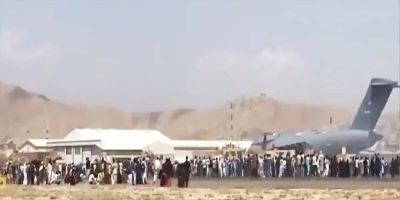
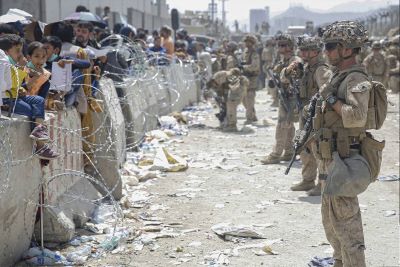
Following the Taliban’s takeover of the Afghan capital on August 15, thousands of Afghans have flooded to Kabul airport to leave the country.
The evacuation flights were continuing as three flights took off on Saturday morning, resident Farhad Mohammadi said.
About 5,000 US troops have been deployed in Kabul airport to help with the airlift process. At least 12 people have been killed in gun shootings and stampedes in the airport since the capital city’s fall.
ADVERTISEMENT
The situation in Afghanistan remains uncertain after the Taliban’s swift takeover of most parts of the country.
UN: Kids in 4 South Asia nations most at risk of climate impact
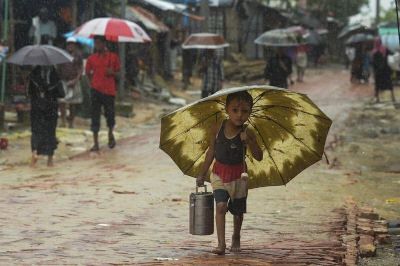
DHAKA – Young people living in Afghanistan, Bangladesh, India and Pakistan are among those most at risk of the impacts of climate change, threatening their health, education, and protection, according to a new UNICEF report received here Friday.
In addition, Nepal and Sri Lanka are among the top 65 countries most impacted globally.
“The Climate Crisis Is a Child Rights Crisis: Introducing the Children’s Climate Risk Index” is UNICEF’s first child-focused climate risk index.
It ranks countries based on children’s exposure to climate and environmental shocks, such as cyclones and heatwaves, as well as their vulnerability to those shocks, based on their access to essential services.
Pakistan, Bangladesh, Afghanistan and India are among four South Asian countries where children are at extremely high risk of the impacts of the climate crisis, with a ranking of 14, 15, 15 and 26 respectively. While Nepal is ranked 51, Sri Lanka is at 61st place. Bhutan is ranked 111, with children at relatively lower risk.
“For the first time, we have clear evidence of the impact of climate change on millions of children in South Asia. Droughts, floods, air pollution and river erosion across the region have left millions of children homeless and hungry, and without any healthcare and water,” said George Laryea-Adjei, UNICEF regional director for South Asia.
ADVERTISEMENTx
“Together, climate change and the COVID-19 pandemic have created an alarming crisis for South Asian children. The time to act is now – if we invest in water, healthcare and education, we can protect their futures from the impacts of a changing climate and degrading environment.”
The report found that these South Asian children are in constant danger from riverine floods and air pollution, yet investments in child health, nutrition, and education can make a significant difference to protect children from climate change.
South Asia is home to over 600 million children and has the highest number of young people globally.
Pentagon hints at more rescues outside Kabul airport, as security worsens, evacuations slow
WASHINGTON – The Pentagon on Saturday strongly hinted that U.S. troops may stage further operations outside the Kabul airport to help evacuate stranded American citizens and Afghans who aided the war effort, as the threat of violence in the capital grows amid the return of the Talibans top political leader and increased concern about potential attacks by the Islamic State.
The signal that U.S. troops could undertake enhanced efforts to rescue people outside the airport came as the Biden administration scrambles to fly thousands of people per day out of Afghanistan, and amid signs there were still significant bottlenecks to doing so. Numerous gates at the Kabul airport were closed for much of Saturday, as crowds continued to swell inside and the U.S. government struggled to process people quickly enough to alleviate the issues, said three U.S. officials familiar with the issue, who spoke on the condition of anonymity to discuss the precarious and evolving situation.
“Look, without getting predictive here, we have troops in a very dynamic environment, a very perilous mission, and they understand that – and they also understand why they’re there, they’re there to help people,” Pentagon spokesman John Kirby said, after indicating there had been no U.S. military operations outside the airport perimeter over the past 24 hours. “I’m not going to rule out that if they see a moment, if they see an opportunity to do it, they won’t do it.”
ADVERTISEMENTx
Kirby’s comments followed the disclosure that U.S. troops, traveling aboard Chinook helicopters, left the airport Thursday to retrieve 169 Americans from a nearby hotel. European commandos have conducted such missions for days, leading some U.S. lawmakers and others to suggest the Biden administration should do more to help people reach the airport.
Several thousand American citizens – and likely far more Afghans who have worked on behalf of the United States – remain in Afghanistan as U.S. forces stare down President Joe Biden’s Aug. 31 deadline to complete the American withdrawal, though he indicated in recent days that time frame could stretch if necessary. Since the evacuation began a week ago, the U.S. military has managed to remove about 17,000 people from Kabul, including 2,500 Americans, Pentagon officials said Saturday – a fraction of the 10,000 to 15,000 U.S. citizens the Biden administration estimated last week still remained in Afghanistan.
On Saturday night, the White House announced that Spain had agreed to temporarily house transiting evacuees from Afghanistan at military bases in Rota and Moron.
In the last measured 24-hour period, amid increased violence outside the airport and new threats that the Islamic State might try to stage an attack, the military evacuated about 1,600 people aboard six C-17 transport aircraft, Maj. General William Taylor told reporters at the Pentagon. Although an additional 2,200 people left Kabul on charter flights, evacuations aboard military aircraft were down from the approximately 2,000 people they were removing in each of the past several days, already well below the Pentagon’s stated capacity of between 5,000 and 9,000 daily.
The Pentagon cited a backup at Al Udeid Air Base in Qatar as a reason for the slowdown. The base has been the first stop for many evacuees. On Friday, U.S. officials described overcrowding with thousands of evacuees inside Kabul airport and at Al Udeid, prompting a stoppage lasting at least six hours, officials said. As a result, the U.S. military has begun flying evacuees from Kabul directly to other military bases in the Persian Gulf, Europe and to Dulles International Airport on the outskirts of Washington, alleviating the bottleneck in Qatar.
ADVERTISEMENT
Thousands of evacuees were due to arrive in the United Arab Emirates on Saturday night en route to the United States, said a U.S. official familiar with the situation. Like other nations, the small Arab country, though a stanch U.S. ally, does not want to host Afghans indefinitely but is allowing its territory to serve as a weigh station.
Three planes landed at Dulles Airport on Saturday, the Pentagon said, noting that the Afghans onboard would be transferred to Fort Bliss, an Army post in Texas, for processing. Such changes, Taylor said, means it is likely the military will “get back into numbers we saw the day before.”
Officials acknowledged Saturday that time was of the essence.
“We know that we’re fighting against both time and space,” Kirby said. “That’s the race that we’re in right now, and we’re trying to do this as quickly and as safely as possible.”
Although the military insists it has control of the Kabul airport and that the gates are open to Americans who arrive with the proper credentials, the State Department on Saturday, citing an unspecified security threat, warned Americans there “to avoid traveling to the airport and to avoid airport gates at this time unless you receive individual instructions from a U.S. government representative to do so.”
ADVERTISEMENT
That warning appears to have been inspired, at least in part, by concerns that Americans could be targeted by fighters loyal to the Islamic State affiliate in Afghanistan. But Kirby also said Saturday that, although the United States has been communicating with the Taliban to guarantee safe passage for Americans and U.S.-sponsored Afghans, apparently “not every Taliban fighter either got the word or decided to obey the word.”
Meanwhile, the Taliban’s de facto leader, Abdul Ghani Baradar, returned to Kabul on Saturday to begin the process of setting up a new government, though north of the capital resistance fighters managed to push back Taliban forces in three districts of Baghlan province – raising the specter that the militant group may not have an absolute lock on power in the country, and that more violent battles for control could ensue.
Baradar appeared in Kabul with Abdullah Abdullah, a senior Afghan official who was a political rival of Ashraf Ghani, the Afghan president who fled the country as the Taliban seized control, according to photographs that Abdullah tweeted. They were joined by Afghanistan’s former president, Hamid Karzai, who was installed as the country’s leader after the U.S. military toppled the Taliban in 2001 and remained in charge through September 2014. Baradar founded the extremist group in 1994 along with three other men and went on to serve as a negotiator for peace talks in Doha, Qatar.
Inside the airport, uncertainty and hardship remains for those who have managed to make it through Taliban checkpoints. An Afghan American, speaking on the condition of anonymity due to security concerns about his family, said Saturday that his brother and other family members had been at the airport since Thursday night. The family, with three children, entered the military side of the airport after braving angry and desperate crowds. The brother was beaten by the Taliban while crossing through a checkpoint, the man said.
Many families inside the airport have been cloistered in tightly packed tents. Some opted to stay outside in the open air because of the smell inside, the Afghan American said. The families have received prepackaged meals and water, but there were no additional accommodations for infants, the man said.
The Afghan American who spoke with The Washington Post said his brother had been directed by U.S. Embassy staff to come to the airport as a special immigrant visa applicant. But when he attempted to find a staff member to talk to about his paperwork, he was told to sit down by U.S. Marines defending the facility and helping to coordinate evacuation flights, the Afghan American said. One Marine told the brother at the airport that the American service members were doing the best they could with limited resources, and that if the Afghans knew anyone who could contact members of Congress, they should, the Afghan American said.
The brothers were communicating in small bursts, with the one in Kabul bringing three cellphones with him to the airport and already burning through batteries on the first two of them.
“The moment your phone is dead, you’re disconnected,” the brother in the United States said.
The number of evacuees inside the Kabul airport has climbed from the estimated 10,000 who were there Friday, a defense official said. The official declined to say how much larger the crowd was Saturday, but noted that the increase had prompted the U.S. military to reduce the number of people it was allowing into the airport from the chaotic streets outside.
Logistically, the official said, it had been “impossible” to keep up with the evacuees entering the airport.
The departments of State and Homeland Security have faced criticism for the pace at which they are able to process non-American citizens. One U.S. official attributed the delays to the Department of Homeland Security’s process for assessing evacuees’ biometric data, which is run through various databases to determine whether an individual has a criminal record, has previously entered the United States illegally or has links to terrorist organizations.
A senior U.S. official said that the military playing catch-up on the bottleneck of people at the air base in Qatar and security screening of Afghans both were playing an issue.
When asked if it is responsible for delays in visas processing, a DHS spokesman said the agency is working alongside the FBI and other agencies to conduct the vetting, “which includes biometric and biographic screening.” The official said DHS personnel are working “around-the-clock” to ensure individuals are screened against U.S. government databases before arriving in the United States and upon arrival.
Another U.S. official familiar with the issue expressed frustration that the government did not appear to be relying more on screening the United States already has done with Afghan partners.
“Every day that the gates aren’t open at the airport is another day lost,” the official said. “We’re running out of time.”
Published : August 22, 2021
By : The Washington Post · Karoun Demirjian, Dan Lamothe, John Hudson
New Covid cases and deaths in Asean fall for second day in a row
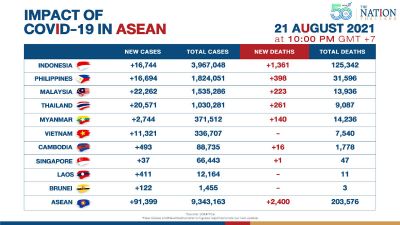
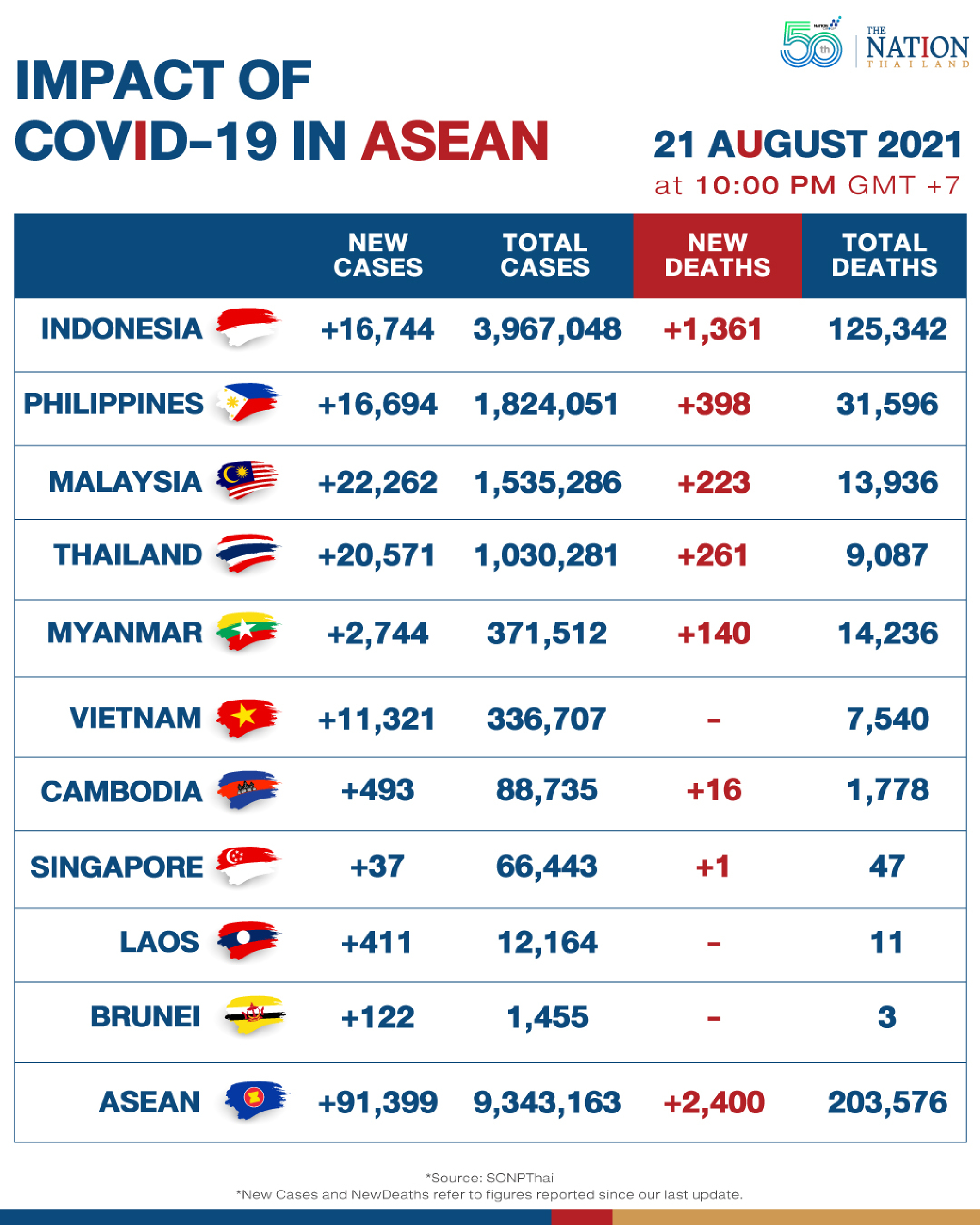
Southeast Asia saw a decrease in new Covid-19 cases and related deaths on Saturday for the second successive day, collated data showed.
Asean countries reported 91,399 infections and 2,400 deaths on Saturday, lower than 95,512 and 2,696 respectively on Friday.
Cambodia’s Prime Minister Hun Sen expected the government to vaccinate 12 million people, or 75 per cent of the total 16 million population, by the end of this year.
The Cambodian government has extended the enforcement of curfew measures in Phnom Penh for another seven days as the country’s daily Covid-19 cases continued to rise due to the outbreak of the Covid-19 delta variant.
The government has accelerated administering the third Covid-19 jab on frontline personnel, as well as the third AstraZeneca jab on people who had received two Sinovac or Sinopharm jabs, in a bid to stimulate their immunity.
ADVERTISEMENTx
The Vietnam government is preparing to enforce maximum lockdown measures in Ho Chi Minh City for two weeks in a bid to reduce the number of Covid-19 infections and deaths due to the Covid-19 delta variant.
Starting on Monday, over 9 million people will be banned from going outdoors unless necessary.
Meanwhile, the Vietnam government has deployed soldiers and police to publicise lockdown measures, deliver foods and necessities, and conduct proactive Covid-19 tests on people.
New Covid cases and deaths in Asean fall for second day in a row
The country also reported another 104 coronavirus-related deaths. The latest data came as the Medicines and Healthcare products Regulatory Agency (MHRA) approved Ronapreve as the first monoclonal antibody combination product indicated for use in the prevention and treatment of acute COVID-19 infection in Britain.
Another 32,058 people in Britain have tested positive for COVID-19, bringing the total number of coronavirus cases in the country to 6,460,930, according to official figures released Saturday.
ADVERTISEMENTx
The country also reported another 104 coronavirus-related deaths. The total number of coronavirus-related deaths in Britain now stands at 131,591. These figures only include the deaths of people who died within 28 days of their first positive test.
The latest data came as the Medicines and Healthcare products Regulatory Agency (MHRA) approved Ronapreve as the first monoclonal antibody combination product indicated for use in the prevention and treatment of acute COVID-19 infection in Britain.
Developed by Regeneron/Roche, the drug is administered either by injection or infusion and acts at the lining of the respiratory system where it binds tightly to the coronavirus and prevents it from gaining access to the cells of the respiratory system, according to a statement by the MHRA.
Clinical trial data assessed by a dedicated team of MHRA scientists and clinicians has shown that Ronapreve may be used to prevent infection, promote resolution of symptoms of acute COVID-19 infection and can reduce the likelihood of being admitted to hospital due to COVID-19, the statement said.
“Ronapreve is the first of its kind for the treatment of COVID-19, and after a meticulous assessment of the data by our expert scientists and clinicians, we are satisfied that this treatment is safe and effective,” said Dr Samantha Atkinson, Interim Chief Quality & Access Officer at the MHRA.
England lifted almost all its remaining COVID-19 restrictions since July 19. More than 87 percent of people aged 16 and over in Britain have had their first dose of vaccine and more than 76 percent have received both doses, the latest figures showed.
To bring life back to normal, countries such as Britain, China, Germany, Russia and the United States have been racing against time to roll out coronavirus vaccines.
People dine in the outdoor dining area of a restaurant in London, Britain, on Aug. 13, 2021.
Washington national zoo celebrates panda cub Xiao Qi Jis 1st birthday
“The relationships that we develop with our Chinese colleagues, including the ambassador, working together to save this endangered species is one of the most incredible parts” of the giant panda conservation program, said Brandie Smith, acting director of the Smithsonians National Zoo.
Xiao Qi Ji, the giant panda cub born in the national zoo in Washington, D.C., turned one on Saturday, and the zoo held a big birthday party for the little cutie featuring ice cakes and other activities to celebrate the occasion with his avid fans coming for a visit.
ADVERTISEMENTx
Staff at the Smithsonian’s National Zoo and Conservation Biology Institute got Xiao Qi Ji’s tiered cake with a large number “1” topper set up just after 7:00 a.m., placing the delicacy at the center of the outdoor ground so that reporters could easily shoot the moment Xiao Qi Ji enjoys his birthday feast.
The cake is made from frozen dilute grape, apple juices and colored water and decorated with sweet potato, apple, carrot, pear, sugar cane, banana and bamboo. Xiao Qi Ji’s parents, mama Mei Xiang and papa Tian Tian, each got their own ice cakes in honor of their son’s birthday.
When Xiao Qi Ji and Mei Xiang stepped out of their house, they went straight toward mama’s cake. It was not until the “Xiao Qi Ji” inscript on the main cake melted that the mother-son duo finally turned their attention to the entree of the day, working on it as spectators cheered in the background.
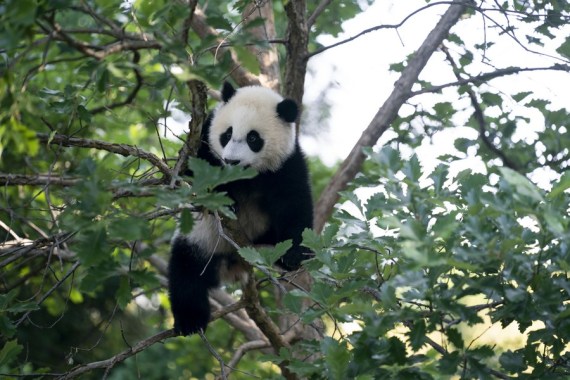
It appeared that Xiao Qi Ji was more than satisfied with the cake, crushing the 1-shaped topper and then, after finishing the special breakfast, climbing onto his favorite tree to inspect those who came for the purpose of wishing him happy birthday.
ADVERTISEMENT
“I’ve been here about four times already, even with the COVID and everything,” said Yolanda Reyes, a panda lover who couldn’t resist the innocence and charm of Xiao Qi Ji, and who could still vividly recall Tai Shan, Bao Bao and Bei Bei — three other cubs Mei Xiang gave birth to in the D.C. zoo who used to live here before returning to China.
“It’s been wonderful. They always have (Xiao Qi Ji) here, and you see the interaction with his mother and everything like that. It’s great,” said the Virginia resident.
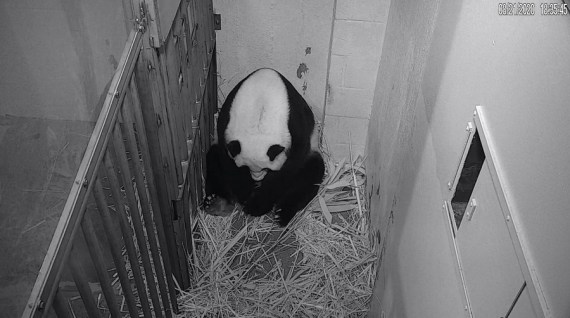
“Xiao Qi Ji” is the Chinese expression of “little miracle” in English. People decided to name the adorable boy that way because his mother, at age 22, was the oldest giant panda to give birth in the United States. When she conceived Xiao Qi Ji, Mei Xiang had a less than 1 percent chance of having another baby.
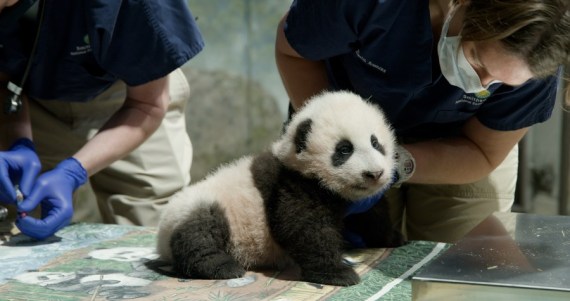
After his miraculous birth, Xiao Qi Ji, who the keepers said is a quick learner, never stopped bringing surprise and joy to people caring for him, having not only reached a number of milestones in the past year — such as going through his first veterinary exam, his first steps, getting his first toys and having his first taste of sweet potato — but also adapted incredibly well to the harsh reality of the pandemic thanks to the love and caring from his keepers.
“Not only was (Mei Xiang’s) age a challenge, in the best case scenario, panda breeding is challenging,” said Bryan Amaral, the national zoo’s senior curator. “Due to the pandemic, we had a lot of tools not available to us that we would normally use to help us be successful.”
ADVERTISEMENT
“We had to take a little bit of a different approach this time,” Amaral said, noting that because of the extraordinary public health crisis, reproductive physiologists working with the giant panda conservation program had to share the lab space and, as a result, were unable to run samples in a timely fashion.
“I don’t know if we’ll use this (new approach) completely as a model in the future, but clearly the results speak for themselves,” he said.
Speaking of the cooperation around Xiao Qi Ji between the national zoo and its partners in China, Brandie Smith, acting director of the zoo, told Xinhua that since there are so many experts in China who know how to take care of pandas, people here at the zoo have been calling and writing to their Chinese counterparts on a regular basis, giving updates about Xiao Qi Ji’s care and growth.
“With the pandemic, we haven’t been able to meet in person, but we’re looking forward to doing that again as soon as we can,” Smith said.
To mark the joyous day, Chinese Ambassador to the United States Qin Gang expressed his birthday wishes to Xiao Qi Ji in a video and sent the adorable baby bear a gift.
“His arrival and every bit of his growth have given us joy and hope. For us, he is a miracle,” the ambassador said of Xiao Qi Ji, adding the cub “has truly added a splash of color to the exchanges between Chinese and American people.”
Smith, who had watched Qin’s video, said in comments to the ambassador’s remarks that “the relationships that we develop with our Chinese colleagues, including the ambassador, working together to save this endangered species is one of the most incredible parts” of the giant panda conservation program.
Celebratory events were held throughout the zoo on Saturday. General visitors attending Xiao Qi Ji’s birthday party received commemorative Xiao Qi Ji buttons, and registered members of the zoo were given reusable fans featuring Xiao Qi Ji’s picture.
“It’s nice to be able to open up and have something really fantastic to celebrate,” Amaral, the senior curator, said.
At least 8 dead, 3 missing after Hurricane Grace in Mexico
State police and the Mexican Army are engaged in rescue efforts and securing infrastructure after dozens of homes were flooded, sections of roads collapsed, and the electricity in parts of the area was cut.
At least eight people were dead and three missing after Hurricane Grace hit eastern Mexico, Cuitlahuac Garcia, governor of the state of Veracruz, reported on Saturday.
ADVERTISEMENTx
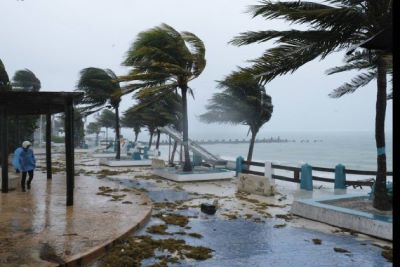
Grace, the second Atlantic hurricane of the season, made landfall in the early hours of Saturday with winds of up to 205 km per hour, leading to severe flooding in more than 20 municipalities in Veracruz.
State police and the Mexican Army are engaged in rescue efforts and securing infrastructure after dozens of homes were flooded, sections of roads collapsed, and the electricity in parts of the area was cut.
In the municipality of Nautla, a large number of crops were lost and roads were flooded during the storm.
According to the latest report from the National Water Commission (Conagua), Grace weakened during the early hours of the day and downgraded to a tropical storm, currently located 55 km northwest of Mexico City.
The tropical cyclone season in Mexico began on May 15 and is expected to end in November, according to Conagua.
Man who claimed to have bomb near Capitol charged with threatening to use weapon of mass destruction
WASHINGTON – A man who prompted an evacuation Thursday of the U.S. Capitol and surrounding buildings by claiming to have a bomb inside his truck faces charges of threatening to use explosives and a weapon of mass destruction.
Floyd Ray Roseberry of North Carolina surrendered to authorities Thursday about five hours after he drove a truck onto the sidewalk outside the Library of Congress and launched a standoff with law enforcement officers, police said. He had demanded to speak to President Joe Biden about a range of grievances against the Democratic Party and claimed that if he was shot, his vehicle and four others would explode.
According to court documents, a relative of Roseberry’s reported to local law enforcement on Wednesday that he “had recently expressed anti-government views and an intent to travel to Virginia or Washington, D.C. to conduct acts of violence.”
Officials said they found no bomb in his car, but there were materials that could be used to make explosives.
In a court appearance Friday when the charges were made public, Roseberry said he went to school through the eighth grade before going to work but eventually returned and got his GED and a welding license. He also said he hadn’t taken his “mind medicine” for at least two days.
“My memory isn’t that well, sir,” he told U.S. Magistrate Judge Zia Faruqui. He said his wife has power of attorney over his medical care.
Faruqui said he would delay any substantive decisions until the medication was provided but told Roseberry he faces up to life in prison.
ADVERTISEMENTx
“I can tell you’re a good man,” Roseberry responded. “I’m willing to do whatever you ask.”
Faruqui ordered a competency screening for Roseberry at the request of the government, which also asked for him to remain jailed. Authorities said Roseberry was 49, but in court he said he was 51.
A federal public defender representing Roseberry declined to comment after the hearing.
Before he was taken into custody, Roseberry delivered a tirade over a Facebook Live video that circulated widely before the website and other social media platforms took it down. In the video, he repeated the false claim that the election was stolen from former President Donald Trump and called on Democrats to resign.
He also threw what he said was $3,000 in cash out of the windows of his truck.
Roseberry’s ex-wife, Crystal Roseberry, said he has had a history of mental instability and had a volatile temper during their decade-long marriage.
Roseberry’s father, Floyd Roseberry, said his son had experienced mental problems in the past and, at times, threatened violence. He said he thought his son had “gotten on his feet” in recent years, running an auto repair business and a mobile home park and had become more religious under the influence of his new wife.
Bishop Brady Jackson, who leads a church in Roseberry’s North Carolina community, said he was never a member and his wife stopped attending. “They’re both pretty good people,” Jackson said. “I never would have thought he would have done that.”
Roseberry’s threat came four months after a Capitol Police officer was killed by a man who rammed his car into the barriers around the U.S. Capitol grounds and seven months after a violent, pro-Trump mob overran law enforcement and took over the building.
Roseberry had been distraught over his mother’s death a few years ago, said Brenda and Charles Humphries, his aunt and uncle. But nothing seemed amiss when the couple last saw Roseberry about a month ago, they said.
Brenda Humphries they learned about the incident in Washington from a friend.
“Oh, my lord,” she said. “I don’t know what happened. Something must have happened to Ray.”
Roseberry’s son’s fiancee, Courtney Foster, said Roseberry would tell everybody how much he agreed with Trump and “the way that he spoke the truth to the people,” but she was not aware of him attending any political events in D.C.
Roseberry also does not “believe in” watching TV and would get his news on his phone, Foster said. She wasn’t sure what sources he relied on, she said, but he came away with a dislike for Biden and refused to get vaccinated against the coronavirus.
“He’s very big in politics and he’s very big in, you know, the way that things are right now. He keeps up with it,” Foster said. “And this is just a result of it.”

 New Covid cases and deaths in Asean fall for second day in a row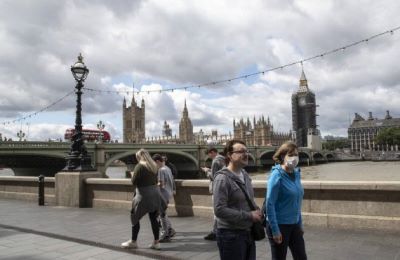

 People dine in the outdoor dining area of a restaurant in London, Britain, on Aug. 13, 2021.

 SootinClaimon.Com