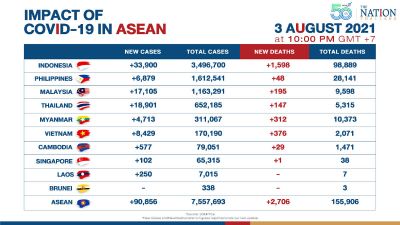
The number of Covid-19 cases in Southeast Asia crossed 7.55 million, with 90,856 new cases reported on Tuesday, higher than Monday’s tally of 76,320. There were 2,706 more deaths, decreasing from Monday’s 2,783 and taking total coronavirus deaths in Asean to 155,906 so far.
Indonesia’s health minister announced that the pandemic had already passed its peak point as the country has been seeing a decreasing number of new infections for several days now.
He added that 258 million doses of vaccine will arrive from August to December, which will enable Indonesia to achieve the target of imparting 70 million jabs per month in August and September. Meanwhile, the government will consider allowing more economic activities from September if the infection rate continues to decline and vaccination and testing rates continue to improve.
Cambodia reported 577 new cases and 29 deaths on Tuesday, bringing cumulative cases in the neighbouring country to 79,051 patients and a total 1,471 deaths so far. Cambodia’s health ministry reported that more than 200 infections linked to the Delta variant has been found in the country, most of which are workers who have returned from Thailand.
It urged people to strictly adhere to disease control measures, including self-isolation, as the Delta variant can spread faster than the original virus.
Germany, France and U.K. prepare for coronavirus vaccine boosters starting in September
BRUSSELS – European nations have been among the most successful in the world at getting their residents vaccinated against the coronavirus. Now, some will be among the first to dole out booster shots.
The small but growing group that is planning additional jabs for the fully inoculated includes some of the continent’s richest and most populous countries, potentially setting a precedent and marking a new phase of the vaccination campaign.
But as covid-19 continues to infect and kill at alarming rates across the Global South, where vaccination levels remain catastrophically low, the decision by wealthy countries to give booster shots to their own people rather than donating those doses to poorer nations is deeply controversial.
Advocates and experts, including at the World Health Organization, have called the move immoral, and the European Union’s foreign policy chief criticized the bloc for its “insufficient” vaccine shipments to countries in Africa and Latin America.
“It fits into the pattern of decisions we’ve seen from wealthy countries since the beginning of the pandemic,” said Andrea Taylor, who is leading research into global vaccine distribution at Duke University. “The wealthy countries are going to allow their citizens to go through the buffet and get seconds while half the world is still starving.”
ADVERTISEMENTx
Those concerns have not stopped a handful of countries from moving ahead, and more may soon follow.
On Monday, Germany announced it would begin offering booster shots in September to the elderly, immunocompromised and anyone who received a full regimen of the AstraZeneca or Johnson & Johnson shots, which may not be as highly protective as mRNA vaccines.
“We want to protect particularly at-risk groups as best as possible in fall and winter,” Germany’s health minister, Jens Spahn, said in a statement. “The risk of declining vaccination protection is greatest for those people.”
Infectious-disease specialists have cautioned against seeking out booster shots until more data becomes available, and scientists continue to disagree about whether and when the additional jabs will be necessary. The latest guidance from Europe’s health authorities says it is “too soon” to make a call on boosters.
Yet the highly transmissible delta variant has changed the calculus for some countries. With new virus cases on the rise across Europe, leaders hope that booster shots can help stave off another cold weather covid-19 wave.
ADVERTISEMENT
In France, those who were the first to receive the vaccine – residents of nursing homes, those over the age of 75 and people with severe health conditions – will be eligible for boosters in September, President Emmanuel Macron said last month.
In Britain, officials at the Department of Health and Social Care said they are preparing to offer booster jabs in September, but are awaiting guidance and confirmation from the country’s expert advisory panel. The booster program would ensure “millions” of people maintain protection “ahead of the winter and against new variants,” a spokesperson said.
Hungary – which has authorized a wider range of coronavirus vaccines than its neighbors, including formulations from Russia and China – is offering booster shots to everyone, regardless of age or health status, recommending people wait at least four months after their second dose.
And top officials in Spain and Italy have said residents will very likely need a booster, but concrete plans have not emerged.
Booster campaigns have also been underway in Russia and in Israel, where adults over 60 years old are now eligible. Prime Minister Naftali Bennett compared it to the flu vaccine, “which needs to be re-administered from time to time.”
ADVERTISEMENT
A booster campaign could be coming in the United States, as well. The U.S. Centers for Disease Control and Prevention has said it is exploring ways to get additional vaccine doses to immunocompromised individuals.
So far, U.S. regulators have approved only a two-dose regimen of the Pfizer-BioNTech and Moderna vaccines, or a single dose of Johnson & Johnson. But the country’s top infectious-disease doctor, Anthony Fauci, said a recommendation for booster shots in certain populations is “likely.”
But the global supply of vaccines is still limited, and every dose used as a booster is one that cannot be sent to countries desperate for shots.
The Biden administration celebrated on Tuesday that the United States had shipped more than 110 million doses of the coronavirus vaccines to more than 60 countries. Yet distributions to needy countries are nowhere near the 11 billion doses that the WHO says are essential to “truly end the pandemic.”
And while the European Union has made ambitious promises about vaccine donations, the bloc and its countries continue to lag the United States, according to officials, reports and publicly available data.
Josep Borrell, the European Commission vice president, said the EU is falling far short of the 200 million doses it promised would be shared by the end of the year.
“Yes, but when?” Borrell told a university class in Spain on Friday, according to Politico Europe. “The problem isn’t just the commitment but the effectiveness.”
According to EU figures from Monday, the bloc has donated 7.1 million doses to other countries, including nearly 1.59 million through Covax, a WHO-backed effort to equitably distribute vaccines.
A spokesperson said the EU’s institutions and member states have also provided about $3.5 billion to Covax and have raised nearly $50 billion in pandemic recovery aid to other countries, with more than a quarter of that earmarked for countries in Africa and Latin America.
“The EU has played and is playing an important role,” the spokesperson told The Washington Post. “But we need to do more. We have made the commitments and created the channels to deliver to our partners, now it’s time to deliver.”
European leaders have also pointed to their exports of tens of millions of vaccine doses (most of those sold to wealthy countries) and to their support of local vaccine manufacturing across Africa.
Taylor, the Duke researcher, said it’s unclear if EU countries will have the capacity to both administer booster shots to residents and fulfill their philanthropic pledges, which could have global implications if vaccination rates worldwide remain low.
Last week, the EU’s vaccination campaign surpassed that of the United States. Roughly 60% of people in the bloc have received at least one dose. In African countries, however, just 3.6% of people have been partially vaccinated and less than 2% are fully inoculated.
This lack of protection is already leading to unchecked spread, allowing the virus more chances to mutate, as happened in India, where the delta variant was first detected.
“It would be wise for us to learn that lesson quite quickly and not make those same mistakes again,” Taylor said. “We are sitting on a time bomb. We are just sitting, waiting for disaster to happen.”
The science on booster shots is also far from settled.
Elena Petelos, of the umbrella European Public Health Association, said additional shots – either targeting current or new variants – will eventually be needed for certain groups, such as those with compromised immune systems. But she said more studies must be done on the dosage and types of booster vaccines. She added that boosters at this stage of the crisis will not have as significant an impact as vaccines in countries with low coverage.
“What we’ve been seeing is local thinking for a global problem, which is not going to work,” she said.
In statements to The Post, the European Centre for Disease Prevention and Control and the European Medicines Agency reiterated their July guidance, saying they’are awaiting more data on the length of vaccine protection before recommending a booster.
“It is currently too early to confirm if and when a booster dose for covid-19 vaccines will be needed,” EMA spokesperson Rebecca Harding said.
Studies have shown that two doses of the mRNA-based Pfizer or Moderna vaccines offer significant protection, even against the delta variant. But Pfizer has said booster shots will still be needed.
The European Commission has already purchased the rights to more than two billion additional doses in preparation for the possibility of booster shots or new variants.
Germany’s vaccine advisory commission, known as Stiko, has not officially recommended booster shots. The commission’s head, Thomas Mertens, did not criticize governments for beginning to administer boosters, but on Friday he said the necessary scientific evidence was not yet available to endorse the approach.
Some have suggested that with German national elections next month, the decision to prioritize booster shots is more political than evidence-based. Clemens Schwanhold, at the German chapter of the ONE Campaign, a nonprofit that fights poverty and disease, said the country’s leaders should limit booster shots to only the most vulnerable and pledge to donate all leftover doses.
“This shouldn’t be a political decision to win more votes,” he said. “It should be a decision backed by science.”
Published : August 04, 2021
By : The Washington Post · Reis Thebault, Kate Brady
Multiple blasts, gunfire rock Kabul as conflict with Taliban intensifies ahead of U.S. withdrawal
KABUL – Several explosions and gunfights rocked Kabul on Tuesday night as the conflict between the Taliban and Afghan government forces is intensifying elsewhere in the country ahead of the complete withdrawal of U.S. forces this month.
The attack began with a car bomb followed by gunmen on foot targeting the guesthouse of a senior Afghan security official in downtown Kabul, one of the largest assaults on the city in months, according to two Afghan officials.
A vehicle laden with explosives detonated at a checkpoint in the center of the city and was followed by a barrage of gunfire, the officials said, speaking on the condition of anonymity because they were not authorized to speak to the media.
Other blasts, rocket and small-arms fire could be heard in downtown Kabul following the attack.
Gunmen entered the acting defense minister’s compound, but Bismillah Khan Mohammadi was not present, according to one of the security officials. The acting minister tweeted, “Don’t worry. Everything is fine,” about an hour after the attack began. It is unclear if clashes were ongoing.
No group claimed responsibility, and the ministry of interior did not immediately release information regarding casualties.
The attack comes as the war in Afghanistan has intensified. Taliban fighters pushed into major Afghan cities over the past week, and the United States has increased the number of airstrikes to defend Afghan ground forces.
As the assault unfolded in Kabul, hundreds of Afghans poured into the streets chanting “God is great” in support of the country’s armed forces against the Taliban. Similar scenes unfolded in the western city of Herat on Monday after hundreds of Afghan special forces were dispatched there to push back Taliban gains.
Mohammadi, the acting defense minister, released a video as clashes began to subside in Kabul.
“This sort of incident won’t stop me and won’t hurt my willingness to defend you and our country,” he said, adding several of his personal bodyguards were wounded.
ADVERTISEMENTx
In Afghanistan’s south, clashes escalated significantly inside the capital of Helmand province. Taliban fighters closed in on the city’s government compound Tuesday, and the Afghan military warned civilians to evacuate their homes ahead of planned heavier use of airstrikes and artillery.
Over the past 24 hours, 40 civilians have been killed in clashes in Helmand’s capital Lashkar Gah and over 100 have been wounded, the United Nations said Tuesday. A report from the U.N. Assistance Mission in Afghanistan warned of record-breaking civilian casualties this year if the conflict continues on its current trajectory.
Taliban leaders have repeatedly criticized the use of U.S. airstrikes, which the group says are in violation of the peace deal signed between the two sides last year. U.S. officials have said their forces will continue to use airstrikes to defend the Afghan government until their withdrawal is complete at the end of August. But Marine Gen. Kenneth “Frank” McKenzie, head of U.S. Central Command, last week did not rule out possible U.S. strikes after Aug. 31 against Taliban targets in support of embattled Afghan troops.
Afghan government troops have retaken a handful of districts, but Taliban forces continue to make steady gains in several parts of the country.
The use of car bombs to breach walls, followed by an infiltration by foot soldiers, is a well-worn militant tactic to overcome hardened security areas and overwhelm any remaining guards.
Large-scale car bomb attacks have largely dropped off in Kabul since the U.S. signed its deal with the Taliban in February 2020. But violence has been on the rise in the country’s rural areas, causing civilian casualties to spike and forcing tens of thousands of people to flee their homes.
New dispensing machine will boost number of jabs delivered daily by 20%
Chulalongkorn University’s Faculty of Science, in collaboration with private agencies, has developed an automatic vaccine dispenser in a bid to relieve the burden on medics.
Public Health Minister Anutin Charnvirakul said one 6.5 millilitre vial of the AstraZeneca vaccine is split into 12 doses of 0.5ml each.
“Since the demand for Covid-19 vaccines is high, the automatic dispenser was developed to use each vial effectively,” he said.
ADVERTISEMENTx
New dispensing machine will boost number of jabs delivered daily by 20%
He explained that the dispenser will fill 12 syringes equally within four minutes, which will increase the number of doses administered by 20 per cent.
“We will discuss the use of this machine in detail later,” he added.
While they were asleep, their Teslas burned in the garage. It is a risk many automakers are taking seriously.
SAN FRANCISCO – Yogi and Carolyn Vindum were still asleep late last year when their Tesla Model S beamed an alert that charging was interrupted.
Twelve minutes after that, they awoke to a blaring car alarm and a fire consuming their house in San Ramon, Calif. The blaze had started in one of the two electric vehicles in their garage and spread to the other.
“If we had lived upstairs in this house, we’d be dead,” said Yogi Vindum, a retired mechanical engineer.
The fire, which has not previously been reported on in the news media, is one in a string of recent examples showing what can happen when electric cars are left parked in garages to charge overnight. The issue is causing mounting concern as a number of electric-vehicle makers have warned owners not to leave the cars charging unattended in certain circumstances, or sitting fully charged in garages.
Automakers including General Motors, Audi and Hyundai have recalled electric vehicles over fire risks in recent years and have warned of the associated dangers.
Chevrolet last year advised owners not to charge their vehicles overnight or keep their fully charged vehicles in garages. It recalled more than 60,000 of its Bolt electric vehicles over concerns about the cars spontaneously combusting while parked with full batteries or charging, after reports of five fires without prior impact damage. The company issued another recall last month covering the same vehicles after two reports of battery fires in repaired vehicles.
“We don’t think every vehicle has this rare manufacturing defect,” General Motors spokesman Dan Flores said. “But we can’t take a chance, so we’re recalling all the vehicles.”
Tesla, which does not typically answer media inquiries, did not respond to a request for comment. A spokesman for Hyundai, which recently recalled Kona and Ioniq EVs and advised owners to park the vehicles outside, did not respond to a request for comment. Audi did not immediately have comment.
Automakers face numerous challenges as they race to get electric vehicles to consumers ahead of regulatory and company deadlines for shifting production away from gas-powered vehicles. They face skepticism about the availability of charging stations, concerns about vehicle range and apprehensions over cost. Fires have drawn attention because of the high-profile recalls and blazes that followed product rollouts, analysts say, further complicating the automakers’ calculations.
Tesla in the past has argued that its cars are 10 times less likely to catch fire than gas-powered vehicles, drawing on data from the National Fire Protection Association and U.S. Federal Highway Administration.
Still, safety experts note that the fires can burn more intensely and last much longer.
“Battery fires can take up to 24 hours to extinguish,” Tesla’s website says in an emergency response guide for the Model S. “Consider allowing the battery to burn while protecting exposures.”
Tesla owners have reported numerous fires involving older-model vehicles, though not all under the same circumstances. The Washington Post has documented at least five fires involving the Model S, including the blaze on Dec. 30, 2020, that destroyed much of the Vindums’ home in San Ramon. In that case, Yogi Vindum recalled, at least six firetrucks came to the home.
Also late last year, flames started shooting out of a five-year-old Tesla Model S in Frisco, Texas, and firefighters struggled to gain access to the cabin after the motorized doors failed to open. Tesla said in 2019 that it had sent investigators to the site of an explosion involving a Model S in a Shanghai car park. Surveillance video showed smoke billowing from the parked car before a fiery blast. In 2018, a Tesla Model S caught fire “out of the blue” on a Los Angeles street, said actress Mary McCormack, whose husband owned the vehicle. Tesla acknowledged that the flames came from the battery.
In late June, a new, top-of-the-line Tesla Model S “Plaid” was destroyed when it erupted in flames shortly after the owner took delivery of the vehicle.
Meanwhile, the National Highway Traffic Safety Administration has been investigating Tesla’s battery management system since 2019. The agency said Tuesday it does not comment on open investigations.
Tesla had come under scrutiny over concerns it allegedly manipulated battery software in older vehicles to lessen the risk of fire. The company has proposed a settlement over the issue, and Elon Musk tweeted late last month: “If we are wrong, we are wrong. In this case, we were.”
NHTSA opened an investigation into Chevrolet Bolt fires in October 2020, before the initial recall of that vehicle.
Battery-powered vehicles have not been shown to catch fire at rates higher than gasoline cars, but when fires do erupt, they burn longer and hotter, propelled by lithium-ion batteries that supercharge the blazes, experts say. Including gas-powered cars, the National Fire Protection Association says there were 189,500 overall highway vehicle fires in the United States in 2019, encompassing passenger and other types of road vehicles.
The case involving the Vindums’ cars is unique because it involved two electric vehicles parked next to each other in a garage, demonstrating the explosive force they can unleash when burning.
A fire inspection report obtained by the Vindums in July cited the Tesla Model S’s thermal management system as one of two possible causes of the fire, the other being a fault in the car’s electrical system as it was charging.
Tesla did not respond to a request for comment on the specifics of the Vindums’ case, including a short narrative of the events and the Vindums’ view of Tesla’s response to the fire.
Yogi Vindum, who described himself as a fan of Tesla’s, missed the initial alert to his iPhone at 5:25 a.m. In the garage, where the 2013 Tesla Model S 85 had been charging overnight, flames broke out and began spreading rapidly. The other Tesla Model S was parked next to it. The garage erupted in flames, with violent explosions powerful enough to blow off the metal garage doors, they said.
A blaring car alarm woke them up. The house was filling with smoke and alarms were going off as they escaped, he said.
From across the street, the Vindums watched as their home went up in flames. Footage from a nearby doorbell camera includes audible explosions.
The Vindums have not been able to live in their home since the Dec. 30 fire, which led to more than $1 million worth of damage, according to a report from the San Ramon Valley Fire Protection District, which was viewed by The Post.
“The firemen said it was so hot that they couldn’t walk up the driveway,” Vindum said.
Vindum eventually replaced the Teslas with a gasoline-powered Audi from the insurance payout, which covered the Blue Book values of the cars. He was disappointed, he said, in what he described as Tesla’s lack of interest after the fire. The charred shells of the cars sat in the couple’s driveway for weeks “waiting for Tesla to assess what went wrong.”
“They never showed as far as I know,” Vindum said.
The fire at his home changed his perspective on whether vehicle fires present a unique risk for owners of electric cars.
“Gasoline driven cars don’t catch fire in the garage when they’re sitting there. And that’s the difference,” he said. “I don’t worry about [my] Audi catching fire downstairs when it’s not running.”
Study shows vaccine cocktail ‘just as effective’ as 2 AstraZeneca jabs
People’s two main concerns about Thailand’s mix-and-match vaccination policy are safety and efficacy, said Department of Disease Control (DDC) chief Opas Karnkawinpong on Wednesday.
So far, nearly 100,000 people had been inoculated with a first dose of Sinovac and a second dose of AstraZeneca vaccine, Opas said.
The vaccine cocktail has caused no deaths directly and is therefore safe, he added.
Laboratory data released soon would prove that the switch to mixed Sinovac-AstraZeneca vaccination is just as effective at boosting immunity as two doses of AstraZeneca injected 12 weeks apart, he said.
Theoretically, different vaccination platforms should stimulate the immune system at different levels, said Opas. Sinovac vaccine stimulates humoral immunity, whereas AstraZeneca boosts cellular immunity, which has different advantages. So these two should complement each other, he said, adding that further research was needed to confirm this theory.
Meanwhile, health officials will check immunity levels 3-6 months after vaccination before deciding whether to roll out booster shots.
Factors that contribute to false rapid test results
The Thai government agreed to allow the use of rapid antigen test kits for Covid-19 because the rate of false positives is low at just 3 per cent. However, these false positives can be caused by many factors.
In a Facebook post on July 28, Thiravat Hemachudha, chief of Chulalongkorn University’s Centre for Emerging Disease Health Sciences, said a negative result from an antigen test for an asymptomatic person does not mean they are completely free of the virus. Similarly, a positive result for an asymptomatic person does not mean they have the virus, but it is necessary for them to undergo a proper RT-PCR test.
Factors that contribute to false rapid test results The Covid-19 Information Centre, meanwhile, has issued a list of factors that may result in false test results:
A false positive can be caused by four factors: • Contamination of the equipment or testing area • Presence of another virus or microorganism • The test has been wrongly conducted • Quality of specimen is bad
A false negative can be caused by three factors: • The infection is just starting and there is a low amount of virus • Specimen has been wrongly collected • The test has been taken incorrectly like too much time spent on the reading or insufficient sample
Japan’s Olympic Games management to be adapted for AIMAG hosted by Thailand
The Sports Authority of Thailand (SAT) plans to adapt Japan’s Olympic Games management for its 2021 Asian Indoor and Martial Arts Games (AIMAG), which Thailand will host in 2022, SAT governor Kongsak Yodmanee said on Wednesday.
He revealed his plan of using the Tokyo Olympic Games’ management strategy as a model in preparation for AIMAG, or “Bangkok-Chonburi 2021”, in 2022.
“The Tokyo Olympic Games is the biggest sports competition arranged amid this Covid-19 pandemic,” Kongsak said. “As Thailand will be hosting the 6th AIMAG, the Sports Authority is gathering information on how Japan is managing the Games, especially in handling infected cases, implementing safety measures, and overall management.”
Japan’s Olympic Games management to be adapted for AIMAG hosted by Thailand Earlier, the Olympic Council of Asia had assigned Thailand to host AIMAG 2021, but it was postponed to 2022 due to the pandemic. Approximately 10,000 athletes from Asia and Asia Oceania are expected to compete in the indoor games running from March 10 to19, 2022. The competition will take place in Bangkok and Chonburi, with 29 main contests and two demonstration sports, with a total 309 coveted gold medals up for grabs.
ADVERTISEMENTx
Japan’s Olympic Games management to be adapted for AIMAG hosted by Thailand
Japan’s Olympic Games management to be adapted for AIMAG hosted by Thailand
De Grasse realizes gold dream in mens 200m, China remains atop medal count
Canadian sprinter Andre de Grasse redeemed his golden dream at the Tokyo Olympics on Wednesday night after winning the mens 200m final, while China saw a day of barren harvest but still leads the medal tally.
With one silver medal from the women’s duet artistic swimming, China now has 32 golds, 22 silvers and 16 bronzes. The United States ranks second with 25 gold and 79 medals in total, followed by host Japan who has 21 gold and 40 medals overall.
De Grasse, who ran his fastest 100m time ever to capture a bronze medal three days ago, won his first Olympic gold by outpacing two Americans Kenneth Bednarek and Noah Lyles to finish in 19.62 seconds. He came second in this event behind Usain Bolt of Jamaica at Rio 2016.
ADVERTISEMENTx
“I’ve been waiting for this moment. I’ve been training hard for this moment,” said the 26-year-old. “I knew the Americans were going to push me, and they were going to take me to a personal best.”
Bednarek took silver in a personal best of 19.68, with Lyles, the 2019 world champion, having to settle for bronze in 19.74.
In women’s duet artistic swimming, Svetlana Romashina and Svetlana Kolesnichenko won the Russian Olympic Committee (ROC) the gold with a total score of 195.9079 points.
Svetlana Kolesnichenko and Svetlana Romashina of ROC at the awarding ceremony for the artistic swimming duet competition at the Tokyo 2020 Olympic Games in Tokyo, Japan, Aug. 4, 2021.
ADVERTISEMENT
China’s Huang Xuechen and Sun Wenyan won their second Olympic duet silver at 192.4499 after the Rio Games. Marta Fiedina and Anastasiya Savchuk took bronze for Ukraine with 189.4620.
But China still stands a chance for gold in the coming days as its ever-victorious table tennis players booked a final slot in both men’s and women’s team events.
The Chinese women’s team claimed a straight-set win over Germany to set up a final clash against Mima Ito’s Japanese team, while their male counterparts whitewashed South Korea 3-0 to face Germany in the final, who upset Japan with a hard 3-2 win.
Wednesday also saw several world records shattered in athletic, cycling, weightlifting.
ADVERTISEMENT
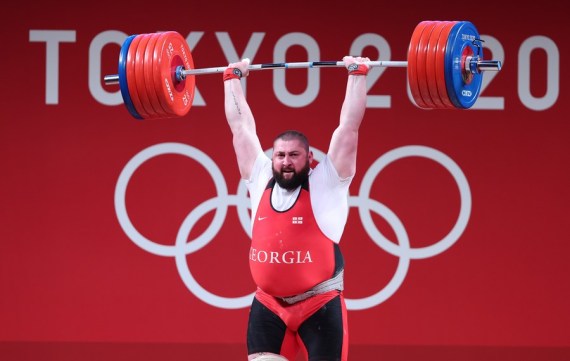
Georgia’s Lasha Talakhadze set three world records en route to win his second Olympic gold in the men’s over 109kg weightlifting, basically in a competition against himself.
Talakhadze met no challenge in the snatch as he hoisted 223kg in third attempt, one kilo more than his own world record. Then he extended the lead, beginning his solo in the clean and jerk after all the lifters finished their competition.
He jerked 245kg in his first attempt to nail the gold medal, but he did not stop and pushed himself to hoist a new world 265kg in his last lift. His total lifts of 488kg eclipsed the world record by three kilos. He also became the first Georgian to win multiple Olympic gold medals in any sport.
“I had a great dream and excitement to win the gold medal again and that dream came true again,” said Talakhadze, adding he will definitely compete at Paris 2024.
Ali Davoudi of Iran, the Asian champion this year, lifted a total of 441kg to claim the silver while the bronze went to Man Asaad of Syria at 424kg.
U.S. runner Sydney McLaughlin won the women’s 400m hurdles title in a world record time of 51.46 seconds, 0.44 seconds faster than the previous world record set by herself on June 27.
Her compatriot Dalilah Muhammad won the silver with personal best of 51.58, also bettering the previous world record of 51.90s. Femke Bol of the Netherlands took bronze in 52.03.
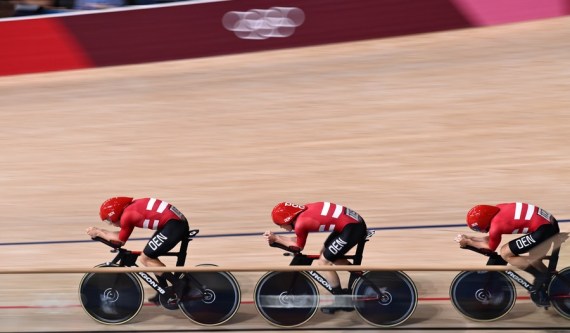
In track cycling, Italy also refreshed the world record of men’s team pursuit to win the gold in three minutes and 42.032 seconds, shattering the previous world and Olympic record of 3:42.307.
It is the first time in 61 years that Italy won an Olympic gold in the team event. The last time they were crowned Olympic champions was at Rome 1960 and their last time on the podium came at Mexico 1968 with a bronze.
Denmark took the silver and Australia bagged the bronze by defeating New Zealand, who lost a rider in a crash.
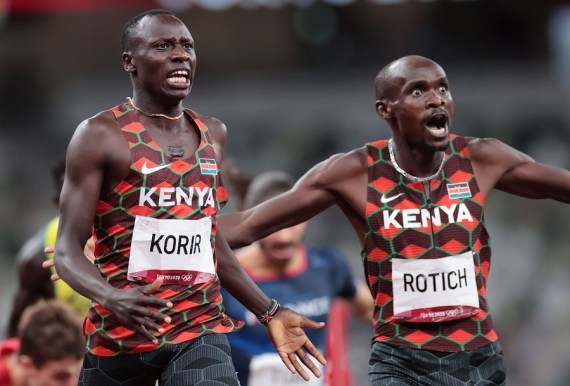
Emmanuel Korir and Ferguson Rotich completed a Kenya 1-2 in men’s 800m final. Korir crossed the finish line first at 1:45.06 to win Kenya’s fourth gold medal in a row in men’s 800m at the Olympic Games after in 2008, 2012 and 2016. Patryk Dobek of Poland won bronze.
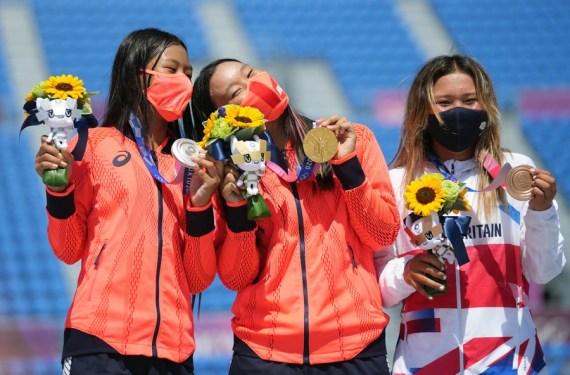
Japan proved its strength in skateboarding after Sakura Yosozumi won the third gold for the host Japan in the women’s park final. The 19-year-old had an impressive first run in the final that earned her 60.09 points which no other skaters could match.
Another Japanese teenager Kokona Hiraki, 12, took silver with 59.04 points, while Britain’s 13-year-old Sky Brown wrapped up her performance with a 56.47-point showdown that secured her a bronze.
The one-two finish for Yosozumi and Hiraki put Japan firmly on top of the skateboarding medal tally, after Yuto Horigome and Momiji Nishiya won men’s and women’s street gold and Funa Nakayama added a bronze after Nishiya.
Japan also claimed its first gold in wrestling as Yukako Kawai won the women’s freestyle 62kg title
Kawai, 23, edged Aisuluu Tynybekova of Kyrgyzstan 4-3 in the final, giving a record-extending 12th Olympic gold medal for Japan in women’s wrestling.
In the bronze medals matches, Ukraine’s Iryna Koliadenko defeated Anastasija Grigorjeva of Latvia while Mustafa Yusein Taybe took other bronze.
The men’s Greco-Roman 67kg title went to Mohammadreza Geraei of Iran, who shut-out Parviz Nasibov of Ukraine 9-1. It is the fourth Olympic title for Iran in Greco-Roman wrestling.
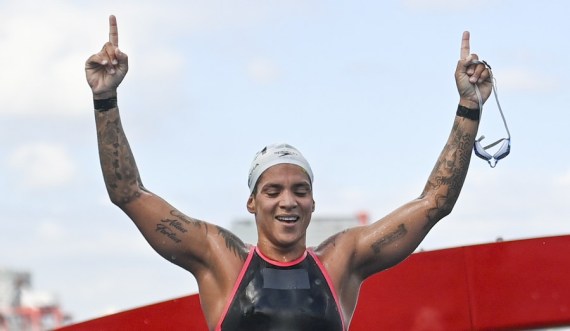
In the first event of the day, Brazilian Ana Marcela Cunha won her first Olympic gold in women’s 10km marathon swimming in one hour 59 minutes 30.8 seconds, beating the silver medalist Sharon Van Rouwendaal of the Netherlands by only 0.9 seconds.
Australia’s Kareena Lee took bronze and China’s Xin Xin finished 8th, after she recorded a fourth place in Rio and won the event at the 2019 World Championships.
“I accept the result, but I am a little disappointed with the ranking. As to the race, there were a lot of body contacts at the beginning, and it took so much energy, so I fell behind in the end,” said Xin.
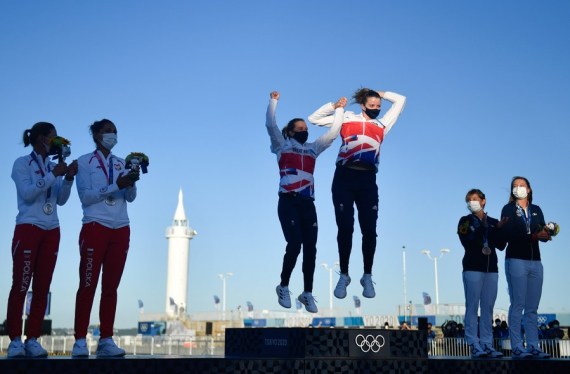
The British crew of Hannah Mills and Eilidh McIntyre won the women’s 470 gold medal. Poland’s Agnieszka Skrzypulec and Jolanta Ogar won silver, with France’s Camille Lecointre and Aloise Retornaz taking bronze.
With silver at London 2012, gold at Rio 2016 and Tokyo 2020 under her belt, Mills has become the most-decorated female sailor in Team GB history.
Already leading the overall classification heading into Wednesday’s medal race, Australia’s Mathew Belcher and Will Ryan sealed the men’s 470 gold in style by winning the medal race as well.
Second-placed Sweden, crewed by Anton Dahlberg and Fredrik Bergstrom, were close to the Aussies throughout the race and took the silver medal. Jordi Xammar and Nicolas Rodriguez won the bronze for Spain.
In women park skateboard, Tokyo youngest Olympians lean on each other
TOKYO – When 13-year-old skateboarding phenom Sky Brown spoke after winning her bronze medal in women park Wednesday in the scorching Tokyo heat, it wasnt her usual manner of public address.
Brown wasn’t communicating directly to her audience on the video app TikTok (she has 1.3 million followers) or Instagram (she had 942,000 followers Wednesday morning and one million Wednesday afternoon). She was facing old-fashioned reporters, most of them men and most of them somewhere in the realm of at least 30 years her senior.
Brown, who lives in California, grew up in Japan and represents Britain thanks to her father’s lineage, had support systems at the ready.
The first was her dad, Stuart, who was able to accompany her in Tokyo because Olympians under 16 are permitted to bring a guardian to the Games. He stood off to the side during her interviews Wednesday, beaming under his mask, helping to remind his daughter when she was asked what he told her before her final run of the day and had forgotten – “Winning this contest doesn’t define you” – and stepping in to deflect questions from British reporters about his background – “This isn’t about Dad, is it?”
The second of the bronze medalist’s supporters was the gold medalist.
“Skyyyy!” Japan’s Sakura Yosozumi sang with delight when she finished her own informal news conference and encountered Brown just beginning hers a few feet away.
Yosozumi, 19, who won with a score of 60.09 and the silver medalist Kokona Hiraki, 12, who had a 59.04, faced an even larger contingent of reporters than Brown because they won Japan its fourth and fifth skateboarding medals of the Tokyo Olympics. Hiraki had the added draw of being the second-youngest athlete of the roughly 11,000 at these Games.
“I’m so stoked! I can’t believe it. It’s unbelievable, it feels like I dream,” said Brown, who earned third with 56.47. “I was definitely a little, like, I thought I was going to get it on the first or second run. I was a little shocked and a little like, ‘Am I going to make it?’ But Sakura, she really was like, ‘You got it, Sky. We know you’re going to make it. Go!’ That made me feel better.”
Women’s park skateboarding made its Olympic debut Wednesday with some of the youngest athletes at these Summer Games. The ages of the eight finalists were: 12, 13, 15, 17, 19, 20, 21 and 23, all skaters who dropped into a roughly swimming pool-sized bowl with differently shaped concrete mounds rising out of the cavity and performed tricks. Runs lasted 45 seconds, with the best score of each skater’s three runs determining her place in the standings.
ADVERTISEMENTx
The skaters brought speed, highflying tricks, turns and cool poses Wednesday. And they had in abundance something that is rare to see at an Olympic venue: exuberant friendship among competitors from different countries.
There is a lot of falling in skateboarding, especially in the park discipline. But skateboarding is perhaps the only Olympic sport where falling is, without fail, accompanied by rousing cheers.
When the Chilean Josefina Tapia Varas fell in the first heat of the day, she earned a fist bump from Brazilian skater Dora Varella, who shrugged, stuck out her tongue and drew rowdy applause from the other skaters when she then fell a few runs later. One of the largest roars of the day came when American Bryce Wettstein took a major spill in the final coming down a ramp and splayed, belly on the concrete. A one-time favorite to win gold, Misugu Okamoto from Japan was hoisted on her competitors’ shoulders and feted after falling and finishing fourth.
“Skateboarding is such a good community,” 17-year-old American Brighton Zeuner said. “I’ve known pretty much all these girls since I was 9, 8 years old, and just being here with them is absolutely surreal. . . . We’re performers, and I think we need that good energy. It is competitive, but in a really healthy way. We’re all just there to watch it unfold, do our very best.”
Competitive skateboarding is a tight community already, bound by people who believe their sport is something closer to a lifestyle or art form than, well, a sport. That community is perhaps even closer knit among girls and women, who for years watched young White men received better promotion, bigger sponsorships and more opportunity to compete.
ADVERTISEMENT
The X Games, the sport’s biggest showcase before Tokyo 2020, didn’t make women’s park skateboarding an official event until 2003. This year’s Olympians grew up learning to skate together. They are so supportive of each other that California native Lizzie Armanto chose to represent her father’s country, Finland, because it left a spot open for another woman on Team USA.
“When I root for them,” Wettstein said, “I root for myself.”
Wednesday’s final, with its constant cheering and hugs along with the flips and tricks, felt at times more like a presentation than a competition: Here, world, is what skateboarding is all about.
But there was competition and showmanship among the friendship, too. Yosozumi earned the highest score of the day on her first run in the final, a powerful, clean showing that displayed technical prowess, and she thrust both fists in the air when she landed one particularly difficult trick.
The diminutive Brown is flippier than most of her competitors, bending low to gather speed, then going for big air and flashy tricks – she fell in her first and second run trying to nail a stunt in which she flips her board horizontally in her hands while her feet hover in midair. She nailed it in a flawless third run to seal the bronze.
ADVERTISEMENT
As Brown finally finished, she crouched into a ball on her board and held her head in her hands. When she popped up out of the bowl, Wettstein and Australian skater Poppy Olsen were the first to run over and celebrate, engulfing her in a hug. The two Brazilian finalists joined shortly after, followed by the rest of the young skaters standing nearby. No one was looking at the scoreboard.




 New dispensing machine will boost number of jabs delivered daily by 20%


 Factors that contribute to false rapid test results
 Japan’s Olympic Games management to be adapted for AIMAG hosted by Thailand
 Japan’s Olympic Games management to be adapted for AIMAG hosted by Thailand
 Japan’s Olympic Games management to be adapted for AIMAG hosted by Thailand

 Svetlana Kolesnichenko and Svetlana Romashina of ROC at the awarding ceremony for the artistic swimming duet competition at the Tokyo 2020 Olympic Games in Tokyo, Japan, Aug. 4, 2021.


 SootinClaimon.Com