5-year fishing ban begins in parts of Yellow River, tributaries
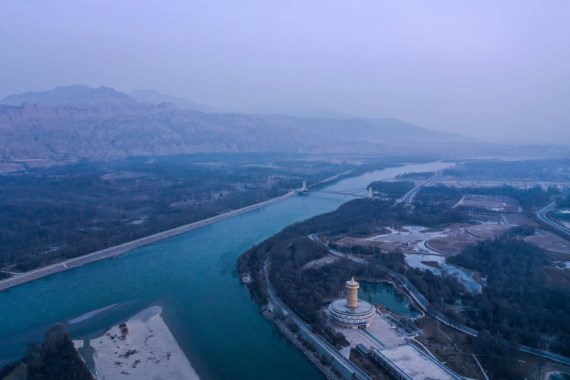
Northwest Chinas Qinghai Province on Sunday initiated a five-year fishing ban in parts of the Qinghai section of the Yellow River and its tributaries.
The ban, which will be effective until July 31, 2026, covers the main stream of the Yellow River in Qinghai, two lakes and nine tributaries of the country’s second-longest river, said the Qinghai provincial agriculture and rural affairs department.
Dubbed “the water tower of China,” Qinghai is home to the Sanjiangyuan (Three-River-Source) area, where the three major rivers — the Yangtze River, the Yellow River and the Lancang River — originated.
Located in the northeastern part of the Qinghai-Tibet Plateau, Qinghai is also home to many rare plateau species of aquatic wild animals that are endemic to China.
ADVERTISEMENTx
Aerial photo taken on Dec. 16, 2020 shows the view of the Yellow River in Guide County of the Tibetan Autonomous Prefecture of Hainan, northwest China’s Qinghai Province
Chinas space-tracking ship Yuanwang-3 completes new monitoring missions
Chinas space-tracking ship Yuanwang-3 returned to its homeport in east Chinas Jiangsu Province Sunday after completing a new round of maritime monitoring missions.
During the missions, Yuanwang-3 ensured Fengyun-3E meteorological satellite’s entry into planned orbit.
Commissioned on May 18, 1995, Yuanwang-3 is a second-generation Chinese space-tracking ship. It has undertaken more than 90 maritime tracking and monitoring tasks for spacecraft, including the Shenzhou spaceships, Chang’e lunar probes and BeiDou satellites.
ADVERTISEMENTx
Aerial photo shows China’s spacecraft tracking ship Yuanwang-3 sailing on the southern Pacific Ocean, June 21, 2019.
Cooperating to trace COVID-19 origins shared responsibilities for countries: Chinese ambassador
Many study reports, including some developed by U.S. researchers, showed that the contagion might originate from several sources and break out in different spots, which is why the probe into the origins should be conducted on a global scale, said Chinas Ambassador to Italy Li Junhua.
“Cooperating on tracing the origins of the virus is everyone’s responsibility,” and such research should be conducted worldwide, China’s Ambassador to Italy Li Junhua has written.
“The COVID-19 pandemic has been raging around the world for over a year, causing enormous trauma to all countries,” the ambassador wrote in an article published Thursday in Diplomatic Journal, an Italian online newspaper.
Noting that both China and Italy have actively shared information and cooperated with the World Health Organization (WHO) to find the origins of the virus, Li urged all countries to take the responsibility to promote origin-tracing work, saying the research should be conducted around the world.
ADVERTISEMENTx
He suggested all countries, where early infections were reported, draw from China’s practice to invite WHO teams for field studies on the origins, or learn from Italy on information sharing to complete origin-tracing work together.
“From the first moment, China reported information and shared experiences in prevention and control with the World Health Organization (WHO) and affected countries,” he said, adding the country has taken the lead in working together with the WHO on origin-tracing, and twice invited international experts to China for research on the source of the virus.
The research on the virus’ source “must be conducted by (WHO) member states, be based on consensus and be undertaken after consultation between the WHO and the member states,” Li stressed.
Meanwhile, many study reports, including some developed by U.S. researchers, showed that the contagion might originate from several sources and break out in different spots, which is why the probe into the origins should be conducted on a global scale, he said.
People walk on Via dei Condotti in Rome, Italy, May 15, 2021.
Chinese Americans make donations to flood-hit central China
“When we faced difficulties, we got help from Henan. Now, we should come forward and make our contributions to disaster relief in Henan,” says Frank Zhang.
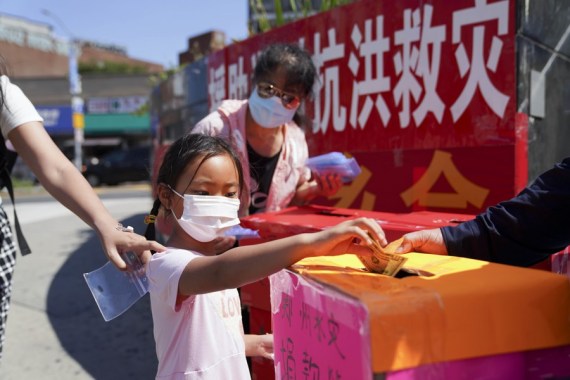
Chinese Americans in New York are donating money to help flood-hit people in central China’s Henan province to restore life and production.
So far, around 500,000 U.S. dollars have been raised by various entities in New York, said Frank Zhang, president of Henan Chinese Associates U.S.A. Inc., a mutual support group for people with Henan origin.
ADVERTISEMENTx
A task force has been established to handle issues related to raising money for disaster relief in Henan with multiple Chinese American groups on board.
The task force alone is expected to raise 200,000 dollars by this weekend, Zhang told Xinhua on Saturday.
More than 200,000 masks were shipped from Henan to New York and handed out to Chinese Americans at the height of the COVID-19 pandemic, according to Zhang.
“When we faced difficulties, we got help from Henan. Now, we should come forward and make our contributions to disaster relief in Henan,” Zhang added.
More than 9.3 million people in Henan have been affected by recent heavy rains and floods. Over 1.1 million local residents have been relocated to safer places.
A girl donates money to help flood-hit people in central China’s Henan province to restore life and production, in New York, the United States, July 31, 2021.
Sharp decline in new Covid-19 cases and deaths in Asean
Southeast Asia reported a drop in new Covid-19 cases and deaths on Sunday, collated data showed.
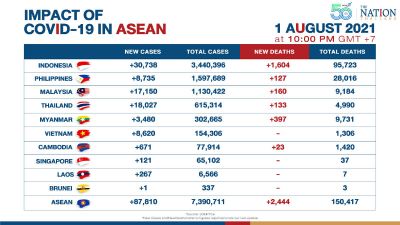
Asean countries logged 87,810 new cases, lower than Saturday’s 96,639, while 2,444 patients died, improving from the previous day’s record 2,877.
The number of Covid-19 cases in the region crossed 7.39 million and deaths climbed to 150,417.
Cambodia reported 671 new cases and 23 deaths on Sunday, bringing cumulative cases in the country to 77,914 patients and 1,420 deaths. Prime Minister Hun Sen announced that the government would provide the third AstraZeneca vaccine jab to boost the immunity of people who have been given two doses of Sinovac, while those who have been given two doses of AstraZeneca will be given a Sinovac or Sinopharm jab as a booster.
Laos reported 267 new cases on Sunday, bringing cumulative cases in the country to 6,566 patients and seven deaths. Of these, 3,529 people have been cured and discharged.
The Laos government on Sunday ordered southern provinces to increase quarantine facilities for workers who have returned from Thailand and ordered hospitals to prepare more beds for infected patients.
Deep in the forest, Germany fights another virus. This one hits pigs.
ODER-SPREE, Germany – In the Brandenburg forest, a bounding 4-year-old black Belgian shepherd named Uschi picks up a scent. Wearing a neon high-visibility jacket, she stops by an overturned tree and lets out a series of barks.
In the mud, teeming with maggots, is the rotting carcass of a wild boar. “Hero Uschi,” shouts a member of the search team. It’s exactly what they spent the day hunting.
As the world fights the coronavirus pandemic, teams in Europe are battling another outbreak: African swine fever. Hundreds of miles of fencing have been thrown up in Europe to stop its steady march west across the continent, threatening the major pig farming industries in Germany and elsewhere.
While the virus cannot be passed to humans, it kills almost every pig it infects in about a week to 10 days, and it has been spreading in Europe in recent years.
In fenced off “red zones” – such as those in the forests of the Oder-Spree district southeast of Berlin – teams work to clear the area of the infectious wild boar that have succumbed to the sickness and hunt any still alive in an attempt to break infection chains.
The carcasses of the dead boars lie scattered in gullies and in wooded clearings, sending the putrid scent of decaying flesh through the forest air. The stakes are high for Germany – Europe’s largest pork producer – exporting $4.7 billion in pig products each year.
The arrival of the virus in the wild boar population in Germany last year triggered bans on pork exports to countries outside Europe, wiping out $867 million in sales to China. Then in mid-July, the first case was discovered in a domestic pig farm in Germany, exactly the spread that the teams picking through the forests had been hoping to prevent.
“We are fighting the pandemic nobody knows about and nobody cares about because all eyes are on corona,” said Christian Tost, a 35-year-old reservist with the German military, one of five on the 17-member search team that spent six hours scouring an area of around a square mile last month.
They found 16 dead or dying boars.
From an office in Beeskow, about 20 miles from the Polish border, Petra Senger, the head veterinarian for the Oder-Spree district, oversees operations to contain the spread. Maps of various infection zones cover the walls.
ADVERTISEMENT
“It’s a huge task,” Senger said. The first dead boars were found in her district on Sept. 10, 2020. They crossed from Poland, where the virus was already rife.
In response, the local authorities fenced off an area of fields and forest the size of Belgium.
But it wasn’t enough. A month later, they found new cases in an area 15 miles away and a new red zone was cordoned off.
Endemic in sub-Saharan Africa, the disease arrived in the European Union in 2014, with the first cases in Lithuania. It slowly spread to neighboring countries.
The more spread there is in wild boars, the bigger the possibility it can infiltrate pig farms, Senger said. Distancing is also important. Traps laid with corn are also set to capture boars in buffer zones.
ADVERTISEMENT
“With people, you can ask them to wash their hands or stay at home,” Senger said. “You can’t tell a pig to stay home.”
More hardy than the coronavirus, the African swine fever can survive in the environment for many months, and it can be spread by people through vehicles, clothing and tools. It can also live for months or years in pork products. Consumption of infected pork doesn’t pose a risk to humans, but it can cause a fresh outbreak if eaten by a pig.
“We think we’ll have a vaccine,” Senger said. “But not until 2023 or 2024.”
Meanwhile, the search teams fan out in the forests several times a week to hunt for their rotten prey, scrambling through dense thickets.
On one scorching day in mid-July, forestry personnel, hunters and dog handlers joined the 17-member team in neon vests to comb the forest, thick with pine and birch. One the dogs, Karl, a 2½-year-old dachshund, struggled with some of the denser undergrowth.
In charge was an easily angered hunter, who occasionally snapped at those lagging behind. “Do you see the people next to you?” he yelled as the forest closed in, making it more challenging to keep sights on other searchers.
They checked gullies and puddles, with dying boars drawn to water as they sicken. Circling ravens can give clues as to where boar carcasses can be found.
Leaning over the putrid remains of a boar under a log, Reiner Favre, a 53-year-old hunter, speculated that it had been there for three or four weeks.
“Maybe it was one of the first ones to get sick around here,” he said. That morning there had been fresher finds, a sick boar piglet that Favre then shot, and what the group assumed to be her siblings and mother, already dead not far away.
The coordinates for each carcass are called in, with a separate team looping back to find them in the thick forest in the afternoon and load them into body bags.
They scoop up soil with the carcasses and cover the area in lime. “(The virus) can stay there for a long time otherwise,” Favre said. “That’s the risk of this virus. It’s not a soft virus.”
Even the presence of the virus in wild boar populations is a major disruption to local farmers. If dead boars are found on a farmer’s land, it can affect their ability to sell their crops due to fear of contagion.
With German pork exports blocked outside the E.U., countries such as Spain have stepped in to help meet China’s pork appetite. China itself has had its own struggles with swine fever, with nearly half its own herds estimated to have been wiped out by outbreaks in 2018 and 2019.
The discovery of the virus at two Brandenburg region pig farms in July was a “huge catastrophe for Brandenburg’s farmers,” said Tino Erstling, a spokesman for the Brandenburg State Farmers’ Association. But Germany is still able to export within the E.U. from regions without the virus.
So more fences are going up. The heartland of Germany’s pork industry lies in states farther west. Germany’s neighbors are already working on their defenses. Denmark has constructed a 40-mile-long, five-foot-high fence along its southern border in attempts to keep out infected boars.
“We will double down on everything we’ve already been doing to try to stop this,” Senger said. “That means finding infected pigs, building more fencing. We have to be stricter about keeping domestic and wild pigs separate.”
Senger said she hopes that lakes and highways might act as natural barriers for infected boar roaming west.
“If it hits where a lot of pig farmers operate, then, of course, they will have a huge problem on their hands,” said Heike Harstick, head of the German Association of the Meat Industry.
Practices in the pork industry have already come under increased scrutiny during the coronavirus pandemic. And the industry was already in decline due to a diminishing appetite in Germany for wurst and schnitzel.
Animal rights groups say that the culls are senseless, with the virus also spread by contaminated food and carried between areas by people.
For dog trainer Michaela Botz, 49, the boar hunts are a good day’s work for Uschi, whose vest is made of Kevlar in case of a run-in with an angry boar. But as for containing the virus, she’s not optimistic, as the group finds dead boar after boar.
Taliban advances into major Afghan cities for first time in two decades
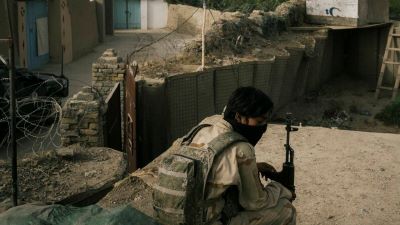
KANDAHAR, Afghanistan – The Taliban is ramping up pressure on some of Afghanistans largest cities, striking busy transit hubs and pushing front lines deep into urban areas for the first time since the militants were overthrown nearly two decades ago.
Taliban fighters launched rockets Saturday at airports in Kandahar and Herat, two of the country’s largest cities and busiest economic centers. The attacks disrupted commercial travel, though flights in and out of Herat subsequently resumed.
“There was a large blast and the whole room started shaking,” said Massoud Ahmad Pashtun, the chief of Kandahar airport, who was present at the time of the attack. He said three rockets landed within seconds of each other and damaged one of the runways.
The attacks mark a potential turning point in the Afghan conflict. Previously, clashes were largely confined to the country’s rural areas or smaller cities contested by the militants. Large-scale conventional attacks on Kandahar and Herat, the second- and fourth-largest cities in the country, have the potential to endanger millions more civilians.
Initial reports suggested the Kandahar rocket attack came from the eastern side of the city, where Taliban fighters have made advances. Pashtun said he feared more attacks in the coming days, because of the deteriorating security situation and the removal of an American antimissile system that protected the airfield before the withdrawal of U.S. forces from the southern province.
ADVERTISEMENTx
Taliban advances into major Afghan cities for first time in two decades
Gen. Ajmal Shinwari, a security forces spokesperson, said at a news conference on Sunday that all troops were on high alert due to “the emergency situations” in Kandahar and Herat. Hundreds more Afghan forces have been sent to the southern and western provinces as reinforcements.
Taliban attacks in Kandahar province have been ongoing for months, but in recent days the group began pushing closer into the city center.
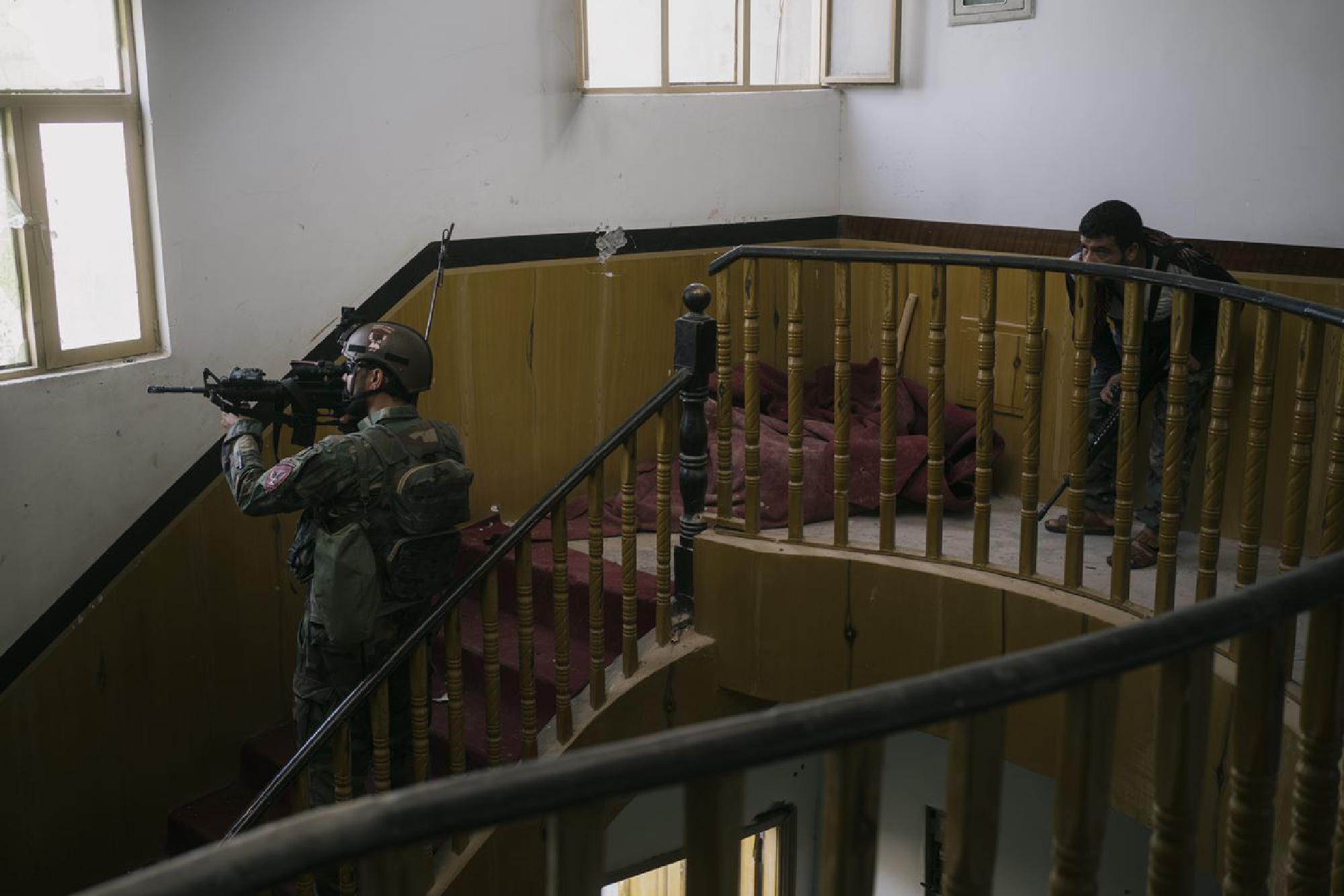
Frontlines that crisscrossed largely agricultural suburbs just weeks ago now span densely populated neighborhoods. Just a few hundred meters from a Taliban-held neighborhood on Kandahar’s western edge, government forces have transformed a wedding hall and an opulent multistory home into makeshift bases.
“They watch us from those houses over there,” said a commando officer, who spoke on the condition of anonymity because he was not authorized to talk to the media. He pointed out a white Taliban flag visible just a few blocks away from a traffic circle.
ADVERTISEMENT
Taliban advances into major Afghan cities for first time in two decades
The government soldiers said they exchanged fire with Taliban fighters occasionally during the day, but it is at night that clashes grow more intense.
Thousands of civilians are being forced to flee their homes. Deeper inside Kandahar city, makeshift camps have sprung up in empty lots.
Jalil Ahmad, 30, said his house was destroyed by a mortar attack and his ears were still ringing from the blast. He said a police unit took up a firing position on to the roof of his home, and Taliban fighters retaliated with a volley of mortars.
“An entire wall collapsed on my family,” he said. “We have never seen fighting like this in our area before.”
ADVERTISEMENT
In Herat, Afghan special forces were deployed to the city on Sunday to help push back Taliban advances. Taliban fighters breached the city limits and a United Nations compound was attacked, as clashed raged for hours. The U.N. condemned the attack. A Taliban statement described the destruction as “regrettable,” saying the group remains committed to protecting the U.N.
Abdul Rahman Rahman, an Interior Ministry adviser, traveled to Herat on Sunday to calm “the atmosphere of panic” growing in the city, he said. Rahman arrived with a team of Afghan special forces, which he pledged would deal “fiercely” with the Taliban.
Taliban advances into major Afghan cities for first time in two decades
The Taliban push on major cities comes as the group continues to squeeze much smaller provincial capitals in areas long contested by militants. In Helmand, a province that has been one of the least stable in Afghanistan for years, fighting intensified last week, heightening fears that the province’s capital would fall. Taliban fighters have pushed inside the city’s limits and are steadily closing in on the central government compound.
Afghan forces responded with a punishing wave of air support. One airstrike hit a small hospital on the city’s outskirts Saturday, killing the relative of a patient and injuring four others, including a patient and three members of staff, according to hospital director Mohammad din Naraiwal.
As the airstrikes drew closer in recent days, Naraiwal repeatedly communicated with Afghan government forces, asking them not to strike the facility. He said no Taliban fighters were present in the building when it was hit.
“I’m worried if the government resupplies their forces there will be more fighting,” he said. “There will be more civilian casualties.”
Day 9 roundup: Jacobs wins mens Olympic 100m, Gong ends long wait for gold
Gong Lijiao of China clinches her first Olympic gold medal with a PB at her forth Olympics while Lamont Marcell Jacobs of Italy crowned champion with surprise in the mens 100m race.
The Tokyo Olympics reached a climax at the halfway point in its schedule, as Italy’s Lamont Marcell Jacobs came out a surprise winner in the men’s 100m race on Sunday.
China bagged three gold medals in athletics, diving and badminton en route to holding onto its top ranking in the medals table with 24 golds and 51 medals overall. The United States tallied 59 medals, of which 20 are gold. Japan rank third with 17 gold medals and 31 in total.
ADVERTISEMENT
Jacobs clocked 9.80 seconds to be crowned the world’s fastest runner, followed by Fred Kerley of the United States in 9.84, and Canada’s Andre de Grasse in 9.89.
“It was my childhood dream to win an Olympics Games and obviously a dream can turn into something different, but to run this final and win it is a dream come true,” said Jacobs.
China’s Su Bingtian came sixth in 9.98, the best ever result for an Asian sprinter. Su had posted a new Asian record time of 9.83 seconds in the semifinals.
Su’s compatriot Gong Lijiao dominated the women’s shot put to claim China’s first Olympic gold in field events.
ADVERTISEMENT
The four-time Olympian set her personal best twice in the final, throwing 20.53 meters in her fifth attempt and then 20.58m in her sixth.
“I have waited this moment for too long. I have imagined this scenario countless times but I am still extremely excited when I am actually feeling it today,” said an emotional Gong.
Raven Saunders of the United States and Valerie Adams of New Zealand took silver and bronze medals respectively.
Coming into the competition as a favorite, Gong led from the beginning with 19.95m in her first attempt, a mark that none of her opponents came close to throughout the competition.
The 32-year-old started to unleash her full power in the fifth attempt when she achieved a personal best of 20.53 meters. Gong went on to refresh her personal best even further to 20.58 meters in the final put.
ADVERTISEMENT
Yulimar Rojas of Venezuela won the women’s triple jump title with a huge final jump of 15.67 meters to break the world record of 15.50m set in 1995.
Chinese diver Shi Tingmao won back-to-back Olympic titles in the women’s 3m springboard, adding to her success in the synchronised 3m springboard earlier this week.
The defending Olympic champion built a convincing lead from the first round, finishing with 383.50 points, 34.75 points ahead of her compatriot Wang Han who finished second.
It is also Shi’s fourth Olympic gold medal after she won the same two events five years ago at Rio 2016. China won its ninth consecutive Olympic gold medal in women’s 3m springboard.
Shi, bursting into tears after her final dive, recalled a tough road in preparation for the delayed Tokyo Olympics.
“I was nearly going to give up because of the postponement of the Games. I even feared to go to the training ground. Now, I am grateful for my faith, and stick to it,” said Shi, the oldest Olympic gold medalist in the event at 29 years and 335 days.
In badminton, China’s Chen Yufei withstood a late comeback of Tai Tzu-ying of Chinese Taipei to win the women’s singles gold medal.
Scores seesawed from the onset before Chen led from a 17-17 tie to 21-18 in the first game. Chen raced to an 11-8 lead in the second game, but Tai recovered from 12-14 down to win 21-19. Chen clinched a 21-18 victory in the decider to emerge the winner.
As nine-day swimming competition wrapped up on Sunday, and the U.S. topped the event medal standings with 11 golds and 30 in total. But America’s 11 gold medals were the country’s fewest in swimming since the 1992 Olympics.
Six world and 20 Olympic records were shattered in the swimming pool at this Games.
American swimmer Caeleb Dressel was the only one to set two world records, in the 100m butterfly final and 4x100m medley relay final. The 24-year-old bagged five gold medals, with the other three coming from the 50m and 100m freestyle and 4x100m freestyle relay.
Emma McKeon of Australia became the first female swimmer to win seven medals at one Olympics, finishing with four golds and three bronzes.
In gymnastics, Artem Dolgopyat gave Israel its second ever Olympic gold medal when he won the men’s floor exercise event at Ariake Gymnastics Centre.
“I’ve been dreaming of this since I was six. It is the best gift for my country. It means a whole lot to give Israel its first gold medal in gymnastics,” said Dolgopyat.
Ghanaian boxer Samuel Takyi is set to win the country’s first medal at the Tokyo Olympic Games after qualifying for the men’s featherweight semifinals, since there will not be a fight for third place.
It is also Africa’s first medal in boxing at the Tokyo Games, and ensures that Ghana ends a 29-year wait for an Olympic medal.
Gong Lijiao of China reacts during the awarding ceremony of the Women’s Shot Put at the Tokyo 2020 Olympic Games in Tokyo, Japan, Aug. 1, 2021.
Shi Tingmao of China reacts on the podium during the awarding ceremony of the women’s 3m springboard final of diving at the Tokyo 2020 Olympic Games in Tokyo, Japan, Aug. 1, 2021.
China’s Chen Yufei celebrates after winning the women’s singles final of badminton against Tai Tzu-Ying of Chinese Taipei at the Tokyo 2020 Olympic Games in Tokyo, Japan, Aug. 1, 2021.
Emma McKeon of Australia competes during the women’s 4X100m medley relay final of swimming competition at the Tokyo 2020 Olympic Games in Tokyo, Japan, Aug. 1, 2021.
Thai golfers Jazz and Gunn hit high notes but miss out on medals.
Reigning Asian Tour No 1 Atiwat “Jazz” Janewattananond and fellow Thai Gunn Charoenkul signed off in 27th and 45th, respectively, as the Olympic Games TOKYO 2020 mens golf concluded on Sunday at the Kasumigaseki Country Club.
World No 150 Jazz carded a finishing 68 for a combined nine-under-par 275 at the par-71 7,447-yard layout. He finished nine strokes behind gold medalist Xander Schauffele of the US.
“I am literally just happy to be here,” said Jazz, who started brilliantly with an opening-round 64 to lie second but was unable to maintain that form and followed up with a 71 and 72.
“The result over the last three days was not the result I was looking for, but I am happy to be here, and I will take away the good things,” added the six-time Asian Tour winner and former world No 38.
“It was weird: in a normal tournament you grind out a result, but this week was a different grind. But I didn’t get super angry. I actually enjoyed it when I realised I didn’t have a chance [to win a medal],” added the 26-year-old.
ADVERTISEMENTx
Thai golfers Jazz and Gunn hit high notes but miss out on medals.
World No 281 Gunn saved his best for last, carding his week’s lowest of 67 for a final score of four-under 280. The All Japan Tour member was hampered by an injured left thumb that contributed to his even-par scores of 71 in the first three rounds.
“I was just trying to complete four rounds without aggravating my injury. I should have taken advantage of my familiarity with the weather conditions and course here. I wish I had scored lower,” said the 29-year-old, who will now return to the Japan Tour.
ADVERTISEMENT
The three-time All Thailand Golf Tour winner may have missed a podium spot but his once-in-a-lifetime experience in Tokyo this week will always linger in his heart.
“It’s always been my dream to play in the Olympics. It’s never easy to get to this point as you have to compete in a lot of tournaments to gain enough ranking points [to qualify]. I kept my fingers crossed until the last minute that I would earn a spot,” said the golfer from Phang Nga province.
Thailand’s best result in the Olympics remains Kiradech Aphibarnrat’s joint fifth place with an eight-under-par 276, eight shots behind gold medalist Justin Rose of Great Britain at the 2016 Rio Games.
ADVERTISEMENT
However, Thai fans can still pin their hopes on two superstars of women’s golf. Patty Tavatanakit and Ariya Jutanugarn launch their campaigns in the Olympic golf singles competition at this course on Wednesday.
Chatchai-Decha and Juthamas suffer Olympic heartbreak, leaving Thailand with one boxing medal hope
Calamity struck for Thai boxing on Sunday as Jutamas Jitpong and Chatchai-Decha Butdee fought impressively but lost their chance of grabbing medals at the Kokugikan Arena.
Chatchai-Decha and Juthamas suffer Olympic heartbreak, leaving Thailand with one boxing medal hope
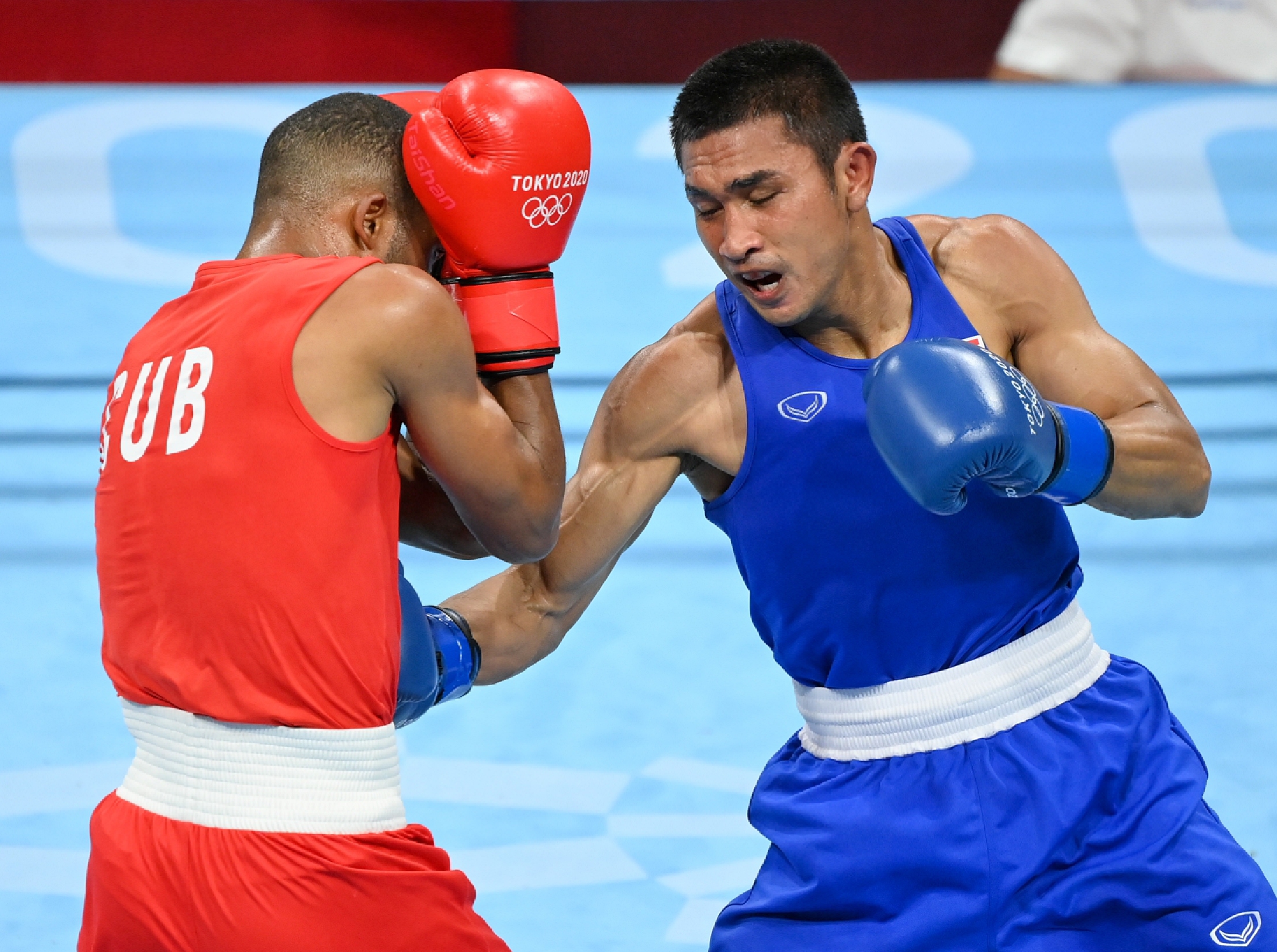
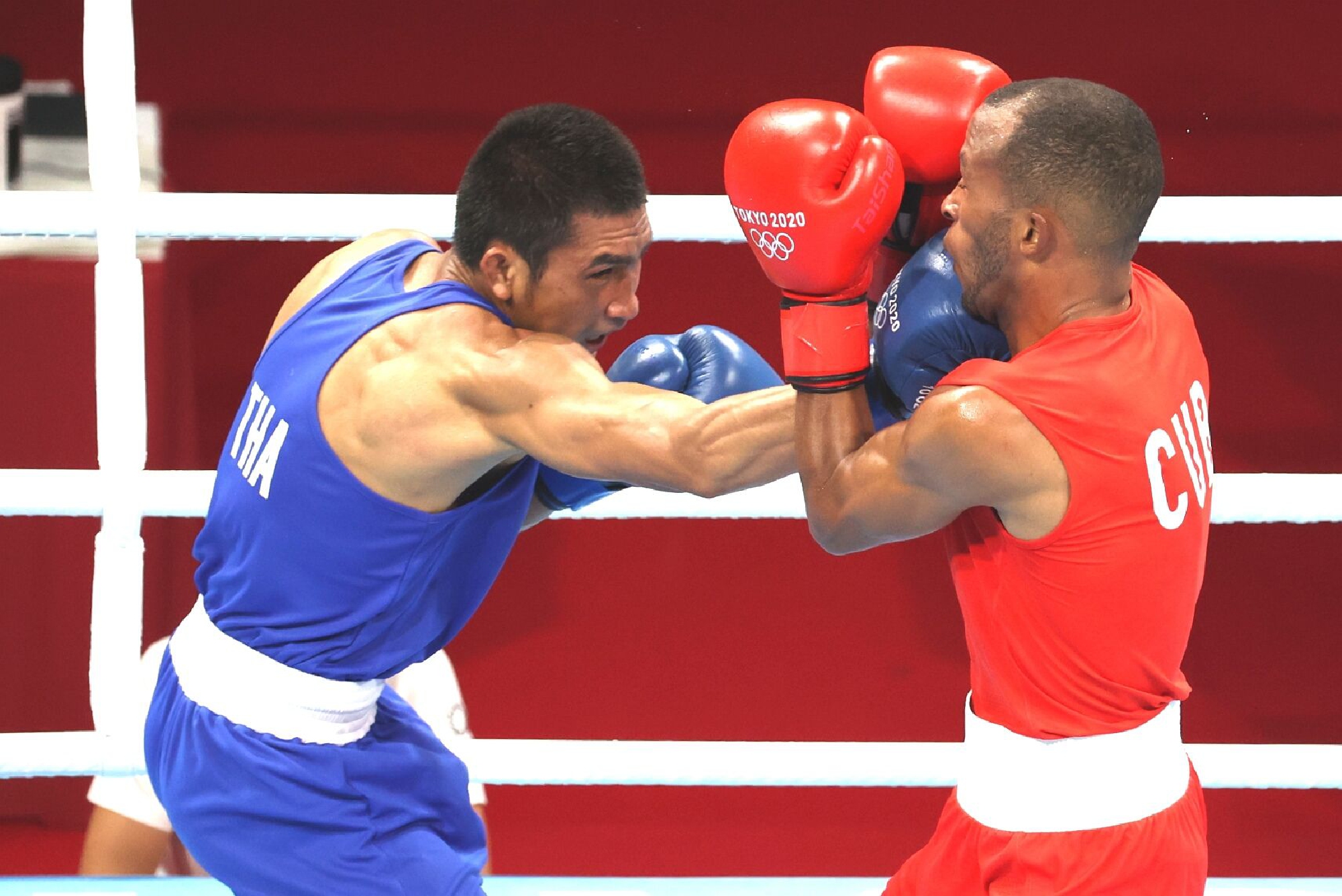
In the women’s 51kg quarter-finals, 2019 SEA Games bronze medalist Jutamas went down to 2019 World Championships silver medalist BuseNaz Cakiroglu 0-5 in the morning. More bad news came in the afternoon when Chatchai-Decha narrowly lost to two-time Olympic bronze medalist Lazaro Alvarez of Cuba 2-3 in the last eight of the men’s 57kg.
Juthamas fought aggressively on the front foot while the Turk stood back, waiting to score points when the Thai fighter dropped her guard. The 2019 European Games champion proved the superior boxer from the start, with Juthamas struggling to adapt to her sniper’s style.
“If I had been leading from the start, I would have boxed more freely. I tried to change my game plan, but it just went her way. It’s a shame that my run ended at this point,” said the 23-year-old fighter from Nakhon Si Thammarat.
Chatchai-Decha and Juthamas suffer Olympic heartbreak, leaving Thailand with one boxing medal hope
Juthamas, in tears, vowed to get even with her opponent in the future.
“If I lose to you, don’t retire so soon as I’m going to get my revenge. I will go back and train even harder. We will meet again for sure in the future,” said the Thai, who apologized to fans for failing to deliver a place on the podium.
“I’m not a talented boxer, but I am a hard-working boxer. I want to make people at home proud and I want them to know that this girl from the neighborhood is a good boxer. I’m sorry that I didn’t make it. If I compete in the 2024 Games, I will try to make amends,” she added.
ADVERTISEMENTx
Chatchai-Decha and Juthamas suffer Olympic heartbreak, leaving Thailand with one boxing medal hope
Chatchai-Decha, meanwhile, put up the fight of his life in a desperate bid to win a medal in his third and farewell Olympics. However, three-time World Championship winner Alvarez showed superior skills at the crucial stage to dash the Thai’s hopes.
“I gave my all out there. We have equal experience and know each other’s style. But as a Cuban boxer, he’s fast and difficult to fight against,” said the 36-year-old Thai in his final bid for an Olympic medal.
Chatchai-Decha and Juthamas suffer Olympic heartbreak, leaving Thailand with one boxing medal hope
“I can say that I am proud of how I performed in this Olympics. I have to thank the fans especially my family for always being by my side. I may not have achieved my dream but I tried the hardest I could,” said Chatchai-Decha who also added that was his last match as a national athlete.
With the two boxers out of the tournament, Thailand’s last boxing hope is Sudaporn Seesondee, who will fight for a bronze medal in the women’s 60kg quarter-finals against 2018 World Youth and Youth Olympic champion Caroline Dubois of Great Britain on Tuesday.
Chatchai-Decha and Juthamas suffer Olympic heartbreak, leaving Thailand with one boxing medal hope





 People walk on Via dei Condotti in Rome, Italy, May 15, 2021.

 Taliban advances into major Afghan cities for first time in two decades
 Taliban advances into major Afghan cities for first time in two decades
 Taliban advances into major Afghan cities for first time in two decades






 Thai golfers Jazz and Gunn hit high notes but miss out on medals.
 Chatchai-Decha and Juthamas suffer Olympic heartbreak, leaving Thailand with one boxing medal hope
 Chatchai-Decha and Juthamas suffer Olympic heartbreak, leaving Thailand with one boxing medal hope
 Chatchai-Decha and Juthamas suffer Olympic heartbreak, leaving Thailand with one boxing medal hope
 Chatchai-Decha and Juthamas suffer Olympic heartbreak, leaving Thailand with one boxing medal hope
 Chatchai-Decha and Juthamas suffer Olympic heartbreak, leaving Thailand with one boxing medal hope
 SootinClaimon.Com