คนจะปังยังไง๊ก็ฉุดไม่อยู่! กับแม่ค้าออนไลน์สุดแซ่บ สวย เซ็กซี่เบอร์ต้นๆ แถมฝีปากที่ฟาดแบบเข็ดฟัน พิมรี่พาย-พิมรดาภรณ์ เบญจวัฒนะพัชร์เจ้าของค่ายเพลง High Cloud Entertainment ที่นอกจากร้องเพลงได้ ขายของออนไลน์ที่ว่าเฮง ปังขั้นสุดแล้ว ยังเดินหน้าอาสาช่วยเหลือชาวบ้านที่เดือดร้อนอยู่เรื่อยๆ ล่าสุดเจ้าตัวประกาศกลางสตอรี่ ยอมใจอ่อน รับงานพรีเซ็นเตอร์ ย้ำว่า พรีเซ็นเตอร์!!!! ครั้งแรกในชีวิตเป็นที่เรียบร้อยแล้ว ตบปากรับคำอย่างเป็นทางการกับแบรนด์แรกอย่างฟู้ดเดลิเวอรี่เจ้าดัง “LINE MAN” ด้วยเหตุผลสุดปัง รับงานนี้ เพราะเข้าใจหัวอกพ่อค้าแม่ค้าร้านอาหาร เศรษฐกิจแบบนี้ต้องช่วยกัน!! โดยรับภารกิจเจ๊ดันสุดตัวให้เหล่าร้านอาหารทั่วไทยมียอดขายถล่มทลาย ในโครงการ LINE MAN คนละครึ่งเฟส3
งานนี้ชาวเน็ตต่างจับตามองพรีเซ็นเตอร์คนใหม่แกะกล่องที่ขึ้นชื่อว่าเป็นตัวแทนของคนไทยสายแมสว่าจะมีกิจกรรมสุดจึ้งแบบไหนมาช่วยปั๊มยอดขาย ที่แน่ๆ ร่วมมือกับ LINE MAN มาเซอร์ไพรส์เหล่าพ่อค้าแม่ค้าร้านอาหารครั้งนี้มาพร้อมไม้เด็ดสำหรับร้านที่เข้าร่วมโครงการด้วย GP สำหรับออร์เดอร์ที่สั่งผ่านคนละครึ่งจะเก็บไม่เกิน 20% พร้อมอัดแคมเปญโปรโมทร้านอาหารให้ทั้งแบบออนไลน์และออฟไลน์แบบจัดเต็ม ส่วนคนสั่งก็มีแต่คุ้มกับคุ้ม แบบว่า “คุ้มคนละชั้น” เพราะจะได้อิ่มอร่อยกับร้านที่หลากหลายในราคาที่จ่ายเพียงครึ่งเดียว แถมยังได้ส่วนลดเพิ่มไปอีก!!
LINE MAN x พิมรี่พาย ครั้งนี้ ต๊าชชชแน่นอน!! เหล่าร้านอาหารทราบแล้ว อย่ารีรอ มาลงทะเบียนเข้าร่วมโครงการคนละครึ่งผ่าน LINE MAN ได้ตั้งแต่ที่ 24 กันยายนนี้เป็นต้นไปที่ ถุงเงินกรุงไทย.com
Most tourists visit Chitlang Valley and surrounding areas to hike; many also love to cycle along green paddy terraces.
Resorts and homestays in Chitlang, Makwanpur, that were severely battered by the Covid-19 pandemic, are slowly making a comeback after 17 months, as domestic and international visitors are showing up at the historic tourism destination.
Located approximately 27 km southwest of Kathmandu, Chitlang straddles an ancient trade route which was the main link between the capital and the rest of the country before Tribhuvan Highway, popularly known as Byroad, was built.
Before Tribhuvan Highway was carved out of the hills surrounding Kathmandu Valley, providing it with the first motorable road to the outside world in 1956, travellers walked over the trade route through Chitlang to reach the capital.
The foot trail starts at Thankot and climbs over the valley rim at Chandragiri Pass, before descending to Chitlang and proceeding to Kulekhani and on to the Indian border in the south.
Chitlang saw the last of its heyday when trucks and buses began rolling over Tribhuvan Highway which bypassed it, and the ancient route lost its shine.
The historic village reinvented itself as a weekend getaway, and before Covid-19, was gaining traction as one of the key tourism destinations.
As the government has lifted the lockdown and Covid-19 infections are decreasing, domestic and international tourists have started returning to Chitlang.
“The number of domestic and foreign tourists has been increasing for the past few weeks,” said Devendra Nepal, director of Chitlang Resort. “Resorts and homestays are again filled with tourists,” he said.
ADVERTISEMENT
“Tourists are coming from Hetauda, ??Birgunj and Chitwan, including Kathmandu,” said Buddha Ratna Manandhar, director of Gurjudhara Homestay. “With the temperature rising, we are expecting more visitors to come to relax in Chitlang on the lap of Chandragiri, which has pleasant weather and fresh air.”
Tourists from Kathmandu normally hike from Thankot over Chandragiri to reach Chitlang.
Hoteliers said they had started recalling their staff who were furloughed due to the Covid-19 pandemic.
As the Thankot, Chandragiri and Chitlang roads are under construction now, vehicles are coming through Markhu and Kulekhani. Locals have been working for a long time to upgrade the route.
“The number of tourists has been expected to increase immensely, after the construction of the Thankot, Chandragiri to Chitlang roads,” said Nepal.
There are 25 homestays and five tourist standard resorts in Chitlang. Most tourists visit Chitlang Valley and surrounding areas to hike; many also love to cycle along green paddy terraces.
Boating is the main attraction of the village located along the shores of the Kulekhani reservoir. Most Nepalis reach Markhu to enjoy motorboat rides. Markhu is also gaining popularity for its fish. Another attraction of Chitlang is goat cheese.
There is an Ashoka Stupa built by Indian emperor Ashoka in Chitlang, which is a confluence of different castes, languages ??and cultures. Buddhists from Tibet, China and other countries come to visit the chaitya.
Homestay and resort owners say they are usually packed with guests on Fridays and Saturdays. Most homestays and resorts here offer only organic food to their guests.
Besides the historic Ashoka Stupa, Chitlang offers temples, stone stupas, Malla-era inscriptions and the first police post outside Kathmandu Valley. Chitlang, which gained popularity for radish farming in the past, is now famous for olive farming.
Chitlang is a satellite settlement of Kirtipur that is inhabited by the Newar community.
As the main gateway to the capital, Chitlang contains heritage rest houses which once provided accommodation to travellers. The artistic structures are now in a dilapidated condition and some are in ruins.
Since 2020, the tourist spot of Chitlang wore a deserted look after the pandemic struck. “But resorts and homestays are happy to get visitors back now,” said Nepal.
On Thursday, Nepal removed the mandatory quarantine for fully vaccinated tourists and resumed on-arrival visas which tourism entrepreneurs said would boost arrivals.
From virtual shops, promos to staff training, companies rush to have something virtual
Agrowing number of South Korean companies are turning to the metaverse to offer new services, promote their products and train their staff, ushering in what has been described as the “future of the internet.”
BGF Retail, the firm behind convenience store chain CU, opened the second store on Zepeto recently — a 3D avatar metaverse platform run by South Korea’s largest web portal operator Naver.
Following the opening of the “world’s first” virtual store in August, the number of visitors to the area on the platform where the store is located has more than doubled, according to the company, with related posts racking up 2.7 million views.
Though it might sound gimmicky, its virtual presence is having a real impact on the convenience store business, resulting in customer surveys and collaborations.
“It is not just South Korea but users from other countries are also visiting, which is an opportunity to promote CU in the global market through an online channel,” Yeon Jeong-wook, the marketing team leader at BGF Retail said.
The metaverse convenience store is one of the many examples in recent months that highlight the race among companies to enter the virtual world. In the metaverse, individuals can interact with each other as avatars using the latest virtual technology such as augmented reality and virtual reality.
The trend has backing from the government as it recently announced plans to invest 2.6 trillion won ($2.2 billion) by 2025 in hyperconnectivity and related technologies used in newly emerging services including metaverse.
“The metaverse sector and other newly emerging industries that promote hyperconnectivity will bridge the real and virtual worlds and expand the country’s economic territory,” said Science Minister Lim Hye-sook.
ADVERTISEMENT
Earlier this month, Coca-Cola Korea also opened “Coca-Cola Wonderful Island” on metaverse platform Gather Town — a virtual space where users can experience the company’s latest plastic recycling campaign.
When users visit a place known as “Coca-Cola Factory,” they can see the process of how plastic bottles are turned into cooler bags.
“We came up with the Wonderful Campaign to raise awareness of the value of transparent plastic bottles which are high quality resources and allow consumers to experience the process of resource circulation and its positive impact,” one official at the company said.
Cyworld, the country’s first-generation social networking service which recently came back to life, also joined the list of companies entering the metaverse by signing a strategic partnership with Hancom, a South Korean office suite software developer last week.
The partnership will see the two companies create a virtual meeting service for corporations.
Netmarble also recently launched Metaverse Entertainment to develop a virtual reality platform and offer game-related metaverse content including one involving the management of virtual idols.
Others are using it to recruit or train staff.
CJ OliveNetworks, an ICT solutions provider of CJ Group, held a two-day recruitment event on Gather Town, overcoming the challenges posed by the COVID-19 pandemic.
Designed based on the company’s headquarters, the virtual space had a main hall and counseling rooms. Job seekers created their own avatars to join the event and were able to speak with other participants.
Samsung Electronics has also joined the trend, offering online consultation sessions to potential job seekers in the metaverse in an effort to reach out to the Millennial and Generation Z demographic.
The list of companies that has incorporated the metaverse in their recruitment process is growing across the sectors, ranging from SK Telecom, LG Innotek to CJ ENM to name a few.
The metaverse boom has also swept the construction industry. In August, Lotte E&C became the first company in the field to hold a recruiting fair in the metaverse using Gather Town, with some 400 job seekers taking part.
Keeping in line with its identity, the online event recreated some of the company’s most famous building projects including its apartment brand Lotte Castle Lotte World Tower and Lotte World.
One participant said taking part in the event as an avatar in a virtual world felt like “being in a video game” and that more free and honest two-way communication was possible.
Lotte E&C said it plans to continue using a metaverse platform for future events.
“Participants are free from space and time constraints as they do not have to be at a certain place at a certain time. For organizers, it means less burden regarding COVID-19 guidelines,” one official at the company said.
Lotte Home Shopping, Retail giant Lotte Group’s home shopping operator, is going one step further by investing 3 billion won in visual-Tech Company 4by4 as it seeks to produce video content featuring its virtual model Lucy.
Lucy who is a digitally created 29-year-old model and a design researcher was made as part of Lotte Home Shopping’s metaverse business. Boasting over 23,000 followers on social media, the company plans to make her debut as a show host.
Within this year, the company also plans to roll out a metaverse shopping platform through which customers can communicate in real time with show hosts as avatars.
“We will continue our innovation efforts as a media commerce firm going forward by pushing for a next-generation shopping service that uses digital technology such as metaverse and virtual reality.
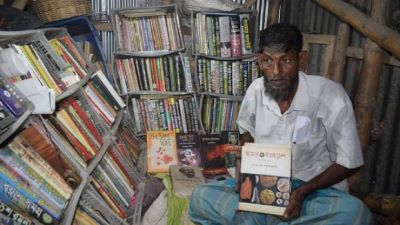
A hawker in Jhenidah, with his own hard-earned money, has established a self-made library at his house in College Para area under Kaliganj municipality.
Mirazul Haque, 58, sells hand fans, handkerchiefs, biscuits, khaja, fruits and other sweetmeats on public buses. Having lost his father when he was 49, Mirazul is the only one among his four siblings to have passed class three in 1978. He could not afford to continue his education and began living in the slum, in a tin shade house on a three decimal land.
A pathagar can help propagate education in the society, Mirazul told this reporter. Mirazul himself is very fond of reading books, and dreams that those who have dropped out of studies can gather knowledge by reading the books in his library free of cost.
He has purchased 450 books using his earnings, which includes a collection of novels, political books, and so on, worth BDT 2.50 lakh. Being a staunch supporter of Bangabandhu, most of the books he purchased are on the life of Sheikh Mujibur Rahman and the liberation war. Mirazul’s intention, now, is to build a library where students, the unemployed, and the elderly are able to read books in their leisure time.
“I cannot afford to purchase land upon which I can build the library,” says Mirazul. He plans on naming it Bangabandhu Smriti Pathagar. “My books are stuck at my tin shade house. They are at risk of being damaged because of the lack of a proper storage facility.” He earnestly requests the local administration to allot a room for his pathagar.
Montu Gopal Das, a freedom fighter of College Para, and Emran Hossain, a timber trader of Bakulia village under the upazila, echoed that Mirazul is “rich in books”—it is his hobby to collect them with the money he earns from hawking. Both of them often borrow books from Mirazul.
ADVERTISEMENT
“Though we are needy, he does not let that get in the way of his dreams”, Julekha Begum, wife of Mirazul Haque, told The Daily Star. “He has taken a noble initiative”. A sweeper at Agrani Bank, Julekha contributes to the family finances with her monthly salary of BDT 3,500.
Of their four children, elder son Jahangir Alam has passed his MA in social welfare and research from Dhaka University in 2020, appeared in the 41st BCS preliminary, and is now looking for a job in Dhaka. The younger son, Alamgir Hossain, is studying global religion and Sanskrit at Dhaka University. He is also a regular football player at Muktijoddha Sangsad Kira Chakra premier league.
UNO Sadia Jerin of Kaliganj upazila has provided assurance that she will try to arrange a room for Mirazul’s initiative.
Mirazul wishes to donate his eyes after his death; he has made a rotary in this regard, and plans to provide his dead body to a medical college and hospital for medical research.
For more book-related news and views, follow Daily Star Books on Facebook, Instagram, Twitter, and LinkedIn. Write to us at thedailystarbooks@gmail.com.




















 SootinClaimon.Com