Myanmar’s ruling military wanted spy gear on network: Telenor
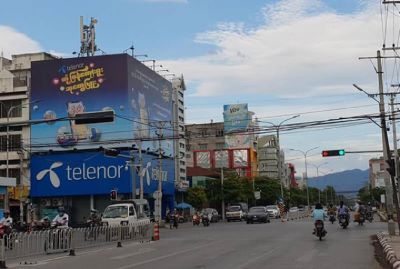
Telenor said yesterday the Myanmar ruling military had demanded it install equipment to intercept communications on the network the Norwegian firm operates in the country.
Telenor announced in July it plans to sell Telenor Myanmar, saying only that since the February military takeover that ousted civilian leader Aung San Suu Kyi and her government it had become increasingly difficult to operate in the country.
But yesterday it disclosed that the ruling military wanted it to install monitoring equipment on the network with some 18 million customers.
“Telenor has not installed such equipment and we will not do so voluntarily,” a spokesman for the firm said in a statement, noting that complying would contravene Norwegian and international sanctions.
The firm added that “operating such equipment in this situation would constitute a breach of our values and standards as a company.”
It was not immediately clear if the ruling military had made similar demands of other telecoms operators present in Myanmar, which include Qatar’s Ooredoo as well as local groups Mytel and MPT.
Telenor, which has had a commercial presence in Myanmar since 2014, said the demand to install surveillance equipment was one of the reasons behind its decision to leave.
ADVERTISEMENT
It reiterated that it believes that selling Telenor Myanmar is “the least detrimental solution” for the country.
But in July, 474 civil society groups in Myanmar called Telenor’s decision to pull out irresponsible, saying it had not sufficiently considered the impact of the move on human rights.
Telenor said it “is deeply concerned and saddened by the deteriorating human rights and security situation caused by the military takeover, especially for the people of Myanmar.”
Telenor plans to sell it Myanmar network to Lebanese conglomerate M1 Group.
The Norwegian firm said it submitted the paperwork for the transaction at the end of August to Myanmar authorities.
Two of Vietnams biosphere reserves win UNESCO recognition
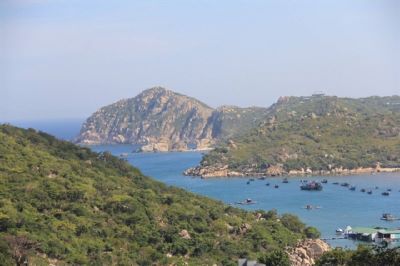
Việt Nam’s two biosphere reserves of Núi Chúa and Kon Hà Nừng have received UNESCO recognition after a vote at the ongoing meeting in Nigeria.
The two biosphere reserves located in the central province of Ninh Thuận and the Central Highlands province of Gia Lai, respectively, officially became world biosphere reserves at the 33rd session of the International Coordinating Council of the Man and the Biosphere Programme (CIC-MAB) in Nigeria from September 13-17.
The event takes place in both online and offline forms marking the first time an annual meeting of CIC-MAB has been organised in an African country.
The two Việt Nam wildlife areas were among 22 other candidates of 20 countries and groups of countries seeking UNESCO recognition at the event.
With this recognition, they have helped increase the total world biosphere reserves in Việt Nam to 11, making it one of the countries with the largest number of UNESCO-recognised biosphere reserves.
Lê Thị Hồng Vân, Ambassador and Việt Nam’s permanent representative to UNESCO, said Việt Nam was the only country with two dossiers approved immediately from the first round. After six years, the country has had new biosphere reserves cited in the world list.
On this occasion, CIC-MAB also reviewed Việt Nam’s 10-year periodical reports on management and development of Cần Giờ World Biosphere Reserve and Cù Lao Chàm – Hội An. These reports had been highly appreciated by the council.
ADVERTISEMENT
Núi Chúa Biosphere Reserve in Ninh Thuận Province is a typical ecosystem in Southeast Asia, with a natural area of 29,856ha. Its core area of Núi Chúa National Park is converging three natural areas of forest, sea and semi-desert, including many rich and diverse ecosystems.
This is living the habitat of more than 1,500 plant species, including 10 endemics and 54 rares recorded in the Việt Nam Red Book and the World Red List. The fauna is also very rich with 756 species of wild animals, over 350 of coral, and hundreds of marine animals.
Núi Chúa sea is also a rare place on the mainland where sea turtles come to lay eggs every year and are currently protected.
One of the special features of Núi Chúa National Park is that this area has a dry and hot climate similar to many places in Africa (the highest temperature is approximately 42 degrees Celsius). Therefore, this place is also called “Phan Rang Dry Forest”.
The harsh climate and diverse topography have created a standard for the most typical and unique dry forest ecosystem of Việt Nam and Southeast Asia.
Meanwhile, Kon Hà Nừng Plateau Biosphere Reserve in the Central Highlands province of Gia Lai, covers a total area of 413,511.67ha with two core areas, Kon Ka Kinh National Park and Kon Chư Răng Nature Reserve.
The reserve has a closed subtropical humid evergreen forest ecosystem that remains relatively intact. It boasts high biodiversity, typical for forest ecosystem, forest flora and fauna in the Central Highlands.
The Biosphere Reserve also plays an important role in fostering socio-economic development and maintaining ecological balance of the Central Highlands and the Central and Southeast regions.
In addition, the two Biosphere Reserves both contain rich and unique cultural heritage treasures with many outstanding features of tangible and intangible cultural values of ethnic minority groups living there. VNS
NK says ballistic missiles tested from new rail-borne system
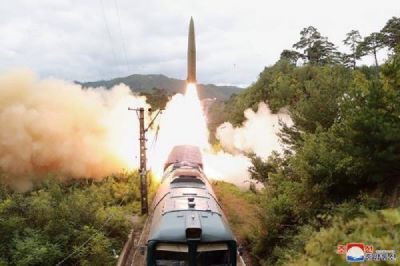
North Korea said Thursday that its ballistic missile test the previous day was carried out by its new railway-borne missile system, stoking concerns over stalled talks on inter-Korean peace.
“For the first time, we tested the viability of our railway-borne missile system to check on the combat readiness and strike capability,” the official Korean Central News Agency said. According to the KCNA, the missiles hit targets 800 kilometers away in the East Sea after being fired from a train.
South Korea’s Joint Chiefs of Staff said the two KN-23s, the codename given for North Korea’s version of Russia’s short-range missile Iskander, flew 200 kilometers longer than in the previous test in March this year. But the JCS declined to confirm whether that was a sign that Pyongyang was testing an upgraded missile.
The launch followed a long-range cruise missile test the previous week. Pyongyang is banned from developing or testing ballistic missiles but not cruise missiles under UN Security Council resolutions.
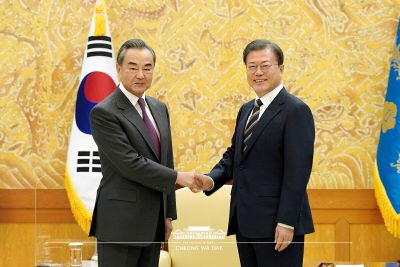
The Wednesday launch took place only hours after President Moon Jae-in met with Chinese Foreign Minister Wang Yi at Cheong Wa Dae. Moon asked for China’s support in resuming nuclear talks. North Korea has rebuffed diplomatic outreach from both South Korea and the US.
Moon, who later in the day attended the country’s first test-firing of a submarine-launched ballistic missile, said the launch had been planned and was not a response to North Korea’s launches, highlighting the increasing missile capability will be an unmistakable deterrence against Pyongyang’s provocations.
Kim Yo-jong, sister of North Korean leader Kim Jong-un and deputy director of Pyongyang’s propaganda affairs, immediately lashed out at Moon, calling him foolish for saying that Seoul’s missiles could be a deterrence against Pyongyang’s “provocation.” Kim warned that inter-Korean ties would hit a new low.
Moon’s peace efforts have essentially been in limbo since North Korea demolished an inter-Korean liaison office in June last year, as it protested the way Seoul handles its anti-Pyongyang activists, who flew anti-Kim leaflets over the inter-Korean border.
The two Koreas saw a brief opportunity to revive momentum for a thaw in late July, when North Korea reached out to South Korea to reconnect the hotlines.
But the two neighbors were back to a standoff as Pyongyang quickly returned to escalating tension by accusing Seoul and Washington of trying to build tension with their annual military drills that ended in late August.
Moon is expected to ask for support for his peace efforts at the UN General Assembly on Sunday. Pyongyang has not responded to Seoul’s suggestion that they meet on the sidelines to commemorate their 30th anniversary of UN membership.
EU seeking to step up engagement with Indo-Pacific region
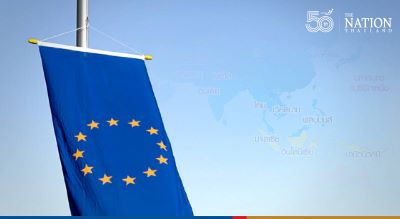
A day after the US, UK and Australia unveiled a new trilateral defence pact for the Indo-Pacific region, the European Union has announced a new plan to step up its engagement with the region, which is increasing in strategic importance for Europe.
“Its [Indo-Pacific’s] growing economic, demographic, and political weight makes it a key player in shaping the rules-based international order and in addressing global challenges,” said a joint communication between the European Commission and the High Representative released today.
To implement the new strategy, the EU will complete trade negotiations with Australia, Indonesia and New Zealand; resume trade negotiations and start investment negotiations with India; complete an Economic Partnership Agreement with the East Africa Community.
The US already has its Indo-Pacific Strategy, which international relations analysts say is aimed at countering China, which has the mega Belt and Road Initiative to connect China to the rest of the world through road, rail, sea and air connectivity.
The EU in a statement said it aims to contribute to the Indo-Pacific region’s stability, security, prosperity and sustainable development, in line with the principles of democracy, rule of law, human rights and international law.
“The economic, demographic, and political weight of the Indo-Pacific region is expanding, from the east coast of Africa to the Pacific island states,” European Commission President Ursula von der Leyen said in a statement.
High Representative/Vice-President Josep Borrell said: “The world’s centre of gravity is moving towards the Indo-Pacific, both in geo-economic and geo-political terms. The futures of the EU and the Indo-Pacific are interlinked.”
ADVERTISEMENT
He said the EU is already the top investor, the leading development cooperation partner and one of the biggest trading partners in the Indo-Pacific region.
“Our engagement aims at maintaining a free and open Indo-Pacific for all, while building strong and lasting partnerships to cooperate on matters from the green transition, ocean governance or the digital agenda to security and defence.”
It will also assess the possible resumption of trade negotiations with Malaysia, the Philippines and Thailand, and the eventual negotiation of a region-to-region trade agreement with ASEAN.
The EU will also conclude Partnership and Cooperation Agreements (PCA) with Malaysia and Thailand; start PCA negotiations with the Maldives, and bring the EU’s upcoming new Partnership Agreement with the African, Caribbean, and Pacific States (ACP) to full fruition.
It will also strengthen ocean governance in the region, including increasing the EU’s support for Indo-Pacific countries’ fisheries management and control systems, the fight against Illegal, unreported and unregulated fishing and the implementation of Sustainable Fisheries Partnership Agreements.
Mekong River Commission, Israel team up to tackle river’s plight
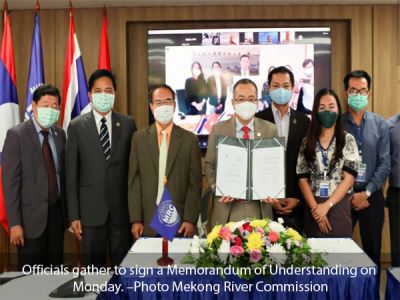
The Mekong River Commission (MRC) and Israel, represented by its Agency for International Development Cooperation of the Ministry of Foreign Affairs, last week signed a pack that will see both sides confront some of the challenges facing the Mekong River, according to MRC
The five-year renewable Memorandum of Understanding was inked in a virtual ceremony on September 9 by Israel’s Ambassador to Vietnam, Nadav Eshcar, and the MRC Secretariat’s Chief Executive Officer, Dr An Pich Hatda.
“The signing of the MOU is another example that represents our timely response to the challenges we are facing today and tomorrow, especially drought,” Dr Hatda said, adding that the agreement will benefit both the MRC and wider Mekong region.
As part of the agreement, both sides will work to develop institutional capacity and share technical expertise with a focus on drought management, agriculture, irrigation and other areas relevant to addressing the Mekong River’s plight.
In addition, the MOU contains a provision for courses, training sessions and workshops that draw on Israel’s expertise in managing scarce water resources.
Shifting seasonal and daily flow patterns resulting from climate change and water being stored for regional power have already affected the Mekong’s ecology.
In 2019 and 2020, droughts saw Mekong water levels fall to record lows. The MRC estimates that severe droughts will only become more frequent.
ADVERTISEMENT
During the signing ceremony, Ambassador Eshcar reflected on Israel’s experience of managing exiguous water resources and its current relevance to the Mekong River’s situation.
“Unlike in the past, Israeli’s many decades of expertise are now very relevant to this region. Israel wishes to contribute to those efforts of the MRC in the spirit of friendship and solidarity with the region in general and the four Member Countries in particular,” he said.
Ambassador Eynat Shlein, Head of Israel’s Agency for International Development Cooperation, also spoke of the MOU’s importance in leveraging Israel’s experience for the betterment of Mekong communities.
A delegation from the Embassy of Israel in Thailand also attended the signing ceremony. The MRC is an intergovernmental organisation established in 1995 for regional dialogue and cooperation in the Lower Mekong River Basin.
Based on the Mekong Agreement between Cambodia, Laos, Thailand and Vietnam, the Commission serves as a regional platform for water diplomacy as well as a knowledge hub of water resources management for the sustainable development of the region.
Afghanistan seeks permission to operate commercial flights to Pakistan
The civil aviation ministry of Afghanistan has requested Pakistan to allow two of its airlines — Ariana Afghan Airlines and Kam Air — to begin commercial flight operations to the neighbouring country.
In a letter, a copy of which is available with Dawn.com, sent by the Ministry of Aviation and Transport of the Islamic Emirate of Afghanistan to Pakistan’s Civil Aviation Authority (CAA) dated Sep 13, it requested Pakistani authorities to permit air operations of two national carriers of Afghanistan on the basis of the memorandum of understanding signed between the two countries.
The Afghan ministry said its two carriers aimed to commence their scheduled flights and requested the CAA to facilitate the process.
The letter also recalled that the Kabul Airport was damaged by American troops before their withdrawal, however, “By technical assistance of our Qatar Brother, the Airport became operational once again and a notice to airmen (Notam) in this regard issued on 6 September 2021,” said the letter.
Warning from Qatar
ADVERTISEMENT
Qatar had a day ago warned it would not take responsibility for Kabul airport without “clear” agreements with all involved, including the Taliban, about its operations, according to AFP.
“We need to make sure that everything is addressed very clearly otherwise … we are not able to take any responsibility of the airport (if) all these things are not addressed,” Foreign Minister Sheikh Mohammed bin Abdulrahman Al-Thani had said at a press briefing.
“Right now the status is still (under) negotiation,” he told the presser.
Meanwhile, a Qatari official was on Sep 9 quoted by Reuters as saying the Kabul Airport was about 90 per cent ready for operations but its reopening was planned gradually.
“Flights into Kabul will fly through Pakistan’s airspace for the time being because the majority of Afghanistan is still not covered by flight radar,” he had said.
Chaos at the airport
The Kabul airport was left inoperable after US-led forces finished a chaotic evacuation of over 120,000 people, and the Taliban have since scrambled to get it operational with technical assistance from Qatar and other nations, according to AFP.
Turbulent scenes were witnessed at the Kabul airport on Aug 16 after thousands rushed the facility following the Taliban’s capture the Afghan capital. Several Afghans had plunged to their deaths while hanging off the side of a US military cargo plane that was leaving the airport.
On Aug 26, two suicide bombers and gunmen had attacked crowds of Afghans flocking to Kabul’s airport, transforming a scene of desperation into one of horror in the waning days of airlift for those fleeing the Taliban takeover. The attacks had killed at least169 Afghans and 13 US troops.
The Pakistan International Airlines (PIA) had on Aug 16 suspended its flights to Afghanistan due to the uncertain security situation in the war-ravaged country and the chaotic scenes prevailing at Kabul airport.
After the situation normalised, the PIA had on Sep 13 run its first commercial flight to Kabul. Prior to it, the national airline was undertaking special flights to evacuate people stranded in the neighbouring country.
A Boeing 777, with flight number PK 6429, departed from Islamabad as a commercial flight chartered by the World Bank, carrying officials from the bank and journalists, airline spokesman Abdullah H. Khan had said.
Qatar Airways had also run a chartered flight from Kabul to Doha on Sept 9, carrying about 113 people.
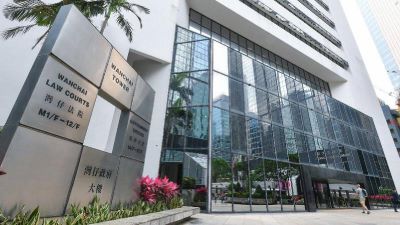
12 jailed for participating in unauthorized assembly in HK
HONG KONG – Twelve anti-China activists were sentenced by the District Court of the Hong Kong Special Administrative Region on Wednesday to up to 10 months in prison for taking part in an unauthorized assembly on June 4 last year.
The 12 defendants participated in an unauthorized assembly in Victoria Park on June 4, 2020, during which they entered the park despite being barred by the police, and shouted anti-National Security Law slogans.
Albert Ho Chun-yan, Figo Chan Ho-wun and Andrew Wan Siu-kin were sentenced to 10 months in prison. Steven Kwok Wing-kin and Chiu Yan-loy were sentenced to eight months in prison. Cyd Ho Sau-lan, Leung Kwok-hung, Eddie Chu Hoi-dick and Yeung Sum were sentenced to six months in prison, while Cheung Man-kwong, Mak Hoi-wah and Leung Kwok-wah received suspended sentences.
Australia will upgrade to nuclear-powered submarines in new security partnership with Britain, US
WASHINGTON – In the most significant move between the three countries in decades, and a sharp signal that defence in Asia and the Indo-Pacific is being beefed up against what is seen as the threat of a rising China, Australia, the US and Britain on Wednesday (Sept 15) announced a new trilateral security partnership.
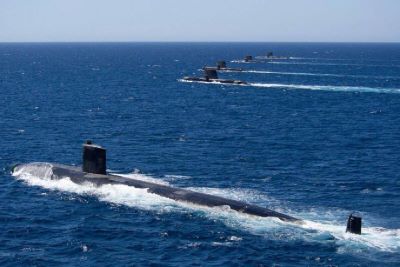
This will, among other things, upgrade Australia’s submarines to a nuclear-powered fleet, vastly expanding its reach and capabilities.
The “new architecture” is “about deepening cooperation on a range of defence capabilities for the 21st century”, a senior US administration official told journalists.
US President Joe Biden – with British Prime Minister Boris Johnson and Australia’s Prime Minister Scott Morrison joining him virtually – announced details late on Wednesday afternoon (5am Singapore time) in Washington.
The partnership will spur cooperation across many new and emerging arenas, including cyber, applied artificial intelligence, quantum technologies and some undersea capabilities, officials said.
“We’ll also work to sustain and deepen information and technology sharing, and I think you’re going to see a much more dedicated effort to pursue integration of security and defence-related science, technology and industrial bases and supply chains,” one of the officials said.
The pact, with the acronym Aukus, is not aimed at China, the senior administration officials insisted – framing it as part of a continuum of US involvement in the region and its alliances with Australia and Britain.
ADVERTISEMENT
“This is about a larger effort to sustain the fabric of engagement and deterrence in the Indo-Pacific,” another senior official said, adding: “We have a history of innovation upgrading capabilities. I would urge you to look at it in this context.”
“One of the things the United States has done most effectively in the Indo-Pacific is to secure peace and stability and to be the ultimate guarantor of that rules-based order.
“This allows Australia to play at a much higher level and to augment American capabilities that will be similar. And this is about maintaining peace and stability in the Indo-Pacific.”
Addressing doubts as to the US’ commitment and resolve in the Indo-Pacific, the official said: “What President Biden is saying with this initiative is, count us in. We are all in for a deeper sustained commitment to the Indo-Pacific, and we recognise that one of our critical roles is indeed the maintenance of peace and stability there.
“This is meant to complement ongoing and existing security and political partnerships, and… to send a message of reassurance and a determination to maintain a strong deterrent stance into the 21st century.”
And on the role of Britain, the officials noted “a desire for Great Britain to substantially step up its game in the Indo-Pacific”.
“The process of this next 18 months is to help chart out what exactly that means. Obviously, Great Britain has… deep historical ties to Asia. I think they’ve indicated to us that they do want to do more going forward. And I think this is a clear and decisive next step in that arena.”
Australia thus far has conventional submarines, which must surface periodically and have limited range, and which are viewed as being outclassed by China’s growing maritime reach. Upgrading to nuclear power will give Australia long-range and stealth capabilities.
“They’re quieter, they’re much more capable; they will allow us to sustain and to improve deterrence across the Indo-Pacific,” one of the senior officials said.
The officials stressed that this was about nuclear propulsion and Australia would remain a non-nuclear power state.
“Australia has no intention of pursuing nuclear weapons,” one of them said.
“This is about nuclear power submarines, but it’s a very important initiative that will basically set us on a new course of trilateral cooperation into the 21st century.
“We will work closely on efforts to ensure the best practices with respect to nuclear stewardship,” he said.
“You will see much deeper interoperability among our navies and our nuclear infrastructure people.
“This is a fundamental decision… that binds decisively Australia to the United States and Great Britain for generations,” he said.
Mr Ashley Townshend, director of foreign policy and defence at the United States Studies Centre at the University of Sydney, tweeted: “This is surprising and a very welcome sign of Biden’s willingness to empower close allies like Australia with highly advanced defence tech assistance — something the US has rarely been willing to do. It suggests a more strategic approach to collective defence.”
The pact comes ahead of the first in-person summit in Washington on Sept 24 of leaders of the Quadrilateral Dialogue or Quad – India, the US, Australia and Japan.
“It’s a huge breakthrough in US-Australia relations” given the sensitivity of the technology the US will share, Dr Patrick Cronin, Asia-Pacific Security Chair at the Hudson Institute in Washington told The Straits Times.
“This is going to give a colossal upgrade to Australia’s submarine capability and the survival of its future missile fleet.
“This counters China’s… area access denial (and) potentially puts Australia, India, the US and Japan into the kind of… joint patrols and operations they have been talking about,” Dr Cronin said.
“It is going to be transformative in Asia, and the Pacific will be the centre of the submarine world for better or worse once you get to the 2030s and beyond.”
Chinese FM arrives in Seoul in latest effort to bolster regional ties
Chinese State Councilor and Foreign Minister Wang Yi arrived in Seoul on Tuesday evening as part of a weeklong Asia tour that aims to bolster regional ties.
According to Seoul’s Foreign Ministry, China’s top diplomat will hold talks with South Korean Foreign Minister Chung Eui-yong on Wednesday. He is also likely to pay a courtesy call to President Moon Jae-in before leaving for China later in the day.
Wang last visited Seoul 10 months ago, in November last year. South Korea is the final destination in an Asia trip that also included stops in Vietnam, Cambodia and Singapore.
The high-level talks are expected to touch on a range of topics, from bilateral ties to North Korea and the Beijing Winter Olympics. But observers downplayed speculation that the aim of the upcoming visit was to increase pressure on South Korea, which has distanced itself from the escalating US-China rivalry and avoided being drawn in.
“The key purpose of Wang’s visit appears to be managing bilateral relations amid the prolonged pandemic,” said Hwang Jae-ho, a professor of international studies at Hankuk University of Foreign Studies.
“For China, South Korea is a key partner in the region, especially ahead of mega-events next year such as the Beijing Olympics and the Communist Party’s party congress. He is more likely to seek backing from South Korea rather than renewing pressure.”
Additionally, the apparent resumption of activity at North Korea’s Yongbyon nuclear complex is expected to be high on the agenda. While the US has reiterated its willingness to resume talks with the North without preconditions, China has urged sanctions relief to expedite the stalled talks.
On Monday, North Korea said it had successfully test-fired a new type of long-range cruise missile over the weekend, possibly in an attempt to gain attention as South Korea, the US and Japan were set to hold a trilateral meeting in Tokyo on Tuesday to discuss the North’s nuclear activities.
“Wang may want to be briefed on discussions ongoing between South Korea and the US on North Korea issues. But it seems unlikely for him to express open hostility toward the Seoul-Washington alliance,” the professor added.
While Chinese President Xi Jinping remains extremely cautious about traveling abroad due to the nation’s heightened pandemic restrictions, Wang, along with Communist Party Politburo member Yang Jiechi, who specializes in US affairs, is holding high-level talks around the world.
South Korean and Chinese officials have sought to arrange a state visit to Seoul for Xi, which was supposed to take place last year but was delayed due to the pandemic. But talks on the subject seem to have fallen apart, with COVID-19 showing no immediate signs of abating.
ADVERTISEMENT
A growing subject of speculation is whether Moon will attend the opening ceremony of the Beijing Olympics in February if the two Koreas agree to take part together, in a resumption of peace efforts on the Korean Peninsula.
Still, uncertainties are mounting. Aside from North Korea’s unresponsiveness, the International Olympics Committee recently suspended the North’s national Olympic committee until the end of 2020 for unilaterally skipping this year’s Tokyo Olympics.
Pharmaceutical companies race to develop oral drugs for COVID
Japanese pharmaceutical companies are among those fiercely competing to develop oral antiviral drugs for COVID-19. Oral medications that could be taken at home by patients with mild symptoms could be a game changer in the fight against the novel coronavirus.
If a patient can recover quickly by taking such drugs in the early stages of the disease, the coronavirus could be treated as a common infection like the flu.
■ High hopes
“The final trial data for the oral drug under development will be available in September or October,” Health, Labor and Welfare Minister Norihisa Tamura said at a press conference on Sept. 3. “We hope to see an application filed soon [by the pharmaceutical company] and provide it to the public as soon as possible.”
At the peak of the fifth wave, the number of infected people resting or receiving treatment at home exceeded 130,000 nationwide due to the overwhelming pressure on the medical system. In some cases, patients could not be admitted to hospitals and their treatment was delayed, resulting in serious illness.
If a highly effective drug becomes available that can be easily stored and transported, and taken at home in mild cases, it could end the pandemic. The competition for development is increasingly heated.
A leading contender is U.S. pharmaceutical giant Merck & Co. with its experimental drug molnupiravir. This drug is in the final stages of international clinical trials in countries such as the United States, Britain and Japan, and the trial data is expected to be released in September or October.
In June, the U.S. government announced plans to procure 1.7 million doses of this drug for $1.2 billion (about ¥130 billion) in anticipation of its approval. With a view to authorizing emergency use as early as this year, the U.S. government has high hopes that many lives can be saved at home and abroad.
ADVERTISEMENT
Swiss pharmaceutical giant Roche is also in the final stages of clinical trials for its experimental drug AT-527. According to an interim analysis of the study on the drug, on Day 2, patients receiving AT-527 experienced an 80% mean reduction from the baseline viral load as compared to a placebo.
Final trial results are expected to be released by the end of this year. In Japan, Chugai Pharmaceutical Co., which is under the umbrella of Roche, aims to file an application for the drug in 2022.
U.S. pharmaceutical giant Pfizer Inc. is also in the final stages of clinical trials for a new drug, and aims to compile data by the end of this year to obtain authorization for emergency use in the United States.
■ Development in Japan
All these experimental oral drugs share a mechanism of suppressing the multiplication of the virus in the body, preventing serious illness and speeding recovery. Development efforts are also underway in Japan.
Shionogi & Co., which has successfully developed drugs for infectious diseases such as the influenza drug Xofluza, began clinical trials for an experimental oral drug in July. The new drug is being administered to healthy people to verify its safety.
The company plans to conduct a large-scale clinical trial within this year, and hopes to establish a manufacturing capacity of 1 million to 2 million doses.
Earlier this month, the health ministry made the company eligible for subsidies to develop the drug, with the aim of early commercialization in Japan.
Shionogi President Isao Teshirogi expressed his enthusiasm for a Japan-made therapeutic drug, saying, “We want to get to the point where people can feel assured that the novel coronavirus is almost the same as the flu.”
■ Mass-produced at lower cost
There are three types of drugs for COVID-19 available in Japan, including anti-inflammatory drugs for patients with moderate and severe symptoms. All these drugs have been converted from drugs for other diseases and have been put to practical use one after another since last year.
For patients with mild to moderate symptoms, a combination of antibodies known as an “antibody cocktail” was rapidly developed and received special approval in July. Although there have been a number of reports that the treatment is highly effective, it is an intravenous medication and must be administered at a medical institution, limiting the number of patients who can be treated.
In contrast, Prof. Katsumi Maenaka of Hokkaido University said oral drugs “take a long time to develop because [the pharmaceutical companies] need to create new compounds that are safe and effective in inhibiting the multiplication of the virus.”
However, if such a drug is successfully developed, it can be mass-produced at a lower cost than antibodies, and has the advantage of being easily taken at home.