Hanoi, Beijing will shore up marine stability #SootinClaimon.Com

#SootinClaimon.Com : ขอบคุณแหล่งข้อมูล : หนังสือพิมพ์ The Nation.

https://www.nationthailand.com/international/40006051

Hanoi, Beijing will shore up marine stability


Vietnams hospitality for FMs visit shows trust, friendship, cooperation
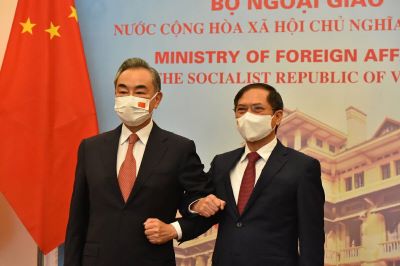
In a series of high-level talks between China and Vietnam, both socialist countries sent clear signals on jointly stabilizing the South China Sea situation, exchanging political support and advancing collaboration in economic recovery.

In particular, properly handling maritime issues and carrying forward the consultations on the expected text of the Code of Conduct in the South China Sea were among the new consensuses made during State Councilor and Foreign Minister Wang Yi’s visit to the southeast Asian country over the weekend.

Behind these positive gestures are Beijing and Hanoi’s mutual trust and willingness to control maritime differences despite Washington’s recent attempts to use the topic to alienate them, experts said.

Wang had a packed schedule during his stay in Hanoi from Friday to Sunday, meeting with prominent figures including Nguyen Phu Trong, general secretary of the Communist Party of Vietnam Central Committee.

Su Xiaohui, deputy director of the Department of American Studies at the China Institute of International Studies, said Hanoi’s great hospitality and the high level of meetings arranged for Wang “reflect Vietnam’s great emphasis on ties with China and the positive atmosphere between the two countries”.

During meetings on Saturday, Wang said the two sides should cherish the hard-won stable situation in the South China Sea, “find a proper place in the overall bilateral ties for maritime issues”, and refrain from worsening the situation.

ADVERTISEMENT

Also, the two countries should “jointly guard against attempts made by external forces for alienating” them, and they should convince the world that the two nations have both the capability and wisdom to manage their divergence, Wang added.

Vietnamese Prime Minister Pham Minh Chinh told Wang that his country is ready to keep the maritime situation stable, embark on maritime cooperation with an incremental approach and contribute to ensuring the region’s peace.

In Wang’s separate talk with Foreign Minister Bui Thanh Son, both sides highlighted the need to carry forward the consultation on the Code of Conduct in the South China Sea together with the nine other members besides Vietnam of the Association of Southeast Asian Nations.

Beijing looks forward to formulating “a valid, substantive agreement that aligns with international law”, Wang said.

The Vietnamese minister echoed the call for promoting the consultation, and said both sides should continue advancing their cooperation in the Beibu Gulf and in areas of low sensitivity.

Su, the CIIS scholar, noted that this year, senior US political figures including Vice-President Kamala Harris have visited Vietnam in an attempt to weaken Beijing-Hanoi ties by hyping maritime tension.

“But the latest messages issued over the weekend show that China still enjoys adequate trust from its neighbors and positivity prevails in their interactions, and their differences are under control,” Su added.

During the weekend meetings, the two sides reaffirmed political support for each other’s following the socialist path, and Wang relayed Beijing’s strong support to Vietnam’s new leadership that took office this year.

For his part, the Vietnamese foreign minister said Hanoi will continue its clear support for China in topics such as democracy, human rights, Hong Kong, Xinjiang, Tibet, Taiwan and novel coronavirus origin tracing.

The two countries should join hands to push back at smearing and attacks made by external forces against socialist countries, champion their common interest, further honor the noninterference principle and support the international system and international order, Wang said.

Yang Baoyun, a professor specializing in ASEAN studies at Thailand’s Thammasat University, said, “The positive signals issued during Wang’s visit show that Beijing is a reliable neighbor for Hanoi given the ravaging pandemic, and that both countries need each other politically, economically and internationally.”

As China and ASEAN became each other’s top trade partner last year, the steadfast growth of trade between China and ASEAN countries including Vietnam “helps keep production chains there afloat and cushion the blow from the pandemic”, Yang said.

Speaking on the lasting impact made by the pandemic, Wang said Beijing is willing to offer support with vaccines, share experiences in COVID-19 response and therapeutics and help Vietnam promote economic recovery.

To keep bilateral economic and trade exchanges afloat, Beijing is ready to advance the construction of cross-border economic cooperation areas, and help Vietnam speed up its industrialization process, he added.

The Vietnamese prime minister said Hanoi is ready to learn from China’s experience in COVID-19 response, shore up teamwork in trade and investment and facilitate China’s investment in Vietnam.

Published : September 13, 2021
N. Korea test-fires new long-range cruise missiles: state media #SootinClaimon.Com

#SootinClaimon.Com : ขอบคุณแหล่งข้อมูล : หนังสือพิมพ์ The Nation.

https://www.nationthailand.com/international/40006050

N. Korea test-fires new long-range cruise missiles: state media


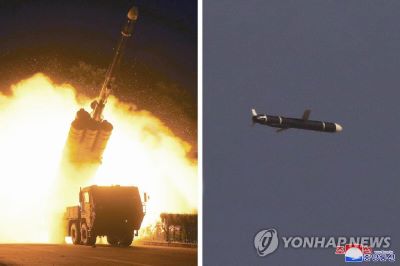
North Korea has successfully test-fired a new type of long-range cruise missile over the weekend, state media reported Monday, a low-level provocation amid stalled talks with the United States.

The test-firings, which took place Saturday and Sunday without leader Kim Jong-un in attendance, came right after the North held a scaled-down military parade, and appeared to be intent on demonstrating its military power in a low-level provocation without violating UN sanctions.

The North is banned from using ballistic technology under multiple UN Security Council resolutions. Cruise missiles, however, are not subject to the sanctions as they are considered less of a threat than ballistic missiles.

The missiles “traveled for 7,580 seconds along an oval and pattern-8 flight orbits in the air above the territorial land and waters” in North Korea and “hit targets 1,500 km away,” the North’s official Korean Central News Agency (KCNA) said.

“The development of the long-range cruise missile, a strategic weapon of great significance in meeting the key target of the five-year plan for the development of the defense science and the weapon system … has been pushed forward according to the scientific and reliable weapon system development process for the past two years,” the KCNA said.

“Detailed tests of missile parts, scores of engine ground thrust tests, various flight tests, control and guidance tests, warhead power tests, etc. were conducted with success,” it added.

South Korea’s Joint Chiefs of Staff (JCS) said that an in-depth analysis is under way in close cooperation with US intelligence authorities but refused to confirm details, including where the test was conducted and if they detected the launches in advance.

The South Korean military has disclosed information on North Korea’s test-firings of ballistic missiles almost on a real-time basis, but not for cruise missile tests.

Experts say the North’s newly unveiled weapon resembles the US’ long-range Tomahawk and South Korea’s Hyunmoo-3C cruise missiles.

Ballistic missiles have a much longer range and move faster than cruise missiles of the same size. But cruise missiles are still threatening as they fly in a relatively straight line and at low altitudes, making them harder to detect. Cruise missiles can also carry nuclear warheads, according to the experts.

The latest test-firings came after the North held a scaled-down military parade at midnight Thursday to mark the 73rd state founding anniversary.

The North paraded mostly paramilitary troops, fire engines and artillery-carrying tractors rather than intercontinental ballistic missiles and other strategic weapons. The event appeared to be aimed at consolidating internal solidarity amid challenges from the coronavirus pandemic and global sanctions on its economy.

Pak Jong-chon, member of the Presidium of the politburo of the ruling Workers’ Party watched the test-firings, along with other senior officials, the KCNA said. Leader Kim did not attend the tests.

“This is another great manifestation of the tremendous capabilities of the defense science and technology and the munitions industry of our country,” Pak said, according to the KCNA.

ADVERTISEMENT

“He stressed the need for the field of the national defense science to go all out to increase the defense capabilities, the war deterrence of the country and keep making achievements in meeting the grand and long-term targets of securing war deterrence.”

Experts said that North Korea appears to have conducted the test-firings in a way that demonstrates its military power, but by using cruise missiles, not ballistic missiles, it avoided provoking the U.S. too much.

They still worried that the North could continue conducting such tests going forward and seek to make those missiles smaller and possibly adaptable to submarines down the line.

“Given that the missile development was launched two years ago as part of the five-year plan, the project appears to have started after mid-2019,” said Hong Min, a senior researcher at the Korea Institute for National Unification, a state-run think tank.

“The North could continue such tests so as to make them smaller as part of the five-year plan, and there is also a possibility that the missiles could be developed to be able to be launched from submarines.”

The latest firing marks the third known major missile test by the communist country so far this year.

On March 21, the North fired two cruise missiles off the west coast, according to the JCS. Four days later, it fired off two ballistic missiles into the East Sea, believed to be an upgraded version of its KN-23 Iskander-type missile.

Some local media also reported that the North conducted a cruise missile test in January just hours after US President Joe Biden took office. (Yonhap)

Published : September 13, 2021

India, US set to launch Climate Action and Finance Mobilisation Dialogue #SootinClaimon.Com

#SootinClaimon.Com : ขอบคุณแหล่งข้อมูล : หนังสือพิมพ์ The Nation.

https://www.nationthailand.com/international/40006049

India, US set to launch Climate Action and Finance Mobilisation Dialogue


India and the US would launch the Climate Action and Finance Mobilisation Dialogue (CAFMD) on Monday as US Special Presidential Envoy for Climate Change, John Kerry visits India as part of his multi-country tour in the run-up to the annual climate summit less than 50 days ahead.

The CAFMD is one of the two main tracks of the US-India Agenda 2030 Partnership that Prime Minister Narendra Modi and President Joe Biden had announced at the Leaders Summit on Climate in April 2021. The other is the Strategic Clean Energy Partnership.

Slated to reach on Sunday, Kerry will be in India till September 14, meeting ministers, top bureaucrats, and private sector leaders. The US State Department has said Kerry will travel to India to “discuss efforts to raise global climate ambition and speed India’s clean energy transition.”

Kerry has visited Korea, Argentina, Japan, and China over last few days to continue vital discussions on reducing emissions and raising ambition ahead of COP26, the annual climate summit that in UK’s Glasgow.

A spokesperson from the Environment, Forests and Climate Change Ministry confirmed the CAFMD launch event on Monday but did not divulge further details.

Earlier in the year, in their joint statement at the launch of the “India-US Climate and Clean Energy Agenda 2030 Partnership”, the two nations had said: “Through this collaboration, India and the United States aim to demonstrate how the world can align swift climate action with inclusive and resilient economic development, taking into account national circumstances and sustainable development priorities.”

On August 24, Environment Minister Bhupender Yadav had held a telephonic conversation with Kerry to discuss CAFMD Track and had said these platforms provide greater opportunities for working together for climate actions and emphasized that India stands committed to working with the US on clean energy.

ADVERTISEMENT

The annual climate summit, the Conference of Parties (COP) to the United Nations Framework Convention for Climate Change (UNFCCC), at Glasgow from October 31, is being seen as a last ditch effort to bring around countries to enhance their emission targets to keep the global temperatures from rising to beyond 1.5 degrees Celsius compared to the pre-Industrial era.

On September 9, when the Intergovernmental Panel on Climate Change (IPCC) had released its sixth Assessment Report of the Working Group I (AR6WGI), Kerry had tweeted: “Life is about making choices, and we’re facing the biggest one yet. The @IPCC_CH report makes it clear our window is narrowing, but it’s not too late to act. We must choose to earnestly respond to the climate crisis while we still can.”

Published : September 13, 2021

India Sourced: Boeing maintains ‘billion-dollar’ sourcing from India #SootinClaimon.Com

#SootinClaimon.Com : ขอบคุณแหล่งข้อมูล : หนังสือพิมพ์ The Nation.

https://www.nationthailand.com/international/40006023

India Sourced: Boeing maintains ‘billion-dollar’ sourcing from India


Global aerospace giant Boeing has maintained the momentum of sourcing from India by going in for deep localisation as well as growing supplier base which caters to its international supply chains.

Accordingly, despite challenges posed by the pandemic and global economic upheaval the aerospace giant has continued to source around a billion worth of components and services from India.

Presently, 275 suppliers provide the company with advanced components, sub-assemblies and software support for commercial and defence aircraft as part of Boeing’s integrated global supply chain.

These parts and assemblies cover critical components such as aerostructures, wire-harness, composites, forgings, avionics, mission systems and ground support equipment.

“Our supplier base in India continues to grow and today we have more than 275 suppliers from India who are part of the global supply chain and are manufacturing critical systems and components that go into some of Boeing’s most advanced aircraft,” Boeing India President Salil Gupte told IANS.

“In 2021, we added new suppliers, including several Micro, Small and Medium Enterprises (MSMEs) in support of our commitment to ‘Aatmanirbhar Bharat’ (Self-reliant India). In fact, 26 per cent of our suppliers from India are MSMEs.”

According to Gupte, Boeing’s growth in India has been marked by an increase in the number of partnerships with MSMEs towards manufacturing, skilling and technology in Indian aerospace.

“The Indian supplier landscape has gone through a transformation over the last few years with proven capabilities in driving manufacturing predictability and performance.

“We have consistently supported our partners in upgrading their capabilities and technologies through training, skilling and other initiatives.”

At present, Tata Boeing Aerospace Limited (TBAL), Boeing’s first equity joint venture in India, with Tata Advanced Systems Limited (TASL) has been producing aero-structures for Boeing’s AH-64 Apache helicopter, including fuselages, secondary structures, and vertical spar boxes for customers worldwide.

Recently, Boeing announced the addition of a new production line to manufacture complex vertical fin structures for the 737 family of airplanes.

“This demonstrates that we are moving onwards in the journey towards ‘Aatmanirbhar Bharat’ with Indian suppliers and in making the country a key hub for aerospace and defence manufacturing for the world.”

Besides, the company sees an accelerated recovery in passenger traffic after Covid 2.0.

It has asserted that India’s key long-term fundamentals remain intact.

As per the latest annual India Commercial Market Outlook (CMO), Boeing predicted strong aviation growth in India due to the country’s growing economy and an expanding middle class, fueling demand for more than 2,200 new jets valued at nearly $320 billion over the next 20 years.

Currently, the company directly employs 3,000 people in India.

It has been present in India’s civil aviation sector for more than 75 years. It has provided aircraft and choppers to the Indian Air Force and the Indian Navy as well.

Published : September 12, 2021

How is New Zealand doing it? #SootinClaimon.Com

#SootinClaimon.Com : ขอบคุณแหล่งข้อมูล : หนังสือพิมพ์ The Nation.

https://www.nationthailand.com/international/40006022

How is New Zealand doing it?


New Zealand, one of the countries that earned global praise last year for its effective pandemic response, quickly imposed a lockdown last month over a single new case of COVID-19.

How is New Zealand doing it?

Prime Minister Jacinda Ardern went live on her Facebook page on Aug. 18 to give a quick 11-minute update on the level-4 lockdown, the country’s strictest alert level, and took questions in a sober, engaging manner — something that did not escape the attention of Filipinos who could only wish they had the same kind of leadership amid a pandemic that has claimed thousands of lives and taken a terrible toll on the economy.
 

To be sure, New Zealand’s COVID-19 playbook has not been spared criticism by its own citizens — the slow vaccination rate, for instance — but the country’s fundamental success so far against the pandemic is undeniable: It has managed to keep the number of cases low and prevent the massive spread of the virus through rigorous contact tracing, isolation, and treatment. It recorded its first death from the Delta variant, the country’s first coronavirus-related death since mid-February, only last Sept. 4.

“We were among the last countries in the world to have the Delta variant in our community… but COVID is very tricky, very hard and it’s all a matter of how we respond once we find it. And New Zealand… we’ve always had our way of respondingʍgo hard, go early because it’s much better than going light and long,” said Ardern.

As of yesterday, the country has reported 3,892 COVID-19 cases and 27 deaths since March last year when the World Health Organization declared a pandemic. In June 2020, Ardern announced that New Zealand was COVID-19-free and then lifted containment measures.

In the Philippines at about the same time, presidential mouthpiece Harry Roque claimed that New Zealand’s success would be hard to replicate in these parts because New Zealand has a much smaller population—5 million—compared to the Philippines’ 109 million. Observers were quick to point out that it was not only a matter of population, but also, and more crucially, of government foresight and leadership.

For instance, New Zealand banned flights from China as early as Feb. 3, 2020, weeks before Feb. 28 when it reported its first confirmed case, and imposed Alert Level 4, with only grocery stores, pharmacies, hospitals, and petrol stations allowed to operate. While the Philippines, on the other hand, banned China flights earlier on Jan. 31, 2020, it did so only after its first COVID-19 case had been reported. The health secretary had earlier justified the dilly-dallying by saying that banning flights from China would have political and diplomatic repercussions.

New Zealand also established from the outset a clear-cut COVID-19 four-level alert system that defined the conditions, risks, and regulations for each levelʍa basic public administration imperative that was seemingly lost on the Philippine government. In “Confusing classifications do not help,” (Safe Space, 9/8/21), Inquirer columnist Anna Cristina Tuazon pointed out how the Duterte administration’s uncoordinated announcements and chaotic policy-making throughout the 18 months of the pandemic have only worsened public anxiety and confusion.

“It is not enough to know what quarantine name we are in; it is more important that we know what to do. When is it time to pause in-person operations? Is it safe to go out and buy groceries? Am I allowed to take a walk around the block? If ‘GCQ’ means something different every single time, with guidelines released right before implementation, this does not allow me to take immediate and appropriate action to keep my family and household safe,” Tuazon wrote.

The Inter-Agency Task Force for the Management of Emerging Infectious Diseases (IATF) has been notorious for its haphazard regulations. Last Sept. 4, it approved a “granular” lockdown for Metro Manila starting Sept. 8; the order was released without any accompanying guidelines. The IATF then abruptly recalled the order on the night of Sept. 7, just hours before it was to take effect. By then, businesses had started preparing for their reopening—one restaurant owner’s post went viral after she went through all the trouble of buying ingredients and briefing her staff, only to learn that the government had clamped down again.

Contrast this administration’s typically muddled messaging with, say, Ardern’s demonstration of reassuring clarity and crisp leadership by answering questions about her government’s support to traders through wage and business subsidies right after announcing New Zealand’s most recent lockdown. And that brand of leadership appears to have worked again — the country is now easing restrictions after cases fell, suggesting that the new outbreak is on its way to being contained. How is New Zealand doing it? If only the smug functionaries in Malacañang—and their principal — would bother to learn from exemplars like it.

Published : September 12, 2021

India, Australia discuss Afghanistan crisis after Taliban takeover #SootinClaimon.Com

#SootinClaimon.Com : ขอบคุณแหล่งข้อมูล : หนังสือพิมพ์ The Nation.

https://www.nationthailand.com/international/40006021

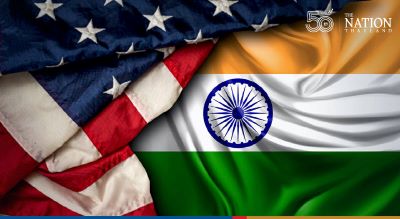
India, Australia discuss Afghanistan crisis after Taliban takeover


India and Australia discuss the prevailing crisis in Afghanistan, maritime security in the Indo-Pacific region and cooperation in multilateral formats on Saturday in New Delhi.

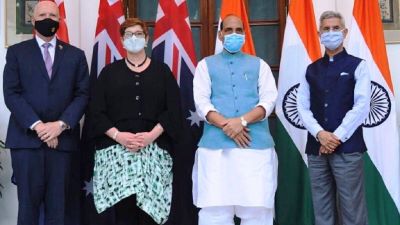
India on Saturday hosted the first-ever 2+2 ministerial dialogue in New Delhi with Australia. Defence Minister Rajnath Singh and External Affairs Minister S. Jaishankar met Australian counterparts — Defence Minister Peter Dutton and Foreign Minister Marise Payne — and discussed the crisis in Afghanistan arising out of the Taliban takeover.

After an in-depth discussion on bilateral and regional issues, Defence Minister Rajnath Singh said that the 2+2 dialogue signifies the importance of the India-Australia Comprehensive Strategic Partnership.

India and Australia share an important partnership that is based on a shared vision of a free, open, inclusive and prosperous Indo-Pacific region. “As two democracies we have a common interest in peace and prosperity of the entire region,” he said.

Singh said, “We have discussed various institutional frameworks for wide-ranging collaboration including defence cooperation and fight against the global pandemic. We exchanged views on Afghanistan, Maritime Security in the Indo-Pacific, cooperation in multilateral formats and other related topics.

During the discussions, both sides emphasised the need to ensure free flow of trade, adherence to international rules and norms and sustainable economic growth in the entire region.

On the bilateral defence cooperation, Singh said that both the countries have decided to expand military engagements across services, facilitate greater defence information sharing and work closely for mutual logistic support.

“In the context of Defence Cooperation, both sides were glad to note continued participation of Australia in the Malabar Exercises. We invited Australia to engage India’s growing defence industry and to collaborate in co-production and co-development of defence equipment,” he said.

The 2+2 dialogue is the outcome of a decision made at the India-Australia leaders’ virtual summit in June 2020 to elevate bilateral relations to a comprehensive strategic partnership. India and Australia admit that diplomatic ties between the two countries are at an all-time high right now.

Published : September 12, 2021

PM agrees on pilot plan to welcome foreign tourists to Phú Quốc starting October #SootinClaimon.Com

#SootinClaimon.Com : ขอบคุณแหล่งข้อมูล : หนังสือพิมพ์ The Nation.

https://www.nationthailand.com/international/40006020

PM agrees on pilot plan to welcome foreign tourists to Phú Quốc starting October


HÀ NỘI — Prime Minister Phạm Minh Chính has agreed in principle with the Ministry of Culture, Sports and Tourisms proposal on a pilot plan to welcome international tourists with vaccine passports to Phú Quốc resort island in the southern province of Kiên Giang for six months from October.

PM agrees on pilot plan to welcome foreign tourists to Phú Quốc starting October

In a document issued on September 10, Deputy PM Vũ Đức Đam on behalf of the PM, asked the provincial People’s Committee to coordinate with the Ministry of Health, the Ministry of Culture, Sports and Tourism and relevant agencies to collect opinions from organisations, associations and businesses in order to develop and issue a specific plan for the implementation.

The Ministry of Health will work with the Ministry of Information and Communications, the Ministry of Public Security and the Ministry of Foreign Affairs in guiding the issuance of certificates of vaccination against COVID-19, and distributing vaccines to swiftly inoculate people living and working in Phú Quốc island city.

The ministries of Culture, Sports and Tourism; Health; Public Security; National Defence; Foreign Affairs; Transport; and Information and Communications and related agencies are required to coordinate with, guide and support the provincial People’s Committee in implementing the plan.

According to a draft pilot scheme, the plan targets foreign tourists who have been fully vaccinated against COVID-19 or those with certificates of recovery from COVID-19 recognised by an authorised agency in Việt Nam.

Eligible tourists should be given their second shots at least 14 days and no more than 12 months before entry. For those who have recovered from COVID-19, the time from hospital discharge to their entry date must not exceed 12 months. Travellers will be requested to take a RT-PCR test within 72 hours prior to their departure, and certified negative for COVID-19 in English by authorities of the country that conduct the test.

The scheme will be applied for visitors who have registered to join package tours of travel agencies.

Some potential markets which also have high vaccination coverage or having COVID-19 outbreaks were listed as selections, such as East Asia, Europe, the US, the Middle East, and Oceanian countries.

General Director of the Việt Nam National Administration of Tourism (VNAT) Nguyễn Trùng Khánh said Phú Quốc needs to speed up the vaccination for its residents, and those that will directly involved in welcoming and serving holiday makers.

Attention should be paid to developing a specific plan for the pilot programme related to medical regulations, immigration procedures, procedures to welcome and serve tourists at accommodation establishments, tourist attractions, and plans for handling medical incidents.

Phú Quốc is one of the eight “green zone” (COVID-19 free) districts and cities of the southern province of Kiên Giang. It has to date recorded five COVID-19 infections which have been successfully treated.

Under the draft plan, Kiên Giang needs to prepare human resources, materials, medical equipment and supplies, strengthen testing capacity, ensure safety plans for disease prevention and settlement of incidents.

It is also supposed to work with the tourism ministry to make a list of businesses, hotels, resorts, accommodation venues and sightseeing destinations that are ready and capable of welcoming international tourists. — VNS

Published : September 12, 2021

3,000 holidaymakers to arrive #SootinClaimon.Com

#SootinClaimon.Com : ขอบคุณแหล่งข้อมูล : หนังสือพิมพ์ The Nation.

https://www.nationthailand.com/international/40006019

3,000 holidaymakers to arrive


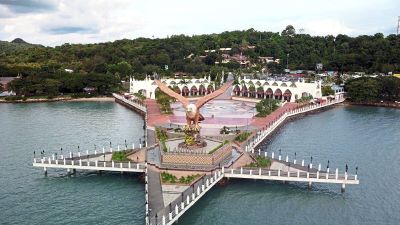
LANGKAWI: The beautiful beaches and duty-free shops here will be under the spotlight come Malaysia Day when some 3,000 fully vaccinated holidaymakers make their way to this island resort under the new tourism bubble plan.

Langkawi Development Authority (Lada) chief executive officer Nasaruddin Abdul Muttalib said to prevent the spread of Covid-19, visitors must strictly adhere to the standard operating procedure and try to avoid crowded places.

“They should come early to prevent overcrowding at the airport or ferry terminals.

“They should also book their hotel or entrance ticket to places of attraction early to avoid a long queue.“Under the new normal, it’s a must for them to practise self-control by following all the standard operating procedures and avoid going to congested places,” he added.

Nasaruddin said the first batch of 3,000 visitors were expected to arrive on the first day by flight and some by sea from the Kuala Perlis ferry terminal.

“There will be 12 flights offered by several airline companies, but coming by boat is only from the Kuala Perlis terminal since the Kuala Kedah jetty has been under enhanced MCO since Monday,” he said when contacted.

Nasaruddin said flights and boat trips to Langkawi might be increased upon demand.

“It is good to start slow, so that tourists and tourism players can get familiarised with the SOP and movement control on the island.

“Local visitors can enjoy Langkawi’s attractions such as the Eagle Square, Langkawi Cable Car, Underwater World Langkawi and Pantai Cenang during their trip to the island,” he added.

Nasaruddin said the reopening of Langkawi was made with careful attention and Lada had sought advice from the state Health Department, the National Security Council, and the Tourism, Arts and Culture Ministry.

Langkawi OCPD Asst Comm Shariman Ashari said tourists should strictly follow the SOP while on the island to prevent any chain of infection from taking root.

“They should practise the new norms, such as wearing face masks and observing physical distancing while visiting Langkawi.

“Comply with the tourism bubble SOP that will be issued in the near future, including obtaining travel permits from the police.

“The police will continue with our SOP compliance operation and will take action against those who violate it,” he added.

ACP Shariman also said police would assign personnel at entry points to Langkawi and would have additional manpower at public places to ensure SOP compliance.

Malindo Air public relations and government affairs director Raja Sa’adi Raja Amrin said there would be six flights from Subang to Langkawi and one from Kuala Lumpur International Airport (KLIA) to Langkawi starting Sept 16.

“Malindo Air does not offer any direct flights from Penang to Langkawi.

“However, passengers may fly to Langkawi from Penang by connecting flights via Subang Airport.

“Malindo Air also offers flights to Langkawi from KLIA,” he said in a statement to The Star.

Raja Sa’adi said the company was positive about the response to Langkawi in line with the travel bubble programme.

He added that for the month of September, an average of 55% of flight tickets to the island had been sold since the programme was announced.

“The company believes the reopening of Langkawi as a travel bubble will be of enormous value to the revival of the hard-hit aviation and tourism industries.

“Everyone in the company has been fully vaccinated to create a safer environment for our staff and customers,” he said.

Tourism, Arts and Culture Minister Datuk Seri Nancy Shukri is expected to visit the island resort on Wednesday to monitor preparations for the reopening.

She said only those who have been fully vaccinated would be allowed to visit Langkawi from Sept 16 onwards.

However, those who come from enhanced MCO areas would not be entitled to the pioneer travel bubble project relaxation.

Published : September 12, 2021

9/11: 20 years on, Chinatown left behind in Manhattan renewal #SootinClaimon.Com

#SootinClaimon.Com : ขอบคุณแหล่งข้อมูล : หนังสือพิมพ์ The Nation.

https://www.nationthailand.com/international/40006018

9/11: 20 years on, Chinatown left behind in Manhattan renewal


Steven Wong was one of the volunteers to enter the World Trade Center site after terrorists attacked it 20 years ago.

Nine years later, the New Yorker was diagnosed with pulmonary fibrosis, an incurable scarring of the lungs, one of the diseases that has been connected to Ground Zero exposure. He also has asthma.

Wong received US$90,000 in compensation for his illness. But “that was nothing”, he said.

Wong said that, because of his lung disease, he was in a weakened state when he became infected with the coronavirus in early March 2020.

READ MORE: Terrorist threats redefined 20 years after 9/11

“My lungs are too fragile to fight against any virus. I’m 66 years old this year. How many years are there left for me?” Wong said.

When American Airlines Flight 11 struck the North Tower of the New York landmark, Wong was on Baxter Street in Chinatown.

“People were screaming, and I heard someone say the World Trade Center exploded, and someone asked, ‘Are they filming a movie?’ It was such a bright sunny day. I saw steel flakes flying in the air everywhere like snowflakes. Those steel flakes were so bright under the sun, they blurred my eyes.”

He said he called his wife as soon as possible and told her “we need to pick up our kids from school, now”.

Then they walked the streets of Chinatown for three hours. “Nothing was there, no cars, nothing,” Wong said.

He remembered that even Confucius Plaza, a building more than a kilometer from the World Trade Center, was covered with a thick layer of black dust. So were the plants outside, and they were dead, he said.

Wong is now the president of the Hotel Chinese American Association and one of the co-founders of a New York-based Asian-American advocacy group, the Coalition of Asian Americans for Civil Rights.

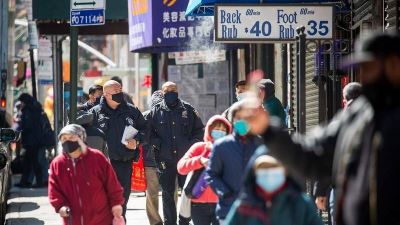
Much of Lower Manhattan has seen a dramatic revival post Sept 11, but Wong said Chinatown hasn’t.

In the first six months, Chinatown’s major businesses lost 60 to 100 percent in their revenue, according to a study by the Asian American Federation of New York.

In the first two weeks after the attacks, three-quarters of Chinatown’s workforce, about 25,000 workers, became unemployed, according to the study, and three months later, nearly 8,000 workers remained unemployed.

While millions of dollars in federal grants and assistance poured into Lower Manhattan for businesses, small businesses in Chinatown received almost one-third less funding than those in other communities, John Wang, the president of the Asian American Business Development Center, told China Daily.

“Many Chinatown businesses trade with cash; they could not show the government good business data to apply for loans or grants,” said Wang.

Wong said a continuing problem in Chinatown since the terror attacks has been a stretch of Park Row. It has historically been a major four-lane artery linking the city’s financial district to Chinatown.

It also hugs the length of the New York Police Department’s headquarters, but it has been closed to civilian traffic since the Sept 11 attacks. The police department asserts that it is necessary to protect its headquarters from a truck bomb attack.

“Before the terrorist attacks, tourist buses could drive into Chinatown from Park Row and parked in the nearby area to wait for their passengers,” Wong said. “There is no parking lot in Chinatown now, nor can the tourist buses come in. The tourism industry in Chinatown has never recovered after the attacks. But Lower Manhattan is full of vigor.”

Published : September 12, 2021

Messages of unity, resolve mark 20th anniversary of 9/11 attacks #SootinClaimon.Com

#SootinClaimon.Com : ขอบคุณแหล่งข้อมูล : หนังสือพิมพ์ The Nation.

https://www.nationthailand.com/international/40006017

Messages of unity, resolve mark 20th anniversary of 9/11 attacks


WASHINGTON – The greatest lesson from the Sept 11, 2001, attacks on the United States was the value of national unity, said President Joe Biden, as the country on Saturday (Sept 11) marked the 20th anniversary of the single largest loss of life from a foreign attack on American soil.

Messages of unity, resolve mark 20th anniversary of 9/11 attacks

“We learnt that unity is the one thing that must never break. Unity is what makes us who we are,” Mr Biden said in his pre-taped video message.

“That is the central lesson… that at our most vulnerable, in the push and pull of all that makes us human, in the battle for the soul of America, unity is our greatest strength,” he said.

“We are unique in the history of the world because we are the only nation based on an idea… that everyone is created equal and should be treated equally throughout their lives. That is the task before us. To once again, lead not just by the example of our power, but by the power of our example.”

Sombre ceremonies in New York City, Arlington in Virginia and Shanksville in Pennsylvania marked the 20th anniversary of the terrorist attacks that killed 2,977 people from 90 nations. 

Mr Biden visited all three sites, starting with New York City, where he was joined by former presidents Bill Clinton and Barack Obama, among others. They held a moment of silence at 8.46am to mark the time the first plane hit. 

In his video message on the eve of the anniversary, Mr Biden said the US witnessed not only heroism, but also “the darker forces of human nature”.

“Fear and anger, resentment and violence against Muslim Americans, true and faithful followers of a peaceful religion. We saw a national unity bend,” he said. 

That day in 2001, 19 militants associated with the Al-Qaeda terrorist group hijacked four commercial airplanes. Two were flown into the Twin Towers of New York’s World Trade Center, which collapsed. A third was flown into the Pentagon in Arlington just outside Washington, DC.

Crew members and passengers on a fourth plane, which was turned to head to the Capitol in Washington DC, fought with the hijackers; the plane crashed in a field near Shanksville.

Several family members of the victims in the attack in New York spoke at the ceremony, their voices often cracking with emotion.

Mr Biden said: “No matter how much time has passed, these commemorations bring everything painfully back.” 

America would also “never stop” hunting down terrorists who sought to harm the nation, he warned.

The event, which reverberated across the world and sparked two wars – with the United States invading Afghanistan in 2001 and Iraq in 2003 – was marked elsewhere too.

Britain’s Queen Elizabeth, in a message to Mr Biden on Saturday, said: “My thoughts and prayers – and those of my family and the entire nation – remain with the victims, survivors and families affected, as well as the first responders and rescue workers called to duty.”

“It reminds me that as we honour those from many nations, faiths and backgrounds who lost their lives, we also pay tribute to the resilience and determination of the communities who joined together to rebuild.”

In Australia, Prime Minister Scott Morrison wrote in an opinion piece: “Sept 11 reminded us that freedom is always fragile.”

“That day was an attack on free peoples everywhere. It was an attack on our way of life and the values of liberal democracy. Despite the pain inflicted on that day, the terrorists ultimately failed in their attempts to crush our resolve and change our way of life.”

French President Emmanuel Macron tweeted: “We will #NeverForget. We will always fight for freedom.”

Indian Prime Minister Narendra Modi said the events of Sep 11, 2001, were “attacks on humanity”.

In an opinion piece in The Straits Times, Singapore Prime Minister Lee Hsien Loong wrote: “Our world changed overnight.”

“We discovered right here among us a terrorist group having a common ideology and direct links with Al-Qaeda in Afghanistan – the Jemaah Islamiah (JI) group.” 

JI’s plans for attacks in Singapore were swiftly disrupted, he noted.

And “in an existential crisis, Singaporeans instinctively pulled together, and responded strongly and cohesively to keep ourselves safe”.

On his Facebook page, Mr Lee wrote: “On the 20th anniversary of 9/11, let us resolve to fortify ourselves so that should we ever face another such test one day, we will come through again, stronger, as one united people.”

In the US, the commemorations have been clouded by the swift return to power in Afghanistan, on the back of a chaotic US withdrawal, of the Taliban – the same regime that gave shelter to the perpetrators of the attacks and has never condemned Al-Qaeda for them.

Mr Lee, on a cautionary note, wrote in ST: “And now that the US has left Afghanistan, we will have to watch closely how the situation there develops, whether groups based in Afghanistan will again threaten our security, and where else new fronts of terrorism may emerge.”

Published : September 12, 2021