ASEAN-Korea Center to present a virtual trip to ASEAN countries
The ASEAN-Korea Center has organized a virtual “ASEAN Familiarization Tour” to enhance the ASEAN-Korea tourism cooperation.
The tour, which lets Korean travel journalists and social media influencers explore tourism destinations in ASEAN member states, moved online last year, when global travel restrictions began. The center produced promotional videos introducing tourism spots and resources in ASEAN countries.
This year, Korean actress and entertainer So Yu-jin and millennials from ASEAN will take online trips to four ASEAN countries — Brunei, Indonesia, Myanmar and Vietnam.
Ulu Temburong National Park in Temburong, Brunei (ASEAN-Korea Center)
The tour, which lets Korean travel journalists and social media influencers explore tourism destinations in ASEAN member states, moved online last year, when global travel restrictions began. The center produced promotional videos introducing tourism spots and resources in ASEAN countries.
This year, Korean actress and entertainer So Yu-jin and millennials from ASEAN will take online trips to four ASEAN countries — Brunei, Indonesia, Myanmar and Vietnam.
Phu Quoc, Vietnam (ASEAN-Korea Center)The first episode which was released on Aug. 31 introduces Brunei’s tourist attractions that have not been widely explored by Korean tourists – the Temburong region, the Amazon of ASEAN, and a wide variety of activities that can be enjoyed in Brunei, ranging from jungle hiking to scuba diving.
The second episode shows highlights of Indonesia, with contrasts between the country’s present and future — Jakarta, the current capital and new mecca of modern art, and Balikpapan, the city in the jungle announced as the new capital; a surfer’s paradise and Bali; Indonesia’s soul food chosen as the World’s Best Food by CNN, rendang and nasi goreng.
Inle Lake, Myanmar (ASEAN-Korea Center)On Sept. 8, the third episode will be released that looks into the lives of the people of Myanmar: the influence of Buddhism on the lives of its people found in golden Shwedagon Pagoda and Bagan City, the largest Buddhist pilgrimage site in Myanmar; locals’ traditional way of life at Inle Lake, a UNESCO Biosphere Reserve, and the country’s cuisine.
The final episode offers virtual travel to various regions and mouth-watering foods of Vietnam, one of the most frequently visited ASEAN countries by Korean travelers: Vietnamese dishes familiar to Koreans such as pho, banh mi, and banh xeo, as well as Hue royal cuisine, the highlight of Vietnam’s food heritage; Hoi An, a UNESCO World Heritage Site where East meets West; and regions where one can enjoy the country’s natural wonders — Tam Coc, Trang An, Dong Van Plateau, Phu Quoc, and Nha Trang.
Nusa Penida, an island southeast of Bali, Indonesia (ASEAN-Korea Center)
The ASEAN Familiarization Tour 2021 videos are available on the official YouTube channels of the Center and ASEAN tourism agencies.
HarperCollins presents startling new investigation of Gandhi’s assassination
“Arguably modern India’s biggest political development, the assassination of Mahatma Gandhi finds a desultory mention in our history textbooks,” the authors, Appu Esthose Suresh and Priyanka Kotamraju, say.
“The Murderer, the Monarch and the Fakir” is a fresh account of one of the most controversial political assassinations in contemporary history – of Mahatma Gandhi.
Based on previously unseen intelligence reports and police records, the book, to be released by HarperCollins on October 1 recreates the circumstances of his murder, the events leading up to it and the investigation afterwards. In doing so, it unearths a conspiracy that runs far deeper than a hate crime and challenges the popular narrative about the assassination that has persisted for the past 70 years.
“The Murderer, the Monarch and the Fakir” examines the potential role of princely states, hyper-masculinity and a militant right-wing in the context of a nation that had just won her independence. It relies on investigative journalism and new evidence set in a strong academic framework to unpack the significance of this tumultuous event.
“Arguably modern India’s biggest political development, the assassination of Mahatma Gandhi finds a desultory mention in our history textbooks,” the authors, Appu Esthose Suresh and Priyanka Kotamraju, say.
“This book presents new evidence that goes against popular narratives and unearths a conspiracy which ran much deeper, with an extraordinary cast of people representing varied interests directly or indirectly involved in it. This holds relevance today as in recent years, we have become preoccupied with either vigorously opposing or enthusiastically supporting the rehabilitation of central figures of the conspiracy, whereas our real aim should be the rehabilitation, critically and empathetically, of Gandhian thought.
“This book is an attempt to understand the political assassination in the context of new evidence to unpack its significance for our present and future,” the authors add.
Swati Chopra, Executive Editor, HarperCollins India, says: “Mahatma Gandhi’s assassination was a cataclysmic event for a newly independent nation, the resonances of which remain till today. Appu Esthose Suresh and Priyanka Kotamraju mine fresh sources to uncover startling, and hitherto unknown, facts about the heinous conspiracy to kill the Mahatma. At a time when India is celebrating her seventy-fifth year of independence, it is imperative that we try and uncover more of the truth behind the murder of one of the country’s foremost founding fathers. It may hold crucial insights we need to navigate our present, and our future.”
As an investigative journalist, Appu Esthose Suresh did extensive work on the changing pattern of communal riots in India, making a significant contribution towards understanding a sensitive and complex topic. Appu was recognized by the Mumbai Press Club’s 2015 RedInk Awards in the ‘Journalist of the Year’ category for his series on the ‘Communal Cauldron in Uttar Pradesh’. He has worked with the Hindustan Times as Editor (Special Assignments), and at the Indian Express and Mint, among other publications. He was part of the International Consortium of Investigative Journalists (ICIJ) team that investigated offshore accounts in British Virgin Islands and the HSBC Swiss accounts.
Appu is currently Senior Atlantic Fellow at the International Inequalities Institute, London School of Economics & Political Science (LSE). He is also the founder of Pixstory. He completed his studies from St. Stephen’s College, New Delhi, and LSE.
Priyanka Kotamraju is a Gates Cambridge scholar pursuing a doctorate in sociology at the University of Cambridge, and a Senior Atlantic Fellow at the International Inequalities Institute at LSE. She was formerly editor of Khabar Lahariya, an award-winning grassroots media organization. She has also worked with the Indian Express and the Hindu Business Line. She is the co-founder of Chitrakoot Collective, a grassroots feminist research collective.
CBM: Exporters to sell export earnings in their accounts in four months after their entry into bank
Central Bank of Myanmar issued a statement dated September 3 saying that exporters must sell their balance income within four months after the earnings they have received with current market price.
It stated that the earnings in foreign currency from export which entered their bank accounts must be sold in four months after the entry to the licensed banks with current market price without fail.
It comes into effect on the day of the announcement. The announcement was issued under the foreign Exchange Management Law, 49 (c), the CBM stated.
According to Foreign Exchange Management Law section 38 (b), 42 (a) and 35, all earnings in foreign currency received in the course of exports must be deposited in respective local bank accounts within a limited time frame after the goods have been loaded and shipped.
China on Friday donated COVID-19 vaccines and anti-pandemic supplies to Myanmar to help the country fight local outbreaks, officials said.
The donated COVID-19 vaccines are made by domestic drugmaker Sinopharm, and other supplies include respirators, oxygenators, testing kits, protective masks and clothing.
An online handover ceremony was held on Friday, attended by Chinese officials from the Ministry of Foreign Affairs, China International Development Cooperation Agency, Yunnan provincial and local governments, health officials and diplomats from Myanmar, as well as officials from the Association of Southeast Asian Nations.
Chen Hai, Chinese ambassador to Myanmar, said during the event that the donation reflects that China puts great emphasis on the bilateral cooperation with Myanmar in virus control efforts, as well as the role of ASEAN.
The donations have been sent to Myanmar’s border areas from several regions in Yunnan that share a long border.
Thet Khaing Win, Myanmar’s minister for health and sports, thanked the Chinese government and Yunnan province for assisting the country in combating the pandemic and expressed a conviction it could win the battle with help from China.
China’s Foreign Ministry spokesman Wang Wenbin told a daily news conference on Friday that the donation is a concrete measure to implement President Xi Jinping’s commitment of making Chinese vaccines a global public good and demonstrates the solidarity between the two countries.
Chen added that since the third wave of COVID-19 outbreaks hit Myanmar, China has provided 8.6 million vaccine doses to the country, including 3.9 million given as donations.
He added that China will continue to assist Myanmar in purchasing Chinese vaccines and realizing the goal of vaccinating 50 percent of its population by the end of this year.
In a separate development, the Red Cross Society of China said on Thursday that it has donated 1.6 million COVID-19 vaccine doses to 12 neighboring or African countries.
The society has also gifted $1 million in cash and anti-epidemic materials worth 4.13 million yuan ($640,000) to India via the International Federation of Red Cross and Red Crescent Societies.
Another batch of anti-virus materials worth 3.99 million yuan was also donated by the society to Nepal.
The society said that it has been expanding international cooperation aimed at fighting the virus.
Potential Suga successors begin setting board for own LDP presidential bids
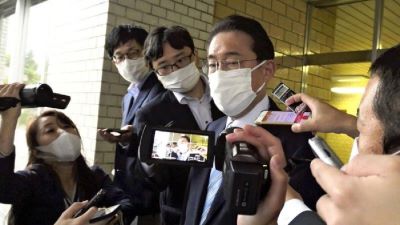
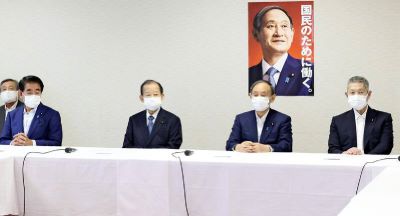
One day after Prime Minister and Liberal Democratic Party President Yoshihide Suga expressed his intention to not run in the upcoming LDP presidential election, prospective successors have begun quietly making their own inroads toward control of the ruling party’s top seat.
Fumio Kishida, 64, has already announced his intent to run in the election, which is scheduled to kick off on Sept. 17 with voting and ballot-counting on Sept. 29. A former chairman of the LDP Policy Research Council, Kishida took to the airwaves to step up his policy messaging on Saturday.
But with Taro Kono, 58, minister in charge of administrative and regulatory reform, still making preparations to announce his candidacy, and Shigeru Ishiba, 64, former LDP secretary general, still debating whether to toss his hat into the ring, the landscape surrounding the LDP presidential election remains uncertain.
Appearing on a YTV program Saturday, Kishida said he was “quite surprised” by Suga’s decision to bow out of the election, adding that “I would like to continue moving steadily forward toward the upcoming presidential election.”
On the subject of economic measures under the coronavirus pandemic, Kishida said, “Bold fiscal spending will be necessary.” Stating that he “was not considering touching consumption tax,” Kishida indicated that the measures would be financed with deficit-covering government bonds, to avoid another consumption tax hike.
The abruptness of the incumbent prime minister’s withdrawal from the upcoming party election has triggered an unusual domino effect.
On Aug. 26, when the schedule for the election was decided, Kishida announced his intent to run in the race as a rival candidate to Suga.
Kishida had been believed to have an edge over Suga, who has been navigating choppy waters within his party. However, Suga’s decision not to seek re-election has dramatically changed the election calculus, with rumors that even more candidates could join the fray.
“If we don’t change our strategy, Kishida will not be able to make himself stand out,” said one mid-level official within the Kishida faction.
Kono evidently spent Saturday morning drumming up support, calling LDP lawmakers from the House of Representatives dormitory in Tokyo’s Akasaka district.
Suga has suggested that he would back Kono, essentially positioning Kono as a de-facto successor. However, as the vaccine czar, Kono is in charge of the current administration’s highest-priority issue.
An aide close to Kono said: “If Kono stands out too soon after Suga’s announcement, it could invite a negative impression.” For that reason, Kono will have to keep his finger on the pulse of the other party members and wait for the right moment to officially announce his candidacy.
Ishiba will likely take the weekend to weigh whether or not to run in the race. He seems to have spent time analyzing the current situation and other issues Saturday morning at the Akasaka dormitory.
Former Internal Affairs and Communications Minister Sanae Takaichi, 60, also has her eye on the presidency.
China law requiring notice from vessels concerning, says top US Coast Guard exec
MANILA, Philippines—A top US Coast Guard (USCG) official on Friday (Sept. 3) expressed concern over China’s new maritime law requiring foreign vessels to give notice before entering waters covered by China’s fictitious nine-dash line claim.
Vice Admiral Michael McAllister, commander of the USCG’s Pacific Area and Coast Guard Defense Force West, said the law “seems to run directly counter to international agreements and norms.”
“If our reading is correct, these are very concerning, and that’s because they begin to build foundations for instability and potential conflicts if those are enforced,” McAllister said in a teleconference.
China announced that beginning Wednesday, it will require foreign vessels “to report their detailed information” in areas that are part of its territorial waters.
The law would require notice for entry of non-Chinese vessels that included submersibles, nuclear vessels, ships carrying radioactive materials and ships carrying bulk oil, chemicals, liquefied gas and other toxic and harmful substances.
The extent of coverage of “territorial waters” was unclear, however, as China claims nearly the entire South China Sea as its territory through its nine-dash line fiction.
McAllister said USCG presence in the region was in part to show support to partners and allies facing China’s aggression and territorial expansion at sea.
He said the United States would continue to work with partners and allies with the goal of being the partner of coast guards in the region.
“Half the world’s commerce and half the world’s population are in the Indo-Pacific; and as leaders in maritime safety and security, we believe we have a role to play,” McAllister said. “And our chief role is to try to contribute to regional stability and security,” he said.
Early this week, the USCG cutter Munro held exercises with the Philippine Coast Guard in the West Philippine Sea, part of the South China Sea within the Philippines’ exclusive economic zone.
The American ship arrived in the Western Pacific in mid-August and is under the command of the US Navy’s 7th Fleet in the coming months.
“We build and leverage partnerships to enhance the capability and capacity of partner nations to carry out missions that contribute to the common good, things like search-and-rescue, marine environmental protection, enforcing fisheries laws and treaties, addressing human smuggling, counter-drug, counterterrorism, disaster response, and others,” McAllister said.
Philippine Airlines struggles to survive in pandemic
MANILA, Philippines — Philippine Airlines (PAL) formalized an anticipated creditor protection plea in the United States — a move its owner, billionaire Lucio Tan, called a “major breakthrough” in the 80-year-old carrier’s battle to survive the pandemic.
PAL announced on Saturday the filing of a Chapter 11 bankruptcy petition in the Southern District of New York which would pave the way for the elimination of $2.1 billion in aircraft related debts and obligations.
The airline assured the public that flights would not be interrupted and all valid tickets, vouchers, benefits and mileage rewards would be honored.
It also committed to build up its flight operations and continue crucial vaccine deliveries and repatriation flights for stranded Filipinos around the world.
Corporate reorganization
PAL said it intended to maintain business continuity, especially for its employees, customers, suppliers, commercial partners, and local communities. Passenger and cargo flights will continue, subject to travel restrictions, it said.
Once approved by the US court, the petition would protect the airline’s assets, such as planes and equipment from being seized and sold. PAL said it was voluntary and prearranged with creditors and lessors, many of whom were international companies and major local banks.
Chapter 11 of the US Bankruptcy Code is a globally recognized and proven measure for corporate reorganization. It has been used by international carriers, such as Chile’s LATAM Airlines and Colombia’s Avianca.
Fleet reduction, job cuts
Wider in scope than PAL’s rehabilitation program filed in the aftermath of the 1997 Asian financial crisis, the plea is a key piece in a sprawling restructuring plan that requires sizeable fleet cutbacks, debt forgiveness, and billions of pesos in fresh capital.
“We are grateful to our lenders, aviation partners and other creditors for supporting the plan, which empowers PAL to overcome the unprecedented impact of the global pandemic that has significantly disrupted businesses in all sectors, especially aviation and emerge stronger for the long term,” Tan said in a statement on Saturday.
A parallel filing would also be made in the Philippines under the Financial Insolvency and Rehabilitation Act of 2010, PAL said.
PAL will also return 21 planes that were no longer needed for its revised long-term business plan.
It was unclear whether the fleet reduction, representing over 20 percent of PAL’s 95 aircraft, would lead to further job cuts.
The carrier removed 2,300 jobs, or 30 percent of its workforce, last March, joining other airlines that reduced manpower to lower costs given the pandemic-induced slowdown.
Chance for ‘reset’
Aviation and banking sources told the Inquirer these steps would give the flag carrier the opportunity to “reset” and retool its business for the future.
They also agreed the airline’s near-term recovery was dependent on counterpandemic efforts and would test the commitment of the Tan family in supporting PAL through continued losses.
“It all depends on how much financial ‘rope’ Lucio Tan is willing to provide,” Avelino Zapanta, PAL’s president during the carrier’s 1999 rehabilitation, told the Inquirer.
“Even until next year, I don’t see normalization for airlines happening,” he added.
While the global health crisis worsened PAL’s financial woes, forcing the flag carrier to suspend debt payments as early as April last year, signs of trouble were long-brewing for the airline.
After Tan regained full control of PAL in 2014, ending a two-year alliance with conglomerate San Miguel Corp., it pursued a new strategy to expand its international network, modernize its fleet and achieve a coveted five-star status by 2020.
When it retired old planes and introduced next-generation Airbus A350-900s, the airline opened nonstop flights from Manila to New York and appeared unstoppable in its mission to connect the Philippines to more global gateways.
Losses since 2016
But financial losses began gradually mounting in 2016 and by 2019, PAL Holdings Inc., its parent company, had accumulated P22.9 billion in losses.
PAL Holdings lost a staggering P71.8 billion in 2020 alone after flights were disrupted by recurring quarantines.
A year earlier, the company’s plans were thrown into disarray due to abrupt management changes, culminating in the surprise retirement of Jaime Bautista, PAL’s longtime president.
The Inquirer learned that current PAL president Gilbert Santa Maria personally flew to New York for the filing of the Chapter 11 plea.
In the statement, Santa Maria thanked PAL’s employees around the world for continuing to deliver “the highest quality of service through these trying times.”
“Following the recent celebration of our 80th anniversary, we move forward with renewed confidence, as today’s actions enable us to continue serving our customers and the Philippine economy long into the future,” he said.
PAL said Tan’s group, as majority shareholder, will infuse $505 million in equity and debt financing while another $150 million in debt was required from global private investors for “postrestructuring” activities.
The rehabilitation filing showed that PAL’s five largest secured claimants, or those whose loans were tied to collateral, such as planes and engines, were owed a total of $866 million.
These included local banks, such as Tan’s Philippine National Bank, or PNB ($156.5 million) and the Sy family’s BDO Unibank Inc. ($80.42 million) and China Banking Corp. ($54.83 million).
Claims worth $1.4B
The airline’s top 40 creditors have unsecured claims worth over $1.4 billion.
They include dozens of international aircraft lessors, local banks, maintenance companies, and even government agencies, such as the Manila International Airport Authority (MIAA) and Civil Aviation Authority of the Philippines (CAAP).
The top unsecured bank lenders were PNB ($115.9 million), Asia United Bank ($75.3 million), China Banking ($65.27 million), and Union Bank of the Philippines ($20.1 million).
Tan’s own Buona Sorte Holdings was the largest unsecured creditor with $358.28 million while the CAAP and MIAA were owed $8.65 million and $21.7 million in regulatory fees.
Sri Lankan extremist shot dead after stabbing attack at New Zealand supermarket
PM says man was “a known threat to New Zealand”
Police in New Zealand shot and killed a “violent extremist” after he stabbed and wounded at least six people in an Auckland supermarket on Friday. New Zealand Prime Minister Jacinda Ardern said the incident was a “terrorist attack” carried out by a Sri Lankan national who was under police surveillance.
The man, who has not been identified, was a supporter of the Islamic State (IS) terrorist group, Ardern said.
Police killed the man within 60 seconds of the attack.
“What happened today was despicable, it was hateful, it was wrong,” Ardern said in a news conference. “It was carried out by an individual, not a faith.”
“Of the six wounded people, three are in a critical condition and one is in a serious condition”, health officials said.
A St John spokesperson told 1 NEWS five ambulances and three rapid response units were called to the scene at 2.40pm. “Police deliberately distracted the man to get his attention, who in turn charged at the officers. It is understood the officers then shot him.” he said. At a press conference Friday, Jacinda Ardern went on to say that the man was “a known threat to New Zealand”.
Ardern said the man was a Sri Lankan national who arrived in New Zealand in October 2011 but became a person of interest from 2016.
He was inspired by ISIS, Ardern said, and had a violent ideology.
The reasons he is known to agencies is subject to court suppression orders, but the Prime Minister said it was her view that it was in the public interest to share as much information as possible.
By law, he was not able to be kept in prison.
Police Commissioner Andrew Coster provided more detail, saying the man was “under heavy surveillance over concerns about his ideology”.
He travelled from Glen Eden to New Lynn closely watched by surveillance teams and tactical teams.
“When the commotion started, two police tactical operators moved to the scene and engaged him. When he approached with a knife he was shot and killed.
“The reality is when you are surveilling someone over 24 hour periods its not possible to be close to him all the time,” Coster said.
Ardern said there will be “multiple inquiries” into the incident.
Coster said police were unaware of any intent of Friday’s terrorist attack nor the extent of it.
“Based on our surveillance what we could tell is that he was undertaking what appeared to be a normal shopping expedition.
“However clearly we have been concerned about his ideology and that’s why he was under surveillance and with a company of tactical teams.
Coster said the man had been very “surveillance conscious and surveillance teams working with an offender over an extended period of weeks need to maintain sufficient distance for that surveillance to remain effective.
He said teams were “as close as possibly could be without compromising the surveillance operation”.
Ardern says suppression orders are in place over the man’s criminal history but says she’s preparing a timeline over “the man’s interactions with agencies and the law”.
“I think it’s in everyone’s best interest” to share that with you, Ardern said.
She said she was confident the man was a lone-wolf offender. She said he was known to “multiple agencies” and was “personally aware of him”.
WeChat, a dominating instant message platform of Chinese tech company Tencent Holdings, is set to offer paid cloud storage services in China that directly rivals iCloud business of United States tech giant Apple Inc, sources told China Daily.
The new business will enable WeChat users to back up their chat records, be it words, photos and videos, on the cloud so that they can recover data whenever they want.
WeChat now only supports personal data storage on equipment like smartphones and computers, meaning that if users lose their equipment, they cannot get their data back.
One source told China Daily that WeChat is prepared to charge users on a yearly basis for such services. The price is likely to be around 180 yuan (US$27.86) per year for iOS system users and 130 yuan for Android system users.
It will be a sizeable source of revenue for Tencent even if only 10 percent of WeChat users pay for such services, the source said. WeChat now boasts an astonishing 1.25 billion monthly active users worldwide, according to Tencent’s second quarter fiscal report.
Market consultancy iiMedia found that the country saw rising personal cloud storage demand over the past years, and the number of users is estimated to exceed 400 million by the end of last year.
Another source who is familiar with the matter confirmed that Tencent has been aggressively pushing forward the new project and has “entered into the final stage” to launch it. “But the company still has to deal with Apple as the function has to be renewed on the iOS system,” the person said.
Tencent’s latest move will directly rival iCloud services of Apple Inc. Apple’s services, which include paid iCloud storage, Apple Arcade, Apple TV+, Apple Music and AppleCare, reported the segment grew by 33 percent to a new record high worldwide in the third fiscal quarter of 2021.
Apple currently offers Chinese users 5 GB, or gigabytes, of free cloud storage. Users from China have to pay 6 yuan and 21 yuan for an extra storage of 50 GB and 200 GB, and 68 yuan for a maximum storage of 2 terabytes.
Japans Prime Minister Yoshihide Suga announced Friday that he will not seek reelection as president of the Liberal Democratic Party.
During an extraordinary meeting of LDP executives, Suga, who currently serves as the ruling party’s president, expressed his intention not to run in the Sept. 29 party leadership election, for which official campaigning will kick off on Sept. 17. With Suga’s decision, his Cabinet is set to end a little over a year after it was launched on Sept. 16 last year.
Suga had repeatedly said he would seek reelection for the LDP presidency. However, he apparently came to think it would be difficult to win the election after his government’s handling of the novel coronavirus pandemic and his abrupt plan to reshuffle LDP executives sparked criticism among party members.
With Suga’s exit, the upcoming LDP election will now be held in a different political landscape.
“Once the official campaigning for the presidential election starts, enormous energy will be needed when I consider measures against the coronavirus and election activities. Both matters can’t be handled at the same time,” Suga told reporters at the Prime Minister’s Office on Friday afternoon. “I should choose one, and I want to commit myself to fulfilling [my duty as the prime minister] to prevent the spread of the virus.”
Suga plans to hold a press conference next week to explain his reasons for not running in the election. He will not carry out a reshuffle of LDP executives, which had been planned for Monday.
Fumio Kishida, a former chairperson of the LDP’s Policy Research Council, has announced his plan to run in the LDP presidential election, which will be held as Suga’s term as party president is set to expire at the end of September. Kishida has called for LDP reform, garnering support from party members. As Suga was increasingly viewed as unlikely to win, he came up with a plan to replace LDP executives, including Secretary General Toshihiro Nikai.
However, such an unusual reshuffle just before the presidential election was met with criticism from LDP members, with some saying that Suga’s move was intended merely to “prolong his life” as prime minister and LDP president.
Regarding the next House of Representatives election, Suga had remained undecided on whether to dissolve the lower house or hold the election when the term for the chamber’s members expires, an option that does not involve Diet dissolution. Such circumstances appear to be behind Suga’s decision to step down as prime minister when his term for the LDP presidency expires.
In September last year, Suga overwhelmingly defeated Kishida and Shigeru Ishiba, a former LDP secretary general, in a presidential race to choose the successor to former Prime Minister Shinzo Abe, who stepped down from the post due to the worsening of his chronic disease. Suga’s Cabinet initially saw high approval ratings, but its response to the pandemic drew criticism, dragging the ratings down.
The LDP then suffered a series of losses in major national and local elections. In August, Hachiro Okonogi, a former chairperson of the National Public Safety Commission who was backed by Suga, lost to a candidate supported by opposition parties in the Yokohama mayoral election. LDP members were increasingly concerned that the party would not be able to win the lower house election under the leadership of Suga.
The LDP presidential election will be held as currently scheduled. In addition to Kishida, former Internal Affairs and Communications Minister Sanae Takaichi has also expressed her desire to seek the party presidency.
“I will state my intentions again after confirming the current situation, but my intention regarding the presidential election has remained unchanged,” Kishida said.
On Friday morning, the LDP held a meeting of its Party Presidential Election Administration Committee, which is chaired by Takeshi Noda, a former internal affairs minister, at the party’s headquarters. The committee decided to not allow election candidates to canvass in regional areas in an official party capacity.
A newly elected LDP president will decide the schedule for the lower house election. As the new leader needs to be nominated as prime minister in the Diet and form a cabinet after the LDP presidential race, the lower house election is expected to be held after the term of the chamber’s members expires on Oct. 21.

 Ulu Temburong National Park in Temburong, Brunei (ASEAN-Korea Center)
 Phu Quoc, Vietnam (ASEAN-Korea Center)The first episode which was released on Aug. 31 introduces Brunei’s tourist attractions that have not been widely explored by Korean tourists – the Temburong region, the Amazon of ASEAN, and a wide variety of activities that can be enjoyed in Brunei, ranging from jungle hiking to scuba diving.
 Inle Lake, Myanmar (ASEAN-Korea Center)On Sept. 8, the third episode will be released that looks into the lives of the people of Myanmar: the influence of Buddhism on the lives of its people found in golden Shwedagon Pagoda and Bagan City, the largest Buddhist pilgrimage site in Myanmar; locals’ traditional way of life at Inle Lake, a UNESCO Biosphere Reserve, and the country’s cuisine.
 Nusa Penida, an island southeast of Bali, Indonesia (ASEAN-Korea Center)