[Weekender] Why is Kim Jong-un clamping down on millennials, K-pop and slang? #SootinClaimon.Com

#SootinClaimon.Com : ขอบคุณแหล่งข้อมูล : หนังสือพิมพ์ The Nation.

https://www.nationthailand.com/international/40003392

[Weekender] Why is Kim Jong-un clamping down on millennials, K-pop and slang?


North Korean leader Kim Jong-un has a new concern: how to control the country’s younger generation.
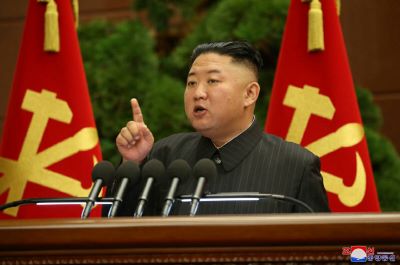
The 37-year-old leader warned in April that “a serious change” was taking place in the “ideological and mental state” of young North Koreans, and that their ideological education was vital to the survival of the party and the country.

Furthermore, the reclusive regime has been cracking down hard on the attire, speaking habits and culture of North Korean millennials, also known as the Jangmadang Generation — people in their 20s and 30s who grew up during the country’s famine in the mid-1990s.

For example, South Korean practices such as a woman calling her husband “oppa” — which means “older brother” but is often used to refer to a boyfriend or spouse — are prohibited. So are South Korean-style clothing and public displays of affection, such as hugging on the street, the South’s spy agency said last week.

Recently, Kim also labeled K-pop a “vicious cancer” and said it was corrupting young North Koreans’ “attire, hairstyles, speeches and behaviors,” according to the New York Times. The leader also enacted a sweeping new law mandating stiff punishment for people who consume or smuggle in South Korean entertainment, which can include imprisonment or even execution.

The clampdown against what the North calls “anti-socialist acts” appears to reflect concern that if the younger generation — which has experienced capitalism and foreign culture — goes unchecked, it could create cracks in the regime’s legitimacy and potentially jeopardize Kim’s dynastic grip on the country, observers say.

“Korean dramas and films have entered the country and the young North Korean generation is influenced by them, such as fashion styles and the way they talk,” said Cheong Seong-chang, director of the Center for North Korean Studies at the Sejong Institute. “Such transformation is visible in the country and Kim sees this could threaten the North Korean system.”

“Kim, who was educated in Switzerland, is well aware that K-pop or Western culture could easily permeate into the younger generation and have a negative impact on its socialist system,” said Yang Moo-jin, a professor at the University of North Korea Studies. “He knows that these cultural aspects could impose a burden on the system. So by stamping them out, Kim is trying to prevent further troubles in the future.” 

Jangmadang Generation: A force for change

A “jangmadang,” which literally translates to “marketplace,” is a kind of black market that sprang up during the country’s devastating famine of the 1990s. The market stalls became a core part of the North’s economic system, where people led double lives between official state jobs and selling imported foods and other goods to make a living.

North Koreans who were born in the 1980s and 1990s grew up during the famine, relying on these markets for survival, making them known as the Jangmadang Generation. Accounting for around 15 percent of the North’s 25 million people, this generation was exposed to capitalism from a young age, buying food and other goods at the black market rather than standing in line for rations like their parents and grandparents.

Having grown up amid economic uncertainty and in the absence of state rationing, this demographic tends to be individualistic and is more concerned with making money than sticking to ideology, according to the National Intelligence Service. They are largely indifferent to politics and lack a sense of allegiance to Kim Jong-un or the regime.

This generation grew up secretly watching South Korean drama series and listening to K-pop smuggled in on flash drives from China. The glitzy TV dramas gave them a glimpse of life south of the border, convincing them the North was not the socialist paradise they had been taught to believe it was. Some defectors who have settled in South Korea have said it was South Korean dramas that motivated them to risk their lives by crossing one of the world’s most heavily fortified borders.

According to a survey of 116 North Korean defectors published last year by Seoul National University’s Institute for Peace and Unification Studies, 47.4 percent said they had frequently consumed South Korean TV programs, dramas, films and songs when they were in the North, while 44 percent said they had consumed them only once or twice. Only 8.6 percent said they had never consumed them.

Concerned with the far-reaching influence of K-drama and K-pop, in December Kim Jong-un enacted the Law on the Elimination of Reactionary Thought and Culture. Under it, those caught in possession of South Korean materials can face 15 years in prison — up from the previous penalty of five years — while those caught distributing it can face the death penalty, according to Rep. Ha Tae-keung, who was briefed by the spy agency.

In May, the country’s official media outlet warned its citizens about the inflow of “capitalistic culture,” saying if it were not restrained, the country could “collapse like a damp wall.”

The paper also warned young people against following the “exotic and decadent lifestyle” of capitalism.

With the generational shift apparent in the North’s top echelon, Kim, who is still in his 30s, views his peers’ ideology with alarm considering that they too will take on more important roles in the near future.

“As seen in the latest Cabinet reshuffle, the age of officials became younger, with people in their 40s to 50s taking the majority. The elite business class also got younger,” said Cheong. “The rise of a younger class could contribute to the country’s economy, but Kim is concerned that it could also weaken their loyalty to the regime.”

Desperate times, tighter control

Tight ideological control and efforts to stamp out foreign culture are nothing new in the totalitarian state led by third-generation leader Kim. But as the North braces for an even more serious food crisis and worse economic hardship amid the pandemic, Kim is looking inward. Through the crackdown, he seeks to secure his grip on power and reinforce internal solidarity.

The isolated nation is said to be facing one of the worst economic situations since Kim took power in 2011. The COVID-19 pandemic forced the North to shut down the border with its largest trade partner, China, causing trade to plummet. Kim also made the rare admission that his country faces food shortages, due to the pandemic and last year’s flooding, which wreaked havoc on its farming sector.

The North also blames the drawn-out UN sanctions, imposed in response to the country’s nuclear weapons program, for its deepening economic crisis.

“With the North facing the ‘triple whammy’ of COVID-19, international sanctions and natural disasters, Kim fears that the younger generation could question and challenge the regime if he doesn’t tighten control,” said Park Won-gon, a professor of North Korean studies at Ewha Womans University.

He stressed that the younger generation, which experienced the market economy and some prosperity while growing up, will feel even more disappointed by the regime’s failure to address the challenges. They are the ones who also witnessed Kim Jong-un meet US President Donald Trump in Singapore and Vietnam and thought changes were happening.

But despite Kim’s high-stakes summitry with Trump in 2018, the nuclear talks collapsed as the two sides failed to agree on details of how sanctions should be lifted in return for steps toward denuclearization.

Published : July 18, 2021

By : The Korea Herald / ANN
India is working to develop counter-drone technology : Amit Shah #SootinClaimon.Com

#SootinClaimon.Com : ขอบคุณแหล่งข้อมูล : หนังสือพิมพ์ The Nation.

https://www.nationthailand.com/international/40003391

India is working to develop counter-drone technology : Amit Shah


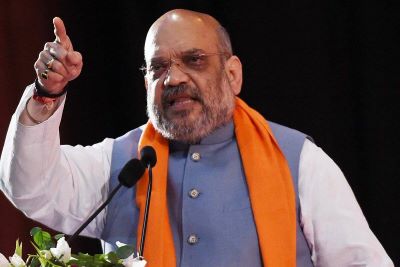
In the wake of India falling victim to drone attacks recently, the Union Home minister Amit Shah has assured that  Defence Research and Development Organisation (DRDO) and other agencies are working together to develop an indigenous counter-drone technology which will be available soon.

The announcement comes days after the Jammu Air Base was attacked last month, on June 27, where explosions were caused using drones. The incident had left two Indian Air Force personnel with injuries. The incident triggered worries among India’s security agencies as the airport where the explosion took place, around 14 km from the border with Pakistan.

The attack took place around 2 am. Sources revealed that drones have since been repeatedly spotted hovering over military installations in the region and over 250 drones have been sighted along the border with Pakistan since 2019.

Noting that smuggling of drugs, arms, and explosives through tunnels and drones is a major challenge, Shah said it is very important for us to deal with these challenges at the earliest.

“DRDO is working to develop anti-drone ‘swadeshi’ (indigenous) technology to get over this new danger. We have given all support to anti-drone research and development projects. I am confident that we will soon improve anti-drone technology,” Shah said while addressing the 18th Border Security Force (BSF) Investiture Ceremony.

Shah, recognising how artificial intelligence can be put to use by groups across the borders to target India, assured the country is working on developing such AI technologies that will soon defeat such drone attacks.

The Home minister reminded top security officers at the investiture ceremony that it is their responsibility to find new technology with the help of experts to help India deal with the threat of the use of AI and robotics technology by enemies and terrorists.

Intelligence Bureau chief Arvinda Kumar, Research and Analysis Wing head Samant Goel, BSF Director General Rakesh Asthana and heads of other central police forces attended the ceremony. Shah made it clear that “India wants peace but security policy is clear to give an answer in the same language as the enemy understands”. There have been reports over the past two years of Pakistan using drones to drop weapons across the border.

The first incident took place in August 2019 in Punjab when a crashed drone was found in a village in Amritsar. In September, terrorists arrested by security forces allegedly revealed that drugs and weapons were dropped in Punjab in eight drone sorties.

On June 20 last year, the BSF shot down a suspected spy drone in the Kathua district of Jammu. The very next month, a network of tunnels from across the border was revealed in Jammu.

In September, the Jammu and Kashmir police found weapons dropped from drones at a village in Akhnoor, also in Jammu. Three militants who had received weapons through such drops were arrested.

“I have complete faith in our paramilitary forces. Under Prime Minister Narendra Modi, we have an independent defence policy, which warned those challenging our sovereignty of response in the same language.”

Shah while paying tribute to the BSF and other paramilitary forces, said “I salute those who have made supreme sacrifice. India is strengthening its position on the world map. These brave hearts and warriors cannot be forgotten. India has a place of pride on the world map due to BSF and our paramilitary forces who are protecting our borders.”

According to a statement issued by the BSF, 27 BSF personnel are being awarded including 14 police medals for gallantry and 13 police medals for meritorious services.

Published : July 18, 2021

By : The Statesman / ANN

China launches pilot zone to develop wine in Gobi Desert #SootinClaimon.Com

#SootinClaimon.Com : ขอบคุณแหล่งข้อมูล : หนังสือพิมพ์ The Nation.

https://www.nationthailand.com/international/40003390

China launches pilot zone to develop wine in Gobi Desert


YINCHUAN – China has launched a national pilot zone to develop premium wine on the edge of the Gobi Desert, aiming to turn the eastern foothills of Helan Mountain into Chinas Bordeaux.

The National Open Development Comprehensive Pilot Zone for Grape and Wine Industry was inaugurated on July 10 in Minning Township, northwest China’s Ningxia Hui Autonomous Region, which is located between 37 degrees and 39 degrees north latitude –  considered to be within the “golden zone” for growing wine grapes.

The pilot zone –  the first of its kind in China –  with a planned area of more than 500 square km, is expected to cultivate 1 million mu (about 66,667 hectares) of vineyards in five years, with an estimated output value of 100 billion yuan (US$15.4 billion).

In the next 15 years, the goal of the wine zone is to have 1.5 million mu of vineyards, with a total output value of 200 billion yuan.

“If this goal can be achieved, the pilot zone will become one of the largest quality wine producing areas in the world,” said Sui Pengfei, director general of the international cooperation department, Ministry of Agriculture and Rural Affairs, at the launch ceremony.

Exposure to international premium wine market

Wineries based in the wine area of Ningxia won 80 medals at the 2021 Concours Mondial De Bruxelles held in Brussels in mid June, including three grand gold medals, 43 gold medals and 34 silver medals, ranking first in the medal tally among China’s wine-producing areas.

Cao He, a winemaker at Chateau Vegani in Minning, had his Matheran wine won the grand gold medal at the international competition in Belgium.

“The most interesting and fulfilling thing as a winemaker is to brew the wine you want by accurately controlling the grape plantation and brewing process, and everyone says yes after tasting it,” said Cao, 33.

Founded in 2014, Vegani Winery currently boasts 500 mu of vineyards producing about 130,000 bottles of wine a year.

Compared with major international wine producers, China’s modern wine industry started late, and the Helan Mountain wine area is even younger. The first bottle of wine was brewed in the desert region in 1984.

A Chinese TV drama series, depicting how grape plantation and cattle breeding were among poverty alleviation measures in Minning Township, has garnered millions of views on YouTube. The Chinese drama “Shanhaiqing” goes by the English title “Minning Town.”

While in a few decades, the edge of the Gobi Desert has been transformed with extending vineyards irrigated by water sourced from the Yellow River.

Currently, the coverage of vineyards in Ningxia accounts for one fourth of China’s total, yielding 36 high-quality grape varieties. There are 211 wine chateaux –  completed or under construction –  with an annual output of 130 million bottles of wine, accounting for 60 percent of China-produced wines.

Chilean Ambassador to China Luis Schmidt Montes extended his congratulations on the launch of the wine pilot zone. He said that the path outlined through this initiative for the grape and wine industry in Ningxia would allow the development of this industry to compete with the most prominent wine-producing regions in the world side by side.

Pioneering role

By designating the wine area as a national pilot zone, China hopes to optimize the whole-chain development of the wine-manufacturing industry and introduce measures and standards of the International Organization of Vine and Wine (OIV) countries to help regulate the sector.

Sui, the official with the Ministry of Agriculture and Rural Affairs, said the establishment of the pilot zone can encourage government departments and market entities to “boldly try” all measures and models that can help industrial development.

The beautiful architecture of chateaux and wine tasting areas have turned wineries into popular tourist spots.

“Last year, our winery received more than a dozen visitors on average every day, including free travelers, wine lovers and distributors,” said Zhang Xueyan, owner of Ningxia Huangkou Winery.

In 2020, the sales of the winery hit 13.95 million yuan. This year, before the arrival of the peak season, the sales of its red wines have chalked up more than 8 million yuan.

Zhang said she believes that with the pilot zone’s preferential policies, the wine zone will become more and more internationally competitive.

Christelle Chene from Burgundy, a famous wine region in France, came to Xige Estate, a winery in Ningxia, in 2019 to work on promoting the local winery products in the global market.

“In Ningxia, I have got my favorite wine taste with a rich fruity aroma and delicate tannin. I want to promote the wines here to the whole world,” she said.

The wine and grape industry has become an important pillar of Ningxia’s sustainable economic development, offering more than 120,000 jobs. Vineyards cultivated in deserts also have ecological functions of water and soil conservation.

Qu Dongyu, director-general of the Food and Agriculture Organization of the United Nations, sent a letter of congratulation on the launch of the pilot zone.

“Being one of the major origins of ancient agricultural civilizations in East Asia and sitting in the heart of wine grape production zones, Ningxia enjoys considerable advantages and enormous potential in developing grape and wine industries with distinctive regional characteristics,” Qu said in the letter.

Published : July 18, 2021

By : China Daily / ANN

HKSAR govt slams US attempts to damage citys reputation #SootinClaimon.Com

#SootinClaimon.Com : ขอบคุณแหล่งข้อมูล : หนังสือพิมพ์ The Nation.

https://www.nationthailand.com/international/40003389

HKSAR govt slams US attempts to damage citys reputation


HONG KONG – The Hong Kong Special Administrative Region (HKSAR)s government has strongly condemned attempts by the US administration to damage Hong Kong’s reputation as a global business hub by slandering the National Security Law for Hong Kong.

In a statement, a spokesperson for the HKSAR government said the US administration issued the so-called “advisory” to US businesses and individuals operating in Hong Kong based on “totally ridiculous and unfounded fear-mongering about the situation in Hong Kong.” The US’ latest move only serves to prove yet again its hypocrisy and double standards, driven by ideological hegemony.

“The main victims of this latest fallout will sadly be those US businesses and US citizens who have taken Hong Kong as their home,” the spokesman said.

Contrary to the US administration’s allegation, developments since the implementation of the National Security Law are characterized by safety, security and stability.

“Under the National Security Law, Hong Kong’s status as an international financial center has not wavered at all,” the spokesman said.

In the past 12 months, the IPO funds raised in Hong Kong exceeded HK$500 billion, representing an increase of more than 50 percent compared to the previous 12 months. 

Hong Kong dollar market also recorded net capital inflows in 2020. In the four months from the implementation of the National Security Law in July to October last year, the amount of funds flowing into the Hong Kong dollar system exceeded HK$300 billion. The total deposits in the Hong Kong banking system have increased by more than five percent over last year, while the net asset value of funds management in Hong Kong at the end of last year also increased by some 20 percent over the end of 2019.

“Business confidence has been restored when their operations are no longer under the threat of terrorist acts, street violence and personal intimidation,” the spokesman noted.

The spokesman said referring to the central government’s enactment of the National Security Law for Hong Kong as an “oppressive action” is “a fallacy that could hardly stand up to challenge.”

“We had reason to believe that foreign politicians who continue to query and smear the National Security Law despite the clear evidence were motivated by a broader geopolitical agenda to suppress China,” the spokesman said.

As a free and open economy as well as an international city, Hong Kong will continue to welcome overseas businesses, including US businesses, to set up offices in Hong Kong and to use Hong Kong as their regional headquarters or regional offices, the spokesman said.

ADVERTISEMENT

The latest moves by the US clearly breached the principle of non-intervention under international law, the spokesman said, urging the US to stop its blatant interference in the internal affairs of the People’s Republic of China and the HKSAR.

The HKSAR government also strongly condemns the so-called sanctions imposed on the seven deputy directors of the Central People’s Government Liaison Office in Hong Kong, the spokesman added.

The Hong Kong government’s Chief Secretary John Lee Ka-chiu, in a separate statement, said it is the HKSAR’s constitutional responsibility to safeguard national security. 

“The unfounded allegations and the publicity stunt of the United States government against the business environment of Hong Kong are clear attempts to create trouble out of nothing and intimidate investors,” he said.

The city’s Secretary for Commerce and Economic Development Edward Yau Tang-wah, meanwhile, said so-called US warnings are “biased, self-serving, of double standard and not fact-based.”

ADVERTISEMENT

He said that Hong Kong — with its prime location, unrivaled connections to China, East Asia, the Association of Southeast Asian Nations, and stability restored — is the best place in Asia for business and for investment.

Hong Kong’s Department of Justice said Hong Kong’s National Security Law is in line with the international practice of safeguarding national security. 

“It is appalling to see that a number of western countries have launched groundless attacks on the NSL with a deliberate attempt to mislead the international community.”

‘Despicable’ US plot

The Office of the Commissioner of the Ministry of Foreign Affairs of China in the HKSAR expressed a similar sentiment on Friday.

Calling the latest moves by the US an “arbitrary and unreasonable bullying act,” a spokesperson for the office said the US’ true intention is to undermine Hong Kong’s prosperity and stability, endanger China’s national security, and contain China’s development.

“The US plot is despicable and contemptible, and it will never succeed,” the spokesperson said.

Citing media reports, the spokesperson said the US business community in Hong Kong had recently opposed the US government to issue a “business warning” for the city, calling it a “crazy and counterproductive move.”

The spokesperson said the so-called sanctions are nothing but a piece of waste paper – they can neither undermine the steady and sustained implementation of “one country, two systems, nor stop the irreversible trend of the Chinese nation’s rejuvenation.

“In response to the US arbitrary move, the Chinese people will certainly fight back,” the spokesperson warned.

Published : July 18, 2021

By : China Daily / ANN

Japan goes on defense against cyberattacks ahead of Tokyo Olympics #SootinClaimon.Com

#SootinClaimon.Com : ขอบคุณแหล่งข้อมูล : หนังสือพิมพ์ The Nation.

https://www.nationthailand.com/international/40003388

Japan goes on defense against cyberattacks ahead of Tokyo Olympics


With only a week to go until the start of the Tokyo Olympics, the risk of cyberattacks grows greater by the day. In the wake of the leak of a large number of names of Olympic-related personnel discovered in June, government officials and members of the Tokyo Organizing Committee of the Olympic and Paralympic Games remain on the edge of their seats over fears that another cyberattack could have a major impact on the Games.

■Sponsors in the crosshairs

“The enemy hackers now know who is in charge of Olympic cyberdefense — they’ve seen where we’ve stationed our ranks,” said one concerned security company executive who has been involved in instituting security protections for the Tokyo Olympics.

On June 2, the National Center of Incident Readiness and Strategy for Cybersecurity (NISC), the government’s command center for cybersecurity, announced: “Information on 170 people from 90 organizations who participated in information-sharing training has been leaked due to unauthorized access. The data includes names, job titles and organization names.”

According to security companies and others, a variety of systems used at the Olympics are controlled by computer. A cyberattack on the Games could cause the lights in a competition venue to suddenly turn off, or take tracking systems offline, rendering it impossible to record times. In a worst case scenario, a hacker seeking to sabotage the Games could launch an attack that would make it impossible for competition to continue.

To avoid such a contingency, NISC has been holding countermeasure trainings since 2019 with key service providers, including power companies, telecommunications companies and medical institutions, all of which are indispensable for the Olympics to run smoothly.

So far, upwards of more than 2,000 people from about 600 companies have participated in these training sessions. According to people familiar with the matter, it was data on these participants that was leaked.

An NISC official worried that “an email purporting to come from a person in charge of Olympic cyberdefense could harbor a virus capable of causing major disruptions in operations.”

Cyberattacks to probe system weaknesses may already be underway.

Kazuhiro Nakanishi of Akamai Technologies, a security company that defends against distributed denial-of-service (DDoS) attacks in which large amounts of data are sent to bring down a system, said, “Companies sponsoring the Olympics have been repeatedly attacked, although it’s unclear whether the Tokyo Olympics themselves are the ultimate target.”

■ Wary of Russia

Russia, a sports powerhouse, has been barred from sending a team to the Tokyo Olympics due to organized doping. It faced the same penalty during the 2018 Pyeongchang Winter Olympics. Instead, Russian athletes must participate individually in the Games, as independent athletes.

Against this background, there is widespread wariness that Russia will launch a cyberattack to tarnish the Olympic prestige.

The British government announced in October that the Russian military intelligence agency, known as GRU, had conducted cyber-reconnaissance of the organizing committee and related officials before the Tokyo Olympics were postponed. Moscow has denied any involvement in the attack.

Also in October, the U.S. Justice Department announced that it had indicted six GRU intelligence officers for attacks on the Pyeongchang Games.

During the 2016 Rio de Janeiro Olympics, a cyberattack targeted the World Anti-Doping Agency (WADA), the independent agency that confirmed Russia’s doping scheme. Medical data on participating athletes was leaked in the attack, which WADA said was committed by a Russian group.

Jun Osawa, a senior researcher at the Nakasone Peace Institute and expert on cybersecurity, said: “Russia has been ostracized from the Olympics, and thus has a motive to sabotage them. It also has the capacity to carry out an attack.”

■ Ticketing problems in Pyeongchang

As lightning rods of international attention, the Olympics have attracted several cyberattacks in years past — including some that have disrupted operations.

A virus dubbed the “Olympic Destroyer” infected systems at the 2018 Pyeongchang Winter Games, causing problems that prevented venue tickets from being issued.

At the 2016 Rio de Janeiro Games, in addition to the attack that siphoned athlete data from WADA, fake Wi-Fi hotspots were also set up to nab information from spectators.

Published : July 18, 2021

By : The Japan News / ANN

Social distancing rules could be strengthened beyond greater Seoul area, prime minister says #SootinClaimon.Com

#SootinClaimon.Com : ขอบคุณแหล่งข้อมูล : หนังสือพิมพ์ The Nation.

https://www.nationthailand.com/international/40003349

Social distancing rules could be strengthened beyond greater Seoul area, prime minister says


South Korea could extend the ban on private gatherings of five or more people under effect in greater Seoul area to the rest of the country, as the country looks to overcome its worst-ever COVID-19 wave to date.

Prime Minister Kim Boo-kyum said Friday that strengthening social distancing rules and other virus control measures should be reviewed to minimize confusion and minimize infection among those who travel during the summer holiday season.

While most of the cases today are reported from Seoul, Incheon and Gyeonggi Province, Kim said other provinces and cities have also experienced surge in number of new cases recently, which should not be regarded lightly.

“I ask local governments outside the capital region to review unifying limitations on private gatherings to up to four,” Kim said during a meeting Friday, meaning local governments should also consider setting a cap of four people for private gatherings.

South Korea on Friday reported 1,536 new COVID-19 cases, 1,476 locally transmitted and 60 imported from overseas. Around 75 percent of the locally transmitted cases were added from Seoul, Incheon and Gyeonggi Province.

The proportion of new daily cases from the non-capital region has stayed above 20 percent for eight consecutive days, the highest of which at 29.4 percent reported Thursday.

As South Korea undergoes its most infectious COVID-19 wave to date, the greater Seoul area has been under the strictest level of social distancing rules since Monday, and most other regions toughened their rules Thursday.

In the greater capital region, private gatherings are limited to no more than four people until 6 p.m., and no more than two after 6 p.m. Most establishments are subject to 10 p.m. curfew, entertainment facilities like nightclubs and bars have been ordered to shut doors.

As resurgence continued, most regions outside the capital applied Level 2 social distancing rules in their areas, which bans gatherings of nine people or more.

Kim asked other local governments to join and heighten their virus control measures, as virus authorities expect daily cases to peak in the 2,000s by mid-August but fall back to the 600s with strict social distancing scheme and continued inoculation efforts.

As of Thursday’s end, 15.9 million people, or 31.1 percent of South Korea’s population, have received their first shots of COVID-19 vaccines. Around 12.3 percent of the whole population have been fully vaccinated.

Published : July 17, 2021

By : Ko Jun-tae/The Korea Herald/ANN

Vietnamese top list of most online shoppers in SEA #SootinClaimon.Com

#SootinClaimon.Com : ขอบคุณแหล่งข้อมูล : หนังสือพิมพ์ The Nation.

https://www.nationthailand.com/international/40003348

Vietnamese top list of most online shoppers in SEA


HÀ NỘI — Việt Nam has the highest number of people shopping on e-commerce platforms in the Southeast Asia region with some 49.3 million people, according to the E-commerce White Book 2021 released by the Việt Nam E-Commerce and Digital Economy Agency (IDEA).

According to IDEA, the country’s e-commerce market, in 2020, reached US$11.8 billion. In the past two years, Việt Nam has seen positive changes in online purchasing with both consumers and firms moving online. The growth rate of e-commerce retail last year was 18 per cent.

Another report from Google, Temasek và Bain & Company announced in the beginning of the year also showed that Việt Nam has been one of the most dynamic e-commerce markets in Southeast Asia.

The report also revealed that internet users in Việt Nam account for 41 per cent of the population, the highest in the region. Up to 94 per cent of new users plan to continue to use the digital services they used during social distancing after the pandemic ceases to be an issue.

This could form a firm foundation for the development of e-commerce in the country, the IDEA added.

Statistics from the E-commerce White Book showed that the rate of new internet users shopping online had also increased from 77 per cent in 2019 to 88 per cent in 2020.

The value of goods purchased online also increased from $229 in 2019 to $240 in 2020 per person. Business-to-customer (B2C) e-commerce revenue now accounts for 5.5 per cent of the country’s total retail sales.

Essential items such as food and household appliances account for an increasing proportion of online sales. The data showed that 53 per cent of users shop for food online; 43 per cent shop for shoes, clothes, and cosmetics; and 33 per cent shop for household appliances.

Specifically, in 2020, 74 per cent of people were shopping on websites and e-commerce platforms. Alternatively, online shoppers buying on forums and social networks reached 33 per cent. This was a significant increase from the previous year with 52 per cent buying on e-commerce channels and 57 per cent on social networks in 2019. 

E-commerce platforms continued to see high growth in terms of revenue, users and sellers and sites like Shopee, Lazada, Tiki and Sendo have increased their offering of food and essential goods to meet user demands.

Online e-commerce platform, Lazada, has seen these outcomes first hand. In the second quarter of 2020, they reported the number of people accessing their platform everyday doubled while the number of orders tripled.

In addition, the number of sellers on the platform doubled too and revenue on all products on Lazada has seen growth from the second quarter of last year.

Big brand names have also started to join e-commerce platforms. In the first three months of the year, the number of big brands joining special promotion programmes on Lazada was double that of the same period last year.

However, the IDEA said there are still many challenges for users participating in online shopping.

Up to 44 per cent of respondents said they think that price held them back from making a purchase, 42 per cent said they were concerned about the quality compared to how they were advertised, and 33 per cent said they were concerned about their personal information being disclosed.

In addition, poor shipping, delivery and customer care services were also listed as reasons many consumers were not open to this form of shopping. — VNS

Published : July 17, 2021

By : Viet Nam News/ANN

Over 50 COVID-19 patients died in a single day in Mandalay #SootinClaimon.Com

#SootinClaimon.Com : ขอบคุณแหล่งข้อมูล : หนังสือพิมพ์ The Nation.

https://www.nationthailand.com/international/40003347

Over 50 COVID-19 patients died in a single day in Mandalay


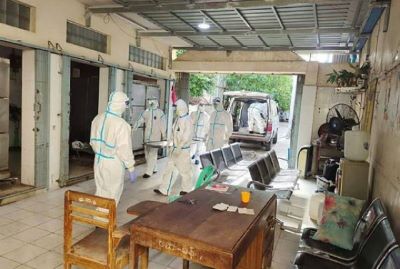
More than 50 patients died on July 14 alone in Mandalay and up to 315 people are died from July 1 to 14 in Mandalay, according to charities.

Over 20 patients from the hospitals in Mandalay are died on July 14 and the rest of the patients expired on July 14 are died in homes, sources said.

“About 60 patients are died yesterday. Our organizations and other affiliated organizations sent about 30 bodies to the cemeteries. We sent about 20 bodies per day to the cemeteries in recent days,” said a person working at a charity in Mandalay.

According to figures from the charities, number of people died of COVID-19 or people assumed to be died of COVID-19 suspected cases are five on July 1, five on July 2, 11 on July 3, 12 on July 4, 6 on July 5, 13 on July 6, 14 on July 7, 29 on July 8, 26 on July 9, 24 on July 10, 39 on July 11, 28 on July 12, 46 on July 13 and 52 on July 14.

Charities are now transporting bodies from mortuaries in hospitals and from the neighborhoods, and they have to carry the bodies in the bags. It made them cost a lot and volunteers are also in need of protective gears from the COVID-19 virus.

At the present, there are full of COVID-19 patients in the hospitals in Mandalay and the charities are facing difficulty to obtain oxygen as the COVID-19 patients in their homes are needed supplemental oxygen.

According to the figures from the Ministry of Health and Sports (MOHS), Mandalay Region found over 300 confirmed patients within 24 hours in recent days and number of death tolls is 12 on July 10, 14 on July 11, five on July 12 and 15 on July 13.

Published : July 17, 2021

By : Le Le Aung/Eleven Media/ANN

Singapore to donate Covid-19 vaccines under global initiative to other countries: PM Lee #SootinClaimon.Com

#SootinClaimon.Com : ขอบคุณแหล่งข้อมูล : หนังสือพิมพ์ The Nation.

https://www.nationthailand.com/international/40003346

Singapore to donate Covid-19 vaccines under global initiative to other countries: PM Lee


SINGAPORE – Asia-Pacific economies should support one another to tackle pandemics, and countries whose vaccination programmes are ahead should make their excess vaccine supplies available to others, Prime Minister Lee Hsien Loong said on Friday (July 16).

Singapore therefore intends to donate its vaccines under the Covax initiative to other countries, he told a virtual gathering of leaders from the 21 Asia-Pacific Economic Cooperation (Apec) members.

Some 43 per cent of Singapore’s population is now fully vaccinated, and the country is on track to cover two-thirds of the population by next month. Covax is a global vaccine distribution scheme that aims to ensure an equitable supply for lower and middle-income countries.

In his speech to fellow leaders, PM Lee said Apec members must work together to prepare for the next pandemic, rebuild connections and liberalise trade, and pursue new areas of growth.

The leaders met at a special Apec Informal Leaders’ Retreat chaired by New Zealand Prime Minister Jacinda Ardern to shape a regional response to the recovery from Covid-19. This is the first time they have held an additional meeting before their formal year-end gathering, due in November.

PM Lee said Covid-19 will not be the last, nor the most serious, pandemic the world will face, and security from pandemics depends on bolstering multilateralism.

This calls for a major step-up in collective investments, including a scaled-up global surveillance system for emerging infectious disease outbreaks, which the Group of 20 (G-20) High Level Independent Panel made a strong case for in its recent report, he noted.

“We need a more agile global governance and financing mechanism that can swiftly plug gaps in global health security,” he said.

“Within our region, Apec economies should support one another, both for the present and future pandemics. For example, through technical assistance to strengthen national public health capabilities, the last mile.”

He added that while countries are understandably working towards more self-reliance, especially for essential goods, amid disrupted international trade and movement of people across borders, they should not take this too far.

“Free trade is still essential to global economic recovery and prosperity,” he said.

“We should also work together to restart international travel safely, by developing common standards for digital vaccine certificates and digital identities.”

Topics the leaders discussed on Friday included speeding up the flow of vaccines; strong, balanced, secure, sustainable and inclusive growth; innovation and digitalisation; and fiscal and monetary tools to sustain economies through the pandemic, as well as the importance of keeping markets open to one another.

“We must ensure our health systems cover all people and have the resilience to cope with current and future shocks. We welcome the varied and continuous efforts as well as the contribution of additional resources across Apec to combat the pandemic,” they said in a joint statement after the meeting.

The leaders also reaffirmed their commitment to an open, dynamic, resilient and peaceful Asia-Pacific community by 2040, for the prosperity of future generations.

In his remarks, PM Lee said that Covid-19 has accelerated the switch to a digital economy, and countries should cooperate on new areas of economic growth.

Singapore, for example, has piloted Digital Economy Agreements with like-minded economies such as New Zealand, Chile and Australia – all Apec members.

ADVERTISEMENT

These agreements align rules and standards, and foster cross-border digital interoperability, data flows and trade.

Beyond Covid-19, the green economy presents another growth opportunity, he said. He noted that like many Apec members, Singapore is highly vulnerable to the effects of climate change, and has a comprehensive national strategy called the Singapore Green Plan 2030 to mitigate climate change and create a green, liveable and sustainable city.

“But being a very small country, our own mitigation efforts will have limited impact. It is only by working together with others that we can overcome this global challenge, and that is why Singapore is exploring Green Economy Agreements to facilitate trade and investment in environmental goods and services, and strengthen environmental governance and capabilities.”

Ms Ardern, who chaired the meeting, said the discussions had focused on all aspects of the global vaccination effort, from making vaccines and sharing them, to using them.

“Nobody is safe from this virus until everyone is safe. Ensuring both global vaccine access and uptake is as high as possible in the shortest time possible gives our regional and individual economies the greatest chance to accelerate recovery, and will support greater economic stability,” she said.

ADVERTISEMENT

Apec, she added, is also pushing for practical solutions to safely reconnect with the world, by exploring options such as vaccine passports, travel green lanes and quarantine-free travel bubbles.

“We have the opportunity to build back better and emerge from this crisis more inclusive, more sustainable and more adaptable than ever. And in order to achieve this as fast as possible, we need to do it together.”

There have been more than 50 million cases of Covid-19 within Apec’s borders, with over one million deaths.

Apec-wide gross domestic product contracted by 1.9 per cent last year, the biggest fall since World War II. While economic growth is recovering, around 81 million jobs have been lost due to the pandemic.

The economic forum, which includes the United States, China and Japan, agreed last month to review trade barriers and expedite the cross-border transit of Covid-19 vaccines and related goods, but stopped short of a broad commitment to remove tariffs.

New Zealand has said leading a regional response to the pandemic is its highest priority as Apec chairman.

Published : July 17, 2021

By : Grace Ho/The Straits Times/ANN

China launches world’s largest carbon market #SootinClaimon.Com

#SootinClaimon.Com : ขอบคุณแหล่งข้อมูล : หนังสือพิมพ์ The Nation.

https://www.nationthailand.com/international/40003345

China launches world’s largest carbon market


Overpassing EUs trading program, it covers over 4.5 billion tons of emissions

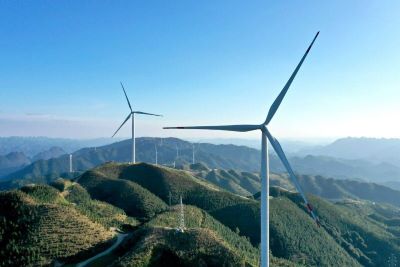
China on Friday inaugurated its national carbon market, a landmark practice that experts said will not only help accelerate the reduction in domestic carbon emissions, but also promote a broader global response to climate change.

The market currently includes over 2,000 companies in the power generation sector and covers over 4.5 billion tons of carbon dioxide a year. It replaces the European Union’s carbon trading program as the world’s largest such mechanism, according to the Ministry of Ecology and Environment.

In the future, the market will be extended to include another seven major carbon-emitting industries, including steel, chemicals and papermaking.

Carbon trading is the process of buying and selling permits to emit carbon dioxide or other greenhouse gases among designated emitters that have such rights. At the end of each cycle, companies will have to buy unused permits from the market if they emit more than allowable amounts.

The mechanism will put companies that do well in containing emissions at an advantage, and thus motivate heavier emitters to adhere to lower carbon development trajectories.

At 9 am on Friday, Vice-Premier Han Zheng announced the opening of the market. The first transaction occurred only two minutes after trading began at 9:30 am. The average price of transactions during the day stood at 51.23 yuan ($7.90) per metric ton, compared with an opening price of 48 yuan, with an upper limit of 52.8 yuan, according to the Shanghai Environment and Energy Exchange.

With a total turnover of roughly 210 million yuan, about 4.1 million tons of carbon emission rights were traded on Friday, it said.

Friday’s average trading price of 51.23 yuan is much higher than the annual average price in the country’s pilot carbon market, which started trading in 2013 in seven areas, including Hubei province, Beijing and Shanghai.

The volume-weighted average price over the past few years stood at about 40 yuan, official data showed.

Zhao Xiaolu, climate director with the Environmental Defense Fund’s China program, said companies have shown strong enthusiasm for participating in trading during the inaugural day of operation.

“The price hovered high after the market opened and approached the daily upper limit when the market closed,” Zhao said. “It shows that power generation companies have stable expectations of the market’s role in helping fulfill the country’s target of reaching peak carbon dioxide emissions before 2030 and going carbon neutral before 2060.”

Fred Krupp, president of the Environmental Defense Fund, said China’s national carbon market will be one of the central policy instruments to achieve its climate goals.

With the first transactions taking place in the system, China has reached an important milestone in its progress on climate action, he said. “A well-functioning carbon market will contribute to a lower peak and a more rapid reduction in emissions afterward.”

On Friday, Foreign Ministry spokesman Zhao Lijian said the launch of China’s national carbon market will also “inject impetus and confidence into the joint endeavors of the world to cope with climate change and offer references for other nations and regions around the world”.

Denis Depoux, global managing director of consultancy Roland Berger, said the establishment of the carbon trading program highlights China’s prominent role in promoting the global response to climate change.

“The successful practice of China’s carbon trading market will also explore a low-carbon green development path that uses market means to stimulate economic development,” Depoux said.

The market has also unleashed huge potential for developing financial products based on emissions rights, which potentially contributes to the country’s climate change management process.

Ye Yanfei, a director with the policy research bureau of the China Banking and Insurance Regulatory Commission, said on Wednesday at a news conference that the banking sector will explore the possibility of using carbon emissions rights as collateral for loans.

Ren Hailong, general manager of the transaction banking department at China Minsheng Banking Corp, said the launch of the market will help promote the circulation of carbon emissions rights as intangible assets.

Published : July 17, 2021

By : HOU LIQIANG, HE WEI and LIU KUN/China Daily/ANN