Japan schools debate mask-wearing during PE #SootinClaimon.Com

#SootinClaimon.Com : ขอบคุณแหล่งข้อมูล : หนังสือพิมพ์ The Nation.

https://www.nationthailand.com/international/40003119

Japan schools debate mask-wearing during PE


As summer approaches, and with it the high risk of heatstroke, many schools are grappling with whether students should wear masks during PE class.
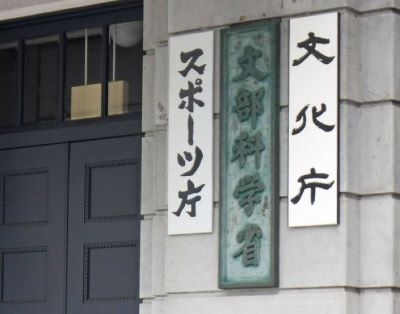
The Education, Culture, Sports, Science and Technology Ministry has said masks are not needed during PE, but fears over the coronavirus spreading have prompted many children to wear them anyway.

During PE class for about 30 sixth-grade students at an elementary school in Toyonaka, Osaka Prefecture, the teacher in charge told the students to take off their masks, to help prevent heatstroke. However, one student put her mask back on, saying, “I’m scared I’ll get infected if I don’t have my mask on.”

If a student wants to wear a mask, their legal guardian can submit a written request to the homeroom teacher.

“I want to pay attention to even the smallest changes in the students’ physical condition,” the school’s principal said.

Tokyo’s Setagaya Ward is asking its municipal elementary and junior high schools to handle mask requests on a case-by-case basis, as many legal guardians do not want their child to take their mask off at school.

“Teachers need to pay particular attention to students wearing masks,” said a member of the ward’s board of education. “We instruct our teachers to talk to them frequently.

“It’s really hard on teachers, but to protect the students’ lives, we have to be alert.”

Keeping in mind risks other than the coronavirus, including heatstroke, the education ministry has deemed it unnecessary for students to wear masks during physical activities. However, it has also repeatedly said it will not deny students the right to wear a mask if they choose.

“Wearing a mask to decrease the risk of transmitting the virus carries with it the risk of heatstroke, but there will be a greater risk of virus transmission if a student takes off their mask,” said an official from Tokyo’s municipal board of education.

From May to September of 2019, a total of 8,707 children between the age of 7 and 17 were taken to the hospital for heatstroke, the Fire and Disaster Management Agency said. In May and June, slightly fewer than 1,000 needed treatment, but 1,988 were taken to the hospital in July and 3,494 in August.

Wearing a mask while exercising puts a great burden on one’s body, according to Hespen, an organization created by healthcare professionals to promote heatstroke awareness. According to the organization, a mask makes it hard for the body to thermoregulate itself, increasing the risk of heatstroke.

“As children are generally at a lesser risk of becoming seriously ill with the coronavirus, I believe that heatstroke — which can be fatal — is a more serious threat,” said the organization’s representative, Dr. Koichi Inukai. “Schools need to seek understanding from legal guardians that students should take their masks off during exercise.”

Published : July 12, 2021

By : The Japan News/ANN
[Singapore] Restaurants see a surge of bookings for bigger groups with 5 people allowed to dine-in #SootinClaimon.Com

#SootinClaimon.Com : ขอบคุณแหล่งข้อมูล : หนังสือพิมพ์ The Nation.

https://www.nationthailand.com/international/40003118

[Singapore] Restaurants see a surge of bookings for bigger groups with 5 people allowed to dine-in


SINGAPORE – Restaurants are getting a booster shot from diners eager to go out with family and friends since the announcement last week that five people can dine in from Monday (July 12). When dining in resumed on June 21 after phase two (heightened alert), only groups of two peeople were allowed.

Chef Andrew Walsh of Cure Concepts, which owns three restaurants in the Central Business District – Cure, Catfish and Butcher Boy – said they had seen bookings, mainly for bigger groups, go up by at least 30 per cent after the announcement on July 7.

Ms Karen Cheng, owner of The Gyu Bar in Stevens Road, known for its wagyu yakiniku, shabu shabu and sukiyaki, also reported a 30 per cent increase in bookings, all for larger groups.

She said: “Our kind of food is popular with guests who tend to dine in groups. With two persons dining in, there simply wasn’t the same sense of camaraderie.”

Canchita Peruvian Cuisine in Dempsey Road said about 60 per cent of its reservations now are for groups of three people or more. Its manager, Mr Celvin Chiang, said that many diners with existing bookings had called to increase the number of people.

Firangi Superstar, a new modern Indian restaurant in Craig Road, said its reservations were already full for coming weeks but it nonetheless saw a 40 per cent increase in requests to increase the table size.

Chinese restaurants that tend to be more popular with big groups, such as Yan at the National Gallery Singapore, benefit most from the relaxation. Yan’s general manager, Mr Shek Chi Kuen, said: “When it was restricted to two persons, we had days with below 20 diners. Our weekend numbers are now up by 60 per cent.”

With bigger groups likely to spend more, he expects revenue to increase by 80 per cent.

Marina Bay Sands saw a surge of 62 per cent in telephone queries for its restaurants, which include Cut, Mott 32, Koma, Lavo Singapore, Waku Ghin and Rise, but said it was not more than the response when dining in for two people was announced last month. Ms Christine Sheares, its vice-president of F&B, nonetheless welcomed the relaxation as Rise, which serves international cuisines, can now showcase its family-style menus.

Some restaurateurs, however, were disappointed that the no-music rule was not lifted.

Chef Walsh of Cure Concepts pointed out: “Guests look forward to the full dining experience – great food and ambience. Without music, the social vibe we create within our spaces isn’t complete.”

Dr Martin Bem, the founding managing director of LeVeL33 restaurant in Marina Bay Financial Centre, agreed. He said: “We only played low background music which actually did not lead to increased speaking volumes. The music contributes immensely to a better experience and ambience. Particularly in these difficult times, everybody deserves a nice experience.”

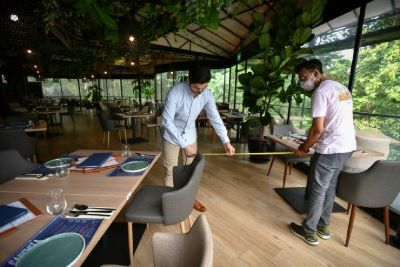
Meanwhile, there is no flurry to get restaurants ready for bigger groups as they had already gone through a similar phase of groups five persons allowed to dine in last year. While some will be reconfiguring tables to accommodate more people, others had earlier left the chairs empty for diners to put their belongings.

Fine-dining French restaurant Saint Pierre at One Fullerton, for example, had reduced the number of tables from 12 to eight since pandemic dining restrictions started last year. For next week, it will convert three of them to seat five people.

The restaurant’s chef-owner Emmanuel Stroobant said: “Reducing the seating capacity turned out to be a blessing in disguise as our guests felt more comfortable. So when Covid-19 measures are further relaxed in future, we will keep to just eight tables.”

The Gyu Bar and Canchita are stocking up their kitchens with more food in anticipation of bigger orders. Canchita is adding staff as well as more eyes will be needed to keep a lookout for diners who violate safe distancing rules.

On making sure everyone sticks to the measures, Mr Stroobant said: “There had been times when customers saw a friend at another table and wanted to stop by to say hi. Our service crew would then gently remind them of the no-intermingling rule. And some diners thanked us for the reminder before returning to their seats.”

Published : July 12, 2021

By : Wong Ah Yoke/The Straits Times/ANN

China provided 500m vaccine doses to global community #SootinClaimon.Com

#SootinClaimon.Com : ขอบคุณแหล่งข้อมูล : หนังสือพิมพ์ The Nation.

https://www.nationthailand.com/international/40003117

China provided 500m vaccine doses to global community


BEIJING – China has provided more than 100 countries and international organizations with 500 million doses of COVID-19 vaccines and concentrates, accounting for one-sixth of the current global COVID-19 vaccine production, a Foreign Ministry official told Xinhua on Friday.

Guo Xuejun, deputy director-general of the department of international economic affairs at the Foreign Ministry, said during an interview with Xinhua that China has also actively supported other developing countries in producing vaccines to expand the global vaccine capacity.

China has always accommodated domestic and foreign needs for COVID-19 vaccines, said Guo, adding that China opposes vaccine nationalism.

With the help of the Chinese government, Chinese vaccine enterprises have carried out joint vaccine production in countries including the UAE, Indonesia, Malaysia, Egypt, Brazil, Turkey, Pakistan and Mexico, with production exceeding 200 million doses, Guo said.

Among the 140 countries that have signed Belt and Road cooperation documents with China, 84 countries have proposed introducing Chinese vaccines in the first half of this year, said Guo, adding that China has made a positive response to all these countries and provided vaccines.

Guo said that in the future China will continue to work with all parties to enhance vaccine cooperation, further improve the accessibility and affordability of vaccines in developing countries to make a greater contribution to fighting the pandemic and promoting economic recovery.

Published : July 12, 2021

By : China Daily/ANN

S. Korea proposes to tax 20% of excess profits from multinationals #SootinClaimon.Com

#SootinClaimon.Com : ขอบคุณแหล่งข้อมูล : หนังสือพิมพ์ The Nation.

https://www.nationthailand.com/international/40003116

S. Korea proposes to tax 20% of excess profits from multinationals


South Korea’s finance chief said on July 11 he had proposed to set tax rates on excess profits of big multinationals at 20 percent in a discussion with his G-20 counterparts over the latest global tax reform.

Global financial leaders have reached a consensus on imposing taxes on companies with rates between 20 percent and 30 percent of the profit they generate in different countries beyond a 10 percent baseline.

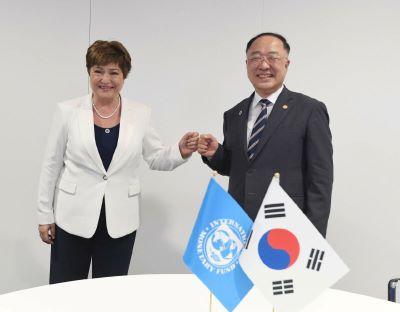
Finance Minister and Deputy Prime Minister Hong Nam-ki pitched the lowest 20 percent rate, saying the figure would determine the relations between countries and the “national interest.”

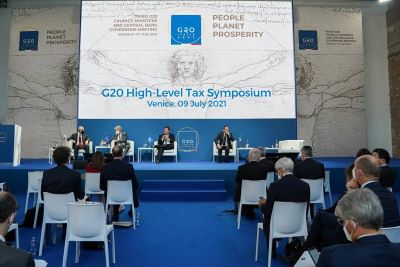
Hong’s remarks came in line with a G-20 meeting of finance ministers and a central bank governors meeting held in Venice, Italy on July 9-10. There, the countries signed up to a framework for international tax reform in a bid to deal with big tech firms that have been booking profits in low-tax countries regardless of where money is earned due to the rise of digital commerce. The reform included a minimum global corporate tax rate of 15 percent.

The rules are slated to be finalized at the G-20 leaders’ summit in Rome in October.

“Hundreds of businesses around the world will be subject to the digital tax known as Pillar I, and if a country is home to several such businesses, the lower the excess profit line, the better,” Hong told reporters.

“One or two major companies in Korea are expected to be included in the 100 list,” Hong said, referring to business giants Samsung Electronics and SK hynix.

But the finance chief of Asia’s fourth-largest economy added that G-20 member nations have yet to announce their “detailed stance” on setting the tax rates for excess profits. US Treasury Secretary Janet Yellen has so far replied that she understands Korea’s position in the matter, Hong said, reflecting the economies’ cautious approach to the issue.

The aim of the digital tax, known as Pillar I, is to ensure that companies operating in multiple countries pay taxes in all the countries where they provide services and earn profit, not just in their home countries.

Meanwhile, Hong also met with International Monetary Fund Managing Director Kristalina Georgieva on the sidelines of the G-20 meeting.

At the meeting, Hong highlighted the need for the global economies to flexibly respond to a sudden inflow and outflow of capital, the Ministry of Economy and Finance said.

Hong’s remarks point to growing calls for the IMF to allow economies to take various measures as the US Federal Reserve has been inching toward tapering its asset purchase programs.

Published : July 12, 2021

By : Jung Min-kyung/The Korea Herald/ANN

Fairer G20 corporate tax plan OK’d #SootinClaimon.Com

#SootinClaimon.Com : ขอบคุณแหล่งข้อมูล : หนังสือพิมพ์ The Nation.

https://www.nationthailand.com/international/40003115

Fairer G20 corporate tax plan OK’d


Finance ministers and central bank governors from G20 economies reached a historic agreement on a new global corporate tax reform plan over the weekend, endorsing a minimum levy on multinational corporations and a reallocation of profits between countries.

It marked a big step forward in the global tax reform process after years of discussions. After the G20 members finished meeting in Venice, Italy, on Saturday, they issued a communique calling the new framework “a more stable and fairer international tax architecture”. However, the minimum corporate tax rate was not fixed.

Earlier this month, the global corporate tax reform initiative, which was designed as a two-pillar solution and proposed a minimum tax rate of 15 percent for large multinational corporations, won support from 132 countries and jurisdictions, including China. Experts expect the final plan could be approved at the next G20 meeting in October.

“This indicates that great progress has been made in the reform of the international corporate tax system,” said Jeff Yuan, PwC Asia Pacific transfer pricing services leader.

“However, there are still uncertainties in the final plan, and we are not sure about the time for reaching a global consensus because a significant amount of political and technical work remains to be completed by October 2021, with key design issues still to be resolved.”

China’s strong economic fundamentals and institutional advantages can ensure that the country takes the lead in global tax reform, said Bai Yanfeng, a professor at the Central University of Finance and Economics in Beijing.

Compared with some advanced economies, which may take longer to implement the new rules, China is able to take action more effectively. As China is becoming the world’s largest single consumer market, the country will also maintain its advantages in attracting international capital, Bai said.

“The most important thing is to do our own things well. When China’s enterprises are competitive enough and consumers from all over the world pay more attention to China-made products, we will be full of confidence in both market share and tax share,” Bai said.

Yuan said a July 1 statement by the Organization for Economic Cooperation and Development as well as the G20 communique made it clear that while implementing the new international tax rules, countries will remove digital services taxes and other similar measures imposed on companies. These removals will be good news for multinational enterprises, especially for high-tech businesses, Yuan said.

The new rules and their potential impacts still need deeper analysis. Multinational companies will need to conduct more impact analysis and scenario planning based on the information in the OECD’s statement and revisit options on alleviating the potential impact of the new rules, he said.

Yi Gang, governor of the People’s Bank of China, the central bank, attended the G20 meeting on Friday and Saturday via video-conferencing. Yi disclosed that the G20 Sustainable Finance Working Group, co-chaired by China’s central bank and the US Treasury this year, is working on a draft plan on sustainable finance in the medium term.

This year, the group is focusing on tasks such as green finance and green industries, streamlining information disclosure and reporting standards related to the climate and environment as well as multilateral development supporting the Paris Agreement, according to a PBOC statement.

Yi called on G20 members to jointly improve standards for classifying and rating environmental, social and governance investments and improving climate information, which will help promote global green finance markets and foster low-carbon transition.

The G20 meeting also discussed central bank digital currencies for cross-border payments. It emphasized that no so-called “global stablecoins”-a new type of cryptoasset designed to maintain a stable value relative to specified assets-should commence operation, until all relevant legal, regulatory and oversight requirements are adequately addressed, according to the communique.

Published : July 12, 2021

By : Chen Jia/China Daily/ANN

Virtual discussions to give an insight into Asian film production #SootinClaimon.Com

#SootinClaimon.Com : ขอบคุณแหล่งข้อมูล : หนังสือพิมพ์ The Nation.

https://www.nationthailand.com/international/40003087

Virtual discussions to give an insight into Asian film production


HÀ NỘI — A series of virtual discussions that offer an insight into the characteristics and issues film productions in Asia face will be held by the Centre for Young Cinematography Talent Development this July and August.

The discussions, entitled Hương Vị Châu Á (Taste of Asia), will be presented by prestigious Vietnamese film researchers such as director Phan Đăng Di, critic Lê Hồng Lâm and Doctor of Literature Mai Anh Tuấn.

Each session’s theme will cover five countries including India, Iran, Korea, Japan and Việt Nam, and take place at 3pm every Saturday and Sunday from July 11 to August 14 via Zoom.

Taste of Asia will kick off with a presentation from director Phan Đăng Di who is well known for his drama Bi, Đừng Sợ! (Bi, Don’t Be Afraid). He will be sharing his thoughts about life and death as portrayed in films by Indian director Satyajit Ray.

Dr Mai Anh Tuấn from Hanoi University of Culture will also talk about Iranian director Abbas Kiarostami.

Covering East Asia will be Film critic, Lê Hồng Lâm, who will explore the global popularity of the new wave of South Korean cinema and researcher Đỗ Văn Hoàng who will discuss films by Japanese director Hiroshi Shimizu.

Vietnamese works and filmmakers will include critic and screenwriter Vũ Ánh Dương who will deliver a talk about films by directors Síu Phạm and Trương Minh Quý. Artist Nguyễn Quốc Thành will also share his thoughts about Song Lang (The Tap Box) by director Leon Quang Lê.

In order to participate in the events, audiences will need to fill in the online registration form available on the Facebook page of TPD. Information about movies and issues that are discussed will also be updated on TPD Facebook prior to each session.

Opening the series is a screening of Pather Panchali (Song of the Little Road) by celebrated Indian director Satyajit Ray (1921-1992). The first film in The Apu Trilogy and also Satyajit’s debut work, Pather Panchali depicts the childhood of the protagonist Apu (Subir Banerjee) and his elder sister Durga (Uma Dasgupta) and the harsh village life for their poor family.

The film is considered a turning point of Indian cinema and one of the pioneers of the parallel cinema movement. Influenced by the Italian neo-realist genre, the film won many acclamations worldwide, taking home the best film award in India in 1955 and a Best Human Document award at the Cannes Film Festival in 1956. — VNS

Published : July 11, 2021

By : Vietnam News / ANN

HK government mulls ban on single-use plastic tableware #SootinClaimon.Com

#SootinClaimon.Com : ขอบคุณแหล่งข้อมูล : หนังสือพิมพ์ The Nation.

https://www.nationthailand.com/international/40003086

HK government mulls ban on single-use plastic tableware


HONG KONG – The Environmental Protection Department has launched a two-month public consultation on regulating disposable plastic tableware in a bid to reduce pollution.

In a statement, the department said it is planning to first ban the sale of disposable expanded polystyrene tableware and its use at restaurants.

As for non-expanded polystyrene disposable tableware, the government aims to implement the ban in two phases.

In the first phase, restaurants will be prohibited from providing all types of disposable plastic tableware to customers for dine-in services. They will also be banned from providing straws, stirrers, forks, knives, spoons and plates for takeaway services.

In the second phase, takeaway services will be regulated in the same manner as dine-in services.

The department said places around the world have been committed to discouraging the use of single-use plastic products in view of the imminent problems of marine plastic pollution and climate change.

“As a coastal city, Hong Kong shall not ignore the issue and has to pay extra attention to the problem of plastic pollution and its impact on the environment,” the statement reads.

The public consultation runs until Sept 8.

Published : July 11, 2021

By : China Daily / ANN

China releases new images taken by Mars rover #SootinClaimon.Com

#SootinClaimon.Com : ขอบคุณแหล่งข้อมูล : หนังสือพิมพ์ The Nation.

https://www.nationthailand.com/international/40003085

China releases new images taken by Mars rover


BEIJING – Chinas Mars rover Zhurong has traveled more than 300 meters on the surface of the red planet and sent back new images about the Martian rocks, sand and dust.

As of Thursday, Zhurong has been working on the Martian surface for 54 Martian days and has traveled more than 300 meters, according to the Lunar Exploration and Space Program Center of the China National Space Administration.

A Martian day is approximately 40 minutes longer than a day on Earth.

Since the rover landed on the surface of Mars, it has been traveling southward to carry out inspection and exploration.

The navigation terrain camera takes images of the landforms along the way every day. The subsurface radar, meteorological measurement instrument and surface magnetic field detector were also turned on for detection.

When the rover met notable landforms like rocks and sand dunes, the surface composition detector and multispectral camera carried out fixed-point detection.

In two images of Martian rocks, the texture features of the Martian rocks and ruts of the rover are seen clearly, and some rock surfaces are covered with dust.

June 26 is Zhurong’s 42nd Martian day. The rover arrived at a sand dune area. The navigation terrain camera onboard took images of a red sand dune about six meters from it. In one image, stones of different sizes are scattered around the dune. The stone facing the rover is about 0.34 meters wide.

July 4 is Zhurong’s 50th Martian day. It drove to the south side of the sand dune, which is about 40 meters long, eight meters wide and 0.6 meters high.

A cluster of stones with various shapes is shown on the left of an image. And the back cover and parachute of the lander can be seen in the upper right corner. When Zhurong took the image, the linear distance between the rover and the landing point was about 210 meters, and the distance between the rover and the back cover and parachute was about 130 meters.

China’s Tianwen-1 mission, consisting of an orbiter, a lander, and a rover, was launched on July 23, 2020. The lander carrying the rover touched down in the southern part of Utopia Planitia, a vast plain in the northern hemisphere of Mars, on May 15.

The rover Zhurong drove down from its landing platform to the Martian surface on May 22, starting its exploration of the red planet, and making China the second country after the United States to land and operate a rover on Mars. 

Published : July 11, 2021

By : China Daily / ANN

Meeting looks at deepening overall reform #SootinClaimon.Com

#SootinClaimon.Com : ขอบคุณแหล่งข้อมูล : หนังสือพิมพ์ The Nation.

https://www.nationthailand.com/international/40003084

Meeting looks at deepening overall reform


One topic at top-level discussion is how to foster new development paradigm

Xi Jinping, general secretary of the Communist Party of China Central Committee, required firm self-awareness, targeted measures and practical actions on Friday to accelerate the country’s establishment of a new development paradigm in order to take the initiative in future development.

Speaking at a meeting of the Central Committee for Deepening Overall Reform, Xi said that fostering a new development paradigm was aimed at improving China’s capacity to survive, compete, develop and persevere in the face of various kinds of risks that can or cannot be predicted.

Xi, who is head of the committee, highlighted the importance of maintaining an indomitable spirit and strategic focus during this long-lasting process.

To foster the new development paradigm, meeting participants emphasized targeted efforts to solve the key difficulties and problems that have been revealed and required continuous efforts to deepen supply-side structural reform.

They agreed that the satisfaction of domestic needs and the improvement of people’s quality of life should be put in a more prominent position and urged more efforts be made on enabling people to feel more satisfied, happy and secure, according to a statement released after the meeting.

Meeting participants required departments and local governments to make targeted efforts to serve the establishment of a new development paradigm, instead of acting at will, without considering the reality and acting just for political achievements.

Talking about the country’s high-level opening-up at the meeting, Xi urged greater efforts to make plans for and push forward the high-quality development of free trade pilot zones.

To this end, it is important to fully utilize both the international and domestic markets, to aim at the high-level international economic and trade rules and to actively promote innovation at the institutional level, Xi said.

Since the 18th National Congress of the CPC in 2012, China has launched 21 free-trade pilot zones across the country that have made major contributions to the country’s high-quality development, participants in the meeting said, calling for greater autonomy to be granted to the FTZs in carrying out reforms.

The FTZs should be built into zones with international influence and competitiveness, thus taking on an exemplary and leading role in the country’s reform and opening-up, they said.

Reviewed and passed at the meeting were a guideline on fostering a new development paradigm, an action plan to boost the seed industry, a plan to protect the environment on the Qinghai-Tibet Plateau and a variety of measures to reform and innovate the facilitation of trade and investment in free trade pilot zones.

To promote high-quality development in plateau regions, meeting participants stressed that people should be put at the center and issues of public concern –including employment, income distribution, education and medical care should be properly dealt with.

They also urged efforts be made to appropriately address and prevent various kinds of risks that relate to national security so as to earnestly safeguard tranquility, unity and development in border areas.

Published : July 11, 2021

By : China Daily / ANN

U.S Secretary of State meets with representatives of Myanmar’s civil society #SootinClaimon.Com

#SootinClaimon.Com : ขอบคุณแหล่งข้อมูล : หนังสือพิมพ์ The Nation.

https://www.nationthailand.com/international/40003083

U.S Secretary of State meets with representatives of Myanmar’s civil society


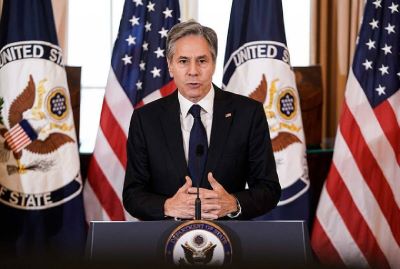
Antony Blinken, United States Secretary of State, received representatives of Myanmar’s civil society on July 8, said Ned Price, Spokesman of the Department of State in a regular press conference.

The State Department also posted on its website that the Secretary of State met with representatives of Myanmar’s civil society.

The Secretary said the U.S will work with the people of Myanmar to support democracy, human rights, and the rule of law.

Moreover he said the U.S is standing in solidarity with those in Myanmar seeking to put Myanmar back on the path to democracy.

The Spokesman said quoting the State Secretary that the United States is standing in solidarity with the people in Myanmar to promote accountability for those responsible for overturning Myanmar’s democratic transition and perpetrating human rights violations and abuses.

At the 47th session of the UN Human Rights Council in Geneva held on July 6, the UN High Commissioner for Human Rights, Michelle Bachelet, commented on the human rights situation in Myanmar “The problem, which began with the military takeover, has turned into an attack on civilians, which has become widespread and systematic. Nearly 900 people were killed. As many as 200,000 people have been forced to flee their homes due to military raids on wards and villages.”

Published : July 11, 2021

By : Eleven Media / ANN