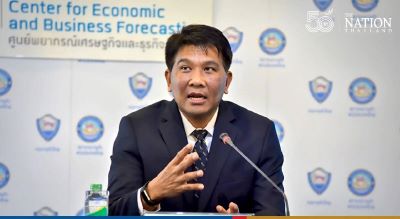
The first lot of savings bonds, “Om Pai Duay Kan” (Let’s Save Together), worth 10 billion baht were snapped up within 12 minutes of being released by the Finance Ministry on November 15.
“The ministry said the buyers were between the ages of 15 and 90, and that only 33.5 per cent of them live in the capital. Most of the bond buyers live upcountry,” deputy government spokesperson Ratchada Thanadirek said on Saturday. “This lot was only sold through the Pao Tang application, which proves that Thais are ready for a cashless society.”
The Finance Ministry will launch a second lot of bonds worth 70 billion baht on November 22 from 8am via the Pao Tang application and through four banks – Krungthai, Kasikorn, Siam Commercial and Bangkok Bank.
Eligible buyers must be Thai nationals or permanent residents aged 15 years and above. The minimum purchase amount is 1,000 baht but there is no maximum limit.
The bonds come in three types:
• 5 years with incremental interest: 1.5 per cent in the first year, 2 per cent in the second to the fourth year, and 2.1 per cent in the fifth year.
• 10 years with incremental interest: 2 per cent in first three years, 3 per cent in the fourth and fifth year, 3.5 per cent in sixth to the ninth year and 4 per cent in 10th year.
• 10 years with fixed interest: 2.2 per cent annual interest throughout the holding period.
The last batch of bonds worth 15 billion baht will be sold from November 24 to December 3 via the four banks and will be reserved only for non-profit juristic persons.
To boost farmers’ income and attract investment, the Eastern Economic Corridor Office (EECO) has decided to start promoting five groups of agricultural products grown in the vicinity of eastern provinces Chonburi, Rayong and Chachoengsao.
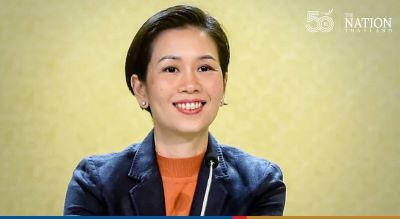
“Our preliminary survey revealed that farmers in EEC areas still use traditional farming techniques, which utilise limited technology and consume high amounts of resources,” Phojanee Attharojphinyo, EECO’s policy and planning specialist, said on Friday.
“Traditional agriculture is taking up 66 per cent of land in EEC areas, 13 per cent of manpower and 64 per cent of water resource, but generates only 2.6 per cent of the country’s gross domestic product [GDP].”
Phojanee added that the project aims to promote five agricultural product groups including fruits, fishery products, plants for bio-based products, herbal products, and high-value crops (like decorative plants and organic vegetables).
“We will operate under three strategies: Improving product quality using high technology, using modern marketing techniques and innovations to maximise sales revenue, and developing new generation human resources in farms to incorporate modern agricultural practices into traditional farming techniques,” she added.
Phojanee added that EECO estimates that in the next 20 years the population in the EEC area will increase by more than 2 million, while the number of visitors landing at U-Tapao International Airport could reach 60 million people.
“To support the increasing population, EECO is planning an urban development project for areas in a 30km radius of the U-Tapao Airport,” she said. “Dubbed the ‘Smart City Suitable for Living’ project, we aim to establish a new city that is driven by the BCG [bio, circular and green] economy following the model of Singapore and Auckland, which have been ranked first in World Smart City Index in 2020 and 2021, respectively.”
Phojanee added that the smart city will have features such as over 30 per cent of green areas, self-sustainable water resources, public transport system powered by clean energy, as well as enhanced public health and education systems.
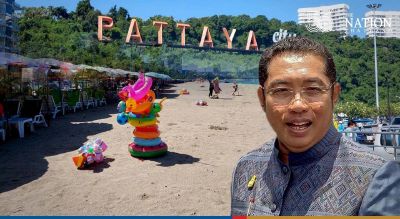
The Eastern Economic Corridor Office (EECO) is working with Pattaya City of Chonburi province on the NEO Pattaya project with an aim to promote investment and tourism in Pattaya City and Koh Lan, a resort island off the coast of Pattaya, said Sonthaya Kunplome, mayor of Pattaya City on Friday.
“The NEO Pattaya project started in 2018, when I first became the mayor,” he said. “It aims to develop Pattaya City as an economic and investment hub in EEC areas which span across three provinces of Chonburi, Rayong and Chachoengsao. The project will make the city ready for expanding economy, tourism and employment brought about by the EEC investments.”
Sonthaya added that Pattaya City has drafted and implemented the first phase of development plan for 2018 to 2022 which covers five aspects of development, namely economy, society, environment, culture and integration. “The second phase plan, which will be implemented from 2022 to 2027, has already been approved by the EECO. The office aims to attract up to 2.2 trillion baht worth of investment in EEC areas in the year 2022, while currently the total investment in 2021 is at 1.6 trillion baht.”
Mayor of Pattaya added that currently the city has ongoing six development projects from the total of 14 projects under the first phase development plan, whereas eight projects have already been completed. “Next year we have asked for a budget of 77 million baht to continue these projects, while aiming to generate up to ten times the investment value in return,” he said. “These projects include the development of tourist attractions in Old Town of Na Klua subdistrict, which expect to attract 1.2 million tourists per year and generate an income of 900 million baht annually.”
The Stock Exchange of Thailand (SET) Index closed at 1,645.06 on Friday, down 5.96 points or 0.36 per cent. Transactions totalled 102.89 billion baht with an index high of 1,656.27 and a low of 1,641.52.
The index fell after rising by 6.42 points or 0.39 per cent on Thursday.
In the morning session, Krungsri Securities forecast the day’s index would fluctuate between 1,640-1,660 points.
It said the index gained positive sentiment from Thailand economic and SET-listed firms’ profit forecasts that they would recover in the fourth quarter this year. Mass buy-ups of shares that gained specific positive sentiment would help boost the index, it added.
“However, the index would be under pressure due to uncertainty over the US Federal Reserve would raise interest rate sooner than expected to deal with rising inflation,” Krungsri Securities predicted.
The 10 stocks with the highest trade value today were SCB, TRUE, EA, KBANK, BBL, GUNKUL, DTAC, GPSC, MONO and PTT.
Other Asian indices were mixed:
Japan’s Nikkei Index closed at 29,745.87, up 147.21 points or 0.50 per cent.
China’s Shanghai SE Composite closed at 3,560.37, up 39.66 points or 1.13 per cent, while the Shenzhen SE Component closed at 14,752.49, up 173.32 points or 1.19 per cent.
Hong Kong’s Hang Seng Index closed at 25,049.97, down 269.75 points or 1.07 per cent.
South Korea’s KOSPI Index closed at 2,971.02, up 23.64 points or 0.80 per cent.
Taiwan’s TAIEX Index closed at 17,818.31, down 23.06 points or 0.13 per cent.
Thailand’s private sector is getting ready to host Apec Business Advisory Council (ABAC) forums next year now that Thailand has taken over as chair of the Asia-Pacific Economic Cooperation (Apec).
Supant Mongkolsuthree, who chairs the Federation of Thai Industries (FTI), said Apec’s private arm ABAC was responsible for advising economic leaders on operations related to free-trade agreements as well as facilitating trade and investment.
ABAC comprises 61 members from the 21 Apec countries, and Thailand is represented by the FTI, the Thai Chamber of Commerce (TCC) and Thai Bankers Association (TBA).
Supant said ABAC’s work focus on five key aspects:
• Promoting regional economic cooperation
• Utilising 5G technology to prevent cyberattacks
• Paying attention to micro, small and medium enterprises (MSMEs)
• Promoting Bio-Circular-Green (BCG) and Environmental, Social, and Governance (ESG) economic models to reduce carbon emissions
• Developing a Public-Private Partnership (PPP) system
For 2022, he said, ABAC will focus on three key themes:
• Embrace: Getting ready for new opportunities and connections after the global economic slowdown.
• Engage: Gathering ideas and cooperation to set up a new economic direction for the future.
• Enable: Enhancing economic potential to make everything possible.
“We believe Thailand is ready to hold ABAC forums next year, which will allow government and private leaders to share their vision,” he said.
“The forums will also contribute to the tourism industry’s recovery as thousands of leaders from the 21 Apec countries, with large working groups and entourages, will arrive in Thailand to attend meetings,” he said.
NIA Collaborates with Business Finland on ‘Innovation Diplomacy’ to Push Thailand to Innovative Country
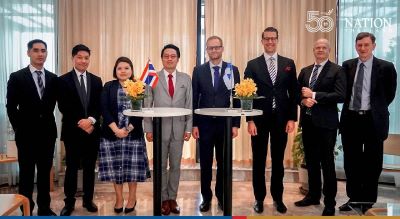
Bangkok, 18th November 2021 – The National Innovation Agency (Public Organization) or NIA today signs a memorandum of collaboration with Business Finland, a state agency promoting investment on innovation of Finland, to expand collaboration on innovation and business development between Thailand and the Republic of Finland for 3 years period, in continuation from 2018, with emphasis on international innovation development in a variety of dimension, comprising BCG economy, digital business development, startup business promotion, upgrading of entrepreneurial abilities of youths, and foresight promotion. This collaboration is a part of the ‘innovation diplomacy’ that will help push for innovations of the country and will also help create the image of Thailand in becoming an ‘innovative country’.
Dr. Pun-arj Chairatana, Director of National Innovation Agency (Public Organization) or NIA said that “NIA has set its own guidelines on development of ‘innovation diplomacy’ continuously by using international relations to help push for innovation of Thailand, basing on strategic cooperation with state agencies having similar roles and missions to NIA and international organizations with innovation potential to upgrade Thailand innovations to international level and to develop the image of Thailand in becoming an “innovative country” in the eyes of the world community.
NIA Collaborates with Business Finland on ‘Innovation Diplomacy’ to Push Thailand to Innovative Country
In the past, NIA and Business Finland had signed a memorandum of collaboration since 2018, when NIA paid a courtesy visit to Mr. Jari Gustafsson, the Permanent Secretary and Assistant Minister of Economic Affairs and Employment of the Republic of Finland at the House of State, Helsinki. Thereafter, NIA has been in collaboration with the Embassy of Finland in Thailand and the Royal Thai Embassy in Helsinki throughout. Since then there have been held consultation meetings on innovation business development guidelines and promotion of innovation operators of both countries, including many academic innovation knowledge exchange activities, such as, Fuse@Bangkok Seminar on Innovation Organization and Innovation for Sustainability, or on-line seminar on the topic of promotion of business operators during COVID-19, etc.
“As for this signing, it is an extension of the collaboration period for another 3 years, with a plan for development of collaboration on innovations in continuation from previous works regarding BCG Economy according to the strategic plan of the Thai Government, be it city development and promotion of potential of business operators, digital business development, promotion of startup businesses of both countries via Global Startup Hub and Landing Pads Program, promotion of trade and investment of potential companies. Also, there will be a development of collaboration in respect of upgrading of abilities of university students and youths via entrepreneurial university development networks, as well as foresight collaboration promotion between NIA and state agencies and private entities of Finland, so that the development of innovation ecosystem of the two countries may cover every dimension”.
NIA Collaborates with Business Finland on ‘Innovation Diplomacy’ to Push Thailand to Innovative Country
H.E. Mr. Jyri Jarviaho, the Ambassador of the Republic of Finland to Thailand, the representative of the Republic of Finland said that
“We are very pleased with today’s signing as it will pave the way for Business Finland and NIA’s deepening collaboration for the next three years. These both organizations have wide range of expertise for innovation, start up support, digital economy, circular and green economy solutions, business partnering and financing. We know that modern innovation ecosystems are not build in isolation, but rather in collaboration with partners and experts around the globe. Therefore and in order to both countries to boost their innovation ecosystems, it is crucial to build such partnerships between Thailand and Finland”.
The baht opened at 32.58 to the US dollar on Friday, unchanged from Thursday’s closing rate.
The Thai currency is likely to move between 32.50 and 32.65 to the greenback during the day, Krungthai Bank market strategist Poon Panichpibool predicted.
Poon said that the baht might strengthen if the dollar weakens. The dollar will weaken if the UK’s retail report is better than expected and cause the pound to strengthen.
The baht strengthen to near the key resistance level at 32.50 to the dollar, which is the level that foreign investors expected. The baht will not strengthen much more if there is no new factor. Foreign investors are also selling the baht which will cause the baht to slow down in strengthening.
For the key resistance level, importers are waiting to buy the dollar at 32.50 to the dollar. Meanwhile, the market is also in a risk-off state in the short term which causes foreign investors to not invest in Thai stocks.
Moreover, the gold price that fell down might cause investors to buy on dips and pressure the baht to weaken.
The price of gold dropped by THB50 in morning trade on Friday.
A9.21am report from the Gold Traders Association showed the buying price of gold bar at THB28,650 per baht weight and selling price at THB28,750, while the buying and selling price of gold ornaments is THB28,136.96 and THB29,250, respectively.
At close on Thursday, the buying price of gold bar was THB28,700 per baht weight and selling price THB28,800, while gold ornaments were THB28,182.44 and THB29,300, respectively.
The spot gold price on Friday morning was moving around US$1,862 (THB60,681) per ounce after Comex gold at close on Thursday dropped by $8.8 to $1,861.4 per ounce due to pressure from concerns that the latest data which indicates the strength of the US labour market and economy may push the Federal Reserve to raise interest rate faster than expected.
The University of the Thai Chamber of Commerce (UTCC) on Thursday (November 18) announced its estimation of gross domestic product (GDP) in 2021 at 1.5 per cent expansion due to a more comprehensive vaccine distribution, easing up of lockdown measures and reopening of some tourism provinces.
“We predicted that the improving economy would drive this year’s exports to expand by 16.5 per cent, while the general inflation will be at 1.2 per cent,” said Thanawat Polvichai, rector at UTCC and chief adviser to the UTCC’s Centre for Economic and Business Forecasting.
“As for next year, we believe the GDP will expand by 4.2 per cent, while exports will expand by 5.4 per cent under 1.5 per cent of general inflation,” he added. “The revenue from tourism alone could be as high as 300 billion baht and should help increase economic expansion by 2 to 2.5 per cent.”
However, to achieve this result the government needs to continue rolling out economic stimulus measures, which are estimated to use the budget of at least 500 billion baht,” he pointed out.
Thanawat added that positive factors that contribute to the expansion of GDP in 2021 and 2022 include the above target vaccination rate, declining number of new infections, easing up of lockdown measures, reopening of tourism provinces to foreign visitors, and government’s economic stimulus campaigns and remedy programmes for those affected by the outbreak.
Negative factors that could hinder the estimated GDP expansion include risk of new cluster cases emerging, increasing of policy rate by central banks of major economies, the energy crisis in China that could affect its economic stability, chip shortage that could continue to affect global industrial manufacturing chain, and the tension between the US and China.
Krungsri Securities forecast the Stock Exchange of Thailand (SET) Index on Friday (November 19) would fluctuate between 1,640-1,660 points.
It said the index gained positive sentiment from Thailand economic and SET-listed firms’ profit forecasts that they would recover in the fourth quarter this year. Mass buy-ups of shares that gained specific positive sentiment would help boost the index, it added.
“However, the index would be under pressure due to uncertainty over the US Federal Reserve would raise interest rate sooner than expected to deal with rising inflation,” Krungsri Securities predicted.
It also recommended buying of the following companies’ shares as an investment strategy:
▪︎ BBL, TTB, KTB, KBANK and BLA, which would benefit from the rising interest rate.
▪︎ HMPRO, CPN, CRC, AMATA, WHA, BTS, BEM, VGI, BDMS and MAJOR which benefit from domestic economic recovery.




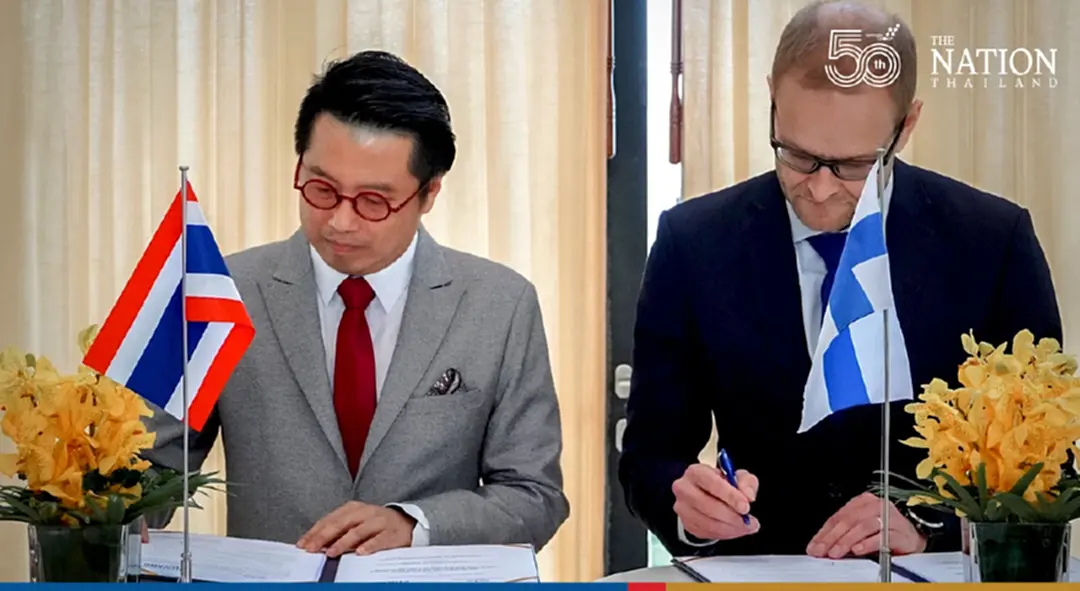 NIA Collaborates with Business Finland on ‘Innovation Diplomacy’ to Push Thailand to Innovative Country
 NIA Collaborates with Business Finland on ‘Innovation Diplomacy’ to Push Thailand to Innovative Country