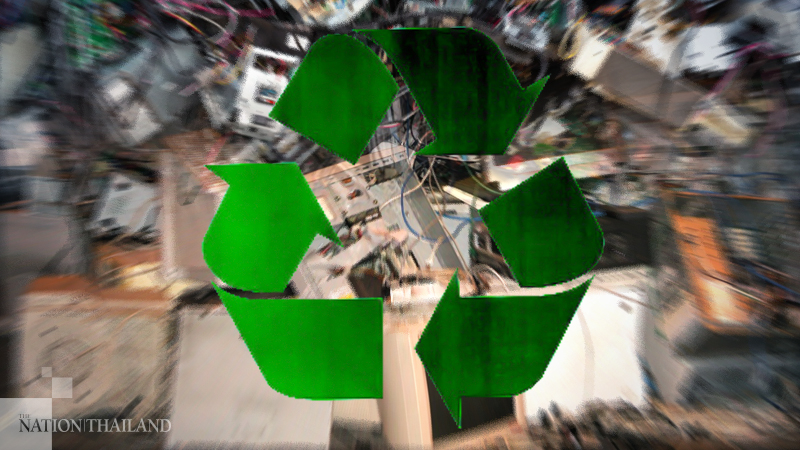
Thailand is developing technology to extract rare-earth metals from recycled industrial and household waste to serve high-tech industries.
The focus is on tapping the waste to extract high-value metals, ranging from rare-earth elements to gold, silver and platinum, said Teerawut Tunnukij, senior metallurgical engineer at the Department of Primary Industries and Mines (DPIM).
His department has already succeeded in creating technology to recycle neodymium from electronic waste. Neodymium is a key component in high-power magnets needed for electronic equipment and the engines of electric vehicles.
The DPIM also plans to extract nano copper oxide from electronic waste, such as copper from plants that produce electricity transmission cables. Nano copper oxide is a key material for coating medical equipment to make it bacteria-resistant.
The department will also conduct research and development on special-grade titanium alloys used in robotic technology.
The DPIM has so far developed 55 prototype recycling technologies and is working on another six to eight prototypes per year. The new recycling tech is transferred to around 300 companies every year.
Thailand generates 500,000 tonnes of electronic waste per year, 80,000 tonnes of which is from industrial factories. The 500,000 tonnes of e-waste contains recyclable metal worth an estimated Bt30 billion.
The government will this week consider measures to increase the purchasing power of low-income groups and support small businesses.
Lavaron Sansnit, the director-general of the Fiscal Policy Office, said on Sunday that the Finance Ministry would urge the government’s centre for economic situation administration to approve the latest stimulus measures on Wednesday or Thursday.
Earlier, the government had said that it planned to spend Bt45 billion to boost consumption among grass roots people and support small businesses.
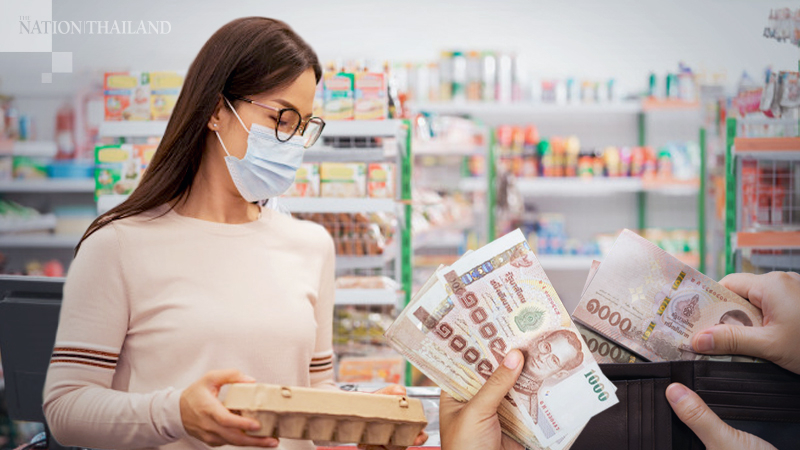
The Finance Ministry is working out details of the shopping stimulus. The government will support half of the daily consumption spending by low-income groups. The measure is expected to be implemented from October to December.
“We want to support as many people as possible, and people are expected to be invited to register for the scheme soon. The measure is aimed at supporting daily spending and reducing the cost of living; it is not a one-time spending on big items,” he clarified.
The concept is that each person will get about Bt3,000 from the government to partially pay for consumer daily spending with their own money, and consumers have to spend the money at small shops, as the government wants to support small businesses, he said.
Meanwhile, Anusorn Tamajai, an economist at Rangsit University, suggested that the government target low-income and small businesses, because shopping stimulus packages in the past had mostly benefited large businesses.
Anusorn said the government should target the 15 million consumers who hold state welfare cards.
Each cardholder may receive grants of about Bt2,500 to Bt5,000 cash handout or credit transferred to e-wallet, he said.
If the government spends Bt45 billion, then it would increase transactions in the market to Bt180 billion to Bt270 billion, boosting economy growth by 0.3 percentage point.
The Bank of Thailand has forecast that the economy will shrink by 8.1 per cent this year due largely to the fallout from Covid-19. More workers are expected to be laid off if economic recovery is delayed by the threat of a second wave of infections.
Anusorn said the United Kingdom’s Brexit deal will also affect Thailand’s export. Currently Thailand’s exports to Britain are worth about US$4 billion annually, representing 1.3 to 1.4 per cent of total exports.
The trade talk tensions between the EU and Britain have worried investors that it may lead to a no-Brexit deal when deadline is reached in December this year.
If there is no deal, Britain will allow 60 per cent of imported goods to have no tariffs in line with World Trade Organisation rules. If so, about 50 to 60 per cent of Thai products to Britain would have a lower tariff burden. These products would cover dog and cat foods, equipments to receive electronic signals, and jewellery, he added.
EconSep 13. 2020Lohmann Brown chickens stand outside a barn at Meadow Haven Farm in Sheffield, Ill., on Aug. 4, 2015. CREDIT: Bloomberg photo by Daniel Acker.
By Syndication Washington Post, Bloomberg · Tiffany Kary · NATIONAL, BUSINESS When covid-19 arrived this winter, Chase Beathard worried so much about meat shortages that he took advantage of a Craigslist ad offering a free boar. Now the 34-year-old breeds pigs.
Producing pork, from his home in Shelton, Washington, places Beathard in a cohort who plunged into do-it-yourselfism while hunkering down during the pandemic. They are gobbling up content, like a YouTube series on growing food from Homesteaders of America that had a 10-fold jump in subscribers in 48 hours. Meanwhile, sales more than doubled at Etsy, an online market for handmade goods. Revenue gains at DIY giants Home Depot and Lowe’s are the highest in nearly two decades. And if you’re looking for a pressure canner, chickens or mason jars, good luck; they’re often sold out.
“Covid-19 has just accelerated some of our long-term homesteading goals,” Beathard said.
While covid has decimated large swathes of the global economy, it has sparked others, like video conferencing and home appliances. Do-it-yourself pursuits, such as bread making, gardening and crafts, have also boomed and appear primed to last after the pandemic becomes a dark, distant memory.
Just as victory gardeners supplemented rations and boosted morale during the World Wars, the DIYers of coronavirus are facing quarantines and shortages with a mix of survivalist bravado and self-expression. Many are skipping the usual retailers, and instead turning to recycled goods, small businesses or individuals for their needs.
Not all of these consumers are as hardcore as Beathard, a plant scientist who lives off a 10-acre plot of land with his wife and four kids.
Take Abdel Elshiekh, a neuroscience doctoral candidate at Montreal’s McGill University. He tried to find moss poles for his houseplant hobby, but they were sold out at Home Depot and Canadian Tire. So the 31-year-old built his own from coconut fiber. Then he made plant fertilizer with banana peels, eggshells and coffee grounds. Soon, he was propagating his own flora.
“It’s a way for me to seek refuge from external events I can’t control,” said Elshiekh, who is also cutting his hair and baking bread.
People who were already DIY hobbyists are expanding their skills. Tynika-Ann Carter, a 24-year-old former model in Western Cape, South Africa, turned to farming and gardening years ago in a quest to replace materialism with something more wholesome. Since the virus, she’s added making baskets, weaving and crocheting. “Covid has given me more time to dive in and give myself fully to the things I love,” she said.
Beathard, Elshiekh and Carter model a new attitude about what’s cool, and show how the pandemic is accelerating it. Like hipsters, they’re setting new trends and flaunting the look on Instagram. But they’re also doing a lot of the hard, survival-focused work that defines homesteading.
Some have dubbed them the hipsteaders.
“We had to learn to do more for ourselves, to be more self-sufficient,” Mary Osirim, a professor of sociology at Bryn Mawr College, said of the past six months of lockdowns and sporadic shortages. This do-it-yourself ethos is being driven by more free time because of less traveling and commuting, but also necessity, she said.
Osirim and her fellow sociologists are only beginning to measure the pandemic’s impact. A survey by Bloomberg News and Morning Consult suggests not only that many more people cooked, baked and worked out at home than ever before, but that they want to continue doing so after the virus.
The poll of 2,200 U.S. residents in late June showed that a third of Americans grew herbs and vegetables and did their own sewing and clothing repairs. Equally significant, 60% of Americans expect in a fully reopened economy to do more for themselves, instead of paying for services.
The survey shows a mix of yearning for tradition and new ways forward. The number of people who want to spend more time raising chickens after the pandemic is 4%, the same as web design. Beekeeping came in at 2%, equaling 3D printing.
While it’s hard to measure the economic impact of hipsteading, it does intersect several giant markets. Globally, there’s $600 billion in home improvement, $576 billion in gardening, $526 billion of handicrafts, $59 billion in kitchenware and $16 billion in organic poultry and meat sales.
That doesn’t even get into clothing and an aesthetic some call “cottagecore,” “farmcore” or “countrycore.” Or shifting real estate values; while views of suburban real estate rose 13% this year, as more people contemplate leaving cities, views of rural real estate grew 16%, according to Realtor.com.
Hipsteading has deeper roots than the past six months. Around 2008 on the streets of Brooklyn, where many a fashion is born, the ironic t-shirts and retro record shops of hipsters gave way to something new: bearded men, small-batch pickles and homemade soaps. Farmers markets proliferated.
By 2013, as Etsy prepared to go public, the term hipsteader made appearances on websites about crab apple cordial and chevron knitting patterns. Since then, as the youngest consumers, Gen Z, eke out their identity, buzzwords like self-care and hygge (a Danish word for coziness) suggest the home-centered mindset is destined to grow.
Then along came Covid-19 and a global recession. Shortages and the need to be frugal created more DIYers than ever.
“When you’re worried that the marketplace won’t function, you engage in more activities necessary to produce your own food or whatever you’re most worried about,” said Beth Redbird, a sociologist at Northwestern University.
And a “psychology of abundance” doesn’t easily return after a trauma, according to Ian Bell, a consumer researcher with Euromonitor International. Activities like stockpiling have continued well after events like Cape Town’s water crisis and Brexit.
Making money off the trend can be challenging, but even do-it-yourselfers need materials and a marketplace. And as people shun travel and leisure, there’s about $1 trillion up for grabs in just the U.S., according to research firm R5 Capital.
Tractor Supply said a shift in spending from travel, entertainment and dining into homesteading, land maintenance and backyard living has helped boost its sales by 35% last quarter-the most in nearly two decades.
The sales booms at Home Depot and Lowe’s came after people cut back on bringing professionals into their homes during Covid, and now these DIYers have more confidence to take on projects. Same goes for Kingfisher Plc, a home-improvement chain in Europe, and Einhell Germany AG, a Bavarian-focused gardening supplier.
Meanwhile at Etsy, which has seen its stock jump about 150% this year after record sales gains, searches for DIY kits have almost quadrupled. Chief Executive Officer Josh Silverman sees this hipsteader movement as an acceleration of a shift toward handmade goods that’s been percolating for several years.
“We want to buy fewer things,” Silverman said. “But we want the things we buy to have more meaning.”
Back in the state of Washington, Beathard now has that boar plus five pigs, 11 piglets, and 34 chickens. And he recently became convinced he needed to buy a dairy cow.
“If the food industry collapses completely, we’ll at least have milk and cheese and butter.”
The Finance Ministry has assured that there are sufficient funds in the state coffers to pay living allowance to elders and disabled people as well as the monthly salaries of state officials.
The ministry’s spokesperson, Lavaron Sangsnit, denied a report that the country had to suspend payment of the allowance to elders and disabled people due to lack of budget, and funds were enough to pay only three months’ salaries of state employees.
He clarified that the government had not stopped the allowance payment but only delayed it, pending budget adjustment for the number of eligible recipients this month. September is the last month of such allowance payment in the 2020 fiscal year. He added that the payment is expected to be finished this month.
The government has already allocated sufficient budget for state officials’ salaries, he added.
Addressing public concerns about non-performing loans in the banking system, he said the government, the Bank of Thailand and financial institutions have joined forces to launch measures to tackle the problem.
Investors in stocks should follow political developments both at home and abroad, as it could pressure the Stock Exchange of Thailand (SET) Index next week, market analysts said.
The baht this week (September 7 to 11) moved between Bt31.23 and Bt31.46 against the dollar before closing at Bt31.32 and Bt31.33.
The baht strengthened against the dollar as the US Federal Reserve looked set to maintain the interest rate at nearly zero in the long term after Fed chairman Jerome Powell announced a plan to raise inflation to support the US labour market and economy. This caused a weakening of the dollar compared to other major currencies.
An analyst at CIMB Thai Bank expected the baht to move between Bt31.00 and Bt31.50 next week against the dollar, adding that several central banks would hold meetings next week, such as the Fed (September 15-16), the Bank of Japan (September 16-17) and the Bank of England (September 17).
The SET Index on Friday (September 11) closed at 1,279.96, down 10.93 points or 0.85 per cent, while total transactions amounted to Bt44.155 billion.
An analyst at Tisco Securities expected the index next week to remain in negative territory between 1,260 and 1,300 due to political pressure both domestic and international.
“In Thailand, student protesters will hold a large political rally next Saturday. Investors were concerned that it would prolong and intensify,” the analyst said. “In foreign countries, we have to follow US-China tensions and the number of Covid-19 cases, so investors should be careful while investing.”
The price of gold on Saturday (September 12) was US$1940.50 per ounce while the price in Thailand was Bt28,700 per baht weight.
An analyst at YLG Bullion International said the price of gold would fluctuate sideways in the short term, advising investors to buy gold when the price dropped to the support line between $1,936 and $1,927 per ounce and take profit when the price rises to the resistance level between $1,956 and $1,966 per ounce.
“If the price drops below the support line, investors should wait to buy gold when the price drops to the next support line at $1,906 per ounce,” the analyst said.
The price of gold dropped by Bt150 per baht weight in morning trade on Saturday (September 12), the Gold Traders Association reported.
As of 9.18am, the buying price of a gold bar was Bt28,600 per baht weight and selling price Bt28,700, while gold ornaments were priced at Bt28,091.48 and Bt29,200, respectively.
At close on Friday (September 11), the buying price of a gold bar was Bt28,750 per baht weight and selling price Bt28,850 while gold ornaments were priced at Bt28,227.92 and Bt29,350, respectively.
The Comex (Commodity Exchange) gold price to be delivered in December dropped by US$16.4, or 0.83 per cent, closing at $1,947.9 (Bt60,908.36) per ounce on Friday. Gold price rose by 0.7 per cent this week.
Gold moved to negative territory on Friday, as investors sold the precious metal to take profit, while it was pressured by strong US economic data.
Projects under the Village Fund worth Bt16 billion have been approved by a state subcommittee vetting the budget for local community development.
The projects will now be submitted to the Cabinet for approval on September 15, said National Village and Urban Community Fund Office director Rakpong Sengcharoen.
He said his office had asked for Bt200,000 for each of 79,604 Village Funds nationwide, aiming to generate jobs and revenue in the communities and mitigate the impact of Covid-19.
He said that the projects could begin in October and will end next February.
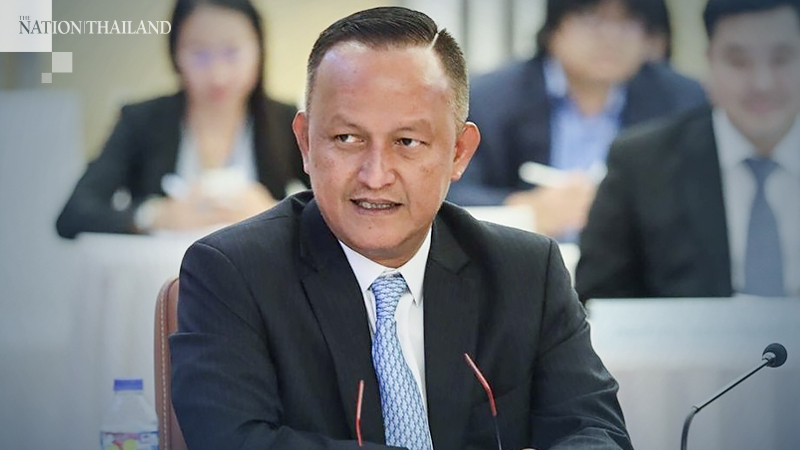
EconSep 11. 2020Deputy Transport Minister Thaworn Senneam, right
By The Nation
Betong Airport in the southern province of Yala should be open for services by December, Deputy Transport Minister Thaworn Senneam said on Friday (September 11).
Now that the airport’s construction has been completed, the authorities are running tests ahead of applying for operating licence and installing related aviation systems. The minister added that he will discuss the airport’s opening with related agencies, including the Civil Aviation Authority of Thailand, to ensure all remaining work is completed in the next two months.
The Stock Exchange of Thailand (SET) Index dropped further on Friday to close at 1,279.96, down 10.93 points or 0.85 per cent. Total transactions amounted to Bt44.155 billion with an index high of 1,296.13 and a low of 1,279.33.
In the morning session, an analyst from Krungsri Securities said he expected the index to fall to between 1,280 and 1,285 due to lack of positive sentiment.
“The index is also under pressure from the direction of foreign indices, the low oil price and uncertainty over domestics politics after student protesters vowed to go ahead with their September 19 rally,” he said.
The 10 stocks with the highest trade value on Friday were JMART, JMT, STGT, MINT, SUPER, KBANK, SCC, GPSC, AOT and CRC.
As of 4.30pm, the price of oil rose by US$0.03 or 0.08 per cent to $37.33 per barrel, while gold dropped by $10.70 or 0.54 per cent, to $1,953.60 per ounce.
Other Asian indices were mixed:
Japan’s Nikkei Index closed at 23,406.49, up 171.02 points or 0.74 per cent.
China’s Shang Hai SE Composite Index closed at 3,260.35, up 25.52 points or 0.79 per cent, while the Shenzhen SE Component Index closed at 12,942.95, up 200.10 points or 1.57 per cent.
Hong Kong’s Hang Seng Index closed at 24,503.31, up 189.77 points or 0.78 per cent.
South Korea’s KOSPI Index closed at 2,396.69, up 0.21 points or 0.0088 per cent.
Taiwan’s TAIEX Index closed at 12,675.95, down 15.80 points or 0.12 per cent.
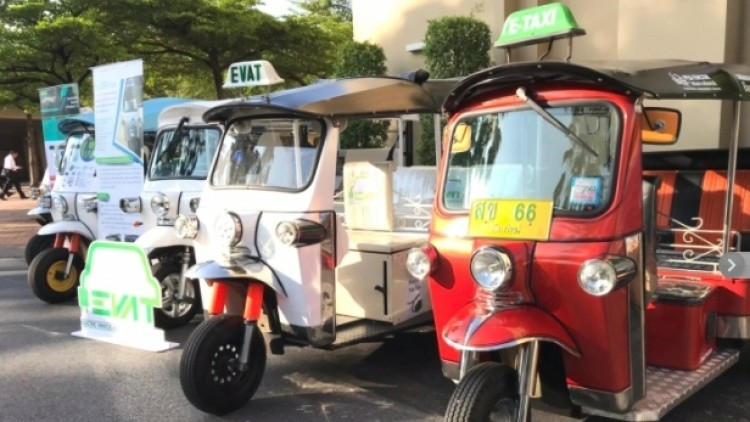
A Swiss company has expressed interest in investing in three-wheel electric vehicles in Thailand to promote clean energy, Yongyuth Nakdang, deputy director-general of the Department of Land Transport, said.
He was speaking after a meeting on Thursday with Helene Budliger Artieda, Switzerland’s ambassador to Thailand.
“This is the first time that the Swiss are interested in doing business in electric tricycles,” Yongyuth said. “Yesterday, they sought information on the approved tricycle models and found that some of their designs do not meet the legal requirements of Thailand. Therefore, the Swiss company would improve the blueprint for the next proposal,” said Yongyuth.
According to the latest report, 19,620 three-wheel vehicles have been registered in Thailand, comprising 1,512 petrol-powered vehicles, 11 diesel, 13,088 LPG, 3,639 LPG-petrol, 1,202 CNG, five CNG-diesel, and 166 electric.
Total car registration nationwide as of August 2020 was 41 million. Of the total, 177,000 are electric cars, divided into 4,799 electric, 161,000 petrol-electric, 11,470 diesel-electric, 30 LPG-petrol-electric, and 75 plug-in petrol-electric.
In 2017-20, there were 16 companies and 26 projects seeking investment promotion benefits from the Board of Investment, totalling production of 560,000 vehicles, of which about 120,000 are electric vehicles. The government aims to produce 750,000 electric vehicles by 2030.

 Lohmann Brown chickens stand outside a barn at Meadow Haven Farm in Sheffield, Ill., on Aug. 4, 2015. CREDIT: Bloomberg photo by Daniel Acker.
  Finance ministry’s spokesperson, Lavaron Sangsnit

 Deputy Transport Minister Thaworn Senneam, right