Experts see good value in Bangkok Commercial Asset Management (BAM) shares, as mutual funds buy up the stock on expectations of a second-half recovery for Thailand’s largest manager of distressed assets.
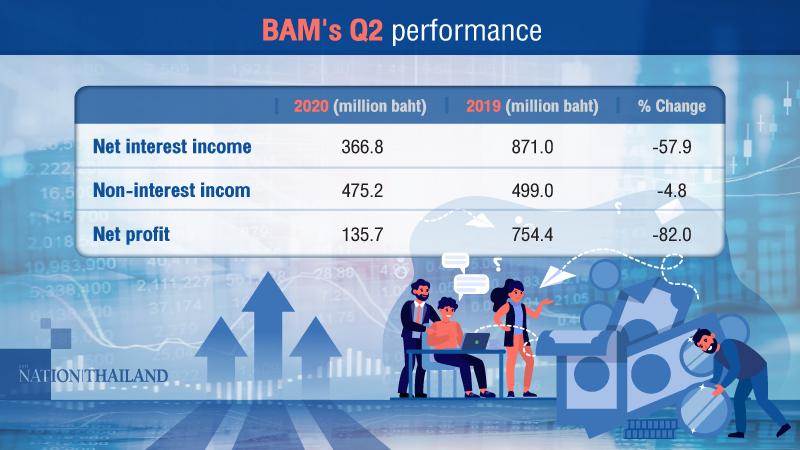
BAM shares closed at Bt23.30, down Bt1.20 or 4.30 per cent on Monday (August 31) after a disappointing second-quarter performance.
Thanatphat Suksrichavalit, an analyst at Maybank Kim Eng Securities (Thailand), said BAM shares dropped after its Q2 performance was lower than market expectations of 80 per cent.
The decline was due mainly to the Covid-19 fallout and changes in financial reporting standards that meant the company was unable to recognise revenue despite cash flowing in.
“In fact, BAM was still able to generate cash flow of about Bt2.7 billion. Although it was 6 per cent down year on year and 14 per cent down quarter on quarter, it was still higher than the 20 per cent drop expected by the market,” said the analyst.
He forecast BAM’s performance would recover to its first-quarter level now that the Legal Execution Department has reopened after the Covid-19 lockdown, allowing the BMA to resume auctioning off its non-performing assets [NPAs].
“We found signs of NPA sales growth after the company held an [assets] auction in June,” he added.
“As the company is not facing cash flow difficulties, we expect it to pay a dividend of Bt1 per share as the market expects.”
Anuwat Srikajornratkul, an analyst at Capital Nomura Securities, said this was an opportunity to gradually buy BAM shares, given that mutual funds are aiming to buy them despite the weak Q2 performance.
“We judge that performance has already bottomed out, but an important risk factor is high expectation in the market as most analysts are waiting for additional information from the company,” he said.
“We have cut its share price forecast from Bt29.50 to Bt27.50 per share as its performance for the rest of this year is expected to be unchanged.”
Tanapat Chatsatien, an analyst at Trinity Securities, said the drop in BAM’s Q2 performance was caused by the temporary closure of the Legal Execution Department.
“The company’s revenue is expected to increase after the Legal Execution Department reopened in June, while the company is offering discounts on its Non-Performing Assets [NPAs] to stimulate sales,” he said.
He added that BAM shares were attractive because the price had dropped sharply but company profit in the rest of this year is expected to recover.
“We have kept the company’s 2021 share price forecast at Bt28.50 per share,” he said.
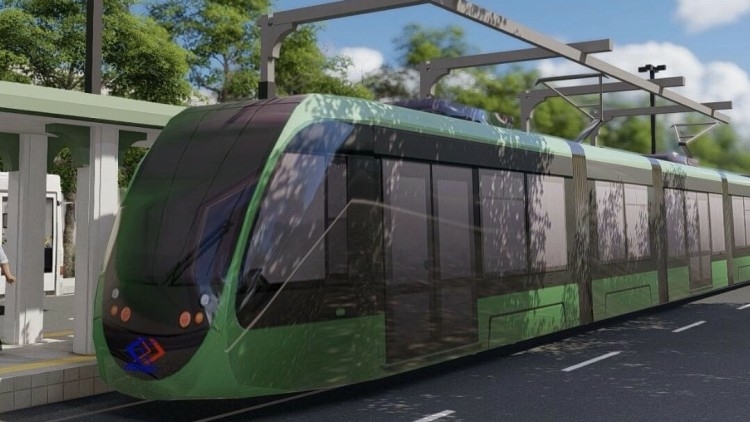
Nakhon Ratchasima should have electric trams by 2025, said Mass Rapid Transit Authority of Thailand (MRTA) deputy governor Theeraphan Tachasirinugune today, during the second market sounding for the city’s Green Line route.
The study of the system, which features 21 stations, should be ready to be presented to the MRTA board this year before being proposed to Cabinet. Bidding for private companies to jointly invest in the project is expected by the middle of next year.
Construction is scheduled to begin in 2022 before the system launches operations in 2025. Successful bidders will be offered a 30-year concession for operation.
The project will cost Bt7.11 billion, of which Bt2.2 billion is for the civil works, Bt2.2 billion for the tram system, Bt995 million for procurement of 10 trams, and B176 million for hiring a consultant. Yield is estimated at 13.11 per cent with a break-even point in the 11th year.
The winning bidder will gain revenue from ticket fare collection and commercial activities such as leasing advertising space in stations.
The Stock Exchange of Thailand (SET) Index closed at 1,310.66 today (August 31), down 12.65 points or 0.96 per cent. Total transactions amounted to Bt54.005 billion with an index high of 1,333.30 and a low of 1,308.73.
In the morning session, an analyst at Krungsri Securities expected the index to rise to between 1,330 and 1,335 in response to news that US President Donald Trump will sign the US$1.3-trillion Covid-19 relief bill, before falling back.
“Meanwhile, the market gained positive sentiment from the Federal Reserve’s move [last Thursday] to change its approach to inflation to support the US economy,” the analyst said.
The 10 stocks with the highest trade value today were BAM, KBANK, SCC, MINT, PTT, CPALL, CPF, BBL, ADVANC and CRC.
As of 4.30pm, the price of oil rose by US$0.45 or 1.05 per cent to $43.42 per barrel, while gold fell by $6.10 or 0.31 per cent, to $1,968.80 per ounce.
Other Asian indices were mixed:
Japan’s Nikkei Index closed at 23,139.76, up 257.11 points or 1.12 per cent.
China’s Shang Hai SE Composite Index closed at 3,395.68, down 8.13 points or 0.24 per cent, while the Shenzhen SE Component Index closed at 13,758.23, down 93.10 points or 0.67 per cent.
Hong Kong’s Hang Seng Index closed at 25,177.05, down 245.01 points or 0.96 per cent.
South Korea’s KOSPI Index closed at 2,326.17, down 27.63 points or 1.17 per cent.
Taiwan’s TAIEX Index closed at 12,591.45, down 137.40 points or 1.08 per cent.
The price of shares in Bangkok Commercial Asset Management (BAM), the country’s biggest manager of distressed assets, fell 6 per cent to Bt23 in today’s morning session (August 31) after it reported a disappointing second-quarter performance.
BAM’s second-quarter profit was Bt136 million, down 82 per cent year on year.
Thanatphat Suksrichavalit, an analyst at Maybank Kim Eng Securities (Thailand), said BAM shares dropped due to a Q2 performance that was lower than market expectations of 80 per cent.
The decline was mainly due to the Covid-19 fallout and changes in financial reporting standards that meant the company was unable to recognise revenue despite cash flowing in.
“In fact, BAM was still able to generate cash flow of about Bt2.7 billion. Although it was 6 per cent down year on year and 14 per cent down quarter on quarter, it was still higher than the 20 per cent drop expected by the market,” said the analyst.
He forecast BAM’s performance would recover to its first-quarter level now that the Legal Execution Department has reopened after the Covid-19 lockdown, allowing the BMA to auction off non-performing asset [NPA]s.
“We found signs of NPA sales growth after the company held an [assets] auction in June,” he added.
“As the company is not facing cash flow difficulties, we expect it to pay a dividend of Bt1 per share as the market expects.”
An analyst at Trinity Securities said BAM revenue from NPLs dropped 28 per cent quarter on quarter because the Legal Execution Department was closed from April to May, causing auctions of collateral assets to be postponed.
“Although profit from selling NPAs increased by 92 per cent quarter on quarter, it could not compensate for the loss in revenue from NPLs,” the analyst said. “The company’s operating cost dropped slightly in line with its revenue, while expected credit loss [ECL] rose slightly from the deduction of NPL income from accrued income.”
The analyst expected the cash flow from NPLs to recover over the remainder of this year, while cash flow from NPAs should be high as the BAM will launch promotions to boost sales.
“BAM has reassessed the value of deferred tax asset [DTA] and found an increase in deferred tax liability (DTL) from the Legal Execution Department’s debtors, causing the company’s remaining DTA to be Bt5 billion,” he added.
An analyst at Yuanta Securities (Thailand) said BAM shares were still interesting because its performance has bottomed out, while its NPL and NPA sales are likely to recover steadily.
“In addition, BAM gained positive sentiment from financial institutions’ bad debt, which is expected to increase in 2021, resulting in a rise in NPLs,” the analyst said.
The Stock Exchange of Thailand (SET) Index rose by 7.31 points, or 0.55 per cent, to 1,330.62 on Monday morning.
An analyst at Krungsri Securities expected the index to rise between 1,330 and 1,335 before falling in response to positive news that US President Donald Trump will sign the US$1.3-trillion Covid-19 relief bill.
“Meanwhile, the market gained positive sentiment from the Federal Reserve’s move to change its approach to inflation to support the US economy,” the analyst said.
He recommended that investors buy stocks whose third-quarter performance will improve, such as CPF, GFPT, TU, ASIAN, KCE, HANA, DELTA, HMPRO, GLOBAL, DOHOME, COM7, JMT, CHG, BCH, PTG, PLANB, CBG and TASCO.
The SET Index had closed at 1,323.31 on Friday (August 28), down 3.50 points or 0.26 per cent. Total transactions amounted to Bt54.673 billion with an index high of 1,337.61 and a low of 1,319.45.
The price of gold rose by Bt50 per baht weight in morning trade on Monday (August 31), the Gold Traders Association reported.
As of 9.23am, the buying price of a gold bar was Bt28,800 per baht weight and selling price Bt28,900, while gold ornaments were priced at Bt28,288.56 and Bt29,400, respectively.
At close on Saturday, the buying price of a gold bar was Bt28,750 per baht weight and selling price Bt28,850 while gold ornaments were priced at Bt28,227.92 and Bt29,350, respectively.
Hong Kong gold price rose by HK$220, opening at $18,250 (Bt73,090.99) per tael this morning.
Spot gold price moved to US$1,970 (Bt61,173.39) per ounce on Monday morning after the price rose by $42.3 to $1,974.9 (Bt61,307) per ounce at Friday’s close.
Gold price closed in positive territory after the US Federal Reserve announced changes to its approach to inflation to support the labour market and economic crisis, as well as maintain the interest rate at a low level.
Also, gold price gained positive sentiment from the weakening dollar as well.
Three-decade economic boom comes to a sudden halt in Vietnam
EconAug 31. 2020People wear protective masks while shopping at a wet market in the Old Quarter in Hanoi, on Aug. 15., 2020. CREDIT: Bloomberg photo by Linh Pham.
By Syndication Washington Post, Bloomberg · John Boudreau, Nguyen Dieu Tu Uyen · BUSINESS, WORLD, US-GLOBAL-MARKETS, ASIA-PACIFIC For the past three decades, Vietnam has known only good — or great — economic news. The nation’s consistent growth as an exporter, propelled by Communist leaders who began embracing market-oriented policies in the late 1980s, pushed many into the middle class.
The coronavirus pandemic changed all that. With garment companies seeing orders slashed and other sectors hit with sudden export declines, Vietnam’s workers are enduring the downside of being tethered to the global economy. The economic slowdown in the U.S. and other markets Vietnam depends on for growth is being felt on the streets of Ho Chi Minh City and Hanoi, as well as in villages and tourist centers.
Le Thi Hoa, who sells pineapple and mango slices outside Ho Chi Minh City’s Ben Thanh Market in the heart of the commercial hub, is among those wondering where the good times have gone.
“Now people don’t go out,” said Hoa, 55, wearing a face mask and sitting on a plastic chair next to fruit baskets in front of a closed seafood restaurant. “I can only sell about a third of what I did before the epidemic.”
Vietnam has been one of globalization’s stars, transforming itself from a largely agricultural economy to a manufacturing powerhouse within the span of a few decades. With exports equivalent to the size of its GDP, Vietnam has seen its economy grow as fast at 7.02% in 2019. Now it’s bracing for the slowest growth in two decades, of 2.4% this year. During the second quarter, it expanded by just 0.36% from a year earlier.
“Vietnam has experienced a tsunami of good news over the past 30 years,” said Ralf Matthaes, managing director of Infocus Mekong Research, who has lived in the country since 1994. “This is the first time since joining the global economic community two decades ago that Vietnam is experiencing a significant economic downturn.”
The abrupt slump highlights the sweep of the epidemic’s financial fallout and how even countries that have been relatively successful in containing the virus are unable to avoid its economic afflictions. Such economies won’t be able to return to business as usual until the rest of the world does.
“It’s likely to be quite bumpy,” said Sian Fenner, a Singapore-based economist at Oxford Economics, which forecasts an 8% contraction in global trade for 2020. “Countries that are export-oriented will remain vulnerable.”
In April, Vietnam’s exports plummeted 14% from a year earlier, followed by a drop of 12.4% in May as global commerce came to a standstill, according to the Department of Vietnam Customs. For the seven months through July, exports rose just 1.5% compared with 8% in the same period last year.
Vietnam’s leaders, though, show no signs of reversing economic course after signing more than a dozen trade agreements in recent years and making the nation a magnet for foreign investment.
The government, grappling with an outbreak in the coastal city of Danang that has spread to 14 provinces and cities, has garnered international respect for its virus containment. Until July 31, the country hadn’t reported a single infection death. It confirmed 1,029 virus cases and 28 deaths as of Aug. 26 as officials employ tough anti-virus measures, while allowing manufacturing businesses to stay open.
Though Vietnam is in better shape than other economies in Asia, where the virus has been far more deadly and disruptive, its reliance on foreign markets and a growing tourism industry have given its residents a lesson in global volatility.
In recent years, Vietnam has become a key cog in the global supply chain. It has opened factories for companies including Intel Corp., Samsung Electronics Co. and LG Electronics Inc., as well as solar panel makers and garment producers. Vietnam’s exports in 2019 reached $264.3 billion — a fourfold jump since 2008. Average annual salaries rose from $1,154 to about $2,800 in that period, according to government data.
The pace of Vietnam’s shipments to the U.S., its largest market representing about 23% of exports in 2019, slowed in the first half of 2020 compared with the same period last year. The government reported a 14.6% increase in exports to the U.S., about half the rate of shipment growth in 2019.
Many of the sectors that have been hard hit, such as garments and textiles, employ millions of low-skilled workers. Samsung’s Vietnam unit, whose electronics products represented about 20% of the country’s total exports last year, revised its 2020 exports forecast to $45.5 billion, a $13.5 billion drop from 2019, according to the industry and trade ministry.
Meanwhile, the tourism industry, which represents about 9% of the economy, had a 55.4% revenue drop during the first seven months of the year. Given the pounding to the manufacturing and hospitality industries, almost a third of the population — 31 million workers — endured a financial fallout during the second quarter.
Consumers kept more money in their wallets during the second quarter, becoming the world’s most avid savers and ranking job security as the top concern, according to Nielsen Vietnam. Still, their historic optimism could lead to a relatively quick return to normal consumption once the pandemic ends, said Nguyen Anh Dzung, head of retail measurement services.
With millions of assembly-line employees out of work, some local governments worry about the potential for social unrest, said Fred Burke, managing partner at the Baker McKenzie law firm in Ho Chi Minh City. He recalled that Minister of Planning and Investment Nguyen Chi Dung recently pleaded with Vietnam Business Forum members not to fire their workers but to hold on to them as long as they could.
Given the disruptions, consumer confidence is at its lowest point in 25 years, according to Infocus Mekong Research. Two-thirds of Vietnamese residents are deferring or deciding not to make big purchases. And 63% of Vietnamese are considering taking out loans as they seek financial lifeboats, the research firm said.
“Everyone is saving and we don’t go out so much,” said Bui Viet Nam, a 34-year-old executive with a Ho Chi Minh City garment manufacturer. “Incomes are going down and people are thinking about ways to earn more money through selling things online or getting a second part-time job. It’s a new world.”
Government to hike repayment in bid to rein in public debt
EconAug 31. 2020Patricia Mongkhonvanit, director-general at the Public Debt Management Office (PDMO)
By The Nation
The government has increased debt repayment to 3 per cent of the total national annual budget in order to maintain fiscal discipline, the Finance Ministry said.
Patricia Mongkhonvanit, director-general at the Public Debt Management Office (PDMO), said the government has increased debt repayment to 3 per cent of the annual budget of Bt 3.3 trillion for fiscal year 2021 (October 2020 to September 2021).
Usually, the government earmarks about 2 per cent of total expenditure for debt payment, she noted.
In the current fiscal year, the government had originally planned principal repayment at 2.68 per cent of total expenditure of Bt3.2 trillion, but following the impact of Covid-19 on the economy, the government cut debt payment to 1.68 per cent, she explained.
According to the fiscal discipline law, debt payment will be between 2.5 to 3.5 per cent.
Meanwhile, interest payment is set at 5-6 per cent of total expenditure, in keeping with the international benchmark of less than 10 per cent.
She assured that Thai public debt was not high, currently at 45.83 per cent of gross domestic product (GDP). However, public debt will shoot up to 57.8 per cent of GDP by the end of fiscal year 2021, approaching the sustainability limit set at 60 per cent of GDP.
Thai public debt is on a rising trend as the government recently issued an emergency decree to borrow Bt1 trillion to deal with Covid-19’s impact on the economy and people’s income. The government also plans to borrow an extra Bt214 billion to finance the budget deficit, originally estimated to be Bt 469 billion.
Of the Bt1-trillion loan for recovery from the impact of Covid-19, so far the government has borrowed about 33 per cent of the target. The government’s borrowing is expected to reach Bt450 billion by the end of September — the end of the current fiscal year. The rest of the Bt550 billion will be borrowed during fiscal year 2021, she added.
The budget bill for fiscal year 2021 is pending approval in Parliament.
Technology shares are playing an important role in driving the economy, as they have beenable to escape the economic slowdown compared to other groups.
The rise in the value of technology shares boosted indices in the US and North Asian markets, such as South Korea, Taiwan and China to rebound higher than the before the Covid-19 outbreak, although the pandemic has not been resolved yet.
One of the mutual funds which invests in North Asian countries is Tisco North Asia Equity Fund (TISCONA) that has a policy to invest in foreign Exchange Traded Funds (ETFs) to generate returns higher than the returns of indices in four North Asian markets, namely South Korea, Taiwan, China and Hong Kong.
TISCONA fund was established in early 2014. The average return in the past five years was 8.92 per cent, higher than the return of four indices in North Asian markets of 5.24 per cent.
The fund had a loss in 2015 and 2018 of 6.65 per cent and 18.18 per cent respectively and had profit in 2016, 2017 and 2019 of 5.76 per cent, 36.70 per cent and 17.70 per cent respectively. The return since the beginning of this year was 3.80 per cent.
The highest loss in the past five years was 34.54 per cent, while the fund’s standard deviation was 18.12 per cent per year.
According to data on June 30 this year, TISCONA fund invested 24.92 per cent in Xtrackers MSCI Taiwan UCITS ETF, 24.86 per cent in Tracker Fund of Hong Kong, 24.82 per cent in iShares Core MSCI China Index ETF and 24.81 per cent in Xtrackers MSCI Korea Index UCITS ETF.
In Taiwan ETF, the fund invested 63.92 per cent in technology shares and 16.35 per cent in finance shares, of which 33.95 per cent of the total shareholding was TWN Semicont Man, followed by 5.14 per cent in HON HAI Precision Industry.
In the Hong Kong ETF, the fund invested 49.68 per cent in finance shares and 11.27 per cent in technology shares, of which 11.27 per cent was Tencent Holdings, followed by 10.31 per cent in AIA Group.
In the China ETF, the fund invested 27.16 per cent in luxury goods shares and 22.22 per cent in telecommunication shares, of which 16.95 per cent of total shareholding was Alibaba Group Holding, followed by 15.42 per cent in Tencent Holdings.
In South Korean ETF, the fund invested 45.73 per cent in technology shares and 9 per cent in telecommunication shares, of which 29.75 per cent was in Samsung Electronics, followed by 5.76 per cent in SK Hynix.
TISCONA fund’s outstanding point is the fund diversified risks in North Asian countries, but the fees charged by the fund are higher than similar funds. The fund currently charges 1.6 per cent.
North Asian stock markets are likely to grow further compared to other Asian regions because of the high proportion of technology shares.
Pilot launch of new ‘Phuket Model’ to let tourists in likely next month
EconAug 29. 2020Tourism and Sports Minister Phiphat Ratchakitprakarn
By The Nation
A new model to reopen Phuket to foreign tourists was expected to be piloted in the middle of next month, Tourism and Sports Minister Phiphat Ratchakitprakarn said.
He said that on August 25, the Cabinet had approved in principle that Thailand Longstay, in which Tourism Authority of Thailand (TAT) owns 30 per cent, should coodinate with tourists on visa application and purchase of insurance. But the tourists would have to bear the cost of visa and insurance.
The tourists will be required to undergo Covid-19 test 48 hours before their departure for Phuket and they will be tested again when they arrive. They will have to stay in alternative state quarantine in Thailand for 14 days before they are allowed to travel in Phuket.
If they want to travel to other provinces outside Phuket, they will have to stay in the quarantine facility for 21 days.
The minister added that this new model should assure people that the tourists would not bring the infection to Thailand.
Phiphat said that this model was expected to be piloted in the middle of September with a first group of around 200 tourists. Most of them will be from Australia and New Zealand.
He said that tourists under this model must be from the countries where there has been no outbreak for at least 30 days.
The ministry will work out final details of the model, which will be forwarded to Prime Minister Prayut Chan-o-cha.
He added that this new model was different from the first “Phuket Model” that allowed tourists to travel only in “sealed areas”.
He said the ministry would push for the Phuket Model to be piloted in October. Around 10 hotels in Phuket are keen to participate in the Phuket Model.
He assured that utmost care would be taken to reopen the country.
Representatives from TAT, Public Health, Interior and Transport ministries, will visit Phuket on September 5-6 to survey the opinions of Phuket residents on the new model and the Phuket Model. The same team will also visit Samui Island next month to see if it is ready to serve the “Samui Bubble” model.
Deputy Government Spokesperson Traisulee Traisoranakul said on Friday (August 28) that Thailand would not be fully reopened to foreign tourists along the lines of the so-called “Phuket Model” any time soon because the government has to consider too many details.
She added that Phuket residents and Thai tourists can rest assured that no steps to reopen the country had been taken, and that utmost precaution would be ensured when borders are reopened.
Thai Airways International announced on Thursday it planned to launch charter flightsto Phuket from six international destinations in late November this year.
The six destinations are: Denmark, Germany, Britain, South Korea, Japan, and Hong Kong. The airline will operate flights twice a month or more on each route based on demand. THAI is also expected to fly charter flight tourists from China to Phuket.
Phiphat said that the ministry had maintained the target of 2 million foreign visitors during October 2020 to March 2021, focusing on high-end tourists who want to escape winter to stay longer than one month in Thailand. Most of them are regular visitors.



 People wear protective masks while shopping at a wet market in the Old Quarter in Hanoi, on Aug. 15., 2020. CREDIT: Bloomberg photo by Linh Pham.
  Patricia Mongkhonvanit, director-general at the Public Debt Management Office (PDMO)
 Tourism and Sports Minister Phiphat Ratchakitprakarn
