The Stock Exchange of Thailand (SET) Index rose by 9.95 points, or 0.74 per cent, to 1,351.02 in the morning session on Wednesday (July 15).
A stock analyst at Krungsri Securities expected the index to rebound between 1,350 and 1,355 before falling in response to positive news about a Covid-19 vaccine and rising crude oil price.
“Recently, Moderna revealed that the mRNA-1273 vaccine helped strengthen the Covid-19 patients’ immunity,” the analyst said.
“Meanwhile, the price of crude oil rose over US$40 per barrel again.”
However, the analyst advised investors to beware of mass sell-offs due to uncertainty following the second Covid-19 wave in Thailand after the number of new cases increased.
“Also, we advise investors to follow developments at the Opec+ meeting to consider an agreement on reducing the production of crude oil,” the analyst added.
He recommended that investors buy:
▪︎ Energy stocks that benefit from rising crude oil price, such as PTT, PTTEP, TOP, PTTGC, IRPC, SPRC and IVL.
▪︎ Food and electronics stocks that benefit from the weakening baht, such as TU, CPF, GFPT, TFG, ASIAN, KCE, DELTA, HANA and SVI.
▪︎ Stocks whose second-quarter performance will improve, such as TOP, PTTGC, SPRC, SCC, BGRIM, CKP, CPF, TU, TASCO, STA, STGT, SPALI, PRM, PTL, AJ, STARK and CBG.
The SET Index fell 1.30 points, or 0.1 per cent, to close at 1,341.07 points on Tuesday (July 14), with total transactions of Bt63.991 billion and an index high of 1,342.30 and a low of 1,326.65.
By Syndication Washington Post, Bloomberg · Sarah Ponczek, Claire Ballentine · BUSINESS U.S. stocks rose in volatile trading, led by gains in the energy, materials and industrial sectors. The dollar weakened to a five-week low and Treasurys were little changed.
The S&P 500 jumped 1% after swinging all day between gains and losses as investors weigh earnings season and the economic hit of rising virus cases. Megacap technology shares were headed for the first two-day slide since mid-May, with the Nasdaq 100 falling as much as 2%, before rallying late in the session. Banks were mixed after JPMorgan Chase & Co. reported strong trading results, while Wells Fargo & Co. tumbled after cutting its dividend and reporting its first quarterly loss since 2008.
“We may see this earnings season as one where companies speak honestly and send a slightly different message than, we’re never going to look back from the bottom,” said Liz Ann Sonders, chief investment strategist at Charles Schwab & Co. “I think it’s appropriate that companies are honest even if it’s deemed as throwing cold water on the V-shaped narrative.”
U.S. stocks finished in the red Monday after the S&P 500 briefly touching the highest level since the coronavirus pandemic. Equities have largely treaded water over the past month as worries about new virus cases are offset by optimism over stimulus spending and the economic recovery.
Still as new outbreaks appear around the world, officials are putting stricter measures in place to control the spread. Japan said a new state of emergency is possible and Hong Kong implemented its toughest social distancing measures yet. Florida reported a record number of coronavirus deaths among residents, while Arizona had the most new cases in 11 days.
“It’s this tug-of-war between the forward-looking assumption around a vaccine and treatment versus what is happening today as it relates to cases, the mortality rate and, more broadly, the spread,” said Matt Miskin, co-chief investment strategist at John Hancock Investment Management.
The U.K.’s two-year bonds yielded less than Japanese debt for the first time. Copper ended a six-day winning streak amid renewed tensions between Beijing and Washington.
In Asia, equities were broadly lower with Chinese and Hong Kong shares faring the worst. The Trump administration rejected China’s expansive maritime claims in the South China Sea, reversing a previous policy of not taking sides in such disputes.
These are some of the main moves in markets:
Stocks
The S&P 500 Index advanced 1.3% to 3,197.52 as of 4:05 p.m. EDT, the highest in five weeks on the largest gain in more than a week.
The Dow Jones industrial average climbed 2.1% to 26,642.59, the highest in almost five weeks on the biggest increase in more than two weeks.
The Nasdaq Composite Index increased 0.9% to 10,488.58.
The MSCI All-Country World Index climbed 0.5% to 543.54, the highest in five weeks.
Currencies
The Bloomberg Dollar Spot Index dipped 0.2% to 1,207.67, the lowest in almost five weeks.
The euro gained 0.4% to $1.1391, the strongest in more than four months.
The Japanese yen was little changed at 107.28 per dollar.
Bonds
The yield on two-year Treasurys gained one basis point to 0.16%, the biggest climb in almost two weeks.
The yield on 10-year Treasurys climbed less than one basis point to 0.62%.
Germany’s 10-year yield fell three basis points to -0.45%, the biggest drop in more than a week.
Commodities
West Texas Intermediate crude increased 0.4% to $40.27 a barrel.
Gold strengthened 0.4% to $1,810.03 an ounce, the highest in almost nine years.
Copper sank 0.6% to $2.94 a pound, the first retreat in almost three weeks and the largest decrease in more than four weeks.
Jul 15. 2020Bank of Thailand governor Veerathai Santiprabhob and other central bank executives meet with financial analysts on Tuesday to share their views on the latest economic situation.
By The Nation
The central bank will not extend the debt moratorium programme which ends in October and will instead focus on debt restructuring to help small businesses cope with the Covid-19 fallout, Bank of Thailand (BOT) governor Veerathai Santiprabhob said on Tuesday (July 14).
This programme was created to help SMEs survive the Covid-19 crisis, but it may damage the credit culture in the long run and lead to financial instability, he said.
“Several financial support schemes will expire in October. We don’t think most SMEs will fall off the cliff, because banks have provided them with more support than the central bank has done, by suspending debt repayment by as much as a year,” Veerathai said.
The important task now is that banks closely follow their debtors and implement appropriate measures for targeted groups, he said.
As for the Bt500-billion soft loan for commercial banks, he said, Bt103 billion in loans has been approved so far.
“Though we are far behind the target, we can extend our support period,” he said.
He also said that BOT is considering banks’ proposal that the Thai Credit Guarantee Corporation provide loan guarantees for more than two years.
Looking ahead, he added, the most important thing is to restructure debts that are consistent with each company’s cash flow and BOT will finely tune regulations to make debt restructuring more effective.
Mathee Supapongse, deputy BOT governor, said the central bank is studying bonds’ yield curve control as central banks in some countries have imposed yield curve control measures. BOT is also studying to see what impact low interest rates will have on financial institutions, savers, banks and financial system, though he said it is unlikely that the key policy rate will drop to zero per cent from the current historic low of 0.5 per cent.
The central bank is also urging local gold traders to trade in dollars instead of the baht in order to reduce the impact on the Thai currency’s exchange rate, he added.
Don Nakhontab, senior director at the central bank, expressed concerns about the severe impact the outbreak has had on the economy, which has prompted the central bank to project an 8.1 per cent contraction in growth.
Also, only about 8 million tourists are expected to arrive this year, down from 40 million last year. Tourism is not expected to recover until the end of next year, assuming a vaccine is available by then. He said the economy has bottomed out in the second quarter, but if the debt default becomes more globally widespread and there is a second wave of infections, then the contraction in the following quarters will be even deeper.
Unemployment rose rapidly in May, as 300,000 people were laid off and applied with the social security fund for assistance, he said, adding that it will become very difficult for new graduates to find employment.
Jul 15. 2020Shop owners close their shops in the Passione mall, formerly known as Laem Thong, for two days of cleaning after an Egyptian soldier visited the mall and was later confirmed infected with Covid-19.
By The Nation
Hotels and other businesses in Rayong province have suffered a further blow from news that a Covid-infected Egyptian soldier paid a short visit to the eastern coastal province.
Pradchaya Samalapa, chairman of the Thai Chamber of Commerce’s committee on the Eastern region’s development, said the incident had taken a toll on local businesses.
“Hotels and resorts have been hard hit as travellers cancelled their bookings after the news broke,” he said on Tuesday (July 14).
The government’s Centre for Covid-19 Situation Administration (CCSA) admitted on Monday that it had made errors in managing the entry of some groups of foreigners. The infected soldier was among a 31-strong delegation of Egyptian military personnel who landed at Rayong’s U-Tapao Airport last Wednesday and stayed in a local hotel and visited a local shopping mall. They were not subject to state quarantine, unlike Thais who return to the country. The group left Thailand on Saturday (July 11), but a test result the next day confirmed the soldier had Covid-19.
The incident sparked fear in the province of a second wave of virus infections.
Pradchaya said tourists had cancelled bookings in the province for the long holiday at the end of July.
Other businesses preparing to reopen after months of lockdown are also suffering, with workers now refusing to return to the province over fears of a second wave of contagion, he added.
By Syndication Washington Post, Bloomberg · Cecile Gutscher, Sam Potter · BUSINESS, US-GLOBAL-MARKETS
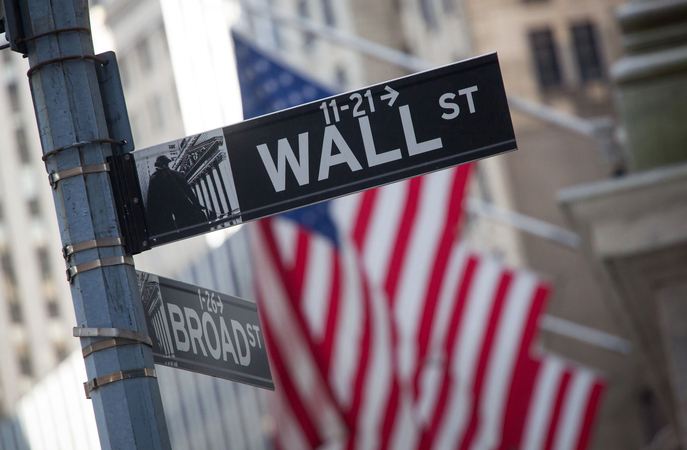
The constant refrain on Wall Street is that markets have broken from pandemic reality, yet the evidence keeps suggesting otherwise.
The S&P 500 staged a late-session reversal on Monday on fresh virus fears that underscore the jitters behind the global rebound in risk. The latter keeps taking place alongside a historic bid for safety and elevated equity volatility.
Those signals of investor fear are appearing in the highest quality bonds, where the more than $13 trillion pile of sub-zero yields has threatened to surpass the March peak. In the safest exchange-traded funds, which hold more gold than ever before. Under the equity surface, where valuations point not to exuberance but to continued defensiveness in favor of growth stocks.
As companies prepare to report how they fared at the pandemic peak, this bifurcated market is one way to make sense of risk appetite that seems to defy economic logic.
“The V-shaped equity market is deceptive,” said Erik Knutzen, the chief investment officer of multi-asset strategies at Neuberger Berman. “Far from a vote of confidence, the rally has been led by a handful of defensive, U.S. large-cap growth stocks, and it has not been backed up by a similar rebound in more economically sensitive sectors and regions or in Treasury yields.”
Much has been made of the apparent disconnect between Main Street and Wall Street after stocks staged the fastest rally in history as the world’s largest economy sunk into recession. With the economic fallout of the coronavirus still unfolding, the fact that global equities trade at about 20 times their forward earnings is often a cause for worry.
Not so fast, say Morgan Stanley strategists. They argue that by looking at equity prices through cyclical ups and downs, and on a current price relative to the last 10 years of real earnings, valuations right now are pretty much average. That would suggest they’re no threat to gains over the next year.
“Valuations are still a long way from implying a normal recovery, and instead reflect a market that remains concerned about long-term growth,” Morgan Stanley cross-asset strategists led by Andrew Sheets wrote in a report last week.
Even before the pandemic struck, the market has looked famously lopsided, with gains driven by tech darlings including Alphabet Inc., Amazon.com Inc., Apple Inc., Facebook Inc. and Microsoft Corp.
Whereas the S&P 500 now trades at 22 times historic earnings per share, the benchmark’s equal-weight counterpart trades at just 18 times. The premium for the market-cap weighted index remains not far from the widest since 2008 — showing just how sacred megacap firms have become.
The partial reopening of economies has only deepened investors’ faith in the privileged few rather than tempt them to make risk-on bets on smaller, cyclical and lower-quality companies. Value stocks won’t stop trading at a historically large discount to larger peers.
Even investors fretting over the rally in junk debt can take solace, according to Morgan Stanley. The likelihood of defaults is already built into the debt prices of the most at-risk companies trading at half their face value, it said.
Meanwhile, caution abounds in the ETF market. Gold’s grind to the highest in nine years has been driven by an almost relentless flow of cash into bullion funds. ETFs have increased their holdings of the metal every month in 2020, and have already added more than in any prior year.
Almost as relentless is the drive for the safest bonds. Months after the worst of the equity selloff abated, the world’s pile of debt with negative yields has been slowly growing as investors divert cash into havens. It topped $14 trillion on Friday, threatening to surpass the level reached in March.
It all points to a market that’s paying close attention to the world around it, reaching for companies that can survive another downturn while the rate of global Covid-19 infections stays elevated. Social distancing and fears over their health are keeping consumers at home, even in economies that have reopened.
“All those represent wagers against a strong recovery, and instead on a world where growth remains weak and uncertainty remains high,” the Morgan Stanley strategists wrote.
The Cabinet on Tuesday (July 14) agreed to grant financial aid worth Bt1.46 billion to Myanmar to improve its electricity system in Yangon’s North Okkalapa and North Dagon townships, government deputy spokesperson Ratchada Thanadirek said.
She added that this offering is part of efforts to forge sound relations with the neighbouring country.
The funding will be provided on a concessional loan basis, and Bt729 million of which will come from the 2021-2023 annual budget, while the remainder will come from the government’s 5-year loan from local financial institutions.
The 30-year loan to Myanmar carries an annual interest rate of 1.5 per cent and requires that the neighbouring country hire Thai contractors and engineers for the project as well as source materials worth 50 per cent of the loan value from Thailand. The loan is also subject to Thai law.
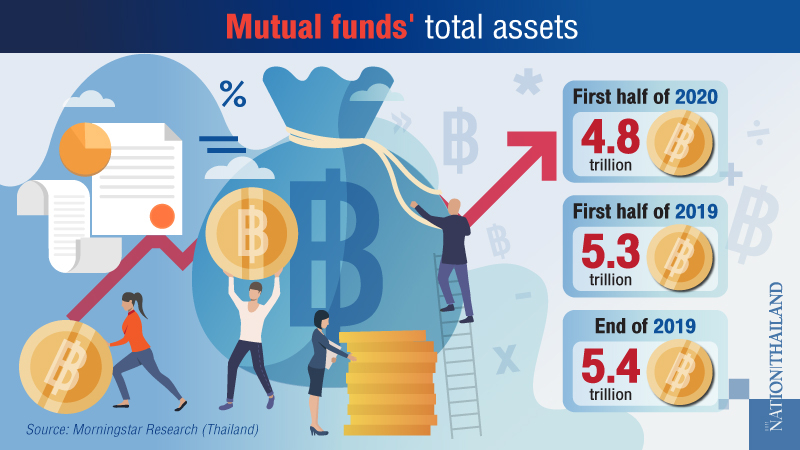
Mutual funds saw a sharp drop in total assets in the first half of this year as market volatility caused investors to turn to low-risk assets, said Morningstar Research (Thailand).
Assets under management (AUM) of mutual funds fell to Bt4.8 trillion, down 10.3 per cent from the Bt5.4 trillion at the end of 2019, said Chayanee Juengmanon, Morningstar Research senior research analyst. AUM in first half of 2019 totalled Bt5.3 trillion, she added.
“We expect cash flows into mutual funds to decline in the second half of this year due to high risks and volatility, causing investors to turn to low-risk assets with cash mostly flowing into money market funds,” she said.
“Investors are also avoiding mutual funds due to uncertainty following economic impacts and long-term investment conditions.”
She advised investors to follow each funds’ return because listed companies’ performance would drop as the country’s gross domestic product (GDP) this year is expected to contract by 8.1 per cent.
Mutual funds’ net outflow in the first half of 2020 was Bt350 billion, with net inflow of just Bt40 billion, she said.
“Cash mostly flowed into the money market and equity funds that invest in foreign countries and were able to escape the Covid-19 impact, while Thai equity funds saw limited inflows despite many companies launching Super Savings Funds Extra [SSFX] in June,” she said.
“Meanwhile, cash mostly flowed out of fixed income funds, commodity funds, and mixed funds that invest in Thailand and gold.”
She said that most mutual funds’ delivered positive results in the second quarter of this year.
“Global technology funds generated an average return of 27.9 per cent in the second quarter of this year and 14.9 per cent in the first half because they benefited during the Covid-19 outbreak,” she said. “Meanwhile, small and mid-cap equity funds generated an average return of 27.6 per cent in the second quarter of this year, but contracted 8.8 per cent in the first half.”
By Syndication Washington Post, Bloomberg · Sarah Ponczek, Claire Ballentine · BUSINESS, US-GLOBAL-MARKETS
U.S. equities rose on expectations earnings will offer an optimistic outlook for the world’s biggest economy amid a raging coronavirus pandemic. The dollar was mostly lower.
U.S. stocks declined after the S&P 500 briefly touched the highest level since the coronavirus pandemic sent markets tumbling worldwide in March. Crude oil also turned lower.
The main U.S. equity index stumbled in afternoon trading on signs the virus was throttling reopening plans in states like California. An increase in tensions with China also damaged sentiment. The measures had almost reclaimed a gain for the year before stumbling. It’s still down almost 7% from a Feb. 19 high.
The volatility in the S&P also corresponded with prices swings in Tesla Inc., which is in the Nasdaq Composite. The Nasdaq hit another record high before closing in the red. The Dow Jones industrial average finished the day slightly higher.
“It’s remarkable how optimistic investors seem to be,” said John Carey, portfolio manager at Pioneer Investment Management. “But there are a lot of uncertainties remaining and it’s a little bit early to assume it’s going to be back to business as usual anytime soon.”
Traders are awaiting reports this week from a slew of companies that have yet to provide concrete guidance on the impact of the virus. Shares of PepsiCo Inc. rose after the snack-maker reported stronger-than-expected second-quarter sales.
European stocks rose with government bond yields. Oil declined ahead of an OPEC+ meeting at which the group may announce plans to start tapering historic production cuts.
With global stocks trading near their highest since February, the focus has turned to whether the profit outlook will back up bullishness fueled by central bank and fiscal policy support. Traders have largely shrugged off new coronavirus outbreaks in some parts of the world. California’s two biggest school districts said they would offer remote learning only in the fall despite calls by the Trump administration for classrooms to fully reopen. The state reported a record number of people hospitalized with coronavirus.
There’s reason for optimism even though earnings are estimated to have contracted by more than 40% in the worst quarter since the financial crisis, as analysts upgrade their forecasts for the rest of the year.
“The backdrop is positive for all sectors of the market,” said Gerry Sparrow, president of Sparrow Capital Management Inc. “The reason for that backdrop is that the recovery has taken hold, so jobs data, consumer credit, home building strength signaled that the economy has shifted in a positive direction.”
These are the main moves in markets:
Stocks
The S&P 500 Index dipped 0.9% to 3,155.35 as of 4 p.m. EDT.
The Dow Jones industrial average was little changed at 26,086.34, the highest in a week.
The Nasdaq Composite Index dipped 2.1% to 10,390.84, the largest decrease in more than two weeks.
The MSCI All-Country World Index decreased 0.3% to 540.26.
Currencies
The Bloomberg Dollar Spot Index rose 0.1% to 1,210.52.
The euro increased 0.4% to $1.1349, the strongest in more than a month.
The Japanese yen weakened 0.3% to 107.24 per dollar, the largest drop in almost two weeks.
Bonds
The yield on two-year Treasurys was unchanged at 0.15%.
The yield on 30-year Treasurys decreased two basis points to 1.32%.
Germany’s 10-year yield gained five basis points to -0.42%, the highest in more than a week on the biggest advance in more than a week.
Commodities
West Texas Intermediate crude decreased 2.1% to $39.69 a barrel.
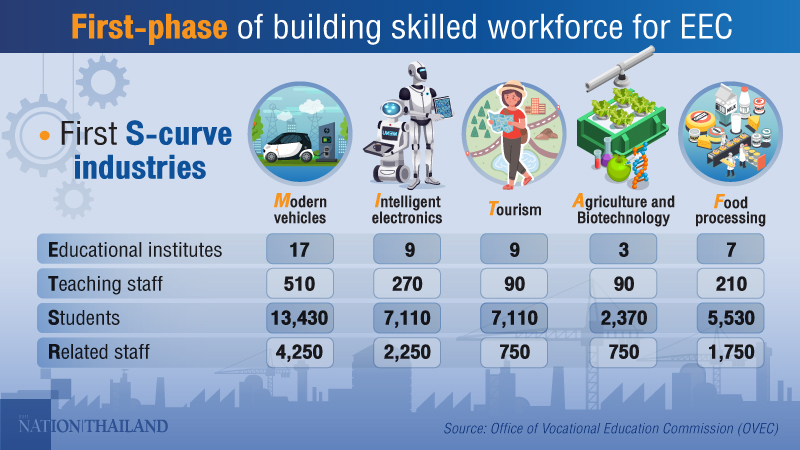
Narong Paewpolsong, secretary-general of the Office of Vocational Education Commission (OVEC), on Monday (July 13) released guidelines on the production of vocational personnel to support investment in the Eastern Economic Corridor (EEC), in a bid to attract investment in industries that require skilled personnel.
According to OVEC, the EEC will in five years require some 475,000 workers, of which 253,000 should have a vocational education, 213,000 should hold at least a bachelor’s degree, while the rest will need to have a master’s or doctorate.
The industries targeted are automotive industry, which should need at least 53,000 people, artificial intelligence 58,000 personnel, tourism 17,000, robotics 36,000, aviation 32,000, digital business 116,000, medical business 11,000, high-speed railway project 24,000, commercial shipping 14,000 and logistics 100,000.
In order to meet this potential demand, OVEC has adjusted curriculums in vocational colleges in the three EEC provinces, namely Chonburi, Rayong and Chachoengsao. There are 10 educational institutes that are equipped to produce personnel for the first S-curve industries, namely artificial intelligence electronics, tourism, biotechnology and food processing.
Personnel will also be required for new S-curve industries in other EEC provinces, namely Chanthaburi, Sa Kaew, Trat, Prachinburi and Nakhon Nayok. The industries targeted here are automobiles, smart electronics, tourism, food processing, industrial robotics, aviation, logistic and digital business.
He added that there are already 370 teaching personnel in place to help with this task.
Apart from eyeing the development of a new workforce for the EEC area, OVEC is also developing vocational institutes so they can upgrade to centres for specialised technical education in both targeted industry groups and advanced industries. There are currently 92 vocational institutes with necessary faculties such as aircraft mechanics, rail systems, petrochemicals, power generation, commercial marine shipping, smart farming, mechatronics, robotics, digital technology, modern automotive, aviation business etc.
Narong added that OVEC has submitted a budget request of Bt1.132 billion for building both a workforce and teaching staff.
“Though this project only requires Bt1.1 billion, we can develop existing teachers and boost the teaching force to 2,490 people. Increasing the number of people who complete their studies in vocational college or pick up a bachelor’s degree by 65,570, including 20,750 students in these fields, will make them an important resource for the country,” Narong said.
Apart from building a highly-skilled workforce for industry, OVEC also aims to open schools to teach English and Mandarin languages to 700,000 students, as well as a job-seeking institute for vocational students.
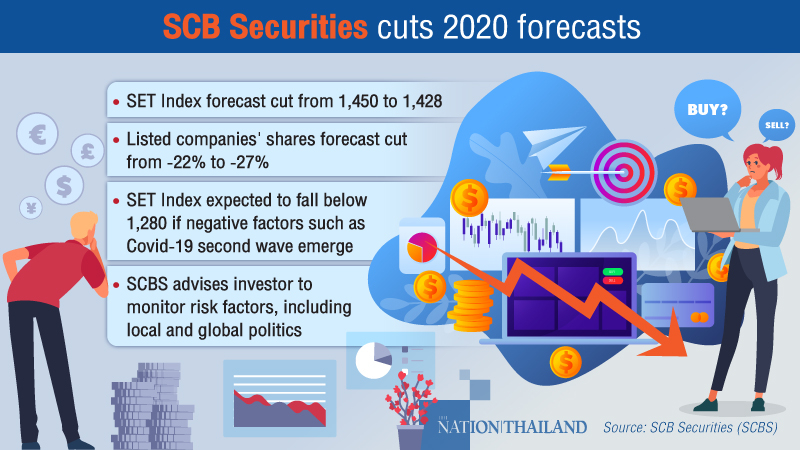
SCB Securities (SCBS) has cut its forecasts for the Stock Exchange of Thailand (SET) Index and listed companies’ shares this year due to numerous negative internal and external factors.
The securities arm of Siam Commercial Bank has reduced its 2020 SET forecast from 1,450 points to 1,428, and its forecast for listed companies to an average Bt62.57 per share – down 27 per cent from 2019’s Bt86.19 per share.
However, SCBS expects share prices to recover next year by 28 per cent or Bt79.96 per share, said Sukit Udomsirikul, managing director of SCBS research group.
“The index lacks new positive sentiment, which can be seen from foreign investors’ mass sell-offs totalling over Bt200 billion. As a result, the index is currently gaining support only from domestic individual and institutional investors, as well as the Super Savings Funds Extra [SSFX],” he said.
Among the many negative sentiments still pressuring the SET Index were concerns over a second wave of Covid-19, the ongoing US-China trade war, debt defaults by small and medium-size businesses, pending changes to the Thai Cabinet and economic team, and this year’s US presidential election.
“The government’s move to reorganise the [Cabinet] economic team has triggered uncertainty among investors because the Thai economy will come under pressure if economic stimulus measures cannot be issued in the third quarter of this year,” said Sukit.
“We expect listed companies’ profits this year to drop because many companies are facing a decline in growth,” he added.
“Meanwhile, the SET Index valuation is still high compared to other countries, so we expect the index to fall below 1,280 if there are more negative factors, such as a second wave of Covid-19.”
He advised investors to invest in food, retail, transportation, ICT and defence stocks, such as BDMS, BEM, BTS, CPF, ADVANC and BCH.
“Also, we suggest investors buy BBL, ERW, IVL and HANA and hold them speculatively for three months,” he added.

 Bank of Thailand governor Veerathai Santiprabhob and other central bank executives meet with financial analysts on Tuesday to share their views on the latest economic situation.
 Shop owners close their shops in the Passione mall, formerly known as Laem Thong, for two days of cleaning after an Egyptian soldier visited the mall and was later confirmed infected with Covid-19.
 Ratchada Thanadirek