PM’s adviser leads race to become next BOT governor #ศาสตร์เกษตรดินปุ๋ย

#ศาสตร์เกษตรดินปุ๋ย : ขอบคุณแหล่งข้อมูล : หนังสือพิมพ์ The Nation.

PM’s adviser leads race to become next BOT governor

Econ

Jul 14. 2020 Adviser to the PM Setthaput Suthiwart-Narueput is widely expected to be picked as next central bank governor.Adviser to the PM Setthaput Suthiwart-Narueput is widely expected to be picked as next central bank governor.

By The Nation

An adviser to PM Prayut and a central bank insider are the two frontrunners in the race to be next central bank governor.

Six candidates are competing for the post of Bank of Thailand governor, with the incumbent Veerathai Santiprabhob set to complete his five-year term in September.

Observers had previously tipped two experienced central bank deputies – Mathee Supapongse and Ronadol Numnonda – as the candidates most likely to be shortlisted by the recruiting committee.

The finance minister is tasked with picking one of two candidates proposed by the recruiting committee before the name goes to the Cabinet for final approval.

However, all eyes shifted to Setthaput Suthiwart-Narueput, 55, when his name appeared on the candidate list.

Setthaput has an advantage over the other five candidates since he is currently an economic adviser to Prime Minister Prayut Chan-o-cha, while his rich experience in economic affairs should also serve him well. Setthaput took a doctorate degree in economics from Yale University before working for the New York-based McKinsey & Company consultancy firm and the World Bank.

Setthaput is currently a member of the central bank’s monetary policy committee (MPC).

He also happens to be a friend of Veerathai.

Veerathai and Setthaput were recruited to work at the Finance Ministry after the 1997 financial crisis hit Thailand. The two were appointed co-directors of the Fiscal Policy Research Institute.

Setthaput was working as senior economist at the World Bank in Washington before joining the Finance Ministry. Then-Finance Minister Tarrin Nimmanahaeminda was managing the economy under the International Monetary Fund’s austerity programme, which was widely criticised in Thailand as the “wrong medicine”. The IMF argued that the Democrat-led Thai government had to restore policy credibility by cutting government spending and increasing taxes. The consequence was that the Democrat Party lost the next election, while the IMF later abandoned such austerity-based programmes for other crisis-hit countries.

After two years at the Finance Ministry, Setthaput resigned and continued to work at the World Bank.

He was then appointed as senior vice president of the Stock Exchange of Thailand between 2005 and 2007. Later, he became managing director and head of research at SCB Securities before going on to be named president of SCB Asset Management. He was appointed vice president and chief economist at Siam Commercial Bank between 2009 and 2011. He resigned to found his own financing consultancy company, The Advisor Co Ltd. 

In 2014, he was invited to join the central bank’s MPC.

Setthaput has been called hawkish by some observers for his emphasis on financial stability over short-term high economic growth. That preference may reflect his work on the IMF’s Thai austerity programme during 1997-98 Asian financial crisis.

Setthaput was among the first economists to raise concerns about the recent rise in household debt levels. In 2016, he also warned of possible debt defaults among companies issuing corporate bonds.

Pipat Luengnaruemitchai, assistant managing director at Phatra Securities, views Setthaput as an economist with strong experience of both fiscal and monetary issues and the private sector. 

“He is quite flexible. For example, when economic growth is fine he focuses on financial stability, but when the economy faces contraction, as with the current Covid-19 crisis, he agrees with policy rate cuts,” said Pipat.

Pipat predicted that Setthaput and one of the central bank deputies may be picked by the recruiting committee, before Finance Minister Uttama Savanayana puts the final name to Cabinet. 

Setthaput was likely encouraged to apply for the post by Uttama, but then backed away when Uttama’s position was undermined by upheaval in the ruling Palang Pracharat Party, say observers. 

When it became clear that Uttama would remain as Finance Minister despite quitting the party last Thursday, Setthaput applied for the post at the last minute after the deadline was extended from June 25 to July 10.

The other candidates are Anusorn Tamajai, former dean at Rangsit University’s Economics Faculty and former MPC member; Tongjai Thanachanan, former head of institutional business at Ayudhya JF Asset Management; and Suchart Techaposai, former head of fixed income at Ayudhya JF Asset Management.
Bt100 billion set aside to help small tourism operators hit by Covid-19 #ศาสตร์เกษตรดินปุ๋ย

#ศาสตร์เกษตรดินปุ๋ย : ขอบคุณแหล่งข้อมูล : หนังสือพิมพ์ The Nation.

Bt100 billion set aside to help small tourism operators hit by Covid-19

Econ

Jul 13. 2020

By THE NATION

The Government Savings Bank (GSB) has earmarked Bt100 billion for soft loans to small and medium enterprises in the tourism sector, Finance Minister Uttama Savanayana said.

This move is in line with Deputy Prime Minister Somkid Jatusripitak’s policy that banks offer more loans to small as well as new businesses that have been affected by the Covid-19 outbreak.

This amount will be lent to commercial banks at an annual interest rate of 0.01 per cent, so they can lend the money to SMEs at no more than 2 per cent per year.

GSB president Vithai Ratanakorn said this money will be spent on those who have failed to access other fund sources and will be limited at Bt50 million per bank. He added that GSB is rushing to seek approval for the Bt100 billion soft loan from its board and the Finance Ministry.

Worries over US-China conflict pulls down SET after positive morning session #ศาสตร์เกษตรดินปุ๋ย

#ศาสตร์เกษตรดินปุ๋ย : ขอบคุณแหล่งข้อมูล : หนังสือพิมพ์ The Nation.

Worries over US-China conflict pulls down SET after positive morning session

Econ

Jul 13. 2020

By The Nation

The Stock Exchange of Thailand (SET) Index fell 8.13 points or 0.60 per cent to close at 1,342.37 today (July 13), with total transactions standing at Bt62.374 billion with an index high of 1,363.82 and a low of 1,339.69.

During the morning session, a stock analyst at Krungsri Securities said he expected the index to rebound between 1,360 and 1,365 points before falling in response to positive news about an anti-Covid-19 drug even as the number of virus cases continue to rise, especially in the US.

“The market gained positive sentiment from the announcement that Gilead’s Remdesivir can reduce the death rate of Covid-19 patients by 62 per cent compared to standard treatments,” the analyst pointed out.

However, he said the index will come under pressure from the US-China conflict and the mass sell-off of stocks from firms whose second-quarter performance has dropped sharply.

The analyst also said the Opec+ will meet on Wednesday to consider an agreement on reducing the production of crude oil as of the end of this month.

The top 10 stocks with the highest trade value today were CPF, STGT, STA, PTT, AOT, KCE, IVL, MINT, PTL and CPALL.

As of 4.30pm, the price of crude oil dropped by US$0.68 or 1.68 per cent to $39.87 per barrel, while gold rose by $12.50 or 0.69 per cent, to $1,814.40 per ounce.

Asian indices were on the rise:

Japan’s Nikkei Index closed at 22,784.74, up 493.93 points, or 2.22 per cent.

China’s Shanghai SE Composite Index closed at 3,443.29, up 59.96 points, or 1.77 per cent, while Shenzhen SE Component Index closed at 14,149.14, up 477.90 points, or 3.50 per cent.

Hong Kong’s Hang Seng Index closed at 25,772.12, up 44.71 points, or 0.17 per cent.

South Korea’s KOSPI Index closed at 2,186.06, up 35.81 points, or 1.67 per cent.

Taiwan’s TAIEX Index closed at 12,211.56, up 137.88 points, or 1.14 per cent.

BEM and BTS fight over Bt140bn Orange line project #ศาสตร์เกษตรดินปุ๋ย

#ศาสตร์เกษตรดินปุ๋ย : ขอบคุณแหล่งข้อมูล : หนังสือพิมพ์ The Nation.

BEM and BTS fight over Bt140bn Orange line project

Econ

Jul 13. 2020

By The Nation

Four companies have expressed interest in bidding to build and operate the Bt140-billion Orange Line extension linking the Thailand Cultural Centre with Bang Khun Non.

The MRT extension will run a distance of 35.9 kilometres under a public-private partnership project. The project is divided into construction of the line (Bt110 billion) and a 30-year concession to operate the system (Bt30 billion).

The four companies who bought bid envelopes on July 10 are the BTS Group Holding Company; Sino-Thai Engineering and Construction; Bangkok Expressway and Metro (BEM); and Chor Karnchang (CK).

However, only two are expected to submit bids – Skytrain operator BTS and Expressway operator BEM.

“There are two private companies to watch in this project auction that have already bought the envelopes,” said Surachet Laophulsuk, Mass Rapid Transit Authority of Thailand (MRTA) deputy governor.

“The private bidder which offers the highest return to the state will win the Orange Line auction. We hope to attract attention from other private entities and also lure foreign countries into the bidding as well,” he added.

Bid envelopes can be purchased until July 24. Bid submissions can be made until September 23.

BEM managing director Sombat Kitjalaksana said that the company is ready for the bidding as BEM’S holding company, CK, has long experience in tunnelling work and has partnered up with CP Group to build a high-speed railway connecting three airports.

Meanwhile Surapong Laoha-Unya, executive director of BTS Group Holdings, said that BTS registered for bidding on the Orange Line project on the first day after carefully studying the project and forming alliances to invest in bidding with STEC.

This may be the right time to invest in shipping firms: analyst #ศาสตร์เกษตรดินปุ๋ย

#ศาสตร์เกษตรดินปุ๋ย : ขอบคุณแหล่งข้อมูล : หนังสือพิมพ์ The Nation.

This may be the right time to invest in shipping firms: analyst

Econ

Jul 13. 2020

By The Nation

Experts are advising investors to consider purchasing the shares of Prima Marine (PRM), because it has generated outstanding revenue despite the Covid-19 outbreak.

Though lockdown measures in many countries had an impact on the shipping industry, this negative sentiment did not have much of an effect on PRM because its main income is based on long-term contracts.

The first quarter of the year, PRM made Bt715.40 million or 47.5 per cent of its revenue from its floating storage unit (FSU) business. This marked a significant increase from the Bt336.9 million revenue earned in the same period last year, which accounted for 28.3 per cent of the total revenue.

The company also earned Bt593.2 million, or 39.4 per cent of total revenue, from domestic crude oil transportation business in the first quarter of this year, compared to Bt548.8 million earned in the same period last year.

A stock analyst at Yuanta Securities (Thailand) said PRM’s FSU business in the second quarter was still running strong after the company increased the service charge of six out of its eight FSU vessels from 20 per cent to 25 per cent.

“The company’s crude oil transportation business, which was affected by Covid-19 in April, recovered quickly in May and June once the infections came under control,” the analyst said.

He added that PRM’s third-quarter performance should be positive because two new vessels, one for the FSU business and another for domestic crude oil transport, will be added to the company’s fleet.

“PRM will also benefit from the Energy Regulatory Commission’s move to allow large power plants to import liquified natural gas [LNG], as it will be given an opportunity to penetrate the LNG transportation market,” the analyst said.

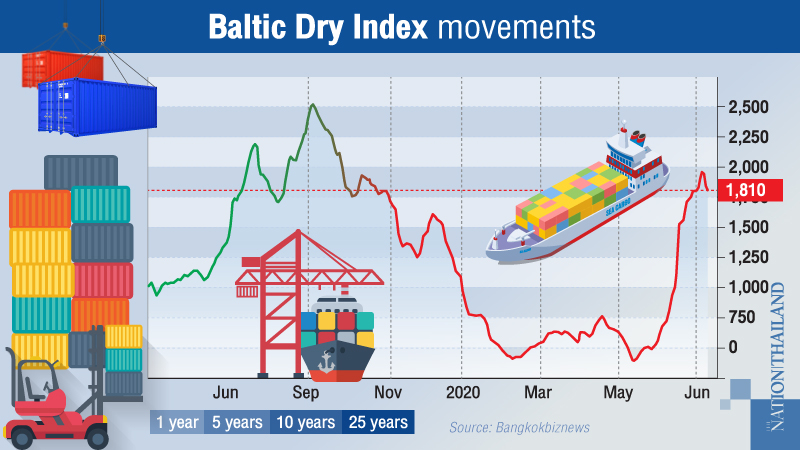
He explained that the situation of international crude oil transportation has improved after many countries eased lockdown measures, which can be seen from the rise in the Baltic Dry Index, which has been sliding since the start of the year.

“The Baltic Dry Index fell to 398, its lowest, in May and is currently rising to its resistance line of 2,000,” the analyst said. “The rise in the Baltic Dry Index has caused marine shipping shares to rise.”

He added that as of July 10, PRM shares closed at Bt8.80 per share, up 180 per cent within four months from its lowest point of Bt3.14 per share on March 18.

“Meanwhile, the AMA Marine shares closed at Bt5.25, up 116 per cent from the lowest point at Bt2.42 per share on March 30, while Thoresen Thai Agencies closed at Bt3.10 per share, up 65 per cent from the lowest point at Bt1.88 per share on March 25,” he said.

The analyst said investors can pick up shares of marine shipping companies provided they have strong fundamentals.

Gold price up slightly amid hopes of economic recovery, effective Covid-19 drug #ศาสตร์เกษตรดินปุ๋ย

#ศาสตร์เกษตรดินปุ๋ย : ขอบคุณแหล่งข้อมูล : หนังสือพิมพ์ The Nation.

Gold price up slightly amid hopes of economic recovery, effective Covid-19 drug

Econ

Jul 13. 2020

By The Nation

The price of gold rose by Bt50 per baht weight in morning trade today (July 13), the Gold Traders Association reported.

As of 9.29am, the buying price of a gold bar was Bt26,600 per baht weight and selling price Bt26,700, while gold ornaments cost Bt26,120.68 and Bt27,200, respectively.

At close on Saturday, the buying price of a gold bar was Bt26,550 per baht weight and selling price Bt26,650, while gold ornaments were priced at Bt26,075.20 and Bt27,150, respectively.

The spot gold price moved to US$1,803 (Bt56,406) this morning after dropping by $1.9 to $1,801.9 per ounce at Friday’s close.

Investors were selling gold after global indices rose on hopes of an economic recovery and news that a Covid-19 drug could effectively reduce the death rate.

Meanwhile, the Hong Kong gold price dropped by HK$20, opening at $16,650 (Bt67,204) per tael this morning.

SET rebounds on news of effective Covid-19 drug #ศาสตร์เกษตรดินปุ๋ย

#ศาสตร์เกษตรดินปุ๋ย : ขอบคุณแหล่งข้อมูล : หนังสือพิมพ์ The Nation.

SET rebounds on news of effective Covid-19 drug

Econ

Jul 13. 2020

By The Nation

The Stock Exchange of Thailand (SET) Index rose by 10.70 points, or 0.79 per cent, to 1,361.20 in morning trade today (July 13).

A stock analyst at Krungsri Securities expected the index to rebound between 1,360 and 1,365 points before falling in response to positive news of an anti-Covid-19 drug even as the number of virus cases continued to increase especially in the United States.

“The market gained positive sentiment from Gilead’s Remdesivir drug, which is said to reduce the death rate of Covid-19 patients by 62 per cent compared to standard treatment,” the analyst pointed out.

However, he said the index would come under pressure from the conflict between the US and China and mass sell-offs in stocks, whose second-quarter performance would drop sharply.

The analyst added that the Opec+ grouping will hold a meeting on Wednesday (July 15) to discuss an agreement to cut crude oil production, which will reach maturity at the end of this month.

He recommended investors buy:

> Food and Electronic stocks that benefit from the weakening baht, such as TU, CPF, GFPT, TFG, KCE, Delta, Hana and SVI.

> Stocks whose second-quarter performance will improve, such as Top, PTTGC, SPRC, BGrim, CKP, Tasco, STA, STGT, SPALI, PRM, PTL and AJ.

> Stocks that benefit from the Covid-19 drug development, such as Mint, Centel, ERW, AOT and AAV.

The Stock Exchange of Thailand (SET) Index dropped 15.31 points, or 1.12 per cent, on Friday, closing at 1,350.50. Transactions totalled Bt64.19 billion with an index high of 1,363.28 and a low of 1,346.72.

Airports Dept eyes Bt5.8bn budget for 2021 upgrades #ศาสตร์เกษตรดินปุ๋ย

#ศาสตร์เกษตรดินปุ๋ย : ขอบคุณแหล่งข้อมูล : หนังสือพิมพ์ The Nation.

Airports Dept eyes Bt5.8bn budget for 2021 upgrades

Econ

Jul 13. 2020

By THE NATION

The Department of Airports has asked for a 2021 budget of Bt5.8 billion, almost the same as last year, said director-general Tawee Gasisam-ang.

Around 90 per cent of the budget will be spent on improving its airports.

Of the total, Bt3.234 billion is earmarked for upgrades at airports in Krabi, Khon Khaen, Nakhon Si Thammarat, Trang, Surat Thani and Buriram.

The state agency will spend some of the budget on extending runways at Trang and Buriram airports.

It will also renovate airport car parking facilities at Ubon Ratchathani and Surat Thani.

Energy Ministry revises plan on developing community power plants #ศาสตร์เกษตรดินปุ๋ย

#ศาสตร์เกษตรดินปุ๋ย : ขอบคุณแหล่งข้อมูล : หนังสือพิมพ์ The Nation.

Energy Ministry revises plan on developing community power plants

Econ

Jul 13. 2020

By THE NATION

The Energy Ministry has said it will present a revised version of the 2018 Power Development Plan to the Cabinet on Tuesday (July 14), which if approved, will allow it to go ahead with calling bids to set up grassroots community power plants.

This project had been postponed from its original schedule by a year.

The revised version of the plan now incorporates the amount of electricity to be generated by these plants totalling 1,933 megawatts from 2020 to 2024. Last December, the National Power Policy Committee had approved the project in the form of very small power plant, with a capacity not exceeding 10MW.

Under the scheme, the government will purchase 700MW between 2020 and 2022 from community based plants.

Bank deposits swell as investors avoid risk assets in uncertain times #ศาสตร์เกษตรดินปุ๋ย

#ศาสตร์เกษตรดินปุ๋ย : ขอบคุณแหล่งข้อมูล : หนังสือพิมพ์ The Nation.

Bank deposits swell as investors avoid risk assets in uncertain times

Econ

Jul 13. 2020

By The Nation

Despite lower interest rates this year, bank deposits have risen sharply as investors have stayed away from investment in risk assets.

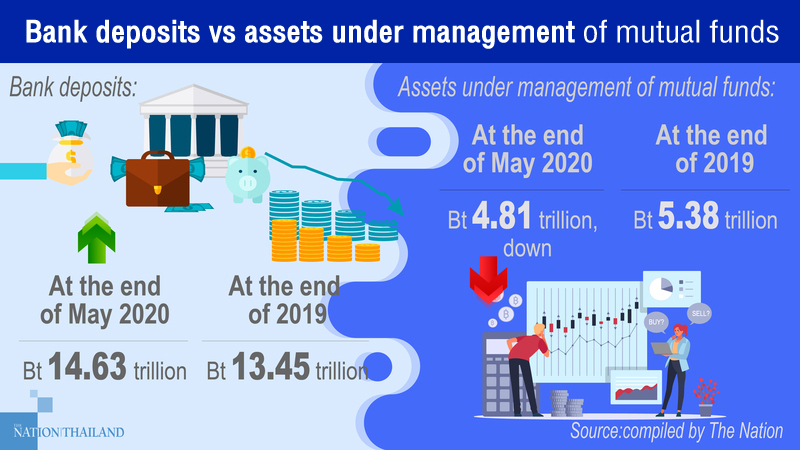
Banks’ deposits as the end of May shot up by 8.76 per cent to Bt 14.63 trillion, an increase of Bt1.18 trillion from the end of last year.

Liquidity has flooded the banking system as investors delay investment in risk assets and put their money into bank accounts instead, Adisorn Sermchaiwong, president and chief executive officer at CIMB Thai, said.

He said CIMB bank’s deposits rose to Bt216 billion at the end of May, up from 199 billion at the end of last year.

“Despite lower interest rates, banks have excess liquidity, as people do not know where to invest. Money is expected to continue flowing into banks but in smaller amounts,” he said. 

Some may start to invest in corporate bonds, as the spread of Covid-19 has been contained in Thailand, he added.

Thaweelap Rittapirom, executive vice president at Bangkok Bank (BBL), said investors were cautious about making new investments so they had parked their money in banks. Banks’ deposits are expected to remain high until the end of this year, he said.

BBL had deposits of Bt2.5 trillion at the end of May, up from Bt2.3 trillion at the end of last year.

He said that rising deposits did not increase the cost for banks, as bankers could find ways to manage the increasing liquidity.

Kangana Chockpisansin, head – research at Kasikorn Research Centre, said banks had cut their interest rates in response to the cut in the key policy rate by the Bank of Thailand, which has lowered its policy rate to 0.50 per cent.

She pointed out that deposits in March rose by Bt750 billion, by Bt238 billion in April and by Bt55 billion in May.

Deposits rose 12 per cent year on year in the first half of the year and are projected to rise 9-12 per cent for the whole year, up by Bt1.4 trillion to total Bt14.6 trillion, the largest deposit pool in nine years.

Naris Sathapholdeja, head of TMB Analytics, said the increase in deposits was at the expense of mutual fund management businesses. Assets under management (AUM) of the mutual fund industry dropped by about 10 per cent from the end of last year. AUM at the end of May was worth Bt4.81 trillion, down from Bt5.38 trillion at the end of last year.

In March, AUM of mutual funds decreased by 15.3 per cent as investors were wary of risk assets.

“The flow into bank deposits partly came from investment funds, driving bank deposits up to Bt14.6 trillion in the first five months of the year, up 13.59 per cent year on year, or 8.76 per cent up from the end of last year,” he said.

Among the five largest banks, Krungthai Bank’s deposits rose by 10.75 per cent, Kasikornbank’s by 10.16 per cent, BBL’s by 8.95 per cent, Krungsri’s by 6.27 per cent and Siam Commercial Bank’s by 3.82 per cent year on year in the first five months of this year. Bank deposits have risen two times faster than lending, he added.