Amid mounting risks, CLMV to witness 6-7% growth in 2020: SCB centre

#ศาสตร์เกษตรดินปุ๋ย : ขอบคุณแหล่งข้อมูล : หนังสือพิมพ์ The Nation

https://www.nationthailand.com/business/30379508?utm_source=category&utm_medium=internal_referral

Amid mounting risks, CLMV to witness 6-7% growth in 2020: SCB centre

Dec 16. 2019
By THE NATION

762 Viewed

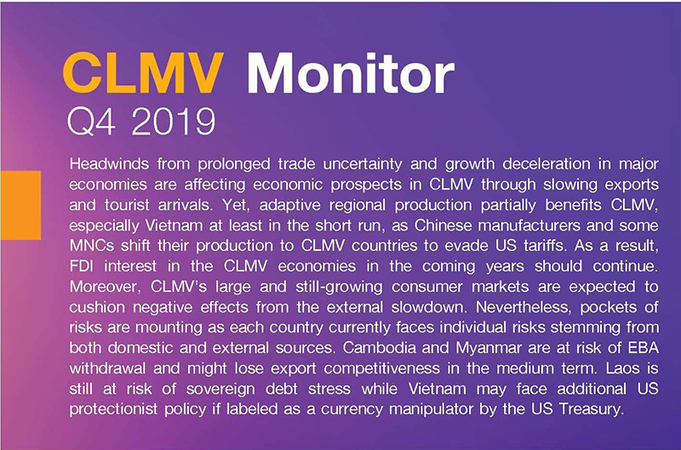
Growth in the CLMV (Cambodia, Laos, Myanmar, Vietnam) bloc will likely moderate to 6-7 per cent in 2020 as headwinds from prolonged trade uncertainties and growth deceleration in major economies affect economic prospects through slowing exports and tourist arrivals, according to Siam Commercial Bank’s Economic Intelligence Centre.

However, adaptive regional production will partially benefit the bloc, especially Vietnam, at least in the short run, as Chinese manufacturers and some multinational corporations shift their production to CLMV countries to evade US tariffs.

As a result, foreign direct investment in CLMV economies in the coming years should continue, the centre said.

Moreover, consumption in the bloc and growing consumer markets are expected to cushion the negative effects from an external slowdown.

However, pockets of risks are mounting as each country currently faces individual risks stemming from both domestic and external sources.

Cambodia and Myanmar are at risk of Everything But Arms (EBA) withdrawal by the European Union and might lose their export competitiveness in the medium term.

Laos is still at risk of sovereign debt stress while Vietnam may face additional US action if labelled a currency manipulator by the US Treasury.

Vietnam is expected to grow at 6.7 per cent in 2020, supported by both domestic demand and exports.

With slowing exports and mounting external risks from US protectionist policies, private consumption should support growth from a strong labour market and moderate inflation.

Meanwhile, continued structural reforms should help spur both private and foreign investment in the country.

Cambodia’s growth is expected to moderate to 6.8 per cent in 2020 due to slow global trade.

Tourism and FDI grew at a slower rate, but the country’s fiscal situation and exports remained strong.

Still, the EBA withdrawal risk remains high and may affect exports to the European Union, Cambodia’s largest export market. Its fast-growing microfinance in household loans may also undermine its future financial stability and consumption outlook.

Laos’s economy is projected to recover to 6.5 per cent in 2020.

Overall economic activity slowed due to the effects of natural disasters in 2018, the trade war, and a China slowdown.

Meanwhile, Laos’s short-term vulnerabilities include limited foreign reserves and fiscal stress from low revenue in tax collection. However, future infrastructure and hydro projects, and policy reforms should boost the economy in the medium term.

Myanmar’s economy is expected to grow by 6.3 per cent in 2020 amid domestic risks before an election next year.

Recent FDI fell considerably, but ongoing policy reforms, continued financial liberalisation and foreign investment from other Asian countries should support its economic recovery. But downside risks come from the unsolved Rohingya crisis as Myanmar is also at risk in the event of an EBA withdrawal.

Community power project gets the nod

#ศาสตร์เกษตรดินปุ๋ย : ขอบคุณแหล่งข้อมูล : หนังสือพิมพ์ The Nation

https://www.nationthailand.com/business/30379506?utm_source=category&utm_medium=internal_referral

Community power project gets the nod

Dec 16. 2019
By The Nation

759 Viewed

The Energy Policy and Planning Office (EPPO) has approved the community-based power plant project, setting the rate of sale at Bt3-5 per unit depending on fuel types while the community can owns 10-40 per cent of the facility.

Energy Minister Sontirat Sontijirawong revealed the decision of EPPO committee today (December 16), approving feed-in tariffs economic policy mechanism in renewable power investment and sell rate for Very Small Power Producers (VSPP).

The committee also tasked the Energy Regulatory Commission (ERC) to draft regulations and make an announcement. It also appointed an executive to oversee trading and manage the project.

The electricity contract of the community-based power plant is a Non-Firm contact, wherein the power producers are able to co-store the power but prohibited from using fossil fuel to generate electricity.

Next year, the government will start buying 700 MW from private producers and has scheduled the commercial operation dates for two types of projects: Quick win project in 2020, followed by general project the year after.

Phase one deal welcomed by businesses

#ศาสตร์เกษตรดินปุ๋ย : ขอบคุณแหล่งข้อมูล : หนังสือพิมพ์ The Nation

https://www.nationthailand.com/business/30379505?utm_source=category&utm_medium=internal_referral

Phase one deal welcomed by businesses

Dec 16. 2019
By China Daily/ANN

815 Viewed

The phase one trade deal between China and the United States, which holds off a planned US tariff increase on billions of dollars of Chinese imports previously set to take effect on Sunday, was welcomed by US business groups. But they urged the removal of all additional duties as well.

Beijing and Washington announced the deal on Friday. China said the two sides had agreed that the US will fulfill its commitments to phase out additional tariffs on Chinese products.

The US has dropped plans to impose new tariffs on $160 billion in Chinese-made consumer goods, including laptops, smartphones and clothing, and cut in half tariffs imposed in September on another $112 billion to 7.5 percent. But it will continue to levy a 25 percent import tax that started last year on $250 billion in Chinese goods.

State Councilor and Foreign Minister Wang Yi said the deal is bullish news for the world.

At a joint news conference on Saturday with Miro Cerar, Slovenia’s deputy prime minister and foreign minister, Wang remarked that China has always been opposed to settling economic and trade disputes by imposing tariffs because there is no winner in a trade war. China also rejects the use of unilateral pressure, as it violates the rules of the World Trade Organization, he said.

The wording of the phase one agreement was settled after rounds of back-and-forth negotiations, Wang noted.

The agreement is conducive to gradually bringing China-US economic and trade relations back to a normal development track and will inject confidence into world economy facing downward pressure, he said, adding that it will also help to stabilize the global trade order.

“The tariff relief included in the phase one deal is welcome and could be a sign that the end of the trade war is in sight,” said Rick Helfenbein, president and CEO of the American Apparel & Footwear Association.

However, Helfenbein noted, US businesses, consumers and workers are still being hammered by tariffs imposed by the US and by China’s retaliatory tariffs on incoming US goods.

“The trade war is a self-inflicted wound that has caused a lot of pain for America. The sooner these tariffs are eliminated, the better. And we won’t stop pressing our case until this happens,” he said in a statement.

Americans for Free Trade, a coalition of more than 150 business groups from every sector of the economy — which are united in the fight against tariffs — said the rollback of tariffs and cancellation of new levies is a small step forward.

“However, the tariffs still in place are a tax that Americans, and not China, continue to pay, to the tune of tens of billions of dollars,” the coalition’s spokesman Jonathan Gold said. “By only reducing the tariffs on a few items, the administration is picking winners and losers in this trade war.”

People in the US have paid an additional $42 billion in tariffs since the beginning of the trade war in early 2018 through October this year, including an additional $4 billion in October alone, the coalition said in a statement on Friday after the announcement of the deal.

“That’s why we urge the administration to continue to work diligently to come to a final agreement with China that will remove all the tariffs currently in place,” Gold said.

The US Chamber of Commerce said the phase one agreement creates “greater certainty” for US businesses as they plan for the year ahead, after months of uncertainty.

“We call upon both governments to continue working diligently toward a final agreement within six months,” Myron Brilliant, the chamber’s executive vice-president and head of international affairs, said in a statement.

Another US industrial group, the National Retail Federation, also underscored the need to eliminate all the remaining tariffs.

“Tariffs create uncertainty and costs for American retail supply chains, and the trade war won’t be over until they are eliminated completely,” said David French, the group’s senior vice-president for government relations.

Mary Lovely, a trade economist at the Peterson Institute for International Economics, said the current 25 percent tariffs fall largely on intermediate inputs, so US factories are feeling the pinch.

“A cease-fire in the trade war will bring much needed relief to America’s factories and farms,” she wrote in an article posted on the institute’s website.

Levies on certain US imports suspended

#ศาสตร์เกษตรดินปุ๋ย : ขอบคุณแหล่งข้อมูล : หนังสือพิมพ์ The Nation

https://www.nationthailand.com/business/30379502?utm_source=category&utm_medium=internal_referral

Levies on certain US imports suspended

Dec 16. 2019
[Photo/VCG]

[Photo/VCG]
By China Daily/ANN

739 Viewed

China suspended extra tariffs on certain products from the United States that had been scheduled on Sunday — a part of the two countries’ broader move to scale back tariffs after agreeing on the text of a phase one trade deal.


Experts said de-escalation of the protracted trade war will help restore the confidence of the global financial market. They also urged both governments to build on this progress and fix more underlying problems.

China suspended extra 10 percent and 5 percent tariffs on some products imported from the US, the Customs Tariff Commission of the State Council said in a statement on Sunday. The country also refrained from implementing tariffs on vehicles and auto parts from the US.

Other additional tariff measures will continue to be implemented, and work on tariff exemptions for imports from the US will proceed, it said.

Stephen Roach, a senior fellow at Yale University’s Jackson Institute of Global Affairs, told Xinhua: “The good news is that the threat of tariffs has been moderated to some degree. It underscores the commitment of both nations to provide some relief to the tariff-related pressures on both economies as well as the broader global economy.”

On Friday, Chinese officials said China and the US have reached agreement on the text of a phase one trade deal on the basis of equality and mutual respect, and the US will implement its promise to eliminate tariffs on Chinese goods “phase by phase”.

Ma Yu, a researcher at the Chinese Academy of International Trade and Economic Cooperation in Beijing, said, “The phase-one trade agreement is considered a clear signal toward de-escalation.

“Companies from the US, China and other major economies, such as Japan and Germany, will restart investment in projects that have been on hold, because unstable elements arising from the trade dispute since March 2018 have caused a number of companies to stop their investment activities,” Ma said.

In addition to boosting investment in many parts of the world, the deal, when signed, will also boost the confidence to global financial markets, stabilize market expectations and build a better environment for trade activities and regional trade deals, he said.

“This is an encouraging first phase that puts a floor under further deterioration of the bilateral relationship,” US-China Business Council President Craig Allen said.

“But this is just the beginning,” he added, noting that the issues facing the US and China are “complex and multifaceted”, and more efforts are needed to address them.

Yale’s Roach said both sides need to focus more on the common ground “that will continue to bind the two economies together, rather than underscore differences in conflicts”, if they want to repair the soured relationship.

China’s economic indicators beat expectations

#ศาสตร์เกษตรดินปุ๋ย : ขอบคุณแหล่งข้อมูล : หนังสือพิมพ์ The Nation

https://www.nationthailand.com/business/30379499?utm_source=category&utm_medium=internal_referral

China’s economic indicators beat expectations

Dec 16. 2019
An employee installs an intelligent pipe winding machine at an industrial park in Lianyungang, Jiangsu province, on Nov 27, 2019. [Photo by Geng Yuhe/For China Daily]

An employee installs an intelligent pipe winding machine at an industrial park in Lianyungang, Jiangsu province, on Nov 27, 2019. [Photo by Geng Yuhe/For China Daily]
By China Daily/ANN

739 Viewed

Major economic indicators performed better than expected in November, showing that the Chinese economy made progress in stability despite challenges both at home and abroad, according to the National Bureau of Statistics on Monday.

The country’s industrial output, an important economic indicator, increased by 6.2 percent year-on-year last month, compared with 4.7 percent for October, the NBS said.

Retail sales rose by 8.0 percent year-on-year in November, compared with 7.2 percent in the previous month, the bureau said.

Fixed-asset investment expanded by 5.2 percent in the first 11 months, unchanged from the January-October period.

The urban employment situation stayed stable last month, with the surveyed jobless rate in urban areas standing at 5.1 percent, the same as October.

Tax reforms to take more time than expected but surprise on the way

#ศาสตร์เกษตรดินปุ๋ย : ขอบคุณแหล่งข้อมูล : หนังสือพิมพ์ The Nation

https://www.nationthailand.com/business/30379486?utm_source=category&utm_medium=internal_referral

Tax reforms to take more time than expected but surprise on the way

Dec 16. 2019
By The Nation

1,539 Viewed

The Ministry of Finance has indicated that plans to reform the income tax structure might not be completed by February as earlier scheduled but says a tax measure will be announced early in 2020 as a New Year’s gift to Thais.

The ministry’s permanent secretary Prasong Poontaneat said that tax reform committee will meet again on December 24 to report the progress of the tax structure study and that although some tax measures might be approved, the 10-per-cent cut in personal income tax will be delayed.

“We will be announcing a tax measure after the festive period but we will not reveal it now. Meanwhile, the 10-per-cent cut in personal income tax might be applied later in 2020 as it is related to financial stability. The tax reforms will remove the flaws from the present system and be fairer to all,” Prasong said.

Ekniti Nitithanprapas, director-general of the Revenue Department, said that the Fiscal Policy Office will be mainly responsible for the tax structure reform.

The Ministry is also aiming to collect 7-per-cent value-added tax on goods ordered online from other counties and also cancel the tax-free status on imported products priced below Bt1,500 so as to be fair to manufacturers who produce similar goods and who are charged 7-per-cent VAT.

“Thais now prefer to order online especially from China and US and the value of this market is worth more than Bt1 billion. Some avoid the tariff by showing the prices of goods as below Bt1,500 but the real value is higher than that, ” said Ekniti.

US-China deal a relief for global economy but Thailand faces political challenges

#ศาสตร์เกษตรดินปุ๋ย : ขอบคุณแหล่งข้อมูล : หนังสือพิมพ์ The Nation

https://www.nationthailand.com/business/30379479?utm_source=category&utm_medium=internal_referral

US-China deal a relief for global economy but Thailand faces political challenges

Dec 16. 2019
Thanathorn and his large crowd of supporters held a brief protest against the latest EC move on Saturday in downtown Bangkok and they vowed to intensify their fight against alleged dictatorship on streets next year.

Thanathorn and his large crowd of supporters held a brief protest against the latest EC move on Saturday in downtown Bangkok and they vowed to intensify their fight against alleged dictatorship on streets next year.
By Wichit Chaitrong
The Nation

1,071 Viewed

External risk may decrease following the easing of US-China trade tensions, but domestic political risks may rise, an economist warned while a stock analyst advisee investors to go back to basics by diversifying their investment portfolio.

Anusorn Tamajai, the director of the Economic and Business Research Centre for Reform at Rangsit University’s Institute of Economics, said that the global economy may be in better shape next year after the US and China reached a phase one deal of their trade agreement last week.

President Donald Trump has cancelled a new round of tariff hike on Chinese products scheduled to come into force on Sunday. US also agreed to cut by half the previous tariff hike while China agreed to purchase more of US farm products and promised to open banking, insurance, brokerage services as well as relax technology transfer regulations.

U.S.-China trade deal still leaves huge cloud over American business

US investors on Friday were still confused about the trade agreement due to lack of specific details and numbers.

Anusorn said in a general context that the agreement may rescue global trade previously adversely affected by their trade war. World trade expansion will benefit Thailand’s exports and those of other countries, said Anusorn.

Thailand was previously expected to gain more from trade diversion, which was expected to rise when the trade war intensified as the US would have bought more Thai products and imported fewer Chinese products. After the trade tensions eased to some extent, Thailand is expected to gain less from trade diversion as US would buy more Chinese products, he said.

Thai products that could replace Chinese products in the US market included farm products, food, frozen sea food and processed food, chemical products, plastic pellets, steel and aluminium and home and office appliances.

“Investors who previously planned to move their factories to Thailand and other Asean countries may review their plans following the US-China trade deal,” he said.

However, markets are still closely watching how the trade deal will further develop as the two sides agreed to negotiate a phase two deal.

The trade direction may be clearer after the US election next year, he said.

Asean countries have a competitive edge and offer generous incentives to foreign investors and may still draw in foreign direct investment, he said.

The impact of Brexit is seen as less worrying after the Conservative Party’s triumph in the UK election.

“Thailand needs to accelerate free trade negotiations with both the United Kingdom and the European Union,” said Anusorn.

He warned about domestic policy risk following the Constitutional Court ruling to disqualify popular opposition leader Thanathorn Juangroongruangkit as a member of Parliament and the Election Commission (EC)’s petition to the court to disband his Future Forward Party.

“Political risk will increase because law enforcement does not uphold the rule of law, potentially leading to a political crisis, which will damage investor confidence,” he said, hinting at allegations of double standards of Thai courts and the EC.

Thanathorn and his large crowd of supporters held a brief protest against the latest EC move on Saturday in downtown Bangkok and they vowed to intensify their fight against alleged dictatorship on streets next year.

Meanwhile, Kavee Chukitkasem, the deputy managing director at Kasikorn Securities, said that trade tensions between the US and China is expected to continue as they rival each other for global leadership, therefore investors are advised to be cautious on the global trade front.

He, however, is optimistic that investment opportunities are also present even though stock markets are highly volatile. “We really don’t know what US President Trump will do next, but we can lessen investment risks by adopting a diversified investment strategy,” he suggested.

Investors may need to invest in both equities in emerging markets and developed markets, invest in bonds, gold and property, to shield themselves against risks, he added.

Winners and losers in Trump’s ‘Phase One’ China trade deal

#ศาสตร์เกษตรดินปุ๋ย : ขอบคุณแหล่งข้อมูล : หนังสือพิมพ์ The Nation

https://www.nationthailand.com/business/30379456?utm_source=category&utm_medium=internal_referral

Winners and losers in Trump’s ‘Phase One’ China trade deal

Dec 15. 2019
File Photo: President Trump /GettyImages

File Photo: President Trump /GettyImages
By The Washington Post · Heather Long

2,875 Viewed

President Donald Trump and China finally agreed to a partial trade deal on Friday, putting the 21-month trade war between the world’s two largest economies on pause — for now.

Trump’s White House rushed to characterize it as “amazing” and “historic.” Top Chinese officials held a rare press conference to emphasize this deal was a win for them that meets the “growing needs of the Chinese people.” Stocks hit record highs Thursday as Wall Street applauded on the news, but stocks were little changed Friday as details trickled out. Democratic leaders and many China hawks slammed Trump for caving too easily to China. Many business groups were cautiously optimistic.

The full text of the deal has not been made public, but Trump’s team and Chinese officials confirmed that Trump agreed to scale back some tariffs in exchange for China buying about $200 billion more of U.S. goods in the next two years and opening up to U.S. financial firms.

Here’s a rundown of the winners and losers:

Winners

– Trump, at least politically. He can say he made a deal, even if it’s limited. It by no means fulfills all the objectives Trump set out to achieve in resetting the trade relationship with China. But he and his team are already spinning this as Trump keeping yet another campaign promise, even in the midst of Democrats trying to impeach him. News of the deal made the front pages of major newspapers and was mentioned on TV. He can trumpet the deal particularly to farmers and manufacturing workers hit hard by the trade war. The China deal (and the recently agreed U.S.-Mexico-Canada trade deal) also make it likely the U.S. economy will grow at 2% or more next year, avoiding a recession and helping Trump’s re-election chances.

– Farmers. China has committed to buying a record amount of U.S. agricultural products next year, surpassing the prior record of about $26 billion in 2012. U.S. officials say China has agreed to buy $32 billion of agricultural products , though Trump says China will probably “hit $50 billion.” The Chinese refuse to utter that exact figure, but they have agreed to bump up purchases and they know Trump wants headlines saying it’s the “most ever” even if it’s not quite $50 billion. This will be a much needed injection of cash for farmers, who have been pounded by China’s retaliatory tariffs despite a program Trump set up to compensate them for losses. Farm bankruptcies are up 24% from last year and farm debt is at a record high, according to the U.S. Farm Bureau. But farmers who voted for Trump before are likely to return to him again after this deal.

– Apple and other tech companies. Apple stock soared Friday, even as the overall market was flat. Tech companies like Apple are some of the biggest beneficiaries of this “phase one” deal because they will not be hit by tariffs. Trump had planned to put tariffs on December 15 on cell phones, laptops and other popular tech products made in China and shipped to the United States, but this deal scraps those plans entirely. This is a reminder that certain U.S. companies have quietly managed to avoid most of the tariffs, even as others suffered.

– Walmart and other retailers. Trump scaled back (or cancelled) tariffs on the most popular items that Americans buy in stores, a massive relief for major U.S. retailers like Walmart who were trying to figure out how to pass on the higher costs to consumers next year. The December 15 tariffs on toys and tech products aren’t happening now, and the tariffs enacted in September on many clothing products (shoes, coats, etc.) were cut in half from 15% to 7.5%. Many retailers were able to keep prices down this holiday season because some shipments arrived before the tariffs went into effect, but it would have been much harder to avoid price hikes in 2020. Now that’s not an issue.

– Wall Street investors. The S&P 500 index is on track for a total return of around 29% this year. That would make this the best year for stocks since 2013 and one of the best years of all time. Stocks did fall sharply at the end of last year, but much of that pain has been forgotten after the rebound. Trump loves touting stock market highs (he did it again Friday after this deal sent stocks to a new record close on Thursday). About half of Americans have at least some money in the stock market.

– J.P. Morgan Chase and other U.S. financial companies. One of the biggest breakthroughs in the deal is China finally allowing U.S. banks and credit card companies to enter China on their own without having to partner with a local Chinese company. This has been on the wish list of big American banks for years. J.P. Morgan Chase already started the groundwork this summer to open in China in anticipation of this deal.

– Business leaders. Chief executives of just about every major U.S. company have been urging Trump to strike a deal soon. On Thursday, shortly after Trump gave his final sign-off, he met with the heads of Cummins, Stanley Black & Decker and Union Pacific, who welcomed the deal. Trump frequently claims his tariffs are paid by China, but that’s not true. U.S. companies have been footing the bill (and sometimes passing costs on to consumers). And that bill so far has been $88 billion, one of the largest tax increases in U.S. history, according to the right-leaning Tax Foundation. This deal lowers that burden a bit and, importantly, signals Trump is unlikely to ramp up tariffs further in 2020.

– Chinese government. China didn’t have to give too much here, and Chinese leaders played Trump skillfully at the end, refusing to confirm there was a deal for hours after the White House leaked there was one. China did agree to buy about $200 billion more of U.S. agriculture, energy and manufactured goods, but they were planning to do most of that anyway. They had even offered around that level of purchases in mid-2018. The biggest concession they made in this deal is to agree to penalties if they don’t hold up their end of the bargain, but there is a long process the United States is supposed to go through before imposing punitive tariffs. In the meantime, Chinese leaders can say they got Trump to rollback some tariffs.

Losers

– Peter Navarro, Steve Bannon and China “hawks.” This deal does little to fundamentally change China’s ambitious “Made in China 2025” plans. Trump’s had many trade advisers like Navarro urging him to keep the tariffs on and push China for a bigger deal that would include China committing to no longer subsidize key industries and steal U.S. trade secrets. Instead, Trump scaled back tariffs and settled for a much less ambitious agreement. Trump promises there will be a “phase two” after the election, but many fear this will end up being a one-and-done deal.

– Trump’s “MAGA” trade agenda. The China deal may be a win for Trump politically, but his goal of forcing China to overhaul its economic policies did not happen here. China remains a power player and its “Made in China 2025” plan is still moving ahead. China also did not agree to scale back any of its government subsidies for industries like steel. While the latest trade data shows a small reduction in the trade deficit with China, the U.S. trade deficit with other nations (especially in southeast Asia) is growing.

– Bankrupt farmers. Some farmers didn’t make it to see the gains from this deal after two brutal years for agriculture. In addition to a spike in farm bankruptcies, farmer suicides are on the rise and now exceed veteran suicide rates.

– Democrats. The “phase one” China deal is part of a string of positive news that is causing an upswing in markets and the economic outlook for 2020. A recession looks unlikely now. Trade was the biggest concern, economists said, and that’s mostly off the table now. It’s going to be harder to run against Trump. Senate Minority Leader Chuck Schumer, D-N.Y., tried to cast this deal as Trump “selling out” to China, but at his China policy, but it is going to be easier for Trump to swat away those attacks, especially if farm purchases set records.

– U.S. companies still facing tariffs. Trump still has tariffs in place on about $370 billion of Chinese imports. That includes hefty 25% tariffs on many parts used in manufacturing, especially for autos. Those tariffs look like they are going to stay in place for a long time. Many small and mid-sized businesses have been hit the hardest since they have less ability to shift production to Thailand or Vietnam.

– Hauwei. The Chinese tech giant has become the poster child of Trump’s anger against China. The U.S. government accuses Huawei of spying on the U.S. government and U.S. companies via Hauwei phones and tech products. Trump heavily restricted Hauwei’s operations. The Chinese government tried to intervene numerous times, but Trump mostly held firm. Huawei told The Washington Post this week that the company may need two or three years to recover from Trump’s actions. The phase one deal does not address Huawei’s situation.

– China’s economy. China was already facing a slowing economy before the trade war began. Trump’s tariffs exacerbated the pain. While there is relief that Trump isn’t going forward with tariffs on all Chinese products, as he had planned to do December 15, Trump has still kept in place tariffs on nearly $370 billion worth of imports. Even more importantly, there is evidence that some companies shifted their supply chains out of China to other countries. That business, while modest as a share of China’s total economy, is unlikely to return.

– Obama and George W. Bush. There will be debate for years about whether Trump’s trade war was worth it and whether he achieved enough from the deal. But there’s agreement that Trump changed the conversation about China. There was bipartisan support to go after China for unfair business practices, and Trump seized on that in a way that former Presidents Barack Obama and George W. Bush did not.

Saudi Aramco set to pay banks only $64 million for record IPO

#ศาสตร์เกษตรดินปุ๋ย : ขอบคุณแหล่งข้อมูล : หนังสือพิมพ์ The Nation

https://www.nationthailand.com/business/30379444?utm_source=category&utm_medium=internal_referral

Saudi Aramco set to pay banks only $64 million for record IPO

Dec 14. 2019
By Syndication Washington Post, Bloomberg · Sarah Algethami, Matthew Martin, Archana Narayanan

1,340 Viewed

Saudi Aramco is poised to pay a combined $64 million to the banks that arranged the world’s largest initial public offering, a letdown for the Wall Street firms that pitched aggressively for a spot on the deal, people with knowledge of the matter said.

The state oil giant plans to pay the top local banks on the deal — known as joint global coordinators — 39 million riyals ($10.4 million) apiece, according to the people. The top foreign banks on the deal are set to each get 13 million riyals, or the equivalent of $3.5 million, the people said.

Aramco raised $25.6 billion in its share sale, which became a local affair after foreign fund managers shunned its premium valuation. The total fee amount, which represents 0.25% of the funds raised, pales in comparison to other large deals. Chinese internet giant Alibaba Group Holding Ltd., which raised $25 billion in its 2014 IPO, paid about $300 million to its underwriters.

IPO banks globally earned average fees equal to 4.1% of the deal size this year, up from 3.6% last year, according to data compiled by Bloomberg.

Saudi Arabia didn’t need the Wall Street firms’ international networks after it scrapped roadshows outside the Middle East, turning instead to local retail buyers and wealthy families to shore up the deal. The foreign underwriters on the deal will barely make enough to cover their costs, Bloomberg News has reported.

Aramco will pay local banks serving as bookrunners, a more junior role, about 5 million riyals each while foreign banks in that position will be paid about 2 million riyals apiece, the people said. The company declined to comment.

U.S. crops pare gains as doubts persist on Chinese Purchases

#ศาสตร์เกษตรดินปุ๋ย : ขอบคุณแหล่งข้อมูล : หนังสือพิมพ์ The Nation

https://www.nationthailand.com/business/30379422?utm_source=category&utm_medium=internal_referral

U.S. crops pare gains as doubts persist on Chinese Purchases

Dec 14. 2019
File Photo: Iowa: First Battleground State In The Presidential Election

RIPPEY, IOWA - OCTOBER 14: An aerial view from a drone shows a combine being used to harvest the soybeans in a field at the Bardole & Son's Ltd farm on October 14, 2019 in Rippey, Iowa. The 2020 Iowa Democratic caucuses will take place on February 3, 2020, making it the first nominating contest in the Democratic Party presidential primaries. (Photo by Joe Raedle/Getty Images)

File Photo: Iowa: First Battleground State In The Presidential Election RIPPEY, IOWA – OCTOBER 14: An aerial view from a drone shows a combine being used to harvest the soybeans in a field at the Bardole & Son’s Ltd farm on October 14, 2019 in Rippey, Iowa. The 2020 Iowa Democratic caucuses will take place on February 3, 2020, making it the first nominating contest in the Democratic Party presidential primaries. (Photo by Joe Raedle/Getty Images)
By Syndication Washington Post, Bloomberg · Michael Hirtzer, Isis Almeida

814 Viewed

Doubts over how much agricultural goods China will buy as part of a preliminary trade pact with the U.S. dampened crop market optimism about the deal.

Prices for soybeans and hogs initially surged as Beijing held a Friday night press conference to announce a phase-one agreement that averts a new wave of tariffs on Dec. 15. But prices retreated from earlier highs after officials failed to specify volume targets for purchases, though they pledged to increase imports of U.S. agriculture goods by a “notable margin.”

“Initially the market liked it, then the last 30 minutes we have given up all of the gains,” Joe Davis, a director at brokerage Futures International in Chicago, said in a message. “Still waiting on details.”

While Chinese officials didn’t specify volume targets, they mentioned agriculture goods including soybeans, pork and poultry. They said wheat, corn and rice purchases will take place within quotas. Imports from the U.S. won’t hurt the local farm industry, they said.

On Thursday, U.S. Agriculture Secretary Sonny Perdue said that while Chinese officials indicated they would buy $40 billion to $50 billion in American farm goods, they were reluctant to commit to contracts. On Friday, the officials didn’t answer questions on the size of American purchases.

“The big takeaway from me is that China refused multiple times to give a value of U.S. ags they would buy as a part of this agreement,” Niko Anderson, a grain broker at SCB Group in Chicago, said.

China stressed it has increased purchases based on market conditions and following WTO rules, adding it will be importing agriculture products from the U.S. and other countries.

“The other countries part is what worries me,” said P.J. Quaid, a corn options broker on the Chicago pit. “South America will be able to take care of their bean needs soon. Lots of optimism this morning and that has all disappeared.”

Soybeans, a bellwether of U.S.-China trade-deal sentiment, were up 0.6% at $9.1825 a bushel, after earlier rising by 2.1%. U.S. traders were pining on a potential rise in soy shipments to China, before top producer Brazil harvests what’s forecast to be a record haul of the oilseed early in 2020.

Agriculture markets have been whipsawed this year as officials worked to hash out a deal. With the U.S. among the world’s leading crop and meat shippers and China a major buyer, the more than yearlong trade spat between the two nations has weighed on commodity prices and upended global trade flows.

U.S. shippers sold about 900,000 tons earlier this week after China granted waivers on as much as 2 million tons to private processors, according to people familiar with the matter. China accounts for almost a third of global soy demand and American sales to China still remain well below levels before the trade dispute.

“This agreement is positive for de-escalating the relationship between the United States and China,” Arlan Suderman, chief commodities economist at INTL FCStone said. “That alone is good, as it should allow for economic growth in China, the United States and the rest of the world. It does not resolve the larger issues between two super powers that are destined to clash once again.”