China, U.S. confirm trade deal, but lack of details leave markets confused

#ศาสตร์เกษตรดินปุ๋ย : ขอบคุณแหล่งข้อมูล : หนังสือพิมพ์ The Nation

https://www.nationthailand.com/business/30379421?utm_source=category&utm_medium=internal_referral

China, U.S. confirm trade deal, but lack of details leave markets confused

Dec 14. 2019
File Photo /GettyImages

File Photo /GettyImages
By The Washington Post · David J. Lynch, Anna Fifield 

827 Viewed

BEIJING – China confirmed Friday it had agreed to a partial trade deal with the United States, but neither government released a text, leaving investors confused about the agreement’s significance.

One day after President Donald Trump approved the so-called “phase one” accord, the only official word from the White House was a presidential tweet that was long on salesmanship and short on details.

“We have agreed to a very large Phase One Deal with China. They have agreed to many structural changes and massive purchases of Agricultural Product, Energy, and Manufactured Goods, plus much more. The 25% Tariffs will remain as is, with 7 1/2% put on much of the remainder …,” the president wrote. “…..The Penalty Tariffs set for December 15th will not be charged because of the fact that we made the deal. We will begin negotiations on the Phase Two Deal immediately, rather than waiting until after the 2020 Election. This is an amazing deal for all. Thank you!

An official statement from the office of the U.S. Trade Representative did little to dispel the confusion, offering no specific figures on the agreed Chinese purchases of U.S. farm goods and other products or what structural changes China would make in its economic system.

Trump has canceled a scheduled tariff increase that would have hit about $160 billion in Chinese goods on Sunday and has agreed to halve the 15% tariff on about $120 billion in Chinese products that took effect in September, according to USTR. A 25% tariff on an additional $250 billion in imports will remain in place as negotiations begin on a second deal.

Financial markets were unimpressed. The Dow Jones industrial average rose about 130 points before quickly surrendering those gains and dipping into the red just before 11 a.m., after the official statements were released.

“This trade negotiation is turning into a 3-ring circus that looks a lot like a game show or reality TV series only the victims are American investors. It won’t be a Record Stock Market & Jobs! for long if the Trump administration doesn’t come clean and show markets their cards. So far we’ve got nothing. Absolutely nothing,” Chris Rupkey, chief financial economist at MUFG Union Bank, wrote in a client note early Friday morning.

The text includes nine chapters, including ones on intellectual property rights, technology transfer, food and farm products, financial services, exchange rates, and dispute resolution, Wang Shouwen said at the 11 p.m. news conference at the State Council Information Office in Beijing.

The Chinese and the American delegations will now carry out a legal review and check the translation as soon as possible, Wang told reporters. They will then make the arrangements for the formal signing of the agreement, he said.

Liao Min, vice finance minister, said that China will consider not imposing the tariffs it had threatened to slap on 3,300 American products Sunday, including auto parts and chemicals.

“China will take corresponding measures by not implementing the new tariffs planned for Dec 15,” Liao said. “This is the consensus reached by both sides in the phase one deal.”

The agreement still, however, seemed tenuous.

The Chinese side did not make any mention of the dollar amount for the farm products that Beijing will buy from the United States in return. The Trump administration had previously suggested that China would buy $50 billion in agricultural goods like soybeans and pork.

Bai Ming, an expert linked to China’s commerce ministry, said the U.S. tariff rollback was “a goodwill gesture.”

“It is an improvement but not enough. China will mean what it says, and the U.S. should not go back on its promise,” the nationalist Global Times quoted Bai as saying.

The deal appeared to be “win-win,” said Su Qingyi, Deputy Director of Department of International Trade at the Chinese Academy of Social Sciences.

Reaching an agreement and lowering tariffs would boost China’s exports and therefor its employment rate and economic growth, Su said before the Friday night news conference.

“Secondly, resuming purchases of U.S. farm products is in our own interests,” he said. “We need some of their agricultural products. And if the deal includes opening financial service sector, that’s good for us.”

Google culture war escalates as era of transparency wanes

#ศาสตร์เกษตรดินปุ๋ย : ขอบคุณแหล่งข้อมูล : หนังสือพิมพ์ The Nation

https://www.nationthailand.com/business/30379420?utm_source=category&utm_medium=internal_referral

Google culture war escalates as era of transparency wanes

Dec 14. 2019
Sundar Pichai MUST CREDIT: Bloomberg photo by Simon Dawson

Sundar Pichai MUST CREDIT: Bloomberg photo by Simon Dawson
By Syndication Washington Post, Bloomberg · Ryan Gallagher, Mark Bergen

924 Viewed

Each morning, workers at Google get an internal newsletter called the “Daily Insider.” Kent Walker, Google’s top lawyer, set off a firestorm when he argued in the Nov. 14 edition that the 21-year old company had outgrown its policy of allowing workers to access nearly any internal document.
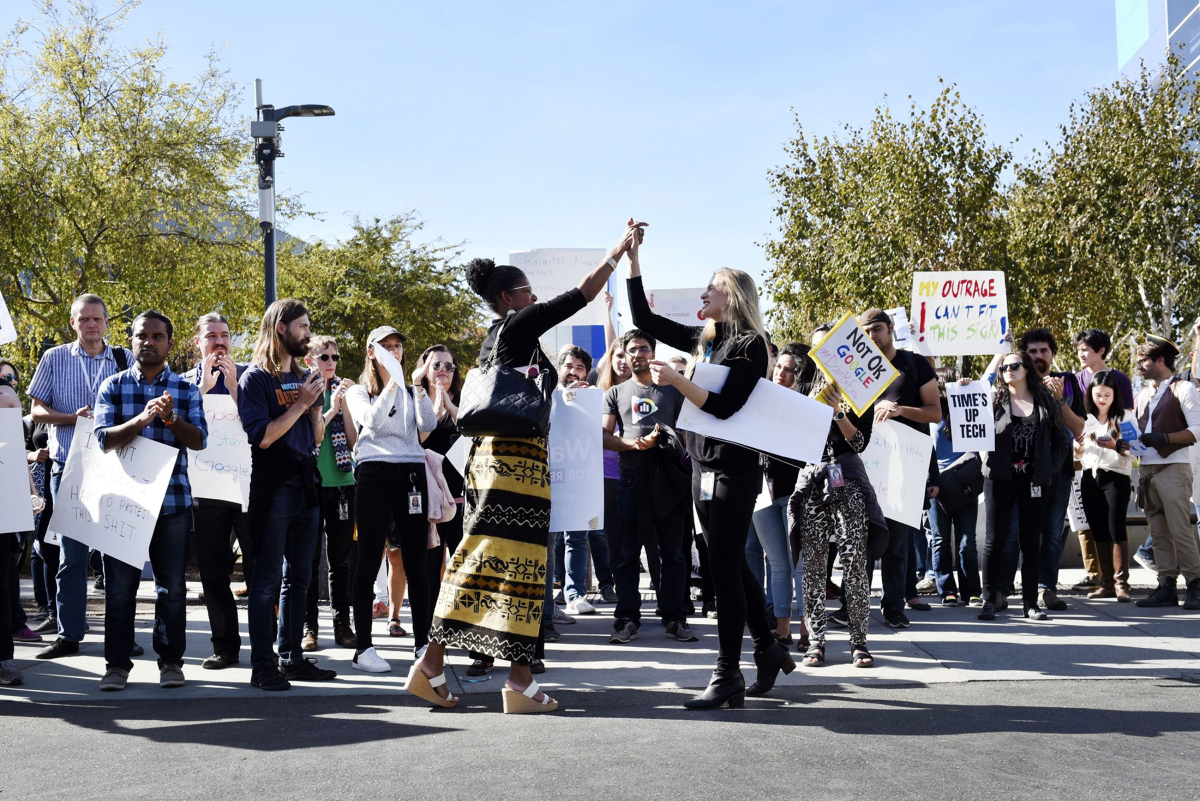
Two women high-five as Google employees hold signs during walkout in protest at Google's offices in Mountain View, Calif., on Nov. 1, 2018. MUST CREDIT: Bloomberg photo by Michael Short

Two women high-five as Google employees hold signs during walkout in protest at Google’s offices in Mountain View, Calif., on Nov. 1, 2018. MUST CREDIT: Bloomberg photo by Michael Short

“When we were smaller, we all worked as one team, on one product, and everyone understood how business decisions were made,” Walker wrote. “It’s harder to give a company of over 100,000 people the full context on everything.”

Many large companies have policies restricting access to sensitive information to a “need-to-know” basis. But in some segments of Google’s workforce, the reaction to Walker’s argument was immediate and harsh. On an internal messaging forum, one employee described the data policy as “a total collapse of Google culture.”

An engineering manager posted a lengthy attack on Walker’s note, which he called “arrogant and infantilizing.” The need-to-know policy “denies us a form of trust and respect that is again an important part of the intrinsic motivation to work here,” the manager wrote.

The complaining also spilled into direct action. A group of Google programmers created a tool that allowed employees to choose to alert Walker with an automated email every time they opened any document at all, according to two people with knowledge of the matter. The deluge of notifications was meant as a protest to what they saw as Walker’s insistence on controlling the minutiae of their professional lives.

“When it comes to data security policies, we’ve never intended to prevent employees from sharing technical learnings and information and we are not limiting anyone’s ability to raise concerns or debate the company’s activities,” said a Google spokeswoman in an email. “We have a responsibility to safeguard our user, business and customer information and these activities need to be done in line with our policies on data security.”

The actions are just the latest chapter in an internal conflict that has been going on for almost two years. About 20,000 employees walked out last fall over the company’s generous treatment of executives accused of sexual harassment, and a handful quit over Google’s work on products for the U.S. military and a censored search engine for the Chinese market. Earlier this year, Google hired IRI Consultants, a firm that advises employers on how to combat labor organizing, and it recently fired four employees for violating its policies on accessing sensitive data.

The extent of Google’s employee rebellion is hard to measure-the company has tried to portray it as the work of a handful of malcontents from the company’s junior ranks. Nor are the company’s message boards unilaterally supportive of revolt. “We want to focus on our jobs when we come into the workplace rather than deal with a new cycle of outrage every few days or vote on petitions for or against Google’s latest project,” wrote one employee on an internal message board viewed by Bloomberg News.

Still, the company seems stuck in a cycle of escalation. Walker’s internal critics say his Nov. 14 email is part of a broader erosion of one of Google’s most distinctive traits-its extreme internal transparency. The fight also illustrates the lack of trust between Google’s leadership and some of its employees, according to interviews with over a dozen current and former employees, as well as internal messages shared with Bloomberg News on the condition it not publish the names of employees who participated.

The conflict comes as Google is changing in other ways, too. On Dec. 3, Sundar Pichai, who took over as Google’s chief executive office in 2015, became the head of Alphabet, its parent company. His elevation marks the end of the active involvement of Sergey Brin and Larry Page, who established Google’s distinctive culture when they founded the company as Stanford graduate students.

Pichai has at times supported internal activism. He spoke at an employee protest against the Trump administration’s immigration policies and apologized to employees for Google’s track record on sexual harassment. His executives met repeatedly with critics of the company’s military work. Some Google managers began signaling that they’re losing patience with internal activism even before the firings, according to one person who worked with them. Executives have not met with dissenting staff leadership in many weeks, according to one of the employees.

While Walker wrote in the “Daily Insider” that organizations have to change as they grow, he simultaneously argued that the policies he described had always existed. “It was that way since the early days of Google, and it’s that way now,” he wrote. This particularly offended several long-time Googlers, who said on internal message boards that Walker’s comments didn’t square with their own memories. For some of them, the incident illustrated a broader breakdown in their trust of leadership.

“I want to believe that executive management is saying everything – disclosing the truth, the whole truth and nothing but the truth,” said Bruce Hahne, a Google technical project manager. “I don’t think we are currently under those conditions.”

Hahne, 51, doesn’t meet the Google management’s profile of internal protestors. He joined the company in 2005, a year after Pichai, partly because he was attracted to its mission to organize the world’s information. His disillusionment crept in gradually during the company’s myriad controversies. In an online essay, Hahne compared Google to a “rogue machine” that was “originally created for good but whose psyche has turned corrupt and destructive,” much like Hal 9000 from the movie 2001: A Space Odyssey. “You don’t treat a rogue machine like family,” wrote Hahne, “instead you come up with a plan, you disable or dismantle the dysfunctional parts of the machine, and you seek to reprogram the machine to serve its original purpose.”

When it was founded two decades ago, Google established an unusual corporate practice. Nearly all of its internal documents were widely available for workers to review. A programmer working on Google search could for instance, dip into the software scaffolding of Google Maps to crib some elegant block of code to fix a bug or replicate a feature. Employees also had access to notes taken during brainstorming sessions, candid project evaluations, computer design documents, and strategic business plans. (The openness doesn’t apply to sensitive data such as user information.)

The idea came from open-source software development, where the broader programming community collaborates to create code by making it freely available to anyone with ideas to alter and improve it. The philosophy came with technical advantages. “That interconnected way of working is an integral part of what got Google to where it is now,” said John Spong, a software engineer who worked at Google until this July.

Google has flaunted its openness as a recruiting tool and public relations tactic as recently as 2015. “As for transparency, it’s part of everything we do,” Laszlo Bock, then the head of Google human relations, said in an interview that year. He cited the immediate access staff have to software documentation, and said employees “have an obligation to make their voices heard.”

Google’s open systems also proved valuable for activists within the company, who have examined its systems for evidence of controversial product developments and then circulated their findings among colleagues. Such investigations have been integral to campaigns against the projects for the Pentagon and China. Some people involved in this research refer to it as “internal journalism.”

Management would describe it differently. In November, Google fired four engineers who it said had been carrying out “systematic searches for other employees’ materials and work. This includes searching for, accessing, and distributing business information outside the scope of their jobs.” The engineers said they were active in an internal campaign against Google’s work with the U.S. Customs and Border Protection, and denied violating the company’s data security policies.

Rebecca Rivers, one of the fired employees, said she initially logged into Google’s intranet, a web portal open to all staff, and typed the terms: “CBP” and “GCP,” for Google Cloud Platform. “That’s how simple it was,” she said. “Anyone could have stumbled onto it easily,” she said.

In an internal email describing the firings, Google accused one employee of tracking a colleague’s calendar without permission, gathering information about both personal and professional appointments in a way that made the targeted employee feel uncomfortable.

Laurence Berland, one of the employees who was fired recently, acknowledged he had accessed internal calendars, but said they were not private. He used them to confirm his suspicions that the company was “coordinating to spy on” activist employees. Berland, who first joined Google in 2005, added that the company has enforced its rules arbitrarily.

Google declined to identify the four employees it fired, but a company spokeswoman said the person who tracked calendars accessed unauthorized information.

Other employees say they are now afraid to click on certain documents from other teams or departments because they are worried they could later be disciplined for doing so, a fear the company says is unfounded. Some workers have interpreted the policies as an attempt to stifle criticism of particular projects, which they allege amounts to a violation of the company’s code of conduct. These employees point to a clause in the code that actively encourages dissent: “Don’t be evil, and if you see something that you think isn’t right -speak up!”

Workers are “trying to report internally on problematic situations, and in some cases are not being allowed to make that information useful and accessible,” said Hahne. There is now a “climate of fear” inside Google offices, he said.

Google’s permissive workplace culture became the prime example of Silicon Valley’s brand of employment. But transparency is hardly universal. Apple Inc. and Amazon.com Inc. demand that workers operate in rigid silos to keep the details of sensitive projects from leaking to competitors. Engineers building a phone’s camera may have no idea what the people building its operating system are doing, and vice versa. Similar restrictions are common at government contractors and other companies working with clients who demand discretion.

The specifics of Google’s business operations traditionally haven’t required this level of secrecy, but that is changing. Google’s cloud business in particular requires it to convince business clients it can handle sensitive data and work on discrete projects. This has brought it more in line with its secrecy-minded competitors. The protests themselves have also inspired new restrictions, as executives have looked to cut off the tools of the activists it argues are operating in bad faith.

Google’s leaders have acknowledged the delicacy of adjusting a culture that has entrenched itself over two decades. “Employees today are much, much more active in the governance in the company,” Eric Schmidt, Google’s former CEO and chair, said at an event at Stanford University in October.

Amy Edmonson, a professor of leadership and management at Harvard Business School, said that Google’s idealistic history increases the burden on its executives to bring along reluctant employees as it adopts more conventional corporate practices. “It’s just really important that if you’re going to do something that is perceived as change that you’re going to explain it,” she said.

Bock, the company’s former HR director who is now CEO of Humu, a workplace software startup, suggested that Google hasn’t succeeded here. “Maybe Alphabet is just a different company than it used to be,” he wrote in an email to Bloomberg News. “But not everyone’s gotten the memo.”

U.S. retail sales miss forecasts as restaurants decline

#ศาสตร์เกษตรดินปุ๋ย : ขอบคุณแหล่งข้อมูล : หนังสือพิมพ์ The Nation

https://www.nationthailand.com/business/30379419?utm_source=category&utm_medium=internal_referral

U.S. retail sales miss forecasts as restaurants decline

Dec 14. 2019
Crowds gather in the electronics section at a Target in the New York borough of Queens on Nov. 28, 2019. MUST CREDIT: Bloomberg photo by Bess Adler.

Crowds gather in the electronics section at a Target in the New York borough of Queens on Nov. 28, 2019. MUST CREDIT: Bloomberg photo by Bess Adler.
By Syndication Washington Post, Bloomberg · Katia Dmitrieva 

809 Viewed

U.S. retail sales missed forecasts calling for an acceleration in November as clothing stores and restaurants posted declines, signaling the economy’s main engine may cool in the fourth quarter by more than previously thought.

The value of overall sales climbed 0.2% after an upwardly revised 0.4% increase the prior month, Commerce Department figures showed Friday. The median estimate in a Bloomberg survey called for a 0.5% increase.

Sales in the “control group” subset increased a below-forecast 0.1% following a 0.3% gain. The measure excludes food services, car dealers, building-materials stores and gasoline stations, providing a reading considered more reflective of underlying consumer demand.

The data suggest a slowdown in business investment and weakness in manufacturing is weighing more broadly on Americans’ willingness to spend, which could mean a soft holiday-shopping season despite a relatively strong labor market, improved wage gains and record stock prices. At the same time, consumers likely still have enough wherewithal to support the expansion, and an easing of U.S.-China trade tensions should aid the economy in 2020.

Bloomberg News reported Thursday that President Donald Trump signed off on a phase-one trade deal with China, averting the Dec. 15 introduction of a new wave of U.S. tariffs on about $160 billion of consumer goods from the Asian nation, according to people familiar with the matter. U.S. stock futures fluctuated Friday morning after a CNBC report saying China still has concerns about targets for agricultural purchases.

Other early indications for the holiday shopping season were more optimistic, with BofA Global Research reporting retailers had the highest sales gains for the period up to Black Friday since 2013.

Online sales were a strong element of Friday’s report. Sales at nonstore retailers, which includes e-commerce, rose 0.8% from the prior month, the biggest gain since August. They’re up 11.5% from a year earlier, though that’s down from October’s increase.

A Bloomberg survey this month showed growth in consumer spending was expected to ease to a 2.1% pace in the fourth quarter, from 2.9% in the prior three months. Control-group sales have increased a paltry annualized 1.3% over the latest three months, down from 3.4% in the three months through October.

Even so, the weakness in consumer spending — which accounts for two-thirds of the economy — is likely not dire enough to spur the Federal Reserve to resume cutting interest rates.

Fed Chairman Jerome Powell noted in a press conference this week that consumer confidence remains elevated and that spending is healthy, with policy makers expecting to hold interest rates steady through the end of 2020. Last week’s jobs report for November showed payroll gains topped all economist estimates.

The retail sales report showed eight of 13 major categories increased, with solid gains in autos and electronics and appliance stores.

Among declines, sales at health and personal care stores dropped by the most in almost a year, while receipts at apparel and sporting goods and hobby stores also fell. Restaurants posted a 0.3% drop, also the largest in almost a year.

Filling-station receipts increased 0.7%, the report showed. The retail figures aren’t adjusted for price changes, so sales could reflect changes in gasoline costs, sales, or both. Separate data on the consumer price index this week showed that gasoline prices rose 1.1% in the month, which could have boosted these figures.

Excluding automobiles and gasoline, retail sales were little changed, following a 0.2% gain the previous month.

The sales data don’t capture all household purchases and tend to be volatile from month to month. Personal-spending figures will offer a fuller picture of U.S. consumption in data due Dec. 20.

A separate Labor Department report Friday added to signs of muted inflation pressures in the economy. The U.S. import price index rose 0.2% in November from the prior month, matching forecasts, and fell 1.3% from a year earlier. Excluding petroleum, the index was also up 0.2% from the prior month.

China confirms trade deal with the U.S., averting new tariffs ahead of Sunday deadline

#ศาสตร์เกษตรดินปุ๋ย : ขอบคุณแหล่งข้อมูล : หนังสือพิมพ์ The Nation

https://www.nationthailand.com/business/30379418?utm_source=category&utm_medium=internal_referral

China confirms trade deal with the U.S., averting new tariffs ahead of Sunday deadline

Dec 13. 2019
By  The Washington Post · Anna Fifield 

541 Viewed

BEIJING – China and the United States have reached agreement on the text of a “phase one” trade deal, China’s vice commerce minister said in a late-night press conference Friday, a day after President Donald Trump signed off on the deal.

The text includes nine chapters, including ones on intellectual property rights, technology transfer, food and farm products, financial services, exchange rates, and dispute resolution, Wang Shouwen said at the 11 p.m. press conference at the State Council Information Office in Beijing.

The Chinese and the American delegations will now carry out a legal review and check the translation as soon as possible, Wang told reporters. They will then make the arrangements for the formal signing of the agreement, he said.

Minister plans energy incentives for customers over New Year

#ศาสตร์เกษตรดินปุ๋ย : ขอบคุณแหล่งข้อมูล : หนังสือพิมพ์ The Nation

https://www.nationthailand.com/business/30379405?utm_source=category&utm_medium=internal_referral

Minister plans energy incentives for customers over New Year

Dec 13. 2019
Energy Minister Sontirat Sontijirawong

Energy Minister Sontirat Sontijirawong
By THE NATION

733 Viewed

Energy Minister Sontirat Sontijirawong will soon propose a number of measures as New Year gift to consumers for the Cabinet’s consideration.

He said today (December 13) that one of the proposals would be to lower the retail price of B10 diesel and E20 gasohol by Bt1 per litre for 15 days from December 25 to January 10 to encourage motorists to use B10 diesel.

B10 will be available at all petrol stations countrywide from March next year.

The Energy Regulatory Commission will also cap the fuel tariff of electricity at minus 11.60 satang per unit and the average electricity price people pay at Bt3.64 per unit for four months during next January to April.

He added that PTT will also launch a promotional campaign during New Year.

He will also propose to the National Energy Policy Council on December 16 the plan to set up a national electric vehicle committee to steer the EV sector’s development.

SET and Asia stocks rally, boosted by US-China trade deal

#ศาสตร์เกษตรดินปุ๋ย : ขอบคุณแหล่งข้อมูล : หนังสือพิมพ์ The Nation

https://www.nationthailand.com/business/30379395?utm_source=category&utm_medium=internal_referral

SET and Asia stocks rally, boosted by US-China trade deal

Dec 13. 2019
By The Nation

1,331 Viewed

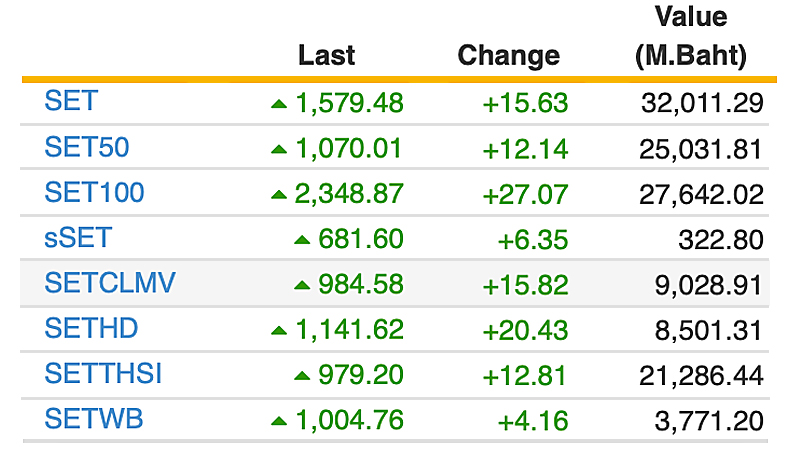
The Stock Exchange of Thailand Index edged up about 1 per cent in morning trade, rising to 1,578.43, or up 0.93 per cent at 10.54am Bangkok time.

Tisco’s market insight suggested it could be the right time for short-term traders to enter the market . The index has high chance to rise further next week provided it maintains its position at 1,570-1,575, said Tisco Financial Group, adding that SET 100 shares prices including AMATA, BJC, Intuch, Centel, Planb, PTG, Ratch and WHA, which have been down since late last month, may also have a chance to recover. SCC, Kbank, PTT and PTTEP shares, earlier the target of short sales, could also rise according to Tisco.

Shares in major market across Asia also rose sharply following the jump of US stocks. Japan’s Nikkei 225 jumped more than 2 per cent, South Korea’s Kospi rose about 1.3 per cent and China’s Shanghai composite index was up 1.2 per cent.

White House, Chinese negotiators reach trade deal in principle

Global stock markets have been boosted by news reports suggesting that US and China have reached a trade deal and the UK election, where exit polls put the Conservatives firmly in the lead.

SEC grants ThaiBMA right to test blockchain tech for trading bonds

#ศาสตร์เกษตรดินปุ๋ย : ขอบคุณแหล่งข้อมูล : หนังสือพิมพ์ The Nation

https://www.nationthailand.com/business/30379393?utm_source=category&utm_medium=internal_referral

SEC grants ThaiBMA right to test blockchain tech for trading bonds

Dec 13. 2019
By The Nation

1,004 Viewed

At its monthly meeting on Wednesday (December 11), the SEC Board passed a resolution to grant a securities depository centre regulatory sandbox license to the Thai Bond Market Association (ThaiBMA) to test the use of distributed ledger technology (DLT) in facilitating faster issuance of bonds and increase efficiency of the bond market, according to press statement from the SEC.

The adoption of technology will shorten the issuance of bonds process and increase efficiency of overall market. Under the sandbox regime, ThaiBMA has set up a DLT-based bondholder data storage system, which will allow entities related to issuance and offering of bonds – i.e., investors, issuers, underwriters, registrars, depositories and regulators – to examine bond information more conveniently and rapidly while benefiting from less redundancy and a shorter timeframe for book closing process.

ThaiBMA’s participation in this regulatory sandbox is expected to solve issues in corporate bond market. These includes the time-consuming process for verification of bondholders’ ownership and the lack of an interconnected data centre due to unconnected data systems of individual bond registrars. Such issues have caused delays and inefficiency in the bond issuance process. The real-time, live testing under the regulatory sandbox can be a protocol for further bond market development and other work processes in the capital market in the future.

This regulatory sandbox is a major step forward and an important part of the implementation of DLT to support the Thai Capital Market Digital Infrastructure initiative . The initiative, spearheaded by the SEC, was officially launched on September 3 to increase efficiency, reduce costs, enhance transparency and strengthen competitiveness of business operators. In addition, investors and issuers will benefit from cost reduction and convenient access to capital market, says the statement.

Trump trade official heads to Hill to ease tensions with GOP senators over trade deal

#ศาสตร์เกษตรดินปุ๋ย : ขอบคุณแหล่งข้อมูล : หนังสือพิมพ์ The Nation

https://www.nationthailand.com/business/30379388?utm_source=category&utm_medium=internal_referral

Trump trade official heads to Hill to ease tensions with GOP senators over trade deal

Dec 13. 2019
President Trump /File Photo:GettyImages

President Trump /File Photo:GettyImages
By The Washington Post · Seung Min Kim

279 Viewed

WASHINGTON – President Donald Trump’s top trade official briefed Senate Republicans on the new trade agreement with Canada and Mexico on Thursday – an attempt to soothe tensions with GOP senators who have voiced frustration that the administration conceded too much to House Democrats to win their support for the deal.

Robert Lighthizer, the U.S. trade representative, met with all GOP senators at a lunch to detail key changes to the U.S.-Mexico-Canada trade agreement. He also separately briefed Republican and Democratic members of the Senate Finance Committee, which oversees trade policy, earlier Thursday.

The White House and congressional Democrats have touted the rewrite of the existing North American Free Trade Agreement as a major improvement over the original 1990s-era compact. But many Republicans have been skeptical about the enthusiastic support for the new trade deal from Democrats and labor unions, and questioned whether the agreement moved too far to the left at the expense of GOP trade priorities.

Some Republicans – including Sen. Patrick Toomey of Pennsylvania, probably the most vocal GOP critic of the administration’s NAFTA rewrite – have criticized the substance of the administration’s accord with House Democrats. But most of the annoyance among Republicans has centered largely on their sense that the GOP was cut out of the administration’s negotiations with House Speaker Nancy Pelosi, D-Calif., and her ranks.

Sen. John Cornyn, R-Texas, told reporters that he registered process complaints with Lighthizer and that the administration had jammed the Senate in negotiating directly with Democrats. That, Cornyn said, was a “lousy way to treat the Senate.”

“I’ve supported NAFTA, and I support this,” Cornyn said. “But I don’t appreciate the Senate being ignored as part of the process.”

Despite the GOP complaints, Congress is still likely to support the trade agreement with large margins, with Senate Majority Whip John Thune, R-S.D., the party’s chief vote counter, conceding that “everybody kind of realized, too, that it’s a take-it-or-leave-it proposition.”

Still, that didn’t stop the venting in private.

During the lunch with Senate Republicans and Lighthizer, Sen. Ted Cruz, R-Texas,s told the trade official that the administration conceded too much to demands from congressional Democrats and labor unions, according to an official in the room who spoke on the condition of anonymity to disclose a private conversation.

Tying Senate Republicans’ hands further is the fast-track procedure that is being deployed to pass the trade deal with Canada and Mexico in Congress – which significantly limits the ability of lawmakers to amend the substance of the agreement.

“Everybody knows that at the end, it’s pretty much an up-or-down-type option,” Thune said. Lighthizer, he continued, “walked through some of the changes they made on labor provisions and enforcement and some of the environmental stuff.”

Thune added: “But like I said, at this point, kind of academic. You either take it or leave it.”

The House is expected to ratify the trade agreement before the end of the year. Senate Majority Leader Mitch McConnell, R-Ky., has said senators won’t vote on it until after the impeachment trial of Trump, which will almost certainly begin in early January.

“It’s imperfect,” Sen. Kevin Cramer, R-N.D., said. “And some people are concerned about the more recent negotiations. But at the end of the day, the speaker of the House and her majority have a lot to say about it, and I think the vast majority of us feel comfortable he got the best deal he could get.”

White House, Chinese negotiators reach trade deal in principle

#ศาสตร์เกษตรดินปุ๋ย : ขอบคุณแหล่งข้อมูล : หนังสือพิมพ์ The Nation

https://www.nationthailand.com/business/30379384?utm_source=category&utm_medium=internal_referral

White House, Chinese negotiators reach trade deal in principle

Dec 13. 2019
By The Washington Post · David J. Lynch 

622 Viewed

WASHINGTON – President Donald Trump on Thursday approved a proposed U.S.-China trade deal, raising hopes for a possible truce in a 21-month commercial conflict that roiled financial markets, disrupted corporate supply chains and cost taxpayers tens of billions of dollars.

At a White House meeting with his top trade advisers, the president signed off on a swap of U.S. tariff reductions in return for China spending $50 billion on U.S. farm goods, tightening its intellectual property protections and opening its financial services markets, according to Michael Pillsbury, a China expert at the Hudson Institute, who says the president briefed him on the deal Thursday.

“It’s a breakthrough,” Pillsbury said. “He says it’s historic. I certainly agree with that.”

The limited accord caps a roller-coaster negotiation that brought the two countries to the brink of success more than once this year only to see talks stall. Diplomats from the world’s two largest economies have been working against a Sunday deadline, when new U.S. tariffs on $160 billion in Chinese goods were scheduled to take effect.

That increase now will not go forward and existing tariffs on $360 billion in Chinese imports will also be reduced, according to Pillsbury and others familiar with the arrangement. The deal includes provisions that will penalize the Chinese government if it fails to place the required agricultural orders.

As of Thursday evening in Washington, the Chinese government had issued no official confirmation of a deal.

Still, the so-called “phase one” agreement leaves the thorniest issues in the U.S.-China trade dispute to future negotiations, which are scheduled to begin next year. China’s massive subsidies for state enterprises and its practice of forcing foreign companies to surrender technology secrets in return for access to the Chinese market will be the subject of “phase two” of the talks.

Pillsbury recounted that the president told him in a late-afternoon phone call that Trump anticipates those talks continuing past the November 2020 election. Pillsbury serves as an occasional outside adviser to the president.

For Trump, the China deal is part of a sudden flurry of policy making that has dazzled official Washington in the past week, as House Democrats are advancing plans to impeach him next week.

This week alone, the administration has reached deals with lawmakers to provide federal workers with 12 weeks of paid parental leave, establish a new military branch called “Space Force,” revise a proposed North American trade deal, and broker a budget deal that would prevent a government shutdown later this month.

“It’s very ironic: In some ways, this has been the best week of Trump’s presidency, and it’s happening at the very moment impeachment is reaching its crescendo,” said Stephen Moore, who advises Trump on economic policy and visited the White House for policy discussions this week. “It’s been revealed by their actions that the strategy was to go on a policy offensive as a way to play defense against impeachment, and it’s made Trump look unfazed by this.”

Plans for announcing the deal, including whether an official text will be made public, remain in flux. The administration has said it does not intend to seek congressional approval of the agreement.

“The deal is essentially done. The mechanics of how you execute it and how you get it signed still have to be worked out,” said one person briefed on the White House’s deliberations, who requested anonymity because they were not authorized to speak to the press.

Under one scenario, Robert Lighthizer, the president’s chief trade negotiator, and Chinese Ambassador to the U.S. Cui Tiankai could sign the document as soon as tomorrow. Alternatively, Lighthizer and Treasury Secretary Steven Mnuchin could travel to Beijing for the signing.

Administration officials expect that Trump will benefit politically from sealing a deal with China. His decision to confront Beijing over its discriminatory trade practices was backed by business and farm groups who had felt the sting of Chinese behavior. Trump began imposing tariffs on Chinese imports in March 2018 in an effort to pressure Beijing to overhaul their state-dominated economy. Chinese leaders retaliated, halting purchases of U.S. farm products, in a bid to pressure some of Trump’s strongest supporters.

As the trade war escalated, costs mounted. Assembly lines were disrupted, as manufacturers petitioned the administration for permission to continue importing tariff-free Chinese parts they depended on to operate. In August alone, more than 10,000 workers were laid off, collateral damage from the trade war’s salvos. To mollify farmers, a politically potent constituency that lost lucrative Chinese sales, Trump doled out $28 billion — an amount that was more than double the controversial 2009 rescue of the auto industry.

Some were unimpressed with Thursday’s news.

“It is unclear that much will really be gained from the deal other than partially unwinding some of the disruptions created earlier this year while leaving other uncertainties in place,” economists at J.P. Morgan told clients.

Business leaders who have grown anxious for relief from the trans-Pacific tariff wars welcomed the development . “That is excellent news. It puts a floor under the deterioration in the relationship,” said Craig Allen, president of the U.S.-China Business Council.

Myron Brilliant, executive vice president of the U.S. Chamber of Commerce, said the deal would benefit American manufacturers and farmers. “It’s an important first step, but just a first step,” he said. “There is more work to be done.”

Several people close to the talks said the administration had not shared with them the text of the deal, which they described as an “agreement-in-principle.” Trump two months said he had reached “an agreement in principle” with China and expected to commit the terms to paper within a few weeks.

Even before a formal presidential decision to proceed, Republican critics of the so-called “Phase One” agreement sounded the alarm.

Senator Marco Rubio, a Florida Republican and member of the Senate Foreign Relations Committee, warned against settling too quickly with Beijing. “@WhiteHouse should consider the risk that a near-term deal with #China would give away the tariff leverage needed for a broader agreement on the issues that matter the most such as subsidies to domestic firms, forced tech transfers & blocking U.S. firms access to key sectors,” Rubio tweeted.

Derek Scissors, a China hawk with the American Enterprise Institute and occasional administration adviser, accused the president of rushing to make a deal. “This timing is really weird,” Scissors said. “Technically, there’s been a deal on the table for the president to sign for some time. What’s changed is they think the president will say ‘yes.'”

Early Thursday morning, Trump teased investors with word of a potential deal with China, sending the stock market briefly higher amid optimism about a breakthrough in the lengthy standoff.

“Getting VERY close to a BIG DEAL with China,” the president tweeted shortly after Wall Street opened. “They want it, and so do we!”

The Dow Jones industrial average quickly rose more than 300 points, or roughly 1 percent, within the first hour of trading as financial markets cheered the prospect of a “Phase 1” deal with China. The market later surrendered some of its gains, though, and closed at 28,132.05, up almost 221 points or 0.8 percent.

The emerging deal would fall well short of the president’s initial goal: a comprehensive settlement of U.S. complaints about subsidized Chinese state businesses and trade secrets theft.

The president has often suggested the two sides were close to a deal only to see negotiations stall in the past. In April, Trump said the White House and Chinese negotiators were within weeks of an “epic” deal. The next month, talks collapsed amid U.S. charges that Beijing had reneged on a tentative bargain.

Progress with China comes as the White House is celebrating victory on another front in Trump’s trade wars. This week, House Democrats agreed to support a revised version of a new North American trade deal, which the president had signed last year with Mexico and Canada.

House Speaker Nancy Pelosi, D-Calif., backed the agreement after securing amendments that toughened enforcement of labor and environmental standards. The modified accord also dropped an extension of patent protections for a class of new drugs known as biologics, which Democrats said would lead to higher prescription drug prices.

The new U.S.-Mexico-Canada Agreement is expected to reach a House vote next week and clear the Senate early next year. Once approved by the legislatures in each country, it will supplant the 1994 North American Free Trade Agreement, which Trump has called “our country’s worst trade deal.”

The bipartisan cooperation on trade is occurring even as House Democrats move forward with plans to impeach the president over his demand that Ukraine announce an investigation of one of his political rivals before receiving $391 million in congressionally authorized military aid.

Enough fiscal room to implement policies: Somkid

#ศาสตร์เกษตรดินปุ๋ย : ขอบคุณแหล่งข้อมูล : หนังสือพิมพ์ The Nation

https://www.nationthailand.com/business/30379360?utm_source=category&utm_medium=internal_referral

Enough fiscal room to implement policies: Somkid

Dec 13. 2019
Deputy Prime Minister Somkid Jatusripitak, left

Deputy Prime Minister Somkid Jatusripitak, left
By THE NATION

820 Viewed

Thailand still has fiscal space to continue the government’s policies and projects in the medium and long-terms without impact on the state coffers.

Deputy Prime Minister Somkid Jatusripitak made the remarks on Thursday (December 12) after the meeting of the committee on government finance and fiscal policy to consider the medium-term fiscal plan for 2021-2024.

Somkid said it was a good thing that S&P Global Ratings had revised its outlook onThailand’s sovereign credit rating to positive from stable, which reflected that the Thai economy was still in good shape when compared to many other countries.

However, Thailand would still keep a close watch on the economic situation next year, he added.