Chocky soars to the top in China’s ‘Double 11’ shopping fest

#ศาสตร์เกษตรดินปุ๋ย : ขอบคุณแหล่งข้อมูล : หนังสือพิมพ์ The Nation

https://www.nationthailand.com/business/30379307?utm_source=category&utm_medium=internal_referral

Chocky soars to the top in China’s ‘Double 11’ shopping fest

Dec 11. 2019
By The Nation

943 Viewed

Thai brand Chocky was the top-seller in the wafer category during China’s “Double 11” shopping festival, which ended recently.

Apart from the usual fierce competition from local businesses, the festival found growing consumer interest in high-quality imported foods. Thai brand Chocky, which has partnered with Beijing Tian Fu Ying International Trade Company, emerged the No 1 seller in the wafer category of Tmall from October 21 to November 11.

According to Frost & Sullivan, the sales volume of China’s snack food industry reached Bt4.4 billion in 2018.

According to the General Administration of Customs China, the sales volume of imported foods in China grew at a compounded annual growth rate of 17.7 per cent from 2009 to 2018, and reached Bt2.15 billion last year.

With the continuous growth of Thailand’s tourism market, Thai snacks have become the dark horse in 2019 “China Double 11”. There are three reasons why Thai food represented by Chocky is widely loved by Chinese consumers. Firstly, Thai enterprises focus on food quality in export. Secondly, many enterprises are Chinese descendants, so they know how to customise their products based on Chinese taste while retaining Thai food’s distinguished features. Thirdly, Chocky has partnered with Tian Fu Ying International Trade Co, who has been deeply engaged in the food market for over 10 years, and continuously promoted Chocky online and offline during the past two years — this is a key factor in this old Thailand snack brand becoming popular in China.

The rapid growth of Chocky in China reflects the growing demand for quality imported food. According to Supra, director of the Guangzhou office of the international trade promotion office of the Ministry of Commerce of Thailand, the Chinese snack market has great potential and Thai enterprises should fully seize the opportunity. With the Belt and Road Initiative and strong online e-commerce channels in China, China-Thailand trade will be further strengthened in the future.

ADB trims growth forecasts as Asia’s biggest economies slow

#ศาสตร์เกษตรดินปุ๋ย : ขอบคุณแหล่งข้อมูล : หนังสือพิมพ์ The Nation

https://www.nationthailand.com/business/30379300?utm_source=category&utm_medium=internal_referral

ADB trims growth forecasts as Asia’s biggest economies slow

Dec 11. 2019
By THE NATION

1,494 Viewed

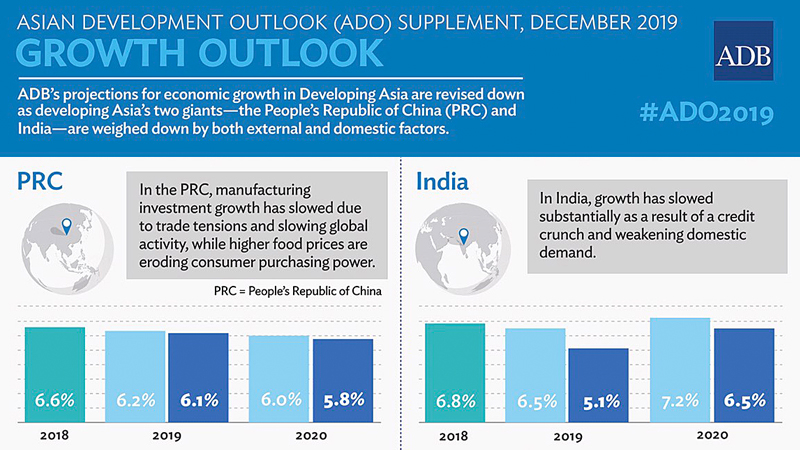
The Asian Development Bank (ADB) has trimmed its forecasts for economic growth in developing Asia this year and next year as growth in the People’s Republic of China (PRC) and India remains weighed down by both external and domestic factors.

In a supplement to its Asian Development Outlook 2019 Update released in September, ADB now expects gross domestic product (GDP) in the region to expand 5.2 per cent in both 2019 and 2020, down from the September forecast of 5.4 per cent growth this year and 5.5 per cent next year.

+++

“While growth rates are still solid in developing Asia, persistent trade tensions have taken a toll on the region and are still the biggest risk to the longer-term economic outlook. Domestic investment is also weakening in many countries, as business sentiment has declined,” said ADB chief economist Yasuyuki Sawada. “Inflation, on the other hand, is ticking up on the back of higher food prices, as African swine fever has raised pork prices significantly.”

The supplement forecasts inflation of 2.8 per cent in 2019 and 3.1per cent in 2020, up from the September prediction that prices would rise 2.7 per cent this year and next.

In East Asia, growth in the PRC is now expected at 6.1 per cent this year and 5.8 per cent next year due to trade tensions and a slowdown in global activity coupled with weaker domestic demand, with family wallets being hit by pork prices that have doubled relative to a year ago. Growth could accelerate, however, should the US and the PRC come to an agreement on trade, the report says. In September, ADB forecast GDP growth of 6.2 per cent in 2019 and 6.0 per cent in 2020.

Hong Kong, China, already in technical recession, will see severe downward pressures persist possibly into 2020. The economy is now expected to contract 1.2 per cent this year and grow 0.3 per cent next year.

In South Asia, India’s growth is now seen at a slower 5.1 per cent in fiscal year 2019 as the foundering of a major non-banking financial company in 2018 led to a rise in risk aversion in the financial sector and a credit crunch. Also, consumption was affected by slow job growth and rural distress aggravated by a poor harvest. Growth should pick up to 6.5 per cent in fiscal year 2020 with supportive policies. In September, ADB forecast India’s GDP to grow 6.5 per cent in 2019 and 7.2 per cent in 2020.

In Southeast Asia, many countries are seeing continued export declines and weaker investment, and growth forecasts have been downgraded for Singapore and Thailand. GDP growth is expected to slow in the Pacific with activity in Fiji, the sub-region’s second largest economy after Papua New Guinea, expected to be more subdued than previously anticipated.

Central Asia is the only sub-region where prospects look a little brighter now than in September, largely thanks to increased public spending in Kazakhstan, the region’s largest economy. Central Asia is now forecast to grow 4.6 per cent in 2019, up from the previous prediction for expansion of 4.4 per cent . The forecast for 2020 is for growth of 4.5 per cent . Kazakhstan’s economy is seen expanding by 4.1 per cent this year and 3.8 per cent next year.

ADB is committed to achieving a prosperous, inclusive, resilient, and sustainable Asia and the Pacific, while sustaining its efforts to eradicate extreme poverty. In 2018, it made commitments of new loans and grants amounting to $21.6 billion.

Some SMEs can now seek urgent loans with TCG guarantee

#ศาสตร์เกษตรดินปุ๋ย : ขอบคุณแหล่งข้อมูล : หนังสือพิมพ์ The Nation

https://www.nationthailand.com/business/30379245?utm_source=category&utm_medium=internal_referral

Some SMEs can now seek urgent loans with TCG guarantee

Dec 11. 2019
By THE NATION

956 Viewed

The state-owned Thai Credit Guarantee Corporation (TCG) will for the first time provide direct guarantees to small and medium-size enterprises in urgent need of loans.

The TCG has prepared direct guarantees of Bt1.5 billion for these SMEs, TCG president Rak Vorrakitpokatorn said, adding that the service will begin later this month.

The direct guarantee is similar to a letter of guarantee to needy SMEs, which can hand it to banks to seek loans with TCG backup.

Currently, SMEs have to seek loans at banks first. If they do not have enough credit, the banks will advise them to seek TCG help.

TCG has already partnered with three banks in the initiative, Rak added.

The SMEs qualified for the direct guarantee must be ones that have been in operation for at least five years and reporting substantial revenue. Their balance sheets must report a positive financial status for a consecutive three years.

The TCG will provide guarantees not exceeding Bt40 million per SME.

The fee for the guarantee is between 2.5 per cent and 3 per cent of the total guaranteed loan.

Analysts differ on baht movement as BOT sees decline

#ศาสตร์เกษตรดินปุ๋ย : ขอบคุณแหล่งข้อมูล : หนังสือพิมพ์ The Nation

https://www.nationthailand.com/business/30379273?utm_source=category&utm_medium=internal_referral

Analysts differ on baht movement as BOT sees decline

Dec 11. 2019
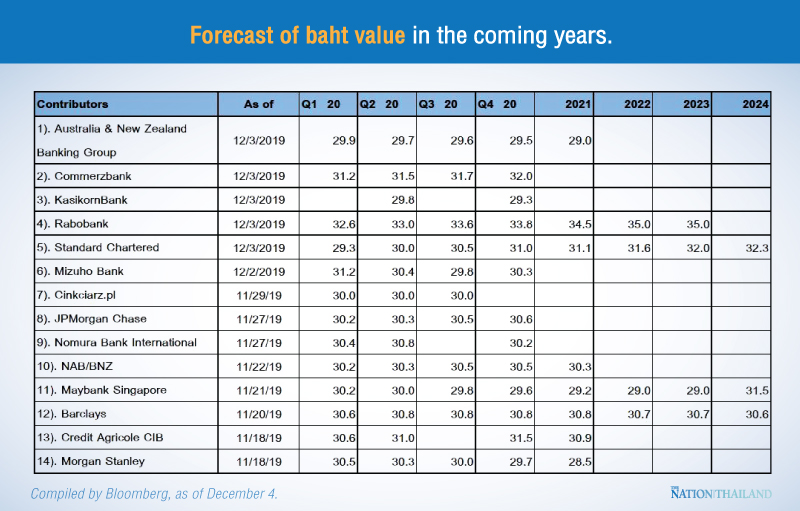
As of December 4, foreign and Thai analysts saw opposing directions of the baht movement. 

As of December 4, foreign and Thai analysts saw opposing directions of the baht movement.
By The Nation

1,405 Viewed

Foreign analysts predicted that the baht would depreciate next year, contrary to the views of their Thai counterparts.

The Bank of Thailand Scholarship Students (BOTSS) cited analysts’ forecast on the baht exchange rate in 2020, complied by Bloomberg news agency. It said median of the baht value would be declining next year.

The BOTSS Facebook page is run by current and former staffs of the central bank, it shares economic news and data with the public.

As of December 4, foreign and Thai analysts saw opposing directions of the baht movement.

JPMorgan Chase forecast the baht would depreciate to Bt30.6 per dollar in the fourth quarter next year. While Standard Chartered believed it would drop to Bt31 per dollar in the same period and Bt31.30 in 2021.

Rabobank put the baht value at Bt33.8 per dollar in the final quarter of next year.

Their views differed from those of Thai analysts who estimated the baht would continue to appreciate against the US dollar and other currencies in the region.

The predictions of foreign and Thai analysts suggested that the baht would move in either direction, or moving in a range between Bt28.7 to 33.8/dollar, according to BOTSS.

Earlier, deputy central bank governor Mathee Supapongse said the baht was on a downtrend but urged exporters to brace for a two-way movement.

His message was apparently intended to counter the negative views of some Thai exporters and analysts who saw continuous strengthening of the baht after a 7 per cent gain on the dollar this year.

Analysts at Kasikornbank forecast the baht to appreciate to Bt29.3 per dollar next year.

Charl Kengchon, executive chairman at Kasikorn Research Centre said on Monday that the baht will strengthen further if the US Federal Reserve lowers its key policy rate again in the first quarter next year. It is likely to happen, he added.

A major factor pushing up the baht is the country’s high current account surplus at around $30 billion, despite the higher figures in the past two years.

Foreign investors will still consider the baht a safe haven asset among emerging market economies, Charl believes.

House Democrats say they back Trump’s revised trade deal with Canada and Mexico, citing recent chang

#ศาสตร์เกษตรดินปุ๋ย : ขอบคุณแหล่งข้อมูล : หนังสือพิมพ์ The Nation

https://www.nationthailand.com/business/30379276?utm_source=category&utm_medium=internal_referral

House Democrats say they back Trump’s revised trade deal with Canada and Mexico, citing recent chang

Dec 11. 2019
File Photo: House Speaker Nancy Pelosi /GettyImages

File Photo: House Speaker Nancy Pelosi /GettyImages
By The Washington Post · David J. Lynch

1,029 Viewed

WASHINGTON – House Democrats took credit Tuesday for rewriting key parts of President Donald Trump’s new North American trade deal to include new protections for workers’ rights and to scrap a provision they said would have led to high prescription drug prices.

“There is no question that this trade agreement is much better than NAFTA. It is infinitely better than what was initially proposed by the administration,” said House Speaker Nancy Pelosi, speaking hours before representatives of the U.S., Mexico and Canada are expected to sign the revised deal at a meeting in Mexico City. “We’re declaring victory for the American worker.”

In a major win for the Trump administration, the nation’s largest labor federation backed the compromise.

“We demanded a trade deal that benefits workers and fought every single day to negotiate that deal; and now we have secured an agreement that working people can proudly support,” said Richard Trumka, the president of the AFL-CIO.

Trumka called the revised accord “a vast improvement over both the original NAFTA and the flawed proposal brought forward in 2017.”

The agreement is the first to include “enforceable labor standards,” which will include inspections of suspect manufacturing sites in Mexico, he said.

In a series of Twitter posts Tuesday, Trump hailed the breakthrough.

He wrote that the “Trade Bill is looking good. It will be the best and most important trade deal ever made by the USA. Good for everybody – Farmers, Manufacturers, Energy, Unions – tremendous support. Importantly, we will finally end our Country’s worst Trade Deal, NAFTA!”

He later wrote that it was “Looking like very good Democrat support for USMCA. That would be great for our Country!”

The U.S. Chamber of Commerce and other business groups also announced backing for the compromise hammered out between congressional Democrats and the Trump administration.

Democrats said they had secured specific changes in the text signed by Trump and the leaders of Mexico and Canada one year ago. The Democratic revisions eliminated a provision in the deal that would have extended data included tougher environmental standards

“We made this agreement,” said Rep. Richard Neal, the chairman of the House Ways and Means Committee.

The revised trade deal – called the U.S.-Mexico-Canada Agreement – represents an overhaul of the 1994 North American Free Trade Agreement.

It would create new intellectual property protections, require more North American parts to be used in automobiles to qualify for zero tariffs, open the Canadian milk market to U.S. farmers, and create new rules for e-commerce. It would also boost wages, benefits, and safety rules for workers and put in place updated environmental protections.

The changes would impact a wide range of industries, including agricultural, pharmaceutical, automotive, and manufacturing.

U.S. Trade Representative Robert Lighthizer and Trump son-in-law and senior adviser Jared Kushner are expected to be in Mexico on Tuesday to help secure the pact.

Senate Republicans are preparing meetings for Lighthizer to brief senators on the details of the proposed agreement, including one for members of the Finance Committee later this week and another tentatively for all GOP senators next Tuesday, according to people familiar with the planning who, like others, spoke on the condition of anonymity because plans were yet to be finalized.

Pelosi met privately Monday evening with several of her party members who have negotiated with Lighthizer for months to revise the initial trade agreement struck with Mexico and Canada for terms more favorable for Democrats. The House Democrats leaving the meeting declined to confirm a deal but signaled one was imminent, with Ways and Means Committee Chairman Richard E. Neal (D-Mass.) indicating that lawmakers could see “verification” of an agreement sometime Tuesday afternoon.

Neal, who was on a flurry of phone calls with Pelosi and Lighthizer over the weekend, also said the House should be able to hold a floor vote on the trade deal by the end of the year.

“If it’s where we think it is and so forth and the pieces that we thought were critically important . . . are there and get a chance to look at that, then I will be satisfied,” said Rep. Rosa DeLauro, D-Conn., a key figure in the party’s left flank who had also been negotiating with Lighthizer.


BOT mulls refinance programme for credit card debtors

#ศาสตร์เกษตรดินปุ๋ย : ขอบคุณแหล่งข้อมูล : หนังสือพิมพ์ The Nation

https://www.nationthailand.com/business/30379271?utm_source=category&utm_medium=internal_referral

BOT mulls refinance programme for credit card debtors

Dec 10. 2019
Chantavarn Sucharitakul

Chantavarn Sucharitakul
By THE NATION

1,894 Viewed

The Bank of Thailand (BOT) is considering a refinance programme for credit card debtors with credible payment history, assistant governor of communications and corporate relations Chantavarn Sucharitakul said.

“BOT has taken note of the problem faced by those credit card debtors’ during its Debt Clinic, and decided to help them via market mechanisms,” she explained. “The programme is being discussed. It will possibly take some time before clear guidelines are created and BOT can proceed.”

The refinance programme aims to help debtors by reducing their interest rates from 18 to 28 per cent to 7 to 12 per cent.

BOT specified that those who can avail of the refinance must not be over seventy years of age on the day the contract ends.

There will be a fixed installment throughout the contract, with an installment period of 1 to 4 years and a financial limit of Bt100,000 per person.

Those interested in the programme must agree to undergo checks by the National Credit Bureau every month.

OTCC moves to regulate franchise business

#ศาสตร์เกษตรดินปุ๋ย : ขอบคุณแหล่งข้อมูล : หนังสือพิมพ์ The Nation

https://www.nationthailand.com/business/30379270?utm_source=category&utm_medium=internal_referral

OTCC moves to regulate franchise business

Dec 10. 2019
Santichai Saratawanpad

Santichai Saratawanpad
By The Nation

899 Viewed

The Office of Trade Competition Commission (OTCC) has issued guidelines on franchise business, aimed at reining in improper behaviour in the segment, said commission member Santichai Saratawanpad.

The resolution and guidelines on franchise business will come into effect on February 4, he added.

The main purpose, Santichai said, is to establish a good corporate governance system and clear codes of practice in establishing correct trade norms through systemic development, which will enhance the franchise business to international standard.

The guidelines identifies prohibited behaviour which may be in violation of Article 57 of the Competition Act B.E. 2560, as follows:

1. Defining conditions that limit franchise rights without valid reasons, such as franchisees having to buy products that are not related to the franchise or purchase raw materials in quantities that are higher than the actual demand.

2. Setting additional conditions after the contract without valid reasons such as allowing the franchisees to purchase products other than those specified

3. Prohibiting franchisees from purchasing products or services from manufacturers or other service providers without valid reasons

4. Prohibiting franchisees form selling discounted perishable goods without vaild reasons.

5. Defining different conditions between franchisees which may lead to unfair trade practices.

6. Defining inappropriate conditions other than maintaining the quality and standards of the contract

Furthermore, to ensure transparency and fairness, the franchisor must disclose important information to the franchisee before drawing up a contract, such as information about compensation and business expenses, franchise business plan, trademark rights, their amendments if any, as well as termination of the contract.

Ministry pushes community power project

#ศาสตร์เกษตรดินปุ๋ย : ขอบคุณแหล่งข้อมูล : หนังสือพิมพ์ The Nation

https://www.nationthailand.com/business/30379241?utm_source=category&utm_medium=internal_referral

Ministry pushes community power project

Dec 09. 2019
Energy Minister Sontirat Sontijirawong

Energy Minister Sontirat Sontijirawong
By THE NATION

1,029 Viewed

Energy Minister Sontirat Sontijirawong today (December 9) outlined short-term measures to drive growth of the grassroot economy next year.

A major item on the agenda is the establishment of community power plants totalling 1,000 megawatts in next three years, adding that details of the plan will be submitted to National Energy Policy Council on December 16.

He expects the project to attract Bt80 billion in investments next year.

The ministry will also promote community-based energy centres, where electricity will be generated from renewable sources .

The difference between community energy centres and community power plants is that the former will generate power for their own use and not for sales.

He added that the ministry will tap into The Energy Conservation Fund in funding the setup of community energy centres and might invite private sector participation.

Vietnam-Laos trade hits US$940 million in ten months

#ศาสตร์เกษตรดินปุ๋ย : ขอบคุณแหล่งข้อมูล : หนังสือพิมพ์ The Nation

https://www.nationthailand.com/business/30379237?utm_source=category&utm_medium=internal_referral

Vietnam-Laos trade hits US$940 million in ten months

Dec 09. 2019
PM Nguyen Xuan Phuc chairs the meeting. — VNA/VNS Photo

PM Nguyen Xuan Phuc chairs the meeting. — VNA/VNS Photo
By Viet Nam News

1,345 Viewed

Hanoi — Trade co-operation was the highlight of Vietnam-Laos relations in the first ten months of the year, with revenue reaching US$940 million.

The figure was unveiled at a meeting of permanent cabinet members in Hanoi on Saturday under the chair of Prime Minister Nguyen Xuan Phuc.

Two-way trade is projected to hit $1.1-1.2 billion in 2019, up 12.6 per cent year-on-year, surpassing the targets of $1 billion and 10 per cent respectively set by the Government.

Vietnam has become the third biggest investor in Laos with 413 projects valued at $4.22 billion, with joint ventures involving Viettel, the Vietnam Rubber Group, Muong Thanh Hotel, Crown Plaza, LaoViet Bank and the Xekaman 1 Hydropower Plant.

Vietnam has committed to providing VNĐ3.25 trillion ($139.8 million) in non-refundable aid for Laos from 2016-20, including VNĐ707 billion in the 2019 fiscal year, up 18.4 per cent against the previous year, aiming to help the neighbouring country implement infrastructure projects in transport, energy, personnel training and social welfare.

In early 2019, Vietnam provided 300 tonnes of seeds for Laos to support locals hit by natural disasters.

Over 1,000 scholarships have been granted to Lao students, and Vietnam has also dispatched teachers to Laos and financed Vietnamese language teaching courses in the country.

This year, five Vietnamese-funded projects have been completed in Laos and two others have been launched.

At the meeting, cabinet members also pointed out slow capital disbursement of these projects, along with bottlenecks in procedures.

The PM and cabinet members called for efforts to remove these difficulties to speed up the implementation of the work and prepare for the meeting of the Vietnam-Laos Inter-Governmental Committee slated for January 2020.

Ethnic work boosted

The same day, a Vietnam – Lao conference was held in the central province of Nghe An to seeks ways to continue nurturing the bilateral relations and friendship and to share experiences in the ethnic work between the two countries.

With the participation of more than 300 delegates from Vietnam – Laos bordering provinces, the event is a chance for them to analyse deeply and comprehensively the issues on the role of the political systems and ethnic minority communities along the border line in nurturing the tradition of the great relations between the two neighbouring countries.

Speaking at the function, Politburo member and Permanent Deputy Prime Minister Truong Hoa Binh stressed that the conference is another chance for the two countries to further strengthen the ties between them as well as the closeness between the ethnic groups living along the sides of the Trường Sơn mountain range.

For his part, Politburo member and President of the Central Committee of the Lao Front for National Construction Saysomphone Phomvihane held that the traditional and long-lasting solidarity and friendship between the two countries have become an exemplary and rare model in the international relations in the current context of the changing world.

Presentations at the conference touched upon the poverty easing and sustainable development in mountainous and ethnic minority areas, lessons on preservation and bringing into full play traditional cultural values of the ethnic minority communities along the Vietnam – Laos border line, and experiences in the building of the unity among those communities in the context of international integration.

Earlier, the Lao delegation offered incense at the Vietnam – Laos international cemetery in Nghe An Province for over 11,000 Vietnamese voluntary soldiers and military experts who laid down their lives in Laos. — VNS

Moody’s negative on Asia-Pacific banking industry

#ศาสตร์เกษตรดินปุ๋ย : ขอบคุณแหล่งข้อมูล : หนังสือพิมพ์ The Nation

https://www.nationthailand.com/business/30379231?utm_source=category&utm_medium=internal_referral

Moody’s negative on Asia-Pacific banking industry

Dec 09. 2019
By THE NATION

1,695 Viewed

Moody’s Investors Service says its outlook for the Asia-Pacific banking industry is negative over the next 12 months as the US-China trade dispute will weaken economic and trade activity in the region and erode investor confidence.

“Weaker economic and trade conditions will lead to moderate increases in problem loans for APAC banks,” said Moody’s vice president and senior credit officer Eugene Tarzimanov.

“Meanwhile, the profitability of banks will fall because they are raising credit provisions while central banks are cutting interest rates to support economic growth,” he added.

Nevertheless, Moody’s said APAC banks have generally maintained good capital and liquidity buffers and the probability of government support for these banks will stay high, except for banks in Hong Kong, because the territory is the only jurisdiction in APAC with an “operational resolution regime”.

Moody’s conclusions are contained in its just published 2020 outlook for the 17 banking systems in the Asia Pacific, namely in Thailand, Australia, Bangladesh, China, Hong Kong, India, Indonesia, Japan, Korea, Malaysia, Mongolia, New Zealand, the Philippines, Singapore, Sri Lanka, Taiwan and Vietnam.

Moody’s pointed out that while high private sector leverage poses a risk to many APAC economies, the buildup in leverage is generally moderating.

Most APAC banking systems have passed Moody’s stress test on capital, except for banks in India, Mongolia, Sri Lanka and Vietnam, “because banks in these jurisdictions have lower starting capital ratios and higher starting problem loan ratios”.

Moody’s report also said that environmental, social and governance risks will increasingly affect the creditworthiness of APAC banks.