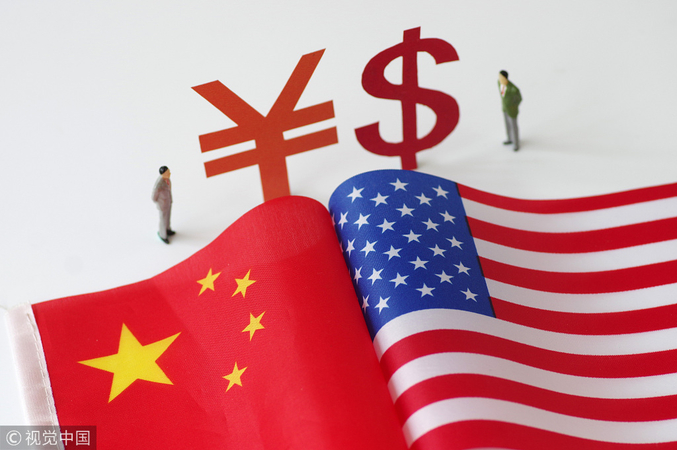
Labor market remained strong in November as U.S. economy added 266,000 jobs and jobless rate fell to

#ศาสตร์เกษตรดินปุ๋ย : ขอบคุณแหล่งข้อมูล : หนังสือพิมพ์ The Nation

https://www.nationthailand.com/business/30379155?utm_source=category&utm_medium=internal_referral

Labor market remained strong in November as U.S. economy added 266,000 jobs and jobless rate fell to

Dec 06. 2019
File Photo

File Photo
By The Washington Post · Rachel Siegel ·

988 Viewed

The United States added 266,000 jobs in November as the jobless rate decreased to 3.5%, the latest snapshot of an economy that appears to have slowed but stabilized in recent months.

The data, released by the Bureau of Labor Statistics, beat expectations. Analysts had forecast roughly 180,000 new jobs for the month.

The tally was impacted by thousands of General Motors workers who returned to their jobs in late October after a lengthy strike.

The labor market has remained one of the brightest spots in the economy, and combined with the high stock market has contributed to high levels of consumer spending and a relatively rosy consumer sentiment.

Many employers are still struggling to find qualified workers to fill jobs, but other companies have had to cut jobs because of a recent pullback in manufacturing demand.

The labor market’s health could have big implications for the 2020 elections.

Concerns about a looming recession have waned, but the economy has still shown signs of cooling. Economists have warned the mounting toll of President Donald Trump’s protracted trade war has strained global trade growth and slowed the creation of American jobs. Federal Reserve Chair Jerome Powell has said Trump’s tariffs have wrought so much uncertainty that companies are delaying investments and slowing the economy.

But major parts of the economy continue to show resilience, buoyed in part by consumer spending and the low unemployment rate.

Uncertainty remains an issue. Just this week, Trump said he could wait to strike a deal with China until after the 2020 election, sending stocks plunging. The volatility followed Trump’s announcement he was reimposing tariffs on steel and aluminum coming from Brazil and Argentina, though the timeline for this action is uncertain.

Diane Swonk, chief economist at accounting firm Grant Thornton, expected November’s numbers to rise significantly from the month before as GM workers returned to work. Roughly 48,000 strikers, and 12,000 workers who suffered layoffs during the strike, are expected to have returned to the payrolls, Swonk said.

Still, Swonk projected some drag on employment thanks to the loss of 12,000 temporary workers who wrapped up their jobs for the 2020 census. Holiday hires were expected to stay muted so long as retail stores continued closing their doors.

Seasonal retail hiring is also down. Compounding store closures is a shift among retailers to focus on their websites and distribution centers to meet customer demand, rather than stocking physical stores with employees, said Julia Pollak, an economist at ZipRecruiter, a popular job site.

Mark Hamrick, senior economic analyst at Bankrate.com, expected November to bring solid job growth. But he said that monthly average job growth for the year is running 26% below the pace seen this time last year. Hamrick said a “major development of some kind” would be needed to change course.

“Employers continue to counter challenges associated with trade disputes and tariffs,” Hamrick wrote in comments Thursday. “The general election, now less than one year away, will add another layer of uncertainty for business leaders trying to make decisions on hiring and investment.”

Additionally, private payroll growth in November grew by just 67,000, according to a Wednesday estimate from ADP and Moody’s Analytics. That number came in far behind estimates of 150,000, marking the slowest growth since May. Mark Zandi, chief economist for Moody’s, said in a statement that the “job market is losing its shine,” adding that manufacturers, commodity producers and retailers were shedding jobs and that openings were declining.

“If job growth slows any further unemployment will increase,” Zandi said earlier this week.

The country added a better-than-expected 128,000 jobs in October when the jobless rate rose slightly to 3.6%. Those numbers were affected by the General Motors strike, in which workers shut down production for six weeks at the automaker. The strike spurred layoffs from Canada to Mexico in related industries and caused a rise in unemployment claims in states like Michigan.

Egat to pursue solar project in dams

#ศาสตร์เกษตรดินปุ๋ย : ขอบคุณแหล่งข้อมูล : หนังสือพิมพ์ The Nation

https://www.nationthailand.com/business/30379074?utm_source=category&utm_medium=internal_referral

Egat to pursue solar project in dams

Dec 06. 2019
1,345 Viewed
The Electricity Generating Authority of Thailand (Egat) intends to press ahead with the development of a floating solar project in dams, regardless of the ongoing revision of the Power Development Plan (PDP) by the Energy Ministry.

Egat governor Viboon Rerksirathai said that the state agency was assigned to develop 16 floating solar projects at nine dams under the present PDP of 2018-2037.

The development will generate a total 2,725 megawatts.

Egat has already granted an engineering, procurement, construction (EPC) contract to a company to build the project with capacity of 45MW at Sirindhorn Dam.

The state agency has also pressed ahead with the study of the project to build a Floating Storage and Regasification Unit (FSRU) of liquified natural gas (LNG) in the Gulf of Thailand with capacity of 5 million tonnes per year.

The plan is at the stage of public hearings with involved parties.

He added that the ministry had not ordered Egat to shelve the solar project and the FSRU project, despite the ministry’s revision of PDP.

Amorn Kansaree, the assistant of the Bhumibol Dam director, said that Egat is also studying the floating solar project at Bhumibol Dam with capacity of 778MW.

The first phase of the project will be able to generate power of 158MW in 2026, an additional 300MW in 2030, and another 320MW in 2033. The construction area will occupy 8,000 rai of land.

If the project is approved by the government, the construction of Phase 1 is expected to begin in 2022.

He added that the cost of electricity generation by the floating solar project at the Bhumibol Dam would not exceed Bt2.40 per unit.

Negative rates are starting to worry ECB officials

#ศาสตร์เกษตรดินปุ๋ย : ขอบคุณแหล่งข้อมูล : หนังสือพิมพ์ The Nation

https://www.nationthailand.com/business/30379122?utm_source=category&utm_medium=internal_referral

Negative rates are starting to worry ECB officials

Dec 06. 2019
The stars of the European Union (EU) sit on banners flying outside the European Central Bank (ECB) headquarters in Frankfurt, Germany, on Nov. 27, 2019. MUST CREDIT: Bloomberg photo by Peter Juelich.

The stars of the European Union (EU) sit on banners flying outside the European Central Bank (ECB) headquarters in Frankfurt, Germany, on Nov. 27, 2019. MUST CREDIT: Bloomberg photo by Peter Juelich.
By Syndication Washington Post, Bloomberg · Craig Stirling ·

964 Viewed

Five weeks since Mario Draghi retired from running the European Central Bank, finding an outright fan of his legacy of negative interest rates has become a lot harder.

Governing Council members, who collectively lowered the key rate to minus 0.5% shortly before Draghi’s term ended, are increasingly portraying it as a necessary evil that shouldn’t be compounded. Sparse communication on monetary matters by his successor as president, Christine Lagarde, hasn’t dispelled that impression.

Banks have picked up on the mood change, dropping predictions that Lagarde — under the guidance of Chief Economist Philip Lane, the intellectual standard-bearer who proposed the latest cut as part of a stimulus package — would ease again at her first policy meeting on Dec. 12.

It’s a striking development for an institution whose credibility hangs on the promise that it can always do more if needed to revive inflation, and whose policy guidance explicitly states that rates can still fall further. It suggests that a strategy review planned by the new chief will need a thoughtful scrutiny of the toolkit.

“We don’t expect they’ll cut rates further,” said Sarah Hewin, chief economist for Americas and Europe at Standard Chartered Bank. “I’m not sure there is a consensus that negative rates are bad, but I’m wondering whether with this transition from Draghi to Lagarde — a new broom at the helm — there’s an opportunity to vocalize their concerns.”

Lane has defended negative rates as a complement to other measures that aim to spur economic activity. In one speech last month, he said they aren’t “super loose” — citing the absence of a price surge as a demonstration of that. In another, he said the policy forces banks to chase higher investment returns.

Aline Schuiling, an economist at ABN Amro Bank, reckons the weakness of the economy means the ECB will cut again, probably in March. There is “some recovery in growth, but not very spectacular,” she said.

Yet the lack of a broad public defense for negative rates has let a chorus of criticism from bankers fill the void. Among them is Deutsche Bank President Karl von Rohr, who last month described them as “the biggest challenge facing the European financial industry.” Even the ECB’s own financial stability review flagged the risks of ultra-loose money.

Two of the ECB’s prospective new board members took a similarly cautious view when quizzed by the European Parliament this week. Italy’s Fabio Panetta said officials need to be alert to the “unintended consequences of monetary policy.” His German colleague, Isabel Schnabel, said the institution should listen carefully to voters’ concerns on sub-zero rates.

Such discontent is vocal in some euro-zone countries, notably Germany and the Netherlands. Reflecting that, ECB officials are also privately encountering pushback from some finance ministers, according to people familiar with the matter.

Bundesbank President Jens Weidmann and Dutch central bank Governor Klaas Knot, already skeptics of loose policy, look unlikely to back another rate cut unless the economy worsens significantly. So far, it seems to be stabilizing. At Draghi’s final meeting in October, one participant made a plea for “patience” to allow current easing to work.

Bank of Spain Governor Pablo Hernandez de Cos said this week he couldn’t rule out that sub-zero policy could eventually harm monetary-policy transmission.

Perhaps most striking is that Bank of Italy Governor Ignazio Visco, a long-time backer of monetary stimulus, has started criticizing the sub-zero policy, saying he prefers asset purchases.

“The longer they remain negative and the lower they go, the higher is the likelihood of significant negative side effects,” the Italian told German newspaper Handelsblatt. “I’m not encouraging this.”

One of the last banks holding out for a December rate cut, JPMorgan Chase, has thrown in the towel. Economist Greg Fuzesi said that “given the lack of any easing signal, and the time it often takes for the ECB to build consensus, it is becoming increasingly hard to see the ECB do more.” Barclays said this week that “the bar for more easing is high.”

The chief worry is that policy is close to the so-called reversal rate, where the harmful effects outweigh the good. Lane’s denial that such a situation is near may be valid, but it’s also unsurprising that the chief economist wants to dispel any impression of monetary impotence.

He and many of his colleagues, including Lagarde, do make the point that more government spending could speed up the path to normalization. Germany, the prime candidate to do that, isn’t rushing to respond though, and a newly created euro-area fiscal capacity is tiny.

In short, central bankers are approaching their last meeting of the year with a heavy heart about one of their signature policy tools, even if there’s no immediate way out.

Austrian Governor Robert Holzmann said in September that negative rates aren’t sustainable and will need to be reversed. That’s a relatively extreme view in the Governing Council — but the open hand-wringing on the matter among his colleagues suggests he could one day have company.

Markets wrap: Stocks advance on fresh hopes for U.S.-China deal

#ศาสตร์เกษตรดินปุ๋ย : ขอบคุณแหล่งข้อมูล : หนังสือพิมพ์ The Nation

https://www.nationthailand.com/business/30379103?utm_source=category&utm_medium=internal_referral

Markets wrap: Stocks advance on fresh hopes for U.S.-China deal

Dec 05. 2019
By Syndication Washington Post, Bloomberg · Rita Nazareth, Vildana Hajric

1,404 Viewed

Stocks rose and bonds fell on speculation the U.S. and China will reach a deal that avoids tariffs due to take hold in 11 days.

The S&P 500 index halted a three-day slide after Bloomberg News reported negotiators are getting near an agreement on the amount of tariff relief in a phase-one accord between the world’s two largest economies. President Donald Trump said discussions with China are going very well, just a day after downplaying the urgency of a deal. Treasury 10-year yields climbed, following the biggest decline since August. The dollar dropped. Oil surged.

Investors are watching for any signs of progress in talks between Washington and Beijing as worries increase that Trump may slap more tariffs on China this month. A flood of trade news has whipsawed global markets, with the U.S. also threatening levies on France after hitting steel from Brazil and Argentina. American equities reached record highs in November, driven in part by optimism that at least an initial trade deal was in the offing.

“You wake up every single day and see that the number one thing that’s dictating markets is trade,” said Matt Miskin, co-chief investment strategist at John Hancock Investment Management. “If those tariffs are avoided, then the recent gains in the market will likely hold.”

On corporate news:

– PG&E Corp. soared as the company was said to be close to a $13.5 billion deal with wildfire victims.

– Expedia Group Inc. surged as Chief Executive Officer Mark Okerstrom and Chief Financial Officer Alan Pickerill resigned after clashing with the board on the online travel agency’s direction.

– Cloud software stocks fell as disappointing forecasts from Workday Inc. and Salesforce.com Inc. added to concern about slowing growth.

– Peloton Interactive Inc. tumbled as a report said it lowered the price of its digital subscription app for workouts in an effort to appeal to more users.

Elsewhere, oil rallied as Energy Information Administration data showed U.S. crude inventories fell more than expected. The British pound touched the highest against the euro since May 2017 as traders stepped up bets on a win for the Conservatives in next week’s election.

Here are some key events coming up this week:

– Germany releases factory-order data for October on Thursday.

– Saudi Aramco’s initial public offering is scheduled to be priced on Thursday, with Riyadh looking to raise more than $25 billion.

– Friday brings the U.S. jobs report, where estimates are for non-farm payrolls to rise by 190,000 in November.

These are the main moves in markets:

– – –

– The S&P 500 climbed 0.8% to 3,118.95 at 2:53 p.m. New York time.

– The Stoxx Europe 600 index surged 1.2%.

– The MSCI Asia Pacific index decreased 0.7%.

– – –

– The Bloomberg Dollar Spot index dipped 0.1%.

– The euro decreased 0.1% to $1.1072.

– The British pound climbed 0.8% to $1.3094.

– The Japanese yen weakened 0.3% to 108.94 per dollar.

– – –

– The yield on 10-year Treasuries increased six basis points to 1.78%.

– Germany’s 10-year yield climbed three basis points to -0.32%.

– Britain’s 10-year yield increased seven basis points to 0.741%.

– – –

– The Bloomberg Commodity index jumped 0.6%.

– West Texas Intermediate crude surged to $58.43 a barrel.

– Gold fell 0.3% to $1,479.30 an ounce.

Commerce Ministry urges industries to increase their exports until early 2020

#ศาสตร์เกษตรดินปุ๋ย : ขอบคุณแหล่งข้อมูล : หนังสือพิมพ์ The Nation

https://www.nationthailand.com/business/30379101?utm_source=category&utm_medium=internal_referral

Commerce Ministry urges industries to increase their exports until early 2020

Dec 05. 2019
Jurin Laksanawisit

Jurin Laksanawisit
By THE NATION

1,808 Viewed

Deputy Prime Minister and Commerce Minister Jurin Laksanawisit said on Wednesday (December 4) that his ministry has held discussions with the Thai Chamber of Commerce, the Federation of Thai Industries and representatives from the private sector, asking them to accelerate the export of products that fall under the MoUs with foreign trade partners signed by Thailand earlier this year during business matching trips.

“To boost exports in the last quarter of 2019, Ministry of Commerce went on several foreign trips to secure trade deals and negotiate with local authorities in an attempt to match Thai entrepreneurs with foreign counterparts,” he said. “We have signed MoUs for the export of Thai products with accumulated value of Bt70.9 billion, and delivery should start this month and continue through early 2020.”

Jurin added that major Thai entrepreneurs participating in these deals include CP Group, who agreed to export additional 10,000 tonnes of its products on top of its regular December export volume of 40,000 tonnes. “Meanwhile, the Thai Chamber of Commerce and Federation of Thai Industries will negotiate with 2 electronics manufacturing giants, namely Western Digital and Seagate Technology to increase their export volume in early 2020 as well,” he said.

“As for the automotive sector, Toyota has informed me that they will add 1,000 units to the December export volume while Honda will increase its export of hybrid cars next year,” he said. “PTT also agreed to export more as the government’s measures to promote use of alternative energy have resulted in more oil in reserve.”

Meanwhile, Thai Chamber of Commerce vice president Sanan Ang-Ubolkul said that Thai exports in 2019 had suffered greatly from the impacts of trade disputes and the appreciation of the Baht, making it a challenge to boost exports at year end. “This year we estimate that exports will shrink by 2.5 per cent with a total volume of US$246.2 billion,” he said. “2020 may see only 1 per cent growth at a total $250 billion, depending on how well the government handles the Baht appreciation problem, which is the top threat to Thai exports.”

Four more businesses to be removed from Foreign Business Act annex

#ศาสตร์เกษตรดินปุ๋ย : ขอบคุณแหล่งข้อมูล : หนังสือพิมพ์ The Nation

https://www.nationthailand.com/business/30379081?utm_source=category&utm_medium=internal_referral

Four more businesses to be removed from Foreign Business Act annex

Dec 05. 2019
Poonpong Naiyanapakorn

Poonpong Naiyanapakorn
By THE NATION

770 Viewed

The Department of Business Development has discussed its plan to remove four more restricted businesses from the list annexed to the Foreign Business Act of 2542, with the Board of Investment (BoI), the department’s deputy director-general Poonpong Naiyanapakorn has said.

These are the type 1 licence of the telecom business and the treasury centre; the aviation maintenance business in relation to certificates for Type 2 and Type 3 of the maintenance unit; and high-value-added software development service.

The Type 1 telecom licence is for telecommunications business operators without a dedicated network.

The department has already removed 45 restricted business types from the list to make things easier for foreigners, who want to work in these fields in Thailand.

The Act bans foreigners from conducting businesses on the list unless they obtain permission from relevant authorities.

He added that the department would also review the restricted businesses on the list more often instead of once a year.

The department will also connect its database with BOI with the aim of awarding business certificates to foreign investors within one day. Under current rules, it is required to do so within 30 days.

U.S. services gauge drops, though details signal stable growth

#ศาสตร์เกษตรดินปุ๋ย : ขอบคุณแหล่งข้อมูล : หนังสือพิมพ์ The Nation

https://www.nationthailand.com/business/30379089?utm_source=category&utm_medium=internal_referral

U.S. services gauge drops, though details signal stable growth

Dec 05. 2019
File Photo/ GettyImages

File Photo/ GettyImages
By Syndication Washington Post, Bloomberg · Reade Pickert

810 Viewed

A gauge of U.S. service industries fell more than forecast in November as business activity cooled, though gains in employment and new orders suggest the biggest part of the economy is holding up in the fourth quarter.

The Institute for Supply Management’s non-manufacturing index fell to 53.9, according to data released Wednesday that missed the 54.5 median estimate in Bloomberg’s survey of economists. The decrease was driven by the weakest reading of business activity since 2010.

The composition of the report showed that declines in components tracking business activity, which parallels the ISM’s measure of factory production, and supplier deliveries outweighed the gains in orders and employment. The split suggests demand still has some momentum heading into the end of the year even as overall activity moderates.

The measure of services employment climbed to 55.5, the highest level since July. Other measures of the labor market’s performance in November were mixed ahead of Friday’s government jobs report.

The ADP Research Institute on Wednesday reported services payrolls rose at slowest pace in six months, with overall private employment climbing a less-than-forecast 67,000. IHS Markit’s gauge of services employment showed growth in November after contracting the previous two months, helping the overall measure improve to 51.6.

While ISM’s services gauge has held for almost a decade above 50, the line between expansion and contraction, the group’s manufacturing gauge has contracted for four straight months. The divergence underscores how the services sector, which makes up most of the economy, has remained a resilient force for the record-long expansion even as factories falter.

New orders for services grew at a faster pace for a second month, lifting the index to 57.1. That helped offset the business activity gauge falling 5.4 points to 51.6.

The report indicates trade tensions and weak global growth continue to weigh on American service providers. Exports rose above 50, but imports contracted for a third-straight month to the lowest level in more than seven years.

A measure of order backlogs contracted for a second month, holding at the lowest level since December 2016, and the gauge of supplier deliveries eased. The prices-paid index rose to 58.5 from 56.6.

ISM’s November factory report on Monday showed the index unexpectedly declined to 48.1, near the expansion’s low point, amid weaker orders and subdued production.

Strengthening baht poised to reverse course, says BOT

#ศาสตร์เกษตรดินปุ๋ย : ขอบคุณแหล่งข้อมูล : หนังสือพิมพ์ The Nation

https://www.nationthailand.com/business/30379086?utm_source=category&utm_medium=internal_referral

Strengthening baht poised to reverse course, says BOT

Dec 05. 2019
BOT deputy governor Mathee Supapongse says the baht is on a declining trend.

BOT deputy governor Mathee Supapongse says the baht is on a declining trend.
By The Nation

1,015 Viewed

The baht is on a declining trend, Bank of Thailand (BOT) deputy governor Mathee Supapongse said on Wednesday (December 4).

“The baht is now moving two-way against the US dollar, and unlike the one-way appreciation of the past it is on a weakening trend.”

He urged exporters and importers to hedge against the baht’s volatility and its implications. The BOT has implemented many measures to rein in the baht, such as limiting the amount of baht for non-resident baht accounts and issuing measures to relax capital flows to encourage Thai individuals to invest in financial assets abroad while exporters are allowed to park more money abroad. Investors are allowed to use dollars for trading gold in the Thailand market.

“Foreign investors have changed their perspective about values of emerging market currencies and they think the baht will not rise further. Investors now short the baht after they previously longed the baht,” Mathee said. Moreover, Thailand’s current account surplus is reducing, easing the pressure on the baht. The indirect impact of the central bank twice cutting policy rates has also lessened pressure on the baht, he said. “Investors may no longer consider baht as a safe haven asset as they see the baht has diverged too much from economic fundamentals, so there is high chance that the baht could reverse course,” he added.

Thai business leaders on the same day, however, still voiced concerns over the strengthening of the baht.

The Joint Standing Committee on Commerce, Industry and Banking (JSCCIB) issued a statement urging the government to help small and medium-sized enterprises impacted by the stronger baht. They said the central bank’s recent measures may prevent the baht’s rise in the short run. If the baht continues to rise it would have a negative impact on the country’s competitiveness, they said.

The baht rose about 7 per cent against the US dollar since early this year. Currently it has moved slightly over Bt30 to the dollar. The weighted-average interbank exchange rate on Wednesday was Bt30.29 per dollar, according to the BOT.

Trump could spark a global recession if he imposes more China tariffs, economists predict

#ศาสตร์เกษตรดินปุ๋ย : ขอบคุณแหล่งข้อมูล : หนังสือพิมพ์ The Nation

https://www.nationthailand.com/business/30379087?utm_source=category&utm_medium=internal_referral

Trump could spark a global recession if he imposes more China tariffs, economists predict

Dec 05. 2019
File Photo : President Donald Trump/ GettyImages

File Photo : President Donald Trump/ GettyImages
By The Washington Post · Tory Newmyer

667 Viewed

President Donald Trump risks tipping the United States – and the world – into recession if he presses ahead with tariffs on Chinese imports set to bite in just 11 days.

That’s the conclusion some economists are drawing after the president renewed trade tensions with Beijing by saying he was open to waiting until after the 2020 election to reach a deal some advisers recently described as imminent.

“The economy is on the precipice and this would just push us over into the abyss. I don’t think we’re very far from recession as it is,” Moody’s Analytics chief economist Mark Zandi told The Washington Post.

Zandi sees a cascade effect ricocheting through the economy if the administration follows through on its threat to impose 15% import levies on $160 billion of Chinese goods, a list that includes laptops, cellphones, toys and other consumer goods. “It would just be too much,” he said of the tariffs planned for December 15. “It would undermine investor confidence, weaken business sentiment and the negative reinforcing dynamics of a recession would take hold.”

Investors are processing the renewed threat, with the Dow Jones industrial average dropping 1 percent, its third straight day of losses and the steepest one-day sell-off since early October, as the Wall Street Journal reports.

Gregory Daco, chief U.S. economist at Oxford Economics, said his firm projects the next round of tariffs would trim 0.2 percent from economic growth. “It’s not huge, but it’s one additional layer of drag on top of the tariffs we’ve already seen,” he said. “I would note the possibility that the loss of confidence from the private sector would exacerbate that.”

Daco says tariffs alone would be unlikely to precipitate a recession. But like Zandi he said they could ripple out dangerously if they depress business confidence, weighing on financial markets, reducing hiring and, ultimately, crimping consumer spending. “If we have an end of the year like last year,” with tariffs rising, a government shutdown looming, and the Federal Reserve signaling it won’t help, Daco noted, “We’re starting off from a much lower point in activity now, and the risks of a recession going into 2020 are that much greater.”

How seriously to take the possibility the Trump team fails to reach an agreement with its Beijing counterparts that forestalls the tariffs remains uncertain. While in London for NATO’s 70th anniversary summit, Trump said “in some ways I like idea of waiting until after the election for the China deal.” Still, he noted that the Chinese “want to make a deal now and we will see whether or not the deal is going to be right.”

But Bloomberg News reports that despite the heated rhetoric, Washington and Beijing are moving closer to agreeing on how many tariffs already in force should be rolled back as part of a phase-one deal. And the Wall Street Journal reports the recent involvement of White House adviser Jared Kushner could indicate a deal is close-at-hand.

Stephen Myrow, managing partner at Beacon Policy Advisors, said his firm has been telling clients they believed the Dec. 15 deadline didn’t necessarily mean much: As long as the two sides were continuing to negotiate in good faith, the Trump team was likely to find a way to put them off. Now, he says, “it’s fluid in the sense that Dec. 15 is starting to look like a harder deadline than it was, say, 48 hours ago. But that in and of itself can change.”

Commerce Secretary Wilbur Ross appeared to underscore the two sides still have difficult issues to resolve, and the U.S. feels no urgency to strike a deal. Ross told Reuters in an interview that the point Trump, in his comments at the NATO summit in London, “was trying to make is we need a proper deal, and whether it comes this December, or it’s next December, or some other date is much less important than getting a proper deal.”

“The important thing is to get a deal that works,” he said. “Because let’s face it, if we don’t make a deal with China now, it’s going to be a long, long time before there is a deal.”

Investors perceive a pattern they hope will play out again in the coming days: Trump tends to ramp up trade confrontations when the stock market is gaining steam and back off when it tumbles. The president was dismissive of the trade-induced selloff, calling it “peanuts.” And, he said, “I don’t watch the stock market.” The claim is belied by his own Twitter feed:

“There’s this binary moment in the market where people are freaking out, and there’s also a group that says, ‘He’s focused on reelection, and he knows how bad this would be for it, so he’ll pull back,'” Myrow says. “There’s a lot of post-hoc rationalization. But a lot of this comes down to what was on Fox News that morning, what did he have for breakfast, and what’s going on with impeachment.”

Salary forecast estimates 5 per cent increase for Thais

#ศาสตร์เกษตรดินปุ๋ย : ขอบคุณแหล่งข้อมูล : หนังสือพิมพ์ The Nation

https://www.nationthailand.com/business/30379082?utm_source=category&utm_medium=internal_referral

Salary forecast estimates 5 per cent increase for Thais

Dec 04. 2019
Thanwa Chulajata, country manager for Korn Ferry Digital in Thailand

Thanwa Chulajata, country manager for Korn Ferry Digital in Thailand
By THE NATION

1,158 Viewed

A forecast issued today (December 4) by a global organisational consulting firm Korn Ferry estimates that salary growth for Thailand will be 5 per cent for 2020, which is slightly lower compared to the average salary increment forecast for Asia at 5.3 per cent.

After accounting for an inflation rate of 1.3 per cent, Thailand’s real-wage growth was forecast to be 3.7 per cent.

The Oil & Gas sector is the leader in salary increase in Thailand at 6.2 per cent while the Chemical sector has the highest variable bonus at 4 months.

Variable bonus payout was forecast to be 2.5 months on average across industries.

Total employee turnover in Thailand was 10.8 per cent and decreased slightly from last year (12.6 per cent). The retails sector possessed the highest total employee turnover by 36.3 per cent.

“With digital disruptions, many organizations in Thailand are rapidly adopting new technologies to remain competitive,” said Thanwa Chulajata, country manager for Korn Ferry Digital in Thailand. “The digital disruptions also changed the way how organisations work leading to changes in operating model, business and organization structure. These changes also impact how human capital is being managed from recruitment, performance management to talent development and retention. HR capital is a key factor to drive transformation within the organization to ensure sustainability, competitiveness and profitability.

“Besides recruiting new talent, organisations should also develop existing talent by reskilling and upskilling these talents for various key competencies, especially to multi-task. The new expectation is for one person to manage tasks equivalent to those that used to be managed by five people in the past. New business model often needs lesser number of employees while still driving productivity,” Thanwa added.

“With new multi-generations and emerging digital talent within the same workforce, a single HR practice or system would no longer work for all. Segmentation would be crucial when managing rewards and benefits. Unlike the baby-boomers, digital talent would want more challenging jobs in a highly competitive market and more flexibility in the work environment. They are more agility in learning and are also focusing more on achieving higher salary, faster career growth and better life status at a faster rate,” he continued.

Across Southeast Asia, Indonesia is forecast to have the highest real-wage growth at 5.1 per cent, after accounting for an inflation rate of 3.0 per cent. Malaysia is forecast to have a real-wage growth at 3.5 per cent, after accounting for an inflation rate of 1.5 per cent.

Although salaries in Singapore are forecast to grow by only 4 percent, the island-nation’s relatively low inflation rate of 0.4 per cent translates into a 3.6 per cent increase in real-wage growth in 2020.

Around the world, salaries are predicted to grow at a rate of 4.9 per cent in 2020. With a global inflation rate prediction of approximately 2.8 per cent, real-wage salary increase is predicted at 2.1 percent.

In 2019, real-wage salary increases across the globe were only 1.0 per cent, with salary growth rate at 5.1 per cent and global inflation at 4.1 per cent.