Bank of Thailand makes its economic database available to public

#ศาสตร์เกษตรดินปุ๋ย : ขอบคุณแหล่งข้อมูล : หนังสือพิมพ์ The Nation

https://www.nationthailand.com/business/30379079?utm_source=category&utm_medium=internal_referral

Bank of Thailand makes its economic database available to public

Dec 04. 2019
Bank of Thailand Governor Veerathai Santiprabhob,left, on Wednesday (November 4) chaired the launch of Thailand’s Integrated Database for Economics (TiDE).

Bank of Thailand Governor Veerathai Santiprabhob,left, on Wednesday (November 4) chaired the launch of Thailand’s Integrated Database for Economics (TiDE).
By The Nation

1,337 Viewed

The central bank has opened free access to its rich database of economic data to the public.

Bank of Thailand Governor Veerathai Santiprabhob on Wednesday (November 4) chaired the launch of Thailand’s Integrated Database for Economics (TiDE).

The database will contain a wealth of economic information, or about 25,000 series, he said.

Public could access the information free of charge via the website  https://tide.pier.or.th. The information has been made available by the central bank’s research arm, known as Puey Ungphakorn Institute for Economic Research. The service starts on Wednesday.

Central bank to push banks to reduce transaction fee for SMEs and retail clients

#ศาสตร์เกษตรดินปุ๋ย : ขอบคุณแหล่งข้อมูล : หนังสือพิมพ์ The Nation

https://www.nationthailand.com/business/30379077?utm_source=category&utm_medium=internal_referral

Central bank to push banks to reduce transaction fee for SMEs and retail clients

Dec 04. 2019
Thanyanit Niyomkarn, assistant central bank governor, says many clients have complained to the Bank of Thailand about the high fees charged by commercial banks.

Thanyanit Niyomkarn, assistant central bank governor, says many clients have complained to the Bank of Thailand about the high fees charged by commercial banks.
By The Nation

1,241 Viewed

Many clients have complained to the Bank of Thailand about the high fees charged by commercial banks, Thanyanit Niyomkarn, assistant central bank governor, said yesterday, adding that the central bank would investigate and ensure that the fees charged are consistent with bank operating costs and that the banks do not place an unnecessary burden on clients.

The central bank aims to issue guidelines on transaction fees for commercial banks in the first quarter of next year and will follow up to see if these are being followed in June 2020,

“Due to many different kinds of fees charged, the central bank aims to help small and medium-sized enterprises (SMEs) first then look into the fees charged to retail clients,” she said.

Meanwhile Piti Thanavat, executive vice president of Krung Thai Bank (KTB) said that bank’s is planning cut fees to make the bank more competitive. Some fees may be cut by half, he added.

Thailand looks to become LNG hub

#ศาสตร์เกษตรดินปุ๋ย : ขอบคุณแหล่งข้อมูล : หนังสือพิมพ์ The Nation

https://www.nationthailand.com/business/30379076?utm_source=category&utm_medium=internal_referral

Thailand looks to become LNG hub

Dec 04. 2019
Energy Minister Sontirat Songtijirawong

Energy Minister Sontirat Songtijirawong
By THE NATION

1,065 Viewed

The Energy Policy Administration Committee today (December 4) acknowledged the guidelines for turning Thailand into the regional trading hub of liquefied natural gas (LNG).

The guidelines came about from a study assigned by the government-appointed energy reform committee to PTT.

Energy Minister Sontirat Songtijirawong said that the move was estimated to generate Bt165 billion for Thailand’s economy between 2020 and 2030.

The country is expected to start full commercial trading late next year or early in 2021.

Thailand has potential to become the regional hub due to its high demand of LNG and its geographical location as the centre of countries with high LNG demand, namely China, India, Japan, Cambodia, and Vietnam.

Moreover, Thailand has a supportive infrastructure to serve regional LNG trading.

Thailand is expected to provide services related to regional LNG trading in the first quarter of next year on a trial basis. The trial will also cover an LNG reload system and filling of LNG-fuelled vessels.

It will also revise the relevant rules and create intra-regional cooperation on the LNG trading.

Rubber sector plan approved

#ศาสตร์เกษตรดินปุ๋ย : ขอบคุณแหล่งข้อมูล : หนังสือพิมพ์ The Nation

https://www.nationthailand.com/business/30379067?utm_source=category&utm_medium=internal_referral

Rubber sector plan approved

Dec 04. 2019
The government’s deputy spokeswoman Rachada Dhnadirek

The government’s deputy spokeswoman Rachada Dhnadirek
By THE NATION

1,365 Viewed

The cabinet yesterday (December 3) approved the 20-year rubber sector strategy (2016-2036), which is designed to boost both the farmers’ incomes and the yield per rai.

The strategy was proposed by the Rubber Authority of Thailand.

The five goals the strategy aims to achieve by 2036 include the reduction of the area used for rubber plantations nationwide area to 18.4 million rai from 23.3 million rai in 2016.

The yield per rai will be boosted to 360 kg/rai from an average of 224 kg/rai in 2016, while farmers’ income should go up to Bt19,800 per rai from Bt11,984 per rai in 2016.

The rubber export value will increase to Bt800 billion per year from Bt250 billion per year in 2016.

The fifth goal is to raise the local use of rubber to 35 per cent from 13.6 per cent in 2016.

The government’s deputy spokeswoman Rachada Dhnadirek said that in the past four months the Deputy Prime Minister and Commerce Minister Jurin Laksanawisit had witnessed the signing of sales of Thai rubber to foreign buyers worth Bt34 billion as part of the international roadshow.

Thailand leads progress in software legalisation campaign

#ศาสตร์เกษตรดินปุ๋ย : ขอบคุณแหล่งข้อมูล : หนังสือพิมพ์ The Nation

https://www.nationthailand.com/business/30379062?utm_source=category&utm_medium=internal_referral

Thailand leads progress in software legalisation campaign

Dec 04. 2019
Tarun Sawney, senior director at BSA

Tarun Sawney, senior director at BSA
By THE NATION

2,003 Viewed

BSA – The Software Alliance (BSA) reports that Thailand is leading the region in a recent campaign aiming to clean up corporate use of illegal software.

Midway through the campaign, Thailand’s results for software legalisation were better than those of the Philippines, Vietnam and Indonesia – thanks in large part to support from the Thai government and good levels of cooperation among Thai business leaders.

BSA reports that nearly 400 corporations in 11 provinces cooperated in software legalisation. Provinces with the highest levels of software legalisation include Bangkok, Samut Prakan, Nonthaburi and Chon Buri.

The campaign will end in February, and at this time BSA will issue performance reports for each participating Asean country. Most of the companies to legalise are manufacturing, engineering and industrial design firms.

“This campaign is working in Thailand because corporations understand the need to legalise, and that it’s much better to do it proactively today than to wait for a cyber crisis or legal issue,” said Tarun Sawney, senior director at BSA.

“The Thai police play an important role in holding corporations accountable. We also believe that CEOs in Thailand are highly aware of their responsibility to use legal software, and they are much more proactive than in some other countries.”

The BSA Legalise and Protect initiative was launched to educate CEOs about the variety of risks linked to use of illegal software, including cyber security risks.

In September, BSA launched a Clean Up to the Countdown campaign to persuade CEOs to ensure their corporations are compliant by the 2020 New Year. The campaign was launched in four large Southeast Asian nations: Indonesia, the Philippines, Thailand and Vietnam.

Thus far, more than 1,000 corporations made software purchases with the goal of legalising their software assets and reducing their risk.

Asean CEOs have approved purchases for software for approximately 6,000 PCs since September.

BSA reports that corporations in Vietnam and Indonesia continue to lag behind the other countries in the race to legalise software assets.

However, Indonesia did provide one highlight in the campaign when one Indonesian conglomerate legalised software for several thousand PCs. But otherwise corporations in Indonesia performed poorly in response to the campaigns and continue to risk the use of illegal software.

BSA anticipates growing levels of software legalisation over the coming months.

To protect themselves from future crises, companies can implement proven software asset management (SAM) best practices to get more out of their technology.

Full software legalisation also helps corporations prevent debilitating cyber security damages, improve productivity, reduce downtime, centralize license management, and even reduces costs due the flexibility of the modern subscription model.

“We like the progress we are seeing this year, but some CEOs will only clean up their companies when they face very significant pressure from government enforcement officials, and so we will work with our partners in government to bring legal action against CEOs whose corporations refuse to comply,” Sawney said.

Stocks sink, bonds jump as Trump dents trade hopes

#ศาสตร์เกษตรดินปุ๋ย : ขอบคุณแหล่งข้อมูล : หนังสือพิมพ์ The Nation

https://www.nationthailand.com/business/30379057?utm_source=category&utm_medium=internal_referral

Stocks sink, bonds jump as Trump dents trade hopes

Dec 04. 2019
Stocks Drop Take Steep Drop After President Trump Says Trade Deal With China May Come After 2020 Election

NEW YORK, NY - DECEMBER 03: A television displays falling share prices on the floor of the New York Stock Exchange on December 3, 2019 in New York City. The Dow Jones Industrial Average dipped over 280 points by the end of trading, losing roughly 1 percent of its value as traders reacted to President Donald Trump's latest remarks on a continuing American trade war with China. (Photo by Scott Heins/Getty Images)

Stocks Drop Take Steep Drop After President Trump Says Trade Deal With China May Come After 2020 Election NEW YORK, NY – DECEMBER 03: A television displays falling share prices on the floor of the New York Stock Exchange on December 3, 2019 in New York City. The Dow Jones Industrial Average dipped over 280 points by the end of trading, losing roughly 1 percent of its value as traders reacted to President Donald Trump’s latest remarks on a continuing American trade war with China. (Photo by Scott Heins/Getty Images)
By Syndication Washington Post, Bloomberg · Rita Nazareth, Vildana Hajric

320 Viewed

Stocks dropped around the world and bonds rallied after President Donald Trump aimed his tariff weapon on economies from South America to Europe and China, denting hopes for a global recovery.

TRADE-ANALYSIS : Struggling to negotiate, Trump often claims countries are eager to talk

Here’s what happens to markets if U.S. tariffs on China kick in Dec. 15

The S&P 500 index fell for a third day, though it pared some of its losses in afternoon trading. The morning

brought a flood of trade headlines that rattled markets, with the Trump administration signaling the U.S. plans to move forward with tariffs on Chinese goods if no deal is reached before the mid-December deadline. The president had earlier indicated he’d be willing to wait another year before striking an agreement with China. He also threatened levies on France after hitting steel from Brazil and Argentina.

Treasuries surged, driving yields down the most since August, as gold, the yen and the Swiss franc paced gains among haven assets. The cost to protect North American investment-grade debt against default jumped as trade-war induced volatility shook markets. Jefferies warned currency traders to buckle up before the tariff deadline, saying “put your helmet back on.”

The flurry of trade news roiled global markets just as investors started dipping their toes into riskier waters. A rush to assets that usually outperform during times of economic growth pushed U.S. stocks to record highs last month. But renewed tariff tension and signs of profit deterioration could make traders again more cautious amid the longest bull market on record.

“The narrative on trade has quickly been turned upside down as negative headlines on tariffs have ignited a risk-averse tone in the markets,” said Charlie Ripley, senior investment strategist for Allianz Investment Management. “Today’s headlines are a short reminder of the downside risks that still remain across the investing landscape.”

Chinese state media said Tuesday the government would soon publish a list of “unreliable entities” that could lead to sanctions against American companies. Meantime, France said the European Union would retaliate if the U.S. follows through on a threat to hit about $2.4 billion of French products with levies.

Elsewhere, oil rose as traders focused on the upcoming OPEC+ meeting that could lead to deeper supply cuts by some of the biggest crude producers.

Here are some key events coming up this week:

–Germany releases factory-order data for October on Thursday.

–Saudi Aramco’s initial public offering is scheduled to be priced on Thursday, with Riyadh looking to raise more than $25 billion.

–Friday brings the U.S. jobs report, where estimates are for non-farm payrolls to rise by 190,000 in November.

These are the main moves in markets:

Stocks

–The S&P 500 dipped 0.9% to 3,085.23 as of 2:54 p.m. New York time. It closed at 3,093,20, or down 0.66%. Nasdag closed at 8,520.64 , down 0.55%. Dow Jones dropped 1.01 per cent to close at 27,502.81.

–The Stoxx Europe 600 index decreased 0.6%.

–The MSCI Asia Pacific index fell 0.3%.

Currencies

–The Bloomberg Dollar Spot index decreased 0.1%.

–The euro was little changed at $1.1081.

–The Japanese yen appreciated 0.4% to 108.59 per dollar.

Bonds

–The yield on 10-year Treasuries sank 11 basis points to 1.71%.

–Germany’s 10-year yield slid seven basis points to -0.35%.

–Britain’s 10-year yield decreased seven basis points to 0.67%.

Commodities

–The Bloomberg Commodity index advanced 0.3%.

–West Texas Intermediate crude climbed to $56.10 a barrel.

–Gold gained 1% to $1,484.20 an ounce.

Gems, jewellery exports see a glittering 37.5% rise

#ศาสตร์เกษตรดินปุ๋ย : ขอบคุณแหล่งข้อมูล : หนังสือพิมพ์ The Nation

https://www.nationthailand.com/business/30379038?utm_source=category&utm_medium=internal_referral

Gems, jewellery exports see a glittering 37.5% rise

Dec 04. 2019
Photo credit: The Gem and Jewelry Institute of Thailand (Public Organization)

Photo credit: The Gem and Jewelry Institute of Thailand (Public Organization)
By THE NATION

824 Viewed

Gems and jewellery exports in the first ten months of this year expanded 37.59 per cent year on year to US$13.97 billion (Bt422.2 billion), Deputy Commerce Minister Weerasak Wangsupakitkosol said.

If gold exports are excluded, the total value will be $6.9 billion, up 6.24 per cent.

The continued growth was mainly attributed to the increase in gold exports of 93.23 per cent, he added.

Exports to Asean countries rose 198.03 per cent, jumping 306 per cent to Singapore and 146 per cent to Cambodia.

However, he warned that exports in the remaining period of this year might face pressure from the ongoing trade wars, the protests in Hong Kong, and a strengthening baht.

Weerasak advised exporters to focus more on growing markets such as Asean and India. They should also concentrate on selling products via e-commerce channels, he added.

Here’s what happens to markets if U.S. tariffs on China kick in Dec. 15

#ศาสตร์เกษตรดินปุ๋ย : ขอบคุณแหล่งข้อมูล : หนังสือพิมพ์ The Nation

https://www.nationthailand.com/business/30379051?utm_source=category&utm_medium=internal_referral

Here’s what happens to markets if U.S. tariffs on China kick in Dec. 15

Dec 04. 2019
File Photo: President Trump/President Donald Trump's latest missives on trade are a wake-up call to markets.

File Photo: President Trump/President Donald Trump’s latest missives on trade are a wake-up call to markets.
By Syndication Washington Post, Bloomberg · Eric Lam, Gregor Stuart Hunter ·

1,005 Viewed

President Donald Trump’s latest missives on trade are a wake-up call to markets close to record highs that a major deadline is looming with China.

The Dec. 15 flashpoint on tariffs was thrown into sharp relief Tuesday when Trump said he sees no urgency to complete a deal, right after he threatened an assortment of trading partners with levies.

TRADE-ANALYSIS : Struggling to negotiate, Trump often claims countries are eager to talk

“If tariffs scheduled for Dec. 15 are implemented it would be a huge shock to the market consensus,” said Sue Trinh, managing director for global macro strategy at Manulife Investment Management in Hong Kong. “Trump would be the Grinch that stole Christmas,” she said.

Global equities came within a whisker of their all-time high last month, propelled in part by swelling optimism that at least an interim U.S.-China trade deal was in the offing. Meantime, the clock kept ticking toward Dec. 15, when Trump has threatened to impose 15% levies on $160 billion of Chinese imports.

With about two weeks to go on the China front, the Trump administration Monday hit Brazil and Argentina with steel tariffs and proposed levies on France as punishment over a tax that’s hit large American tech companies.

Moves by self-styled Tariff Man Monday were enough to trigger the biggest Wall Street sell-off in eight weeks — with a little help from a weak U.S. manufacturing report.

“I have no deadline,” Trump told reporters Tuesday in London when asked if he wanted an agreement by year end. Stocks fell.

The U.S. president suggested that in some ways, it might be better to wait until after the November election.

The following are the views of a number of market participants on what happens if the tariffs on China kick in Dec. 15.

It will be “definitely risk-off across the screen,” Tongli Han, chief investment officer at Deepblue Global Investment, said in an interview with Bloomberg TV. “What happened recently makes this trade deal more costly for Chinese leaders — so I’m seeing a gloomy future for the short term, one-to-two months.”

With the clock running down on 2019 and a prospects of a trade deal looking more remote it’s time for investors to take a little bit of risk off the table, said Steve Brice, chief investment strategist at Standard Chartered private bank, on Bloomberg TV.

“It looks like it’s going to be pushed to the beginning of next year at the best case,” Brice said. The message to investors is “maybe trim a little bit of equity exposure, or certainly not chase the market at this stage. But look to do so in the next few weeks if we see a 5-to-7% pullback.”

Longer term, Brice remains optimistic “the U.S. and China will still strike a deal of some sort. That will reduce uncertainty and help the global economy do well.”

For Kerry Craig, global market strategist at JPMorgan Asset Management, a key concern is markets have already priced in the prospect of a trade deal that has yet to be signed.

“There had been a lot of optimism built in around a trade deal and it’s still the thing that will weigh on markets over the coming months,” Craig said on Bloomberg TV. “In the meantime we need to see more of a pick-up in the global economy to really offset some of those uncertainties.”

For some, the retreat in equities at the start of the week already presents a buying opportunity.

“I’d fade the correction today,” Eli Lee, head of investment strategy at Bank of Singapore, told Bloomberg TV.

The renewed tariff pressures on South America and Europe are likely an effort to bolster Trump’s “tariff man” image ahead of a trade deal with China, he said.

“With the economy in a very delicate situation, if this came on, it would seriously ratchet up the risk of a recession — and the White House wouldn’t want this situation going into the 2020 presidential election next year,” Lee said.

There may be some massive initial market swings in store, said Chris Weston, head of research at Pepperstone Group Ltd. in a note to clients.

“We could face a wild day,” he said. The S&P 500 is likely to fall about 2%, with currencies including the yuan, Australian dollar and Korean won also likely to move, he said. A relief rally may be in the offing afterward, particularly if there’s agreement to revisit talks in 2020, he said.

“Even if there is a trade deal, it doesn’t solve most of the issues that we still have with China,” which is something that markets are going to have to reflect in time, said Christopher Smart, chief global strategist at Barings Investment Institute, on Bloomberg TV. “In fact, it probably makes the relationship more difficult to manage, because we’ve taken tariffs off the table.”

Smart said “time is running out” to get a deal done this year, given the logistics involved in setting up a presidential meeting. What does offer solace is that global central banks have eased policy and injected liquidity, postponing the recession that investors had been worrying about, he said.

“We would hope that a bout of common sense breaks out,” Philip Shaw, chief economist at Investec, told Bloomberg TV. “Don’t forget that this situation is very volatile — it swings to and fro. We wouldn’t interpret too strongly events of one day.”

Market welcomes new tax incentives for long-term investment in mutual funds

#ศาสตร์เกษตรดินปุ๋ย : ขอบคุณแหล่งข้อมูล : หนังสือพิมพ์ The Nation

https://www.nationthailand.com/business/30379050?utm_source=category&utm_medium=internal_referral

Market welcomes new tax incentives for long-term investment in mutual funds

Dec 04. 2019
By The Nation

1,078 Viewed

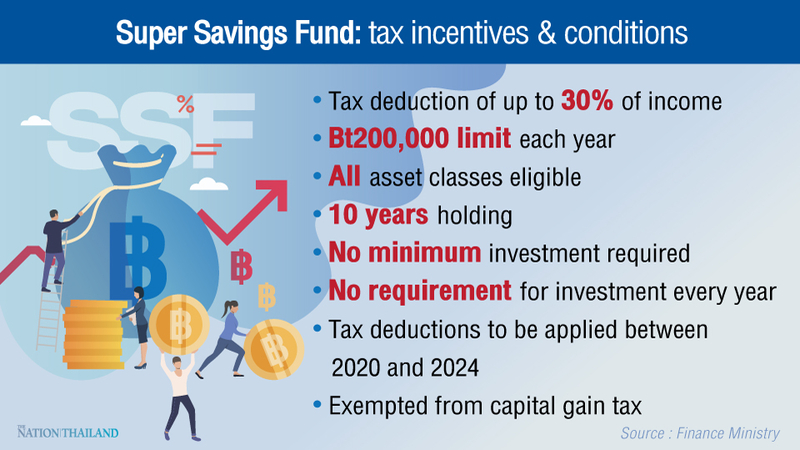
The introduction of super savings fund (SSF) with new tax incentives to promote long-term investment met positive responses from analysts yesterday (December 3), despite not being as attractive as the long-term equity fund( LTF) which is due to expire at the end of this year.

Theeranat Rujimethapass, president of TISCO Asset Management Co, said the SSF was a new product of the Finance Ministry in promoting long-term investment among the middle and low income groups.

“It would not lead to a sudden inflows of fund into the market, it would take time as it is not attractive as LTF,” he said.

Under the SSF, investors must hold their investment units for up to 10 years, compared with 5 years for LTF. Investment in SSF is limited at Bt200,000 a year while the investment limit in LTF was set at Bt500,000.

Young investors may prefer SSF as there is no minimum requirement, nor is annual investment required. Those who invested in retirement mutual fund(RMF) may migrate to SSF, he said.

Investment conditions and tax incentives for RMF and SSF do not differ significantly, those who do not want to make an annual investment would prefer SSF, he added.

The Finance Ministry has revised tax incentives for RMF, limiting total tax deduction to no more than Bt500,000 a year including the tax incentives of SSF and other pensions.

Total tax deduction under the old schemes was capped at Bt1 million.

Kobsidthi Silpachai, head of capital markets research at Kasikornbank said most people would still invest in the new fund since there is not a lot of tax shields available, adding that” people will take whatever tax shield they can get their hands on”.

Analysts at the Stock Exchange of Thailand(SET) said they will calculate the impact of SSF and release the findings.

Earlier, Pakorn Peetathawatchai, president of SET, voiced concerns over liquidity if investors had to hold the investment for up to 10 years.

Trump stuns Wall Street, foreign capitals with new trade fights

#ศาสตร์เกษตรดินปุ๋ย : ขอบคุณแหล่งข้อมูล : หนังสือพิมพ์ The Nation

https://www.nationthailand.com/business/30379046?utm_source=category&utm_medium=internal_referral

Trump stuns Wall Street, foreign capitals with new trade fights

Dec 03. 2019
By The Washington Post · Tory Newmyer

809 Viewed

President Donald Trump is sending shock waves from Wall Street to Washington and foreign capitals by dialing up his trade war around the world – after spending the past two months retreating from its various fronts.

Trump said he may wait until after the 2020 election to strike a trade agreement with China, saying there is “no deadline” on the talks. “In some ways I like the idea of waiting until after the election for the China deal,” he said from London, where he is attending a NATO summit. The comments followed his announcement, via Twitter, that he is restoring tariffs on steel and aluminum imports from Brazil and Argentina. And his administration separately said it is considering new levies on a range of French goods in retaliation for a new digital tax.

The consequences could reach well beyond the metals trade between the United States and its erstwhile South American economic allies and higher prices on French wine and makeup. For one, it signals Trump still views new tariffs as an effective lever to advance his trade agenda, a belief packed with peril for the markets broadly, and manufacturers and retailers in particular, among others.

These are our big takeaways from Trump’s announcements:

1. The escalation of trade hostilities marks a serious U-turn by the administration.

Trump’s team appeared to be winding down its trade fights in recent weeks, quietly foregoing tariffs on European auto imports, allowing American companies to continue doing business with Chinese telecom giant Huawei, and canceling a tariff hike on Chinese goods planned for October while working toward “phase one” trade deal with Beijing.

But the confrontations the administration just launched could widen trade showdowns in both Asia and Europe.

At issue in France, according to a Washington Post report, is “a 3% tax France introduced last year, which the administration says would unfairly target America’s digital economy icons. French lawmakers call the levy ‘Les GAFA’ – an acronym for Google, Amazon, Facebook and Apple, companies that French officials accuse of paying insufficient taxes on revenue earned in France. . . Administration officials worry that the French tax could set a precedent for other countries. [U.S. Trade Representative Robert] Lighthizer said he may open investigations into similar taxes in Austria, Italy and Turkey.” Lighthizer proposed striking back by levying tariffs of up to 100 percent on $2.4 billion of French products, including cheese, porcelain and handbags.

Trump’s moves against Brazil and Argentina “took officials in both countries by surprise,” the report said.. “In a sign of how abruptly Trump had acted, his own administration was unprepared to provide details.”

2. Don’t expect a Christmas calm for the markets.

Stock market investors have largely priced in progress toward a trade truce between the United States and China. They have been counting on a deal to scuttle new import levies Trump is set to impose on $160 billion of Chinese goods on Dec. 15 – and they have been betting the president would see it through in part to put the market on sounder footing heading into his reelection campaign.

But the president’s renewed fight with Argentina and Brazil throws the assumption into doubt, a fact reflected in a Monday stock market sell-off. The Washington Post reported: “The record bull run of the past month flamed out, with the Dow Jones industrial average declining 268 points, or .95%, to close at 27,783. The Standard & Poor’s 500 index dropped 27 points, or .86%, to close at 3,113. The tech-laden Nasdaq composite was hit particularly hard, finishing at 8,567, a 97-point drop of 1.1%.”

Chris Krueger of Cowen Washington Research Group said Trump’s latest turn points to one of his central conflicts. “The id and ego of Trump (in our opinion) is Dow Man vs. Tariff Man,” he wrote in a note. “Tariffs remain Trump’s primary trade security blanket and what he reverts to when he feels aggrieved.”

3. Trump is turning the trade war into a currency war.

The president, in announcing the renewed metals tariffs, accused Brazil and Argentina of devaluing their currencies to make their exports more competitive. The claim, for which there is no evidence, is “very different from what Trump said in 2018, when he first imposed tariffs on steel and aluminum imports, and it marks the latest unpredictable trade shock from the White House as business leaders are begging for more certainty,” The Washington Post reported.

Commerce Secretary Wilbur Ross underlined the wider threat the decision poses in a Fox Business interview. Brazil, he said, is not “the only one where there are currency issues.”

From The Post’s report: “Now Trump is showing a willingness to impose tariffs for yet another reason: currency moves, opening the door to more action, potentially against China. . . Trump has long railed against China for purposefully devaluing its currency and even promised to label China a “currency manipulator” as soon as he took office (something he eventually did in August 2019). Ross went out of his way on Fox Business to say China appeared to be doing better now. Still, the threat is hanging out there that other nations could be next.”

4. Trump promised the trade war would revive manufacturing. It isn’t working.

Indeed, manufacturing is in a recession, and it’s getting worse. “U.S. factory activity contracted for a fourth straight month in November as new orders slumped back to around their lowest level since 2012, while construction spending fell in October, tempering optimism over the economy that had been

fanned by a recent run of upbeat reports,” Reuters’ Lucia Mutikani reports.