Markets marginally up in Asia, trading slow on Thailand exchange

#ศาสตร์เกษตรดินปุ๋ย : ขอบคุณแหล่งข้อมูล : หนังสือพิมพ์ The Nation

https://www.nationthailand.com/business/30378984?utm_source=category&utm_medium=internal_referral

Markets marginally up in Asia, trading slow on Thailand exchange

Dec 02. 2019
Investors are still concerned about the impactz of the Sino-US trade war as negotiations drag on.

Investors are still concerned about the impactz of the Sino-US trade war as negotiations drag on.
By The Nation

1,140 Viewed

China’s PMI rebound is likely to have a limited positive effect on Thai and Asian stocks, says Tisco Market Insight.

Market unease shouldn’t scare off investors, says wealth manager

Major Asian markets rallied today after China reported its MPI on Sunday; Japan’s Nikkei 225 was up almost 1 per cent to 23,523.16 at 2.10pm Japan time and Hong Kong’s Hang Seng, South Korea’s Kospi and China’s Shanghai composite index also rose. China’s purchasing managers index(PMI) for the manufacturing sector bounced back to 50.2 in November from October’s 49.3, according to the National Bureau of Statistics. The growth beat many analysts’ expectation for a below-50 reading.

A reading above 50 indicates expansion, while a reading below reflects contraction.

It is the first expansion in the past eight months, but it is ony likely to boost stock markets in the short-term, said Tisco Market Insight of Tisco Financial Group.

Investors are still concerned about the impactz of the Sino-US trade war as negotiations drag on.

Tisco predicted downside risks for the Stock Exchange of Thailand Index today. It expects the index would move down to 1,585 or 1580 while the barrier level is estimated to be 1,600. The index was down 1 per cent in the morning session to 1,573.46.

Tisco suggested investors not to enter the market for short-term speculation but instead wait and see until the SET index moves up above the 1,600 level.

Investors are advised to take selective buys, choosing fundamental and high-dividend paid stocks. Interesting stocks includes PTG, PTT, BBL, KBank, SCB, AMATA, SCC, ROJNA, WHA, EASTW, BGRIM and BDMS, according to Tisco Market Insight.

Health-conscious Chinese deal with rising nut prices

#ศาสตร์เกษตรดินปุ๋ย : ขอบคุณแหล่งข้อมูล : หนังสือพิมพ์ The Nation

https://www.nationthailand.com/business/30378951?utm_source=category&utm_medium=internal_referral

Health-conscious Chinese deal with rising nut prices

Dec 02. 2019
By The Nation

987 Viewed

The price of edible nuts in China is rising due to increasing demand among health-conscious consumers.

Beijing in August imposed high import duties of up to 60 per cent on almonds in response to the United States’ punitive tariff actions, but they’re still flowing in from the US.

Meanwhile averse whether has curtailed almond production in China.

The price of almonds hit $3.60 per pound in July and is currently about $3.45, 15 per cent higher than the price this time last year. In May and June alone, the price rose by 8 per cent.

It’s estimated that the harvest completed in October will yield 2.3 billion-2.35 billion pounds of almonds, on target. The US produces about 80 per cent of the almonds consumed around the world, with California growing more than any other locale in the world.

While global demand for US almonds remains high, Americans are increasingly turning to almond milk and almond butter as healthier substitutes for their dairy counterparts, just as soy milk is preferred in the East.

Almond milk is free of cholesterol and gluten and is being touted as a “superfood” due to its claimed health benefits. It’s rich in antioxidants and Vitamin E, which help boost the immune system and reduce the risk of colon cancer. It has flavonoids that protect the walls of blood vessels, curbing the risk of cardiovascular disease.

The fat in almonds is unsaturated, a good choice for reducing cholesterol, controlling blood sugar and lowering the risk of diabetes.

Almonds’ potassium content keeps blood pressure in check, reduces fatigue and, along with magnesium, is beneficial to bones and teeth.

The healthful appeal of almonds nevertheless didn’t stop Beijing from boosting import duties on US products from 50 to 60 per cent. It’s been claimed that imports dropped less than expected, though, with the California Almond Committee saying exports to China and Hong Kong up to August were down 25 per cent compared to the same month last year.

China also imports almonds from Australia, imposing no duties but paying a higher price – even though the nuts remain cheaper there than the US variety.

The US is also the world’s second-largest producer of walnuts, exports of which were forecast to drop to 570,000 tonnes in September due to bad weather in California. The price is currently $3.50 per pound, up 40 per cent from a year earlier.

China grows more walnuts than any other country, especially in Yunnan province, but traders lament that Chinese dessert makers prefer US walnuts, so American imports represent 70-75 per cent of the total consumed in China.

The price of cashew nuts is meanwhile currently declining, from about $5.50 per pound in 2018 to $4.10 currently.

Market unease shouldn’t scare off investors, says wealth manager

#ศาสตร์เกษตรดินปุ๋ย : ขอบคุณแหล่งข้อมูล : หนังสือพิมพ์ The Nation

https://www.nationthailand.com/business/30378964?utm_source=category&utm_medium=internal_referral

Market unease shouldn’t scare off investors, says wealth manager

Dec 02. 2019
The index on Friday (November 29) closed at 1,590.59, 0.45 per cent down from the previous week, with daily turnover at Bt56.3 billion, up 23.2 per cent. 
A lower boundary for this week is expected of 1,575 or 1,550 and an upper bound of 1,605 or 1,615, according to Kasikorn Securities.

The index on Friday (November 29) closed at 1,590.59, 0.45 per cent down from the previous week, with daily turnover at Bt56.3 billion, up 23.2 per cent.  A lower boundary for this week is expected of 1,575 or 1,550 and an upper bound of 1,605 or 1,615, according to Kasikorn Securities.
By The Nation

1,094 Viewed

Retail investors are being urged to invest in Thai stocks via RMF or LTF schemes despite high volatility in the market.

“It’s worth investing because you at least get tax deductions on your investments in retirement mutual funds [RMF] and long-term equity funds [LTF],” said Pipat Luengnaruemitchai, assistant managing director and co-head of the CIO office at Phatra Wealth Management.

Capital gains can also be made in the long run since equity investment has been shown to offer higher returns than bank deposits or investments in bonds, he said.

There is a “high chance” the index will return to about the 1,700 level, he said, blaming the current downturn in the stock market partly on listed firms performing more poorly than expected.

Corporate earnings are expected to rise next year, with market consensus agreeing that earnings-per-share growth would reach 10 per cent.

The Finance Ministry is considering a new long-term investment fund scheme because the LTF will expire at the end of this year.

The Stock Exchange of Thailand Index last week closed below the supported level of 1,600 as foreign investors sold on concerns partly about bleak prospects for the US and China completing a trade deal.

The index on Friday (November 29) closed at 1,590.59, 0.45 per cent down from the previous week, with daily turnover at Bt56.3 billion, up 23.2 per cent.

A lower boundary for this week is expected of 1,575 or 1,550 and an upper bound of 1,605 or 1,615, according to Kasikorn Securities.

The market dropped after US President Donald Trump signed off on legislation supporting democracy in Hong Kong that would allow Washington to impose sanctions on rights abusers in the Chinese enclave, which has seen pro-democracy protests over the past five months.

The protests and the US legislation have both angered Beijing.

SET suggests cryptocoin to protect overseas transactions

#ศาสตร์เกษตรดินปุ๋ย : ขอบคุณแหล่งข้อมูล : หนังสือพิมพ์ The Nation

https://www.nationthailand.com/business/30378958?utm_source=category&utm_medium=internal_referral

SET suggests cryptocoin to protect overseas transactions

Dec 02. 2019
SET president Pakorn Peetathawatchai  has floated the idea of issuing a type of virtual currency to support Thai investors eyeing equities and other assets abroad.

SET president Pakorn Peetathawatchai has floated the idea of issuing a type of virtual currency to support Thai investors eyeing equities and other assets abroad.
By Wichit Chaitrong
The Nation

982 Viewed

The Stock Exchange of Thailand (SET) is considering issuing a stable token coin that Thai investors could use to invest in financial assets abroad and lower the risks encountered due to exchange-rate volatility.

SET president Pakorn Peetathawatchai has floated the idea of issuing a type of virtual currency to support Thai investors eyeing equities and other assets abroad.

The Thai Bond Market Association is mulling a similar idea with the aim of reducing investors’ transaction costs.

Investors sending money overseas often struggle with exchange-rate discrepancies and end up short despite earning capital gains, Pakorn said.

A dedicated, stable cryptocurrency would help them manage any risks that arise and could be purchased for baht at an “almost fixed” exchange rate and later resold when they repatriate their foreign investment, he said.

Thais who invested in Vietnamese equities earned capital gains, only to lose it all upon exchanging the Vietnamese currency for baht. The Vietnamese dong is more volatile than the baht, which has been appreciating for several years, according to a source in financial industry.

The Bank of Thailand, known to be cautious about cryptocurrency, has yet to comment on Pakorn’s proposal.

The central bank is currently experimenting with its own digital currency in the so-called Inthanon project, developing a virtual currency for use in its financial settlements with the commercial banks.

If given permission, Pakorn said, the SET would try out a stable coin of its own in the central bank’s online sandbox.

The central bank has in the meantime introduced several measures to encourage Thais to invest in foreign financial assets, hoping capital outflow will ease pressure on the muscular baht.

Pakorn insisted the stable coin he proposes would also cut transaction fees for investors trading in equities on foreign stock markets.

In another development, the SET is seeking dual listings with Indonesia, home to many growth stocks but lacking in the kind of high-return dividend stocks that are in abundant on the SET, he said.

If large companies in Indonesia could list on the Thai market, Thais would discover more investment opportunities, he explained.

Tokyo stocks seen swayed by trade developments this week

#ศาสตร์เกษตรดินปุ๋ย : ขอบคุณแหล่งข้อมูล : หนังสือพิมพ์ The Nation

https://www.nationthailand.com/business/30378953?utm_source=category&utm_medium=internal_referral

Tokyo stocks seen swayed by trade developments this week

Dec 01. 2019
By The Japan News/ANN1,053 Viewed

TOKYO (Jiji Press) — Developments in U.S.-China trade talks are expected to strongly influence the moves of Tokyo stocks this week, analysts and brokers said.

Last week, the key 225-issue Nikkei average rose 181.03 points, or 0.78%, to 23,293.91, after optimism for progress in the trade talks was fueled by comments from both sides that they are close to a phase-one deal.

This week, the Nikkei is expected to move mainly between 23,150 and 23,700, the analysts and brokers said.

Masahiro Ichikawa, senior strategist at Sumitomo Mitsui DS Asset Management Co., warned that the Nikkei may fall if there is no further progress in the trade talks, as market players will become increasingly worried that the negotiations are not going well.

On the other hand, Ichikawa said that the Nikkei may rise “if there is any news indicating progress in the talks,” including news that the United States will delay another round of tariffs on Chinese goods scheduled to take effect on Dec. 15.

Meanwhile, Yutaka Miura, senior technical analyst at Mizuho Securities Co., said that market players will also focus on U.S. economic indicators, including the Institute for Supply Management’s manufacturing index for November, due out Monday.

https://the-japan-news.com/news/article/0006197630?fp=06c0e4566e19f302a9374d6be3d2a6a7

Sluggish exports, consumption cast shadow on SKorea’s economy

#ศาสตร์เกษตรดินปุ๋ย : ขอบคุณแหล่งข้อมูล : หนังสือพิมพ์ The Nation

https://www.nationthailand.com/business/30378950?utm_source=category&utm_medium=internal_referral

Sluggish exports, consumption cast shadow on SKorea’s economy

Dec 01. 2019
(Yonhap)

(Yonhap)
By The Korea Herald/ANN

1,063 Viewed

While the government is likely to further lower its economic growth forecast for this year, the latest statistics are not bright, with exports extending the downtrend for 12 consecutive months and consumption hitting a six-year low, data showed Sunday.

South Korea’s exports amounted to $44.1 billion in November, shedding 14.3 percent from a year earlier, extending the downtrend, Imports fell 13 percent during the same period to $40.7 billion, shrinking for the seventh consecutive month, according to the Ministry of Trade, Industry, and Energy.

The trade surplus came to $3.37 billion, marking 94 consecutive months that exports exceeded imports, but this was a 27.8 percent fall from a year earlier.

The sluggish exports were attributed to the weak prices of semiconductor and petrochemical products, as well as the impact of the ongoing US-China trade tensions. There were also fewer working days in November, compared with the previous year, the ministry added.

The memory chip business — backbone sector of the trade-dependent country — slipped 30.8 percent to $7.39 billion in November, accounting for around 15 percent of total outbound shipments. Petrochemical goods shed 19 percent to $3.21 billion during the same period.

Marking the steepest on-year dip was the shipbuilding sector, which plunged 62.1 percent due to a major project cancellation, despite the general recovery of the sector.

Government officials say exports should regain momentum next year, on the back of recovery in the chip industry.

Last week, the Korea International Trade Association suggested that outbound shipments will climb 3.3 percent on-year in 2020, as against this year’s estimated on-year drop of 10.2 percent.

“We believe that exports will gain momentum, starting December,” said Industry Minister Sung Yun-mo.

Private consumption is likely to grow 1.9 percent this year, hitting a six-year low, reflecting the downbeat market sentiment, according to the Bank of Korea. The corresponding figure last year was 2.8 percent.

Last week, the central bank inched down its outlook for the nation’s economic growth pace to 2 percent from the previous 2.2 percent.

“The economic growth rate for this year is anticipated to be around 2 percent,” said Bank of Korea Gov. Lee Ju-yeol, after the rate-setting Monetary Policy Board meeting that froze the nation’s key interest rate at the current 1.25 percent.

The monetary chief’s remark triggered speculation that the figure may end up dipping even below the 2 percent threshold.

Last month, Finance Minister Hong Nam-ki projected the economic growth pace for this year will be in the 2-2.1 percent range, marking the first downward adjustment in the government’s forecasts.

As government figures have always exceeded those from private institutions, concerns are mounting that the final figure will fall within the 1 percent range.

http://m.koreaherald.com/view.php?ud=20191201000120

Licence applications for pico finance operators on the rise

ศาสตร์เกษตรดินปุ๋ย : ขอบคุณแหล่งข้อมูล : หนังสือพิมพ์ The Nation

https://www.nationthailand.com/business/30378933?utm_source=category&utm_medium=internal_referral

Licence applications for pico finance operators on the rise

Nov 30. 2019
By THE NATION

1,150 Viewed

The number of applicants for a licence to become pico finance and pico-plus finance operators continued to increase in October from September, according to Fiscal Policy Office (FPO) spokesman Pornchai Triraveja.

A pico finance operator is one with a capital of at least Bt5 million, who is allowed to lend not more than Bt50,000 per person. A pico-plus operator has a capital of Bt10 million and is allowed to lend not more than Bt100,000 per person.

The number of companies applying for both licences since December 2016 to the end of October this year was 1,231 in 76 provinces of which the top three provinces were  Nakon Ratchasima (110 applicants), Bangkok (95 applicants), and Khon Kaen (64 applicants).

Given that in the same period 126 companies returned their licences in 51 provinces, the net number of applicants in 75 provinces was 1,106.

Of the total, the number of those obtaining both licences was 712 in 72 provinces. Six hundred and seventeen firms in 68 provinces have started operations.

The net number of applicants for pico finance was 997 in 76 provinces, of which 701 were granted. Of the total, 606 have started service in 68 provinces.

The net number of applicants for pico plus was 109 in 43 provinces, of which 11 were granted in six provinces. All have started operation.

As of September this year, accumulated approved loans stood at 138,479 accounts totalling Bt3.679 billion or an average of Bt26,572 per account. Of the total, 68,199 accounts totalling Bt2.011 billion were loans with collateral backing. They account for 55 per cent of total accumulated approved loan.

As of the same month, the outstanding loans stood at 64,336 accounts totalling Bt1.755 billion.

Biotech stocks post their second-best month of 2019

ศาสตร์เกษตรดินปุ๋ย : ขอบคุณแหล่งข้อมูล : หนังสือพิมพ์ The Nation

https://www.nationthailand.com/business/30378911?utm_source=category&utm_medium=internal_referral

Biotech stocks post their second-best month of 2019

Nov 30. 2019
By Syndication Washington Post, Bloomberg · Tatiana Darie ·210 Viewed

Biotech stocks are on pace for their second-best month of the year with momentum revived by a return of M&A activity and early FDA approvals for highly anticipated drugs.

The Nasdaq Biotechnology Index rose for its eighth consecutive session on Friday. The benchmark has gained 12% in November, its largest monthly gain since January when the gauge posted its best-ever start to the year. The broader S&P 500 Index has climbed 3.6% since the start of November, while the S&P 500 Health Index has risen about 4.8%.

Industry experts are anticipating more mergers and acquisitions after Novartis’s nearly $10 billion deal for Medicines Co, an $85 a share bid which represents a 45% premium to the company’s closing price on Nov. 18.

“In terms of more deals, we expect more, and believe the Street will begin to position for further announcements into early 2020,” Jefferies health-care strategist Jared Holz wrote to clients on Wednesday.

He sees Sanofi, Gilead Sciences, Merck & Co. and Denmark-based Novo Nordisk as likely buyers. Premiums could come in far higher than expectations if the Novartis/Medicines tie-up and other deals are any indication, Holz said.

Small- to medium-sized biotech companies that could be snapped up by larger drugmakers have led gains in the Nasdaq Biotechnology Index. Among them, Clovis Oncology has surged 367% this month while Arrowhead Pharmaceuticals gained 83%. Earlier this week, a Cantor Fitzgerald analyst said Arrowhead’s stock increase “reflects anticipation of M&A.”

Bristol-Myers Squibb’s record takeout of Celgene kicked off this year’s string of acquisitions. News of that tie-up came ahead of the JPMorgan Health Care Conference in January, an annual industry confab in San Francisco that is frequently a catalyst for mergers and other deals. The event will take place again in early 2020.

U.S. stocks drop from record highs; crude declines

ศาสตร์เกษตรดินปุ๋ย : ขอบคุณแหล่งข้อมูล : หนังสือพิมพ์ The Nation

https://www.nationthailand.com/business/30378910?utm_source=category&utm_medium=internal_referral

U.S. stocks drop from record highs; crude declines

Nov 30. 2019
By Syndication Washington Post, Bloomberg · Vildana Hajric, Claire Ballentine233 Viewed

U.S. stocks dropped from record highs in the wake of lower European and Asian equities, rounding out a lackluster finale to the third straight month of gains for global benchmarks. The dollar strengthened.

The S&P 500, Nasdaq 100 and Dow Jones Industrial Average all finished lower as trading resumed on Wall Street after the Thanksgiving break. Shares of energy and consumer discretionary goods companies were the biggest decliners, with overall trading volume about 30% below the 30-day average. The Stoxx Europe 600 Index slumped, while Asian shares closed lower.

Treasuries were mixed as they returned to trading post-holiday. The dollar posted a ninth straight session of gains, the longest winning streak since January 2016. U.S. equity markets closed at 1 p.m. New York time, while bond trading is slated to end an hour later.

“It looks like it will be a lazy day with the U.S. half day of trading,” said Didier Anthamatten, senior portfolio manager at Unigestion. “Very low liquidity and most of the traders digesting the turkey.”

Investors are hungry for evidence of progress on a Sino-U.S. trade deal, with the next batch of American tariffs on Chinese goods due to begin Dec. 15 and additional tension building over Hong Kong. China’s foreign ministry warned again of unspecified retaliation for President Donald Trump’s signing of legislation that expresses support for protesters in Hong Kong.

“The real issue is not the Hong Kong bill,” Macquarie Group’s Thierry Wizman told Bloomberg TV. “The real issue is whether or not if you do not see convergence on those negotiations by Dec. 15, do we get an increase, a scheduled increase, in those U.S. tariffs and does that derail the negotiations?”

Elsewhere, West Texas-grade oil traded dropped below $57 a barrel amid signals OPEC and allied crude producers are averse to deepening output cuts when they convene next week. The won closed lower in normal trading hours after the Bank of Korea kept its policy rate unchanged, as expected.

These are the main moves in markets:

Stocks:

– The S&P 500 Index sank 0.4% to 3,141.49 as of 1:01 p.m. New York time, the first retreat in more than a week and the largest decrease in six weeks.The Index closed at 3,140.98.

– The Nasdaq Composite Index dipped 0.5% to 8,665.47, the first retreat in more than a week.

– The Dow Jones Industrial Average decreased 0.4% to 28,054.64, hitting the lowest in a week with the first retreat in more than a week. It closed at 28,051.41.

– Germany’s DAX Index declined 0.1% to 13,236.38, the lowest in a week.

– The MSCI All-Country World Index sank 0.5% to 546.72, the lowest in a week on the largest decrease in more than seven weeks.

Currencies:

– The Bloomberg Dollar Spot Index was little changed at 1,209, the first retreat in more than a week.

– The euro advanced 0.1% to $1.1019.

– The Japanese yen strengthened 0.1% to 109.41 per dollar, the biggest climb in more than a week.

– The British pound increased 0.2% to $1.2932, the strongest in more than a week.

Bonds:

– The yield on two-year Treasuries sank two basis points to 1.60%.

– The yield on 10-year Treasuries advanced one basis point to 1.78%, the highest in more than a week.

– Germany’s 10-year yield gained less than one basis point to -0.36%.

– Britain’s 10-year yield climbed two basis points to 0.697%, the highest in a week.

Commodities:

– West Texas Intermediate crude sank 4.3% to $55.59 a barrel, the lowest in more than a week on the biggest tumble in more than 10 weeks.

– Gold strengthened 0.6% to $1,464.06 an ounce, the highest in more than a week on the largest climb in more than four weeks.

Economic downtrend continues in Oct despite private consumption, tourism growth

ศาสตร์เกษตรดินปุ๋ย : ขอบคุณแหล่งข้อมูล : หนังสือพิมพ์ The Nation

https://www.nationthailand.com/business/30378905?utm_source=category&utm_medium=internal_referral

Economic downtrend continues in Oct despite private consumption, tourism growth

Nov 30. 2019
Private consumption indicators expanded at a higher pace compared with the previous month after temporarily benefiting from the government’s economic stimulus measures.

Private consumption indicators expanded at a higher pace compared with the previous month after temporarily benefiting from the government’s economic stimulus measures.
By The Nation

1,034 Viewed

The Thai economy stayed on the path of deceleration in October, the Bank of Thailand said in a report yesterday (November 29).

The value of merchandise exports continued to contract, mainly due to the economic slowdown of trading partners, consistent with deterioration in manufacturing production and private investment indicators.

Public spending contracted again, after an expansion in September from capital expenditures. However, private consumption indicators expanded at a higher pace compared with the previous month after temporarily benefiting from the government’s economicstimulus measures.

New measures out to boost economic growth

The tourism sector also continued to grow. On the stability front, headline inflation edged lower on the back of falling energy prices while core inflation held steady. The seasonally adjusted unemployment rate slightly decreased, in line with the rising number of employed persons in agricultural sector. The current account registered a smaller surplus from trade balance while the capital and financial accounts posted a deficit from the asset position.

Details of the economic conditions are as follows:

The value of merchandise exports, both including and excluding gold, dropped by 5.0 per cent compared with the same period last year. The contraction of exports in several categories was due to 1) the economic slowdown of trading partners; 2) the continued downturn in electronic cycle without clear sign of recovery; and 3) the contraction of global crude oil prices, coupled with the temporary maintenance shutdown of oil refineries, leading to the contraction of petroleum-related products exports, both in terms of prices and quantity. Nevertheless, the value of exports in some categories, including agro-manufacturing products, electrical appliances, and automotive and parts, continued to expand, partly as substitution for Chinese products in the US market. In addition, the exports of hard disk drive grew for the first time in 12 months, thanks to the relocation of production base to Thailand. As a consequence of the merchandise exports contraction, manufacturing production continued to decline.
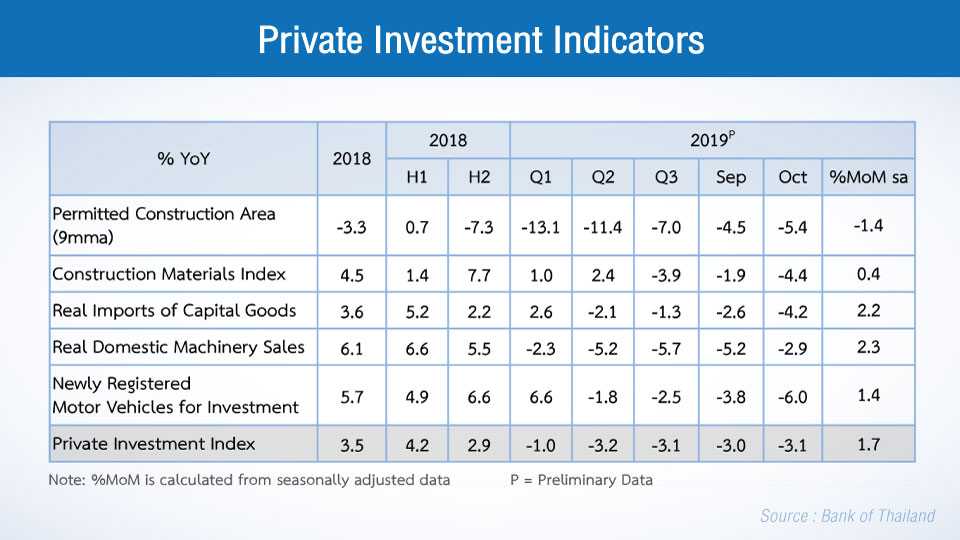
Private investment indicators continued to deteriorate from the same period last year, in line with weak domestic and external demand. Investment in machinery and equipment continued to contract from imports of capital goods, domestic machinery sales, and the number of newly-registered motor vehicles. Meanwhile, investment in construction in permitted areas for almost all purposes declined, consistent with subdued activities. Nevertheless, the permitted construction area for manufacturing purposes continued to grow.

The value of merchandise imports contracted by 9.2 per cent from the same period last year in almost every category, consistent with softening economic activities.

The contraction was attributable to the decrease in imports of raw materials and intermediate goods, particularly in 1) crude oil, due to the maintenance shutdown of oil refineries; and 2) electronic parts, partly owing to the high base effect in the previous year as well as the contraction in the exports of electronic products. In addition, after last month expansion, imports of consumer goods contracted, especially in seafood, mainly due to the high base effect in the previous year.

However, imports of capital goods accelerated due to imports of aircraft, ships, floating structures, and locomotive, though mostly in form of operational leasing. Excluding the category, the imports of capital goods continued to contract. Public spending, excluding transfers, contracted due to 1) central government’s capital expenditures, as the FY2020 budget has yet to be enforced; and 2) state enterprises’ capital expenditures, particularly disbursement of the Mass Rapid Transit Authority of Thailand (MRTA). Meanwhile, current expenditures continued to grow owing to the compensation of civil servants and purchases of goods and services.

Private consumption indicators expanded at a higher pace compared with the previous month but continued on a downward trend. This month, the private consumption indicators temporarily benefited from the government’s economic stimulus measures, boosting spending on non-durable goods and services.
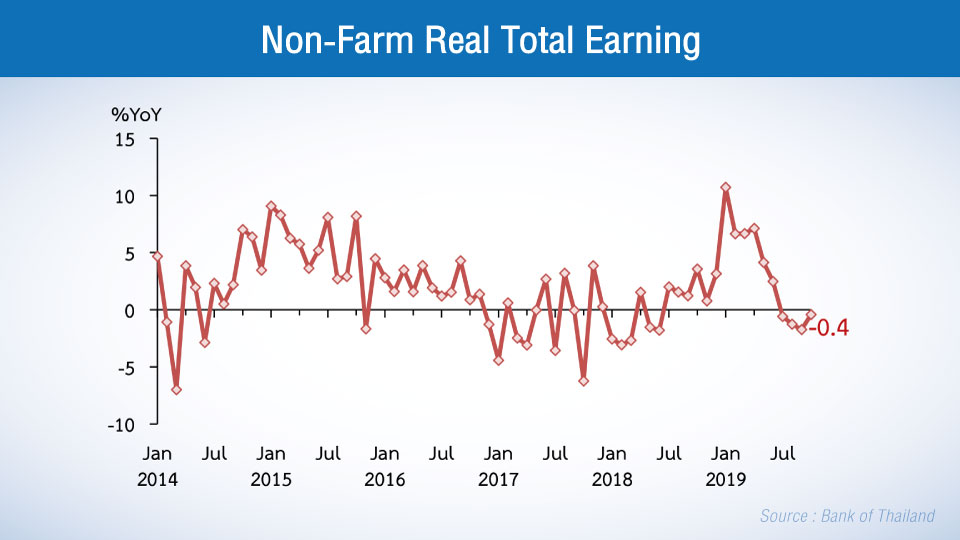
On the other hand, spending on semi-durable and durable goods contracted, especially on vehicles, in line with weakening supporting factors, namely continued contraction in non-farm income, softer farm income growth, and lower consumer confidence, together with financial institutions’ tightening of credit standards for auto-leasing loans after credit quality deteriorated.

The number of foreign tourist arrivals continued to expand, rising 12.5 per cent compared with the same period last year. This was driven by 1) the low base effect from the tour boat incident in Phuket; and 2) the exemption of the visa on arrival fee, encouraging more visitors from China, India, and Taiwan. Additionally, the number of tourists from other Asian countries continued to grow such as those from South Korea, Japan, and Laos. The number of Malaysian visitors also rebounded from a temporary factor as Deepavali Holiday was celebrated at the end of October this year.

The current account surplus narrowed from trade balance as a result of the increase in merchandise imports value compared with the previous month. The overall capital and financial accounts registered a deficit from the asset position following the increase in Thai Other Depository Corporations’ (ODCs) deposits and Thai portfolio investment abroad.