Govt looking for new export markets for Thai rubber

ศาสตร์เกษตรดินปุ๋ย : ขอบคุณแหล่งข้อมูล : หนังสือพิมพ์ The Nation

https://www.nationthailand.com/business/30378904?utm_source=category&utm_medium=internal_referral

Govt looking for new export markets for Thai rubber

Nov 29. 2019
By THE NATION

977 Viewed

The government is aggressively exploring new export markets for rubber, Prime Minister Prayut Chan-o-cha said on Friday (November 29) on the first day of the “Thailand Rubber Expo”.

The premier presided over the opening ceremony of the event held by the Rubber Authority of Thailand at the Impact Muang Thong Thani exhibition centre. It ends on December 1.

Prayut said that the government was aggressively exploring new markets such as India and Turkey for Thai rubber exports.

He added that Thailand’s rubber industry was facing challenges. Its main rubber importers like US and Europe are facing a slowing economy, while China can increase its own rubber capacity for domestic consumption.

He urged all related agencies to seek ways to address the problems.

EU paper outlines measures to boost business ties with Thailand

ศาสตร์เกษตรดินปุ๋ย : ขอบคุณแหล่งข้อมูล : หนังสือพิมพ์ The Nation

https://www.nationthailand.com/business/30378902?utm_source=category&utm_medium=internal_referral

EU paper outlines measures to boost business ties with Thailand

Nov 29. 2019
By THE NATION

1,166 Viewed

The European Association for Business and Commerce (EABC) on Friday (November 29) called for enhanced competitiveness, further improvement of ease of doing business, and negotiation of an EU‐Thailand Free Trade Agreement.

Tht EABC said these factors were crucial to strengthen Thailand’s economy, support the Thailand 4.0 vision and bring about enhanced trade and investment for Thailand.

The launch of the 2019‐20 European Business Position Paper was held at the Anantara Siam Bangkok Hotel.

The paper “reflects the shared efforts from European business leaders in Thailand from a broad range of industries and policy areas to provide practical recommendations for Thailand to become a more competitive economy. It is a reference and guideline to develop enhanced policy for Thailand. There is no better proof of the commitment of EU businesses to Thailand,” Ambassador Pirkka Tapiola, EU Ambassador to Thailand, said in his opening remarks.

He noted the importance of defending the rules-based multilateral trading system as a powerful instrument to deliver on economic growth and social development.

Sansern Samalapa, Vice Minister of Commerce, delivered the keynote address and said, “this is an important opportunity to improve trade and investment between Thailand and the EU”.

He noted that closer economic ties between Thailand and the EU were vital for ensuring sustainable regional economic development.

Jan Eriksson, president of the EABC, commended the Thai government for its efforts in promoting trade and investment through carrying out various measures to enhance competitiveness and improveease of doing business.

He admitted, however, that in today’s highly competitive environment, investors looked for advantages beyond investment incentives, to ensure that their business would be competitive and profitable in the longer term and could be used as highly effective regional bases as needed. Ongoing reforms to support competitiveness and ease of doing business continued to be essential.

While investment incentives available in Thailand may have attraction in terms of tax benefits, some relaxation of foreign ownership limits, hiring of foreigners and importing equipment, they do not alleviate the general daily interactions with doing business nor address fundamental reforms, so further progress is needed.

He urged the Thai government to address a number of areas of competitiveness, including structural reform, services liberalisation, streamlining the regulatory frameworks for increased ease of doing business and to join the European Union in the EU‐Thailand FTAnegotiation to achieve and make it a meaningful differentiator.

The Position Paper reflects five key policy recommendations for Thailand:

1 General reduction of trade barriers in goods and services, non-tariff Barriers, non-tariff measures

2 Service sector liberalisation

3 Structural reforms (often deep) to achieve the major vision and goal of Thailand 4.0 in a reasonable time

4 Ease of doing business beyond the World Bank’s existing criteria, with new ways of quality law-making, digital government and heightened respect for the rule of law;

5 Engagement on EU‐Thailand FTA negotiations to achieve a meaningful differentiator.

GPF seeks expansion in foreign investment

ศาสตร์เกษตรดินปุ๋ย : ขอบคุณแหล่งข้อมูล : หนังสือพิมพ์ The Nation

https://www.nationthailand.com/business/30378899?utm_source=category&utm_medium=internal_referral

GPF seeks expansion in foreign investment

Nov 29. 2019
GPF secretary-General Vithai Rattanakorn

GPF secretary-General Vithai Rattanakorn
By THE NATION

1,026 Viewed

The Government Pension Fund (GPF) plans to raise the proportion of its investment in overseas asset to 40 per cent of total portfolio from the current 28 per cent.

The Finance Ministry caps the fund’s holdings in foreign asset at 30 per cent of its total investment.

GPF secretary-General Vithai Rattanakorn said that GPF was seeking the board’s approval to raise the ceiling to 40 per cent, adding that it needed to raise foreign asset investment to divert risks from local holdings and to seek better return.

The GPF will focus on alternative assets in foreign countries, such as infrastructure funds, private equity funds, foreign equities, or governments’ bonds, Vithai said.

Despite strengthening of the baht by about 7 per cent against the dollar this year, GPF investment in international assets, including foreign stocks, has yielded return of 18 per cent in term of baht value.

The GPF has 1.1 million members. As of October this year, its net asset amounted to Bt935 billion.

MoU signed with major universities to train staff for EEC businesses

ศาสตร์เกษตรดินปุ๋ย : ขอบคุณแหล่งข้อมูล : หนังสือพิมพ์ The Nation

https://www.nationthailand.com/business/30378893?utm_source=category&utm_medium=internal_referral

MoU signed with major universities to train staff for EEC businesses

Nov 29. 2019
EA deputy chief executive officer Amorn Sapthaweekul

EA deputy chief executive officer Amorn Sapthaweekul
By THE NATION

1,166 Viewed

Energy Absolute (EA) business group today (November 29) signed a memorandum of understanding (MoU) with ten educational institutes and Double P Land to develop human resources to serve its business expansion in the Eastern Economic Corridor (EEC).

EA deputy chief executive officer Amorn Sapthaweekul said that the companies under EA group that signed the deal are involved in energy storage, oleochemicals and electric vehicles. Double P Land plans to develop the Chachoengsao Bluetech City Industrial Zone.

The participating EA companies in the MoU are EA, Amita Technology (Thailand) Co., EA Bio Innovation, and MINE Mobility Corporation Co while the educational institutes have been named as Burapha University, Rajamangala University of Technology Tawan-ok, Kasetsart University Si Racha Campus, Thammaset University Pattaya Campus, Prachin Buri Technical College, Chon Buri Technical College, Chachoengsao Technical College, Chachoengsao Vocational College, Thai-Austrian Technical College, and Rayong Technical College.

Govt aid for home buyers earns broad support

ศาสตร์เกษตรดินปุ๋ย : ขอบคุณแหล่งข้อมูล : หนังสือพิมพ์ The Nation

https://www.nationthailand.com/business/30378864?utm_source=category&utm_medium=internal_referral

Govt aid for home buyers earns broad support

Nov 29. 2019
Finance Minister Uttama Savanayana

Finance Minister Uttama Savanayana
By THE NATION

979 Viewed

Thailand’s three major housing associations are ready to support the government’s latest measure to bolster home purchases, Finance Ministry spokesman Lavaron Sangsnit said on Thursday (November 28).

Ministry officials met representatives of the Housing Business Association, Thai Real Estate Organisation and Thai Condominium Association and 19 financial institutions earlier in the day to brief them on the“Good house with down payment”campaign.

It is one of the government’s latest economic stimulus measures unveiled on Tuesday.

To reduce the cost of buying a home, the government will offer Bt50,000 cash-back per buyer on the down payment.

Buyers must earn no more than Bt100,000 a month and be registered on the Revenue Department’s tax database.

The campaign began on Wednesday and continues through next March.

Several banks have introduced their own down-payment measures to support the campaign.

Krungthai Bank president Payong Srivanich said it fully supported the ministry’s approach.

Speaking at a separate event, Finance Minister Uttama Savanayana likened the Thai economyto a sick person needing a remedy to prevent the condition getting worse.

The government must thus keep introducing economic stimuli, he said, but it must do so cautiously.

BOT wants banks to lower interest spread

ศาสตร์เกษตรดินปุ๋ย : ขอบคุณแหล่งข้อมูล : หนังสือพิมพ์ The Nation

https://www.nationthailand.com/business/30378874?utm_source=category&utm_medium=internal_referral

BOT wants banks to lower interest spread

Nov 29. 2019
 Bank of Thailand governor Veerathai Santiprabhob says the BOT is not satisfied with the high spread. (File photo)

Bank of Thailand governor Veerathai Santiprabhob says the BOT is not satisfied with the high spread. (File photo)
By The Nation

1,188 Viewed

The Thai central bank is pushing banks to narrow the difference between lending and deposit rates in order to make it fairer for retail customers.

Bank of Thailand (BOT) Governor Veerathai Santiprabhob said the current interest rate spread — the difference between the bank’s lending rate and deposit rate — is about 2.7 to  2.8 per cent.

Compared to rate spreads  in the region, the interest rate spread in Thailand is in the middle range — not too large, or too small.

The interest rate spread in Singapore is much lower at 1.5 per cent.

Singapore’s banks have fewer branches, are widely adopting electronic services and most of their customers are big businesses, so lending risks are much lower, he said. This allows banks to offer lower lending rates, he said.

The BOT is not satisfied with the high spread, he said, adding, the high spread is derived partly from the higher operating costs as banks have to have more branches, he said.

Thai banks offer lower lending rates to affluent customers than they do to less affluent customers. Smaller customers also get lower deposit rates from banks as they do not have much bargaining power.

One solution is to open the market for non-bank operators to compete in financial services for retail clients. This could ease the financial burden on those who have little bargaining power, he said.

Many people use the minimum lending rate minus deposit rate, resulting in an interest rate spread of 6 per cent which is misleading because banks have other operating costs, he noted.

The BOT estimates that the real interest rate spread is between 2.7 and 2.8 per cent, he said.

The central bank has succeeded in lowering the fee for financial transactions after implementing the electronic transaction system. Earlier, banks did not charge affluent customers but they levied a fee of between Bt25- Bt30 per transaction on small customers. After implementing the electronic payment system, the fee has been cut substantially.

However, he admitted that it was more challenging to narrow the interest rate spread since lending to rich customers have lower risks while loans to less-affluent clients have more risks.

Naris Sathapholdeja, the head of TMB Analytics, said the net interest margin (NIM) of the Thai banking system was at 2.75 per cent  at the end of the third quarter, compared to 1.93 per cent in Malaysia, 1.88 per cent in Singapore and 2.01 per cent in South Korea.

Part of the issue is that Thai banks have loaned more clean loans (no collateral required).

Among large banks, Siam Commercial Bank has the highest NIM rate at 3.65 per cent , followed by Krungsri 3.47, Kasikornbank 3.31, Krung Thai Bank 3.08 and Bangkok Bank 2.26 per cent.

Southeast Asian furniture industry seeks to achieve prosperity together

ศาสตร์เกษตรดินปุ๋ย : ขอบคุณแหล่งข้อมูล : หนังสือพิมพ์ The Nation

https://www.nationthailand.com/business/30378848?utm_source=category&utm_medium=internal_referral

Southeast Asian furniture industry seeks to achieve prosperity together

Nov 28. 2019
Foreign customers visit a furniture showroom. — VNA/VNS Photo

Foreign customers visit a furniture showroom. — VNA/VNS Photo
By Viet Nam News

1,950 Viewed

HCM CITY — Furniture companies and industries in Southeast Asia should pool their strengths and enhance co-operation to achieve prosperity and sustainability, a forum heard in HCM City on Wednesday.

Delegates at the “ASEAN Market Attraction” forum organised by Handicraft and Wood Industry Association of HCM City (HAWA) and the ASEAN Furniture Industry Council (AFIC) agreed that the region boasts many great advantages in terms of materials, production, design, distribution and market size in wood and furniture processing.

Last year, the countries in the region exported US$12.1 billion worth of wooden furniture out of the global total of $150 billion, with the US, Europe, Japan, Korea, and Canada being their main markets.

Nguyen Quoc Khanh, HAWA chairman, said Vietnam, Malaysia, Indonesia, Thailand, and the Philippines are fast growing furniture suppliers with two-thirds of their production prioritised for export.

Their export to production ratio is more than double the global average of around 30 per cent with Southeast Asia’s wood and furniture exports meeting 5 per cent of demand in the US and 2 per cent in Western Europe, he said.

Nguyen Xuan Thuy, deputy director of the Ministry of Industry and Trade’s Industry Development Centre, said with a population of over 600 million, rapid economic growth and increasing income, Southeast Asia is a huge market with high demand and purchasing power.

“But intra-regional trade is still low compared to the potential. A lot of things are needed to improve [this].”

Khanh said: “While the ASEAN market is obviously large, the question is how to enable Vietnamese and regional enterprises to exploit that potential? The most convincing answer is creating a ‘Cooperation – Link – Alliance’ model between Vietnamese enterprises and between businesses and associations in the region.

“Vietnam’s wood industry is leading the region in terms of potential, but most businesses only focus on their own interests, brands and products without seeing the great benefits of building an industry brand.

“ASEAN countries compete with each other. Therefore, a larger common goal is needed to create cohesion, consensus and co-operation for mutual prosperity.

“A combination of everyone’s strengths and alliances with regional partners will create a value chain in the wood industry.”

Co-operation in the regional wood industry should be based on the potential of countries and the strategy of enterprises, he said.

There should be vertical links between strong producers like Vietnam, Indonesia, Laos, and Myanmar and those strong in trade, design and services like Thailand, Singapore, Malaysia, and the Philippines, he said.

The horizontal links should be between AFIC member associations in strategic orientations and alliances for sustainable development of the industry, he said.

With the impact of the US-China trade war, many buyers have shifted their orders from China to Southeast Asia.

In the first seven months of this year, Chinese wooden furniture and furniture exports to the US fell by 18.3 per cent year-on-year to $14.3 billion.

Khanh said: “Most US and European customers want to source goods from outside China, and this is a great opportunity for AFIC to have a common vision and undertake activities to seize this valuable opportunity and enhance the position of the region.

“We should link to supplement each other and become stronger to counterbalance and compete in other production markets such as China and Europe.”

Emmanuel Padiernos, president of AFIC, said in addition to gathering twice a year, “We have started organising trade missions to each other countries. I think trade missions play a very important role in developing intra-ASEAN trade across different segments.”

Delegates also suggested that Vietnamese and ASEAN businesses should embrace digital transformation to better meet customers’ demands and promote consumption of their products since customer buying behaviours and expectations have changed dramatically.

Tran Viet Tien of HAWA said the ASEAN wood industry has been responding positively to changes in global markets by introducing national mechanisms and policies and changes in business and production activities at the enterprise level.

“The highest and consistent goal of the ASEAN Market Attraction forum is to promote and support links between Vietnamese enterprises and between regional enterprises and alliances between member associations for a prosperous and sustainable ASEAN wood industry.” — VNS

Hong Kong leader Lam due for trade talks

ศาสตร์เกษตรดินปุ๋ย : ขอบคุณแหล่งข้อมูล : หนังสือพิมพ์ The Nation

https://www.nationthailand.com/business/30378830?utm_source=category&utm_medium=internal_referral

Hong Kong leader Lam due for trade talks

Nov 28. 2019
By THE NATION

2,129 Viewed

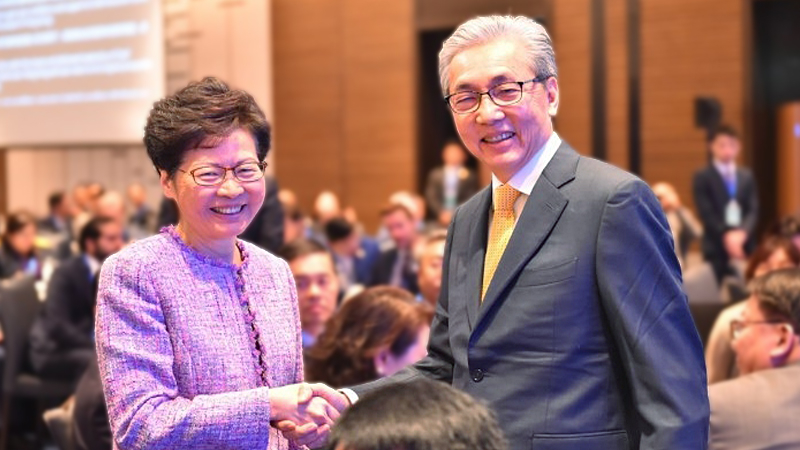
Carrie Lam Cheng Yuet-ngor, chief executive of Hong Kong, will arrive in Bangkok tomorrow (November 29) to bolster economic ties with the Kingdom, according to Kobsak Pootrakool, deputy secretary-general to the prime minister/political affairs.

During her visit, Lam will hold talks with Prime Minister Prayut Chan-o-cha and participate in a meeting of the Thailand-Hong Kong High Level Committee with Deputy Prime Minister Somkid Jatusripitak.

Lam and Somkid will sign six memorandum of understanding on strengthening economic relations.

The MoUs will pave the way to negotiations of a Thailand-Hong Kong free trade agreement, Korbsak said.

He said Hong Kong was interested in using Thailand as a gateway to CLMV countries: Cambodia, Lao, Myanmar and Vietnam.

U.S. stocks extend record run, Treasuries decline

ศาสตร์เกษตรดินปุ๋ย : ขอบคุณแหล่งข้อมูล : หนังสือพิมพ์ The Nation

https://www.nationthailand.com/business/30378837?utm_source=category&utm_medium=internal_referral

U.S. stocks extend record run, Treasuries decline

Nov 28. 2019
By Syndication Washington Post, Bloomberg · Vildana Hajric, Claire Ballentine ·

473 Viewed

U.S. equities rallied as the risk-on mood that’s driven American benchmarks to consecutive record highs showed few signs of abating. The dollar strengthened and Treasury yields rose.

The S&P 500 and Nasdaq Composite indexes rose for a fourth day, while Boeing Co. weighed on the Dow Jones Industrial Average after regulators signaled they’ll retain control over the aircraft maker’s grounded 737 Max jet. Data on U.S. gross domestic product and claims for unemployment beat analysts’ expectations. The Stoxx Europe 600 benchmark rose to within 1% of its record close, with 14 of 19 sector groups advancing.

“There’s a lot to be thankful for in today’s GDP revision — namely the strength of the consumer,” said Mike Loewengart, vice president of investment strategy at E*Trade Financial Corp. “If our economy is one thing, it’s resilient.”

Equities climbed across Asia except in China, where data showed the economy slowing further, as investors continue to monitor developments on trade. President Donald Trump declared Tuesday that talks on the first phase of a deal were nearly done after negotiators from both sides spoke by telephone.

Investors are searching among trade developments and the final earnings-season reports for reasons to stay positive on stocks, and as a global benchmark of developing and emerging-market equities hovers just below its all-time record.

“It’s been the same story for the past four to six weeks,” said Juha Seppala, director of macro asset allocation strategy for UBS Asset Management. “You have cloudy skies lifting a little bit and the sun is showing up, not fully but there are positive signs.”

Elsewhere, a a benchmark stock index in Australia ended the day close to a record high after the country’s central bank laid out a road map for interest-rate cuts and quantitative easing. Bitcoin turned higher after 10 straight sessions of declines, the worst streak on record.

Here are some key events coming up this week:

The U.S. celebrates Thanksgiving on Thursday, when equity and bond markets will be shut.

Euro area inflation for October is due Friday.

The Bank of Korea sets policy on Friday.

These are the main moves in markets:

Stocks

-The S&P 500 index climbed 0.4% to 3,153.11 as of 2:56 p.m. New York time, the highest on record, it closed at 3,153.63, up 0.42 %.

-The Dow Jones Industrial Average gained 0.2% to 28,162.21, the highest on record.

-The Nasdaq Composite index increased 0.6% to 8,697.55, the highest on record.

-The MSCI All-Country World index advanced 0.3% to 549.62, the highest in 22 months.

Currencies

-The Bloomberg Dollar Spot index gained 0.2% to 1,209.23, hitting the highest in more than six weeks with its seventh straight advance.

-The euro fell 0.2% to $1.1004, the weakest in almost seven weeks.

-The Japanese yen depreciated 0.4% to 109.54 per dollar, hitting the weakest in six months with its sixth straight decline and the largest dip in almost three weeks.

-The British pound climbed 0.3% to $1.2912.

Bonds

-The yield on two-year Treasuries gained three basis points to 1.62%, the largest rise in more than two weeks.

-The yield on 10-year Treasuries advanced two basis points to 1.76%.

-Germany’s 10-year yield was unchanged at -0.37%, the lowest in more than three weeks.

-Britain’s 10-year yield advanced three basis points to 0.675%, the biggest rise in more than two weeks.

Commodities

-Gold depreciated 0.5% to $1,454.97 an ounce, the weakest in more than 16 weeks on the largest fall in more than two weeks.

-West Texas Intermediate crude decreased 0.6% to $58.07 a barrel.

-Copper was unchanged at $2.70 a pound, the highest in more than two weeks.

Sri Racha – Map Ta Phut double track rail to cost Bt38.5 billion

ศาสตร์เกษตรดินปุ๋ย : ขอบคุณแหล่งข้อมูล : หนังสือพิมพ์ The Nation

https://www.nationthailand.com/business/30378827?utm_source=category&utm_medium=internal_referral

Sri Racha-Map Ra Phut double track rail to cost Bt38.5 billion

Nov 28. 2019
By THE NATION

1,068 Viewed

The double track rail system linking Sri Racha with Map Ta Phut is expected to cost Bt38.5 billion, according to the State Railway of Thailand (SRT).

The route, 202 kilometres long, will have 18 stations. It will run through Bangkok, Chachoengsao, Chon Buri and Rayong provinces.

It will also be connected with the main transport modes in the Eastern Economic Corridor (EEC) and three sea ports, including the Laem Chabang sea port, said the Sri Racha-Map Ta Phut double rail project manager, Somkiat Jang-arun, on Wednesday (November 27). He was speaking at a public hearing on the project arranged by the SRT.

The project, which can boost Thailand’s logistics capacity, will be able to serve 2.3 million passengers per year in the first year of operation before rising to 5.9 million per year in 2055.

The line is expected to carry 83 million tonnes of goods per year in the first year of operation before rising to 250 million tonnes in 2055.