Kbank analyst paints grim picture as Thailand teeters on recession

ศาสตร์เกษตรดินปุ๋ย : ขอบคุณแหล่งข้อมูล : หนังสือพิมพ์ The Nation

https://www.nationthailand.com/business/30378831?utm_source=category&utm_medium=internal_referral

Kbank analyst paints grim picture as Thailand teeters on recession

Nov 28. 2019
“We haven’t yet experienced recession, but we’re on the verge of it if we look at quarter-on-quarter growth of 0.1 per cent in the third quarter, the positive result coming from the downward revision for growth in the second,” said Kobsidthi.

“We haven’t yet experienced recession, but we’re on the verge of it if we look at quarter-on-quarter growth of 0.1 per cent in the third quarter, the positive result coming from the downward revision for growth in the second,” said Kobsidthi.
By The Nation

1,611 Viewed

The Thai economy is on the verge of a recession while the baht will remain strong, a financial analyst has warned.

Kobsidthi Silpachai, head of capital markets research at Kasikornbank, said it will be interesting to see whether Thailand’s economic growth slows in the fourth quarter compared to the third.

The economy expanded 2.4 per cent year-on-year, he noted, but quarter-on-quarter growth in the third quarter was just 0.1 per cent.

Had the National Economic and Social Development Council not revised downward growth in the second quarter by 0.2 percentage point, quarter-on-quarter growth would have been negative, Kobsidthi said at a seminar hosted by Kasikornbank on Wednesday (November 27).

He said that the chance of the Thai economy entering a recession next year was now 20 per cent, up from the 15 per cent forecast earlier.

“We haven’t yet experienced recession, but we’re on the verge of it if we look at quarter-on-quarter growth of 0.1 per cent in the third quarter, the positive result coming from the downward revision for growth in the second,” said Kobsidthi.

“It is challenging for the Thai economy in the fourth quarter as we see signs of further economic weakening,” he pointed out.

The baht’s appreciation is meanwhile expected to continue, to around Bt30.5 per dollar by the end of this year, Bt29.75 in mid-2020 and Bt29.25 by the end of next year.

A relatively high current-account surplus, estimated to be $30 billion next year, would underpin the strong value of the baht, he said.

Continuation of the trade war between the United States and China will also help ensure the baht remains a safe haven for foreign investors.

The Kasikorn Research Centre has forecast economic growth next year of 2.7 per cent, down from 2.8 per cent in its previous projection.

The US-China trade war will hurt Thai exports, which are expected to contract by 2 per cent next year, compared with estimated 1 per cent fall this year.

Manufacturing and employment are unlikely to expand much next year, and Thailand is also facing a labour shortage as the average age of the population rises.

Government spending and stimulus packages can shore up the economy in the short run but cannot bring about a higher growth rate, Kobsidthi warned.

The number of foreign tourist arrivals will increase little because of the global economic slowdown. With China’s economy sluggish too, Beijing is expected to promote domestic tourism next year, resulting in a drop in Chinese visitors to Thailand, he noted.

Even with the Kingdom on the fiscal ropes, the Bank of Thailand is unlikely to lower its benchmark interest rate due to limited monetary space, Kobsidthi said. “The current 1.25 per cent rate is a historic low, and a further cut would not curb the baht’s rise.”

The central bank, however, will face considerable pressure next year to do something to boost the economy, he said.

Due to high volatility in the financial markets, many investors have sold off their Thai bonds. They are also required by the central bank to hold at least a limited amount of baht currency.

Short-term bond holdings among foreigners has dropped to Bt50 billion from Bt107 billion – the level before the central bank imposed restrictive measures on the amount of baht that could be held, he said.

The outstanding maturity for short-term bonds held by foreigners is the lowest in 16 years, he noted.

Foreign holdings of long-term bonds have also decreased to Bt858 billion from Bt879 billion, he said.

IFC, central bank team up in drive for sustainable finance in Thailand

ศาสตร์เกษตรดินปุ๋ย : ขอบคุณแหล่งข้อมูล : หนังสือพิมพ์ The Nation

https://www.nationthailand.com/business/30378829?utm_source=category&utm_medium=internal_referral

IFC, central bank team up in drive for sustainable finance in Thailand

Nov 27. 2019
However, more can and needs to be done to steer the Thai financial sector towards more sustainable practices,” said Nawaron Dejsuvan, assistant governor of the Bank of Thailand’s Financial Institutions Policy Group, left.

However, more can and needs to be done to steer the Thai financial sector towards more sustainable practices,” said Nawaron Dejsuvan, assistant governor of the Bank of Thailand’s Financial Institutions Policy Group, left.
By The Nation

1,154 Viewed

IFC, a member of the World Bank Group, today (November 27) signed a memorandum of understanding (MoU) with the Bank of Thailand (BOT) on collaboration in accelerating sustainable financing in Thailand.

The partnership aims to enable more sustainable business practices by the financial industry and tackle key challenges to address environmental, social, and governance (ESG) risks.

Addressing ESG risks is integral to sustainable financing. Subsequently, this will help Thailand’s financial sector bolster its regulatory and industry cooperation to improve risk management practices and enhance governance. The issuance of the Responsible Lending Guidelines by the Thai Bankers’ Association in 2019 — under BOT’s leadership — has already set a precedent, highlighting the importance of sustainable banking in translating the nation’s reform efforts into a competitive and resilient financial sector.

“Thailand recognises the importance of adopting ESG practices in the financial sector and has recently made significant progress including the launch of the Thai Bankers’ Association Sustainable Banking guidelines. However, more can and needs to be done to steer the Thai financial sector towards more sustainable practices,” said Nawaron Dejsuvan, assistant governor of the Bank of Thailand’s Financial Institutions Policy Group. She added, “The Bank of Thailand and the Thai financial sector can benefit greatly from IFC’s extensive experiences to support continued development of Thailand’s sustainable finance”.

As part of this collaboration, IFC will support BOT in developing a Sustainable Finance policy framework, which includes a sustainability roadmap and tools to help the banking sector improve ESG risk management practices. This includes directing more capital to sectors and projects that have environmental and social benefits.

IFC, supported by the government of Australia, will also assist BOT and other financial institutions in the country build capacity in sustainable finance. Further, the partnership will facilitate knowledge sharing with other central banks that are members of Asean (Association of South East Asian Nations) and with members of the Sustainable Banking Network (SBN).

“The Thai financial sector is a key contributor to the growth of regional economies. Sustainable finance by Thai banks will not only have an impact in Thailand, but also on neighbouring markets,” said Vikram Kumar, IFC Country Manager for Thailand.

“Together with the central bank, we will support the Thai banking sector to emerge as the regional sustainable finance leader, by sharing its capital and expertise with neighboring markets”, he added.​​​​​

Crude price seen at $55-$65/barrel next year

ศาสตร์เกษตรดินปุ๋ย : ขอบคุณแหล่งข้อมูล : หนังสือพิมพ์ The Nation

https://www.nationthailand.com/business/30378828?utm_source=category&utm_medium=internal_referral

Crude price seen at $55-$65/barrel next year

Nov 27. 2019
Chansin Treenuchagron, president and CEO of PTT

Chansin Treenuchagron, president and CEO of PTT
By THE NATION

1,361 Viewed

Price of Dubai crude oil would be around US$55 – 65 per barrel next year, according to a joint forecast by ​Petrochemicals and Refining Integrated Synergy Management (PRISM) and Petroleum Refining Industry Club of the Federation of Thai Industries.

Factors that should be closely monitored include the US-China trade war, economic stimulus measures, increase in oil production capacity of non-Opec countries and output policy of the Organisation of the Petroleum Exporting Countries (Opec).

Chansin Treenuchagron, president and chief executive officer of PTT Public Company Limited, said today (November 27) that PRISM’s expert insight and professional viewpoints will help businesses in handling abrupt changes and embark on new opportunities.

“These data will allow us to be the leaders. The most important thing is to provide fact-based information and valuable knowledge to the public, promoting collaboration in accordance with PTT Group’s Sustainable Growth for All policy,” he said at the Annual Petroleum Outlook Forum 2019 titled “Sustainable Energy…Shaping A Better Future”. The event was co-hosted by PRISM Expert and the Petroleum Refining Industry Club of Federation of Thai Industries.

The 2019 forum, presided over by Chansin, presented future direction of global oil price, upcoming challenges in the energy sector, and solutions for sustainable energy.

Bandhit Thamprajamchit, president of Petroleum Refining Industry Club, commented on the global oil price trend, saying that “the global economic growth is currently at 3.4 per cent, causing crude oil demand to grow around 1.0 – 1.3 million barrel per day.

Although, the US-China trade war and Brexit have an impact on global economic growth as well as oil demand, the supply of crude oil in the world market tends to surge due to an increase in production capacity of non-Opec countries, including the United States. Meanwhile, Opec is maintaining its oil production level.

PRISM, therefore, forecast that Dubai crude oil price next year will be around the US$55 – 65 per barrel.

The long-term factors that will have an impact on the global oil situation are green energy policies and innovation & technology development for sustainable energy.

The Annual Petroleum Outlook Forum has been held since 2012, featuring an analysis by PRISM. Regular analysis on energy situation from PRISM can be reached via PRISM.PTTGRP.COM

Petronas wins Egat’s bid for LNG purchases, imports

ศาสตร์เกษตรดินปุ๋ย : ขอบคุณแหล่งข้อมูล : หนังสือพิมพ์ The Nation

https://www.nationthailand.com/business/30378818?utm_source=category&utm_medium=internal_referral

Petronas wins Egat’s bid for LNG purchases, imports

Nov 27. 2019
Egat deputy governor for strategy Patana Sangsriroujana

Egat deputy governor for strategy Patana Sangsriroujana
By THE NATION

1,726 Viewed

Malaysia’s Petronas LNG has been named bid winner for the procurement and imports of 130,000 tonnes of Liquefied Natural Gas (LNG) for the state-owned Electricity Generating Authority of Thailand (Egat).

Petronas LNG proposed the lowest price among the 12 bidders, said Egat deputy governor for strategy Patana Sangsriroujana in a statement today (November 27).

Egat planned to procure and import LNG in two stages of 65,000 tonnes each in the spot markets.

The Energy Policy Administrative Committee had set two periods for the imports . The first shipment will arrive at Map Ta Phut sea port from December 28 to 31.

The state agency will use the first delivery to power Unit 5 of Bangpakong power plant in Chachoengsao, and Unit 4 at Wang Noi plant, Ayutthya.

The second shipment, due next April, will fuel the newly-built Unit 1 of the South Bangkok power plant in Samut Prakarn, in addition to Unit 5 of Bangpakong power plant in Chachoengsao, and Unit 4 at Wang Noi plant, Ayutthya.

NZ shines in conduciveness to women’s entrepreneurship, Thailand makes top 20

ศาสตร์เกษตรดินปุ๋ย : ขอบคุณแหล่งข้อมูล : หนังสือพิมพ์ The Nation

https://www.nationthailand.com/business/30378798?utm_source=category&utm_medium=internal_referral

NZ shines in conduciveness to women’s entrepreneurship, Thailand makes top 20

Nov 27. 2019
By The Nation

1,189 Viewed

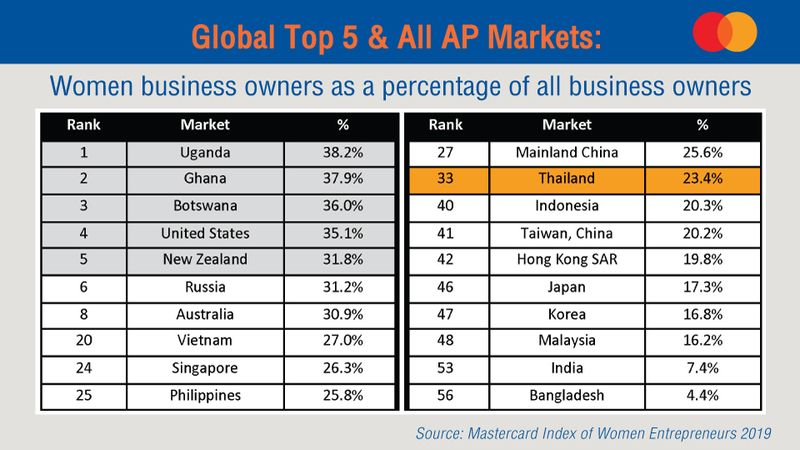
New Zealand emerged as the top-ranked market in the Asia Pacific region, and second in the world behind only the United States, for its conduciveness to women’s entrepreneurship.

Mastercard today (November 27) released the third edition of its Mastercard Index of Women Entrepreneurs, celebrating the markets where women entrepreneurs are most likely to thrive, while sounding the alarm that there are still significant inequalities that hold us all back.

Based on publicly available data from international organisations including the International Labour Organisation, Unesco and the Global Entrepreneurship Monitor, the global Index tracks the progress and achievement of women entrepreneurs and business owners in 58 societies(representing nearly 80 per cent of the world’s female labour force) across three components: (i) Women’s Advancement Outcomes, (ii) Knowledge Assets & Financial Access, and (iii) Supporting Entrepreneurial Factors.

The results reaffirmed that women are able to make further business inroads and have higher labour force participation rates in open and vibrant markets like New Zealand, Singapore and Australia, where the support for SMEs and ease of doing business are high. Women are also able to draw from enabling resources, including access to capital, financial services and academic programmes.  Typically, these markets are also driven by social norms that deeply encourage and promote innovation, creativity, risk‐taking and success through personal perseverance, and grant women fair opportunities to rise as business leaders, gain tertiary education and to be perceived and accepted as successful entrepreneurs. Out of the 20 highest-ranking markets globally, 80 per cent are high income economies. Top 20 markets for women entrepreneurs

Women Business Owners (as percentage of Total Business Owners) is the benchmark indicator of the MIWE, which is derived from the three components outlined above. TTTTT

Of the 58 markets included in the index, eight moved up by more than five ranks year-on-year. Asia Pacific’s fast-rising markets included Indonesia (+13), Taiwan (China) (+9) and Thailand (+5) which all saw significant jumps in their rankings.

On the other end of the spectrum, for markets at the lower end of the index, women tend to be held back by lack of opportunities to assume higher-level economic roles, are marginalised by poor support for SMEs, low financial inclusion, poor opportunities for tertiary education and often restrictive and underdeveloped business and financial systems that make doing business difficult.

Importantly, societal and cultural norms also discourage them from working, being ambitious, or assuming leadership roles.

“What is clear through this research is that gender inequality continues to persist across the world, although it manifests in different ways. It isn’t a developed or developing world problem alone. Even in markets with the most promising entrepreneurial conditions, women’s business ownership hasn’t reached its full potential. This marginalisation hinders the empowerment of women socially, professionally, economically and politically – to the detriment of society as a whole. That’s why Mastercard is tackling this problem head on, all over the world, by providing the tools and networks that drive inclusive growth and put the digital economy to work for everyone, everywhere,” said Julienne Loh, executive vice president/Enterprise Partnerships, Asia Pacific, Mastercard.

“Women-owned and led businesses are strong catalysts for economic growth, improving the lives of everyone. With this study, we are shining a light on those under-represented because even today, inequality and exclusion still hold women back. At Mastercard, we believe good ideas come from everywhere. Now is the time for governments and organizations to power together to support women to advance their businesses by eradicating gender-bias and ensuring greater access to education and financial inclusion,” said Ann Cairns, Executive Vice Chairman, Mastercard.

Methodology

The Mastercard Index of Women Entrepreneurs 2019 is the third report profiling the progress and achievement of women entrepreneurs/business owners across 58 societies around the world. With Angola as the newest market added to the Middle East & Africa region, the index expands its attempt to track the factors that underpin the gender gap among business owners. Representing nearly 80 per cent of the world’s female labour force, it highlights how the 58 markets differ at three levels: (i) Women’s Advancement Outcomes, (ii) Knowledge Assets & Financial Access, and (iii) Supporting Entrepreneurial Factors.

The results also shed light on which factors and conditions are the most conducive in helping to narrow the gender gap among female entrepreneurs/business owners, or the most inhibitive and disabling, thereby weighing on women’s ability to thrive in business.

More measures needed for an economic turnaround

ศาสตร์เกษตรดินปุ๋ย : ขอบคุณแหล่งข้อมูล : หนังสือพิมพ์ The Nation

https://www.nationthailand.com/business/30378785?utm_source=category&utm_medium=internal_referral

More measures needed for an economic turnaround

Nov 27. 2019
Public investment and private investment grew 3.7 per cent and 2.4 per cent respectively in the third quarter, according to the National Economic and Social Development Council.

Public investment and private investment grew 3.7 per cent and 2.4 per cent respectively in the third quarter, according to the National Economic and Social Development Council.
By Wichit Chaitrong
The Nation

1,107 Viewed

Economists see more government stimulus packages in the pipeline amid the bleak economic outlook for next year.

“The government should be credited for the latest economic stimulus package as it would at least shore up growth this year,” said Charl Kengchon, executive chairman at Kasikorn Research Centre.

His comment comes as the Cabinet on Tuesday approved economic packages targeting farmers, villagers, homebuyers and property developers. Finance Ministry estimated the package would inject about Bt144 billion into the economy with Bt80 billion in the next 3-4 months.

The government expected the package to shore up economic growth to 2.6 per cent this year, after a mere 2.4 per cent in the third quarter.

Charl, said economic impact of the latest package would not be significant this year as there is only a few week left. Government spending has been constrained, pending the passage of the fiscal 2020 budget by parliament early next year. The government would start public investments, if the proposed budget is approved, he said.

Economic outlook remain bleak as major economies such as US, China, Japan would continue to face growth deceleration next year,according to projection by the International Monetary Fund, he said.

For Thailand, economic growth would be at 2.5 per cent this year and 2.7 per cent next year, he said. The Thai economy largely depend on exports, and we need to monitor world trade and impact from the US-China trade conflicts, he said.Thai exports contracted 4.5 per cent in October.

If the two countries could reach a trade deal this year as expected, it would still take sometime before the global economy returns to normal, he said, adding that Thai exports next year might recover to a certain extent.

Somprawin Manprasert, executive vice president and head of research at Krungsri Bank said that it was not sure yet how the latest stimulus package would help small and medium-sized enterprises hard hit by falling exports.

He forecast exports to contract by 2.5 per cent this year and may grow 1.5 per cent next year.

“Global economy may be better than the Thai economy next year,” he said.

“Central banks in major economies have implemented monetary easing measures to stabilise their economies, but they may not be strong enough to pull our economy out of a slowdown,” he said.

Krungsri forcast Thai GDP growth at 2.4 per cent this year and 2.5 per cent in 2020. The growth rate is lower than the full potential of 3.5-3.8 per cent, Somprawin added. Public spending on infrastructure projects may start to enter the economy in the second half of next year but it would take time to gather momentum. Currently private investment remains at a low level and consumption flat, he said.

Public investment and private investment grew 3.7 per cent and 2.4 per cent respectively in the third quarter, according to the National Economic and Social Development Council.

The government may need to offer tax incentives for the middle income group to spend more, he added.

Meanwhile, Lavaron Sangsnit, director general of the Fiscal Policy Office, is more optimistic, saying that the latest package would inject about Bt144 billion into economy. For example the cash back offer of Bt50,000 for 100,000 potential home buyers would help to clear up the inventory of about 270,000-280,000 residential units. Property developers could start investing again, he said.

Previous measures such as cash handouts via welfare card scheme, income guarantee for farmers and local tourism stimulating package have somewhat failed to spur private consumption, he said, referring to the 4.2 per cent growth in private consumption in the third quarter.

U.S. goods trade deficit narrowed in October as imports plunged

ศาสตร์เกษตรดินปุ๋ย : ขอบคุณแหล่งข้อมูล : หนังสือพิมพ์ The Nation

https://www.nationthailand.com/business/30378784?utm_source=category&utm_medium=internal_referral

U.S. goods trade deficit narrowed in October as imports plunged

Nov 27. 2019
By Syndication Washington Post, Bloomberg · Jeff Kearns, Katia Dmitrieva987 Viewed

The U.S. merchandise-trade deficit unexpectedly narrowed to the lowest in more than a year as imports plummeted, signaling the impact of tariffs on shipments.

The gap decreased to $66.5 billion in October from $70.5 billion the prior month, Census Bureau data showed Tuesday. That compared with forecasts of a widening to $71 billion. Exports of goods eased to $135.3 billion, down $0.9 billion from September. Imports dropped to a two-year low of $201.8 billion.

The latest figures offer a glimpse of how trade may impact gross domestic product in the fourth quarter.

U.S. trade with China has suffered as President Donald Trump ratcheted up tariffs on imports from the Asian nation, which retaliated with its own levies on U.S. goods since 2018.

The report comes as the world’s two biggest economies edge closer to a partial deal to avert steeper tariffs that the U.S. has threatened on Chinese goods.

The report also showed wholesale inventories advanced 0.2% in the month as retail inventories rose 0.3%. Analysts look to these numbers to adjust estimates for economic growth during the quarter.

Exports and imports of goods account for about three-fourths of America’s total trade; the U.S. typically runs a deficit in merchandise and a surplus in services.

Tuesday’s figures cover goods only. The Commerce Department will release full October data for international trade Dec. 5, including services and more details on merchandise shipments.

U.S. consumer confidence declines for fourth straight month

ศาสตร์เกษตรดินปุ๋ย : ขอบคุณแหล่งข้อมูล : หนังสือพิมพ์ The Nation

https://www.nationthailand.com/business/30378783?utm_source=category&utm_medium=internal_referral

U.S. consumer confidence declines for fourth straight month

Nov 26. 2019
Lynn Franco
By Syndication Washington Post, Bloomberg · William Edwards936 Viewed

U.S. consumer confidence unexpectedly fell for a fourth straight month as sentiment about current labor-market conditions eased, posing a challenge to retailers heading into the all-important holiday-shopping season.

The Conference Board’s gauge decreased to 125.5 from an upwardly revised 126.1 in October. The reading, issued Tuesday, fell short of the 127 median projection in a Bloomberg survey of economists. The group’s measure of present conditions dropped to a five-month low, while economic expectations rose for the first time since July.

The string of declines is the longest since March-June 2012 and shows cracks may be emerging in what’s been the economy’s mainstay – consumer spending. Job gains have been moderating along with wage growth, suggesting households may pull back some after two very solid quarters of consumer spending that have kept the economy forging ahead.

The share of consumers who said jobs were plentiful fell to 44.8% in November from 47.7% a month earlier, while the share of those who said positions were hard to get climbed to a five-month high.

Expectations of the economy eased as 17.2% said business conditions would be better in the coming six months, down from 18.7% in October.

Other recent data on sentiment have been mixed, with the University of Michigan’s gauge at a four-month high in November and the Bloomberg Consumer Comfort weekly measure near its lowest point since January.

“The decline in the Present Situation Index suggests that economic growth in the final quarter of 2019 will remain weak,” Lynn Franco, director of economic indicators at the Conference Board, said in a statement. “However, consumers’ short-term expectations improved modestly, and growth in early 2020 is likely to remain at around 2%.”

October sees surge in registered capital of new firms

ศาสตร์เกษตรดินปุ๋ย : ขอบคุณแหล่งข้อมูล : หนังสือพิมพ์ The Nation

https://www.nationthailand.com/business/30378779?utm_source=category&utm_medium=internal_referral

October sees surge in registered capital of new firms

Nov 26. 2019
By THE NATION

952 Viewed

The number of newly registered companies in October stood at 5,751, down 7 per cent year on year, according to Sorada Lertharpachit, deputy director-general of Department of Business Development.

However, their total registered capital amounted to Bt98.590 billion, up 393 per cent year on year.

In terms of numbers, the top three applicants were construction firms, property developers, and restaurants.

The number of the firms dissolved in October stood at 2,116, up 2 per cent year on year with a total capital of Bt8.050 billion, down 20 per cent from the same period last year. Most of them were in the construction, real estate, and restaurant businesses.

The number of newly registered firms in the past ten months (January-October) totalled 63,359, up 1 per cent over the same period last year. Their combined  capital amounted to Bt284.618 billion, up 9 per cent.

There were 14,070 firms closed in the period, down 2 per cent year on year, with a total capital of Bt82.959 billion, up 15 per cent.

Energy Ministry prepares New Year ‘gifts’ for Thais

ศาสตร์เกษตรดินปุ๋ย : ขอบคุณแหล่งข้อมูล : หนังสือพิมพ์ The Nation

https://www.nationthailand.com/business/30378770?utm_source=category&utm_medium=internal_referral

Energy Ministry prepares New Year ‘gifts’ for Thais

Nov 26. 2019
Energy Minister Sontirat Sontijirawong

Energy Minister Sontirat Sontijirawong
By THE NATION

1,240 Viewed

Energy Minister Sontirat Sontijirawong said on Tuesday (November 26) that the ministry was preparing measures as New Year gifts for Thais.

He said the details would be forwarded to the Cabinet next week.

Sontirat said there were many ways to ease the cost of living, including capping the cooking gas price.