Visa debit cardholders in Southeast Asia can now get money transfers

ศาสตร์เกษตรดินปุ๋ย : ขอบคุณแหล่งข้อมูล : หนังสือพิมพ์ The Nation

https://www.nationthailand.com/business/30378673?utm_source=category&utm_medium=internal_referral

Visa debit cardholders in Southeast Asia can now get money transfers

Nov 23. 2019
A new digital cross-border payments platform, Nium enables users to make real-time money transfers to Visa debit cardholders across Southeast Asia including Viet Nam. — Photo Courtesy Visa Vietnam

A new digital cross-border payments platform, Nium enables users to make real-time money transfers to Visa debit cardholders across Southeast Asia including Viet Nam. — Photo Courtesy Visa Vietnam
By Viet Nam News

186 Viewed

Nium Pte Ltd, a digital cross-border payments platform, is enabling users to make real-time money transfers to Visa debit cardholders across Southeast Asia including Viet Nam.

It is based on Visa’s real-time push payments solution Visa Direct.

Nium is the first fintech-based money transfer service provider in Southeast Asia to offer instant money transfer services through recipients’ 16-digit Visa debit card numbers.

Now available in Singapore, it offers both peer-to-peer and business-to-business transfers.

In the first phase, remittances can be made to various Southeast Asia countries.

Prajit Nanu, co-founder and CEO of Nium said: “We understand that individuals and businesses need to receive money quickly, especially in markets where there are no instant payment solutions like FAST or IMPS. The partnership using Visa’s push payment solution and secure network will allow our consumers to transfer money in a faster, convenient and more secure way.”

According to a recent Visa survey, more than one in three respondents in Singapore make international money transfers at least once a year. Almost half of them expect their funds to be successfully transferred in less than a day.

Singapore has a Vietnamese community of around 12,000, many of them migrant workers who remit money back to their families.

Visa country manager for Vietnam and Laos, Dang Tuyet Dung, said: “Remittances are incredibly important for many families here, and in fact, Viet Nam is among the top 10 receivers of remittances in the world. As such, having fast, reliable and cost-effective means of sending money isn’t just a necessity, it also helps drive the economy.” — VNS

Vietnam’s economic growth could reach 7 per cent in 2021-25

ศาสตร์เกษตรดินปุ๋ย : ขอบคุณแหล่งข้อมูล : หนังสือพิมพ์ The Nation

https://www.nationthailand.com/business/30378672?utm_source=category&utm_medium=internal_referral

Vietnam’s economic growth could reach 7 per cent in 2021-25

Nov 23. 2019

NCIF’s Director Tran Thi Hong Minh addresses a seminar held in Hanoi on Thursday, themed “Vietnam economy perspective for 2021-25: opportunities and challenges from new generation free trade agreements”. — VNA/VNS Photo Danh Lam

NCIF’s Director Tran Thi Hong Minh addresses a seminar held in Hanoi on Thursday, themed “Vietnam economy perspective for 2021-25: opportunities and challenges from new generation free trade agreements”. — VNA/VNS Photo Danh Lam
By Viet Nam News212 Viewed

Hanoi – Vietnam’s economic growth is forecast to reach 7 per cent in the 2021-25 period thanks to the country’s participation in new-generation free trade agreements.

During the period, inflation will stand at a moderate rate of 3.5-4.5 per cent year. Labour productivity will be improved with an annual growth rate of about 6.3 per cent.

The information was released during a seminar held in Hanoi on Thursday, themed “Vietnam economy perspective for 2021-25: opportunities and challenges from new generation free trade agreements”.

It was organised by the National Centre for Socio-Economic Information and Forecast (NCIF) under the Ministry of Planning and Investment.

According to NCIF’s Director Tran Thi Hong Minh, the signing and implementation of new generation free trade agreements, especially the Comprehensive and Progressive Agreement for Trans-Pacific Partnership (CPTPP) and the Vietnam-EU Free Trade Agreement (EVFTA) would put a profound and wide impact on Vietnam’s economy in the period of 2021-25.

“Both CPTPP and EVFTA have wider range of ​​commitment compared to other trade pacts, as they cover import and export terms while setting production methods for goods exchanges,” Minh said.

“They have positive influence on economic growth, especially in markets of the signatories.”

EVFTA and CPTPP, respectively, can boost Vietnam’s GDP up by 4.3 per cent and 1.3 per cent by 2030, Minh said, adding that Vietnam’s export turnover to the EU by 2030 is expected to surge 44.4 per cent while that to CPTPP member countries will rise by 14.3 per cent by 2035 .

“The trade deals will exert influence on the Vietnamese economy in mid-and long-terms as they put pressure on the Government to improve institutions and business climate,” she said.

In another scenario, Vietnam’s GDP could expand 7.5 per cent if the country can take advantage of the Fourth Industrial Revolution, improve quality of investment and well develop the modern economy, Minh said.

Meanwhile, Tran Toan Thang, an official from the NCIF, said the EVFTA and CPTPP’s commitments were higher than WTO in terms of investment openness, investment protection and dispute settlement, and they helped Vietnam promote exports as well as improve supply chains.

Although Vietnam could improve its competitive capacity in terms of market scale and labour productivity, it could take time for the country to better infrastructure and promote innovation and technology readiness, Thang said.

The country should work more to renew its growth model, accelerate key drivers of economic growth, and make good use of opportunities from global integration, science-technology development and the Fourth Industrial Revolution, Thang said.

Digital transformation

Also on Thursday, the Vietnam Chamber of Commerce and Industry (VCCI) co-operated with Alibaba Group and OSB Investment and Technology JSC to hold the seminar “Vietnam exports on the eve of the EVFTA and digital transformation trends”.

VCCI Deputy Chairman Doan Duy Khuong said EVFTA created motivation for the development of Vietnam’s economy in general and exporting enterprises in particular.

After the trade deal takes effect, the EU will eliminate about 85.6 per cent of import tariffs on Vietnamese goods, equivalent to 70.3 per cent of Vietnam’s revenue from exports to the EU.

The trend of switching from traditional businesses to digital platforms was becoming increasingly popular and was considered a useful solution to help businesses expand export markets, in the context of Vietnam’s deeper integration into the global economy, Khuong said.

The seminar provided attendees with useful information about EVFTA, digital transformation trends as well as the importance of e-commerce application in seeking commodity sources for global importers.

It also provides effective marketing and promotion methods on e-commerce site Alibaba.com.

Bernard Dewamme from Belgium-based Mentally Fit Global Group shared useful information to help Vietnamese exporters enhance their leadership capacity, improving the competitiveness of Vietnamese businesses. — VNS

Xi calls for collective effort to innovate

ศาสตร์เกษตรดินปุ๋ย : ขอบคุณแหล่งข้อมูล : หนังสือพิมพ์ The Nation

https://www.nationthailand.com/business/30378670?utm_source=category&utm_medium=internal_referral

Xi calls for collective effort to innovate

Nov 23. 2019

President Xi Jinping meets with Henry Kissinger (second from left), former US secretary of state, and others attending the 2019 New Economy Forum in Beijing on Friday. [FENG YONGBIN / CHINA DAILY]

President Xi Jinping meets with Henry Kissinger (second from left), former US secretary of state, and others attending the 2019 New Economy Forum in Beijing on Friday. [FENG YONGBIN / CHINA DAILY]
By China Daily221 Viewed

President says China, US should strengthen their communication China would like to promote innovation cooperation with all countries, including the United States, to bring more benefits to the people of all nations, President Xi Jinping said Friday.

Xi made the remark while meeting with foreign representatives at the 2019 New Economy Forum at the Great Hall of the People in Beijing.

Innovation outcomes should benefit the whole world rather than being a treasure hidden in a mountain cave, Xi said. No country can be the only center for innovation or exclusively benefit from its outcomes, Xi said.

Given that both China and the US are major centers of innovation, Xi said, they should promote cooperation on innovation.

Xi recalled China’s ancient civilization, saying that the Chinese people have never surrendered despite China becoming a semicolonial and semifeudal society after the Opium Wars.

China’s remarkable achievements are attributed to the right path — socialism with Chinese characteristics — that fits China’s national conditions, follows the trend of the times and wins the hearts of the people, Xi said. He added that the people are confident in staying on the path.

The Chinese Dream of national rejuvenation is not a dream of hegemony, and China will not seek to replace any other country, Xi said, adding that China only strives to restore the country’s dignity and the position it deserves.

China will uphold the path of peace and development and be dedicated to cooperation with all other countries, Xi said. China will continue to follow the path of reform and opening-up despite obstacles deliberately set by others, and the obstacles and difficulties will make the country more determined to boost opening-up, he said. China will fulfill its commitment and keep its promises, Xi added.

Belt and Road cooperation has achieved fruitful outcomes, and win-win cooperation through this initiative will not be slowed but will move further in the right direction, he said.

Five representatives, including Henry Kissinger, former US secretary of state, and Henry Paulson, former US treasury secretary, delivered speeches at the meeting. They spoke highly of China’s achievements and the country’s contributions to global peace and development.

The representatives said protectionism has caused trade frictions, and the world situation is full of uncertainties. China’s efforts to boost opening-up are of great significance in promoting sustainable development and stabilizing international relations, they said.

Speakers said that all parties should enhance innovation cooperation to avoid the development of an “economic iron curtain”.

The 2019 New Economy Forum, held in suburban Beijing, was attended by over 500 people from the political and business sectors of over 60 countries.

Meeting with Kissinger

In a separate meeting with Kissinger on the same day, Xi said China and the US should strengthen communication on strategic issues to avoid misunderstandings and misjudgments. The China-US relationship is now at a critical juncture and facing some difficulties and challenges, he said.

Xi said the two nations should act in the fundamental interests of people in both countries as well as the world, respect each other, seek common ground and achieve win-win results through cooperation so as to advance bilateral ties’ development in the right direction.

Xi recalled that Kissinger, with profound historical vision and deep understanding of traditional Chinese culture, worked with the leaders of China and the US at the time to promote the normalization of relations between two countries with different national conditions.

The two countries and the world are still feeling the effect of those moves, he said.

The president also praised the 96-year-old veteran diplomat’s sincere feelings and active efforts in promoting the development of relations between the two great countries over the years, saying that his significant contribution will be written into history.

Kissinger said he was honored to have visited China almost 100 times over the past 50 years and witnessed the country’s earthshaking transformations.

The US-China relationship has kept moving forward despite ups and downs over the past five decades, he said, and now this relationship has become even more important as times have changed.

Trump says he might veto legislation that aims to protect human rights in Hong Kong

ศาสตร์เกษตรดินปุ๋ย : ขอบคุณแหล่งข้อมูล : หนังสือพิมพ์ The Nation

https://www.nationthailand.com/business/30378660?utm_source=category&utm_medium=internal_referral

Trump says he might veto legislation that aims to protect human rights in Hong Kong

Nov 23. 2019
President Trump might veto legislation designed to support pro-democracy protesters in Hong Kong. File Photo: Getty Images

President Trump might veto legislation designed to support pro-democracy protesters in Hong Kong. File Photo: Getty Images
By The Washington Post · David J. Lynch

500 Viewed

WASHINGTON – President Donald Trump suggested Friday that he might veto legislation designed to support pro-democracy protesters in Hong Kong – despite its near-unanimous support in the House and Senate – to pave the way for a trade deal with China.

Speaking on the “Fox & Friends” morning program, the president said that he was balancing competing priorities in the U.S.-China relationship.

“We have to stand with Hong Kong, but I’m also standing with President Xi [Jinping],” Trump said. “He’s a friend of mine. He’s an incredible guy…But I’d like to see them work it out. OK. We have to see and work it out. But I stand with Hong Kong. I stand with freedom. I stand with all of the things that we want to do, but we also are in the process of making the largest trade deal in history. And if we could do that, that would be great.”

The House on Wednesday passed the Hong Kong Human Rights and Democracy Act by a vote of 417 to 1. The lone holdout was Rep. Thomas Massie, R-Ky. That came one day after the Senate had approved the measure on a unanimous vote.


The veto-proof majorities indicate that Congress could overrule the president if he tries to block the bill from becoming law. As the U.S.-China trade talks approach the one-year mark, the episode shows how other elements of the relationship between the world’s two largest economies are influencing prospects for a deal.


The president’s uncertain remarks drew swift opposition from members of both parties. Sen. Ted Cruz, R-Texas, said the Hong Kong bill “will become law. This was a true bipartisan moment and a clear signal to the rest of the world that political threats from corrupt regimes will not stand in the way of America supporting the millions of freedom fighters in Hong Kong.”

Senate Minority Leader Charles Schumer, D-N.Y., accused the president of going soft on the Chinese leader. “For a guy who promised to be tough on China, President Trump’s reliable deference to President Xi is all the more bewildering,” Schumer said in a statement. “Being tough on China when it comes to human rights will also help us win the battle on trade.”

Once a bill is passed by both chambers of Congress, the president has 10 days to sign it into law or to veto it. If he does neither, it will become law automatically. That means Trump has until early December to decide.

The legislation authorizes sanctions on Chinese and Hong Kong officials involved in human rights abuses and requires the State Department to conduct an annual review of the special status that the U.S. grants Hong Kong in trade matters.

The bill threatens to complicate trade negotiations that already are stalled on several key issues. Chinese officials have criticized the congressional action as interference in their internal affairs. Vice President Pence said this week it would be “very hard” to finalize a trade deal if China resorts to violence to put down the protests, now in their sixth month.

But some experts say Xi will keep the trade talks and the Hong Kong protests on separate tracks. The Chinese economy grew at a 6 percent annual rate in the quarter that ended September 30, its slowest pace in 27 years. And the trans-Pacific tariff war is only adding to economic pressures, giving officials an incentive to negotiate a ceasefire. If Xi sees a trade deal as easing his economic woes, he will sign it regardless of other irritants in China’s relationship with the U.S., said Aaron Friedberg, a China scholar at Princeton University.

“The idea of linkage between Hong Kong and the trade talks is largely a figment of Trump’s imagination. I doubt that the Chinese side has made any such overt connection although, now that Trump has done so, they may be happy to reinforce the idea that, if we somehow go easy on them on Hong Kong, they may eventually ink that illusive ‘great deal,’ ” said Friedberg, a former adviser to Vice President Dick Cheney.

China regained sovereignty over Hong Kong in 1997, ending more than 150 years of British colonial rule. Maintaining control over the prosperous enclave, which Beijing governs under “the one-country, two-systems framework,” is a top priority for Xi. But there has been widespread tension in Hong Kong for months over China’s governance of the economic hub, triggering large – at times, violent – protests that have led to multiple deaths.

Chinese officials would likely react sharply if the U.S. legislation becomes law. But that reaction wouldn’t necessarily imperil the negotiations, according to Jeff Moon, a former U.S. trade negotiator in the Obama administration. In the past, China has reacted to perceived slights by denying permission for U.S. Navy vessels to make port visits to Hong Kong, he noted.

“Trump’s task is to de-link Hong Kong from trade, and to help Xi find a way to express displeasure over U.S. legislation without taking precipitous action that will create indefinite deadlock in the trade war,” Moon said. “The irony here is that Trump’s comments on Fox signal uncertain resolve and negotiating weakness in the trade war while talks are faltering and he needs to show determination to press China on the whole range of issues, not just agricultural products and tariffs.”

Trump last month announced an “agreement in principle” with China on a partial trade deal, which he hoped to sign by mid-November. But talks have deadlocked over the details of Chinese purchases of U.S. farm products and plans for the removal of Trump’s tariffs on $360 billion in Chinese goods.

Trump’s comments Friday come one day after Sen. Marco Rubio, R-Fla., one of the authors of the Hong Kong legislation, predicted on CNBC that the president would sign the measure.

“My understanding is that they will sign it,” Rubio said, referring to the White House.

Trump’s public comments about Hong Kong have been inconsistent. In June, he said a resolution of the protests was between Hong Kong and China “because Hong Kong is part of China.”

Two months later, he tweeted that Xi should “humanely” deal with the situation before a trade deal was inked. “Of course China wants to make a deal. Let them work humanely with Hong Kong first!” the president wrote.

The president has faced calls from lawmakers in both parties to speak out about what’s at stake in Hong Kong’s escalating demonstrations. “The world should hear from him directly that the United States stands with these brave men and women,” Senate Majority Leader Mitch McConnell said this week.

On Friday, Sen. Ron Wyden, the senior Democrat on the Senate Finance Committee, said: “Basic human rights in Hong Kong aren’t something Donald Trump can bargain away. Congress has overwhelmingly spoken against the Chinese government’s violent repression of peaceful protest, and any action by Donald Trump to side with China over Congress must be quickly overridden.”

The president also told Fox, without evidence, that he had saved the lives of thousands of Hong Kong demonstrators by telling Xi not to intervene.

“The only reason he’s not going in is because I’m saying it’s going to affect our trade deal,” Trump said.

The U.S.-China trade talks have charted a winding path for the past year. Trump and Xi agreed to launch negotiations last December 1 over a steak dinner in Buenos Aires, on the sidelines of the Group of 20 leaders’ summit.

Negotiators failed to meet their initial March 1 deadline, but Trump agreed to delay a planned tariff increase while talks continued. At the beginning of April, Trump said negotiators were close to an “epic” deal that could be finalized “within the next four weeks.”

Instead, the talks fell apart in May, with U.S. officials accusing the Chinese of reneging on a nearly-complete deal and the president expanded tariffs to additional Chinese products later in the summer.

Stocks climb as Trump says a trade deal is ‘close’

ศาสตร์เกษตรดินปุ๋ย : ขอบคุณแหล่งข้อมูล : หนังสือพิมพ์ The Nation

https://www.nationthailand.com/business/30378659?utm_source=category&utm_medium=internal_referral

Stocks climb as Trump says a trade deal is ‘close’

Nov 23. 2019
By Syndication Washington Post, Bloomberg · Vildana Hajric313 Viewed

U.S. equities edged higher after President Donald Trump said he was “very close” to a trade pact with China even as he warned that Beijing wanted a deal more than he did.

Automakers, an industry particularly sensitive to trade, led advances after Trump’s comments in an interview on Fox News. Bitcoin tumbled to a six-month low and the dollar gained. Oil fell and Treasury yields held steady. The S&P 500 index posted a small weekly loss, its first since early October.

It’s been a mixed picture on the trade front this week, suppressing volatility and keeping stocks in a tight range within 1% of a record high. Chinese Vice Premier Liu He has invited Robert Lighthizer to Beijing for further talks later this month, according to people familiar with the matter, and Washington will likely postpone new tariffs scheduled for December even if there’s no deal by then, the South China Morning Post reported. However, Trump may soon sign a bill supporting Hong Kong’s protesters, a move likely to anger China. He declined to reveal plans when asked Friday.

“Stocks’ short-term direction is still all about trade,” said Alec Young, managing director of global markets research at FTSE Russell. “Given precious little substance of late on that front, it’s no surprise stocks are stuck in a tight trading range with volatility at multi month lows.”

Elsewhere, European stocks advanced. The pound fell — boosting U.K. equities — following a gloomy reading of company sentiment. Government bonds in Europe rose as a measure of services in the euro area disappointed.

Japanese shares steadied after three days of declines, while stocks climbed in Australia and Hong Kong, and slipped in China.

These are the main moves in markets:

Stocks

–The S&P 500 index rose 0.2% at the close of trading in New York; it lost 0.3% for the week.

–The Stoxx Europe 600 index climbed 0.4%.

–The U.K.’s FTSE 100 index surged 1.2%.

–The MSCI Asia Pacific index increased 0.2%.

Currencies

–The Bloomberg Dollar Spot index rose 0.2%.

–The euro fell 0.3% to $1.1021.

–The British pound decreased 0.6% to $1.2835.

–The Japanese yen was little changed at 108.63 per dollar.

Bonds

–The yield on 10-year Treasuries was little changed at 1.77%.

–Germany’s 10-year yield fell three basis points to -0.36%.

–Britain’s 10-year yield decreased five basis points to 0.7%.

Commodities

–West Texas Intermediate crude fell 1.1% to $57.91 a barrel.

–Gold slipped 0.1% to $1,463.04 an ounce.

Lagarde calls for government help in first major ECB speech

ศาสตร์เกษตรดินปุ๋ย : ขอบคุณแหล่งข้อมูล : หนังสือพิมพ์ The Nation

https://www.nationthailand.com/business/30378657?utm_source=category&utm_medium=internal_referral

Lagarde calls for government help in first major ECB speech

Nov 23. 2019
By Syndication Washington Post, Bloomberg · Piotr Skolimowski, Jana Randow, Yuko Takeo ·947 Viewed

European Central Bank President Christine Lagarde called for a new policy mix, saying public investment should be stepped up to ease the burden on monetary stimulus and ensure the region can thrive in an uncertain world.

In her first major speech, three weeks into the job, the new ECB chief said her institution will continue to support the euro-zone economy. But she also said fiscal policy is a key element for overcoming the two main challenges facing the bloc: the changing nature of global trade, and declining domestic growth. Minutes after she finished, fresh data showed the current slowdown worsening.

“Twin external and domestic challenges call on us to consider — as Europeans — how we should respond to the new environment,” Lagarde said at a banking conference in Frankfurt. “The answer lies in converting the world’s second-largest economy into one that is open to the world but confident in itself — an economy that makes full use of Europe’s potential to unleash higher rates of domestic demand and long-term growth.”

The size of the challenge was highlighted by purchasing managers indexes published Friday, which showed the economy unexpectedly weakened this month, with a downturn in services activity. That suggests a slump in manufacturing, especially in Germany, is starting to spread to other sectors. That kind of data, which drove the euro lower, is something Lagarde will need to address at her first policy meeting on Dec. 12.

“It is remarkable that she spoke only about responding to ‘future risks,’ even though in our view there is a problem with low inflation and below-potential growth right now,” said Greg Fuzesi, an economist at JPMorgan. “Clearly, the wait for more clarity about the ECB’s thinking goes on.”

Lagarde is picking up where her predecessor Mario Draghi left off. In his final speech, he called for euro-zone fiscal support so that monetary policy isn’t “the only game in town” — a phrase that the new president also used. With her remarks, the Frenchwoman is building on an idea she expressed in Berlin earlier this month, when she urged Europe to overcome its self-doubt and show strength and resolve instead.

“We have a unique possibility to respond to a changing and challenging world by investing in our future,” she said. “All of this would be a game changer, not just for our own stability and prosperity, but for that of the global economy, too.”

Lagarde also said she’ll announce a strategy review of the central bank “in the near future.” That’s a step that may help to heal the divisions that opened up among policy makers after Draghi drove through another stimulus package in his final weeks. She already started building bridges earlier this month by taking the 25-member Governing Council on a retreat to a luxury hotel to discuss their decision-making processes and communication.

After years of unprecedented stimulus — negative interest rates, large-scale asset purchases, and long-term loans to banks — fears are growing over consequences such as rising real-estate prices and excessive risk-taking by investors in search of higher yields.

The ECB noted its own concerns in its Financial Stability Review this week, and the account of Draghi’s final policy meeting, also published this week, included a plea to allow current stimulus to show its potency. Lagarde said the ECB will “continuously monitor the side effects” of its policies.

Above all though, her speech, peppered with quotes from T.S. Eliot and Saint Francis of Assisi, was a call for European leaders to think bigger. She said they’ve been slow to capitalize on the digital age, with the result that productivity growth has slowed, and have been hindered from completing the economic and monetary union because of too much attention to risk reduction.

“Completing EMU is about finding the right trade-off: enough protection against moral hazard to discourage under-saving, but enough mutual insurance to prevent over-saving,” she said. “In this way, we could tap into new sources of growth that would otherwise be suppressed. And, in the spirit of this conference, that would truly represent a ‘new approach’ for Europe.”

U.S. consumer sentiment rises to four-month high on outlook

ศาสตร์เกษตรดินปุ๋ย : ขอบคุณแหล่งข้อมูล : หนังสือพิมพ์ The Nation

https://www.nationthailand.com/business/30378654?utm_source=category&utm_medium=internal_referral

U.S. consumer sentiment rises to four-month high on outlook

Nov 23. 2019
A pedestrian carries a Nike shopping bag in San Francisco on March 11, 2019. MUST CREDIT: Bloomberg photo by David Paul Morris.
Photo by: David Paul Morris — Bloomberg

A pedestrian carries a Nike shopping bag in San Francisco on March 11, 2019. MUST CREDIT: Bloomberg photo by David Paul Morris. Photo by: David Paul Morris — Bloomberg
By Syndication Washington Post, Bloomberg · William Edwards

763 Viewed

U.S. consumer sentiment extended gains in mid-November as Americans’ economic outlook improved against a backdrop of solid hiring, record stock prices and the prospect of a trade truce with China.

The University of Michigan’s final sentiment index advanced to 96.8 in November from 95.5 in October, data showed Friday. It was also above both the preliminary reading and median analyst estimate of 95.7. The gauge of current conditions decreased to 111.6 while the expectations index climbed to 87.3, and both were higher than in the initial report.

The upbeat reading, marking the longest streak in sentiment gains since early 2017, signals consumers will continue to drive the longest economic expansion in U.S. history as the holiday shopping season begins.

The measure of Americans’ expectations for inflation five to 10 years out rebounded to 2.5% from a reading that matched a record low. That may give some comfort to Federal Reserve officials, after some policy makers flagged concerns about low inflation expectations in supporting a third straight interest-rate cut last month, according to minutes of their meeting.

Americans’ optimism is being supported by record stock values and a still-solid job market as well as lower interest rates following the Federal Reserve’s third straight reduction in borrowing costs. The Trump administration and Chinese officials are in the process of negotiating an initial trade accord, though it could still fall through.

While Americans’ sentiment remains sharply divided among partisan lines, the data suggested that the start of impeachment proceedings against Republican President Donald Trump is seeping into views: The index rose to a three- month high among Democratic respondents and slumped to a three-month low among Republicans. Still, just 2% of respondents made spontaneous references to impeachment.

“Personal spending will be energized by record favorable evaluations by consumers of their personal financial situation,” Richard Curtin, director of the University of Michigan consumer survey, said in a statement. “Nonetheless, there is little point in dismissing the significant risks from potential negative shocks, associated with tariffs, impeachment, global growth, or geopolitical events.”

Consumer expectations for inflation over the coming year were unchanged from the prior month at 2.5%.

A measure of buying conditions for household durable goods dipped less than initially reported, while lower mortgage rates have helped boost home-buying attitudes.

Fifty-four percent of households said their finances had recently improved, not far from the record high of 57%.

The report reflects surveys from Oct. 22 to Nov. 18. The preliminary report’s cutoff was Nov. 6.

U.S. stocks hit record highs this week. Analysts call it a ‘nervous’ rally

ศาสตร์เกษตรดินปุ๋ย : ขอบคุณแหล่งข้อมูล : หนังสือพิมพ์ The Nation

https://www.nationthailand.com/business/30378651?utm_source=category&utm_medium=internal_referral

U.S. stocks hit record highs this week. Analysts call it a ‘nervous’ rally

Nov 22. 2019
Photo by: The Washington Post — The Washington Post

Photo by: The Washington Post — The Washington Post
By The Washington Post · Heather Long

726 Viewed

The U.S. stock market hit record highs this week as a stunning surge of optimism has flooded Wall Street and fears of an imminent recession have all but disappeared.

The market “melt up” is driven by three main factors: Belief that the trade war has peaked, belief there won’t be a U.S. – or global – recession in 2020, and belief that the Federal Reserve has the market’s back. Investors are making a bet that corporate profits will be a bit better next year than this year. They see a future where American consumers keep spending and businesses start investing again as the economy stabilizes and President Trump hits pause on any more tariffs.

The three main stock indexes hit their peaks early in the week, retreated slightly, but regained momentum Friday morning. The stock market is effectively at its highest level in U.S. history, a phenomenon that the White House has openly cheered.

“I am of the opinion that neither the U.S., nor the global, economy are facing a recession through the end of 2020,” said Ed Yardeni, head of Yardeni Research. “The market rightly anticipates Trump wants another term as president and he’s got enough going on with impeachment issues that he wants to put trade on the back burner for awhile.”

But there are a lot of “ifs” in the bullish scenario for next year, especially around trade, which is why markets has already pulled back slightly from its highs. This remains a tip-toe higher market, many analysts say. They point out that while the Dow Jones industrial average is up nearly 20% this year, it is only about 4% higher than it was on October 3, 2018, an indication of the hesitancy that remains among investors.

“It’s a nervous market,” said Howard Silverblatt, senior analyst at S&P Dow Jones Indices. “Everyone is talking a great ball game, but when you come down to it, everyone has their finger just over the sell button. You are one tweet away from concern.”

Goldman Sachs sent a note to clients on November 3 declaring that “tariffs have peaked” and Trump was unlikely to implement any more taxes on China. In a sign of how quickly momentum can shift, the prominent investment bank sent another note on November 19 saying risks of a tariff increase have risen again.

Trump largely credits himself for the recent record highs. The stock market is “through the roof” since election day, he said as cameras recorded his cabinet meeting Tuesday. “That’s something nobody would have thought possible.” Trump adviser Peter Navarro has predicted that the Dow, which broke 28,000 for the first time on Friday, will soon surpass 30,000.

Most market analysts praise the Fed, not Trump, for the rebound in the stock market this year. The Fed has cut interest rates three times, a move that is likely to stimulate the economy well into next year. The housing market is already showing signs of an uptick.

“I believe the stock rally is justifiable because of what Fed Chair Jay Powell said a few weeks ago when he made it clear there is a high bar for raising rates,” said Kristina Hooper, chief global market strategist at Invesco. “This is an environment in which monetary policy is going to be an important support for equities.”

Stocks rallied after Trump enacted the largest corporate tax cut in U.S. history, but his trade war has caused business investment to contract for the past two quarters, a drag on the economy and an indication of how concerned business leaders are. In a new report out this week, researchers at the Federal Reserve Bank of Dallas found that policy uncertainty triggered most of the downturns in the stock market since Trump took office.

“In the absence of such uncertainty, the Standard & Poor’s’ 500 Index would have been about 12% higher over the past two years,” wrote Pavel Kapinos and Alex Musatov from the Dallas Fed.

Photo by: The Washington Post — The Washington Post

Photo by: The Washington Post — The Washington Post

What’s changed in recent weeks is that experts see less risk of a recession — or near-recession – in 2020. Few outside the White House are predicting an economic surge, but the growing consensus is that the economy will continue to chug along at around 2% growth, enough to keep profits healthy and jobs fairly plentiful.

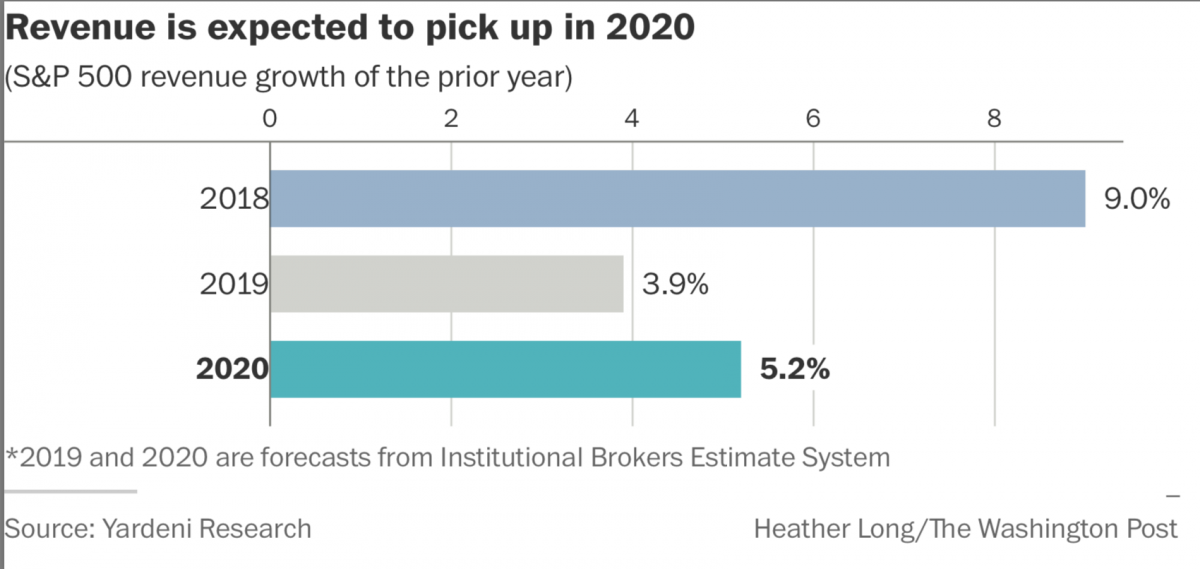
Yardeni and his research team describe it like this: Corporate revenues were flying high at 9% last year as economic growth ticked up in the wake of the big tax cuts. This year revenues for S&P 500 companies are widely expected to fall under 4%, a weak year but not the bloodbath some feared over the summer. The prediction for next year is revenue growth over 5% — a slight pickup and part of the reason the market has been rallying.

There are a number of factors playing into the market momentum. Historically, the stock market has risen by more than 10% in the six months following the Fed’s first rate cut, said Sam Stovall, chief investment strategist at CFRA Research. The third and fourth years of a president’s term have also had strong market performance, according to Bespoke Research.

A number of key economic indicators have also come in better-than-expected: Businesses in most industries continue to add jobs, consumers keep spending, and even the manufacturing slump appears to be plateauing instead of getting worse. The yield curve, which flashed a major warning sign in August when it inverted, is now back to a normal shape.

Corporate earnings have also outperformed with 75% beating expectations, according to the latest data from S&P Dow Jones Indices. But long-time market analyst Silverblatt remains cautious. He has been pointing out to readers of his popular market emails that most companies cut their earnings expectations a lot this year. They are beating this much lower bar, not the initial bar they set heading into 2019.

Despite the fresh market highs, many investors continue to take money out of stocks and pour it into ultra-conservative money market funds, another sign of unease. In a new report out this week, Morningstar said investors have removed more than $36 billion from U.S. equity funds so far this year, including pulling nearly $15 billion out in October alone. In contrast, money market funds are sitting on the largest pile of cash in a decade.

There’s growing belief the markets and the economy are unlikely to tank in 2020, but debate remains over how much upside is left in a bull market that has been running for more than a decade.

GDP growth target for 2020 set at 2.7 to 3.7 per cent

ศาสตร์เกษตรดินปุ๋ย : ขอบคุณแหล่งข้อมูล : หนังสือพิมพ์ The Nation

https://www.nationthailand.com/business/30378640?utm_source=category&utm_medium=internal_referral

GDP growth target for 2020 set at 2.7 to 3.7 per cent

Nov 22. 2019
Kobsak Pootrakool

Kobsak Pootrakool
By THE NATION

1,302 Viewed

The Council of the Economic Ministers on Friday (November 22) approved the government’s economic target of 2.7 per cent to 3.7 per cent gross domestic product (GDP) growth next year.

Kobsak Pootrakool, deputy secretary-general to the prime minister for political affairs, said the government also targeted budget disbursement of 92.3 per cent of total budget next year in order to achieve the 2020 GDP growth target.

The council also set export growth target of at least 3 per cent next year and total 41.8 million tourist arrivals. It also aims for private local and foreign investment of at least Bt3.3 trillion next year.

The council urged all state agencies to accelerate budget disbursement of Bt110 billion in this quarter.

The meeting was also briefed on projects faced with slow disbursement, including the the Thai-China high-speed train project.

New Trump administration plan could boost oil drilling on remote Alaska reserve

ศาสตร์เกษตรดินปุ๋ย : ขอบคุณแหล่งข้อมูล : หนังสือพิมพ์ The Nation

https://www.nationthailand.com/business/30378621?utm_source=category&utm_medium=internal_referral

New Trump administration plan could boost oil drilling on remote Alaska reserve

Nov 22. 2019
By The Washington Post234 Viewed

WASHINGTON – The Trump administration announced a plan Thursday that could allow oil drilling on over three-quarters of the nation’s largest piece of unprotected wilderness, overhauling a 2013 plan that limited development on the Alaskan reserve.

The 23-million acre National Petroleum Reserve-Alaska, which is roughly the size of Indiana, has attracted relatively little public attention compared with the neighboring Arctic National Wildlife Refuge. But it ranks as one of the most ecologically valuable and promising oil prospects in the country.

The Interior Department’s Bureau of Land Management announced it is considering four possible options for the reserve, from slightly scaling back the 11.7 million acres eligible for development to expanding the leasing area to 18.3 million acres.

The Obama administration had put half of the reserve off limits to development six years ago, on the grounds that specific areas provided crucial habitat for hundreds of thousands of migrating birds and tens of thousands of caribou. But it is also the site of significant oil deposits, and recent discoveries suggest that it could hold as much as 8.7 billion barrels in undiscovered oil.

The bureau did not pick a “preferred alternative” in its new proposal. But its Alaska state director Chad Padgett said the plan, which will be subject to a 60-day comment period, reflects the administration’s emphasis on energy development.

“With advancements in technology and increased knowledge of the area, it was prudent to develop a new plan that provides greater economic development of our resources while still providing protections for important resources and subsistence access,” he said.

The agency’s draft Environmental Impact Statement is required to include an alternative of keeping the existing protections for the reserve in place. Under one scenario, BLM would cut the amount of area eligible for drilling from 11.8 million acres to 11.4 million. But the other two plans would expand energy development significantly, to either 17.1 million acres or 18.3 million acres, which amounts to 80 percent of the reserve.

Under this last scenario, federal officials would allow drilling around Teshekpuk Lake, a 22-mile-wide reservoir created by the thawing of ice-rich permafrost. The lake hosts hundreds of thousands of breeding shorebirds, along with denning polar bears and tens of thousands of molting geese and caribou.

Nicole Whittington-Evans, Alaska program director at the advocacy group Defenders of Wildlife, said her organization would fight any move to expand fossil fuel development in the remote region.

David Krause, Alaska assistant director for the Wilderness Society, questioned why the administration would upend the existing plan when it includes more than 10 million acres yet to be leased. “Clearly the only reason to scrap the existing, science-based management is to pander to oil companies who will drill anywhere, regardless of the social and ecological impacts,” he said.

Designated a naval reserve in 1923, the area has been the subject of energy exploration for years. But in 1976, the Navy transferred control of the area to Interior under a law that required any oil exploration conducted in areas with “significant subsistence, recreational, fish and wildlife, or historical or scenic value” be conducted in a way that provides “maximum protection.”

Commercial companies became interested in the area in the 1990s, and have been producing oil in the reserve for two decades. But operations there are subject to strict rules, and each new project has spurred significant controversy.

“It is arguably the most special place for birds in the Arctic,” said David Yarnold, president of the National Audubon Society, in an interview. “If you were to try to find a place to do more damage in the Arctic, you couldn’t.”

But Kara Moriarty, president of the Alaska Oil and Gas Association, said in a phone interview earlier this year that her members were committed to minimizing their operations’ environmental impact.

“Nobody cares about the backyard more than than we do,” she said, adding that Alaska remains a critical component to fulfilling President Donald Trump’s vision of expanding fossil fuel production at home. “The only way you can do that is through Alaska. There’s a recognition that this administration is very focused on energy security and this is their words, energy dominance.”

The federal government’s fluctuating estimates of the reserve’s energy potential has influenced what sort of limits previous administrations have imposed there. In 2010 the USGS downgraded its estimate of the area’s undiscovered oil from 10 billion to 896 million barrels. The Obama administration developed a master plan for the reserve that allowed leasing in half the reserve, and put the other half off limits.

But just a few years later, federal experts were forced to reassess their projections. After 150 exploration wells produced only modest finds, Armstrong Oil and Gas discovered the Pikka oil pool in 2015 on nearby state lands. The field, now known as Pikka/Horseshoe, alone could hold more than 1 billion barrels. Two years later, the third-biggest U.S. oil company ConocoPhillips tapped Willow, an oil reservoir on federal land that could hold more than 300 million barrels.

The latest oil boom holds out economic promise for the state of Alaska, which is heavily reliant on income from the petroleum industry. Drilling in the reserve is particularly lucrative for Alaska due to a special deal crafted by the late senator Ted Stevens (R-Alaska), which gives the state half of the reserve’s federal royalties.

And it has split the Alaska Native community on the North Slope, which funds much of its local government operations with taxes on oil and gas companies. A year ago North Borough Mayor Harry K. Brower Jr., joined Alaska’s Director of Resources at the time, Andy Mack, in asking Trump officials to expand leasing in the reserve.

“While always mindful of the need to protect the environment and critical subsistence opportunities, our residents also recognize that our ability to continue to provide even the most basic services to our communities depends largely upon a revenue stream generated by taxes on land-based oil and gas facilities,” he wrote.

However some village leaders in Nuiqsut, a town of just under 500 people at the edge of the federal reserve, have begun to push for limit drilling in the region.