Analyst predicts SET Index could fall below 1,600

ศาสตร์เกษตรดินปุ๋ย : ขอบคุณแหล่งข้อมูล : หนังสือพิมพ์ The Nation

https://www.nationthailand.com/business/30377046

Analyst predicts SET Index could fall below 1,600

Oct 03. 2019
By The Nation

520 Viewed

The Stock Exchange of Thailand Index yesterday slumped 2.95 points, or 0.18 per cent, to end the day at 1,610.69, as the global economic situation continued to shake investors.

International investors made net sales of Bt780 million and the Net Long Thailand Futures Exchange had 1,350 contracts.

A Krungsri Securities analyst has predicted that the stock market might slide to 1,590-1,600 points due to worries about the new US-EU trade protectionism after a World Trade Organisation (WTO) ruling allowed the US to raise tariffs on merchandises from the EU worth US$7.5 billion as European governments were found to have illegally subsidised aeronautics giant Airbus.

The US measure will be effective from October 18 while the EU has announced it will react to this move. Following the WTO ruling, the US could impose tariffs on a range of EU goods from aircraft to cheese and olives. The two sides are also awaiting a WTO ruling on tariffs the EU can impose against the US in retaliation for state subsidies provided to American aerospace giant Boeing.

Meanwhile, job growth in the US private sector has dwindled, pointing towards a possible recession. The crude oil price has dropped to US$53 per barrel because of increasing stocks. Concerns over slowdown in demand due to economic conditions are another factor that has pushed down the power business group and the index.

Somkid seeks budget for second phase of ‘Eat, Shop, Spend’ campaign

ศาสตร์เกษตรดินปุ๋ย : ขอบคุณแหล่งข้อมูล : หนังสือพิมพ์ The Nation

https://www.nationthailand.com/business/30377033

Somkid seeks budget for second phase of ‘Eat, Shop, Spend’ campaign

Oct 03. 2019
By The Nation

464 Viewed

Deputy Prime Minister Somkid Jatusripitak has called on the Finance Ministry to find funds for the second phase of the “Eat, Shop, Spend” scheme launched to stimulate the economy.

“The campaign’s second phase to be launched in the last quarter aims to help boost Thailand’s economic situation, since the global economy is slowing down and internal political conflicts have started erupting. Income from tourism will help carry the economy through this crisis,” he said.

The government plans to invite another 100,000 local shops to join the campaign in a move to boost the value of the local economy, while Somkid has called on related agencies to hold seminars upcountry to encourage local businesses.

Meanwhile, Finance Minister Uttama Savanayana said his ministry was considering the number of registrants for the second phase. The first phase only allowed 10 million people to register.

Nam dok mai mango finally finds its way to US shelves

ศาสตร์เกษตรดินปุ๋ย : ขอบคุณแหล่งข้อมูล : หนังสือพิมพ์ The Nation

https://www.nationthailand.com/business/30377017

Nam dok mai mango finally finds its way to US shelves

Oct 03. 2019
By The Nation

1,360 Viewed

Dr Suvit Maesincee, Minister of Higher Education, Science, Research and Innovation (NIMT), said this week that Thailand had finally been able to export the gold-hued Nam Dok Mai mango to the US after 12 years of trying. Ripened mangoes had long faced export problems due to the different import regulations imposed by various countries to prevent disease and keep out insects.

Since 2007, the US Agriculture Ministry has only allowed in mangoes that passed the gamma radiation test.

To solve the problem, the National Research Office, the Office of Economic Development, Naresuan University and the National Institute of Nuclear Technology have worked together on research following Boston Consulting Group model (BCG) by monitoring the mango, both pre-radiated and after the radiation process, until it achieved US standards. Many mangoes treated with this process have been shipped to US stores since September.

Several start-ups working in collaboration with 7 universities in Thailand’s north, including Recute, a recycled garbage system company, NU Bio Bag, a bio-plastic bag maker, and TRIBES, distributor of tea and coffee products from hilltribe minorities in Chiang Rai, Suvit added.

Export of Thai gems, jewellery rises despites challenges this year

ศาสตร์เกษตรดินปุ๋ย : ขอบคุณแหล่งข้อมูล : หนังสือพิมพ์ The Nation

https://www.nationthailand.com/business/30377002

Export of Thai gems, jewellery rises despites challenges this year

Oct 03. 2019
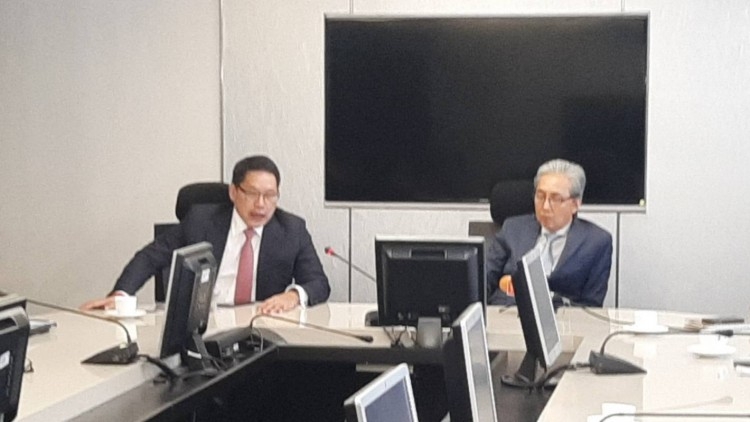
Deputy Commerce Minister Weerasak Wangsuphakijkosol

Deputy Commerce Minister Weerasak Wangsuphakijkosol
By THE NATION

613 Viewed

The value of Thailand’s gems and jewellery export was US$11.452 billion (Bt351 billion) in the first eight months of the year, up 45.81 per cent year on year, Deputy Commerce Minister Weerasak Wangsuphakijkosol said.

Of the exports, gold alone accounted for $6.212 billion, recording an increase of 107.16 per cent year on year.

Southeast Asia has been the biggest market for gems and jewellery from Thailand, and export of this commodity to the region has expanded 190.8 per cent. Export of gems and jewellery to Singapore has risen 307 per cent, to Cambodia 137 per cent, and to India by 84.14 per cent, because the Indian middle-class has higher buying power.

However, exports to other markets such as Hong Kong, European Union and the US has dropped. For instance, export to EU has dropped 0.74 per cent.

The export of gems and jewellery is the third biggest earner for the country, and growth in this industry has benefited the Thai economy, Weerasak said.,

Duangkamol Jiambutr, director of the Gems and Jewellery Institute of Thailand Public Organisation, said the export sector will be in a weak position for the rest of the year due to several factors, such as the US-China trade war, protests in Hong Kong and volatility of the baht.

Joint probe on carriers not complying with slot schedules

ศาสตร์เกษตรดินปุ๋ย : ขอบคุณแหล่งข้อมูล : หนังสือพิมพ์ The Nation

https://www.nationthailand.com/business/30376998

Joint probe on carriers not complying with slot schedules

Oct 03. 2019
By THE NATION

1,175 Viewed

Transport Minister Saksayam Chidchob has instructed the Airports of Thailand (AOT), the Civil Aviation Authority of Thailand (CAAT), and Thai Airways International (THAI) to jointly probe into the issue that some airlines, which had reserved slots in Thai airports, have declined to follow the schedules.

AOT President Nitinai Sirismatthakar said that a number of carriers declined to fly to Thailand according to the slots they had reserved. In some periods, the incidence rate was very high, he added.

CAAT director-general Chula Sukmanop said the state agency had finished setting the rules on the matter which would become effective in January next year.

Dow plunges as Trump tries to pin ‘impeachment nonsense’ for Wall Street rout

ศาสตร์เกษตรดินปุ๋ย : ขอบคุณแหล่งข้อมูล : หนังสือพิมพ์ The Nation

https://www.nationthailand.com/business/30377005

Dow plunges as Trump tries to pin ‘impeachment nonsense’ for Wall Street rout

Oct 03. 2019
Credit:marketwatch

Credit:marketwatch
By by Rachel Siegel

The Washington Post

1,343 Viewed

October’s history as an irascible month for stocks reared its head in its first two days as markets plunged on fears both real and imagined.

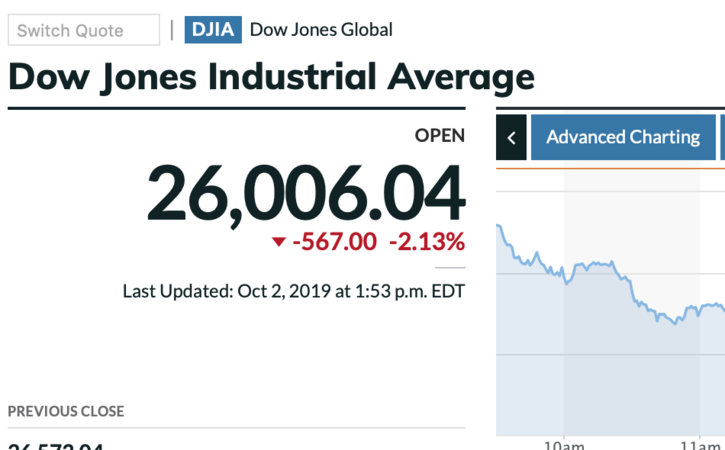
Update: Dow Jones closed, down 1.86 per cent, Nasdaq 1.56 per cent down and S&P500 down 1.75per cent.

The Dow Jones industrial average gave up all its September gains and then some, plunging more than 800 points by Wednesday afternoon, the second day of the month. Technology received the biggest shellacking, with Visa, Intel, and Cisco all running in the deep red.

The pullback’s immediate cause was Tuesday’s dismal manufacturing report, but fears of a slowdown, complications over Brexit and never-ending trade anxiety weight on investors.

“October’s reputation is preceding itself,” said Sam Stovall of CFRA Research. “Historically, October has witnessed 30 percent higher volatility than the average month.”

The Dow blue chips slumped nearly 600 points, or more than 2 percent, in early Wednesday afternoon trading. Wednesday’s mayhem followed a rocky start on Tuesday, which saw a 344-point drop after the Institute for Supply Management’s manufacturing index signaled that September was the worst month for U.S. manufacturing in more than a decade. Tuesday wiped out all of September’s market gains.

The Standard & Poor’s 500-stock index and Nasdaq composite index were 2 percent in the red Wednesday, the worst day for stocks since Aug. 23. All 11 stock market sectors had sunk by early afternoon, led by the industrials and the information sector.

Analysts were finding it difficult to put an exact cause on the selloff. Some referred to October itself as a jinx month that hosted historic crashes in 1929, 1987, 1997 and the financial meltdown of 2008. The month is also known for being a “bottom” for bear markets that have then reversed and turned upward. Others even speculated that Sen. Bernie Sanders. a Democratic presidential candidate, exacerbated the sell-off because of reported health problems. Some on Wall Street fears that Sanders’ Democratic rival Sen. Elizabeth Warren would be unfriendly to Wall Street if she won the presidency.

“It is all speculation on the source of weakness in the near term,” said Nancy Tengler of Tengler Wealth Management. “Manufacturing was disappointing. Job growth is slowing. In the very short term, the algorithms are reading the headlines and the sell programs are taking over. I am not panicking yet.”

President President Trump blamed “all of this impeachment nonsense, which is going nowhere.” In a tweet midday Wednesday, he blamed the inquiry for “driving the Stock Market, and your 401K’s down. But that is exactly what the Democrats want to do. They are willing to hurt the Country, with only the 2020 Election in mind!”

Trump’s tweet marked the second time in two days that he has punted the blame for negative economic news. On Tuesday, in the wake of the dismal manufacturing report, he tweeted that Fed Chair “Jay Powell and the Federal Reserve have allowed the Dollar to get so strong, especially relative to ALL other currencies, that our manufacturers are being negatively affected.”

“Fed Rate too high. They are their own worst enemies, they don’t have a clue. Pathetic!” he wrote.

The impeachment drama comes as economists have grown more concerned that the ongoing U.S.-China trade war and the slump in manufacturing could have ripple effects for the rest of the U.S. economy.

“There is no end in sight to this slowdown, the recession risk is real,” said Torsten Slok, chief economist at Deutsche Bank Securities, in an email to clients Tuesday.

Hiring cooled in August, and a new report Wednesday from ADP and Moody’s Analytics found that the private sector created more jobs than expected in September, even while the pace slowed alongside concerns of a tight labor market.

Companies hired 135,000 more workers in September, according to the jobs report, topping the 125,000 that economists surveyed by the Dow Jones had expected. But the September figure was the slowest since June and brought the 2019 monthly average down to 145,000 – markedly down from the 214,000 for the same period last year. The September numbers were also down from August’s 157,000.

American consumers are increasingly propping up the global economy, but there are concerns that confidence could begin to slip. U.S. vehicle sales for Ford Motor declined 4.9 percent during the third quarter, the company said Wednesday, with demand for the top-selling F-series pickup starting to slouch. The company’s stock was down 4 percent midday Wednesday.

The National Retail Federation is set to issue its holiday season forecast Thursday.

Tuesday’s manufacturing news erased hopes of a quick turnaround for the industry and bruised Trump’s vows to revive American blue-collar jobs. Manufacturing fell into a “technical recession” in the first half of the year, and the latest ISM data suggests that situation is only growing more grave.

The European markets were on a downturn, with the FTSE down more than 230 points, or 3.2 percent, and the DAX down nearly 300 points, or 2.4 percent. The S&P 500 was also roughly 50 points in the red.

Also on Tuesday, the World Trade Organization downgraded its forecast for global trade growth for this year and next. The U.S.-China trade war and a global economic slowdown spurred economists to project that world merchandise trade volume is expected to rise 1.2 percent in 2019 – markedly slower than the 2.6 percent forecast in April. For 2020, the forecast estimates 2.7 percent growth instead of 3 percent.

The cut forecast came mere weeks after Trump called China a “threat to the world” and said there was little urgency for an interim trade agreement. On Sept. 20, he told reporters he was under no pressure to reach a deal with China before the 2020 election, despite his early insistence that China was eager to return to the negotiation table.


ADB and DHD sign $37m loan agreement for Southeast Asia’s floating PV solar project

ศาสตร์เกษตรดินปุ๋ย : ขอบคุณแหล่งข้อมูล : หนังสือพิมพ์ The Nation

https://www.nationthailand.com/business/30377000

ADB and DHD sign $37m loan agreement for Southeast Asia’s floating PV solar project

Oct 02. 2019
DHD’s general director Le Van Quang and Christopher Thieme from ADB after the signing agreement. — Photo courtesy of ADB

DHD’s general director Le Van Quang and Christopher Thieme from ADB after the signing agreement. — Photo courtesy of ADB
By VNS

719 Viewed

The Asian Development Bank (ADB) and Da Nhim – Ham Thuan – Da Mi Hydro Power Joint Stock Company (DHD) on Wednesday (October 2) signed a US$37 loan agreement to finance the installation of a 47.5MWp floating photovoltaic (PV) solar power facility.

The system, situated on the man-made reservoir of DHD’s existing 175MW Da Mi hydropower plant, is the first large-scale installation of floating solar PV panels in Viet Nam and in Southeast Asia.

“This project will help boost the share of renewable energy in Viet Nam’s overall energy mix and decrease the dependence on imported fossil fuels such as coal,” said Christopher Thieme, deputy general director of ADB Private Sector Operations Department.

“The pairing of these two clean energy technologies – hydropower and solar – is a simple but highly innovative achievement which can be replicated elsewhere in Viet Nam and across Asia and Pacific.”

DHD, a subsidiary of the Vietnam Electricity Power Generation Corp 1, currently owns and operates four hydropower plants with total generation capacity of 642.5MW, about 17 per cent of Viet Nam’s total generation capacity.

Le Van Quang, DHD’s general director, said hydropower reservoirs in southern Viet Nam have vast solar power potential. Both sides have worked together to catalyse a new source of power for the country, contributing to energy security, environmental protection and sustainable socio-economic development.

The financing package includes $17.6 million loan from ADB’s ordinary capital source, $15 million of blended concessional co-financing provided by the Canadian Climate Fund for the Private Sector in Asia and $4.4 million parallel loan from the Leading Asia’s Private Infrastructure Fund (LEAP) of Japan International Cooperation Agency. — VNS

‘Eat, Shop, Spend’ travellers dish out Bt628m

ศาสตร์เกษตรดินปุ๋ย : ขอบคุณแหล่งข้อมูล : หนังสือพิมพ์ The Nation

https://www.nationthailand.com/business/30376997

‘Eat, Shop, Spend’ travellers dish out Bt628m

Oct 02. 2019
By The Nation

662 Viewed

The number of people applying for the government’s “Eat, Shop, Spend” travel-and-business promotion in its first 10 days topped out at the daily limit of one million, with around 200,000 proving ineligible to register.

Lavaron Sangsnit, director-general of the Fiscal Policy Office, said on Wednesday (October 2) that applications would continue being accepted until registration reached 10 million.

He said everyone who applied in the first seven days – 5,538,368 people – had qualified.

The vast majority were registered within the first six days and have received confirmation by SMS, while the remaining 814,776 can expect a digital alert on Wednesday.

In the first five days, 706,450 registrants spent a combined Bt628 million using G-wallet. Half of that amount, about Bt330 million, was spent at shops selling OTOP products, at community stores and at discount-price Thong Fah Pracha Rat outlets.

Another Bt98 million was spent on food and Bt10 million on hotel accommodations.

A further Bt142 million was spent at large stores with multiple branches, representing 22 per cent of the five-day total.

Fitch upbeat on Thailand’s economic resilience amid global trade tensions

ศาสตร์เกษตรดินปุ๋ย : ขอบคุณแหล่งข้อมูล : หนังสือพิมพ์ The Nation

https://www.nationthailand.com/business/30376989

Fitch upbeat on Thailand’s economic resilience amid global trade tensions

Oct 02. 2019
James McCormack, managing director and global head of Sovereigns at Fitch Ratings

James McCormack, managing director and global head of Sovereigns at Fitch Ratings
By THE NATION

840 Viewed

Thailand’s sound economic fundamentals can cope with the challenges from global trade tensions, while the Thai banking sector is less exposed to external risks, such as a slowdown in China, relative to other Fitch-rated banks in Asia, according to Fitch Ratings’ sovereign and banking analysts at its annual global risk conference in Bangkok today (October 2).

James McCormack, managing director and global head of Sovereigns at Fitch Ratings, said revision of the ‘BBB+’ sovereign outlook rating on Thailand to ‘positive’ in July 2019 was driven by Fitch’s increasing confidence that lingering political risks are unlikely to derail the country’s macroeconomic management.

Thailand overcame a major political hurdle earlier this year with the formation of a new civilian-led government following elections in March, and the country has maintained sound external and public finance positions for several years.

Risks to the growth outlook stem primarily from the challenging global trade environment, although this may be mitigated by the more-supportive monetary policy and infrastructure projects, which are intended to increase investment and support growth in the medium term.

Global risks centre on policy uncertainty, particularly as it affects the trade outlook, and the UK’s upcoming Brexit deadline, which could result in a recession in the country and weaker growth in the euro zone.

Fitch believes widespread monetary easing by central banks cannot fully offset the slowdown in trade, and policymakers will have to turn increasingly to accommodative fiscal policies, including in countries where government debt levels are already high.

In his presentation on the banking sector, Parson Singha, senior director of Financial Institutions at Fitch Ratings (Thailand) Limited, said Thai banks were well-positioned, in terms of potential vulnerabilities and loan-loss buffers, and they were able to cope with downside stresses such as a economic slowdown in China or a property-market downturn.

However, the upside for Thai banks’ financial performance may be limited in the near term due to the challenging operating environment.

A sharp slowdown in China would likely have the most impact on developed markets, such as Hong Kong and Singapore.

Meanwhile, banking sectors with high property exposures include those in developed markets, such as Australia and New Zealand, and in emerging markets such as Malaysia.

Mervyn Tang, senior director, head of ESG Research, Sustainable Finance at Fitch Ratings, discussed regional trends in environmental, social and corporate governance (ESG).

ESG factors come with some level of influence on the credit ratings of around 22 per cent of corporate issuers in the world, with the governance element accounting for more than half of affected issuers, he said, adding that emerging-market credit ratings are more often influenced by governance issues.

Financial transparency and governance structure issues relating to key-person risks, concentrated ownership and board independence are most common in Asia. Environmental and social factors have more influence on credit ratings in the developed markets than in emerging markets due to tighter regulation and stiffer penalties for violations.

Fitch Ratings (Thailand)’s annual global risk conference was attended by more than 300 executives and officials from the regulatory, investor, financial and corporate sectors. Dr Uttama Savanayana, Minister of Finance, was the guest of honour and keynote speaker at the event.

Joint committee lowers growth forecast for 2019

ศาสตร์เกษตรดินปุ๋ย : ขอบคุณแหล่งข้อมูล : หนังสือพิมพ์ The Nation

https://www.nationthailand.com/business/30376978

Joint committee lowers growth forecast for 2019

Oct 02. 2019
By THE NATION

1,095 Viewed

The Joint Standing Committee on Commerce, Industry and Banking has revised downward its forecast of Thailand’s economic growth this year to between 2.7 per cent and 3.0 per cent from the previous projection of between 2.9 per cent and 3.3 per cent.

It has also revised down its prediction of this year’s exports to between minus 2 per cent to 0 per cent from the previously forecast between minus 1 per cent and growth of one per cent.

The revised export outlook reflects uncertainties in the economies of major countries, the prolonged US-China trade war and the stronger baht.

The committee added that the economic indicators in July and August suggested possible softened economic growth in the third quarter, due to the slowing global economy, US-China trade war and the stronger baht.

The committee has also estimated that flooding will cost the economy between Bt20 billion and Bt25 billion.

It has estimated that the government’s economic stimulus “Eat, Shop, Spend” campaign, which has proved popular with Thais, will inject Bt20 billion and Bt30 billion into the economy.

The committee said it hoped to see additional new monetary and fiscal measures from the government to boost the economy.

Earlier this week the Kasikorn Research Centre (KResearch) revised downward its economic growth forecast for 2019 from 3.1 per cent to 2.8 per cent, while predicting that the economy may grow at less than 3.0 per cent next year amid numerous negative factors.

Its assistant managing director Nattaporn Triratanasirikul said the downgrade in GDP growth was in line with the global economic slowdown. The slowdown has caused the country’s exports during the first eight months of 2019 to see a worse-than-expected contraction, as witnessed in various product categories and in most major markets.