WTO lowers trade forecast as tensions unsettle global economy

ศาสตร์เกษตรดินปุ๋ย : ขอบคุณแหล่งข้อมูล : หนังสือพิมพ์ The Nation

https://www.nationthailand.com/business/30376964

WTO lowers trade forecast as tensions unsettle global economy

Oct 02. 2019
World merchandise exports and imports by level of development, 2012Q1-2019Q2
Volume index, 2012Q1=100 /Source:WTO,UNCTAD

World merchandise exports and imports by level of development, 2012Q1-2019Q2 Volume index, 2012Q1=100 /Source:WTO,UNCTAD
By The Nation

257 Viewed

Escalating trade tensions and a slowing global economy have led World Trade Organization (WTO) economists to sharply downgrade their forecasts for trade growth in 2019 and 2020. World merchandise trade volumes are now expected to rise by only 1.2 per cent in 2019, substantially slower than the 2.6 per cent growth forecast in April.

The projected increase in 2020 is now 2.7 per cent, down from 3 per cent previously. The economists caution that downside risks remain high and that the 2020 projection depends on a return to more normal trade relations.

MAIN POINTS

• World merchandise trade volume is forecast to grow 1.2 per cnt in 2019. This is substantially below the 2.6 per cent trade growth projected in April.

• Trade volume growth should accelerate slightly to 2.7 per cent in 2020 while global GDP growth holds steady at 2.3 per cent (at market exchange rates), but this depends on an easing of trade tensions.

• Trade conflicts pose the biggest downside risk to the forecast but macroeconomic shocks and financial volatility are also potential triggers for a steeper downturn.

• Trade-related indicators signal a worrying trajectory for world trade based on global export orders and economic policy uncertainty.

• Export and import growth slowed across all regions and at all levels of development in the first half of 2019.

“The darkening outlook for trade is discouraging but not unexpected. Beyond their direct effects, trade conflicts heighten uncertainty and are leading some businesses to delay the productivity-enhancing investments that are essential to raising living standards,” said WTO Director-General Roberto Azevedo. “Job creation may also be hampered as firms employ fewer workers to produce goods and services for export.”

“Resolving trade disagreements would allow WTO members to avoid such costs,” the WTO Director-General added. “The multilateral trading system remains the most important global forum for settling differences and providing solutions for the challenges of the 21st century global economy. Members should work together in a spirit of cooperation to reform the WTO and make it even stronger and more effective.”

The updated trade forecast is based on consensus estimates of world GDP growth of 2.3 per cent at market exchange rates for both 2019 and 2020, down from 2.6 per cent previously. Slowing economic growth is partly due to rising trade tensions but also reflects country-specific cyclical and structural factors, including the shifting monetary policy stance in developed economies and Brexit-related uncertainty in the European Union. Macroeconomic risks are firmly tilted to the downside.

Due to the high degree of uncertainty associated with trade forecasts under current conditions, the estimated growth rate for world trade in 2019 is placed within a range of 0.5 per cent to 1.6 per cent. Trade growth could fall below this range if trade tensions continue to build, or outperform it if they start to recede. The range of likely values is wider for 2020, ranging from 1.7 per cent to 3.7 per cent, with better outcomes depending on an easing of trade tensions.

Risks to the forecast are heavily weighted to the downside and dominated by trade policy. Further rounds of tariffs and retaliation could produce a destructive cycle of recrimination. Shifting monetary and fiscal policies could destabilise volatile financial markets. A sharper slowing of the global economy could produce an even bigger downturn in trade. Finally, a disorderly Brexit could have a significant regional impact, mostly confined to Europe.

Chart 1: World merchandise exports and imports by level of development, 2012Q1-2019Q2

Volume index, 2012Q1=100

Source: WTO and UNCTAD

Source: WTO and UNCTAD

Charts 1 and 2 show quarterly merchandise export and import volumes on a seasonally-adjusted basis by level of development and geographic region. In the first half of 2019, world merchandise trade was up 0.6 per cent compared to the same period in the previous year. This marks a substantial slowdown compared to recent years. Exports of developed economies were up just 0.2 per cent for the year-to-date, while those of developing economies were up 1.3 per cent. On the import side, developed economies recorded year-on-year growth of 1.1 per cent while developing countries declined by 0.4 per cemt. Growth rates based on quarterly data may differ slightly from calculations based on annual statistics, but they should be of similar magnitude.

Chart 2: Merchandise exports and imports by region, 2012Q1-2019Q2

Volume index, 2012Q1=100
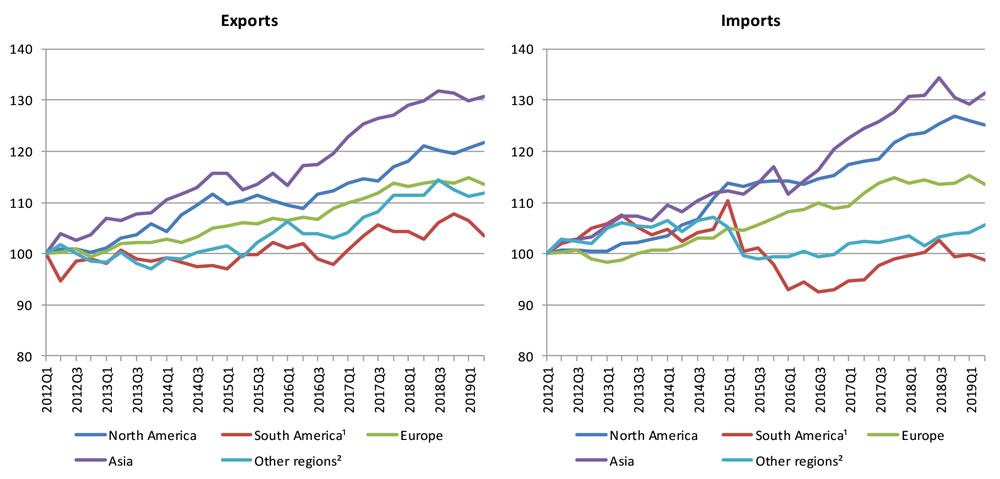
1 Refers to South and Central America and the Caribbean. 2 Other regions comprise Africa, Middle East and the Commonwealth of Independent States, including associate and former member States. Source:	WTO and UNCTAD

1 Refers to South and Central America and the Caribbean. 2 Other regions comprise Africa, Middle East and the Commonwealth of Independent States, including associate and former member States. Source: WTO and UNCTAD

Results of ‘Eat, Spend, Shop’ scheme will determine launch of Phase 2: Finance Ministry

ศาสตร์เกษตรดินปุ๋ย : ขอบคุณแหล่งข้อมูล : หนังสือพิมพ์ The Nation

https://www.nationthailand.com/business/30376953

Results of ‘Eat, Spend, Shop’ scheme will determine launch of Phase 2: Finance Ministry

Oct 02. 2019
By THE NATION

1,119 Viewed

The Finance Ministry will evaluate the results of the “Eat, Shop, Spend” Bt1,000 cash hand-out first before considering a second phase, said Lavaron Sangsnit, director-general of the Fiscal Policy Office.

If the ministry does decide to launch Phase 2, details will be concluded within this month, he added.

As of October 1, 9 million people have signed up for the scheme since it was launched on September 23. Registration will close on November 15 or when the scheme hits the 10-million registrations target.

Thailand among three Asean economies featured in Standard Chartered’s new Trade20 Index

ศาสตร์เกษตรดินปุ๋ย : ขอบคุณแหล่งข้อมูล : หนังสือพิมพ์ The Nation

https://www.nationthailand.com/business/30376959

Thailand among three Asean economies featured in Standard Chartered’s new Trade20 Index

Oct 02. 2019
By The Nation

1,418 Viewed

Three Asean economies have substantial growth potential in trade, according to a report by Standard Chartered Bank.

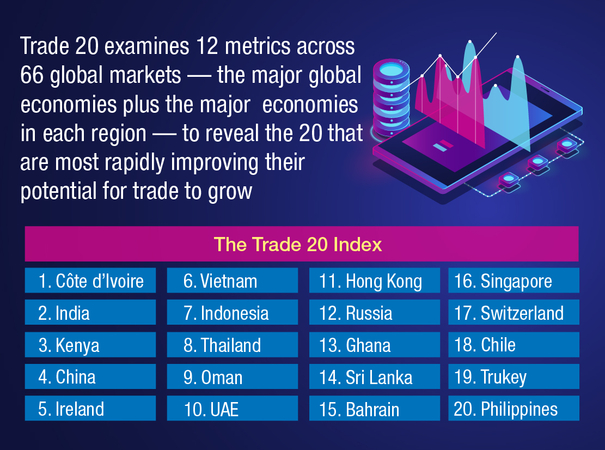
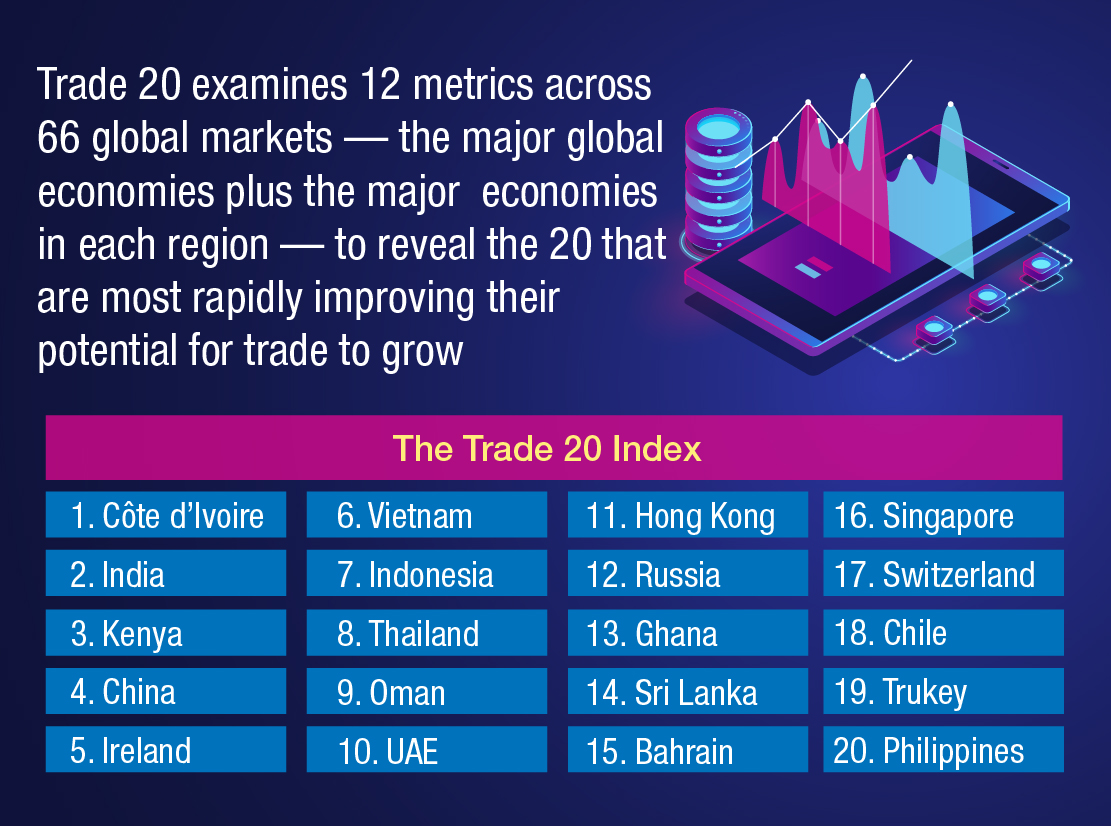
Thailand, Indonesia, and Vietnam featured in Standard Chartered’s new Trade20 Index, which identifies the 20 economies with the greatest potential for trade growth.

Thailand has been ranked eighth in the bank’s new Trade20 Index which identifies economies with strong trade growth potential, thanks to its improving trade readiness and substantial progress in e-commerce.

The Trade20 study by Standard Chartered examined 66 economies across the globe, determined each market’s potential for trade growth by analysing changes across 12 equally-weighted metrics under three pillars: economic dynamism, trade readiness and export diversity.

The Asean accelerators

Our index points to accelerated Asian trade growth potential, particularly in Thailand, Indonesia and Vietnam, which performed well in the trade readiness pillar – defined as a market’s foundation for future trade growth.

These three economies are being propelled forward by export-oriented manufacturing, growing intra-Asean trade, strong domestic demand, close trading ties with China and healthy job markets. While they all face challenges from heightened global uncertainty, they are well placed to benefit if multinationals consider moving their supply chains due to trade tensions elsewhere. Regional trade deals, infrastructure improvements, and legislative reforms are also promoting increased openness.

According to Thailand’s Board of Investment (BOI), the number of project applications for Foreign Direct Investment (FDI) increased by 7 per cent to 758 projects worth Bt232.61 billion during the first half of 2019. The FDI value in BOI’s five targeted industries, including the biotechnology industry and robotics and automation, jumped 58 per cent to Bt23.84 billion during the January-June period from a year earlier.

Thailand’s trade readiness

Thailand has also been focusing on digitising processes and increasing efficiency across industries and activities, particularly international trade and exports. Working together with its regional neighbours, Thailand should be able to adopt trade digitisation relatively quickly, helping to accelerate Asian trade growth.

Export diversity

Thailand is ranked outside of the top 20 for export diversity as the index weighs on a market’s progress in its breadth of exports. Export diversity is measured by the variety of products exported and how export revenue is spread across that product range. The markets that rank highly in this category have made the most progress in terms of diversifying their exports, which should open new prospects for trade growth and make them less vulnerable to market pressures.

Plakorn Wanglee, President & CEO of Standard Chartered Bank (Thai) said, “the Trade20 Index maps the rising stars of trade, identifying the markets where the trade environment – and trade growth potential – has been improving most rapidly over the past decade”.

“Thailand is not only a trade and investment destination for foreign countries, but also a growing number of Thai companies have strongly expanded overseas,” added Plakorn.

According to the Stock Exchange of Thailand, net outflow of foreign direct investment in 2018 by Thai firms listed on the Thai bourse hit an 8-year high at Bt199 billion. This excluded their domestic investment in 2018, which increased by 15 per cent to Bt818 billion from 2017.

“There is a huge opportunity in cross border trading. Standard Chartered Bank (Thai) has leveraged our global network and innovation and has been increasingly applying automation systems to better serve our clients,” said Plakorn. “Apart from joining the Bank of Thailand in its Project Inthanon and running the issuance of a bank guarantee on blockchain (eGuarantee), we recently succeeded in executing the first cross-border Letter of Credit issued over the Voltron blockchain platform in the oil industry.”

“In the face of rising protectionism and slow global growth, the markets that are demonstrating this impressive pace of progress may represent interesting opportunities for corporates seeking new investments, imports and supply chain partners”.

​​​

Cabinet okays plan to inspect e-bank transfers of above Bt50,000

ศาสตร์เกษตรดินปุ๋ย : ขอบคุณแหล่งข้อมูล : หนังสือพิมพ์ The Nation

https://www.nationthailand.com/business/30376952

Cabinet okays plan to inspect e-bank transfers of above Bt50,000

Oct 01. 2019
By The Nation

2,933 Viewed

Deputy Government Spokesman Rachada Dhnadirek said the Cabinet has approved a draft bill proposed by the Anti-Money Laundering Office (AMLO) to inspect electronic transactions exceeding Bt50,000, in a move to combat money laundering and financing of terrorists.

According to international standards, Thailand has been found lacking on 17 issues in relation to preventing money laundering and the financing of terrorism.

Financial institutions and businesses that come under the Anti-Money Laundering Act’s Section 16, such as gem dealers, car dealers or real-estate brokers, must undergo assessment. All transactions will be stopped and reported to AMLO if any signs of risky behaviour are detected.

Individuals who send more than Bt50,000 overseas and the recipient will have to provide their identification and information to banks before the transfer is completed.

KResearch cuts its Thai economic growth forecast

ศาสตร์เกษตรดินปุ๋ย : ขอบคุณแหล่งข้อมูล : หนังสือพิมพ์ The Nation

https://www.nationthailand.com/business/30376938

KResearch cuts its Thai economic growth forecast

Oct 01. 2019
By THE NATION

910 Viewed

Kasikorn Research Centre (KResearch) has revised downward its Thailand economic growth forecast for 2019 from 3.1 per cent to 2.8 per cent, while predicting that the economy may grow at less than 3.0 per cent next year amid numerous negative factors.

Assistant managing director Nattaporn Triratanasirikul said the downgrade in GDP growth was in line with the global economic slowdown, which caused the country’s exports during the first eight months of 2019 to see a worse-than-expected contraction, as witnessed in various product categories and in most major markets.

“KResearch has therefore cut our export projection to a range of -2.0 to zero per cent, from zero per cent previously,” Nattaporn added.

For the 2020 outlook, several global challenges will weigh on the kingdom’s exports, which will be a crucial factor in shrinking the growth of Thailand’s GDP to less than 3 per cent.

This projection is based on an estimate of present conditions, and excludes the government’s economic stimulus measures.

However, the government’s Bt1,000 “Eat, Shop, Spend” handout programme may lift the country’s GDP by 0.02 per cent this year. But it remains to be seen whether the government will launch additional fiscal measures to boost the economy next year.

Any such measures should focus on workers lacking a social safety net, such as freelancers or small and medium enterprise entrepreneurs, who may see a drop in sales after customers become more cautious in spending, Nattaporn said.

As for monetary policy, the Bank of Thailand’s Monetary Policy Committee may further cut the policy rate in the near future. Nonetheless, monetary measures would only gradually produce a positive effect on the economy, Nattaporn added.

KResearch assistant managing director Siwat Luangsomboon expressed the view that the protracted US-China trade dispute may trim Thai exports by an additional $1 billion-$2.5 billion (Bt76.3 billion) in 2020 after the US imposed tariffs on Chinese imports, compared to $2.1 billion-$3 billion projected for 2019.

Although Thailand would likely see some benefit from the relocation of production bases to this country, such relocation may primarily be seen in industries among which foreign companies already have production bases here in Thailand, Siwat said.

Regarding Brexit, it is highly likely that the UK will leave the European Union without a deal, he said.

The next step is the UK and the EU would have to negotiate on the format of any free trade agreement and the border issue with Northern Ireland. These developments may affect global financial markets, while the impact of Brexit on the Thai economy should be limited, Siwat added.

Govt considers expanding limits on ‘Eat, Shop, Spend’ scheme

ศาสตร์เกษตรดินปุ๋ย : ขอบคุณแหล่งข้อมูล : หนังสือพิมพ์ The Nation

https://www.nationthailand.com/business/30376918

Govt considers expanding limits on ‘Eat, Shop, Spend’ scheme

Oct 01. 2019
By The Nation

618 Viewed

Deputy Prime Minister for economic affairs Somkid Jatusripitak said on Monday (September 30) that the government is considering expanding the 10-million participants limit in the “Eat, Shop, Spend” scheme as the campaign has earned an overwhelming response. The Finance Ministry will also look into the possibility of boosting the Bt19-billion budget.

“Interest in this project is widespread and we were asked to extend the campaign,” Somkid said.

Kobsak Pootrakool, deputy secretary-general to the prime minister, said he has called on agencies who monitor the economy to write a summary report on the current economic state, which will be presented to the Cabinet on October 7.

“When we first proposed the project, we expected all economic stimulus packages to help boost the GDP by 0.3 to 0.5 per cent, helping the growth rate to hit 3 per cent. However, we found the economy worsening and we are looking for measures to solve this problem,” Kobsak said.

Somkid calls for haste in consideration of funding for digital projects

ศาสตร์เกษตรดินปุ๋ย : ขอบคุณแหล่งข้อมูล : หนังสือพิมพ์ The Nation

https://www.nationthailand.com/business/30376911

Somkid calls for haste in consideration of funding for digital projects

Oct 01. 2019
Deputy PM Somkid, right

Deputy PM Somkid, right
By THE NATION

649 Viewed

Deputy Prime Minister Somkid Jatusripitak on Monday (September 30) urged the Digital Economy and Society Development Fund to speed up consideration of projects that apply for funding.

The fund, chaired by Somkid, has around Bt5 billion, which was allocated to it by the National Broadcasting and Telecommunications Commission.

State and private sectors can apply for funding to develop digital projects.

The fund has earmarked Bt2.6 billion for projects this year and Bt2 billion for projects next year.

Somkid also assigned the fund to set up a subcommittee to speed up the process of granting funds to qualified recipients. The subcommittee will have to make decisions on funding every month. This will see the quick injection of funds into the economy, he said.

Kobsak Pootrakool, deputy secretary-general to the prime minister for political affairs, said that 130 projects worth Bt12 billion had applied for funding this year. However, the fund had yet to convene to consider the proposals.

He added that the fund would complete consideration of all proposals for this year within the next few months. The fund will focus on projects involving cybersecurity, digital infrastructure and development of digital skills.

Digital Economy and Society Minister Buddhipongse Punakanta said at the fund meeting on Monday that the granting of Bt2 billion for next year’s projects would focus on health-tech and agri-tech projects.

Sharp hike in subsidy to encourage consumption of B10 diesel

ศาสตร์เกษตรดินปุ๋ย : ขอบคุณแหล่งข้อมูล : หนังสือพิมพ์ The Nation

https://www.nationthailand.com/business/30376899

Sharp hike in subsidy to encourage consumption of B10 diesel

Oct 01. 2019
By THE NATION

1,134 Viewed

The Oil Fund Committee on Monday (September 30) resolved to sharply increase the subsidy for B10 diesel to Bt1.80 per litre from Bt0.95 per litre at present, the committee director, Viraphol Jirapraditkul, said.

The committee also cut by half the subsidy on B7 diesel to Bt0.05 per litre from Bt0.10 per litre. The subsidy on B20 diesel was also slashed, to Bt2.55 per litre from Bt4.80 per litre.

The resolution, which will take effect on October 1, will lower the price of B10 diesel to Bt22.99 per litre, cheaper than B7 diesel by Bt2 per litre.

The price of B20 diesel will be Bt22.99 per litre, Bt3 cheaper than B7.

The committee’s resolution is in line with the National Energy Policy Committee’s decision on September 11 that the Oil Fund be used to manage the price difference of diesel prices in order to encourage consumers to use diesel B10. This will help absorb the glut of crude palm oil in the market.

Consumption of B20 diesel is expected to decline following the committee’s decision on Monday to cut subsidy.

As of July this year, B20 diesel consumption stood at 6.71 million litres per day.

The consumption of B10 is also expected to increase from 13,000 litres per day as of July this year.

People are also expected to use less of B7 and more of B10. The consumption of diesel B7 was 54 million litres per day as of July.

Viraphol said that the global benzene price had already fallen to the level before the recent drone attacks on two major oil-processing facilities of Saudi Arabia’s Aramco.

However, the global diesel price remains high. He believes that the retail benzene operators might reduce their retail prices in the future.

Consumption weakening due to drop in earnings of non-farm labour: BOT

ศาสตร์เกษตรดินปุ๋ย : ขอบคุณแหล่งข้อมูล : หนังสือพิมพ์ The Nation

https://www.nationthailand.com/business/30376919

Consumption weakening due to drop in earnings of non-farm labour: BOT

Oct 01. 2019
By Wichit Chaitrong
The Nation

1,176 Viewed

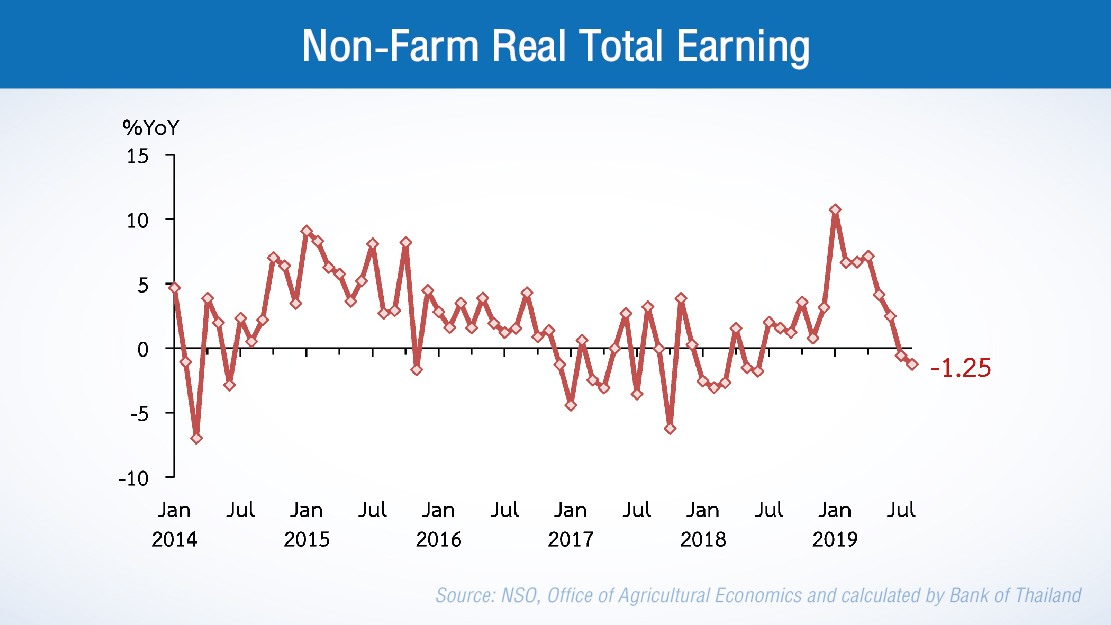
Consumer spending in August weakened, as the real earnings of non-farm labour remained in the contraction territory, according to the central bank.

Veerathai Santiprabhob, governor of the Bank of Thailand (BOT), said the central bank had forecast an economic growth of 2.8 per cent this year, which is below the country’s growth potential. However, he said, this does not mean there is an economic crisis looming, though BOT’s monetary policy committee is still concerned about the strong baht, which could have an adverse impact on the economy.

The currency has, however, been on a downward trend, he added.

Meanwhile, Don Nakornthab, senior director at the Economic and Policy Department of the central bank, said all indicators, apart from tourist arrivals, appeared to be weaker in August as economic slowdown continues.

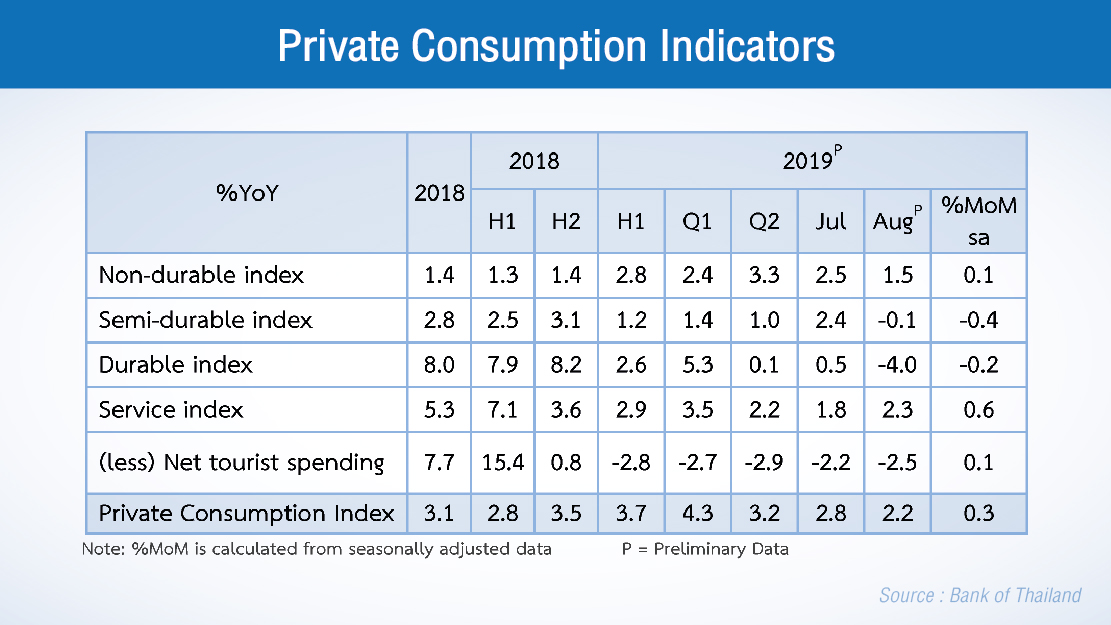
Private consumption indicators expanded moderately from the same period last year. The National Economic and Social Development Council, a state think-tank, previously considered consumer spending as a growth engine, at a time when exports, private investment and public investment weakened.

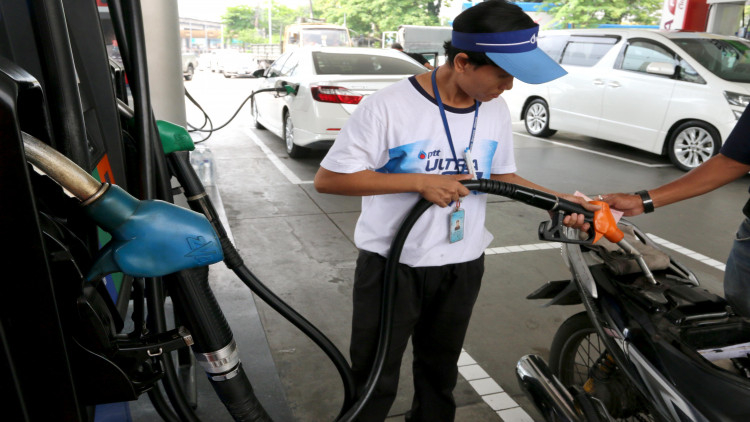
BOT said on Monday (September 30) that spending on durable goods significantly contracted following a decrease in every category of vehicle sales, partly due to weakening of income, together with credit tightening of financial institutions, after credit quality showed signs of deterioration. Spending on non-durable goods expanded at a softer pace mainly from moderate fuel usage, in line with contracting domestic vehicle sales.

In addition, spending on semi-durable goods was flat. However, spending on services expanded at a higher rate, attributed to the expansion of expenditures on hotel and restaurants. The fundamental factors supporting the overall purchasing power remained weak.

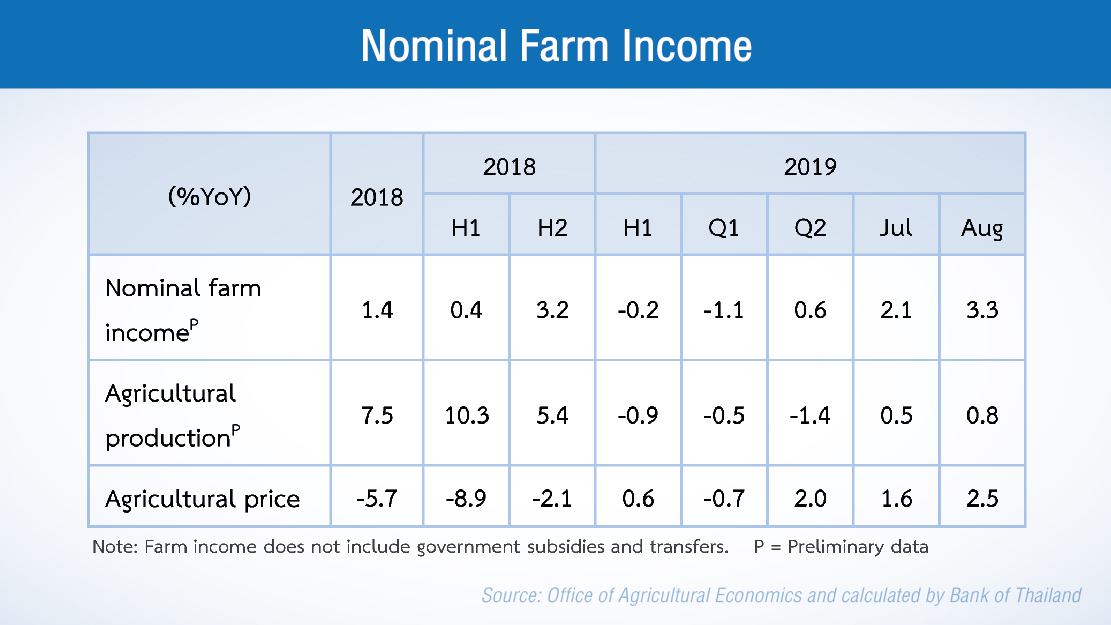
Non-farm income further contracted, while farm income rose mainly due to rising agricultural prices. Consumer confidence continued to deteriorate for the sixth consecutive month.

The report came as many factories have started laying off workers, or cutting down on overtime, especially in industries that rely heavily on exports.

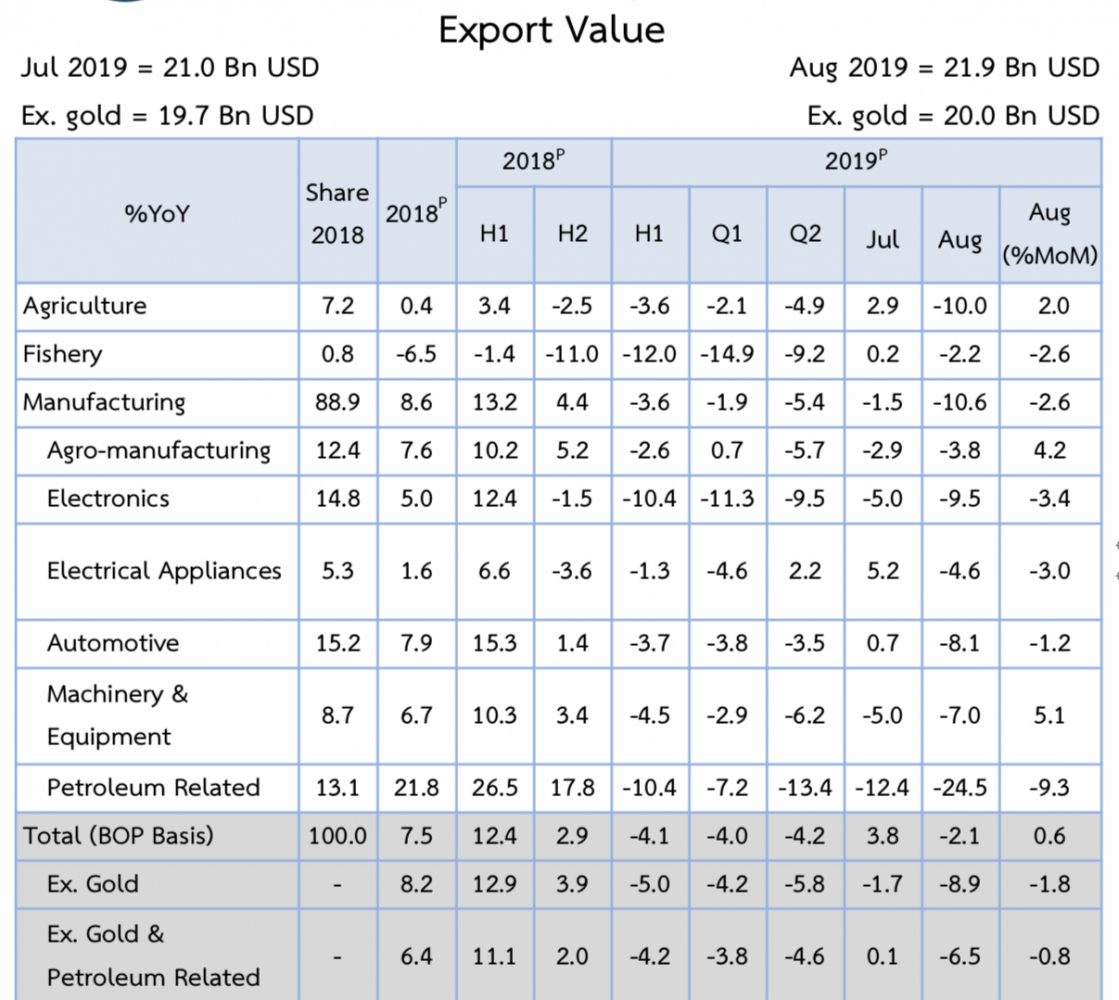
The central bank said the value of merchandise exports turned into contraction by 2.1 per cent from the same period last year. With the exception of gold, the value of all merchandise exports continued contracting at 8.9 per cent.

The continual contraction for the 10th consecutive month can be attributed to weaker global demand as a result of slower economic growth in a number of major trading economies, the US-China trade conflict, the continued downturn in electronic cycle, the contraction of global crude oil prices and a high base effect from front-load exports last year before the US started imposing import tariffs on Chinese products.

This contraction was also put down to a drop in the export of petroleum-related products and electronic products, which continued to contract for a ninth month. However, hard disk drive exports showed signs of recovery, as the production of hard disk drives, which were previously supported by the relocation of production base from Malaysia, expanded this month.

Exports in several other categories also expanded, partly due to the substitution of Chinese and American goods in the two markets, such as exports to the US market, which is continuing to expand, includes car tyres, refrigerators, television set, and apparel and textiles; while exports to China expanded at a higher rate with some products, such as high-end cars and motorcycles. However, the gains were not large enough to offset the slowdown in other export markets.

Private investment indicators also contracted from the same period last year, said the central bank.

Investment in machinery and equipment turned into contraction mainly from the drop in import of capital goods and the number of newly registered motor vehicles for investment. Investment in construction contracted due to a drop in permitted construction areas, apart from areas allocated for factories, which expanded. The sale of construction materials subsequently contracted, consistent with the slowdown in the real-estate sector. After seasonal adjustment, private investment indicators decreased from the previous month.

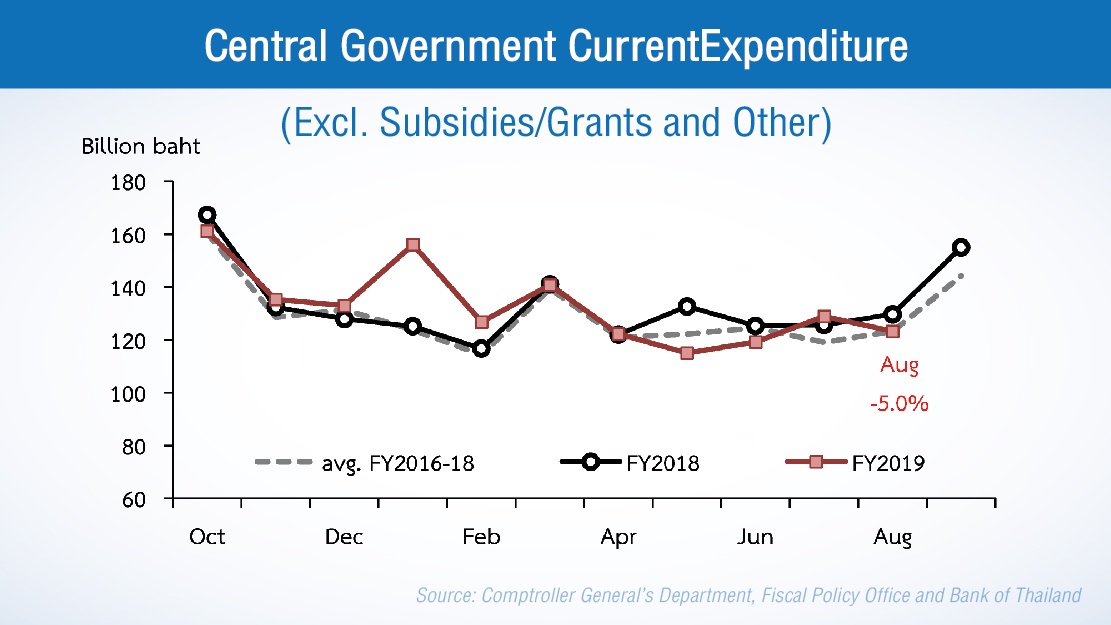
Public spending, excluding transfers, turned into contraction from the same period last year

due to current expenditures mainly on the back of expenditure on goods and services for the Army and the Royal Thai Police.

However, capital expenditure rose slightly from the disbursement of the Department of Highways, and additionally state enterprises’ capital expenditures rebounded from the disbursement of funds to PTT Public Co Ltd and Airports of Thailand Public Company Limited.

The value of merchandise imports sharply contracted by 15.5 per cent from the same period last year. Excluding gold, the value of merchandise imports contracted by 8 per cent.

The contraction was attributed to a drop in:1) Imports of raw and intermediate goods, particularly material for base metal, consistent with the contraction of private construction and car production; electronic parts, consistent with the contraction of production and exports of this product; and imports of fuel which contracted as global crude oil prices declined; 2) Imports of capital goods excluding aircraft, ships, floating structures, and locomotive, particularly telecommunication equipment and machinery and equipment, consistent with the contraction of private investment indicators;

3) Imports of consumer goods; and 4) Imports of automotive and parts, consistent with the slowdown of private consumption.

Meanwhile, the number of foreign arrivals rose by 7.4 per cent from the same period

last year, due to: 1) A low base effect from the tour boat incident in Phuket last year and

2) An increase in tourist arrivals who benefited from the exemption of visa on arrival fees, particularly those from China, India and Taiwan.

Moreover, some Chinese tourists chose Thailand over Hong Kong due to the political unrest. However, the number of European tourists, particularly from Germany and Russia, continued to drop due to the economic slowdown, according the central bank.

On the stability front, headline inflation decelerated to 0.52 per cent from 0.98 per cent

last month, due mainly to a larger contraction in energy prices caused by a fall in global crude oil prices, coupled with a decrease in fresh food prices. Meanwhile, core inflation accelerated from the previous month.

The seasonally adjusted number of employed persons decreased from previous month, mainly owing to a decline in non-farm employment. The seasonally adjusted unemployment rate remained nearly unchanged from the previous month. The current account registered a higher surplus due mainly to an increase in trade surplus. The overall capital and financial accounts registered a deficit from both the assets and liabilities positions, the central bank added.

Thai sugar industry bitter as exports and price fall

ศาสตร์เกษตรดินปุ๋ย : ขอบคุณแหล่งข้อมูล : หนังสือพิมพ์ The Nation

https://www.nationthailand.com/business/30376901

Thai sugar industry bitter as exports and price fall

Sep 30. 2019
By THE NATION

702 Viewed

The Thai sugar industry is hit by the twin crises of falling exports and sliding price, according to industry experts. The most imminent threat to the industry is the falling price of sugar in the global market, which has currently dropped by 10 to 11 cent per pound, the lowest price in six years.

FO Licht, an agribusiness intelligence agency, reported on September 19 that the global sugar stocks in fiscal year 2018-2019 (October to September) were 78.19 million tonnes, while global sugar production was 181.48 million tonnes and global consumption 186.45 million tonnes.

The report predicted that the global sugar reserves would drop to 72.67 million tonnes at the end of 2019, or 38.97 per cent of global consumption.

The huge amount of global reserve has caused the price of sugar to drop continuously with no signs of recovery in sight.

The country whose practice has caused the most concern is India, which has more than 15 million tonnes of sugar in reserve, while the government has promoted the export of six million tonnes of sugar.

Some countries sees India’s move to increase sugar export as a factor behind the lower price of sugar.

Thailand’s sugar exports in the first eight months of 2018 dropped from 7.212 million to 6.067 million tonnes compared to the previous year. Major clients included Indonesia, Cambodia, Taiwan and Myanmar, who have all reduced their imports.

Piromsak Saisunee, director of Karpolpalit Namtarn Co Ltd, said that besides the falling global sugar price, another factor that was of concern to the Thai sugar industry was the appreciation of the baht. “If the baht grows stronger than Bt30.50 to the US dollar, the Thai sugar industry will lose most of its clients to Brazil, our biggest competitor,” he said. “Currently Brazil’s currency, the real, is weakening which is boosting their sugar exports considerably.”