APAC banks face risk from leveraged corporates: Moody’s

ศาสตร์เกษตรดินปุ๋ย : ขอบคุณแหล่งข้อมูล : หนังสือพิมพ์ The Nation

https://www.nationthailand.com/business/30376893

APAC banks face risk from leveraged corporates: Moody’s

Sep 30. 2019
By THE NATION

569 Viewed

Moody’s Investors Service says in a new report that high corporate leveraging across Asia Pacific is posing increasing risk to the region’s banks, as slower economic growth and rising trade and geopolitical tensions could weaken debt servicing abilities.

“Corporate default rates in Asia Pacific have been low so far, helped by low interest rates and favourable financing conditions, but the intensifying trade and geopolitical tensions are weighing on the global economy and supply chains amid already slowing growth,” said Rebaca Tan, a Moody’s assistant vice president and analyst.

“Our stress test – which assumes a 25 per cent decline in EBITDA – shows banks in India and Indonesia are most prone to a deterioration in corporate debt repayment capacity, followed by banks in Singapore, Malaysia and China,” added Tan.

Total corporate debt across the 13 economies covered by Moody’s report grew only 1 per cent year over year in US dollar terms at the end of 2018, the slowest pace since the global financial crisis. Yet, overall corporate leverage remains high relative to GDP in many of the region’s economies.

Moreover, outstanding debt is heavily concentrated among corporates that hold debt more than four times EBITDA, raising the risk of rising defaults as operating conditions weaken.

Somewhat mitigating these risks are the strong buffers kept by most Asia Pacific banks, in the form of both loan loss reserves and capital, to withstand a sharp deterioration in asset quality.

Under Moody’s stress scenario, capital ratios would decline by 1 to 4 percentage points in most economies, leaving banks with sufficient buffers. Among the 13 banking systems, Indian banks are the most vulnerable.

Pet business reaches Bt40 billion as people indulge their darlings

ศาสตร์เกษตรดินปุ๋ย : ขอบคุณแหล่งข้อมูล : หนังสือพิมพ์ The Nation

https://www.nationthailand.com/business/30376890

Pet business reaches Bt40 billion as people indulge their darlings

Sep 30. 2019
By The Nation

756 Viewed

The pet business in Thailand has quietly grown to worth up to Bt40 billion in economic value, growing at least 10 per cent yearly, as owners indulge their pets with food and services.

Nantaphon Tantiwongampai, the vice president of the Thai Pet Products Industry Association, predicted pet-related businesses would likely experience continuous growth.

Despite various risks including to the economy the market has not been affected, he said. The market for pet dogs and cats alone is now worth nearly Bt40 billion yearly, with an average growth of not less than 10 per cent per year, with food products taking up a big share of its growth.

The behaviour of Thai animal lovers has changed, he said, as they tend to look after and pay attention to every detail for their pet, treating them much like their own child, including for food, clothing and medical care. The pet in Thailand has become a family member rather than just a housekeeper.

The population of cats in Thailand has now reached 4 million, almost double the 2.2 million of six years ago, while the dog population is growing by 10 per cent yearly. Thai people are interested in raising small dogs rather than large dogs, he said.

The average spend on pets around the world is at 3-5 per cent of household income, with the spending on food and services even higher among families that do not have children.

Also adding to the pet market in Thailand is exports, with most customers located in Asia, including in China, Korea, and Hong Kong, as well as in neighbouring countries such as Laos, Myanmar and Malaysia.

Economic ministers to discuss tourism, exports at Oct 7 meeting

ศาสตร์เกษตรดินปุ๋ย : ขอบคุณแหล่งข้อมูล : หนังสือพิมพ์ The Nation

https://www.nationthailand.com/business/30376872

Economic ministers to discuss tourism, exports at Oct 7 meeting

Sep 30. 2019
Kobsak

Kobsak
By THE NATION

754 Viewed

The council of economic ministers will meet on October 7 to discuss the current economic situation and also seek solutions for obstacles facing the tourism industry, Kobsak Pootrakool, deputy secretary-general to the prime minister for political affairs, said.

The ministers will also discuss the country’s export situation, he added.

The Commerce Ministry will present the latest export report to the meeting as well as the measures to boost exports for the rest of this year.

He added that the council wants to tackle all problems in the tourism sector, which is entering the high season.

The meeting will also focus on gross domestic product this year meeting the target of 3 per cent.

The next council meetings, scheduled for October 16 and November 1, will discuss ways to help small and medium-sized enterprises survive the economic difficulties and creative economy issues.

SRT board likely to give in to minister’s pressure and hand in resignations

ศาสตร์เกษตรดินปุ๋ย : ขอบคุณแหล่งข้อมูล : หนังสือพิมพ์ The Nation

https://www.nationthailand.com/business/30376875

SRT board likely to give in to minister’s pressure and hand in resignations

Sep 30. 2019
Saksayam

Saksayam
By THE NATION

590 Viewed

Board members of the State Railway of Thailand (SRT) are expected to tender their resignations to Transport Minister Saksayam Chidchob soon, according to sources.

There has been speculation for some time that the members have been under pressure to resign, as the minister reportedly wants to reconstitute the board.

The current board still has some key projects to handle.The ministry has set October 15 as the deadline for the consortium led by Thai conglomerate Charoen Pokphand (CP) group to sign a contract with the SRT to build the high-speed railway linking three major international airports.

The CP-led consortium had proposed the lowest price in the bid, but it would be deemed as abandoning the project if it failed to sign the contract with the SRT on that date.

Cheaper biodiesel to go on sale from next month

ศาสตร์เกษตรดินปุ๋ย : ขอบคุณแหล่งข้อมูล : หนังสือพิมพ์ The Nation

https://www.nationthailand.com/business/30376880

Cheaper biodiesel to go on sale from next month

Sep 30. 2019
Photo credit: Energy Ministry's website

Photo credit: Energy Ministry’s website
By THE NATION

680 Viewed

Cheaper biodiesel will be available next month at some petrol stations.

The Energy Ministry plans to launch biodiesel B10, made up of 90 per cent diesel and 10 per cent palm oil.

It will be Bt2 cheaper per litre than the current Bt7 per litre, said Somboon Norkaew, deputy permanent secretary at the Energy Ministry.

Of the 100 palm oil refineries, nine have met the palm oil standards required for it to be mixed with diesel, he said.

Four other manufacturers are upgrading their production process and are expected to be able to meet the criterion by the end of this year.

Palm oil producers are required to reduce monoglyceride to be less than 0.4 per cent from the current 0.7 per cent. Meanwhile, diesel refinery plants must reduce water content to less than 200 parts per million (ppm) from the current level of 300ppm. The standard is set by Japanese automobile manufacturers.

He said he will soon consult with palm oil producers in preparation for the B10 launch nationwide in January. It will be available at some gas stations starting from October this year, he said.

Auttapol Rerkpiboon, chairman of the PTT Oil and Retail Business (PTTOR), said that the B10 oil would be available nationwide by January next year. Currently it is available at 100 out of its total 1,800 petrol stations. By the end of this year, about 150 petrol stations would provide B10 to customers. The PTTOR currently also sells B20 at 500 petrol stations, he said.

Currently, B10 is Bt1 cheaper per litre than B7, he said.

Chairit Simaroj, managing director at Susco Public Company Limited said B10 will be available in January and the company will stop selling B7. Currently, the company also sells B20 at 105 petrol stations.

“My concern is the high cost of production of palm oil because the government guarantees fresh palm at Bt4 per kilogram, but if the government could make B10 cheaper than B7, by Bt2 per litre, then it would encourage consumption,” he added.

Airbus investment in EEC hinges on thorny PPP issue

ศาสตร์เกษตรดินปุ๋ย : ขอบคุณแหล่งข้อมูล : หนังสือพิมพ์ The Nation

https://www.nationthailand.com/business/30376878

Airbus investment in EEC hinges on thorny PPP issue

Sep 30. 2019
By THE NATION

666 Viewed

Airbus’ commitment to invest in the Eastern Economic Corridor could materialise next month if a thorny issue were to be resolved, according to a source at the Eastern Economic Corridor Office (EECO).

The European aircraft manufacturer and Thai authorities have still not agreed on the framework of investment in a maintenance, repair and overhaul of aircraft (MRO) at U-tapao International Airport in Rayong province, according to the source at the EECO.

The Thai side insists that the joint venture between Airbus and Thai Airways be a public-private partnership (PPP) as a public infrastructure project whose assets would be handed over to the government after 50 years of operation.

Airbus, however, is opposed to a PPP joint venture, and instead wants it to be a joint investment project between two private companies without a lifespan for the project.

The source said that the selection committee responsible for selecting a partner for the investment project may need to forward Airbus’ proposal to the Cabinet for consideration, or make changes to the previous investment framework.

The source said that Airbus remains interested in the MRO investment projects as it sees its potential.

According to the Thai Airways investment plan, Thai Airways will invest Bt2 billion between 2023 and 2043 of the total estimated investment of Bt6.3 billion in the project. The rest will be invested by business partners. The land area designated for this investment is 210 rai.

Its capacity is about 80 to 100 planes. If investment goes as planned, it will start operating in 2023 with revenue projection of Bt400 million to Bt500 million in the first year.

It will repair about 10 airplanes in the first year of operation. Revenue is expected to grow about 2 per cent per year and total revenue for 50 years is projected at Bt200 billion.

Sumeth Damrongchaitham, president of Thai Airways, was optimistic about the investment plan. He said the selection committee was awaiting a proposal from Airbus, which is expected to submit its plan by next month.

“We learn that Airbus will make a proposal due to the high demand for MOR services, but only small details of the investment contract need to be resolved,” he added.

Marginal increase in new companies registering in the EEC

ศาสตร์เกษตรดินปุ๋ย : ขอบคุณแหล่งข้อมูล : หนังสือพิมพ์ The Nation

https://www.nationthailand.com/business/30376873

Marginal increase in new companies registering in the EEC

Sep 30. 2019
By THE NATION

1,100 Viewed

The number of new companies registering in the Eastern Economic Corridor (EEC) from January to August this year rose 2.03 per cent year on year to 4,976, according to the director-general of the Department of Business Development, Vuttikrai Leewiraphan.

Their total registered capital was Bt17.462 billion, up 38.05 per cent year on year.

The top three business sectors were: real estate companies totalling 829 companies, with total capital of Bt2.364 billion, followed by building construction companies (398) with Bt661 million, and restaurants (183) with Bt438 million.

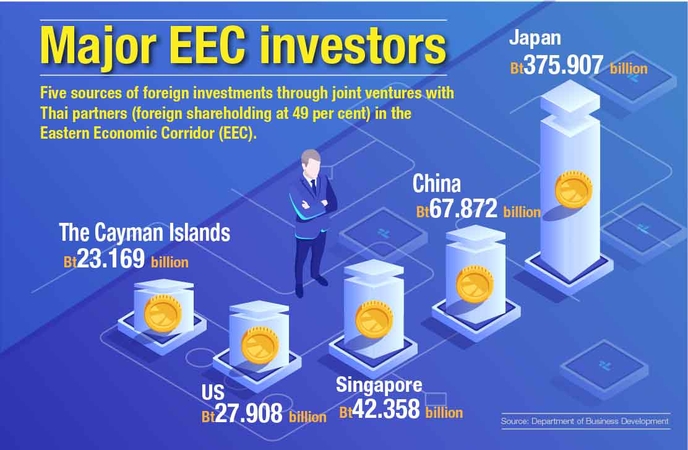
Foreign investment via their joint ventures with Thai partners (foreign shareholding at 49 per cent) in the EEC stood at Bt752.780 billion.

Japanese investors pledged Bt375.907 billion, followed by China Bt67.872 billion, Singapore Bt42.358 billion, US Bt27.908 billion and those from the Cayman Islands at Bt23.169 billion.

Vuttikrai said that investors from Cayman Islands were interested in the production of electricity controls and distribution equipment, holdings, and communications devices.

The EEC covers Rayong, Chon Buri and Chachoengsao provinces.

Deal signed with Japanese agency to tackle electronic waste

ศาสตร์เกษตรดินปุ๋ย : ขอบคุณแหล่งข้อมูล : หนังสือพิมพ์ The Nation

https://www.nationthailand.com/business/30376849

Deal signed with Japanese agency to tackle electronic waste

Sep 28. 2019
By The Nation

960 Viewed

A Japanese agency is joining hands with the Thai government to implement a demonstration project for an energy-saving resource circulation system to utilise electronic and electrical equipment waste (WEEE) in Thailand. Japan seeks to invest Bt130 million in the construction of a high-tech waste disposal project in Thailand that can recycle 400,000 tonnes.

Thailand’s Department of Industrial Works (DIW) signed a memorandum of understanding with the New Energy Development Organisation and Industrial Technology Japan (NEDO) for cooperation in waste and used electronic equipment management.

The move marks the revival of cooperation between the two agencies after an earlier attempt in 2015.

Improper treatment of WEEE has become an important issue as there are concerns that it may harm workers’ health and cause water and soil contamination.

Thongchai Chavalitphichet, director-general of the Department of Industrial Works, said that with the signing of this cooperation NEDO has requested funding from the Ministry of Economy, Trade and Industry (METI) and encouraged the private sector of Japan seeks to invest Bt130 million per month in the construct a 100-tonne waste disposal facility. ABIZ Corporation and Hidayakago Enterprise have been selected to operate the project as a pilot project or a prototype of recycling of used electrical products business in Thailand.

Currently, Thailand has about 148 electronic recycling plants, which is not enough for the amount of electronic waste generated in Thailand. Data from the Pollution Control Department in 2018 found that the remains of used electronic products from the community amounted to 414 billion tonnes and were expected to increase continuously.

“If we handle electronic waste incorrectly, regardless of whether we bring it to waste dumping area or hire people to sort or burn them, it will cause broad pollution. Therefore, there should be a selection of high-value electronic waste by using technology for recycling,” he said.

Investment in the waste management business was expected to increase in the future, especially to deal with electronic waste problems likely to arise from future industrial activities in the Eastern Economic Corridor.

Jurin’s China trip hailed a triumph for rubber, cassava, fruit producers

ศาสตร์เกษตรดินปุ๋ย : ขอบคุณแหล่งข้อมูล : หนังสือพิมพ์ The Nation

https://www.nationthailand.com/business/30376832

Jurin’s China trip hailed a triumph for rubber, cassava, fruit producers

Sep 27. 2019
By The Nation

648 Viewed

Banjongjitt Angsusingh, director-general of the Department of International Trade Promotion (DITP), has called Commerce Minister Julin Laksanawisit’s visit to China last weekend “beautifully successful”.

“We urged China to buy up rice and rubber from the remaining quota and China provided the opportunity to export more cassava, rubber and fruits there,” he said on Friday (September 27).

The department plans to invite Chinese importers to meet Thai cassava entrepreneurs in November. During the visit to China, its officials explored the market in Guangxi Zhuang autonomous region, where businesses that require cassava are blooming, especially the construction industry.

Thailand is China’s top-ranked partner in the cassava trade. China imports around seven million tonnes of Thai cassava chips and flour per year, with a combined value of Bt60 billion, to Nanjing, Qingdao, Hefei and Shanghai’s Huangpu district.

Bankongjitt said representatives of the Rubber Authority of Thailand and Sinochem Group would meet in Beijing from October 19-21 to explore ways to hasten the trading process for rubber.

The DITP is meanwhile coordinating with the departments of Foreign Trade and Internal Trade to expand the market for rubber with a booth at a major rubber-products exhibition in Shanghai later this year.

It will also assist Thai businessman in negotiations with rubberwood and latex producers in Malaysia and in November fly them to meet Turkish entrepreneurs.

The DITP is looking for new buyers among makers of latex gloves and automobiles.

Bankongjitt said the visit to China also resulted in the sale of Bt100 million worth of Thai fruit.

“And China agreed to ease restrictions on Thai fruit imports, suggested ways to increase trade value through e-commerce and is allowing Thailand to participate in a fruit exhibition in Guangxi next month, where we plan to promote coconuts, which are popular in China.”

Thailand slips a place in digital competitiveness ranking

ศาสตร์เกษตรดินปุ๋ย : ขอบคุณแหล่งข้อมูล : หนังสือพิมพ์ The Nation

https://www.nationthailand.com/business/30376797

Thailand slips a place in digital competitiveness ranking

Sep 27. 2019
By The Nation

1,454 Viewed

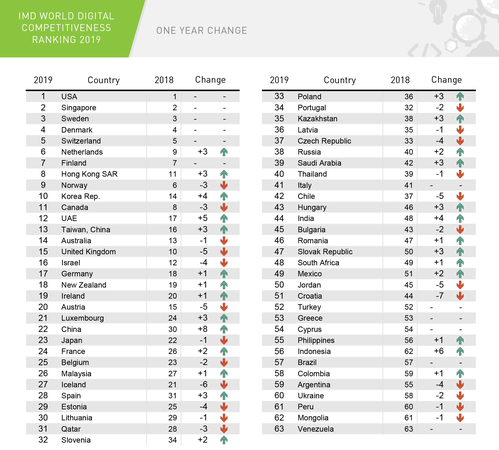
Thailand’s world digital competitiveness ranking dropped one place to 40th in 2019 from 39 the previous year, according to an IMD World Digital Competitiveness Ranking (WDCR) report released late on Thursday.

The WDCR said that Thailand dropped one place to 40th as a result of a mixed performance across three digital factors while future readiness (50th), knowledge (43rd) and technology (27th) improved compared to 2018. Several indicators related to public investment in education, agility of companies and the use of big data and analytics in firms declined.

Meanwhile, the United States held on to the WDCR number one spot in 2019, with all top five economies in the ranking unchanged: US, Singapore, Sweden, Denmark and Switzerland.

Digital Competitiveness Ranking 2019

In the top 10, the Netherlands, Hong Kong SAR and South Korea moved up (to 6th, 8th and 10th, respectively), while Norway dropped to 9th and Canada fell from 8th to 11th.

Now in its third year, the WDCR produced by the IMD World Competitiveness Centre measures the capacity and readiness of 63 economies to adopt and explore digital technologies as a key driver for economic transformation in business, government and wider society.

Technology not only affects how businesses perform but also how economies function and prepare for the future. Governments around the world are investing heavily in their digital economy to enhance value creation and prosperity.

The top five share a common thread in terms of their focus on knowledge generation, but they each approach digital competitiveness differently, the report said. The United States and Sweden follow a balanced approach between knowledge generation, the creation of a supportive environment for technology development and a readiness to adopt innovation. Singapore, Denmark and Switzerland give priority to one or two factors, the report added.

“In the midst of uncertainty and a fluid global situation, it seems that business and societies that are agile correlate strongly with the IMD World Digital Competitiveness ranking. Knowledge also remains of paramount importance for the digital performance of different economies,” said Professor Arturo Bris, director of the IMD World Competitiveness Centre.

Several Asian economies advanced significantly in the ranking compared to 2018. Hong Kong SAR and South Korea entered the top 10 while Taiwan and China moved up to 13th and 22nd respectively. All these economies experienced marked progress in their technological infrastructure and the agility of their businesses. Further down the ranking, India and Indonesia jumped four and six positions respectively, supported by positive results in talent, training and education as well as the enhancement of technological infrastructure.

In the Middle East, the UAE and Israel remained key regional digital hubs but followed opposing trends with respect to 2018. The UAE climbed five places thanks to improvements in capital availability and supportive regulation for technology development. Israel dropped four positions, due to a decline in business agility and e-government indicators.

In Latin America, Mexico and Colombia were the only economies to advance in the rankings this year. The lack of resources to support talent and technological development prevents most economies in the region from improving knowledge generation and getting the most from digital transformation.

To evaluate an economy, WDCR examines three factors:

knowledge – the capacity to understand and learn the new technologies; technology – the competence to develop new digital innovations; future readiness – the preparedness for the coming developments.

This year, two new variables related to robotics were introduced in the calculation of the WDCR: “industrial robot” to measure the total number of robots in operation; and “robots in education and R&D” worldwide. The data is provided by the International Federation of Robotics.