BBL sees rising credit card defaults

ศาสตร์เกษตรดินปุ๋ย : ขอบคุณแหล่งข้อมูล : หนังสือพิมพ์ The Nation

https://www.nationthailand.com/business/30375210

BBL sees rising credit card defaults

Aug 23. 2019
By The Nation

841 Viewed

Bangkok Bank (BBL) is facing rising non-performing loans (NPL) of its credit card accounts with more clients resorting to cash withdrawals as revolving fund for their businesses.

Shoke Na Ranong, the bank’s executive vice president and manager of credit card division, said NPLs rose to 2.1 -2.2 per cent in the second quarter this year from 1.9 per cent from the end of last year.

The trend can be attributed to the slowing economy, prompting cardholders to withdraw cash for business and general expense. Cardholders who have defaulted on their monthly payments will be subject to a higher interest rate than other loans.

It is not a major concern but the bank would keep a close watch on the situation, he said , adding that he does not recommend cash withdrawals on credit card as cardholders should instead seek other loans with lower interest rates.

These cardholders are mostly running their own businesses or working as freelancers.

The bank will deal with this customer group by monitoring their behaviour or limiting the amount they could withdraw with the card.

It will also be more prudent in issuing new cards.

Amata poised for turning Yangon into a smart city

ศาสตร์เกษตรดินปุ๋ย : ขอบคุณแหล่งข้อมูล : หนังสือพิมพ์ The Nation

https://www.nationthailand.com/business/30375220

Amata poised for turning Yangon into a smart city

Aug 23. 2019
From left, Vikrom Kromadit, Lena Ng, Surachai Pornjindachote and Paramate Nisagornsen at a signing ceremony in Yangon (Photo courtesy of Yangon Region Government)

From left, Vikrom Kromadit, Lena Ng, Surachai Pornjindachote and Paramate Nisagornsen at a signing ceremony in Yangon (Photo courtesy of Yangon Region Government)
By KHINE KYAW
THE NATION
YANGON

1,121 Viewed

The long-awaited dream of turning Yangon, Myanmar’s commercial hub, into a smart city may soon be realised with the support of Amata Corporation Pcl, Thailand’s largest industrial estate developer.

Vikrom Kromadit, chairman of Amata Corporation Pcl, said at a signing ceremony on Thursday (August 22) that the firm would bring advanced technology and quality investors to Myanmar while ensuring environment protection for the local communities.

“We will take on a grand project, unforgettable in the history of your country. We will make sure that Yangon  become one of the best future cities in Myanmar,” he said.

Vikrom Kromadit, chairman of Amata Corporation Pcl (Photo coutesy of Yangon Region Government)

Vikrom Kromadit, chairman of Amata Corporation Pcl (Photo coutesy of Yangon Region Government)

“We will bring good investors in line with the All Win philosophy, which means we will not only bring the best customers but also protect the environment. We will ensure the future Yangon city will be better than Amata in Thailand.”

At the event, Vikrom sought support from the regional authorities. He called for one-stop service so that investors do not need to visit various government offices before building their factories in a 2,000-acre [5,059 rai] industrial estate, to be developed by Yangon Amata Smart and Eco City (YASEC), a subsidiary of Amata Corporation, in cooperation with Myanmar’s Department of Urban and Housing Development (DUHD).

“We just need the licence and the land. We would like to start immediately,” he said.

Vikrom expects to start construction work once the rainy season is over.  Amata’s team in Myanmar is now much bigger than that three years ago. He also takes pride in saying that Amata now has more than 1,300 factories with an extensive workforce of over 300,000 employees, contributing US$500 million in  tax to the Royal Thai government every year.

“Today, I come back with a new dream. We are expanding our presence in the whole region, and Myanmar is the most important destination for us because nowadays a lot of Thai companies are coming here,” he said.

With Japanese corporations such as Toyota having established their presence in Myanmar, Vikrom is fully confident that the nation could take advantages of geopolitical issues including international companies moving out of China amid its prolonged trade war with the US.

“It is a good time, even though we are a little bit late,” he said.

“In our planning for  the first phase, we are targeting an inflow of $1 billion in foreign direct investment and job opportunities for nearly 30,000 people. We expect the government  to receive  at least $60 million in taxation.”

Vikrom said PTT Co would establish a 600-megawatt power plant, supplying natural gas to Yangon  to meet the city’s surging demand for electricity once the industrial park becomes operational.

“As the largest company in Thailand, PTT accounts for over 20 per cent of Thailand’s GDP [gross domestic product]. It would like to invest in this power plant in Yangon. They would like to install   their equipment  as soon as possible, and they are willing to provide all the gas Yangon needs in the future,” he said.

Vikrom, together with Yangon Chief Minister Phyo Min Thein, witnessed the signing of a framework agreement to turn Yangon into  a smart and eco city with supporting infrastructure, logistics, services and other related businesses  According to the agreement, DUHD will hold a 20 per cent stake in the mega project.

Yasuo Tsutsui, managing director of YASEC, said the project would come with  huge employment opportunities, reduce regional poverty and promote capacity building for peopole in Myanmar. He said the green and smart technology concept would be adopted in project management.

“It will be the first sustainable eco city in the country,” he said.

“We believe it will meet all the conditions of a sustainable city with the focus  on providing an eco-friendly environment, quality employment opportunities, education, healthcare and commercial facilities in a single venue.”

Ye Sit Min, deputy director at DUHD, told The Nation that the framework agreement is the very first step in the implementation of the large-scale industrial estate which will ultimately become much larger than the Thilawa Special Economic Zone upon completion.

According to the official, the first phase would be developed on  200 acres [506 rai] in the East Dagon township of Yangon. Light and medium scale industries will be prioritised in the initial phase which is scheduled for completion in two years.

“Today, we signed the framework agreement and hope to enter into a joint venture agreement soon. We we will immediately implement the project once we have received the permit from the Myanmar Investment Commission,” he said.


BAAC sets aside Bt55 bn for loans to drought-affected farmers

ศาสตร์เกษตรดินปุ๋ย : ขอบคุณแหล่งข้อมูล : หนังสือพิมพ์ The Nation

https://www.nationthailand.com/business/30375218

BAAC sets aside Bt55 bn for loans to drought-affected farmers

Aug 22. 2019
By THE NATION

585 Viewed

A fund worth Bt55 billion has been set aside to grant soft loans to farmers affected by this year’s severe drought, a senior BAAC official said on August 22.

A fund worth Bt55 billion has been set aside to grant soft loans to farmers affected by this year’s severe drought, a senior official from the Bank for Agriculture and Agricultural Cooperatives (BAAC) said on August 22.

Speaking at an event in Surin province, assistant BAAC manager Somkiat Kimaoha said the 1 million loans of Bt50,000 each will be interest free in first-year repayment, while those repaying the loan in two to five years will have to pay a low unspecified interest rate.

He said Bt50 billion will be used to provide loans worth Bt50,000 each until December 31, adding that the remaining Bt5 billion will cover loans for farmers who want to restore their farm’s fertility or want to switch to crops that do not require too much water.

The Bt5 billion will cover 10,000 loans of Bt500,000 each, which can be repaid over 15 years at an interest rate of 5 per cent.

Somkiat said farmers registered with the Department of Agriculture Extension are entitled to receive compensation for drought at the rate of Bt500 per rai for no more than 20 rai.

No ‘stimulus’ for property sector, says Uttama

ศาสตร์เกษตรดินปุ๋ย : ขอบคุณแหล่งข้อมูล : หนังสือพิมพ์ The Nation

https://www.nationthailand.com/business/30375211

No ‘stimulus’ for property sector, says Uttama

Aug 22. 2019
Uttama

Uttama
By THE NATION

449 Viewed

Finance Minister Uttama Savanayana has insisted that the real estate sector can cope economically on its own without the government’s help.

Speaking at a realty seminar hosted by the newspaper Krungthep Turakit on Thursday, he said the sector could readily adjust to the Bank of Thailand’s loan-to-value (LTV) policy on mortgage loans that took effect on April 1.

He also pointed out that the Thai economy continues to expand.

The government’s latest economic stimulus packages are aimed at helping revive the grassroots economy, and that should in turn benefit to the property sector, Uttama said.

The Bt316-billion stimulus package approved by the Cabinet on August 20 focuses on cash handouts for low-income earners and domestic travellers and extends soft loans to drought-afflicted farmers.

Uttama said that, once the US-China trade war ends, the Thai economy will expand at a faster rate.

He predicted that, regardless, GDP growth will reach 3 per cent, as forecast by the National Economic and Social Development Council.

He asked everyone involved to help build public confidence in the economy despite any challenges that might arise.

Trade agency gears up for push in China, globally

ศาสตร์เกษตรดินปุ๋ย : ขอบคุณแหล่งข้อมูล : หนังสือพิมพ์ The Nation

https://www.nationthailand.com/business/30375196

Trade agency gears up for push in China, globally

Aug 22. 2019
By The Nation

426 Viewed

The high quality of Thai products, especially in the personal care, apparel and lifestyle categories, has been credited for a rise in demand in China, where online shopping is booming.

Wittayakorn Maneenetr, deputy director-general of the Department of International Trade Promotion (DITP), said this week the agency would create a “TopThai Flagship Store” page on the business-to-consumer website Tmall Global to meet Chinese demand.

It’s targeting 250 million female online shoppers who have a combined purchasing power of Bt20 trillion.

Wittayakorn said the DITP expected to attract more than 50 top companies and SME businesses and offer more than 1,000 items. Major marketing campaigns will coincide with annual Chinese festivals.

The department will also seek e-commerce partnerships with entities such as Amazon and Kha-leang.com, which has expertise extending across Cambodia, Laos, Myanmar and Vietnam, to support its marketing of Thai food and other products globally in a “roving commercial” promotion taking place from August 28-31 in Songkhla and Nakhon Ratchasima.

The DITP is also approaching potential partners in the United States (Amazon and eBay), South America (B2Brazil), Africa (Gosoko), Myanmar (Bagantrade), South Korea (TradeKorea and Coupang) and Hong Kong (HKTDC).

Standard Chartered lowers GDP growth forecast

ศาสตร์เกษตรดินปุ๋ย : ขอบคุณแหล่งข้อมูล : หนังสือพิมพ์ The Nation

https://www.nationthailand.com/business/30375184

Standard Chartered lowers GDP growth forecast

Aug 22. 2019
Tim

Tim
By THE NATION

742 Viewed

Standard Chartered Bank has lowered its 2019 GDP growth forecast for Thailand to 3.0 per cent from 3.3 per cent to reflect disappointing growth in the first half and persistent headwinds faced by the economy, according to Standard Chartered Bank (Thai)’s economist Tim Leelahaphan.

It also expects the Bank of Thailand (BoT) to introduce macro-prudential measures to curb household leverage, likely further denting car sales.

Implementation of the budget for the 2020 fiscal year (FY20), which starts on October 1) may be delayed to January 2020. The US-China trade war, meanwhile, continues to hamper exports and investment.

The bank has also lowered its 2020 and 2021 growth forecasts of Thailand to 3.5 per cent (from 4.0 percent) and to 4.0 per cent (from 4.5 per cent), respectively, to reflect these headwinds.

Despite the downward revision of its 2019 forecast, the bank expects the second half 2019 growth to improve from a weak 2.6 per cent in the first half.

Coordinated policy easing in the form of BoT rate cuts and a soon-to-be-implemented fiscal stimulus package should support growth from late in the third quarter, along with a low base for exports and tourism. Stimulus measures implemented in past years have proved effective in shoring up the economy.

The cabinet approved an economic stimulus package worth Bt316 billion (2 per cent of GDP) on August 20, with a focus on cash handouts for low-income earners and domestic travellers and soft loans for drought-afflicted farmers.

It will be implemented immediately and financed by loans from state run-banks, the government’s ‘Pracharath’ welfare scheme and the FY19 unallocated budget.

The bank now expect a 25-basis-point rate cut by the BoT in September, versus the bank’s previous view of no change for the rest of the year. This brings its end-2019 policy rate forecast to 1.25 per cent from 1.50 percent; it continues to expect no change in 2020 or 2021.

Chinese paying increasing attention to culture, leisure lifestyle

ศาสตร์เกษตรดินปุ๋ย : ขอบคุณแหล่งข้อมูล : หนังสือพิมพ์ The Nation

https://www.nationthailand.com/business/30375182

Chinese paying increasing attention to culture, leisure lifestyle

Aug 22. 2019
Chih-yuan Wang, category research director, retail, Mintel China Reports

Chih-yuan Wang, category research director, retail, Mintel China Reports
By THE NATION

98 Viewed

With China undergoing an industrial transformation, shifting from a primarily manufacturing economy toward a more service- and creative-centric one, Chinese consumers are paying more attention to cultural and leisure lifestyles.

Chinese are being increasingly encouraged to visit cultural and creative venues as the latest research from market intelligence agency Mintel reveals that as many as three in five (60 per cent) urban respondents say that they have been visiting more cafés in the past six months, while over half of those surveyed have increased visits to libraries (56 per cent) and bookstores (55 per cent). What’s more, two in five (40 per cent) in urban areas say they have been visiting more museums, and more than a third (36 per cent) say the same of art galleries.

Meanwhile, lower tier cities in China present great potential for cultural and creative industries. According to Mintel’s research, 61 per cent of respondents from Tier 2 cities visited libraries more in the past six months compared to just over half (51 per cent) of respondents in Tier 1 cities. This is also happening at bookstores (59 per cent Tier 2 versus 50 per cent Tier 1) and art galleries (39 per cent Tier 3 vs 32 per cent Tier 1).

“Chinese consumers today are paying more attention to cultural and leisure lifestyles, and are therefore spending more money on leisure and entertainment,” said Chih-yuan Wang, category research director, retail, Mintel China Reports. “As discussed in the Mintel Trend report ‘Slow it All Down’, as lives become faster and more hectic, there is a wider appreciation for taking one’s time. Cultural and creative visits present an opportunity for Chinese consumers to enjoy a degree of slow-paced escapism. We are seeing the emergence of new-format bookstores and lifestyle stores featuring comfortable spaces, aligning with consumers’ pursuit of leisure and better living. It’s not just about selling products, it’s also about selling a way of life,” Chih-yuan added.

“There is also great potential for the cultural and creative market in China’s lower tier cities. Compared to consumers living in Tier 1 cities, lower tier city residents tend to have a more laid-back lifestyle with less work stress and more free time. As such, they are more active when it comes to visiting cultural and creative venues. In addition, lower tier city consumers are ready to adopt more aspirational lifestyles – something that the cultural and creative industry should take note of.”

Research from Mintel’s report also shows that Chinese consumers are indeed spending more on leisure and entertainment. Total expenditure in the sector reached an estimated 2.04 trillion yuam (Bt8.87 trillion) in 2018, growing 9.7 per cent from 2017. The research reveals that going to the cinema has become the most popular cultural activity, with three quarters (74 per cent) of urban Chinese respondents having purchased film tickets in the past six months. This is followed by spending on exhibitions (40 per cent) and concerts, operas, dramas or plays (35 per cent).

“Despite the popularity of video streaming services, our research shows that Chinese consumers love going to the cinema. Going to the cinema is perceived as a leisure activity rather than a cultural one, showcasing the potential to explore the cultural aspects of cinema and the overall film industry. Transforming cinema from a leisure venue into a cultural venue will open up opportunities for the film- or play-related merchandise market.” Chih-yuan said.

Planned biorefinery first step to ‘Biopolis’

ศาสตร์เกษตรดินปุ๋ย : ขอบคุณแหล่งข้อมูล : หนังสือพิมพ์ The Nation

https://www.nationthailand.com/business/30375158

Planned biorefinery first step to ‘Biopolis’

Aug 22. 2019
Narong Sirilertworakul

Narong Sirilertworakul
By THE NATION

749 Viewed

The National Science and Technology Development Agency will invest Bt3.4 billion in a pilot biorefinery in the Eastern Economic Corridor of Innovation (ECCi).

The aim is to add value from biological research to industrial manufacturing and create innovative products, while raising Thailand’s as a hub for bio-technology in Southeast Asia.

President Narong Sirilertworakul said the agency in charge of managing the EECi had arranged for Prime Minister Prayut Chan-o-cha to lift the symbolic first shovel of soil next February 27 and construction of Phase 1A would be completed in the first quarter of 2021.

A significant aspect of the project is the development of a modern agricultural and the biorefinery industry to promote the benefits of both by mobilising a “Biopolis” – a city of innovation.

“We will set up the pilot plant at a scale similar to industrial manufacturing,” Narong said. “It will be able to handle many raw materials and produce diversified products. It will be certified with GMP [Good Manufacturing Practice] standards for the production of consumed goods, such as nutrients and medical foods, and will be non-GMP for products with external use, such as biochemicals and bioplastic products.”

He said the biorefinery will cost Bt3.4 billion for both the GMP and non-GMP factories.

“We are now recruiting a consulting firm that will tackle engineering design. Construction is expected to start next year and operations can begin in 2022,” said Narong.

He said the plant will help establish a “circular economy” in Thailand and reduce environmental problems by turning waste into useful products.

“This pilot plant will be the first in Southeast Asia and will play a crucial role in developing biological technology in Thailand,” Narong said. “We also plan to expand by offering plants to other potential markets, such as the United States, South America and Africa, which will promote the role of Thailand in the field.”

Bidding terms ready for Digital Park Thailand

ศาสตร์เกษตรดินปุ๋ย : ขอบคุณแหล่งข้อมูล : หนังสือพิมพ์ The Nation

https://www.nationthailand.com/business/30375151

Bidding terms ready for Digital Park Thailand

Aug 22. 2019
Dr Nuttapon Nimmanphatcharin

Dr Nuttapon Nimmanphatcharin
By NOPHAKHUN LIMSAMARNPHUN
THE NATION

832 Viewed

The Digital Economy Promotion Agency (Depa) is expected to issue new terms of reference shortly for the private sector to invest in the Digital Park Thailand project in Chonburi’s Sri Racha district.

Depa president and CEO Dr Nuttapon Nimmanphatcharin said the terms for bidding should have government approval soon after August.

The 800-rai, Bt4-billion infrastructure project is part of the Eastern Economic Corridor (EEC) special economic zone covering Chonburi, Rayong and Chachoengsao.

The aim is to attract world-class tech firms to set up shop here for ventures in edutainment, drones, robots, e-sports and other technology.

“Digital Park Thailand will be implemented as a public-private sector participation [PPP] greenfield project,” Nuttapon said. “We plan to turn Sri Racha into an innovation city, with the government offering tax and other incentives to promote high-value-added software and digital industries such as content for games and movies or the design and manufacture of smart devices, as well as robots.

“Digital Park Thailand also aims to tap startup entrepreneurs similar to Airbnb and Grab. The upcoming fifth-generation [5G] network also opens opportunities in new-use cases and applications for the internet of things [IoT],” he said.

Nuttapon said an IoT institute would also be established at Digital Park to develop entrepreneurs for new growth industries such as those in 5G, cloud innovation labs, AI design labs and data analytic centres.

The availability of physical infrastructure, a digital eco-system and other supportive facilities is crucial to the success of investors in the IoT institute, who will be given tax incentives from the Board of Investment as well as work permits and other privileges for foreign staff.

“Other countries such as Indonesia help startups by pledging to buy products and services from them so that they have a ready market at the outset to generate income for further development and for survival,” he said.

Thailand offers no such a government procurement, so it’s more difficult for startups in terms of marketing their products in the initial stage.

“Over the past two years, Depa has supported dozens of Thai startups, including those in manufacturing, most of which focus on direct-selling their products. Other impressive startups include those for logistics and truck-sharing or hotel catering platforms,” Nuttapon said.

“Chef and hotel kitchen-sharing platforms, for example, are good for small hotels because they don’t have to invest a lot of money in catering services or hire many people.

“In fact, tech-driven startups are good for the overall economy because they boost productivity in various sectors facing tech disruption.

“We need e-payment, e-services, e-inventory, e-logistic via sharing platforms to reduce business costs, and even e-products, for which orders are shared among multiple factories.

“The digital transformation life-cycle covers the starting point, preparations, action plans and growth and has to be managed properly. Compared to Vietnam, Malaysia and Indonesia, the country’s transformation pace has been too slow, while our labour costs and business competition keep rising.”

For tech startups, he said, the challenge is to nurture enough successful entrepreneurs. Too few startups are succeeding here.

“Only 10 per cent will survive, so the government has to help by creating a favourable eco-system. We also need accelerator and incubator programmes, as well as early-stage business-growth funding etc,” he said.

Depa currently provides each qualified startup with a Bt50,000 grant, after which those showing promise can apply for a Bt1-million “angel’s fund”.

Depa has also introduced a digital-transformation fund to help startups and existing businesses and industries in the development and adoption of new technologies.

The planned IoT institute, Nuttapon said, will provide office space and other infrastructure and enable AI, virtual reality, augmented reality and 5G labs for the development of smart devices or robots.

“Thailand should focus on food catering, healthcare, tourism and related platforms to drive digital economic growth, because these are also scalable in foreign markets,” he said.

US market a boon for Thai exporters as trade war bites

ศาสตร์เกษตรดินปุ๋ย : ขอบคุณแหล่งข้อมูล : หนังสือพิมพ์ The Nation

https://www.nationthailand.com/business/30375162

US market a boon for Thai exporters as trade war bites

Aug 22. 2019
By WICHIT CHAITRONG
THE NATION

951 Viewed

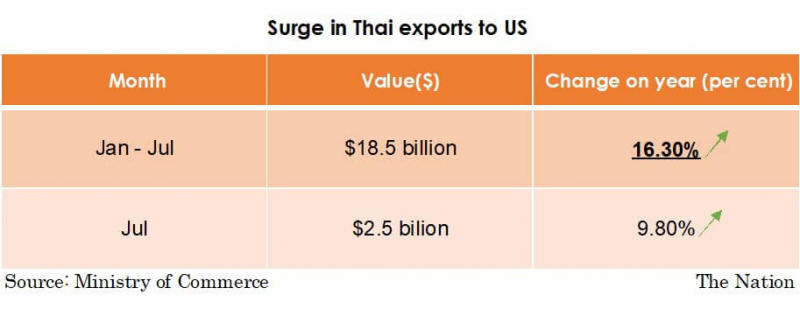
Thailand’s exports to the US rose by double digits in the first seven months of the year, partly due to the ongoing US-China trade war, which is making importers turn to Thailand.

As of July 30, Thai exports to the US had risen 16.4 per cent to US$18.5 billion (Bt569.31 billion), closely followed by Thai exports to China at $16.3 billion for the same period. In July alone, Thai exports to the US rose 9.8 per cent to $2.5 billion.

Exports to the US accounted for 12.8 per cent of Thailand’s total exports, followed by 11.3 per cent to China from January to July this year, the Commerce Ministry said.

Last year, exports to the US accounted for 11.1 per cent of total exports, compared to 12 per cent to China.

“The growth of Thai exports to the US in the first seven months is high, partly due to the ongoing trade war and also because Thailand offers diversified products that can meet market demands there,” Pimchanok Vonkorpon, director-general of the Trade Policy and Strategy Office, said.

Thailand exports many different kinds of products to the US, such as rubber products, autos and auto parts, steel products, electrical home appliances, frozen food and home decorations, she said, adding that the prospect of the US market looks good overall.

Thai exports in July bounced back to 4.28 per cent with a total value of $21.2 billion (Bt652.3 billion), largely from gold exports as a safe-haven asset, the Commerce Ministry said, while exports not including gold and oil products, rose by 1.6 per cent.

“These figures provide us with some relief as we are seeing the export sector turn around and we expect a rise in the rest of the year,” Pimchanok said.

Previously, Orapin Sermpraphasilp, chairperson of the Federation of Thai Industries of the Eastern Region, said she has observed more US importers turning to Thailand as Chinese products are now subject to higher tariff.

The National Economic and Social Development Council also said on August 19 that some foreign investors have started relocating factories from China to Thailand in order to avoid high US tariffs.

A series of messages posted online by US President Donald Trump have convinced many investors that he is in it for the long haul where the dispute with China is concerned.