Nine-minute miss costs CP Bt290-billion project

ศาสตร์เกษตรดินปุ๋ย : ขอบคุณแหล่งข้อมูล : หนังสือพิมพ์ The Nation

https://www.nationthailand.com/business/30375160

Nine-minute miss costs CP Bt290-billion project

Aug 21. 2019
By THE NATION

1,443 Viewed

The court heard a testimony from the five petitioners that they had missed the 3-pm deadline for the formal submission by a mere nine minutes due to traffic congestion.

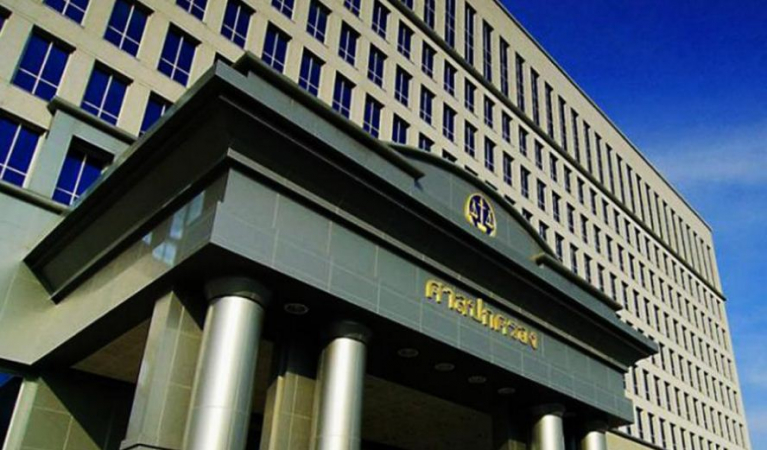
The Central Administrative Court today ruled against a construction consortium representing Charoen Pokphand Group (CP) through five affiliates that tried to submit bids, after the submission deadline on March 21, for the U-Tapao airport and Eastern Aviation City development projects worth a total of Bt290 billion.

The court heard a testimony from the five petitioners representing Thana Holding Joint Venture Co Ltd and four affiliates that they had missed the 3-pm deadline for the formal submission of bidding documents by a mere nine minutes due to traffic congestion.

The five petitioners are Thana Holding Joint Venture Co Ltd, B Grimm Joint Venture Co Ltd, Italian Thai Development Plc, Ch Karnchang Plc and Orient Success International Co Ltd.

They filed a joint complaint on April 10 with the court against a selection committee appointed by project owner Royal Thai Navy (RTN) for not formally accepting their bidding documents on that day at the RTN headquarters in Bangkok Noi district on the Thon Buri side of Bangkok.

As of 7.30 pm today (August 21), CP and the five petitioners have not issued a public statement as to whether they would appeal the court’s ruling, to exercise the right they are entitled to within a 30-day time frame.

Sontirat’s new energy plan to include local communities

ศาสตร์เกษตรดินปุ๋ย : ขอบคุณแหล่งข้อมูล : หนังสือพิมพ์ The Nation

https://www.nationthailand.com/business/30375157

Sontirat’s new energy plan to include local communities

Aug 21. 2019
Sontirat Sontijirawong

Sontirat Sontijirawong
By THE NATION

448 Viewed

Energy Minister Sontirat Sontijirawong plans to propose a new draft at the Energy Regulatory Commission’s meeting in September for future policies that will allow local communities to participate in electricity generation.

The minister also aims to boost alternative energy resources such as solar cell, biomass and biogas. Once his proposal is approved, he said he will release more details of the plan and procedure.

Sontirat also discussed his plan with leaders of the National Energy Reform Committee on August 21, and all attendees agreed that the generation of alternative energy will strengthen the economy at the grassroots level. The minister also plans to set up an advisory committee comprising representatives of related agencies as well as four members of the energy reform committee.

Separately, the National Energy Reform Committee gave Sonti a petition on the following issues:

1. Retail price of oil should not be based on Singapore’s price and the price calculation must be improved so it is fair;

2. Concerns about Thailand-Cambodia territorial claims, as Thailand may lose rights on the area if it agrees it is overlapping;

3. Corruption in the bidding for Erawan and Bongkot gas fields, which are allegedly not operating for the sake of Thai people;

4. Listing the PTT Oil and Retail Business Co Ltd (PTTOR) in the Stock Exchange of Thailand may be against the law;

5. The national electricity generating plant must generate more than half of all the electricity consumed in the country;

6. Investigation into the Rolls-Royce corruption case must be speeded up as it involves the state-owned energy company.

Govt posts Bt457.33 billion deficit for first 10 months

ศาสตร์เกษตรดินปุ๋ย : ขอบคุณแหล่งข้อมูล : หนังสือพิมพ์ The Nation

https://www.nationthailand.com/business/30375148

Govt posts Bt457.33 billion deficit for first 10 months

Aug 21. 2019
Lavaron Sangsnit

Lavaron Sangsnit
By The Nation

449 Viewed

Thailand posted a deficit of Bt457.33 billion for the first ten months of this fiscal year (October 2018 to July 2019), said Director-General Lavaron Sangsnit of the Fiscal Policy Office on Wednesday.

Lavaron,  also spokesperson of  the Finance Ministry, added that the government recorded Bt2.129 trillion in revenue while budget disbursement amounted to Bt2.586 trillion for the same period.

The government borrowed Bt322,978 million to cover the deficit incurred during the first ten months with treasury reserve declining to Bt484.55 billion as of  the end of July 2019.

Somkid hears upbeat talk on Japanese rail investment

ศาสตร์เกษตรดินปุ๋ย : ขอบคุณแหล่งข้อมูล : หนังสือพิมพ์ The Nation

https://www.nationthailand.com/business/30375147

Somkid hears upbeat talk on Japanese rail investment

Aug 21. 2019
By THE NATION

671 Viewed

Deputy Prime Minister Somkid Jatusripitak on Wednesday spoke with Japanese Ambassador Shiro Sadoshima at Government House about the possibilities for investment in a high-speed railway on the Mukdahan-Mae Sot route in the Eastern Economic Corridor.

He said the ambassador told him the Japan International Cooperation Agency had studied the idea and found potential for investment.

Somkid noted that Thailand has for years sought investment from Japan with an eye to promoting rail transport linking Vietnam, Cambodia, Thailand and Myanmar.

He planned to discuss the matter with the transportation minister and ask the Thai-Japanese Joint Committee on Trade, Investment and Economic Cooperation to consider it.

Sadoshima urged that priority be given to vocational education and industrial training in Thailand, along the lines of Japan’s Toyota National College of Technology, which trains students to work in factories.

Somkid said he would take the recommendation to the prime minister and education minister.

He also invited Japanese companies to invest in the Thailand Cyberport project and vowed to ensure that mass anti-Beijing protests in Hong Kong do not disrupt Thailand’s dealings with the territory.

CPD chief proposes 3-point plan as alternative to price-guarantee scheme

ศาสตร์เกษตรดินปุ๋ย : ขอบคุณแหล่งข้อมูล : หนังสือพิมพ์ The Nation

https://www.nationthailand.com/business/30375144

CPD chief proposes 3-point plan as alternative to price-guarantee scheme

Aug 21. 2019
By THE NATION

449 Viewed

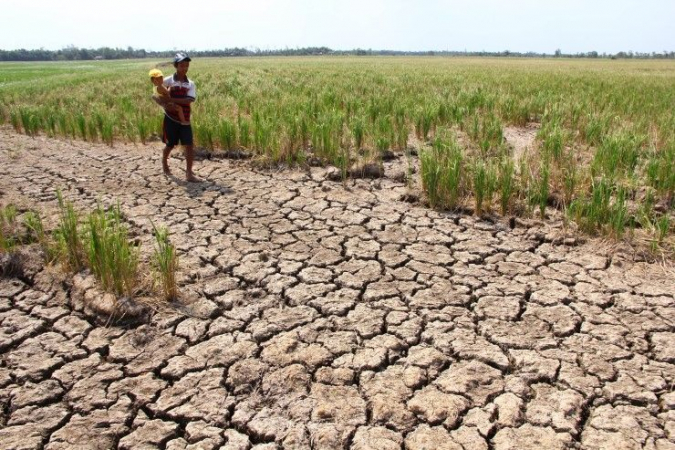
The Cooperative Promotion Department (CPD) has come up with a three-point plan to fix the problem of farmers’ debts instead of having them rely on the government’s price-guarantee policy, which is now useless considering that most crops have been destroyed by the drought.

CPD director-general Phichead Wiriyaphaha said this year’s drought has been serious and has already destroyed most crops in several regions.

“This renders the price-guarantee policy useless as farmers don’t have anything to sell. As a result, many will not be able to pay the debts they owe to agricultural cooperatives,” he said.

Phichead added that agricultural cooperatives have accumulated debts of Bt175 billion, of which Bt163.5 billion is from members of agricultural cooperatives, Bt590 million from fishery cooperatives, Bt8.2 billion from land cooperatives, and Bt2.6 billion from other cooperatives.

“The agricultural cooperatives expect non-performing loans [NPLs] worth up to Bt41.6 billion,” he said. “The main reason behind this is the drought and the rise in production cost since the start of this year.”

In order to battle this debt problem, the director-general has proposed a three-point plan:

1) Categorising the source of funds and adjusting the interest rate and loan policies accordingly, such as reserving short-term funds for short-term borrowers etc;

2) Encouraging cooperative members to find additional income sources by providing loans for new businesses; and

3) Formulating debt-restructuring measures such as reducing interest and fines or providing debt-relief programmes.

Phichead added that CPD has earmarked Bt1.6 billion for five-year loans at 1 per cent interest for cooperatives that want to dig artesian wells and ponds to help farmers earn extra income from farming alternative crops.

“CPD realises that water is key to helping farmers get back on their feet and not be too burdened with debts,” he said.

Next month’s Medical Fair to bring together key stakeholders from medical, healthcare sectors

ศาสตร์เกษตรดินปุ๋ย : ขอบคุณแหล่งข้อมูล : หนังสือพิมพ์ The Nation

https://www.nationthailand.com/business/30375143

Next month’s Medical Fair to bring together key stakeholders from medical, healthcare sectors

Aug 21. 2019
By THE NATION

233 Viewed

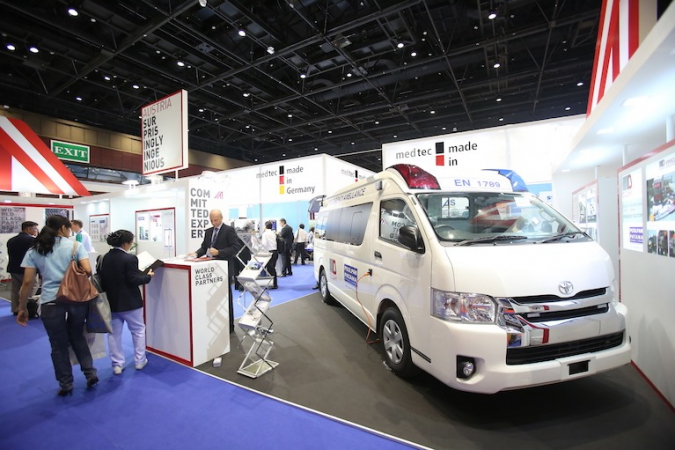
The ninth edition of Medical Fair Thailand, scheduled to be held from September 11 to 13 at new venue BITEC, expects to welcome more trade visitors and exhibitors than ever before.

More than 12,000 trade visitors are expected to attend the exhibition, with more than 40 per cent of them coming from overseas.

The three-day expo will showcase 1,000 exhibitors from 60 countries – 20 per cent more than the last exhibition in 2017. On offer will be a comprehensive range of medical and healthcare innovations, spanning state-of-the-art imaging and diagnostic equipment, patient monitoring systems, cost-effective consumables, digital healthcare solutions and more.

This year’s fair will also see the widest representation of national pavilions and country groups, including newcomers Brazil, Denmark, Indonesia, Israel and Hong Kong.

On the domestic front, there’s been a notable jump of 60 per cent in Thai exhibitors, reflecting the importance of fairs being a strategic platform for Thai companies to meet quality buyers and relevant partners on an international scale.

“Established in 2003, Medical Fair Thailand is the country’s largest international medical exhibition and is the only event of its calibre, with experience, connections and infrastructure to enable medical and healthcare companies to springboard into Asia and Southeast Asian,” said Gernot Ringling, managing director of the fair organiser, Messe Düsseldorf Asia.

Thailand 4.0 and the medical sector

Thailand 4.0 is a 20-year economic roadmap that the government unveiled in May 2016 as part of an effort to transform the economy into one that is driven by science, technology and innovation. Three years in, Thailand is making good progress as it deepens its focus on four key pillars identified in the strategy – wellness, medical services, academics and health products, with the government now providing additional technology-based incentives for investment in the development of biotechnology, nanotechnology, advanced material technology, and digital technology and enabling services that support targeted technology development.

“International exhibitions such as Medical Fair Thailand play a vital role in contributing to the growth and development of Thailand’s MICE [meetings, incentives, conferencing and exhibitions] industry as well as target industries stipulated by Thailand’s 4.0 policy, which include the medical sector. The growth of the private medical sector in Thailand is being driven by the growth in medical tourism and increasing demands from Thailand’s growing middle-class.

“Thailand’s middle-class incomes are rising and so is spending on healthcare as people are becoming more concerned about their health due to increasing prevalence of non-communicable diseases and work stress. With these factors, the Medical Fair Thailand could not take place at a more opportune time,” said Kanokporn Damrongkul, director of Thailand Convention and Exhibition Bureau’s exhibition department.

Banks urged to facilitate development of sustainable economies

ศาสตร์เกษตรดินปุ๋ย : ขอบคุณแหล่งข้อมูล : หนังสือพิมพ์ The Nation

https://www.nationthailand.com/business/30375136

Banks urged to facilitate development of sustainable economies

Aug 21. 2019
By THE NATION

187 Viewed

The Asean bloc is facing existential threats such as climate change and environmental degradation, which could potentially lead to financial instability and social unrest, according to WWF’s 2019 Sustainable Banking Assessment (SUSBA).

The report finds that of the 35 Asean banks assessed, all are not responding fast enough to these threats, based on the level of ESG integration as measured by a framework covering six aspects: purpose, policies, processes, people, products and portfolio.

Humanity stands on the edge of a precipice with the Intergovernmental Panel on Climate Change (IPCC) report issued in 2018 saying that there were 12 years left to limit global warming to 1.5°C and prevent a climate crisis.

The number of heatwaves hitting Europe and Asia-Pacific in recent months is testament that climate change is already disrupting our daily lives and business operations. Unfortunately, the Asean economy remains highly dependent on fossil fuels, which contributes significantly to greenhouse gas emissions. 91 per cent of the banks assessed have continued to finance new coal-fired power plants and are therefore fuelling the fire.

Coal is not the only problem. Rampant deforestation has exacerbated climate change and caused biodiversity loss, which threatens food security by disrupting essential ecosystem services such as soil fertility maintenance and pollination. The recent IPCC special report on land use and climate emphasises that sustainable land management alongside rapid decarbonisation of the energy system are critical to meet the 1.5°C goal of the Paris Agreement. SUSBA finds that only 9 per cent of banks assessed have no-deforestation policies, despite being home to some of the world’s deforestation hot spots in Greater Mekong, Sumatra and Borneo.

Southeast Asia is suffering from manifestations of climate change in the form of water-related disasters – from crops and manufacturing facilities being destroyed by floods in Thailand, Malaysia’s water resources expected to be reduced by 20-25 per cent from 2025 to 2030, to major coastal cities such as Jakarta being susceptible to rising sea level. Asean banks remain highly exposed, with just 17 per cent recognising risks of water, while none requires clients to conduct water-risk assessments.

Regulators understand the threat to financial stability and are responding. By the end of the year, seven banking associations or regulators in Asean will have issued sustainable banking guidelines. The central banks of Malaysia, Singapore and Thailand have joined the Network for Greening the Financial System (NGFS), established to enhance the ability of the financial system to manage climate risks and mobilise capital for sustainable development. The NGFS is recommending central banks and supervisors to better integrate climate-related risks into financial stability monitoring. Banks will increasingly be expected to test their resilience of their loan books to climate risks and report the results to the regulators.

374 financial institutions representing US$118 trillion of assets have endorsed the Task Force on Climate-related Financial Disclosures (TCFD), which has specific recommendations for financial institutions on climate disclosures. Asean banks have not made much progress to meet these expectations, with only three banks developing a strategy to manage climate-related risks or conducting climate-risk assessment.

Investors are increasingly engaging with banks on their management of climate and environmental risks. Alistair Thompson, director of First State Investments (Singapore) said, “The WWF Sustainable Banking assessment has proven to be a valuable tool for us in Asean. It allows us to track where progress is being made, or not, and the areas in which investors like ourselves can push for improvement. We have used it to engage in areas such as Thermal Coal and Palm Oil.”

SUSBA finds that of the 35 banks assessed, four banks from Singapore and Thailand met half-way the standards set by the indicators while 51 per cent reached less than a quarter. However, there is still progress with 74 per cent of the banks making some improvement compared to last year. In particular, the three Singapore banks have demonstrated leadership by prohibiting the financing of new coal-fired power plants and implementing no deforestation commitments. The uneven playing field undermines the region’s response to these impending threats as unsustainable activities continue to be financed.

“The prosperity of Asean’s economies is underpinned by the bedrock of natural capital which provides climate and air quality regulation as well as food and freshwater production. These are the basic necessities for our societies to thrive. Asean’s economies are very much interdependent, which magnifies the effects of climate change and environmental destruction. To ensure that the people of ASEAN have a secure future, Asean banks must be the lifeblood of sustainable development,” said Jeanne Stampe, WWF’s head of Asia Sustainable Finance.

Asean banks are also leaving money on the table by not actively supporting the urgently needed transition to a low carbon and sustainable economy. A DBS and UNEPFI study estimated the demand for green investment to be US$3 trillion from 2016 to 2030 in sectors such as infrastructure, renewable energy, energy efficiency, food, agriculture and land use. 51 per cent of the banks that offer green financial products have mostly focused on renewable energy, there remains a huge financing gap in the other sectors.

Encouragingly, some banks understand that there is no time to lose and are laying the foundations for good governance of ESG issues. 57 per cent of Asean banks have senior management oversight of ESG issues, nearly half of which have additional responsibilities over climate-related risks and opportunities. However, this needs to be translated down to sector policies based on science-based standards to ensure robust management of material ESG risks. Resources such as Asia Sustainable Finance Initiative (ASFI), a multi-stakeholder platform, can support banks with cutting-edge sustainable finance tools and capacity building.

Financial institutions need to work together on a pre-competitive basis to create a resilient financial sector that can support the region’s sustainable development needs and boost livelihoods. The Association of Banks in Singapore (ABS) has been facilitating peer-to-peer learning in cooperation with WWF to catalyse the transition throughout Asean.

Ong-Ang Ai Boon, director of ABS, said, “Banks in Singapore have been advancing their ESG integration and capacity building efforts following the issuance of the ABS Responsible Finance Guidelines in 2015 and are continuing to improve their practices. We are glad this progress is reflected in the SUSBA results and look forward to continue sharing our experience with our counterparts in the region”.

Rice-price guarantees ready for Cabinet

ศาสตร์เกษตรดินปุ๋ย : ขอบคุณแหล่งข้อมูล : หนังสือพิมพ์ The Nation

https://www.nationthailand.com/business/30375131

Rice-price guarantees ready for Cabinet

Aug 21. 2019
By The Nation

471 Viewed

The National Rice Policy Committee on Wednesday approved a Bt21-billion budget to guarantee the price of rice harvested in 2019 and 2020.

Deputy Prime Minister and Commerce Minister Jurin Luxanavisit said Prime Minister Prayut Chan-o-cha chaired the meeting, at which it was forecast that 3.9 million members of rice-farming families would be registered for the programme.

Cabinet approval will soon be sought for the rice guarantees in five types, Jurin said:

•    Rice grown at 15 per cent humidity will be priced at Bt10,000 per tonne with an income guarantee of not more than 30 tonnes per household or not more than 40 rai.

•    Glutinous rice is guaranteed a price of Bt12,000 per tonne, for not more than 16 tonnes per household or not over 40 rai.

•    Jasmine rice has been guaranteed a price of Bt15,000, not exceeding 40 rai or 14 tonnes per household.

•    Fragrant rice will be assured Bt14,000 per tonne, not more than 40 rai or not over 16 tonnes.

•    Pathumthani fragrant rice has been guaranteed a price not exceeding Bt11,000, not more than 40 rai or not more than 25 tonnes.

The committee assigned the Bank of Agriculture and the Agricultural Cooperatives and Commerce Ministry to prepare the details and a formal budget in accordance with the Financial Discipline Act.

Growers must register with the ministry’s Agricultural Extension Department before October 31, except those in the South, who have until February 28.

The Finance Ministry has proposed measures to improve production, harvesting and quality that would see farmers receive Bt500 per tonne, limited to 20 rai each. The committee assigned Finance Minister Uttama Savanayana to discuss the programme with the Budget Bureau, Jurin said.

Thai Rice Exporters Association president Charoen Laothammatas called the price guarantee a short-term measure to ensure farmers have a stable income, but in the longer term, the association expects the government to improve the quality of seeds and support farmers in producing higher-quality crops, and to expand their overseas markets.

Thailand exports 300,000 tonnes of rice annually to Japan and on average 800,000 tonnes to Iraq and Iran. It also has a government-to-government contract with China to ship up to two million tonnes there. Already 1.7 million tonnes have been sent and the remainder will be delivered later this year.

Charoen said global rice production for 2018-2019 dropped by 760,000 tonnes – about 0.15 per cent – from 2017-2018.

The global export market declined 4.9 per cent between January and August, when Thailand shipped 5.27 million tonnes, down from 6.15 million tonnes or 22.4 per cent compared to the same period last year.

The value of exports in that same period this year was Bt88 billion, down nearly 17.1 per cent, he said.

Thailand ranked second in the world for rice exports in those eight months, behind India.

Thai exports show growth in July

ศาสตร์เกษตรดินปุ๋ย : ขอบคุณแหล่งข้อมูล : หนังสือพิมพ์ The Nation

https://www.nationthailand.com/business/30375118

Thai exports show growth in July

Aug 21. 2019
By The Nation

457 Viewed

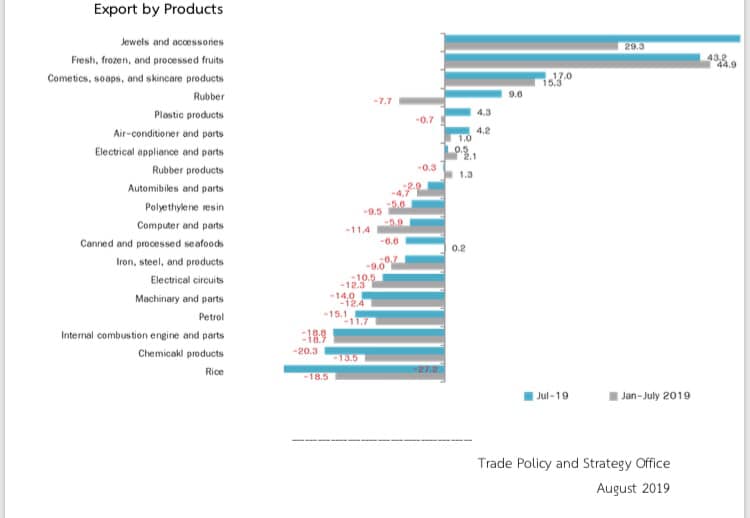
Thai exports in July 2019 bounced back up to 4.28 percent with a total value of US$21.2 billion (Bt652.3 billion), largely from gold exports as a safe-haven asset, according to the Commerce Ministry.

While global oil prices dampened exports of oil-related products, practical proactive export strategies are likely to balance negative impacts from the US-China trade dispute. In the first seven months of 2019, Thai exports contracted 1.9 percent.

Diversity of exports including agricultural and food products, lifestyle products related to tourism and rising industrial products appear likely to help Thai exports for the rest of 2019. Together with government stimulus packages in many countries, new export promotion schemes endorsed by a Joint Public and Private Consultative Committee on Commerce, would gradually boostThai exports in the fourth quarter of 2019.

Thai exports to most major trading partners markets, for example, US Japan Hong Kong, Taiwan, and China, include fresh, frozen, and processed fruits as well as automobiles. Exports to India remain robust but those to CLMV (Cambodia, Laos, Myanmar, and Vietnam) and ASEAN contracted because of oil and oil-related products.

Growth of agricultural and agro-industrial products returned to positive growth and stood at 1.4 per cent,” the ministry said. Top performers that still expanded favourably were fresh, frozen, and processed fruits (+26.1 per cent), rubber (+9.6 per cent), cassava products (+8.7 per cent), and fresh, frozen, and processed shrimps (+7.3 per cent).

Meanwhile, exports of some major products declined, for example, rice (-27.2 per cent), sugar (-25.4 per cent), and canned tuna (-13.6 per cent). In the first seven months of 2019, agricultural and agro-industrial products contracted 1.7 percent.


In contrast, industrial products remained positive for a second consecutive month. Top performers are gold (+406.9%), cosmetics, soaps, and skincare products (+17.0 per cent), and air-conditioners (+4.2 per cent). However, some industrial products decreased, for example, oil-related products (-14.2 per cent), computer and parts (-5.9%), automobiles and parts (-2.9 per cent). In the first seven months of 2019, industrial products contracted 1.4 percent.

Despite a variety of challenging factors in common with other export-oriented countries, many positive factors are likely to strengthen and improve Thai exports namely new rising -star products, the opportunity to substitute products subject to retaliatory measures in US and China markets, expansion of tourism related products, potential exports to new areas according to customized strategies, and new export promotion schemes underway endorsed by a Joint Public and Private Consultative Committee on Commerce. Last but not least, expansionary monetary policy would also diminish the baht-appreciation effect in the fourth quarter of the year 2019.

Government speeds up spending as only 87 per cent of year’s budget used so far

ศาสตร์เกษตรดินปุ๋ย : ขอบคุณแหล่งข้อมูล : หนังสือพิมพ์ The Nation

https://www.nationthailand.com/business/30375111

Government speeds up spending as only 87 per cent of year’s budget used so far

Aug 21. 2019
Yanee Sangsrichun

Yanee Sangsrichun
By The Nation

244 Viewed

The Comptroller General’s Department of the Finance Ministry has reported that the government’s spending of the 2019 fiscal budget as of July 2019 had reached only Bt2.2 trillion or 87.01 per cent of the total Bt2.52 trillion budget for 2019.

The department advisor of fiscal and financial system development, Yanee Sangsrichun, on Wednesday said that from October 1, 2018 through July 31, 2019, Bt2.2 trillion of the Bt2.52 trillion total fiscal budget for the year had been spent – about 87.01 per cent.

This can be separated out to the current expenditures worth Bt1.75 trillion, the investment budget worth Bt441.7 billion, as well as Bt297.02 billion for the budget for overlapping years, said Yanee, who is also spokesperson for the department.

The government has tried to speed up spending of the remaining budget for the remaining two months of the fiscal year, August and September, Yanee added.