The United States called out China and Russia on Wednesday for opposing further United Nations sanctions against North Korea, warning that the Security Council “cannot stay silent any longer” as Pyongyang prepares for a seventh nuclear test.
US Ambassador to the United Nations Linda Thomas-Greenfield referred to “two council members” who she said argued that restraint by the council would encourage North Korea “to stop escalating and instead come to the negotiating table”.
“Silence and restraint have not worked,” Thomas-Greenfield told a council meeting convened by the United States on North Korea’s latest ballistic missile launches. “It is time to stop providing tacit permission and to start taking action.”
North Korea has been subject to UN sanctions since 2006 over its nuclear and ballistic missile programmes. Washington would like the 15-member Security Council to vote this month on a US-drafted resolution to further sanction Pyongyang.
“We cannot wait until [North Korea] conducts additional provocative, illegal and dangerous acts – like a nuclear test,” Thomas-Greenfield said.
According to Washington’s assessment, North Korea could be ready to carry out such a test as early as this month.
However, veto powers China and Russia are opposed to further sanctions and have long been pushing for the council to ease measures on the North on humanitarian grounds. But the United States says now is not the time.
China’s UN Ambassador Zhang Jun said on Wednesday that the resolution was “not an appropriate way to address the current situation”.
“Regrettably, the US has turned a blind eye to reasonable proposals from China and other relevant council members, and remains enamoured superstitiously of the magical power of sanctions,” Zhang told the council.
Russia’s deputy UN Ambassador Anna Evstigneeva said the resolution drafted by Moscow and Beijing to ease North Korean sanctions “remains on the table” and “could encourage parties to step up negotiation efforts”.
The council last tightened sanctions on Pyongyang in 2017. But North Korea has successfully worked to evade some, according to independent UN monitors.
Palestinian protesters clashed with Israeli police in Jerusalem on Wednesday over the death of an Al Jazeera reporter who was killed during an Israeli raid in the occupied West bank. This video contains graphic images. Lisa Bernhard produced this report.
Palestinian protesters clashed with Israeli police in Jerusalem on Wednesday over the death of an Al Jazeera reporter who was killed during an Israeli raid in the occupied West bank.
Graphic footage shows the immediate aftermath of the moment 51-year-old Palestinian-American TV reporter Shireen Abu Akleh was killed in the city of Jenin.
The White House strongly condemned the killing and called for an investigation into her death, which has sparked outrage among Palestinians…
Many waved Palestinian flags as they took to the streets in Jerusalem to express their anger and sadness.
[PROTESTER] “She’s a Palestinian citizen, we don’t want to say she’s a journalist, she is a human who was killed in cold blood, she was executed in front of all cameras and we saw that. We are here to express our sadness and anger in a peaceful and legitimate manner.”
The veteran journalist had been covering the latest arrest operation launched by the Israeli military amid deadly Arab attacks in Israel.
Palestinian President Mahmoud Abbas and Al Jazeera blamed Israeli forces for her death, describing it as a blatant, cold-blooded murder.
Israeli Prime Minister Naftali Bennett said Abbas was making unfounded allegations before Israel had conducted a “thorough investigation”.
Bennett said it appeared likely that Palestinians “firing indiscriminately” were responsible.
Another Al Jazeera reporter, Ali al-Samudi, was also shot. Speaking to Reuters from a hospital, he said he and Abu Akleh were clearly identified as member of the press.
“We were obvious. We made sure to walk right in front of the army patrols so that they can see us and they saw us, after we went to a road where there were no armed people, no civilians and there was no shooting and no incidents there, we were shocked by the shooting. I was lucky and I turned my back when the first bullet was shot and injured my back, they wanted to kill me.”
Journalists in Arab countries also gathered on Wednesday to protest her death, many carrying her picture and lighting candles in her honor.
The US House of Representatives on Tuesday approved more than $40 billion additional aid for Ukraine, as Congress races to keep military aid flowing to boost the government in Kyiv as it grapples with the Russian invasion, Reuters reported.
The House passed the Ukraine spending bill 368 to 57. All the no votes came from Republicans. The measure now heads to the Senate, which is expected to act quickly.
President Joe Biden had asked Congress to approve an additional $33 billion in aid for Ukraine two weeks ago, but lawmakers decided to increase the military and humanitarian funding, Reuters said.
“This bill will protect democracy, limit Russian aggression, and strengthen our national security, while, most importantly, supporting Ukraine,” Democratic Representative Rosa DeLauro, who chairs the House Appropriations Committee, said, urging support for the spending package.
Biden had called on Congress to move quickly so that he could sign the bill into law before existing defence aid for Ukraine runs out later in May.
Some Republicans opposed the bill, criticising Democrats for moving too quickly to send too many US taxpayer dollars abroad. Biden’s fellow Democrats narrowly control Congress, but the bill will need Republican votes to get through the Senate.
Oksana Markarova, Ukraine’s ambassador to the United States, appealed for assistance from both Democratic and Republican senators at their weekly party lunches on Tuesday, Reuters said.
“It was a very heartfelt, and easy to understand the message: Their people are dying, they’re running out of supplies and ammunition. They need our help quickly. Thank you for all your help. Please. Speed it up,” Democratic Senator Dick Durbin said after Markarova spoke.
Republican Senator Rob Portman, a member of the Senate Foreign Relations Committee and leader of the Senate Ukraine caucus, said he expected enough Republican backing for the bill to get it through the Senate, Reuters said.
“I think it will pass. There will be significant Republican support,” he said.
Japan’s parliament on Wednesday passed an economic security bill aimed at guarding technology and reinforcing critical supply chains, while imposing tighter oversight of Japanese firms working in sensitive sectors or critical infrastructure.
According to the bill, measures in the legislation, which is primarily aimed at China, will be implemented over two years once it is enacted. It comes after the United States imposed restrictions on technology imports, such as semiconductors, amid growing tensions with Beijing.
The new law also arrives as Russia’s invasion of Ukraine continues – Moscow calls its actions “a special operation” – adding pressure on Japan to do more to protect supply chains and infrastructure from hacking and cyberattacks, and ensuring that technology critical to national security is not stolen.
The bill will give Japan’s government the power to order companies to notify it about software updates and vet some equipment procurement in 14 industries, including energy, water supply, information technology, finance, and transportation. It also establishes a system of secret patents kept in Japan to ensure technological breakthroughs are not used by other countries to develop nuclear weapons or other military equipment.
Ferdinand Marcos Jr, the son of the Philippines dictator deposed in a 1986 popular uprising, thanked his supporters on Monday after winning the presidential election by a huge margin, according to unofficial results, marking a stunning comeback for the country’s most famous political dynasty.
An unofficial tally showed Marcos, popularly known as “Bongbong”, had surpassed the 27.5 million votes needed for a majority, setting the stage for a once-unthinkable return to power of the Marcos family, 36 years after its humiliating retreat into exile during a “people power” uprising.
Marcos trounced bitter rival Leni Robredo to become the first candidate in recent history to win a Philippines presidential election majority.
“Even if the voting is not yet done, my gratitude cannot wait. I extend my thanks to everyone. To all who helped out, to all who joined our cause, to your sacrifices, to your hard work, to your time, your abilities, your eagerness,” he said in a video message on his official Facebook page.
But Filipinos express mixed feelings about the election outcome.
While some voters in Manila were happy with the outcome, others like 22-year-old Lila Victoria Mortel expressed their concerns.
“My grandfather was held at gunpoint just for wanting to go to a clinic at night. So hearing that, with you know, like other country’s elections, it’s terrifying,” she said
Around 400 Filipinos staged a protest outside the Philippine Elections Commission in Manila
Demonstrators, mostly students, chanted slogans and waved Philippine national flags in protest against Marcos, citing election irregularities.
The elections commission, which said the poll was relatively peaceful, is due on Tuesday to rule on petitions seeking to overturn its dismissal of complaints trying to bar Marcos from the presidential race.
The 64-year-old’s runaway victory now looks certain with 96 per cent of the eligible ballots counted in an unofficial tally, showing he has more than 30 million votes, double that of Robredo.
The official result is expected around the end of the month.
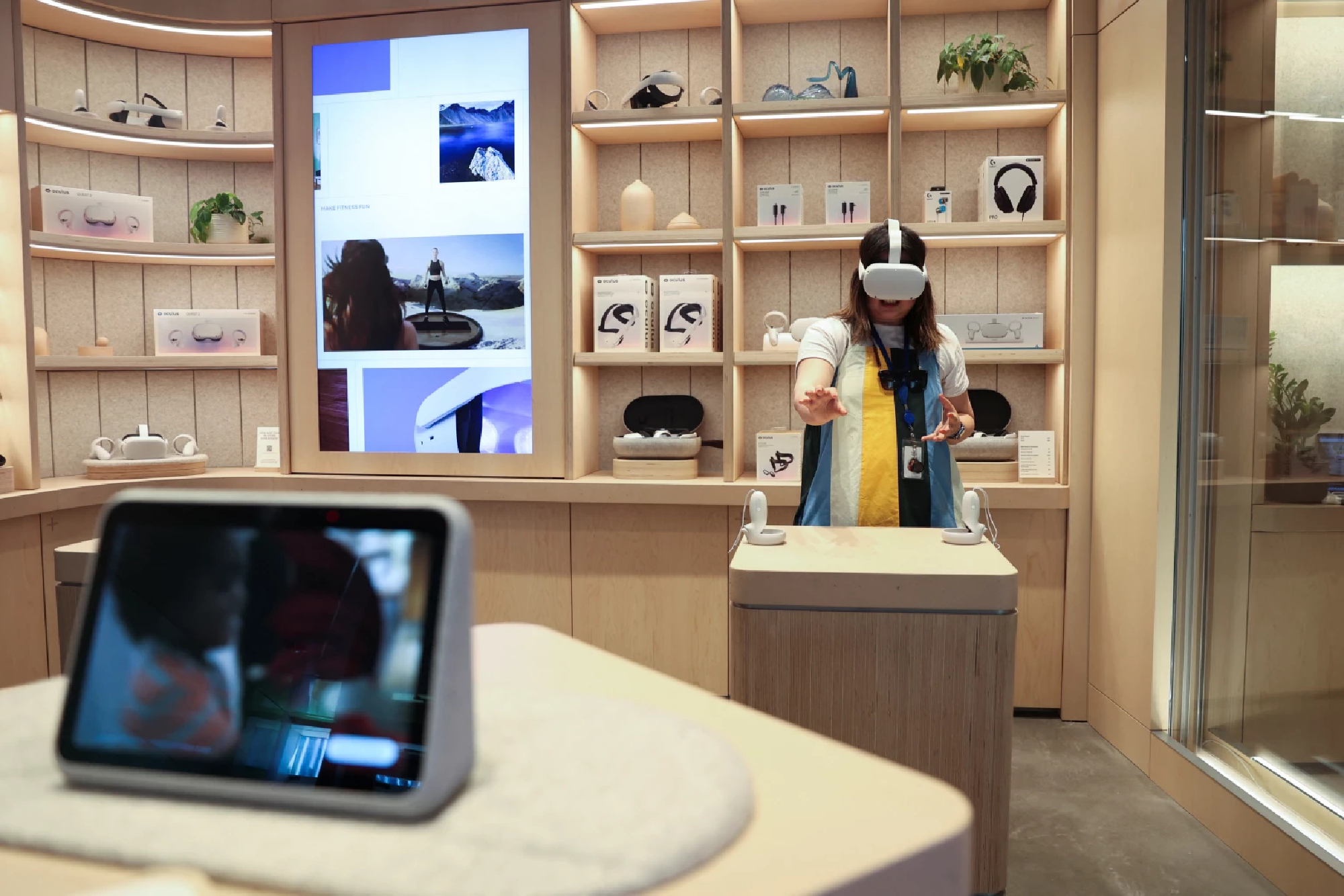
Facebook owner Meta Platforms opened its first physical store on Monday, allowing customers and staff to see and experience its virtual reality headsets and video calling devices.
The store is located at Meta’s Reality Labs campus, in the Silicon Valley town of Burlingame, California. The campus is developing the metaverse hardware showcased at the store, including Ray-Ban smart glasses, Portal video-calling devices and Oculus VR headsets.
Thomas Kobayashi, 29, a software founder who works on virtual reality technology in San Francisco, was among the first in line.
“Yeah, this building will be the first like Apple Store. This is history. And we are the first customers. I am so excited about it. I am so proud of it,” said Kobayashi, who bought a Meta Quest 2 headset.
The opening began with a ribbon-cutting outside the front door in front of a line of more than 25 people. Organisers let in around 20 people at a time, Reuters reported. Some of those in line were Meta employees.
Inside customers had the opportunity to try out some of the technology.
Frank Saunders, 81, a church organist and psychologist in nearby Foster City, was trying the Meta Quest 2 headset for a virtual fishing trip.
“I was very impressed. First visually, just with the visual experience. The interactivity of it was comfortable. And I was getting sound. I was using a fishing demo and it was delightful,” he told Reuters, adding that he sees potential for virtual reality.
The opening of the Meta store makes tangible what is largely a theoretical future business for the world’s largest social media company, which has invested heavily in virtual and augmented reality in a push to build the “metaverse”, a term used to describe shared and immersive virtual spaces.
Chief executive Mark Zuckerberg says the metaverse could be the world’s next big computing platform but has warned that it may take about a decade for the company’s bet to pay off.
In the meantime, with growth slowing and the company still almost entirely reliant on digital ads for revenue, Meta is cutting back on some of its long-term investments.
Martin Gilliard, head of the Meta Store, didn’t comment on any revenue projections but said they were happy with how their products were being adopted.
He was also silent on the future of the stores but said they were focused on this original location so their developers could learn directly from the customers.
“It was important for us to keep the customer experience core to how we build our products, so it made a lot of sense to put it where we’re building our product so we can get that feedback from our customers,” Gilliard said.
When asked where the store fits with Meta’s long history as a social media company and its recent rebranding from Facebook, Gilliard said the store represents a move forward.
“I see this as an evolution of what we are kind of continuing to become. If we think about the Internet moving from a desktop to a mobile experience, what we see now is Web 3 and Metaverse experience being created, and we’ve built products to be part of helping people connect with that,” he said.
In addition to promoting its hardware devices to consumers, Meta is increasingly pitching them to businesses. It gave a demonstration at the store of conference calls that can feature a mix of virtual reality avatars and traditional video calling.
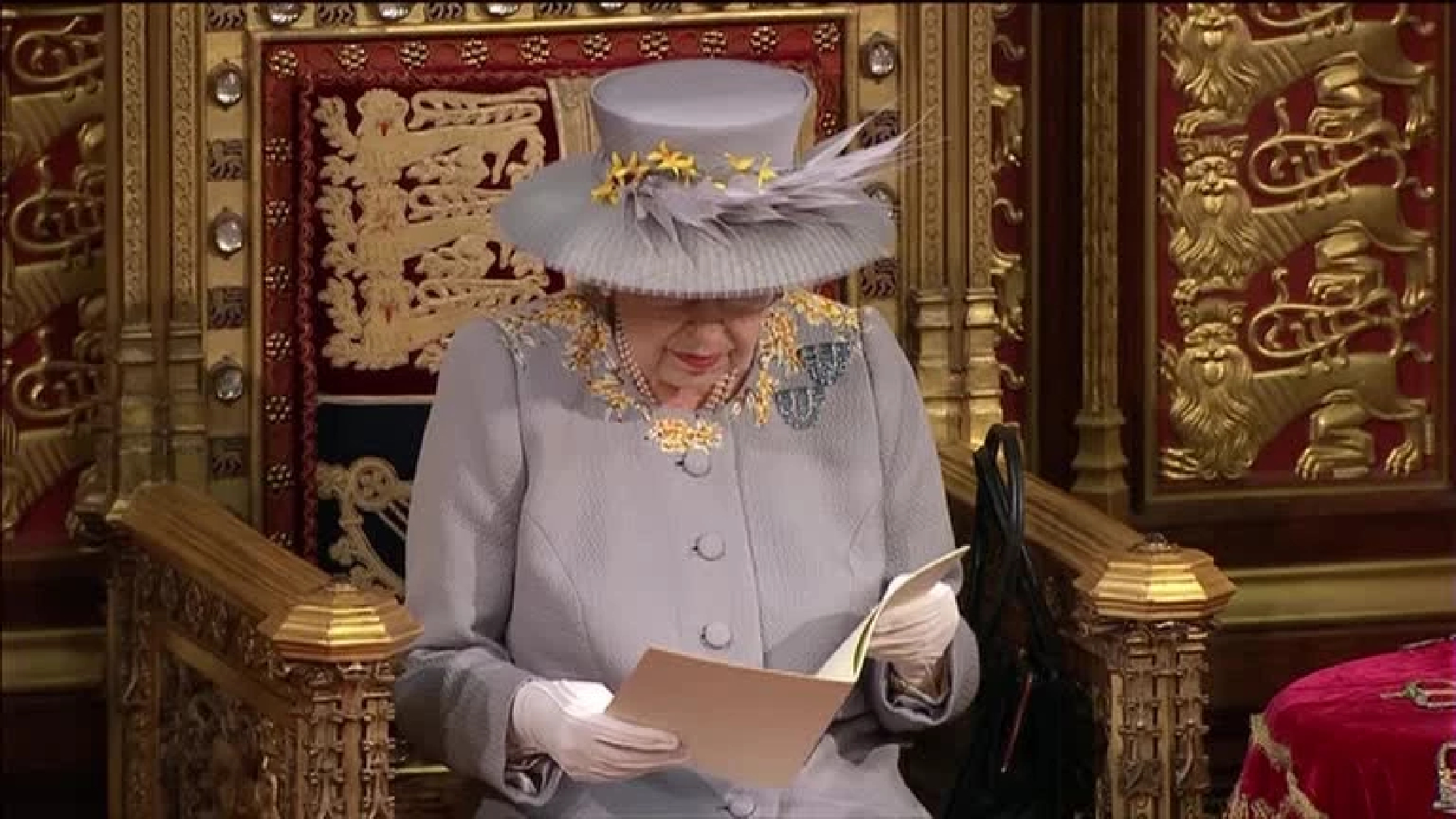
Britain’s Queen Elizabeth will not attend the opening of parliament today (Tuesday) as she has had a recurrence of issues with her mobility, Buckingham Palace said on Monday.
“The Queen continues to experience episodic mobility problems, and in consultation with her doctors has reluctantly decided that she will not attend the State Opening of Parliament tomorrow,” the palace said in a statement.
“At Her Majesty’s request, and with the agreement of the relevant authorities, the Prince of Wales will read the Queen’s speech on Her Majesty’s behalf, with the Duke of Cambridge also in attendance.”
Her son and heir Prince Charles, accompanied by his eldest son Prince William, will step in to replace her for the grand set-piece ceremony, in which the monarch sets out the government’s agenda.
The state opening of parliament is an event of pomp and pageantry which sees the queen travelling to the assembly in a State Coach, escorted by cavalry in ceremonial uniform, while the Imperial State Crown and other regalia travel ahead in a carriage of their own.
The monarch puts on the Robe of State before leading a procession to the House of Lords, where she sits on a throne and formally opens the new session of parliament, reading a speech outlining the government’s legislative plans.
She has missed the occasion twice during her 70-year reign – in 1959 and 1963, when she was pregnant with sons Andrew and Edward, respectively. Prince Charles has attended the opening before, but it is the first time that William, also destined to be a future king, will be officially involved.
Aged 96, Queen Elizabeth II is the world’s oldest monarch.
On May 6 the Hong Kong Tourism Board (HKTB) held its annual Tourism Update event online and announced a revival plan that highlights Hong Kong’s vibrant developments and new experiences, aiming to generate a positive ambience and make the city top-of-mind destination for worldwide travellers when travel resumes.
With the theme “Together Towards New Horizons”, Tourism Update 2022 attracted 3,200 trade representatives from travel agencies, attractions, hotels, airlines, retailers, restaurants, and meeting and exhibition organisers from Hong Kong, Mainland China, and overseas markets. The HKTB shared insights into the latest tourism trends and its work plan for the coming year.
In his opening remarks, HKTB Chairman Dr Y K Pang highlighted Hong Kong’s return to normality. “The fifth wave of the pandemic is subsiding,” he said. “Hong Kong’s daily life and economic activities are now gradually returning to normal, allowing us to stage large-scale events and prepare to welcome back visitors.
“Throughout the pandemic, Hong Kong never stopped building and upgrading its tourism infrastructure. We will see the grand opening of the Hong Kong Palace Museum this summer, while the third runway at Hong Kong International Airport is expected to go into service within the next couple of years. With these new infrastructure elements and the support of the Central and Hong Kong SAR Governments, Hong Kong’s competitive edge has held firm and we can head towards new horizons with confidence.”
In his presentation of the work plan for the coming year, HKTB Executive Director Dane Cheng described how the HKTB will focus first on generating a positive ambience in the city, stimulating consumption, and maintaining Hong Kong’s profile globally by launching “Hong Kong Summer Treats”. The campaign will provide a wide range of discounts and promotional offerings, and will begin with “Arts in Hong Kong” – a campaign that supports international art and cultural events, such as Art Basel, which will return in a physical format.
When social distancing measures are further relaxed, the HKTB will arrange more world-class events in phases, including the Hong Kong Wine & Dine Festival and Hong Kong WinterFest, and give its support to other high-profile events such as the Hong Kong Sevens.
Cheng stressed the importance of ensuring a recovery at home in the run-up to the return of worldwide visitors. “These promotions will generate a positive ambience in Hong Kong and demonstrate how we have returned to normal. The HKTB will then launch extensive promotions, including the tactical ‘Open House Hong Kong’ campaign, to welcome back visitors when the time is right. To better respond to market needs, we will also strive to enhance the visitor journey into a seamless experience through a comprehensive digital transformation.”
He revealed: “The HKTB has conducted extensive research in 16 markets and found Hong Kong is still well-loved by travellers worldwide. They have specifically identified some major driving factors to visit Hong Kong, including cleanliness, local culture, in-depth experiences, unique cuisine, high accessibility, and ease of communications. These factors are not only core strengths of Hong Kong but also match the trends and tastes of the post-COVID travel era.
“With our solid tourism foundations, our status as an East-meets-West centre for international cultural exchange, our position at the heart of the dynamic Greater Bay Area, and our wealth of new tourism assets and infrastructure, Hong Kong’s tourism future is full of potential.”
Guest speakers from major organisations also outlined new developments to further enhance Hong Kong’s world-class tourism infrastructure.
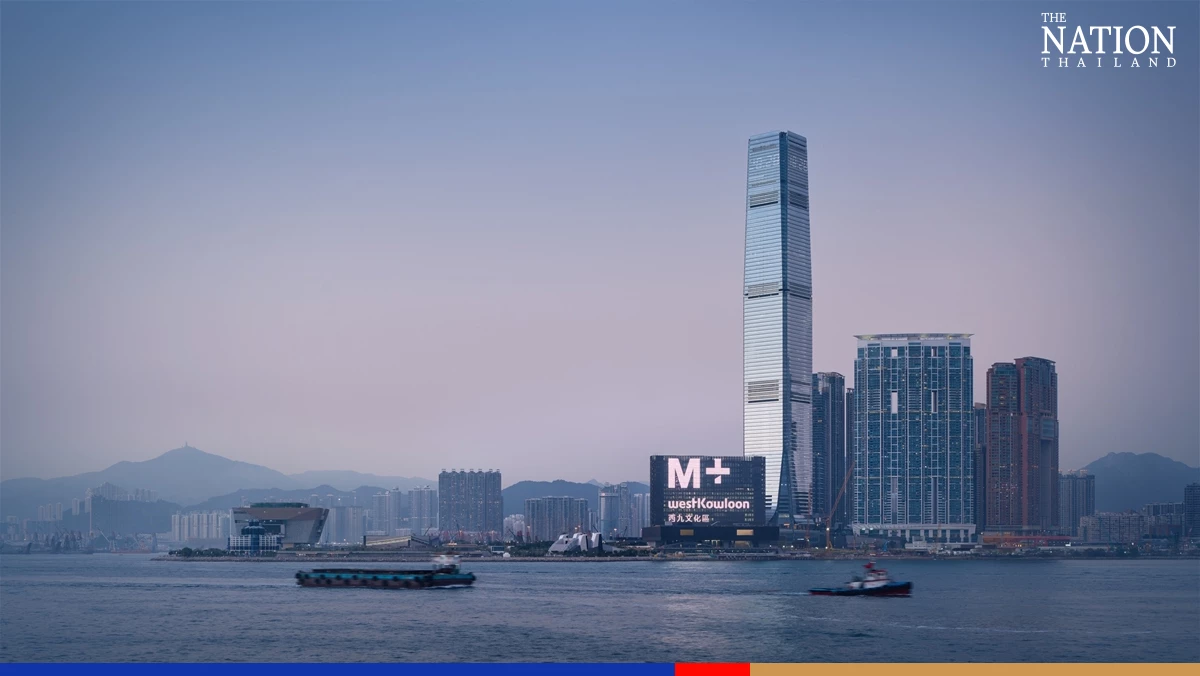
The West Kowloon Cultural District is one of Hong Kong’s major arts and cultural projects. Its contemporary art museum M+ opened last year and the Hong Kong Palace Museum will welcome its first visitors this summer. Speaking at the event, Chief Executive Officer of the West Kowloon Cultural District Betty Fung said: “As a unique cultural hub with unrivalled connectivity in Hong Kong and Asia, WKCD presents the best of the eastern and western culture to visitors, from Chinese arts and antiquities to contemporary visual culture, and offers visitors a holistic experience blending arts and culture with retail, dining and entertainment.”
Hong Kong International Airport plays a pivotal role in maintaining the city’s status as a leading international aviation hub. Airport Authority Hong Kong Executive Director (Airport Operations) Vivian Cheung said: “In addition to maintaining our aviation hub status, our strategy is to transform Hong Kong International Airport from a city airport into an Airport City, developing ourselves into a destination in itself for visitors. The Airport City aims to attract global visitors through its wide range of offerings in retail, dining, entertainment and leisure, while providing a business platform through its convention and exhibition facilities. In parallel we are further enhancing the airport’s sea and land connectivity with the Guangdong-Hong Kong-Macao Greater Bay Area, with a view to facilitating a seamless journey for the 70 million people in the region to visit the Airport City.”
The integration of culture, sports, and tourism is a key development direction. General Director (Commercial) of Kai Tak Sports Park James Irvine said: “As one of the most significant sports infrastructures in Hong Kong, Kai Tak Sports Park will add vibrancy to the city’s dynamic tourism landscape with its world-class sports, leisure and entertainment experiences. A first-of-its-kind destination set in the heart of the city will bring the global community to Hong Kong.”
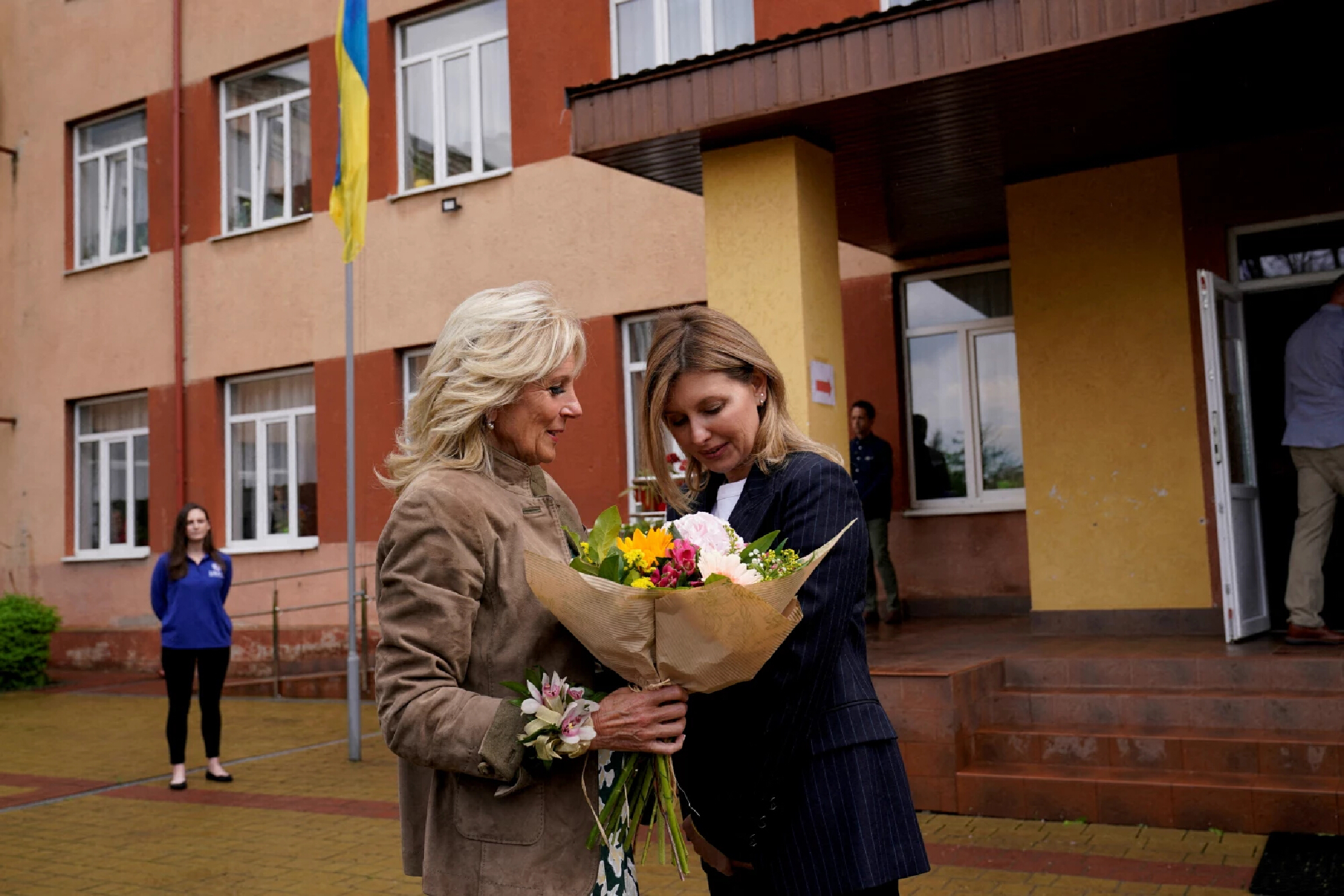
U.S. first lady Jill Biden made an unannounced trip to Ukraine on Sunday (May 8) to show support for its people amid Russia’s invasion, visiting a school that is serving as a temporary shelter and meeting Ukraine’s first lady, Olena Zelenska.
“Ithought it was important to show the Ukrainian people that this war has to stop and this war has been brutal and that the people of the United States stand with the people of Ukraine,” Biden said during her meeting with Zelenska.
The school is serving as a shelter for 163 displaced Ukrainians, including 47 children, the report said.
Biden, who had been travelling in neighbouring Slovakia, gave flowers to Zelenska, who was making her first public appearance since the Russian invasion began on Feb. 24, according to a U.S. official.
Zelenska said Biden was courageous for making the trip.
“We understand what it takes for the U.S. first lady to come here during a war when the military actions are taking place every day, where the air sirens are happening every day even today,” she said through an interpreter, according to the report.
“We all feel your support and we all feel the leadership of the U.S. president, but we would like to note that Mother’s Day is a very symbolic day for us because we also feel your love and support during such an important day.”
U.S. President Joe Biden has been leading efforts to impose economic sanctions on Russia and pressure President Vladimir Putin to end the war. The U.S. president has not been to Ukraine since the invasion, but other top U.S. officials have: Secretary of State Antony Blinken, Defense Secretary Lloyd Austin, and House Speaker Nancy Pelosi visited Kiev in the last two weeks.
Jill Biden returned to Slovakia after her trip across the border.
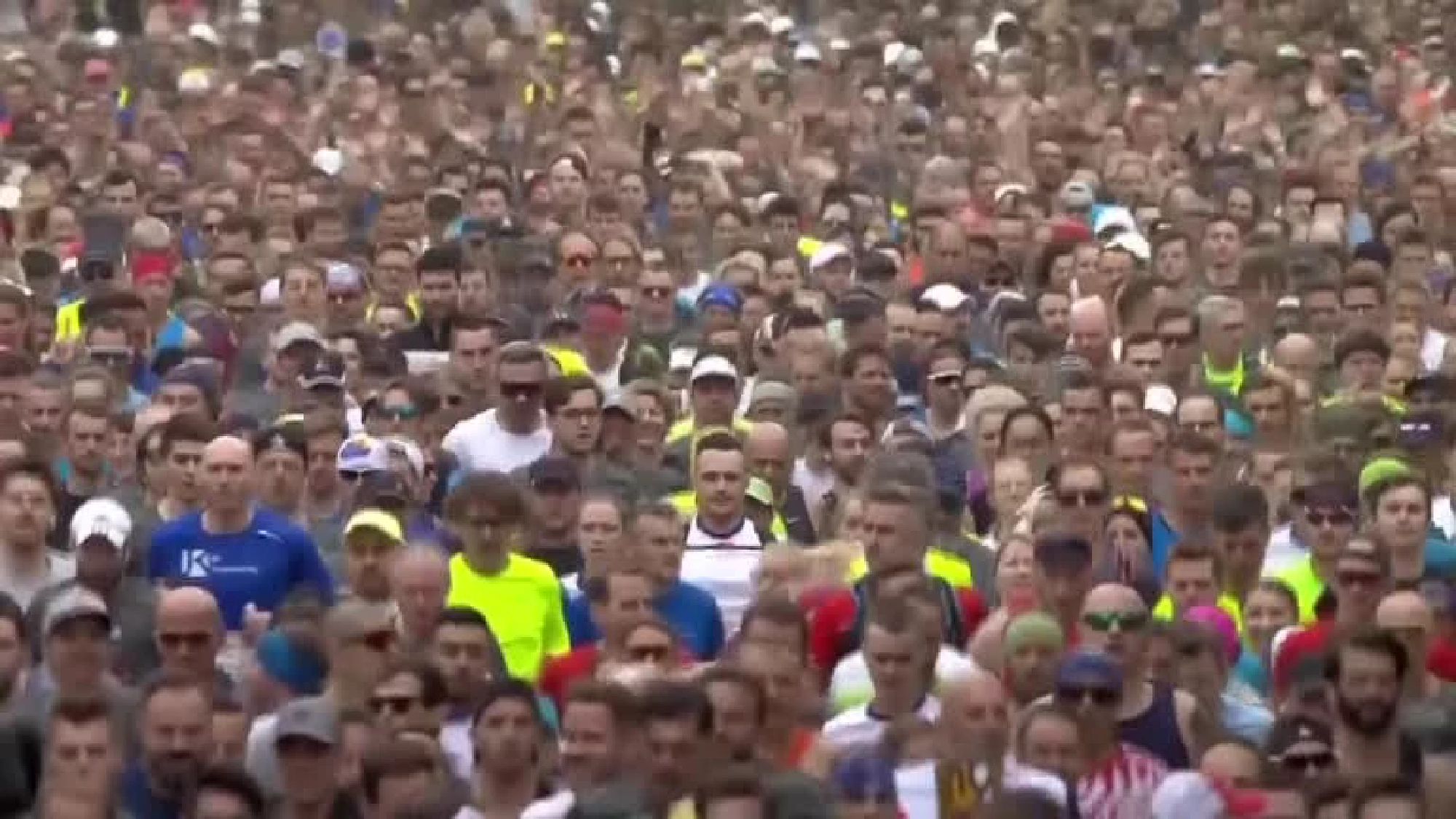
Over 160,000 runners across 165 countries took part in the Wings for Life World Run on Sunday (May 8), raising 4.7 million euros through entry fees and donations for spinal cord research.
There was no set start or finish line to the race: people all over the world joined the run either at one of seven large-scale group runs, in organised groups or on their own via an app. The race ended when participants were caught by a real or virtual Catcher Car, which set off 30 minutes after the runners.
At the ninth edition of the race on Sunday, participants averaged 11.9 kilometres before they were caught by the car.
Nina Zarina of Russia ran 56 kilometres in Santa Monica in the United States to win the women’s race, while Japan’s Jo Fukuda, running in Tokyo, won the men’s race by covering 64.43 kilometres.
Everyone around the world set off at the same time, meaning for some it was a night race, while others took part in the day. The conditions differed for many participants: the hottest temperature runners had to face was in Jaipur, India, where it was 42C (108F) and the coldest was in Nuussuag, Greenland at -8C (18F).
With the 2022 race complete, runners now look to 2023, which will see a special 10th-anniversary edition of the race.