Four global organizations urge 15 bln USD grants this year to fight pandemics

#SootinClaimon.Com : ขอบคุณแหล่งข้อมูล : หนังสือพิมพ์ The Nation.

https://www.nationthailand.com/international/40014237


“A future in which we are to respond to the next Disease X with new vaccines, therapeutics, and diagnostics in just 100 days is possible – but it will take vision, political will, and commensurate financial investments from governments around the world,” said Richard Hatchett, CEO of CEPI.
Four global organizations urge 15 bln USD grants this year to fight pandemics

The International Monetary Fund (IMF) and three other global organizations on Tuesday urged the allocation of 15 billion U.S. dollars in grants this year to fight pandemics and strengthen health systems both domestically and overseas.

The IMF, in partnership with the Coalition for Epidemic Preparedness Innovations (CEPI), the Global Fund, and Wellcome Trust, published “A Global Strategy to Manage the Long-term Risks of COVID-19” working paper, which calls for a more “comprehensive” and “integrated” pandemic response from the international community.

“It is now evident that COVID-19 will be with us for the long term, and there are very different scenarios for how it could evolve, from a mild endemic scenario to a dangerous variant scenario,” the working paper noted.

“This realization calls for a new strategy that manages both the uncertainty and the long-term risks of COVID-19,” it continued.
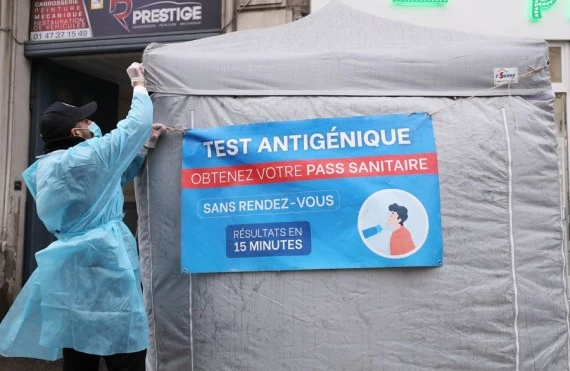
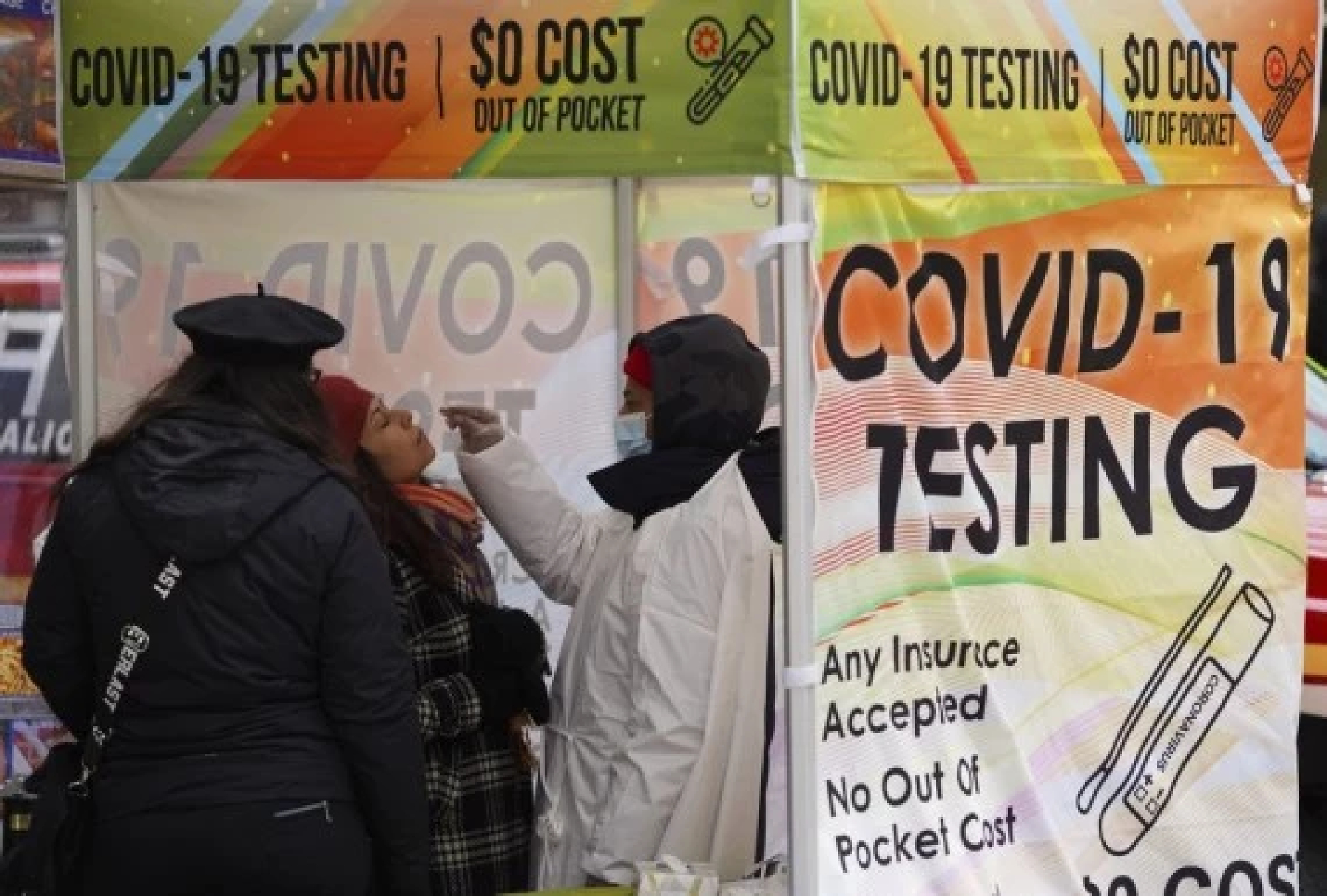
A medical staff member adjusts a sign in the wind at a fast COVID-19 test screening tent in Paris, France, April 1, 2022. (Xinhua/Gao Jing)A medical staff member adjusts a sign in the wind at a fast COVID-19 test screening tent in Paris, France, April 1, 2022. (Xinhua/Gao Jing)

“Overall, health security is economic security,” said IMF’s First Deputy Managing Director Gita Gopinath, who previously served as the Fund’s chief economist. “The international community should recognize that its pandemic financing addresses a systemic risk to the global economy.”

Gopinath noted that the IMF’s January World Economic Outlook Update estimated the cumulative losses from the pandemic to reach 13.8 trillion dollars from 2020 to 2024. “The cost of inaction – for all of us – is very high. We need to act – now,” she said.

Echoing her remarks, Jeremy Farrar, director of Wellcome Trust and a renowned medical researcher, said “now is not the time to ease up,” noting that the virus’ next move is “anything but certain” and the risk of new variants remains high.

“We need to set our sights on developing next generation vaccines that can block transmission and won’t require endless boosters, strengthening genomic surveillance globally so we can identify and track new variants and improving global access to vaccines, treatments and tests,” Farrar said. “Leaving any countries unprotected puts us all at risk.”

The newly released working paper laid out four policy implications: achieve equitable access beyond vaccines to encompass a comprehensive toolkit; monitor the evolving virus and dynamically upgrade the toolkit; transition from the acute response to a sustainable strategy toward COVID-19, balanced and integrated with other health and social priorities; adopt a unified risk-mitigation approach to future infectious disease threats beyond COVID-19.

Accordingly, the international community should allocate additional funding to fight pandemics and strengthen health systems both domestically and overseas, the paper argued. This will require about 15 billion dollars in grants this year and 10 billion dollars annually after that.

“This price tag is substantial, but failure to invest now – and build on the gains made in the response to COVID-19 – will result in human and economic costs that will reverberate for generations,” said Richard Hatchett, CEO of CEPI.

“A future in which we are to respond to the next Disease X with new vaccines, therapeutics, and diagnostics in just 100 days is possible – but it will take vision, political will, and commensurate financial investments from governments around the world,” Hatchett said.

Peter Sands, executive director of Global Fund, believed that the next phase of the fight against COVID-19 will be different. “We are in for a long fight against a virus that continues to evolve. So we must shift to a more sustainable response that recognizes the linkages between responding to COVID-19, tackling the earlier pandemics of HIV, TB (Tuberculosis) and malaria, and preparing for future pandemic threats,” he said.

The working paper also showed that one of the dangerous legacies of the COVID-19 pandemic, exacerbated by the consequences of Russia-Ukraine war, is weakened capacity in developing countries to invest in their people (including in health) combined with lower appetite for grant support for development as countries prioritize their economies.

“This means the fundamental problem of weak health systems in developing countries and under-investment in global health threats will remain – unless securing resilience is recognized as a common goal and its financing is taken up as a global priority,” according to the paper. 
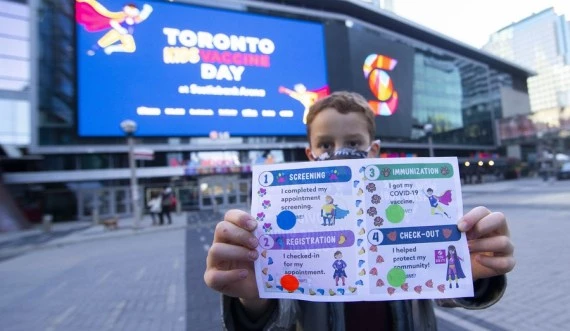
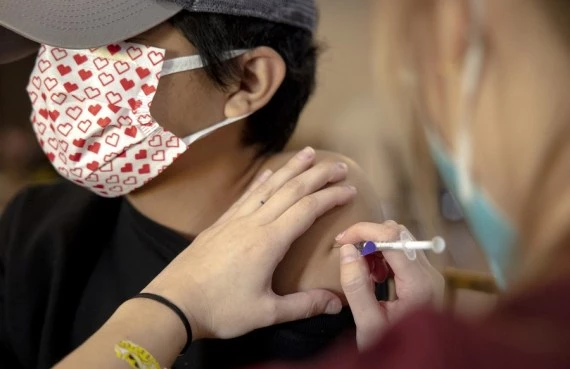
A boy wearing a face mask poses for photos with a COVID-19 vaccination "passport" after being vaccinated outside a vaccination site in Toronto, Canada, on Dec. 12, 2021. (Photo by Zou Zheng/Xinhua)A boy wearing a face mask poses for photos with a COVID-19 vaccination “passport” after being vaccinated outside a vaccination site in Toronto, Canada, on Dec. 12, 2021. (Photo by Zou Zheng/Xinhua)

Published : April 06, 2022

By : Xinhua
Japan fisheries federation remains opposed to gov’t plan to dump toxic Fukushima water

#SootinClaimon.Com : ขอบคุณแหล่งข้อมูล : หนังสือพิมพ์ The Nation.

https://www.nationthailand.com/international/40014235


“I told (Prime Minister Fumio) Kishida our position to oppose the discharge remains exactly the same,” said Hiroshi Kishi, head of Japan’s national fisheries cooperatives. “We just hope people in the fisheries industry will be able to continue fishing with peace of mind.”

Japan fisheries federation remains opposed to gov't plan to dump toxic Fukushima water

Japan’s fisheries federation said on Tuesday that it remained firmly opposed to the government’s plan of dumping toxic water from the crippled Fukushima nuclear power plant into the Pacific.
 

“I told (Prime Minister Fumio) Kishida our position to oppose the discharge remains exactly the same,” Hiroshi Kishi, head of the national fisheries cooperatives, told reporters after his meeting with the prime minister.

Kishida, for his part, said the government will be fully responsible for the impact of the discharged treated water, Kishi said.

Earlier in the day, Kishi held talks with Industry Minister Koichi Hagiuda, during which he also expressed his ardent opposition to the plan to dump contaminated water from the crisis-hit plant into the ocean.

“We just hope people in the fisheries industry will be able to continue fishing with peace of mind,” Kishi said after meeting Hagiuda in the federation’s office in Tokyo.

Hagiuda’s visit to the organization was his first since the decision was made in April last year to release low-level radioactive water into the sea from around the spring of 2023.

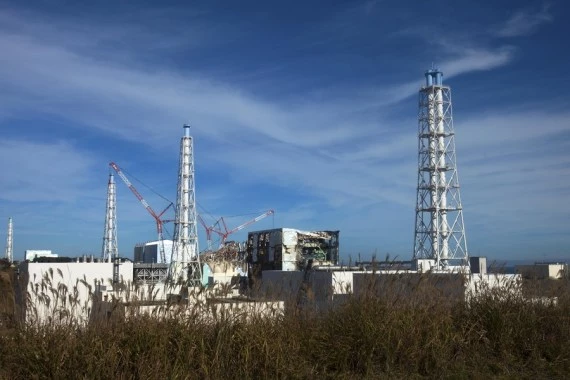
File photo taken on Nov. 12, 2011 shows the exterior of Fukushima Daiichi nuclear plant in Fukushima Prefecture, Japan. (Xinhua)File photo taken on Nov. 12, 2011 shows the exterior of Fukushima Daiichi nuclear plant in Fukushima Prefecture, Japan. (Xinhua)

During the meeting, Hagiuda reportedly explained ways to ensure safety and measures to tackle reputational damage to food products.

The minister said the government will keep its promise to the fishermen that the crippled plant will not dump the water into the ocean without their understanding and that it will “create a very large fund to support their businesses,” Kishi said.

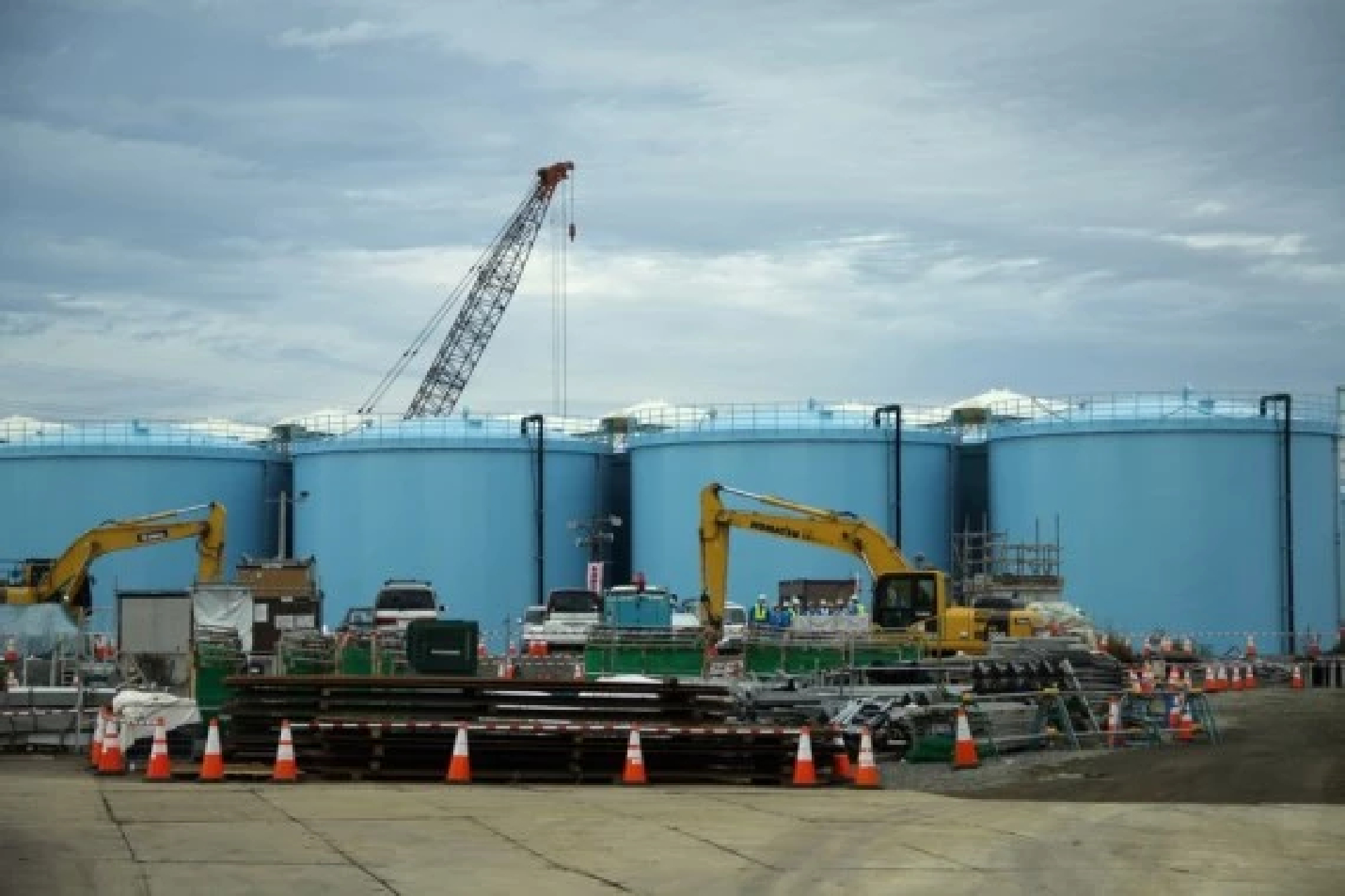
Tokyo Electric Power Company Holdings Inc., the operator of the crippled nuclear plant that underwent core meltdowns after being pummeled by a devastating earthquake-triggered tsunami in 2011, said that it is running out of storage tanks to hold water used to cool the melted-down cores.

The Japanese government has been looking into ways to dispose of more than 1 million tons of water used to cool the cores, with the plant struggling to store the water, the amount of which is rising by around 150 tons per day.

After cooling the melted-down cores, the radioactive water is treated before being stored in the tanks by an Advanced Liquid Processing System (ALPS). This process, however, does not remove radioactive tritium and some other radioactive materials.

Much to the chagrin of the international community, including some of Japan’s closest neighbors, Japan unilaterally decided in April last year that it plans to release radioactive water that has accumulated at the crisis-hit plant into the Pacific. The toxic water, stored in tanks at the plant in Japan’s northeast, is expected to soon reach capacity.

The tainted water contains radioactive tritium as a result of being used to cool down melted nuclear fuel at the plant in Fukushima Prefecture.

The plan is to release the water through a tunnel under the seabed into the Pacific roughly 1 km away from the stricken plant. The controversial plan is proposed to begin in the spring of 2023, much to the consternation of local fisheries and the international community.

Japan’s fisheries industry has on numerous occasions voiced its opposition to the plan, as it will almost certainly cause further damage to the industry’s reputation.

Moreover, some of Japan’s closest neighbor countries have voiced strong concerns over the plan.

Japan’s government had been considering a number of feasible alternative plans other than its unilateral proposal to just dump radioactive water into the ocean.

These options included injecting the toxic water deep into the ground, releasing it into the atmosphere after vaporizing it, or making it into a solid state and burying it underground

Published : April 06, 2022

By : Xinhua
Biden’s Supreme Court nominee to be confirmed Thursday, says Senate majority leader

#SootinClaimon.Com : ขอบคุณแหล่งข้อมูล : หนังสือพิมพ์ The Nation.

https://www.nationthailand.com/international/40014233


It requires a simple majority of votes from the 100-seat Senate to confirm Jackson to be the first African American female justice on the Supreme Court.

Biden's Supreme Court nominee to be confirmed Thursday, says Senate majority leader

The U.S. Senate could confirm Judge Ketanji Brown Jackson for the Supreme Court as soon as Thursday, according to Majority Leader and Democrat Chuck Schumer.

“Once I file cloture, the stage will be set for the Senate to close debate on Judge Jackson’s nomination by Thursday,” Schumer said on Tuesday from the Senate floor. “A vote on final confirmation will then follow.”

Senate Republicans, most of whom have opposed Jackson’s nomination, could potentially delay a final vote until Friday.

Minority Leader Mitch McConnell said on Tuesday that he intends to use the upcoming full floor debate to discuss “why Judge Jackson’s apparent judicial philosophy is not well suited to our highest Court.”

McConnell also warned that Biden would have to tack to the center if he expects to fill another vacancy on the Supreme Court should Republicans win back control of the Senate in the midterms.

Jackson, 51, was nominated by Biden late February to succeed liberal Supreme Court Justice Stephen Breyer, who is about to retire this summer.

White House press secretary Jen Psaki told reporters on Tuesday that Biden “is looking forward to Judge Jackson getting confirmed.”

A former public defender, Jackson currently sits on the U.S. Court of Appeals for the D.C. Circuit, often referred to as the nation’s second most powerful court.

It requires a simple majority of votes from the 100-seat Senate to confirm Jackson to be the first African American female justice on the Supreme Court.

This year, the Supreme Court will rule on cases involving a series of major issues, including abortion, affirmative action, and gun control.

The Supreme Court is the final appellate court of the U.S. judicial system, with the power to review and overturn lower court decisions, and is also generally the final interpreter of federal law, including the country’s constitution.

The justices have life tenure and can serve until they die, resign, retire, or are impeached and removed from office.

Published : April 06, 2022

By : Xinhua

Drone footage shows people queueing for humanitarian aid in besieged Mariupol

#SootinClaimon.Com : ขอบคุณแหล่งข้อมูล : หนังสือพิมพ์ The Nation.

https://www.nationthailand.com/international/40014230


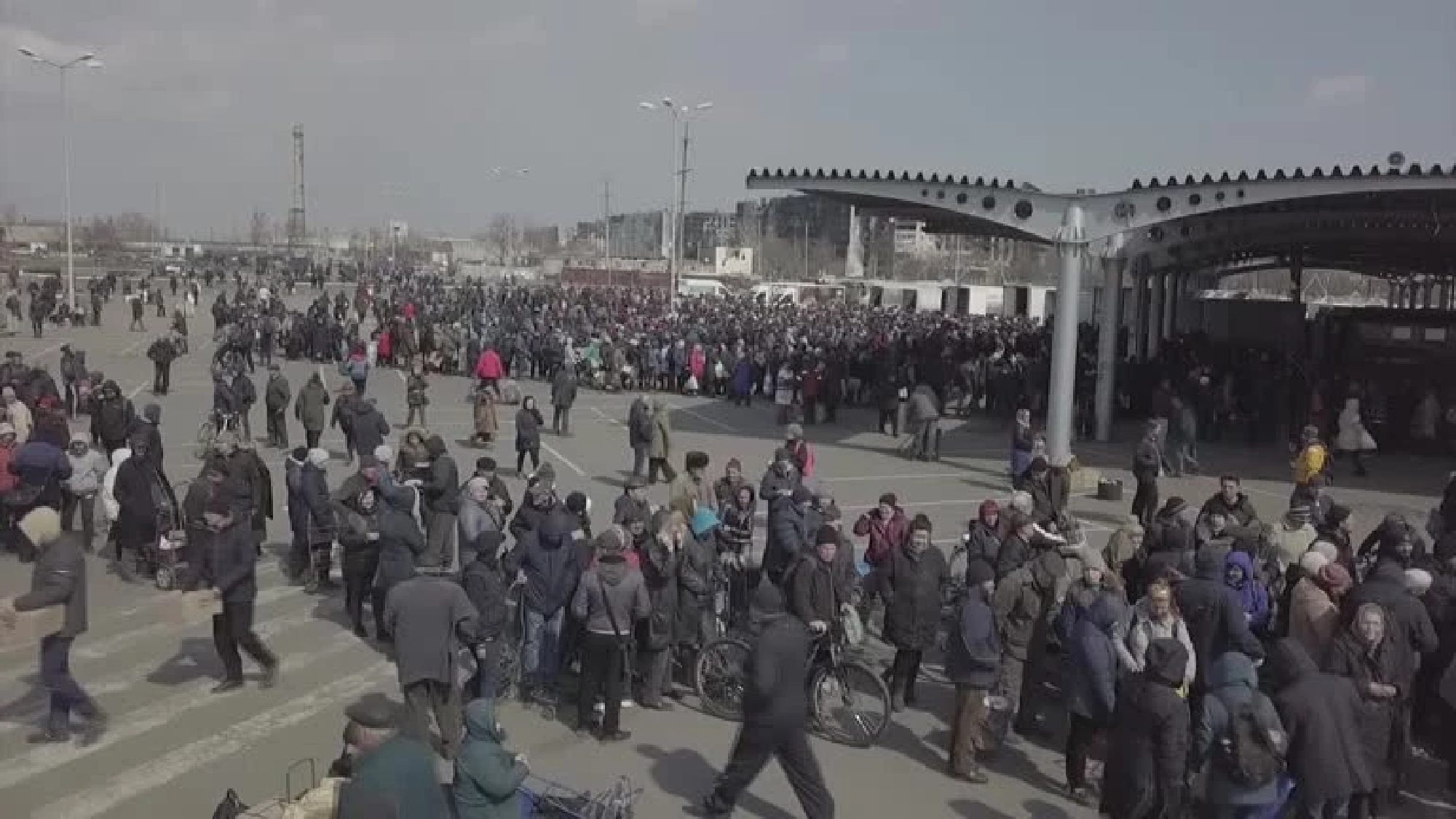
Drone footage filmed on Tuesday (April 5) shows Mariupol residents waiting in long queues for humanitarian aid from Russia outside a former shopping centre.

Drone footage shows people queueing for humanitarian aid in besieged Mariupol

The southern Ukrainian port of Mariupol, once a city of 400,000 people, has been almost completely flattened by prolonged Russian bombardment aimed at breaking the resistance of the city’s Ukrainian defenders.

Hundreds of thousands of people have been hiding in basements with no running water, food, medicine or power, unable or unwilling to leave. Ukraine’s President Volodymyr Zelenskiy has said there was “nothing left” of the city.

Russia’s Defence Ministry has blamed “Ukrainian nationalists” for what it called the “humanitarian catastrophe” in Mariupol.

The ministry said on Tuesday that its forces would “liberate” Mariupol from Ukrainian “nationalists,” the RIA news agency reported.

Another agency, Interfax, quoted the ministry as saying that the Russian side had proposed that Ukrainian forces leave the city but they refused to do so.

People are still only able to flee the besieged Ukrainian city of Mariupol on foot or by private car as efforts to organize mass evacuations by bus to safer parts of Ukraine have failed, Ukraine’s Deputy Prime Minister Iryna Vereshchuk said.

Buses cannot reach the first part of the evacuation route from Mariupol, which is “nearly 80 km (50 miles) – people have to either walk or find a way to make this journey in a private car,” she said on national television.

Published : April 06, 2022

By : Reuters

‘So many bodies piled up’: Hong Kong funeral services overwhelmed by COVID

#SootinClaimon.Com : ขอบคุณแหล่งข้อมูล : หนังสือพิมพ์ The Nation.

https://www.nationthailand.com/international/40014229


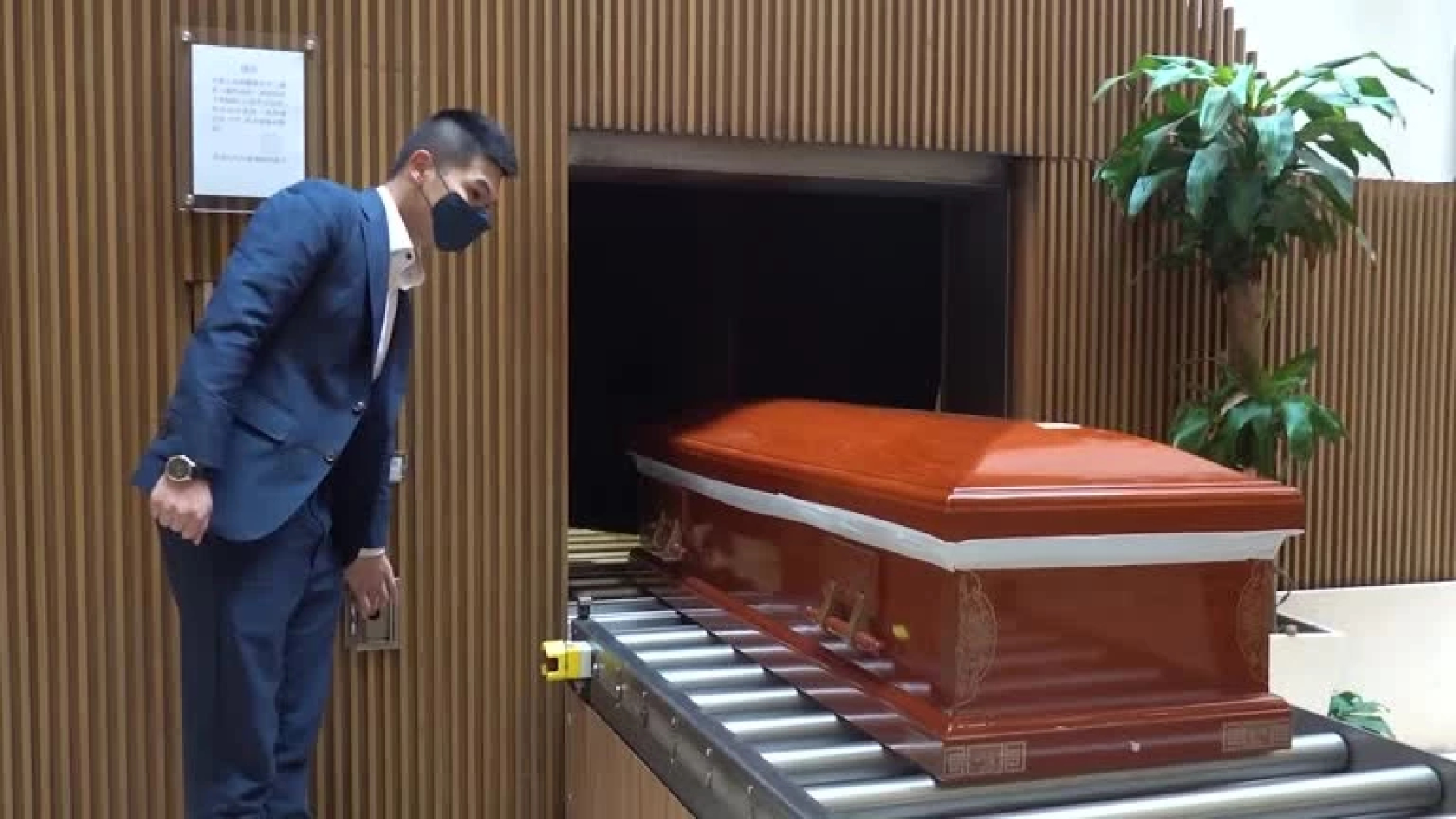
At a Hong Kong public hospital’s mortuary, funeral director Hades Chung claimed the body of a COVID-19 victim on behalf of his family who lives in mainland China. The family could not arrive in time due to quarantine measures. 

'So many bodies piled up': Hong Kong funeral services overwhelmed by COVID

Chan, accompanied by his colleague in full protective gear, opened the coffin and spread paper money on the body as part of a traditional ritual before sending it to a cremation site. 

“I feel heartbroken,” Chan, 31, who has been working round the clock to help bereaved families, as the global financial hub battles a surge in COVID-19 deaths that is overwhelming its funeral parlours.

Since the fifth wave of coronavirus hit the former British colony this year, it has reported more than a million infections and nearly 8,000 deaths. Scenes of bodies stacked in emergency rooms next to patients have shocked many as places in mortuaries run out.

“I’ve never seen so many bodies that they have been piled up together,” said another funeral director Lok Chung, 37, who has been organising about 40 funerals in March, up from roughly 15 in an average month.

“I’ve never seen the family members been so upset, so disappointed,” he said.

Housewife Kate, 36 said the March death of her father-in-law from COVID-19 took a huge emotional toll on the family and added that her biggest regret was being unable to visit him in hospital.

“When they (the doctors and nurses) thought my father-in-law’s situation was not ok, we rushed to the hospital, but it was too late. As he was in the isolation ward, we couldn’t see him for the last time,” she told Reuters at the funeral ceremony.

The surge in COVID-19 deaths has resulted in a long wait for documents, including death certificates, to be processed, according to Chung.

Traditional wooden coffins are running short, and also in demand are the traditional paper replicas of items, from cars to homes and other personal effects, burnt as offerings at Chinese funerals for use in the afterlife. Much of the delay is blamed on a logjam in transport from the neighbouring southern Chinese city of Shenzhen, which supplies many of the items, but is now fighting its outbreak of COVID-19.

The border with Hong Kong is largely closed due to the disease.

China supplies more than 95% of the 250 to 300 coffins Hong Kong needs each day, authorities said.

It received more than 3,570 coffins during the period from March 14 to 26, after the government of the Chinese-ruled city coordinated with mainland authorities.

The six crematoriums now run almost round the clock to get through nearly 300 cremations a day or double the usual figure. And public mortuaries have been expanded to accommodate 4,600 bodies from 1,350 earlier, authorities said.

Non-government body Forget Thee Not has partnered with an eco-friendly coffin maker LifeArt Asia, to donate 300 such coffins and 1,000 boxes of preservatives to six public hospitals. Each coffin is made of cardboard with recycled wood fibres and can take a weight up to 200 kg (441 lb).

Placed in coffins or body bags, the powder-like preservative turns to gas, to keep the body in its natural state for up to five days.

“We are in the eye of the storm,” said LifeArt Asia’s chief executive, Wilson Tong. “And amid this storm, we are trying to provide a moment of respite.”

Published : April 06, 2022

By : Reuters

El Salvador to build prison for 20,000 gang members, says President Bukele

#SootinClaimon.Com : ขอบคุณแหล่งข้อมูล : หนังสือพิมพ์ The Nation.

https://www.nationthailand.com/international/40014228


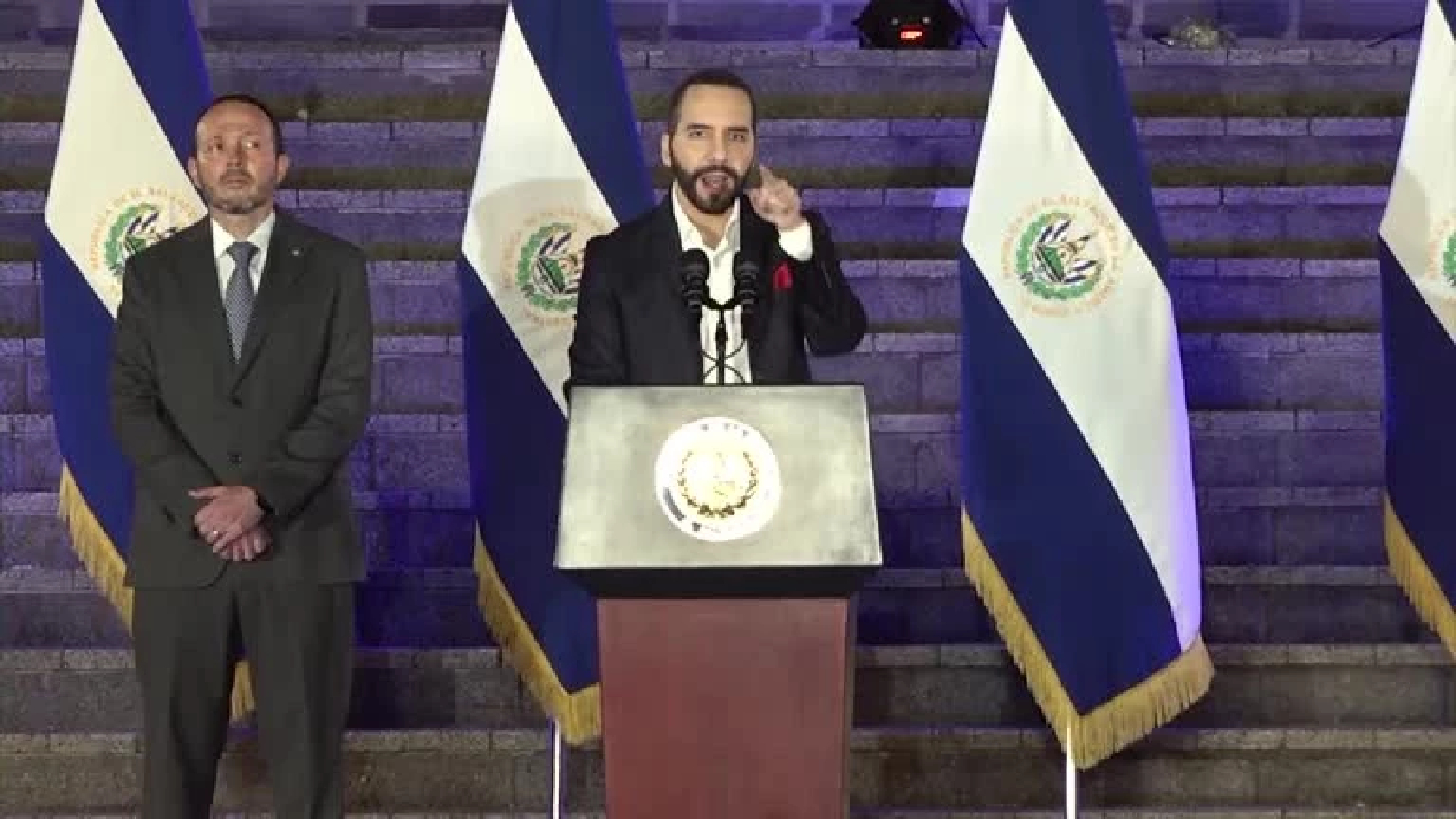
President of El Salvador Nayib Bukele announced his intention to build a maximum-security prison for 20,000 gang members during a graduation ceremony for army cadets on Tuesday (April 5).

El Salvador to build prison for 20,000 gang members, says President Bukele

Bukele warned of gangs that he will keep rationing food in jail unless the violence ends. “Let’s see how long those “home-boys” last in there. I swear to God that they won’t eat a (grain of) rice. Let’s see how long they last.” Said Bukele.

El Salvador’s Congress approved on March 27 emergency powers that temporarily suspended some constitutional protections after the Central American country recorded a sharp rise in killings attributed to criminal gangs.

In 2015, El Salvador recorded a rate of 103 homicides for every 100,000 people, one of the highest in the world. Figures show that the rate has fallen steadily since Bukele took office in 2019.

Yet, critics say Bukele’s administration has been marked by democratic backsliding, as he has sought to consolidate his control over the legislative and judicial branches.

Director at Cristosal Human Rights Organization, Abraham Abrego, says the government’s actions put the youth at risk.

“Everyone can potentially be a gang member or suspected gang member. Young people are vulnerable, and we are seeing this in buses and houses raids. Just because they are minors and because of their appearances, (the government) is prompting abuses against minors and children,” he said.

Bukele’s government has also been accused of brokering a pact with the two main gangs, offering gang members better prison conditions, money and other benefits in exchange for them reducing homicide rates and giving electoral support to Bukele’s party at legislative elections. He has repeatedly denied those accusations.

Published : April 06, 2022

Hundreds of Ukrainians shelter in Mexico as they wait to cross U.S. border

#SootinClaimon.Com : ขอบคุณแหล่งข้อมูล : หนังสือพิมพ์ The Nation.

https://www.nationthailand.com/international/40014226


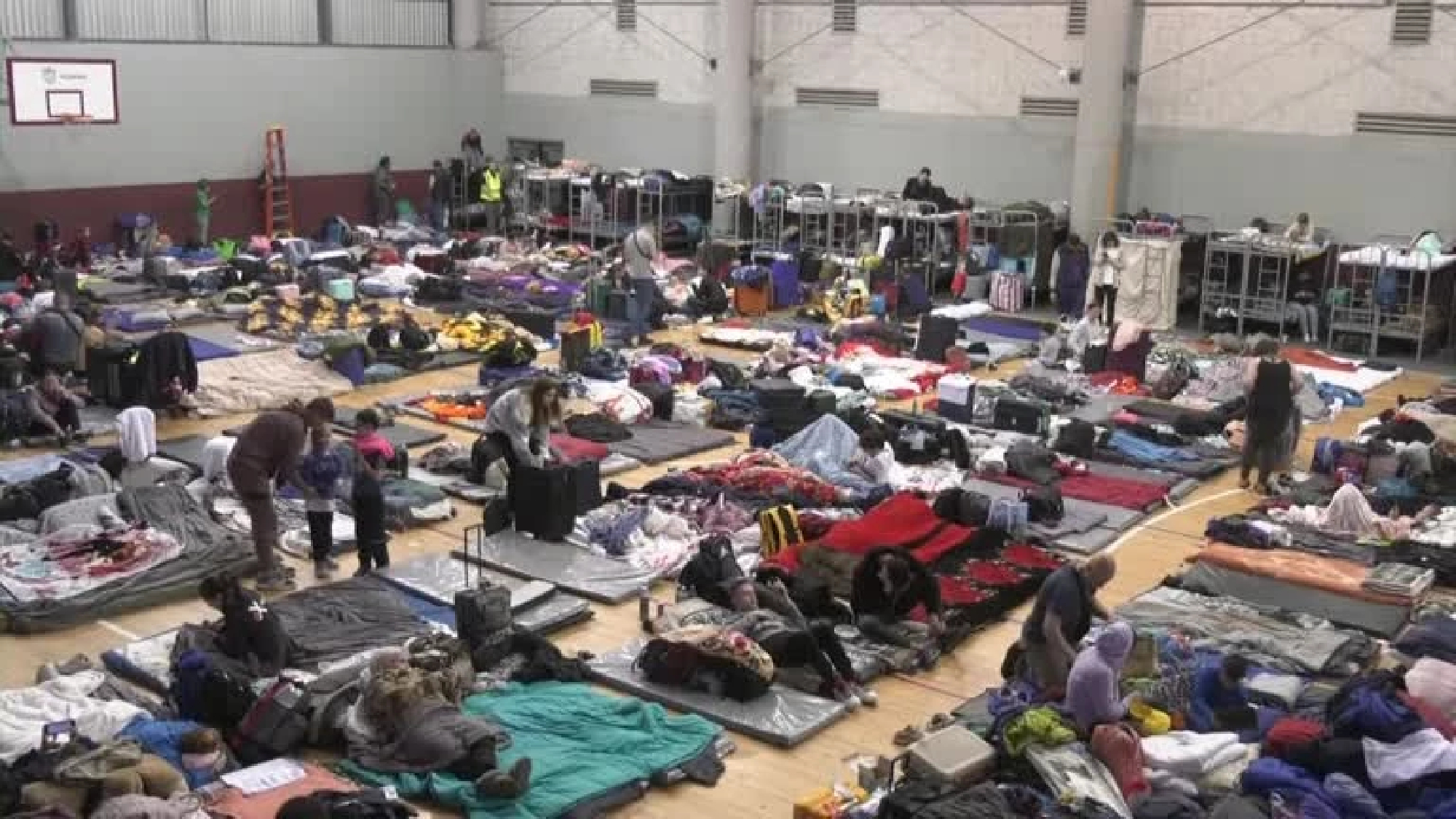
Hundreds of Ukrainian refugees who fled to Mexico were transferred to a sports centre that was converted into a government shelter in the northern city of Tijuana, authorities said on Monday (April 5), as they wait to be allowed to cross the border and enter the United States.

Hundreds of Ukrainians shelter in Mexico as they wait to cross U.S. border

Some 400 Ukrainians, about 30% of whom are children, arrived in Tijuana on Saturday (April 2) and Sunday (April 3) after entering the country through airports in Cancun and Mexico City, said Enrique Lucero, Tijuana’s migration affairs director.

They joined a growing number of Ukrainians who have escaped war in their home country and have crammed into improvised camps near the international port of entry, which connects Tijuana with California.

As of Sunday night, Lucero said an estimated 1,700 Ukrainians have arrived in Tijuana in recent weeks.

“We are hoping the United States will increase the number of migrant affairs and border personnel so that the flow will be faster,” Lucero said. “That way in three to four weeks the situation could be neutralised.”

The increase of Ukrainians in Tijuana comes as U.S. officials are ramping up efforts to process migrants and asylum seekers, regardless of nationality, amid an expected increase in arrivals as the United States lifts a pandemic-era policy that effectively shut down asylum at the border.

In the shelter, families of migrants rested, ate, and played.

”I’m really surprised about how people have been helping us here, the conditions of the shelter are perfect,” Ukrainian citizens seeking asylum in the U.S. Yevhen Shyshkin told Reuters.

On Monday, U.S. Customs and Border Protection (CBP) Commissioner Chris Magnus said in a statement that the agency is ramping up personnel and resources at the southwest border, without providing details about the number of agents being deployed or specific locations for deployments.

Lucero said he was hopeful that the U.S. officials would speed up Ukrainian migrants’ processing and that the shelter should ease housing issues until then.

In late March, U.S. President Joe Biden said that the United States would accept up to 100,000 Ukrainians to resettle in the country this year.

Published : April 06, 2022

By : Reuters

Russian auto boomtown grinds to halt over Ukraine sanctions

#SootinClaimon.Com : ขอบคุณแหล่งข้อมูล : หนังสือพิมพ์ The Nation.

https://www.nationthailand.com/international/40014197


Thousands of autoworkers have been furloughed and food prices are soaring as Western sanctions pummel the small Russian city of Kaluga and its flagship foreign carmakers, with more sanctions likely to come.

Russian auto boomtown grinds to halt over Ukraine sanctions

Once the hometown of Russian and Soviet rocket scientist Konstantin Tsiolkovsky, Kaluga remains a key hub for Russia’s aerospace industry, but today the city relies on more down-to-earth business.

The Kaluga region, 190 kilometres (120 miles) southwest of Moscow, says it has attracted more than 1.3 trillion roubles ($15 billion) in investment, mostly foreign, since 2006.

But Western sanctions imposed in recent weeks over Russia’s invasion of Ukraine have exacerbated lingering component shortages and halted production at two flagship car plants, Germany’s Volkswagen and Sweden’s Volvo.

A third, the PSMA Rus plant is a joint venture between Stellantis and Mitsubishi that employs 2,000, may halt production soon due to a lack of parts, Stellantis’ chief executive said last Thursday (March 31). “It is not clear what will happen. They don’t give us any concrete information,” said Pavel Terpugov, a welder at the PSMA Rus plant.

Terpugov said he needs twice as much money to buy groceries than before the sanctions. Analysts have forecast that Russian inflation could soar to 24% this year, while the economy may shrink to 2009 levels.

The hardships of the Russian people are a far cry from the devastation the war has caused Ukrainians. International outrage spread on Monday over civilian killings in northern Ukraine, where a mass grave was found in Bucha, outside Kyiv. The deaths are likely to galvanize the United States and Europe into additional sanctions against Moscow.

Russia calls its actions in Ukraine a “special operation” and the Kremlin categorically denied any accusations related to the murder of civilians, including in Bucha.

The region hosts three car factories, owned by global carmakers Volkswagen, Stellantis and Volvo, as well as global manufacturers of automotive components, pharmaceutical and food products, and Samsung TV’s factory.

One source of hope for some in Kaluga, with its 325,000 residents, is that the West may be reluctant to hurt its own companies.

“Does it make sense to impose sanctions on its own plant and lose money?” said Valery Uglov, an auto mechanic at the Volkswagen plant. “Does it make sense to lose the Russian market?”

“We hope to return to work as soon as possible and everyone will have confidence in the future again,” Uglov said.

Volkswagen, whose factory employs 4,200 people, in early March suspended operations due to the war. A spokeswoman said production remained frozen.

Volvo Group, which employs over 600 people to build trucks, also suspended production.

Even before the sanctions, Russian car sales had contracted from 2.8 million units when the Volkswagen factory opened in 2007 to 1.67 million units last year, damaged by both sanctions after the 2014 annexation of Crimea and the COVID-19 pandemic.

Some factories cut output last year due to disruptions caused by the pandemic.

“We have had similar furloughs at the factory… but now, of course, the situation is different, more serious,” said Alexander Netesov, a warehouse foreman at the Volkswagen plant. “But we are waiting anyway, we are not losing hope,” he said.

In a sign of the squeeze workers are feeling, Netesov said a new Polo car he ordered with a factory discount had increased in price by 20% since his pre-order.

Others in the city, also boast production by pharmaceutical and food companies as well as Samsung televisions 005930.KS, derive optimism from the fact that almost every crisis that has ravaged the Russian economy over the past two decades has been followed by a boom.

“The prices have increased, the situation in the country is unstable, but we all hope that in the near future everything will stabilize in the country and at our dealership, at the plant, and sales will be good again,” said Angelina Minnigulova, a marketing executive at Volkswagen dealer KorsGroup, which has seen a fall in demand as car prices soar.

Published : April 05, 2022

By : Reuters

How could Russia’s Putin be prosecuted for war crimes in Ukraine?

#SootinClaimon.Com : ขอบคุณแหล่งข้อมูล : หนังสือพิมพ์ The Nation.

https://www.nationthailand.com/international/40014191


Ukraine has accused Russia of war crimes in the town of Bucha just outside Kyiv, with Germany, France and others expressing outrage at the images of dead civilians. Legal experts said the prosecution of President Vladimir Putin or other Russian leaders would face high hurdles and could take years.

How could Russia's Putin be prosecuted for war crimes in Ukraine?

The mayor of Bucha said on Saturday that 300 residents had been killed by Russian troops during a month-long occupation. Victims were seen by Reuters in a mass grave and lying in the streets.

Russia’s defence ministry denied the Ukrainian allegations, saying footage and photographs showing bodies in Bucha were “yet another provocation” by the Ukrainian government.

Russia has previously denied targeting civilians and rejected allegations of war crimes in what it calls a “special military operation” in Ukraine.

Even before Bucha, Ukraine and its Western allies accused Russian forces of targeting civilians indiscriminately, citing the bombing in the southern port of Mariupol of a maternity hospital and a theatre marked as sheltering children.

Legal experts said prosecution of President Vladimir Putin or other Russian leaders would face high hurdles and could take years, as outlined below:

HOW IS A WAR CRIME DEFINED?

The International Criminal Court in The Hague defines war crimes as “grave breaches” of the post-World War Two Geneva Conventions, agreements which layout the international humanitarian laws to be followed in wartime. Breaches include deliberately targeting civilians and attacking legitimate military targets where civilian casualties would be “excessive,” legal experts said.

The USSR ratified the Geneva Convention in 1954. In 2019, Russia revoked its recognition of one of the protocols but remains a signatory to the rest of the agreements.

HOW MIGHT A CASE PROCEED?

The International Criminal Court’s chief prosecutor, Karim Khan, said last month he had opened an investigation into possible war crimes in Ukraine.

Neither Russia nor Ukraine is a member of the ICC and Moscow does not recognize the tribunal. But Ukraine has given its approval to examine alleged atrocities on its territory dating back to Russia’s annexation of Crimea in 2014.

Russia may decide not to cooperate with the ICC and any trial would be delayed until a defendant is arrested.

WHAT IS THE STANDARD OF PROOF?

The ICC will issue an arrest warrant if prosecutors can show “reasonable grounds to believe” war crimes were committed. To obtain a conviction, the prosecutor would have to prove a defendant’s guilt beyond a reasonable doubt, experts said.

For most charges, that requires proving intent. One way to do this would be for a prosecutor to show there were no military targets in the area of an attack and that it was not an accident.

WHO COULD BE CHARGED?

A war crimes investigation may focus on soldiers, commanders and heads of state, experts said.

A prosecutor could present evidence that Putin or another state leader committed a war crime by directly ordering an illegal attack or knew crimes were being committed and failed to prevent them.

WHAT MAKES A WAR CRIME CONVICTION DIFFICULT?

Legal experts said the bombings of the theatre and maternity hospital in Mariupol appear to fall under the definition of war crimes. But securing a conviction can be difficult.

In addition to the challenges they face in proving intent in many cases and linking leaders directly to specific attacks, prosecutors can have a tough time obtaining evidence from a war zone, including interviews with witnesses who might be intimidated or otherwise reluctant to speak.

In the case of Ukraine, ICC prosecutors will comb through publicly available video and photographic evidence.

Bringing defendants to trial can also be difficult. Moscow is almost certain to refuse to comply with arrest warrants. The ICC will have to track potential defendants to see whether they travel to countries where they can be arrested.

ARE THERE ANY PRECEDENTS?

Since the ICC was formed, it has overseen 30 cases, some with multiple defendants, its website says. ICC judges have convicted five people of war crimes, crimes against humanity and genocide, and acquitted four others. Congolese warlord Thomas Lubanga Dyilo was convicted in 2012.

The court has issued arrest warrants for several defendants who remain at large, including Joseph Kony, leader of the Lord’s Resistance Army militia group in Uganda.

In 1993, The United Nations created the separate International Criminal Tribunal for the former Yugoslavia to examine crimes that took place during the Balkan Wars, which issued 161 indictments and sentenced 90 individuals.

A year later, the United Nations set up the International Criminal Tribunal for Rwanda to judge those responsible for the genocide and other crimes committed there and in neighbouring states. It indicted 93 people and sentenced 62.

Published : April 05, 2022

By : Reuters

U.S. pins hope on 2nd booster to protect certain groups from COVID-19

#SootinClaimon.Com : ขอบคุณแหล่งข้อมูล : หนังสือพิมพ์ The Nation.

https://www.nationthailand.com/international/40014172


Deaths among American nursing home residents from COVID-19 appear to be at their lowest levels since the coronavirus first swept the country more than two years ago, according to the U.S. Centers for Disease Control and Prevention.

U.S. pins hope on 2nd booster to protect certain groups from COVID-19

The United States is promoting a second booster vaccine to protect aged people and those with underlying conditions or chronicle illnesses, as the average daily COVID-19 deaths dropped to 649 nationwide on Sunday with a minus 41 percent change over 14 days.
 

NURSING-HOME DEATHS DOWN

Deaths among American nursing home residents from COVID-19 appear to be at their lowest levels since the coronavirus first swept the country more than two years ago, according to the most recent data from the U.S. Centers for Disease Control and Prevention (CDC).

Some 67 residents died during the week ending March 27. While that number could be adjusted in the coming weeks, it mirrors the lows last reached during June 2021 before facilities were hit with the Delta and Omicron variants, The New York Times cited the data.

Cases among nursing home residents rose sharply in the fall and winter, with deaths reaching 1,500 in January prior to a steady decline. Experts, however, raised little reason for complacency, as this group remains highly vulnerable to the virus for their age and underlying medical conditions.

Amid growing concern over a highly contagious subvariant of Omicron, with booster shots proved protective against severe illness, federal regulators already authorized second booster shots of the Pfizer-BioNTech and Moderna coronavirus vaccines last week.

A man receives a dose of COVID-19 vaccine at a vaccine clinic in San Antonio, Texas, the United States, Jan. 9, 2022. (Photo by Nick Wagner/Xinhua)A man receives a dose of COVID-19 vaccine at a vaccine clinic in San Antonio, Texas, the United States, Jan. 9, 2022. (Photo by Nick Wagner/Xinhua)

SECOND BOOSTER CONFUSION

The federal government offered little detailed guidance about who should get the additional booster dose and when. Instead, the CDC said on Tuesday that immunocompromised and older Americans could get a second booster while stopping short of recommending they do so.

CDC Director Rochelle Walensky said that those most likely to benefit fall into two categories: those 65 and older; or anyone 50 and older with underlying medical conditions who are at higher risk for severe disease from COVID-19.

Some doctors and experts argued that “the agency’s scant guidance left them responsible for complicated clinical decisions in a landscape with unclear and constantly evolving data,” “leaving them unprepared and confused by the policy shift,” reported The Washington Post on Saturday.

However, other experts agreed with CDC’s decision, saying that risk varies widely from person to person, and doctors and patients should have the opportunity to make individual choices about a fourth shot based on a slew of factors, according to the report.

DIABETES PATIENTS WORRIED

After older people and nursing home residents, perhaps no group has been harder hit by the pandemic than people with diabetes, reported The New York Times on Sunday. Recent studies suggest that 30 to 40 percent of all coronavirus deaths in the United States have occurred among people with diabetes.

“People with diabetes are especially vulnerable to severe illness from COVID, partly because diabetes impairs the immune system but also because those with the disease often struggle with high blood pressure, obesity and other underlying medical conditions,” said the report.

Diabetes patients hospitalized with COVID-19 spend more time in the ICU, are more likely to be intubated and are less likely to survive, according to several studies, one of which found that 20 percent of hospitalized coronavirus patients with diabetes died within a month of admission.

“Though researchers are still trying to understand the dynamics between the two diseases, most agree on one thing: uncontrolled diabetes impairs the immune system and decreases a patient’s ability to withstand a coronavirus infection,” the report added.

Published : April 05, 2022

By : Xinhua