Egyptian researchers have “digitally unwrapped” the mummy of King Amenhotep I for the first time, revealing many secrets about the pharaoh who ruled Egypt from 1525 to 1504 BC, a renowned Egyptologist said on Tuesday.
Researchers used advanced x-ray technology, computed tomography (CT) scanning and advanced computer software programs to digitally remove the wrappings on the mummy of King Amenhotep I in a safe, non-invasive method without touching the mummy, Zahi Hawass, also the former Egyptian minister of state for antiquities affairs, said in a statement.
The research team, which included Sahar Saleem, professor of radiology at Faculty of Medicine of Cairo University and experts in antiquities radiology, revealed for the first time “the face of King Amenhotep I, his age, health condition, as well as many secrets about the mummy’s unique mummification and reburial,” Hawass said.
Digital analysis showed Amenhotep I’s face resembles his father Ahmose I. The king was believed to be in good health when he died at the age of 35, since no disease or injury to the mummy appeared to indicate the cause of his death.
A CT scan shows the skull of Egyptian Pharaoh Amenhotep I and its outer face mask. Egyptian researchers have “digitally unwrapped” the mummy of King Amenhotep I for the first time, revealing many secrets about the pharaoh who ruled Egypt from 1525 to 1504 BC. (Egyptian Ministry of Tourism and Antiquities/Handout via Xinhua)
Unlike most of the rulers of the modern kingdoms, such as Tutankhamun and Ramses II whose brains were removed and embalming materials and resins were deposited inside the skull, the brain of King Amenhotep I was not removed during the mummification process, the statement added.
The mummy of Amenhotep I was found in 1881 in the Royal cache at Deir-el Bahri in Luxor, where the priests of the 21st dynasty reburied and hid the mummies of many previous kings and queens to protect them from the recurrent tomb theft.
It is the only royal mummy that has not been unwrapped in the modern era in order to preserve the unique beauty of it, which was covered with a funerary mask and garlands of colorful flowers.
King Amenhotep I was the son of King Ahmose I, who was conqueror of the Hyksos and founder of the New Kingdom of Ancient Egyptian Civilization.
For the week ending Dec. 23, almost 199,000 child COVID-19 cases were reported, a 50 percent increase over the weekly new cases in the beginning of December.
Over 7.5 million children have tested positive for COVID-19 since the onset of the pandemic in the United States, representing 1 in 10 American children, according to the latest report of the American Academy of Pediatrics (AAP) and the Children’s Hospital Association.
A total of 7,565,416 child COVID-19 cases had been reported across the country as of Dec. 23, and children represented 17.4 percent of all confirmed cases, according to the report published on Monday.
The overall rate was 10,052 cases per 100,000 children in the population.
COVID-19 cases among U.S. children are “extremely high and increasing,” according to the report.
Kindergarten children play toys in a classroom at Montrara Ave. Elementary School in Los Angeles, California, the United States, on Aug. 16, 2021. (Xinhua)
For the week ending Dec. 23, almost 199,000 child COVID-19 cases were reported, a 50 percent increase over the weekly new cases the beginning of December. This marked the 20th consecutive week child COVID-19 cases are above 100,000.
Since the first week of September, there have been over 2.5 million additional child cases, according to the AAP.
Children accounted for 1.8 percent to 4.1 percent of total reported hospitalizations, and 0 to 0.27 percent of all COVID-19 deaths, said the report.
“At this time, it appears that severe illness due to COVID-19 is uncommon among children. However, there is an urgent need to collect more data to assess the severity of illness related to new variants as well as the longer-term impacts of the pandemic on children, including ways the virus may harm the long-term physical health of infected children, as well as its emotional and mental health effects,” the AAP said in the report.
Top U.S. defense contractors are competing for billions of dollars of work tied to the next big technology focus in national-security circles: hypersonic weapons.
The military’s renewed interest in ultra-high-speed missiles — spurred by concern that the U.S. is lagging behind Russia and China — opens the door to lucrative contracts that could last decades. That may provide a much-needed boon for manufacturers seeking to capitalize on growth segments as the Biden administration keeps overall defense outlays in check.
The industry is developing an array of the super-high speed armaments for the U.S. Army, Navy and Air Force, with the aim of being able to launch them from planes, submarines and trucks. Lockheed Martin Corp. has the leading position in key programs that aim to deliver prototypes the soonest — with flight tests on a new missile slated for the first half of next year. Raytheon Technologies Corp. and Northrop Grumman Corp. are also seeking to get a toehold in the market for missiles that fly at more than five times the speed of sound.
“It’s all about making sure that we have more and more capability and classes of capability in hypersonic weapons,” said Jay Pitman, the vice president of air dominance and strike weapons at Lockheed’s missiles and fire control division. “That will enhance the strategic deterrence that we are able to provide.”
Pentagon officials recently estimated that Army and Navy programs that share a common missile may alone add a combined $28.5 billion to the services’ budgets over the coming years.
Critics question the price tag, technical feasibility and battlefield utility of the new class of military hardware. The Union of Concerned Scientists has cast doubt on claims that the weapons offer better performance than existing ballistic missiles and has warned of a destabilizing global arms race.
The pursuit of the weapons by strategic rivals in some ways evokes the tensions of the Cold War, when fears abounded that a conflict between the U.S. and Soviet Union could bring about global annihilation via nuclear missiles. It also was a lucrative epoch for defense contractors.
But just how much hypersonic weapons will alter the global balance of power remains a matter of debate. Some observers see a risk that the weapons’ high speed and unpredictable flight paths could lead to miscalculations that may escalate conflicts, according to the nonpartisan Congressional Research Service. Others argue that hypersonic weapons do little to alter the dynamic between the U.S., Russia and China, because the countries already have enough nuclear missiles to overwhelm an enemy’s defenses, the group said.
Flying at speeds topping 3,800 miles (6,100 kilometers) per hour is nothing new — ballistic missiles exceed that level when they re-enter the Earth’s atmosphere from space. But these next-generation weapons are designed be highly maneuverable at those velocities within the Earth’s atmosphere, helping them evade traditional defenses better than ballistic missiles that travel along a predictable arc.
The U.S. has been studying hypersonic weapons for decades, but spending has jumped in recent years as interest in the technology soared. The topic came into focus when General Mark Milley, chairman of the Joint Chiefs of Staff, said in an October interview on Bloomberg TV that a recent hypersonic test by China was close to a “Sputnik moment” for the U.S.
U.S. military officials have confirmed the Asian nation recently tested a hypersonic weapon that traveled around the world and hit a target back in China.
President Vladimir Putin has boasted about Russia’s hypersonic capabilities after showing them off in 2018, though the U.S. has been more vocal about concerns over China’s program.
Until the technology progresses, it’s unclear precisely how big a boon it will be for top U.S. defense contractors. Beyond near-term plans to deliver hypersonic weapons through a handful of development programs, Pentagon officials have made few decisions about how many and what type of weapons they plan to pursue longer term.
“We’re still waiting on the Department of Defense to define where this fits in their portfolio,” said Wesley Kremer, president of Raytheon Missiles & Defense.
Lockheed Martin is the prime contractor for a hypersonic boost-glide missile for the U.S. Army and Navy, which also are sharing flight test plans to help speed development.
Lockheed’s Eric Scherff, vice president of the space systems division overseeing the program, said the company plans an initial flight test in the first half of 2022 and its first hypersonic missiles are on track to be delivered to the Army by the end of the government’s 2023 fiscal year. The Bethesda, Maryland-based defense giant is working on six hypersonic programs for the U.S. that could enter production between 2023 and 2026, Chief Executive Officer Jim Taiclet said told analysts in October.
Annual revenue tied to hypersonic weapons should rise to $3 billion by 2026 from $1.5 billion today, assuming key programs reach production, acting Chief Financial Officer John Mollard said during the same conference call.
Northrop Grumman supplies the missile’s rocket motors while Leidos Holdings Inc.’s Dynetics subsidiary is making the hypersonic glide body. Dynetics has a $342 million contract to produce 14 gliders, which could lead to a deal to produce 124 worth some $1 billion in revenue, according to the company.
After launch, the missile deploys a wedge-shaped glider when it’s above the atmosphere that enables it to zoom toward a target at ultra-high speeds.
Raytheon and Northrop Grumman successfully test fired an air-breathing concept weapon in September, part of a $200 million contract. The test “went a long way to demonstrating how far and how fast we’ve been able to mature that technology,” said Raytheon’s Kremer.
The aircraft-launched hypersonic weapon uses a rocket booster to accelerate beyond the sound barrier before a supersonic ramjet — or scramjet — engine kicks in to propel the weapon past Mach 5. This type of missile could be purchased in larger quantities than boost-glide systems and at a lower unit cost, Kremer said.
The Pentagon’s rapid development effort has also seen some stumbles. Lockheed’s air-launched hypersonic weapon under development for the Air Force has failed three tests since April, most recently on Dec. 15.
As high-tech as this new generation of hardware sounds, it may be just a prelude to what contractors’ secretive research-and-development operations hint they could pursue next: a jump to light speed.
“Hypersonic technology is the natural evolution on the path to where we’ll eventually go, which is to speed-of-light weapons,” Kremer said.
The omicron variant thats taking the world by storm is not “the same disease we were seeing a year ago,” a University of Oxford immunologist said, reinforcing reports about the strains milder nature.
The strain first discovered at the end of November appears to be less severe and even patients who do end up in the hospital spend less time there, John Bell, regius professor of medicine at Oxford, said on BBC Radio 4’s Today program.
“The horrific scenes that we saw a year ago — intensive care units being full, lots of people dying prematurely — that is now history in my view, and I think we should be reassured that that’s likely to continue,” Bell said.
Bell’s comments came after the U.K. government said it wouldn’t introduce stricter Covid-19 restrictions in England before the end of the year.
Infections have jumped by more than a quarter of a million in the past week, heaping pressure on Prime Minister Boris Johnson to respond. Health Secretary Sajid Javid late Monday said he’s monitoring the latest data and urged people to be careful, particularly at New Year celebrations.
Germany is buying 1 million packs of Pfizer Inc.s newly approved pill to treat Covid-19, securing supplies as infections from the fast-spreading omicron variant rise rapidly.
The Paxlovid drug is “extremely promising” because it can help people who risk falling seriously ill, Health Minister Karl Lauterbach told German news agency DPA. The country’s health authorities reported a total of 10,443 omicron cases as of Tuesday, a 43% jump from the previous day.
Doctors will be looking for the Pfizer pill to fill a gap for high-risk patients, who until now have been treated with monoclonal antibody therapies. Germany expects first deliveries of the medication in January, according to DPA.
So far omicron hasn’t shown signs of making an overall impact on Germany’s outbreak, as contagion rates continue to recede from record levels in late November.
On Tuesday, the country reported 215.6 cases per 100,000 people over the past seven days, the lowest level since Nov. 9. Germany, which is discussing making shots compulsory, aims to fully inoculate 80% of the population by the end of January, compared with 71% currently.
Thousands of people across Germany gathered on Monday evening to protest the government’s Covid rules and the prospect of a vaccine mandate. Stricter limits on private gatherings took effect on Tuesday, with as many as 10 vaccinated and recovered people allowed to meet. If unvaccinated people are involved, only two people from another household are allowed.
Hong Kong will mandate three-day hotel quarantines for air cargo crew, as the Asian city steps up efforts to prevent any local transmission of the contagious omicron Covid-19 variant.
“We have to balance between the risk of infectious disease outbreaks and the cargo operation,” Edwin Tsui, controller of the Center for Health Protection, said at a press briefing on Tuesday in Hong Kong. He didn’t provide a start date for the new rules.
He added that the three-day quarantine should “intercept” cases on arrival, noting that the government was mulling similar measures for regular air crew.
The move comes as Hong Kong imposes increasingly stringent border control measures as the highly mutated and wildly transmissible omicron variant is spurring record case counts globally. The city is one of the only places to have avoided a delta outbreak, with no local virus spread occurring since early June.
Earlier Tuesday, local broadcaster Cable TV reported the Hong Kong government planned to extend its vaccine mandate to schools and workplaces, citing unidentified people. That move would build on inoculation requirements that already apply to bars, clubs, bathhouses, karaoke parlors and some restaurants.
The Education Bureau said in a Tuesday letter published online that it would “keep in view” the announcement of the government’s “vaccine bubble” at indoor premises, and make a “timely announcement” to schools and kindergartens about related arrangements as appropriate.
“Vaccination is a vital step in the fight against the virus and the epidemic. We encourage teachers and school staff, students and parents to continue to get vaccinated pro-actively,” it added.
Hong Kong said last week it would require government employees to present their Covid-19 vaccination records when they enter government buildings and offices for work-related purposes from mid-February. About 62% of the city’s population is fully vaccinated, according to Bloomberg’s vaccine tracker.
Teachers who have not received their first vaccination dose will be required to test every three days, rather than weekly, as of Jan. 10, the EDB wrote. Exceptions will be made for those with medical certificates proving they cannot receive a vaccination, the EDB added.
Hong Kong has maintained a zero-tolerance approach toward Covid throughout the pandemic to align with policies in China. Hong Kong Chief Executive Carrie Lam and other officials have defended it as necessary to reopen the border with the mainland, which is their priority.
Israel is battling the coronavirus and a surge in flu cases. But its an outbreak of the H5N1 avian flu among migratory cranes and domestic poultry that is drawing global concern.
The bird flu, as its also called, is spreading fast in northern Israel, where at least 5,200 cranes have died from the disease and hundreds of thousands of chickens have been culled in an effort to contain its advance.
The avian flu is confined mostly to birds. It rarely jumps to humans, but when it does it can be lethal. As of October, the World Health Organization had confirmed 863 cases of H5N1 in people, 456 of whom died, around the world since 2003.
Israel has not recorded any infections in humans this year. Those possibly exposed to the virus are receiving preventive antiviral treatments.
Other countries, including Britain, China, Norway and South Korea, have also reported major or higher-than-unusual H5N1 outbreaks in recent months. In November, Great Britain declared a bird flu prevention zone, requiring all farmers to follow stricter biosecurity protocols after several outbreaks.
Israel is a central stop along the thoroughfare for many species of birds migrating from Europe and Asia to Africa, a convergence that raises the risk of avian flu spreading from wild birds to captive poultry populations in the country.
Each year around 500,000 cranes migrate through Israel, around 30,000 of which stayed to winter this year.. The yearly stopover, often part of journeys lasting thousands of miles, draws the attention of bird enthusiasts, who travel to observe the large, long-legged and necked birds.
The H5N1 outbreak has wrought “the most serious damage to wildlife in the history of the country,” Environmental Protection Minister Tamar Zandberg said in tweet Sunday.
She shared a photo of dead cranes peppering a lake in Israel’s Hula Nature Reserve, a hotspot for migratory birds.
“The extent of the damage is still unclear,” Zandberg said.
Israel reported its first cases of bird flu in 2006, and since has seen outbreaks nearly every year, according to the country’s Ministry of Agriculture and Rural Development.
The extent of this year’s train of transmission is not yet clear, but regulations require poultry and wild birds be kept separated to limit the chance of transference.
Word of Israel’s latest outbreak began to spread on Dec. 19, when the Ministry of Agriculture report that H5N1 had been detected in a farming community, Margaliot, near Israel’s northern border with Lebanon. The ministry said it isolated the area and halted egg production.
Crowded and unregulated chicken coops are a “ticking bomb” for developing diseases, Minister of Agriculture Oded Feror said in a statement at the time.
That same day Israeli media reported that around 100 cranes had died in a bird flu outbreak in Hula Lake in a nature reserve in northern Israel. Authorities closed down the area to the public and days later temporarily shut the entire nature reserve.
Israel’s Nature and Parks Authority shared photos of workers in hazmat suits collecting the bodies of dead cranes from the water.
In the following days, outbreaks were detected in at least three other farms in the north as the agriculture ministry underwent mass testing.
The parks authority said Thursday that an estimated one in five cranes in Israel were likely infected with the virus, Israeli media reported. There have also been reports of deaths from the virus among other bird species.
Israel’s agricultural ministry has warned the public to buy only eggs with the required regulatory stamp and consume thoroughly cooked eggs to prevent any further spread. The public has also been warned to keep a distance from wild birds.
On Tuesday, the ministry told chicken farmers in Margaliot to monitor cats who spend time around the coops, as felines can become infected with the virus too.
Israeli media outlets reported that the mass culling of chickens has created an egg shortage of between 15 to 20 million a month. About 200 million eggs are consumed monthly in Israel.
MOSCOW – Russias Supreme Court on Tuesday ordered the liquidation of the countrys most prominent human rights organization, the International Memorial Society, in a decision that dismayed rights advocates.
The ruling signaled the Kremlin’s determination to obliterate dissent, after a year in which authorities have jailed and harassed hundreds of opposition figures, activists, journalists and human rights lawyers, forcing dozens of them to flee the country.
The International Memorial Society, known as Memorial, was set up by dissidents – including renowned Nobel Peace Prize laureate Andrei Sakharov – during the final years of the Soviet Union. It is focused on researching Soviet abuses in the gulag, a vast web of prison camps where political prisoners toiled and died, many of them executed on the basis of concocted evidence.
It also has an archive of the case files of more than 60,000 Soviet victims of state repression – a sensitive issue as Russia rolls back rights and jails critics for protesting or even for joking about the regime.
Prosecutors accused the International Memorial Society of violating Russia’s law on foreign agents, which is used by authorities to target rights groups, independent journalists and activists. The court accepted the prosecutors’ call to liquidate Memorial for failing to tag all its materials with a foreign agent label, and it ruled that the organization and all of its regional and structural units would be abolished.
The organization countered that it had made strenuous efforts to meet the many requirements of the law. Memorial lawyer Grigory Vaipan said it was the first prosecution in Russia that sought to abolish an organization based solely on breaches of the law on foreign agents.
After the decision, Memorial supporters chanted “Shame!” outside the court. Police earlier arrested several Memorial supporters at the court who held up signs with slogans such as “We are Memorial” and “Hands off Memorial.” They also detained a few Memorial opponents with posters portraying the group as Nazis.
The organization’s human rights wing, Memorial Human Rights Center, faces a similar court hearing Wednesday to address charges of justifying terrorism and extremism, which could also result in its liquidation. The center focuses on contemporary human rights abuses. It released a tally of the 419 political prisoners jailed in Russia several months ago, and it has helped more than 1,500 Russians take their cases to the European Court of Human Rights in Strasbourg, France, to challenge rights abuses by Russian authorities.
President Vladimir Putin has taken a sharp authoritarian turn since engineering constitutional changes in 2020 to allow him to stay in power potentially until 2036. Authorities have targeted critics, declaring them to be foreign agents, undesirable organizations or extremists.
State agents poisoned the country’s leading opposition figure, Alexei Navalny, last year using a banned chemical weapon, according to the U.S. State Department. Authorities jailed him in February, designated his organizations as extremist in June and barred his associates from running for office.
The court decision on Memorial sets an ominous precedent for dozens of other organizations designated as foreign agents by Russian authorities.
It also raises questions about the fate of Memorial’s archives containing the personal files of 60,000 victims of Soviet repression, its searchable database containing 3 million names of victims, and its database with the names of nearly 42,000 people who worked for the Soviet secret police from 1935 to 1939, when repression peaked.
The archives are seen by activists as an irreplaceable record of the crimes of the Soviet state against millions of its citizens. Memorial’s own lawyers have said the group raises uncomfortable questions for a regime increasingly bent on legal repression of critics.
Prosecutor Alexei Zhafyarov said Tuesday that the International Memorial Society focused on “distorting history,” particularly about the Soviet record during the “Great Patriotic War,” as World War II is called in Russia. He asserted that the group worked at the behest of foreigners to create a false image of the Soviet Union as a “terrorist state.”
“It is obvious that, by cashing in on the subject of political reprisals of the 20th century, Memorial is mendaciously portraying the USSR as a terrorist state and whitewashing and vindicating Nazi criminals having blood of Soviet citizens on their hands,” Zhafyarov said.
Vaipan, Memorial’s lawyer, said the real violator was not Memorial but the Russian state for its law on foreign agents.
Another Memorial advocate, Maria Eismont, said the organization was dedicated to fighting for the openness of information, yet was accused by prosecutors of hiding the truth. She quoted George Orwell’s dystopian novel “1984” to describe the prosecution’s case, saying: “War is peace. Freedom is slavery. Ignorance is strength.”
“The liquidation of the International Memorial Society will throw the country backward and increase the risk of all-out repression,” she added.
Andrei Plushev, a presenter with the independent radio station Echo of Moscow, said the court’s decision was political and amounted to “a public justification of Stalinist repression.”
Renowned Russian human rights lawyer Ivan Pavlov, who fled Russia in September after authorities charged him with disclosing state secrets when he was representing a journalist charged with treason, said the verdict sends a message that anyone engaged in activism faces possible prosecution. Pavlov is known for defending opposition figures, journalists and rights activists.
“Memorial began the human rights era in our country, and it ends it today,” he said.
Condemnation of the decision poured in from rights advocates around the world. U.S. Ambassador to Russia John Sullivan called the ruling “a blatant and tragic attempt to suppress freedom of expression and erase history.”
Agnès Callamard, secretary general of Amnesty International, called it “heart-breaking” in a tweet.
Denmark’s foreign minister, Jeppe Kofod, said Memorial’s liquidation “is another step in the deplorable degradation of human rights” in Russia. Sam Zarifi, secretary general of the Geneva-based International Commission of Jurists, called it “another step toward darkness” in the country.
Piotr M.A. Cywinski, director of the Auschwitz-Birkenau museum and memorial in Poland, tweeted, “A power that is afraid of memory will never be able to achieve democratic maturity.”
Rachel Denber, deputy director of the Europe and Central Asian division of Human Rights Watch, wrote on Twitter that Memorial had worked for more than 30 years “to commemorate victims of Soviet repression, preserve truth about The Great Terror, [and] promote open debate.”
“It’s an outrageous assault on the jugular of Russia’s civil society,” she wrote. “Even when authorities have banned key opposition movement, jailed opposition figures, pushed independent media to the margins . . . today’s ruling is heralding a new era of repression.”
The European Parliament adopted a resolution Dec. 15 condemning what it called Russia’s politically motivated attempt to liquidate the two organizations.
On Monday, a Russian court increased the sentence of Yuri Dmitriyev, Memorial’s local chief in Karelia, in northwestern Russia, from 13 years to 15 years, after he was convicted of child pornography in a case that he says was fabricated for political reasons. Dmitriyev, a historian, played a key role in the investigation of a mass grave in Sandarmokh where at least 6,000 corpses were buried, victims of Stalin-era executions in 1937 and 1938.
Russian authorities also on Monday blocked the website of OVD-Info, a rights group that provides legal support to regime critics who are arrested.
Kremlin spokesman Dmitry Peskov said Monday that there was no trend in Russia to prohibit human rights groups.
“Yes, these are individual situations,” he said. “Some are less high-profile from a public viewpoint, some are more high-profile, but we don’t believe it’s some kind of a mass tendency. We don’t see any tendencies here.”
But a senior lawyer for Memorial, Marina Agaltsova, who has spent many years fighting for the release of archival materials in Russian courts, said that past repressions were painful for Russia’s authorities because they reflected on the present repression of critics and activists.
The message sent by liquidating the International Memorial Society is “that basically it’s very dangerous to do anything connected to politics,” she said. “And don’t be courageous, because it will lead to bad results, meaning that your organization can be liquidated or you can be imprisoned.”
Agaltsova added: “Russia sees itself as the child of the USSR. Of course we showed that there was state-organized terror during the Soviet era, but this is somehow very painful for the state authorities.” She said officials told her that the names of prosecutors and secret police from decades ago must continue to be kept secret because they were “serving our motherland.”
“Since they perceive this service that the prosecutors were doing at that time as something good – serving the country – I believe they are also afraid for themselves as well. It’s all interconnected,” Agaltsova said in a phone interview after the decision.
The United Nations called for an investigation following reports that at least 35 people, including a child, were killed in a massacre by Myanmars military on Christmas Eve. Two workers for Save the Children, a humanitarian organization, were among those killed, the London-based organization said Tuesday.
Photos of the charred remains of victims in torched vehicles circulated on social media in Myanmar, where activists say more than 1,300 people have died amid unrest since the military seized power on Feb. 1 and ousted the country’s civilian leader, Aung San Suu Kyi.
“I condemn this grievous incident and all attacks against civilians throughout the country, which are prohibited under international humanitarian law,” U.N. humanitarian affairs chief Martin Griffiths said in a statement Sunday.
He called for “a thorough and transparent investigation into the incident so that perpetrators can be swiftly brought to justice,” at a time when “millions of people in Myanmar remain in dire need of humanitarian support.”
The U.S. Embassy in Myanmar, in a statement Sunday, called the killings a “barbaric attack” and said it would “continue to press for accountability for the perpetrators of the ongoing campaign of violence against the people.”
In Friday’s attack, security forces reportedly rounded up civilians in Mo So, a village in the eastern state of Kayah, where people have been displaced by military offensives and clashes with armed groups.
A villager who visited the scene told the Associated Press that the occupants of three vehicles had been arrested, shot and burned in the vehicles. They had been en route to camps for internally displaced people in the western part of nearby Hpruso township, he said.
Save the Children said the military had attacked a car carrying two workers for the organization. They were initially reported missing.
“Two of our staff, who were on the way back to the office after conducting humanitarian response work in a nearby community, were caught up in the incident,” the aid organization said in a statement Saturday. “We have confirmation that their private vehicle was attacked and burned out. The military reportedly forced people from their cars, arrested some, killed others and burned their bodies.”
The aid agency, which placed an early death toll at 38, said it was “horrified at the violence carried out against innocent civilians and our staff.” It said its own investigation was underway.
On Tuesday, the group confirmed the death of two staff members, age 32 and 28. Save the Children withheld their names for security reasons but said both had recently become fathers.
Save the Children has been working in Myanmar since 1995. It said Saturday that it had suspended its work in the area and in parts of nearby Magway and Kayin.
Myanmar’s government has not commented on the allegations, the AP reported. But the country’s state-run Myanma Alinn daily newspaper reported Saturday that the military torched seven cars in fighting with guerrilla forces in Mo So on Friday, according to the AP.
A Washington Post investigation published in December reported that Myanmar’s military has carried out a premeditated campaign of arson and killing targeting civilians in western Chin state since September.
By analyzing more than 300 videos and photos, satellite imagery, eyewitness accounts and military planning documents, The Post found that the attacks were planned as early as June and that soldiers were given orders to “clear the region,” similar to the military’s 2017 operation against Rohingya Muslims.
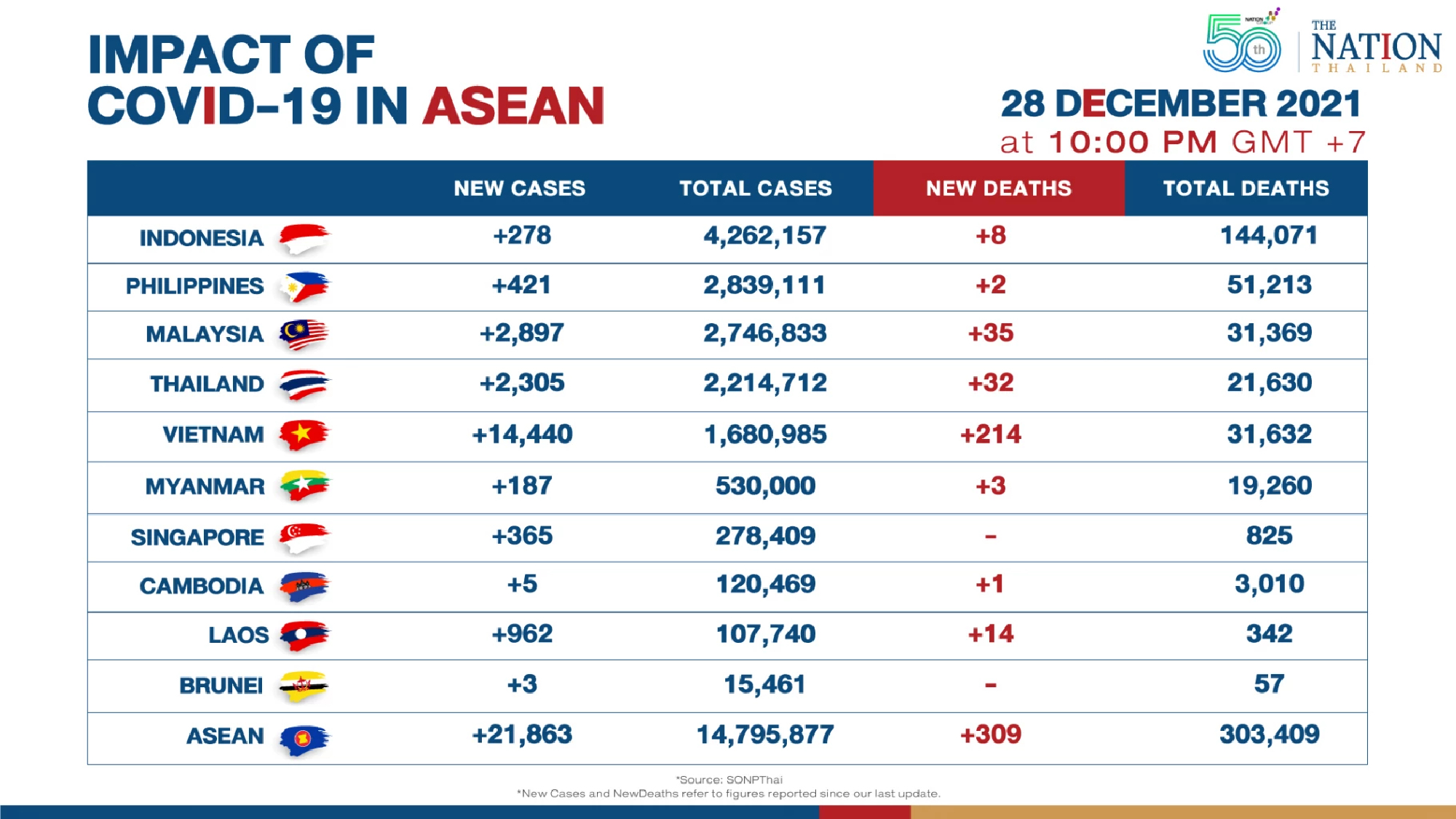
The number of Covid-19 cases crossed 14.79 million across Southeast Asia, with 21,863 new cases reported on Tuesday (December 28). New deaths are at 309, bringing accumulated Covid-19 deaths in Asean to 303,409.
Indonesia on Tuesday announced its first locally transmitted Omicron case in capital Jakarta, pushing the government to be more vigilant in tracking the spread of the virus. The patient is a male aged 37 years old, with no history of overseas travel in the last few months, nor any contact with international visitors.
With this new patient, the total number of Covid-19 cases of the Omicron variant stands at 47, including 45 international travelers and a worker at a quarantine center.
Meanwhile, Vietnam on Tuesday has detected its first Covid-19 case of Omicron variant in a quarantine facility in the capital Hanoi. The patient arrived in Hanoi on December 19 from Britain and tested positive for Covid-19. He was immediately transferred to a quarantine center under a hospital in the capital while his sample was sent for genome sequencing test. The result achieved on December 21 confirmed that he had the Omicron variant.
The government of the capital Hanoi on Monday mandated that everyone arriving in the city from the countries and regions, where the Omicron variant has been detected, should be put under quarantine regardless of their vaccination or recovery status.


 A CT scan shows the skull of Egyptian Pharaoh Amenhotep I and its outer face mask. Egyptian researchers have “digitally unwrapped” the mummy of King Amenhotep I for the first time, revealing many secrets about the pharaoh who ruled Egypt from 1525 to 1504 BC. (Egyptian Ministry of Tourism and Antiquities/Handout via Xinhua)
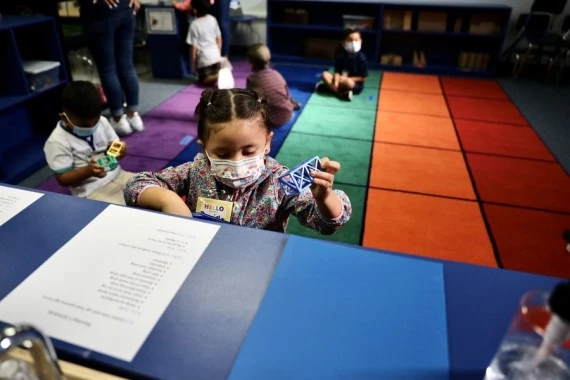 Kindergarten children play toys in a classroom at Montrara Ave. Elementary School in Los Angeles, California, the United States, on Aug. 16, 2021. (Xinhua)