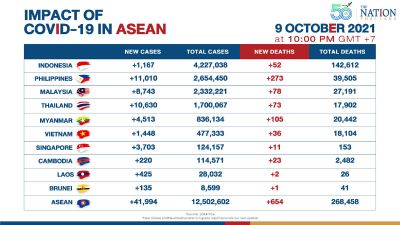
Southeast Asia saw a decrease in new Covid-19 cases and related deaths on Saturday, collated data showed.
Asean countries reported 41,994 infections and 654 deaths on Saturday compared to 43,943 and 678 respectively on Friday.
A total of 60 food and beverage outlets in Singapore have been penalised for breaching Covid-19 preventive measures, stating that they must refrain from providing dine-in services, since mid-September.
ADVERTISEMENT
Of them, 36 were ordered to temporarily close for ten days, 21 were fined about 25,000 baht and three pivoted nightlife establishments had their food licences permanently revoked.
Sarawak Disaster Management Committee has allowed cinemas to reopen under the Malaysia government’s third phase Covid-19 preventive measures from Sunday onwards.
The country’s cumulative cases are over 2.3 million with over 27,000 total deaths.
Player representatives voted Friday night to extend the contract of DeMaurice Smith for a final term as executive director of the NFL Players Association.
The player reps for the 32 teams, meeting via conference call, also voted to reduce the minimum length of Smith’s next term to as little as one year, according to a person familiar with the deliberations. Smith’s next contract thus will last for anywhere from one to five years, under the NFLPA election rules put in place before his previous reelection in 2017.
Smith told the players on the call that this will be his final term.
“I shared with the players that I wanted this to be my last term as their Executive Director and that I wanted to stay to ensure that we have a succession plan which puts the NFLPA in the strongest possible position after I leave,” Smith said in a written statement. “From the beginning of my tenure here, my mission has been the same and the fact is that I serve at the pleasure of the players. Thank you to the Board [of player reps] and I look forward to continuing to fight for players.”
JC Tretter, the Cleveland Browns center who is the NFLPA’s president, confirmed that the player reps had voted to extend Smith’s contract “for one more term” as executive director.
“He was transparent with us about his interest in moving on after this term,” Tretter said in a written statement, “and for the stability and security of our union, he will work with our player leadership to ensure we have a succession plan in place for the next leader. De cares deeply about our union and about our players and we thank him for staying to help us secure a strong future for the NFLPA.”
Smith, who has been the union’s executive director since 2009, faced a tougher reelection this time, one year after players narrowly ratified a new collective bargaining agreement with the league. That CBA provided economic gains for the players while authorizing team owners to add a 17th game to the regular season, which they put into effect this year.
ADVERTISEMENT
The player reps voted, 22-8, on Friday’s call to extend Smith’s contract, according to a person familiar with the results. Two of the player reps abstained from the vote. The 22 votes were the minimum needed to be secured by Smith to keep the election process from being opened to other candidates in March.
The matter was put before the 32 player reps after players on the NFLPA’s 14-member selection committee were split, 7 to 7, in their vote on the issue Tuesday night. A unanimous vote in Smith’s favor in that initial vote would have led to his contract being extended without a vote of all 32 player reps.
Smith will next negotiate a contract extension with the players on the union’s ruling executive committee. His current contract expires next year. Before Friday’s decision to reduce the minimum length of Smith’s next term to one year, the NFLPA election rules had said that his next contract would be for three to five years.
A Louisiana teenager could face up to five years behind bars for assaulting a teacher, an attack that authorities say could have been inspired by a TikTok challenge.
Larrianna Jackson, 18, was charged with felony battery of a schoolteacher after a video shared across social media showed her attacking a Covington High School teacher on Oct. 6, police said.
A spokesman for the Covington Police Department, Sgt. Edwin Masters, told The Washington Post that some students and teachers have suggested that the attack was inspired by the “slap a teacher” trend found on social media site TikTok.
“We’re still trying to figure out if it’s isolated or related to TikTok,” he said, noting that soap dispensers have been stolen and urinals have gone missing across St. Tammany Parish in recent weeks. Such antics reportedly have been part of a September challenge known as “devious licks.”
Jackson’s filmed actions are part of a string of similar incidents that have left teachers hurt, administrators on alert and elected officials calling for TikTok to take more accountability for the content on its site. Earlier this month, a South Carolina teacher was struck in the back of the head in the name of the challenge, according to the Lancaster County School District. A Springfield, Mo., teacher was reportedly slapped by a student this week, an assault that school leaders said was motivated by the TikTok challenge.
In a Twitter statement on Wednesday, TikTok’s communications team called the “slap a teacher challenge” a rumor and “an insult to educators everywhere.” The company said that if the challenge shows up on its site at any point, the content will be removed.
ADVERTISEMENT
A TikTok spokesperson told The Post’s Julian Mark earlier this week that such challenges would violate the company’s policies and that “most people appear to be learning about the offline dare from sources other than TikTok.”
In the most recent video allegedly influenced by the challenge, Jackson can be seen talking to a teacher who was sitting behind her desk.
People recording the video seemed to expect that something was about to occur, making comments such as “She better [expletive] not” and “I’m a start running” as Jackson uttered inaudible words to the teacher.
Jackson’s words appeared to be emphasized with hand movements that swiftly turned into closed-fist punches. The video showed the teacher falling to the floor as Jackson continued to pummel her near her face and head and as onlookers squawked in the background.
The 64-year-old teacher, who has a disability, is at home resting with some soreness and bruising following the attack, Masters said.
Jackson’s charges were escalated from a misdemeanor to a felony because the teacher was left with injuries following the assault, Masters said.
Masters said the felony carries a penalty of up to five years of incarceration with at least a year served and a fine of up to $5,000.
Jackson was released Thursday on a $25,000 bond, according to the local jail roster. No attorney information was listed.
Calls to Jackson and her parents were not immediately returned.
St. Tammany Parish Public Schools Superintendent Frank Jabbia, in a statement to The Post, called the attack and the recording of it by other students “disturbing.”
“The school system is taking the appropriate disciplinary action against all students involved,” he said. “We don’t have any evidence from our investigation that this incident is related to the TikTok challenge, but any acts of violence including participation in illegal social media trends will not be tolerated in our school system.”
Jackson’s TikTok account is mainly filled with dance challenges with family and friends and posts of her mouthing commentary from popular audio.
The Covington Police Department said Friday afternoon that a juvenile and 18-year-old Trinity Gervais were charged with a misdemeanor of unlawful posting of criminal activity for notoriety and publicity. The juvenile has since been released on a custodial agreement, and Gervais was issued a misdemeanor summons, police said.
“The Covington Police Department wants this incident to serve as a reminder to our youth that even videoing illegal activities can land you criminal charges,” the department said in a news release.
A federal appeals court late Friday reinstated the nations most restrictive abortion law, which bars the procedure as early as six weeks into pregnancy with no exceptions for rape or incest.
The U.S. Court of Appeals for the 5th Circuit granted a request filed Friday afternoon by the Texas attorney general to temporarily suspend a judge’s order blocking the law, which has halted most abortions in the state.
Attorney General Ken Paxton, R, asked the appeals court to reverse the injunction by U.S. District Judge Robert Pitman, who sided with the Biden administration Wednesday night and characterized the abortion ban as an “unprecedented and aggressive scheme to deprive its citizens of a significant and well-established constitutional right.”
A three-judge panel of the conservative-leaning court gave the Justice Department until 5 p.m. Tuesday to respond to the appeal.
Paxton told the appeals court that the Justice Department has no legal authority to sue the state and said the appeals court must intervene immediately to lift the injunction.
The lower-court judge overstepped, Paxton said in his filing, by halting a law that is enforced by private citizens, not state government officials.
“A court ‘cannot lawfully enjoin the world at large’ let alone hold Texas responsible for the filings of private citizens that Texas is powerless to prevent,” the filing states.
ADVERTISEMENT
It asked the court to rule on that issue by Tuesday morning and to temporarily suspend Pitman’s injunction “as soon as possible.”
The brief order, issued about five hours after the appeal was filed, did not rule on the merits of the state’s request. Any decision from the 5th Circuit could put the issue back before the Supreme Court, which declined to block the law when it took effect Sept. 1 but said it raises serious constitutional questions.
For the nearly 48 hours that the ban was lifted, abortion providers were scramblingto decide whether to resume terminating pregnancies beyond thethe six-week mark – a point at which many patients do not yet know they are pregnant.
At Whole Woman’s Health, one of thestate’s largest abortion providers, the decision was left to individual doctors. Some decided to again offer the procedure after Pitman’s order, but many said they would comply with the ban at least until the appeals court acts, to ensure they did not expose themselves to legal risk.
Bans on abortion after six weeks have been blocked in several other states by federal judges because they are at odds with the Supreme Court’s landmark Roe v. Wade decision, which guarantees the right to abortion before viability, usually around 22 to 24 weeks.
The Texas law is different because it is not enforced by state officials. Instead, it relies on private citizens, who can sue anyone who helps someone in Texas get an abortion. The Supreme Court cited that enforcement mechanism when it declined to block the law from taking effect.
In his ruling late Wednesday, Pitman – a nominee of President Barack Obama – alsotook issue with the law’s enforcement mechanism, among other things.
Instead of directly banning abortion after the six-week limit, Pitman said, the state had contrived a “transparent statutory scheme” that allows citizens with no connection to the person seeking an abortion to interfere with a constitutional right through the state’s judicial system.
Pitman’s injunction on enforcing the ban extended to state court judges and courthouse clerks to block any proceedings in civil suits filed under the law.
Abortion providers, however, could still be liable for performing the procedure while the litigation is underway. If Pitman’s injunction is permanently reversed, individuals who provided or assisted in abortions while it was in place can still be sued, according to the statute – a provision that critics say also raises legal concerns.
In his filing Friday, Paxton said federal judges do not have the power to interfere with state court operations.
Pitman’s injunction “grossly and irreparably interferes with Texas state-court operations,” the attorney general’s office said. “It also places state courts and their employees under imminent threat of contempt based on the actions of third parties that they cannot control.”
Pitman’s injunction lifting the ban came in response to a lawsuit the Justice Department filed against Texas after the Supreme Court allowed the law to stand. The high court was responding to a separate challenge to the ban filed by abortion providers.
The justices said last month that the providers”raised serious questions” about the constitutionality of the law. But in a 5-to-4 decision, the high court’s conservative majority said opponents had not shown they were suing the proper defendants.
All of the dissenting justices wrote separately, with the court’s three liberals characterizing the Texas law as an end run around the Constitution and court precedent.
The lawsuit filed by abortion providers is scheduled to be reviewed by the 5th Circuit in December. Providers have asked the Supreme Court a second time to intervene in the case and to rule before the appeals court considers it.
A three-judge panel of the 5th Circuit previously called off a hearing Pitman had scheduled in that case to consider blocking the law before it took effect Sept. 1.
The Supreme Court is separately scheduled in December to review Mississippi’s 15-week abortion ban. State officials in that case are directly asking the justices to overrule Roe v. Wade.
COLLEYVILLE, Texas – Just after 11 a.m. on a steamy Thursday in September, when Sean Vo should have been heading to AP Statistics, the 18-year-old shut his laptop, zipped his backpack and walked out of school.
All around him, in the well-appointed brick high school that serves Sean’s affluent, mostly White, conservative hometown, other children were doing the same. Like Sean, an Asian American who said reading books by Angela Davis raised his racial consciousness, most of those leaving were students of color. Most of those staying put were White.
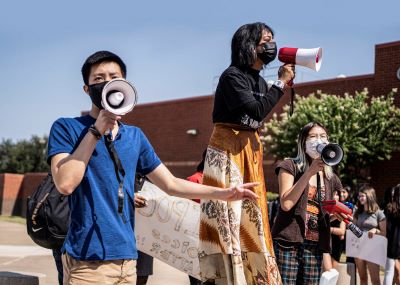
Sean Vo, 18, Sunehra Chowdhury, 17, and Grace Nguyen, 17, lead a student walk-out in early September at Colleyville Heritage High School to protest the suspension of their high school’s first Black principal, James Whitfield.
Photo for The Washington Post by Nitashia Johnson.
Close to a hundred teenagers eventually streamed through the glass doors of Colleyville Heritage High School on Sept. 9, wincing at the sunlight and at the mostly White administrators lined up against a wall to watch.
Sean, who will perform in Colleyville Heritage’s fall play, “Mousetrap,” led the students through the parking lot to a red car, where they grabbed posters scrawled with sharpie slogans – “STUDENT VOICES MATTER,” “Our Youth Will Lead Us” – before marching around campus once and returning to the front of the school.
“You guys are amazing,” Sean told the group, then turned to face the line of adults.
Sean walked closer, until he was inches from a man in a cowboy hat who was looking down at his watch, not meeting the teens’ eyes.
“Hey hey, what do you say?” Sean shouted through his mask, gesturing to the other students to start chanting, too. “Dr. Whitfield is here to stay!”
ADVERTISEMENT
They were defending James Whitfield, the first Black principal ever to lead Colleyville Heritage High. His treatment by White district officials was the reason the teens had walked out of class. It was why they would stay outside for five hours in 93-degree heat that Thursday. It was why they would leave class again the next day to spend another five hours marching around campus chanting, “No more silence! No more lies! We will not be victimized!”
Whitfield’s job was in danger. Over the summer, White adults had accused the principal of embracing critical race theory, a decades-old academic framework that argues racism in America is systemic. Critical race theory has become a target for conservatives around the country. Texas passed two controversial laws this year meant to ban any mention of it from public school classrooms.
In a lengthy Facebook post in July, Whitfield denied the allegations against him, suggesting he was being targeted for his race and because his marriage to a White woman made some people uncomfortable.
Shortly after the start of school, the White superintendent of the Grapevine-Colleyville Independent School District placed Whitfield on paid leave. Rumors began circulating online and in the hallways that the district planned to fire Whitfield at the next school board meeting.
Colleyville was a community where almost no one talked about race and where, according to the Fort Worth Star-Telegram, a Republican candidate for city council once lost a race because people circulated a picture of her posing with Barack Obama. The town voted for Trump in the 2016 presidential election, and again in 2020.
The teens of color here had learned early on, from parents or older siblings: The way to get along in suburban Dallas-Fort Worth was to fit in with the dominant White culture. For years, that meant students of color, LGBTQ teens, those from low-income families and those of minority faiths kept quiet about their beliefs and traditions, the languages they spoke and food they ate at home and most of all about the racism, antisemitism, Islamophobia and homophobia that they experienced in school.
Most stayed silent even after George Floyd’s killing rocked America in the summer of 2020, spurring a reckoning in many places that had long avoided acknowledging racism.
Whitfield, now 43, set out to change that, creating a diversity advisory committee with student members to elevate minority voices and give students greater input into school rules.
“For so long, students or people of color, any time we’ve brought up issues of race . . . it’s always turned back on you,” he said in an interview. “It’s, ‘Well, just focus on moving on.’ ‘Don’t worry about those people.'”
In the year he served as principal, the teens came to view him as a symbol of the change they hoped to see in their hometown. His removal would symbolize something else.
Sean and four other seniors – Samantha Zelling, Sunehra Chowdhury, Grace Nguyen and Kristen Garsaud, all 17 – organized the protests to demand Whitfield’s reinstatement.
None of them had any experience with racial justice demonstrations; neither did most of the teens walking out of school. They knew what they were doing could alienate White classmates, teachers, even their own parents.
Already, some school staffers and coaches were threatening to strip protesting students of leadership positions and playing time.
“It’s valid to be scared about punishments and consequences,” Sean wrote to more than 200 students in a planning group chat ahead of the walk-out. But “don’t be afraid. They want to instill fear in us. They want us to follow the rules they set to make sure we can’t speak out about things like this.”
Near the end of the first walk-out, Sunehra grabbed a megaphone and pointed to a strip of grass by the road. Following her, the teens came face-to-face with a long line of cars, including several Teslas that glittered in the sun. Colleyville parents were queuing to pick up their children from an elementary school across the way.
Sunehra, who is Bangladeshi and Muslim and wants to work in art conservation someday, thought back to her own time in a Colleyville middle school – the middle school just across the road – when classmates asked her why her father “did 9/11.” She thought about how, until sophomore year of high school, one of her best friends spoke to Sunehra using a crude, sing-song approximation of a South Asian accent.
Sunehra took a gulp of hot Texas air and yelled the instructions she wished someone gave her a long time ago.
“Make yourselves loud!” she said, gesturing first at the students, then at the parents. “Let them know how you feel!”
– – –
The five seniors all had stories like Sunehra’s. They’d never felt comfortable in their own community.
Located a half-hour drive from both Fort Worth and Dallas, Colleyville – a suburban idyll of huge homes set atop sweeping green lawns, where the median household income tops $160,000 – is 90% White. The high school is more diverse: Colleyville Heritage’s 2,000 students are 53% White, 19% Hispanic, 16% Asian, and 6% Black.
So many times, though, the five friends found themselves in classrooms filled with White children and led by White teachers. During the coronavirus pandemic, they began sharing what that felt like for the first time, sometimes over FaceTime or Discord calls and sometimes in-person, speaking through masks under the trees at Parr Park, a favorite hangout spot.
Samantha, who is Jewish and serves as president of the Dallas Holocaust and Human Rights Museum’s junior board, recalled how a classmate made her cry in middle school by entering “Heil Hitler” into her calculator when she wasn’t looking. And later, when her older sister ran for the high school’s class council, she heard other students warn each other, “Don’t vote for the Jew.”
Sean and Grace, who are both of Vietnamese and Chinese descent, remembered how classmates used to ask if they were dating, just because they were the only two Asian kids in fifth grade. Grace said groups of popular White boys insisted her good grades didn’t count, because Asians always did well. Sean remembered these boys, too, and how they joked that Sean should be eating dogs and cats for lunch – or spoke to him in loud, crude imitations of an Asian accent, swapping l’s for r’s.
“There were some guys that I was friends with up until middle school – Asian guys, and they would make fun of Asian people,” Grace said. “They don’t realize the implications, how it makes their White peers think it’s okay or even funny to make these kinds of jokes.”
Sean looked down at the ground in Parr Park.
“Honestly, I also made those jokes,” he said, “thinking it would make White people laugh.”
He looked up at Grace, who nodded at him.
For a long time, Sunehra said, she assumed the bullying about being Muslim would peter out as students matured. Then, close to the 2016 presidential election and a year before she was supposed to start high school, Sunehra checked her phone and saw that Colleyville Heritage students had hosted a football pep rally with the theme, “Make Colleyville Great Again.” They’d painted a poster to look like a brick wall, evoking Trump’s election promise to “Build the Wall.”
Flicking through the images, Sunehra felt sick. “It’s scary to see that these people don’t go away as you grow up,” she said.
That feeling was reinforced when a White man named Stetson Clark spoke at a board meeting in late July – a few weeks before Sunehra’s senior year, and several weeks after he unsuccessfully ran for a seat on the school board – to accuse Whitfield of promoting critical race theory. As evidence, Clark pointed to Whitfield’s social media activity and to a letter the principal sent out shortly after Floyd’s killing, in which Whitfield wrote that systemic racism was “alive and well” and asked students and parents to “commit to being an anti-racist.” Clark, cheered by the audience, demanded that the board fire Whitfield.
Sunehra and her friends, alerted to Clark’s comments by Samantha’s mother, decided they had to do something. They began recruiting students to speak in Whitfield’s favor at an August board meeting. They started a GroupMe titled “Supporting Whitfield” and invited everyone they thought might be sympathetic, eventually swelling the chat to more than 220 people. And they helped circulate an anonymous online form, created by alumni, to collect stories of harassment teens had experienced at school.
“Been called a monkey and have been said I resemble one cause of my skin color,” one student wrote in a submission.
“They call a Jewish boy on the [wrestling] team ‘Anne Frank’ or ‘Jew,'” wrote another. “The coaches know about this as well.”
“I was told to go back to my country,” wrote a third. “Many people may think what did I do to deserve this. I got the highest test grade in my AP Human Geo class. Keep in mind, I was the only Mexican-American in my class.”
District spokeswoman Kristin Snively called the behavior the teens described “unacceptable” and said the school system investigates every allegation of bullying or harassment to ensure all students feel welcome.
More than 30 teens showed up to rally for Whitfield outside the Aug. 23 school board meeting. More than a dozen spoke inside, sharing stories submitted online as well as their own.
Whitfield’s treatment by White school district officials, they said, looked like another version of the harassment they’d endured for years at the hands of White classmates.
Afterward, Sunehra, Sean, Samantha, Grace and Kristen felt hopeful – like they’d finally been heard.
They got the email a week later: The superintendent was placing Whitfield on leave.
– – –
On day two of the walk-outs, 17-year-old Caris Enright searched her green drawstring bag for a bottle of sunscreen. An electronic sign outside the middle school across the street recorded the temperature: 94 degrees.
“Sunscreen anyone?” she called.
Caris, who is White, was pleased to see White students protesting alongside their Black, Hispanic and Asian classmates. But she knew many more remained inside, indifferent.
Caris was raised by conservative parents to believe her Christian faith meant she should “lead with love.” As early as middle school, she grew tearful when she saw students abused for their skin color, sexual orientation or religious beliefs. Her freshman year, she found the courage to speak out, shaming a group of White girls for teasing a transgender teen during choir.
After Floyd’s killing, Caris began posting on social media about systemic racism and how White people could help combat it. After the district suspended Whitfield, she saw an opportunity to go further.
She knew her white skin meant other White teens might listen to her when they would dismiss classmates of color. She developed a strategy: She started by asking if students had seen the most recent board meeting or what they thought about Whitfield’s suspension. Slowly, she brought the conversation around to racism and the school’s long-standing culture of silence. She tried to explain why Whitfield’s principalship felt so crucial for so many minority students.
The discussions almost always ended the same way.
“i was talking to a pep boy today,” Caris wrote in the “Supporting Whitfield” GroupMe, referring to a White student involved in planning pep rallies. “i asked if he was going to walk out and [he] said ‘only if it’s during my math class i don’t really care about what’s going on.'”
Many White teachers were no better – in some cases, worse. A boy reported in the GroupMe just before the second walk-out that one of his teachers was “slamming everyone doing the protest” in class and threatening specific punishments for members of the basketball team. Other educators stood by the high school’s front doors, warning students that if they walked outside they could not go back in. Administrators also prevented protesting teens from heading back inside to use the bathroom.
Asked about staff behavior during the walk-outs, Snively said the school wanted to “avoid the disruption of students moving in and out of the building.” No students were prevented from joining the protests. Snively added that some of the administrators who stood outside during the walk-outs, watching from the wall, were counselors and support staff ready to help “students in need of emotional support.”
As local media coverage mounted, backlash was building among White parents. A Facebook group titled “GCISD Parents for Strong Schools” slammed students for ditching classes, ignoring their responsibilities and “disrupting” learning.
Sometimes, it was the protesters’ parents pushing back.
A girl wrote in the GroupMe that her stepfather had called her “anti-American” and suggested she move to Venezuela if she dislikes the United States so much.
Another girl, who had joined the first day’s walk-out, wrote that she could not attend the second because “my parents got mad at me.”
Kristen Garsaud, who is White and wants to be an oceanographer, avoided telling her parents about the walk-outs until the morning of the second day. Her father is conservative, and she feared how he would react. He was unhappy, she said, but he let her go.
But Grace’s parents, after receiving a warning email from administrators that their daughter had earned an “unexcused absence” during the first walk-out, asked her not to join the second one. They were concerned about possible punishment from the school, Grace said – and that it could hurt her college prospects. Grace, who loves to sew and is applying to fashion design programs, obeyed, although she didn’t want to.
For Sienna Scruggs, a 15-year-old sophomore at neighboring Grapevine High School, the disapproval was unsurprising. Sienna, whose mother is White and whose father is Black, has never felt welcome in Colleyville. She cannot remember a time when trips to the grocery store did not lead to other adults asking if she was adopted. She and her 10-year-old sister Sophie faced so many questions at school, often from classmates who could not understand why a White woman was driving two Black girls, that their father played them a video of Sophie’s birth to prove it.
When she read about the walk-outs on social media, Sienna felt she had to join. She wanted to show support both for the students and for Whitfield, who said he has faced criticism for photos he shared on Facebook showing him and his wife, who is White, celebrating their anniversary on a beach.
On the day of the second walk-out, Sienna rose and left school just before geometry class. Earlier that morning, she had overheard a group of White students call the protests “stupid” and “weird.”
The remarks reminded Sienna of hostile messages White teens began sending her on social media after George Floyd’s death. A White boy about her own age, referencing the police killing of Breonna Taylor, wrote that “more white killed by police than black . . . but we don’t talk about that do we?”
At Colleyville Heritage, Sienna climbed onto a bench and, tucking a stray lock of hair behind her ears, addressed the crowd. She hadn’t planned to speak, but suddenly felt she must, telling the other teens she was from another high school and admitting she didn’t know Whitfield very well.
“If you guys care about him this much, it just shows that he needs to be here,” she said. “I stand with Dr. Whitfield, and I stand with the students of Colleyville Heritage High School who want change.”
Her voice broke as she added, “We need change!”
– – –
The walk-outs didn’t work.
A top district administrator called Whitfield into a meeting on the day of the first walk-out and said the superintendent planned to ask the board to terminate Whitfield’s employment contract, the principal said in an interview. Soon after, the superintendent recommended that the board not renew Whitfield’s contract for next year. The district still refused to give a reason, citing the need to keep personnel matters private, but a spokesperson said the recommendation was unrelated to complaints about Whitfield teaching critical race theory or to the principal’s anniversary photos.
The school board’s seven members – six White, one Hispanic – would vote on the issue in late September.
In the students’ GroupMe, someone broke the news by sharing an article from a local TV station. The replies poured in: “bruh” “NOOO :((” “They better not!”
One student predicted there would be public outcry, and another replied: “Yeah us.”
Samantha picked up her phone, buzzing with notifications, and tapped out her own response: “please record videos and send them to me,” she wrote.
She, Sean, Grace, Kristen and Sunehra had already started strategizing. They wanted to flood the Sept. 20 board meeting on every possible front: Students would hold a protest outside beforehand. Others would speak during public comment in Whitfield’s favor. And, for those who could not attend in-person, Samantha would gather as much video testimony as possible.
Balancing homework, interview requests from reporters and, for the seniors, college applications, the teens got ready to make their final stand.
On the night of the pivotal board meeting, Whitfield showed up in a blue suit and red tie. He gave a short speech, thanking the teens who walked out of school on his behalf and adding he was sorry some adults were criticizing them. His wife Kerrie spoke afterward, calling her husband “an amazing man” and a “phenomenal educator.” Then the couple watched as more than 30 parents, teachers and students – many reading speeches prewritten on their iPhones – took turns behind a wooden lectern. Every single speaker asked the board to reconsider firing Whitfield.
“It has become a method of survival for marginalized students to endure ignorant hate,” Sunehra told the board.
Grace said she was sick of an “ever-pervasive culture of silence that shames students for speaking our minds.”
Sean approached the lectern in a corduroy jacket and black mask. “I’m done,” he said, “being ignored.”
Afterward, students traded messages in the GroupMe congratulating the speakers. Then the board moved into a closed meeting and the teens, those in the building and those huddled behind screens at home, settled back to wait.
About an hour later, board members took their seats again as, at their request, executive director of human resources Gemma Padgett walked behind the lectern to explain officials’ reasons for removing Whitfield. She accused Whitfield of being “disrespectful, unreasonable and insubordinate,” of sowing division in the community, of failing to communicate with colleagues and of unprofessional conduct. She said many of these concerns dated to early 2020, long before the allegations surfaced around critical race theory.
Close to 11 p.m., the board voted 7-0 to formally propose Whitfield’s termination. But they emphasized the beleaguered principal could request a hearing to argue against the dismissal.
Two weeks later, he would do so, asking in an Oct. 4 letter to the board for an “open hearing” and a chance to prove he deserves his job. The hearing could take place in the next few weeks.
In the GroupMe after the board vote, though, confused teenagers were just trying to figure out what it all meant. Several people asked what had happened. Someone said she wished live-streamed video of the board meeting came with subtitles. Another student asked if Whitfield was still suspended (he was).
“wait so when are they deciding?” a boy messaged at 11:20 p.m, wondering when the board would take a real, final vote whether to fire Whitfield.
Caris responded in less than a minute: “i don’t think we know yet,” she wrote. “but we’ll be there.”
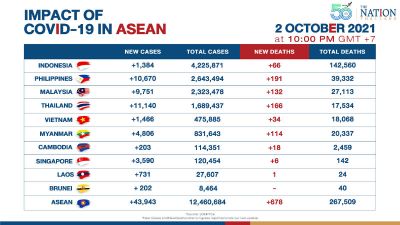
The number of Covid-19 cases crossed 12.46 million across Southeast Asia, with 43,943 new cases reported on Friday (October 8), higher than Thursday’s tally at 42,279. New deaths are at 678, increasing from Thursday’s number of 583. Total Covid-19 deaths in Asean are now at 267,509.
Laos imposed a full lockdown in Luang Prabang province until October 21 after the Covid-19 cases in the city have been rising. Residents are not allowed to leave their homes unless there are medical emergencies while visitors from other provinces will be barred from entering Luang Prabang. Laos reported 731 new cases and one death on Friday, bringing cumulative cases in the countries to 27,607 patients and total 24 deaths.
Meanwhile, Malaysia’s Public Health Ministry has granted conditional approval for the Covid-19 vaccine made by Pfizer and BioNTech to be used as a booster shot. The approval allows the vaccine to be used only on adults aged 18 and above, at least six months after they have received their second dose. The mixing of different vaccines will also be allowed for booster doses.
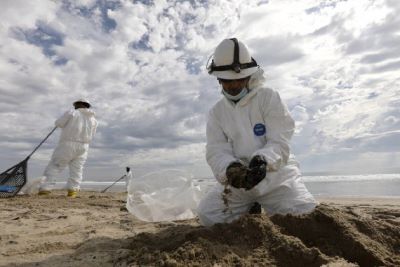
Authorities said their current estimates of the amount the oil spill range from a minimum of about 25,000 gallons to a worst-case scenario of more than 131,000 gallons.
Nearly a week after a mass oil spill off the coast of U.S. Southern California, the authorities have not reached a conclusion on the amount of oil leaked from a ruptured underwater pipeline, but some officials hint that it may be smaller than originally projected.
Initial estimates in the days after the spill were that at least 126,000 gallons of oil had leaked into the ocean, and the number was raised on Monday to potentially 144,000 gallons, the local ABC 7 news channel reported Friday, adding officials are now saying a lower number is within the range of possibilities even though the analysis would continue.
ADVERTISEMENT
Authorities said their current estimates range from a minimum of about 25,000 gallons to a worst-case scenario of more than 131,000 gallons, the report said.
Capt. Rebecca Ore, commander of the U.S. Coast Guard’s Los Angeles-Long Beach sector, was quoted as saying that after further assessments officials determined that a minimum of about 24,696 gallons, or 588 barrels, and a maximum of 131,000 gallons, or 3,134 barrels, of oil was released from the pipeline.
The 131,000-gallon estimate was a “maximum worst-case discharge that is a planning scenario based on a volume in a pipeline,” Ore said.
She disclosed that five federal and state agencies assessed pipeline data, but those numbers had not been confirmed.
This move appeared to confuse some experts who said the amount should be easy to calculate.
David Pettit, a senior attorney at the Natural Resources Defense Council who worked on the response to the massive Deepwater Horizon oil spill in the Gulf of Mexico, told ABC 7 that the amount of oil spilled into the ocean should be easily and quickly known to Amplify, the company who runs the pipeline.
“If they know what the flow rate was in the pipeline, and how much the pressure dropped, and for how long, you could calculate that in a matter of minutes,” Pettit said. “This is money to them.”
“They know how much they lost, I am certain of that,” he noted.
“Officials were unable to narrow that estimate, leaving another unanswered question as the mystery surrounding how the leak occurred continues to unfold.” the Los Angeles Times reported Friday.
“We’re nearly a week into this, and while our cleanup and our emergency response is well underway, we still don’t know answers to how this happened, why it happened and who is ultimately responsible,” Orange County Supervisor Katrina Foley said.
Workers collect oil from the sea water at Huntington Beach, Orange County, California, the United States, Oct. 4, 2021. (Xinhua)
The unemployment rate fell by 0.4 percentage points to 4.8 percent in September, after dropping by 0.2 percentage points in the previous month. The measure was down considerably from its recent high in April 2020, but remained well above the pre-pandemic level of 3.5 percent.
U.S. employers added fewer-than-expected 194,000 jobs in September, as the labor market recovery continues to slow down amid a Delta variant-fueled COVID-19 surge, the U.S. Labor Department reported Friday.
The latest data followed upwardly revised job gains of 366,000 in August. In July, job gains were over 1 million.
ADVERTISEMENT
Thus far this year, monthly job growth has averaged 561,000, according to the report.
In September, job gains were notable in leisure and hospitality, in professional and business services, in retail trade, and in transportation and warehousing, the report showed. Employment in public education, meanwhile, declined over the month.
Employment in leisure and hospitality increased by 74,000 in September, with continued job growth in arts, entertainment, and recreation. Employment in food services and drinking places changed little for the second consecutive month.
Photo taken on Sept. 3, 2021 shows a leasing notice in Washington, D.C., the United States. (Xinhua/Liu Jie)
Meanwhile, employment in retail trade rose by 56,000 in September, following two months of little change, the report showed.
Employment decreased by 144,000 in local government education and by 17,000 in state government education in the month, and employment fell by 19,000 in private education.
“The shortfall in public sector education jobs is partially a seasonal problem,” Diane Swonk, chief economist at major accounting firm Grant Thornton, wrote in a blog.
“We usually see more than a million workers return to their jobs in education in September. The need to close schools due to quarantines as cases spread undermined those gains along with a hesitancy by workers to return to low-wage support jobs, which also carry a high risk of contagion,” Swonk said.
Employment in health care declined by 18,000 in September, with job losses occurring in nursing and residential care facilities and hospitals, according to the Labor Department.
Swonk noted that hiring in the health care sector is still lagging as quits and retirements remain “elevated,” and the country has lost jobs in nursing and residential care facilities “for the last 18 months in a row.”
The unemployment rate fell by 0.4 percentage points to 4.8 percent in September, after dropping by 0.2 percentage points in the previous month. The measure was down considerably from its recent high in April 2020, but remained well above the pre-pandemic level of 3.5 percent.
The “realistic” unemployment rate for September, however, is 6.2 percent, 1.4 points higher than the official rate “due to the unusually large withdrawal of millions of people from the workforce and a misclassification error,” Peterson Institute for International Economics (PIIE) senior fellow and Harvard professor Jason Furman, and Harvard Kennedy School research associate Wilson Powell said in an article.
Furman and Powell also noted that Black and Hispanic workers experienced a more severe fall, though the gap is narrowing. The monthly job report showed that among the major worker groups, the unemployment rates for Whites (4.2 percent), and Blacks (7.9 percent) declined over the month, and the rates for Asians (4.2 percent), and Hispanics (6.3 percent) showed little change.
The number of unemployed persons fell by 710,000 to 7.7 million, well above the pre-pandemic level of 5.7 million.
Among the unemployed, the number of permanent job losers declined by 236,000 to 2.3 million in September but is 953,000 higher than in February 2020. The number of persons on temporary layoff, at 1.1 million, changed little in September, and is 374,000 above the pre-pandemic level.
The labor force participation rate ticked down to 61.6 percent in September, the report showed, noting that it has remained within a narrow range of 61.4 percent to 61.7 percent since June 2020.
Swonk noted that nearly 200,000 left the labor force during the month, reversing the gains from August, and that all of the losses were women.
“Mothers continued to struggle with childcare and the challenge of quarantines after schools reopened,” she said, adding that women make up 64 percent of the 3 million workers that left workforce since the pandemic.
“Job gains are well within the range of what the Federal Reserve required to move forward with tapering its asset purchases,” Swonk said, noting that she think tapering will commence in November.
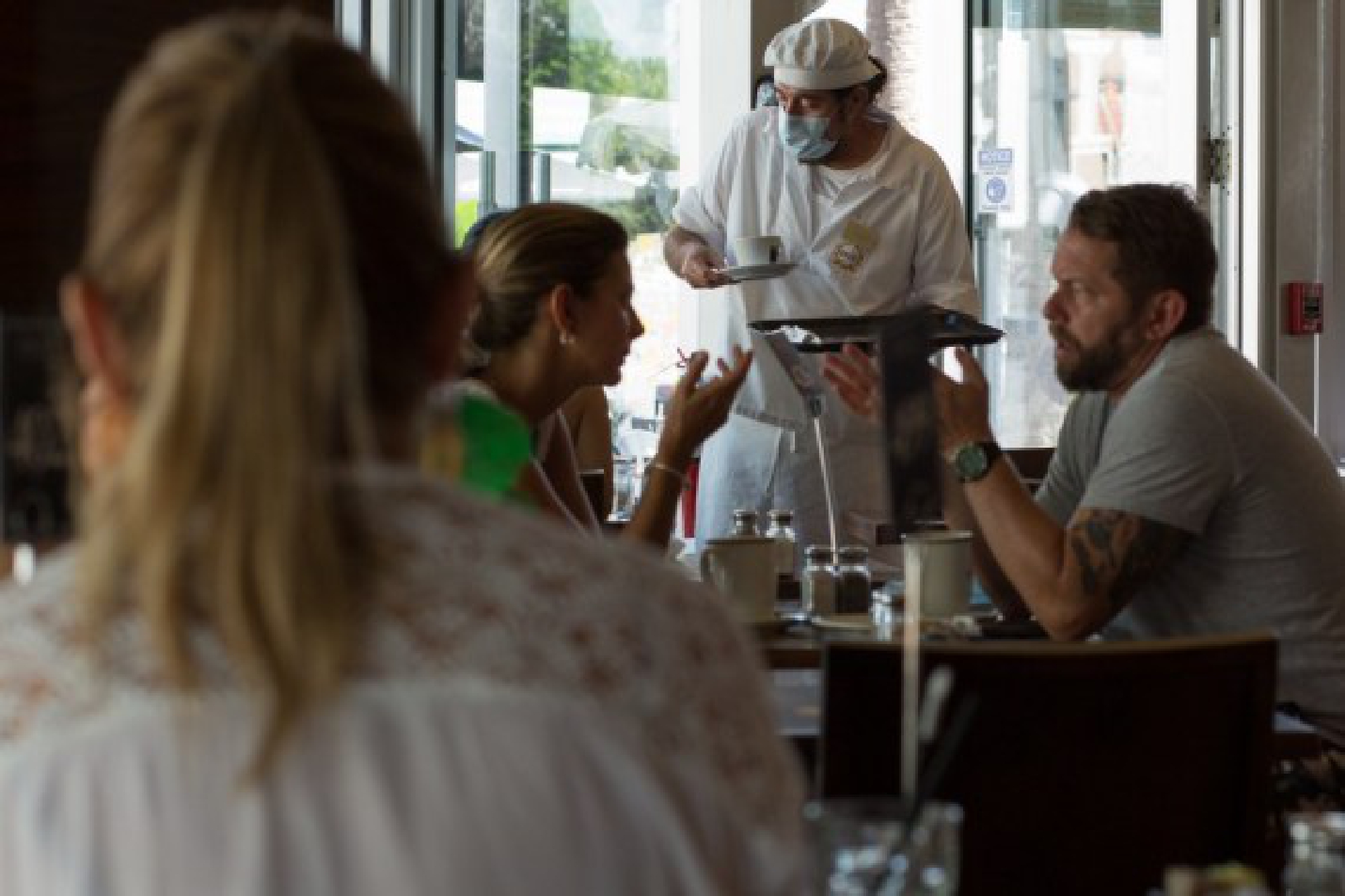
A waiter wearing a mask serves the customers at a restaurant in Miami-Dade County, Florida, the United States, Aug. 6, 2021. (Photo by Monica McGivern/Xinhua)
“President (Joe) Biden has determined that an assertion of executive privilege is not in the best interests of the United States, and therefore is not justified as to any of the documents,” a White House counsel said.
The White House said on Friday that it will not assert executive privilege to hold former President Donald Trump-era documents from a House committee probing the Jan. 6 Capitol riot.
“President (Joe) Biden has determined that an assertion of executive privilege is not in the best interests of the United States, and therefore is not justified as to any of the documents,” White House counsel Dana Remus wrote to the National Archives, according to NBC News, which obtained the letter.
ADVERTISEMENT
“These are unique and extraordinary circumstances,” Remus wrote, “The constitutional protections of executive privilege should not be used to shield, from Congress or the public, information that reflects a clear and apparent effort to subvert the Constitution itself.”
White House Press Secretary Jen Psaki said on Friday that the tranche of documents released to the committee is only the first set and that White House “will evaluate claims of privilege on a case by case basis.”
The House Jan. 6 committee issued the first batch of subpoenas last month, asking four Trump’s allies to appear for depositions.
The subpoenas were sent to former top White House adviser Steve Bannon, former White House Chief of Staff Mark Meadows, former White House Deputy Chief of Staff Dan Scavino, and former Pentagon Chief of Staff Kash Patel.
Republicans have claimed that the select committee, whose members are mostly Democrats, is nothing but a tool for Democrats to gain partisan interests.
Some 140 police officers were reportedly injured when confronting Trump’s supporters who breached the Capitol on Jan. 6 in an attempt to stop Congress from certifying the results of the 2020 U.S. presidential election, which Democrat Joe Biden won.
The Capitol riot left five dead, including a Capitol Police officer. Four officers who responded to the riot reportedly died by suicide within seven months.
Trump was impeached by the Democrat-led House on one article of inciting insurrection on Jan. 13 before being acquitted by the Senate. The Republican was the first-ever U.S. president to have been impeached and tried twice.
File photo taken on Jan. 6, 2021 shows supporters of U.S. President Donald Trump gathering near the U.S. Capitol building in Washington, D.C., the United States. (Xinhua/Liu Jie)
“The fundamental principle and spirit of this legislative amendment is respect – respect our country and respect the national flag and the national emblem, which are the symbols and signs of our country,” said an HKSAR government spokesman.
The National Flag and National Emblem (Amendment) Ordinance was published in the Gazette and came into effect Friday in China’s Hong Kong Special Administrative Region (HKSAR).
“The fundamental principle and spirit of this legislative amendment is ‘respect’ – respect our country and respect the national flag and the national emblem, which are the symbols and signs of our country,” said an HKSAR government spokesman, adding that the amendment provides for the use, etiquette, education, and promotion in relation to the national flag and the national emblem.
ADVERTISEMENT
Targeting persons who conduct public and intentional acts with intent to desecrate the national flag or national emblem, the revised bill has maintained and clarified the provisions regarding offenses and penalties, as punishment and deterrent, said the spokesman. Related Stories
HKSAR Chief Executive Carrie Lam has revised and published in the Gazette on Friday the stipulations for the display and use of the national flag and emblem as well as the HKSAR flag and emblem.
The revisions include the addition of three specified days — Labor Day (May 1), first day of the Lunar New Year and Constitution Day (Dec. 4) for the display of the national flag and the HKSAR flag.
The national flag and emblem must be displayed at the oath-taking ceremonies of the chief executive, principal officials, the judiciary, the Executive Council, the Legislative Council (LegCo), and the District Council, according to the amended bill.
The design of the national emblem must be used in the websites of the HKSAR government, the LegCo, and the judiciary.
The Education Bureau will issue a circular to schools, providing the latest guidelines on the inclusion of the national flag and national emblem in primary and secondary education, as well as matters relating to the daily display of the national flag and the weekly conduct of the national flag-raising ceremony in schools.
In light of the endorsement of the amendments to the National Flag Law and the National Emblem Law by the Standing Committee of the National People’s Congress in October 2020, the HKSAR has fulfilled its constitutional responsibility to implement the two amended national laws locally in accordance with Article 18 of the Basic Law of the HKSAR.



 Workers collect oil from the sea water at Huntington Beach, Orange County, California, the United States, Oct. 4, 2021. (Xinhua)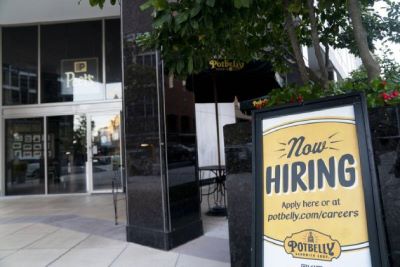
 Photo taken on Sept. 3, 2021 shows a leasing notice in Washington, D.C., the United States. (Xinhua/Liu Jie)
 A waiter wearing a mask serves the customers at a restaurant in Miami-Dade County, Florida, the United States, Aug. 6, 2021. (Photo by Monica McGivern/Xinhua)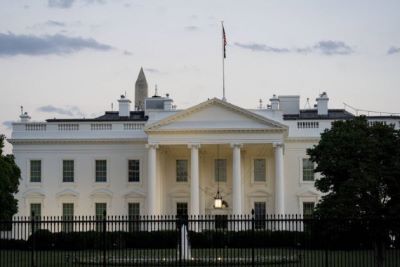
 File photo taken on Jan. 6, 2021 shows supporters of U.S. President Donald Trump gathering near the U.S. Capitol building in Washington, D.C., the United States. (Xinhua/Liu Jie)