Foreign military intervention does nothing to help solve any problem: Chinese envoy #SootinClaimon.Com

#SootinClaimon.Com : ขอบคุณแหล่งข้อมูล : หนังสือพิมพ์ The Nation.

https://www.nationthailand.com/international/40005851

Foreign military intervention does nothing to help solve any problem: Chinese envoy


“The way the situation in Afghanistan has transpired recently is proof that foreign military intervention and the imposition of a democratic transformation program does nothing to help solve any problem. It only creates more problems and failure is the inevitable outcome,” a Chinese envoy said.
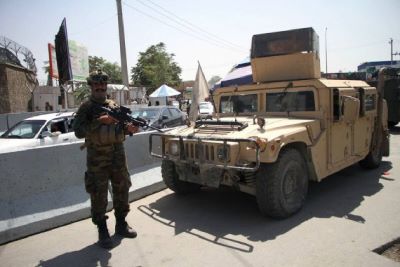
AChinese envoy on Tuesday told the Security Council that foreign military intervention does nothing to help solve any problem.

“The way the situation in Afghanistan has transpired recently is proof that foreign military intervention and the imposition of a ‘democratic transformation’ program does nothing to help solve any problem. It only creates more problems and failure is the inevitable outcome,” Dai Bing, charge d’affaires of China’s permanent mission to the UN, said at the Security Council Briefing on the Maintenance of International Peace and Security.

“The frantic and disorganized withdrawal of troops from Afghanistan by the countries concerned has plunged Kabul into chaos and upheaval. It has created a major humanitarian disaster, and left the Afghan people to pick up the pieces and there are heaps of them,” said Dai.

“We urge the countries concerned to honor their commitment to the peaceful reconstruction of Afghanistan, and not to pass the buck to its neighbors or the wider international community,” he added.
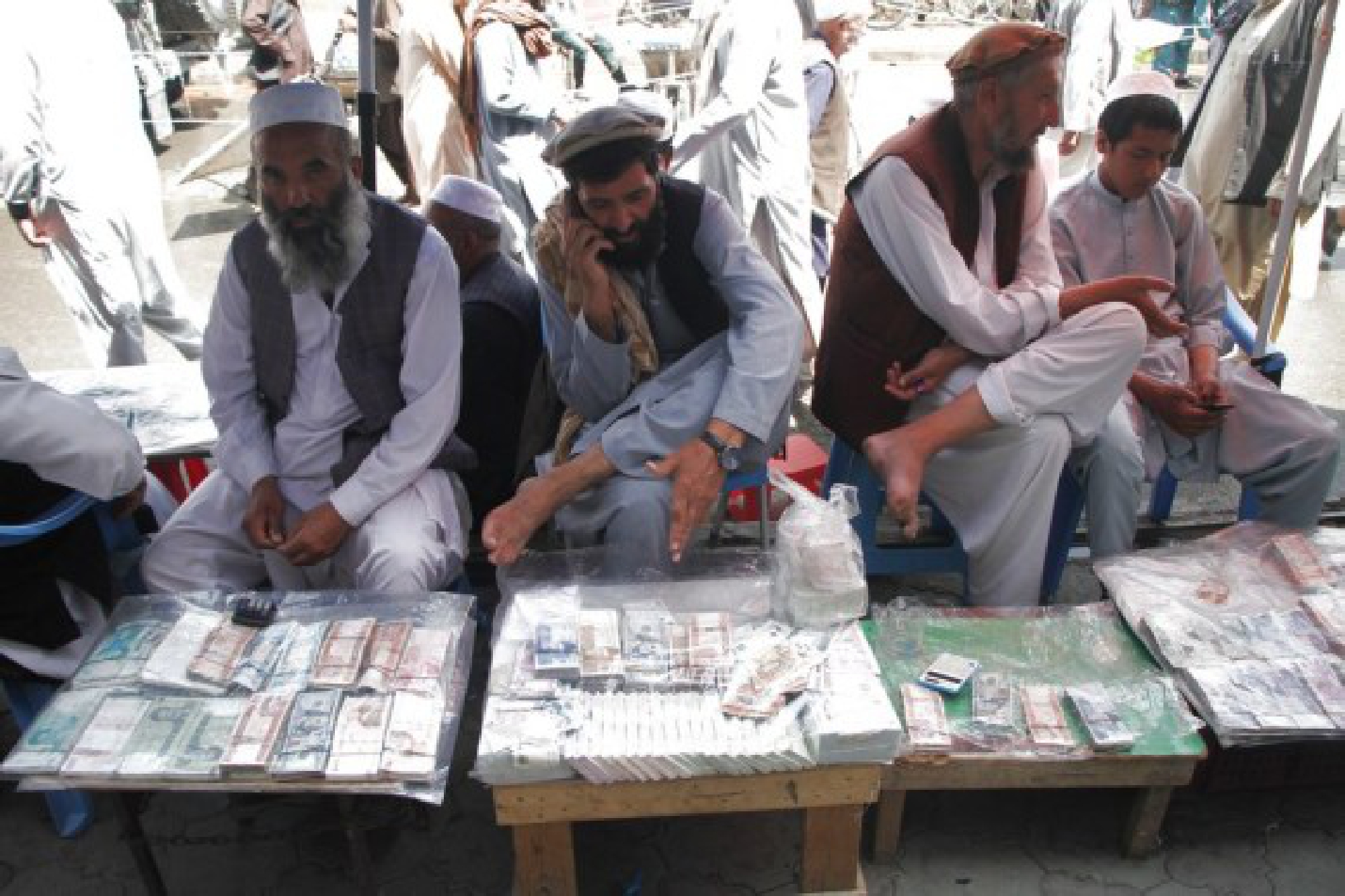
Afghan currency exchange dealers wait for customers in Kabul, capital of Afghanistan, Sept. 4, 2021. Afghan currency exchange dealers wait for customers in Kabul, capital of Afghanistan, Sept. 4, 2021.

The ambassador pointed out that the maintenance of international peace and security is something the Security Council has primary responsibility for under the UN Charter.

“Today, the international security landscape is fraught with challenges and a tangle of both traditional and non-traditional security issues. The ongoing COVID-19 global pandemic has exacerbated the uncertainties and instabilities on the peace and security front,” he said. “To achieve lasting peace and universal security in the face of these global challenges, it is imperative to uphold true multilateralism and translate it into practice.”

Related Stories

“It remains the case that our common priority is to combat the pandemic in unity and solidarity. COVID-19 is not just a threat to the entire human race, putting our lives and public health in jeopardy. It also has the potential to enable and hasten the breeding of terrorism and extremism,” said the envoy.

Speaking about COVID-19 vaccines, Dai said that universal vaccine access is “a touchstone” of the effectiveness of multilateralism.

He stressed that vaccines are very hard to come by in many developing countries, while some developed countries are still hoarding them in much greater numbers than they need for themselves.

“These vaccines are left sitting in storage as their expire dates lapse. China calls on these countries to put an end to vaccine nationalism, and contribute to global vaccine accessibility and equitable distribution in a tangible way.”

On the role of the Security Council, Dai said that pushing for the political settlement of regional hotspot issues is the core mandate of the Security Council. “Many such issues on the Council’s agenda are at a critical stage, and it is imperative to practice true multilateralism, respect the sovereignty and independence of all countries and the development path chosen by the people of their own free will, and promote, through good offices and mediation, dialogue and consultation among the parties to overcome their differences,” the ambassador added.

“Circumventing the Security Council to impose unilateral coercive measures has no basis in law, defies reason and is an affront to common decency,” he stressed.

“In the face of terrorism, climate change and other non-traditional security threats, the international community must uphold true multilateralism, strengthen coordination and work together to address them,” said Dai.

On the 20th anniversary of the 9/11 terror attacks, the envoy said that 20 years on, the threat of terrorism facing the international community has not been eliminated once and for all, and combating terrorism in all its forms and manifestations remains the common responsibility of the international community.

“Double standards and selective counter-terrorism are the dominant force of interference in international counter-terrorism cooperation. We must reject them and say no to them,” he said.

Referring to the 50th anniversary of the restoration of the lawful seat of the People’s Republic of China at the United Nations, Dai said that the five decades since has witnessed China supporting and practicing real multilateralism, lending consistent, sustained and dependable support to the UN.

“Going forward, we have the confidence and ability to make even greater contribution to the maintenance of world peace and security,” said Dai.

Photo taken on Sept. 4, 2021 shows the main money exchange market after reopening in Kabul, capital of Afghanistan.Photo taken on Sept. 4, 2021 shows the main money exchange market after reopening in Kabul, capital of Afghanistan.
 

Published : September 08, 2021

Japan steps up self-driving to revive rural areas, help elderly #SootinClaimon.Com

#SootinClaimon.Com : ขอบคุณแหล่งข้อมูล : หนังสือพิมพ์ The Nation.

https://www.nationthailand.com/international/40005848

Japan steps up self-driving to revive rural areas, help elderly


Japan is bolstering its autonomous driving ambitions with a new project to be formally introduced Wednesday to expand the use of self-driving vehicles in more than 40 locations around the country by 2025.

The “Road to the L4” project aims to popularize advanced mobility services including Level 4 autonomous driving, wherein vehicles can operate without a human at the wheel. It will include demonstrations of the technology to promote acceptance and understanding, according to the Ministry of Economy, Trade and Industry. One of the goals is to help revitalize communities.

“People including the elderly don’t have ways to get around in rural areas,” said Tatsuki Izawa, an assistant manager in the ministry’s autonomous driving division. “If there are city-circular autonomous buses, they will be able to go shopping and have outings.”

The government has earmarked about 6 billion yen ($55 million) for developing autonomous-driving services this fiscal year, including for the L4 project, which comes as many elderly Japanese give up driving. Almost 300,000 people aged 75 or over returning their licenses in 2020, according to the National Police Agency. The figure was even higher the previous year.

While companies such as Toyota and NEC are testing highly autonomous vehicles, this will be one of the first Level 4 government projects. One of its goals will be ensuring autonomous vehicles operate safely and effectively where there are other vehicles and humans.

“It’s a big challenge” to transition to Level 4 from 3, Izawa said. “We will have to show people, through experiments, that safety can be assured as we’re heading into a technologically tough area.”

There’s no perfect accident-proof technology and it takes major infrastructure investment for autonomous cars to become a reality, even in closed operating environments, said Takashi Oguchi, a professor of traffic engineering at Tokyo University who is part of the project. “No one has figured out an answer” on who takes responsibility and compensates in case of an accident, he said.

German lawmakers agreed in May to allow some Level 4 vehicles on public roads as soon as 2022. Japan revised laws in 2019 to allow Level 3 cars, which are capable of automated driving under certain conditions, to run on its roads.

Safety and consumer acceptance are the main barriers for autonomous vehicles, according to a recent study by Nottingham Trent University and Qatar University researchers. A collision between a Toyota self-driving vehicle and a visually impaired Japanese athlete during the Tokyo Paralympics left him unable to compete in his event, reinforcing concerns over safety.

“It shows that autonomous vehicles are not yet realistic for normal roads,” Toyota President Akio Toyoda said in a video on Aug. 27 following the incident at the Paralympic Athletes’ Village. There still aren’t any rules for deciding whether autonomous cars or safety operators take responsibility, he said.

Published : September 08, 2021

Asean sees over 75,000 new Covid cases #SootinClaimon.Com

#SootinClaimon.Com : ขอบคุณแหล่งข้อมูล : หนังสือพิมพ์ The Nation.

https://www.nationthailand.com/international/40005846

Asean sees over 75,000 new Covid cases


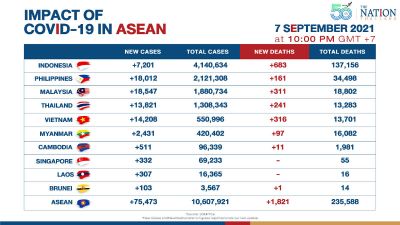
The number of Covid-19 cases in Southeast Asia crossed 10.6 million, with 75,473 new cases reported on Tuesday, higher than Monday’s tally of 74,233.

Asean also saw 1,821 additional deaths, an increase from Monday’s 1,593, taking total coronavirus deaths to at 235,588.

Indonesia’s government has approved the easing of Covid-19 curbs across Java Island with the aim to reopen tourist attractions. Dining in at restaurants will be allowed for 60 minutes at a time from the previous 30.

Bali, however, will remain under the strictest social restriction measures, or PPKM Level 4, for at least another week to curb Covid-19 infections.

Meanwhile, the World Health Organisation office in Cambodia announced that 70.6 per cent of the neighbouring country’s 16-million population have received at least one vaccine dose, while 9 million, or 56 per cent of the population, have received both shots.

WHO’s representative however warned people that although data indicated an improving situation, the risk of another Covid-19 surge is still very high, especially from the more transmissible Alpha and Delta variants.

Published : September 08, 2021

Inside the Wuhan lab: French engineering, deadly viruses and a big mystery #SootinClaimon.Com

#SootinClaimon.Com : ขอบคุณแหล่งข้อมูล : หนังสือพิมพ์ The Nation.

https://www.nationthailand.com/international/40005843

Inside the Wuhan lab: French engineering, deadly viruses and a big mystery


One chilly morning in February 2017, a tall Chinese scientist in his 50s named Yuan Zhiming showed Bernard Cazeneuve, then the French prime minister, around Wuhans new high-security pathogen lab.

Built with French engineering, it was China’s first P4 lab, one of several dozen in the world with that highest security designation. Yuan, the director of the lab, had worked more than a decade to make it a reality.

Yuan and his colleagues at the Wuhan Institute of Virology (WIV) hoped they could help prevent another catastrophe like the SARS outbreak in 2003, which embarrassed Beijing and resulted in the dismissal of the health minister.

But just a couple of years after the P4 lab’s ribbon-cutting, China was engulfed in a far deadlier outbreak. Yuan’s team hadn’t prevented it. And worse, some suspected they might have been involved in its genesis.

Yuan has vociferously denied that the WIV had any part in the coronavirus pandemic’s origins. “The Wuhan P4 lab has never seen any laboratory leaks or human infections since it began operating in 2018,” Yuan said at a news conference in July.

Amid the scrutiny, the WIV has turned inward. Yuan said at the news conference that his team took a virus database offline because of “the large number of malicious attacks,” and that they are under great pressure from rumors.

U.S. intelligence agencies said in a report last month that the virus was not a biological weapon, and that it’s unclear whether it originated naturally or from a laboratory-associated incident. The report said confirmation is unlikely without China’s cooperation, which Beijing withdrew in July.

For Yuan and his team, it means the cloud of suspicion lingers. After their high hopes, it’s a disappointment.

“Scientific collaboration in virology – it’s gone,” said a foreign researcher who has worked for years with the WIV and who spoke on the condition of anonymity because of the hostile political climate. “Now, the Chinese will not welcome foreigners because their view is you’re coming in to dig dirt.”

This account of the WIV’s 65-year history, its coronavirus research and its P4 lab is based on interviews with visiting scientists, lab audit reports, satellite images, archival records and other documentation. The WIV did not respond to requests for comment.

The P4 lab is located off an eight-lane road in Wuhan’s southern industrial outskirts, where factories give way to low mountains and farmland. The lab facilities cover roughly two football fields, on a tract of land 12 times as large, according to a June 2018 environmental safety audit report.

The building’s austere gray lines are softened by trees: From 2005 to 2015, when the lab was under construction, scientists would drive out on Arbor Day to add a few more saplings to the perimeter.

Based on the French P4 lab in Lyon, the building has four floors: waste management at the bottom; experimental labs and animal rooms on the main floor; and on the top two, apparatuses to ensure safe airflow, the report says.

Visitors called it state-of-the-art, in contrast to other, aging WIV buildings, where scientists wore coats indoors in winter because of scant heating.

The lab had “the newest technology, a huge complex,” recalled Boris Klempa, a Slovak Academy of Sciences researcher who visited in 2017.

Not everything there was meant for public eyes. Asked in 2018 what kind of viruses they kept by a reporter for the state-run Guangzhou Daily, the P4 lab’s deputy director, Song Donglin, replied that “disclosure of this kind of information must be controlled.”

WIV management has reminded staffers for years about state-secrets requirements and to be wary of foreign spies.

Jean-Pierre de Cavel, a French expert who conducted safety training at the WIV in 2010, said the Chinese researchers hoped to use the new lab to study highly infectious diseases like Ebola, Crimean-Congo hemorrhagic fever, and smallpox.

“Their expectations were to have a powerful tool, to have a P4, like any other big country,” he said. “They wanted to have the best of the best.”

The new P4 lab was not being used for researching coronaviruses, however, which are classified at lower security levels.

At a scientific conference in Barcelona in 1986, Danish researcher Ole Skovmand met a gangly Chinese scientist in his early 20s. His name was Yuan Zhiming, and he was studying how to kill malaria-carrying mosquitoes with Bacillus sphaericus bacteria.

Skovmand, 73, recalls that Yuan’s research at the time wasn’t cutting-edge. But it impressed Skovmand enough for him to help Yuan secure scholarships in France and Denmark. In Denmark, Yuan moonlighted as a cook in a Chinese restaurant and played ping-pong with Skovmand’s son, Skovmand said.

Yuan was outgoing and garrulous, recalls Christina Nielsen-LeRoux, research director of France’s National Institute for Agricultural Research, who met him in Europe two decades ago. Yuan would later reminisce about his time in Europe, and occasionally gripe about having to relinquish his research to focus on the P4 lab’s construction, Nielsen-LeRoux said.

“He said, ‘I miss that day we spent together. It was one of the best things in my life,’ ” she said.

The WIV was beginning to reach its stride then, after tumultuous origins.

Founded in 1956 as a branch of the Chinese Academy of Sciences (CAS), the WIV’s early work focused on agricultural pests, a serious concern during the famine that began in 1959. During the Cultural Revolution from 1966 to 1976, its research was disrupted, as 229 CAS scientists were killed in the political purges, according to official figures.

After Chinese leader Deng Xiaoping’s official welcoming of scientific research again in 1978, Beijing ordered the WIV to build the nation’s first archive of viruses, with 400 collected over a decade, according to an official history. In 1985, the WIV helped set up China’s first mechanized pesticide factory.

The WIV set its sights higher in 2003, with the SARS outbreak. Chen Zhu, CAS’s top official for biological sciences and soon to be China’s health minister, asked WIV to build a P4 lab, according to people familiar with the project.

Yuan accompanied Chen to France to persuade French experts to take on the construction. President Hu Jintao flew to Paris in January 2004 to seal the deal.

“Yuan Zhiming really wanted the P4 lab,” said Gabriel Gras, a French biosecurity expert who helped oversee the lab’s construction. “It’s the project of his life.”

While the WIV had Beijing’s support for the P4 lab, it also struggled against bureaucracy. When SARS took hold, the WIV had such trouble getting official research access to the new virus that director Hu Zhihong ended up “stealing” a sample from a morgue, according to a 2006 article in the state-run China Youth Daily.

Around this time, another fateful figure in the WIV’s story emerged. Yuan’s colleague, Shi Zhengli, was beginning to search bat caves for the origin of SARS.

Shi was a year younger than Yuan and also had studied in France, specializing in aquatic viruses. Now she turned to bats, in collaboration with a prominent Singapore-based virologist, Linfa Wang. In 2004, her team collected samples from 408 bats across China.

It was tough work. Shi and colleagues crawled on their stomachs through narrow caves, she recounted in a speech in June 2018. They caught bats with nets, releasing most of them after taking samples, and occasionally taking a few bats back to the lab.

Seven years into her search, Shi discovered in 2011 a close relative to SARS in a cave in subtropical Yunnan province. Her team’s paper, published in 2013, launched her to national prominence, and she gained the nickname “Bat Woman.”

In 2014, at age 50, Shi received a $585,000 national grant to continue studying coronaviruses in China’s south. Three years later, her team announced that they had found all the genetic pieces of the SARS virus in bats in a Yunnan cave – essentially proving the disease’s origin.

Meanwhile, Yuan’s 13-year endeavor was finally bearing fruit, with the P4 lab greenlighted in 2017 to begin operation. The $42 million lab was not for everyday experiments. Only a handful of the WIV’s 300 scientists had been trained to use it, including Shi, the deputy director.

Shi entered the international limelight on Jan. 23, 2020, the same day Chinese authorities sealed off Wuhan to contain a new disease. In a preprint paper, her team announced that they had found a virus 96.2 percent identical to the novel coronavirus.

Shi had originally feared that the virus could have come from her lab, as she told Scientific American. But she has since become adamant that the WIV never crossed paths with the virus, saying that she checked the lab records and that all staffers tested negative for SARS-CoV-2 antibodies.

Shi’s supporters say that if there had been a lab coverup, it’s unlikely the staff could have kept the secret from leaking out, especially with a full-court press by U.S. intelligence agencies. The U.S. intelligence report delivered to President Biden last month said that the coronavirus was not a bioweapon and that Chinese authorities didn’t know about the virus in advance.

Yuan and Shi have retreated from the world amid the controversy. The “comprehensive news” section of the WIV’s website once highlighted international collaborations, but has dwindled to politically correct posts about researchers studying the speeches of Chinese leader Xi Jinping.

Nielsen-LeRoux said she last heard from Yuan in March 2020, toward the end of the Wuhan lockdown.

“We had a very hard time in combating the infection in Wuhan,” Yuan wrote to her in an email. “The virus is spreading in your country, and more people are infected during the last days, and the situation worries me a lot. I am confident that we could finally curb the spreading of the virus with our joint effort, and our life will return back to normal soon.”

Published : September 08, 2021

Mexico decriminalizes abortion, a dramatic step in worlds second-biggest Catholic country #SootinClaimon.Com

#SootinClaimon.Com : ขอบคุณแหล่งข้อมูล : หนังสือพิมพ์ The Nation.

https://www.nationthailand.com/blogs/international/40005842

Mexico decriminalizes abortion, a dramatic step in worlds second-biggest Catholic country


MEXICO CITY – Mexicos supreme court voted Tuesday to decriminalize abortion, a striking step in a country with one of the worlds largest Catholic populations and a decision that contrasts with tighter restrictions introduced across the border in Texas.

Ten supreme court judges ruled unconstitutional a law in northern Coahuila state that imposed up to three years of prison for women who underwent illegal abortions, or people who aided them. The 11th judge was absent during the vote. The ruling is binding on other states.

“Today is a watershed in the history of the rights of women and pregnant people, above all the most vulnerable,” Chief Justice Arturo Zaldívar said.

The vote comes as a powerful women’s movement is transforming Mexico. Female politicians now make up half of the National Congress, and an ambitious constitutional reform passed in 2019 aims to ensure gender equality in senior government positions. While abortion remains illegal in most of Latin America, there has been a surge in demonstrations demanding more rights for women, particularly focused on rising violence.

“This will not only have an impact in Mexico; it will set the agenda for the entire Latin American region,” said Melissa Ayala, coordinator of litigation for the Mexican feminist organization GIRE.

Four countries in Latin America allow abortion under virtually all circumstances in the early stages of pregnancy: Argentina, Cuba, Uruguay and Guyana. At the other end of the spectrum, some nations forbid abortion for any reason. In El Salvador, women accused of aborting a fetus can be prosecuted on assault or homicide charges, and face decades in prison.

Four of Mexico’s 32 federal entities have broadly legalized the procedure – Oaxaca, Veracruz, Hidalgo and Mexico City. Abortion has also been available to women who became pregnant through rape.

A handful of antiabortion protesters prayed and demonstrated outside the supreme court Tuesday as the justices wrapped up their second day of arguments. The Catholic Church had expressed its concern a day earlier, in an editorial in its magazine Desde la Fe – “From the Faith.” “Don’t create a huge setback just to please an ideology in vogue, or due to peer pressure,” it urged the judges.

The conservative National Action Party also rejected the court’s arguments. “We are in favor of defending life from the moment of conception until natural death,” it said in a statement.

Yet the decision was out of the hands of politicians. Under Mexican law, a supreme court ruling supported by at least eight justices supersedes state laws.

Abortion won’t become widely available right away, but the ruling will “outline a route, a criteria” that states will use to change their laws, said Diego Valadés, a former supreme court judge.

“Abortion has been effectively decriminalized in Mexico,” said Paula Avila-Guillen, executive director of the New York-based Women’s Equality Center. “And every woman currently imprisoned in the country for abortion can use this precedent to be freed.”

It’s unclear how many Mexicans have been jailed on abortion charges. In a recent study, GIRE found at least 500 criminal trials were held between 2007 and 2016, but it acknowledged that it was unable to find data for many states.

Mexico has the world’s second-largest population of Catholics, after Brazil. Around three-quarters of Mexicans identify as members of the faith, according to census data. But the government is officially secular, and the church has been losing influence, due in part to clerical sex-abuse scandals.

Mexicans have also become increasingly aware of the problem of unwanted pregnancies, especially among teenagers. More than 1 million abortions are performed each year in Mexico, most in unsafe conditions, according to estimates by the U.S.-based Guttmacher Institute, a research organization that supports access to reproductive health.

“The effects on women’s health, including the number of deaths registered due to clandestine abortions, and the number of child pregnancies, represent a profound social problem,” said Valadés. “So the attitude of most of society toward abortion has changed, despite the resistance of ecclesiastical authorities.”

Analysts said the ruling reflected years of activism by women’s groups who have promoted gender equity and rights in federal and state governments, health ministries and courts. Before the pandemic, hundreds of thousands of women joined protests against femicide and labor abuses, in a burgeoning movement also fueled by the global “#MeToo” phenomenon.

“The Mexican supreme court understood the climate had changed,” said Denise Dresser, a prominent political scientist. She noted that political factors may have also been in play. Zaldívar, the chief justice, has been under fire for his close relationship with President Andrés Manuel López Obrador. A congressional maneuver that would have extended the chief justice’s term was recently dropped, after critics assailed it as unconstitutional.

“This is a way of recuperating his reputation as a progressive,” said Dresser. “It’s a way in which the court positions itself as a protector of rights, when rights are being limited or are being suppressed in other areas.”

López Obrador rose to power as a leader of the left, but many feminists have expressed disappointment with his policies. He cut funds for women’s shelters as part of a broader austerity program and has expressed suspicion that opposition political parties are behind the women’s movement. The president has defended his record, noting he named Mexico’s first cabinet in which women made up half of the members.

His winning coalition included a small party, Social Encounter, that is firmly opposed to abortion. For his part, López Obrador has been neutral on the subject.

“Women have to sort this out, the Mexican people have to sort this out,” he said at his daily news conference Tuesday, when asked about the court deliberations. “We have acted, in my case as president, with prudence, in a respectful manner, because these are very controversial, polemical topics. And we don’t want to encourage any confrontation.”

The ruling comes as Texas is implementing a law that effectively bans abortions after six weeks. Republican leaders in at least seven states are considering copying it. The Guttmacher Institute said recently that more abortion restrictions had been enacted by U.S. states in 2021 than in any year since the U.S. Supreme Court legalized abortion in the 1973 Roe v. Wade decision.

Published : September 08, 2021

Taliban forms acting government in Afghanistan, saying permanent leadership to be named soon, as protests grow #SootinClaimon.Com

#SootinClaimon.Com : ขอบคุณแหล่งข้อมูล : หนังสือพิมพ์ The Nation.

https://www.nationthailand.com/blogs/international/40005841

Taliban forms acting government in Afghanistan, saying permanent leadership to be named soon, as protests grow


KABUL, Afghanistan – The Taliban on Tuesday took its first step toward formalizing its rule of Afghanistan, announcing the leaders of a caretaker government that included members of the powerful Haqqani network but excluded representatives of the countrys toppled government.

The group said it would name permanent leadership soon. The interim cabinet – all Taliban members, many of whom had close ties to Taliban founder Muhammad Omar – excludes Afghanistan’s former leaders, such as former president Hamid Karzai and former national reconciliation leader Abdullah Abdullah, who have held talks with Taliban leaders in recent weeks.

The move reflects the Taliban’s dominance politically and militarily in Afghanistan, just days after the last U.S. troops withdrew from the country. But it could complicate the movement’s pledges to restart the country’s economy. The United States, which controls billions of dollars in frozen reserves that Afghanistan relies on, had pushed for an inclusive government consisting of non-Taliban members.

Taliban spokesman Zabihullah Mujahid defended the appointments, describing them as inclusive, with the Taliban holding discussions about the temporary cabinet “all over the country.” He said people were chosen based only on who “fought hard and sacrificed the most for freedom.”

Muhammad Hassan Akhund, a close aide to Omar, was appointed acting prime minister. Abdul Ghani Baradar, one of the Taliban’s founding members and a longtime confidant of Omar, was named Akhund’s deputy. The acting defense minister, Mohammad Yaqoob, is a son of Omar, who died in 2013.

In a statement, Akhund said the temporary ministers would protect the human rights of all Afghans and called on educated and experienced citizens not to leave the country, saying Afghanistan’s new government “desperately needs their talents, guidance and work.” The Taliban has been accused of not allowing hundreds of Afghans in the northern city of Mazar-e Sharif to leave the country on planes chartered for their evacuation.

Members of the Haqqani network, an insurgent group closely allied with the Taliban that has been labeled a terrorist organization by the United States, were also named to head two ministries, including Sirajuddin Haqqani, who was appointed as the acting interior minister. Haqqani, the leader of the network, is on the FBI’s most wanted list in connection with a 2008 terrorist attack in Kabul that killed six people, including a U.S. citizen.

The announcement of an acting government came as the movement faced growing anti-Taliban protests across Kabul. Hundreds of men and women marched the streets of the capital Tuesday in support of resistance fighters in Panjshir province after the Taliban claimed victory and took control of the area Monday.

For much of the march, Taliban fighters escorted the protest – until the demonstrators neared the presidential palace and the firing began.

“We were attacked by Taliban, they opened fire, some of the protesters were detained. Journalists were stopped from filming and covering the rally,” Maryam, an activist, texted from Kabul. She also said a Taliban vehicle plowed into the crowd.

Maryam, who for security reasons spoke on the condition that only her first name be used, said the rally in Kabul was against foreign interference in Afghanistan, particularly by Pakistan, which is widely seen as a backer of the Taliban. Online videos showed people running for cover amid gunfire, and there were reports of women detained.

Maryam added that Taliban members deleted photos and videos of the protests from phones of people they seized. A cameraman for Afghanistan’s Tolo News was briefly detained by the Taliban, according to the station’s owner, Saad Mohseni.

“People were different today,” said one protester and employee of the former Afghan government, who like others spoke on the condition of anonymity for fear of reprisal. Many of the protesters “were afraid, but they pushed forward anyway.”

Following the demonstration, Mujahid, the Taliban spokesman, said protests would not be allowed during this tenuous period, so people are not able to “use the current situation to cause trouble.”

On Monday, women also marched through the northern city of Mazar-e Sharif. The demonstrators dispersed only when the protest threatened to turn violent, with Taliban fighters growing agitated. One witness said two police vehicles intentionally drove toward the marchers.

“We were afraid, but at least we demanded our rights,” said Karima Shujazada, a 26-year-old protester in Mazar-e Sharif who helped organize a march to the provincial governor’s office and through the city.

Women’s rights protests have also taken place in recent days in Herat and Kabul. Women also took to the streets of Zaranj, near the border with Iran, to demand respect for civil liberties. The Taliban on Saturday violently suppressed a march in Kabul, although a spokesman for the group later told the Guardian newspaper that the Taliban detained four men who allegedly struck women at that demonstration.

Across Afghanistan, a generation of girls has grown up in a world completely different from the one their parents knew. When it last ruled, from 1996 to 2001, the Taliban banned girls from school and women from the workplace. While the Islamist militants have pledged to govern more moderately, many Afghans remain deeply skeptical of such promises.

As university classes resumed across Afghanistan this week for the first time since the Taliban takeover, some institutions imposed gender segregation and divided classrooms with curtains or boards.

“I really felt terrible when I entered the class. . . . We are gradually going back to 20 years ago,” a female student at Kabul University told Reuters.

The Taliban’s actions are being closely watched from abroad, with Western governments signaling that the resumption of most aid will be contingent on whether Afghanistan’s new rulers respect basic human rights.

Mujahid said at a recent news conference that women would eventually be “asked to return” to their jobs.

Ahmad Massoud, the leader of the last pocket of resistance forces in the Panjshir region, on Monday called for a national uprising against the Taliban, saying the group had “become even more brutal, radicalized, hateful and fanatic.”

The Taliban said Monday it had seized the mountainous province from forces led by Massoud.

A senior resistance official said that while the Taliban had taken control of the Panjshir Valley, resistance forces had retreated into the mountains to fight the Islamist militants. The person, who spoke on the condition of anonymity due to the sensitivity of the situation, said that some families who live in the valley have fled for the relative safety of Kabul and other provinces.

A top U.N. official pressed the Taliban this week to facilitate humanitarian work as the group consolidates its control of Afghanistan. Martin Griffiths, the U.N. undersecretary general for humanitarian affairs and coordinator for emergency relief, spoke with reporters after a visit to Kabul, where he met with Baradar, the senior Taliban official who was named acting deputy prime minister Tuesday.

“My message to him was actually rather simple,” Griffiths said. “I said we need to work together for a reason, because we need to deliver the humanitarian assistance that the people of Afghanistan urgently need. . . . So I set out to the Taliban very clearly what humanitarian agencies around the world, in every country, need to operate.”

Among the things Griffiths said aid groups would require were guarantees about the security of their employees, the ability to independently deliver and monitor assistance, and the protection of fundamental rights and freedoms for women.

Griffiths said Baradar appeared to agree to at least some of the United Nations’ requests. “Although he did add that the rights of people in Afghanistan were subject to the culture and religion of Afghanistan,” Griffiths said.

The Taliban takeover has occurred as humanitarian needs surge in Afghanistan, where conflict has already forced many Afghans from their homes and where drought and the coronavirus pandemic have added to already strained conditions. Griffiths said that roughly 18 million Afghans require some kind of humanitarian assistance.

One of the key ways that any aid could get into the country would be via the Kabul airport, which Qatar and Turkey have offered to help run, although an agreement remains elusive.

Qatar’s foreign minister, Mohammed bin Abdulrahman al-Thani, said Doha hopes that the Kabul airport can reopen in the next few days.

Amid the uncertainty, U.S. officials are under pressure to find ways to help evacuate remaining American citizens and at-risk Afghans from the country. In Mazar-e Sharif, several planes chartered to evacuate people have been unable to leave the country for days amid conflicting accounts on why they are being held up.

An Afghan official at the airport told the Associated Press that those seeking to leave were Afghans, many of whom did not have passports or visas. But Sen. Richard Blumenthal, D-Conn., said at least two planes were waiting in the city to take American citizens, at-risk Afghan allies and their families to safety in Qatar.

Asked about that at a news conference in Doha, Blinken said the United States was making efforts to ensure that charter flights can fly out of Afghanistan safely. Washington estimates that nearly 100 U.S. citizens remain in Afghanistan, including dual nationals, he said.

Blinken said the Taliban has agreed to allow anyone to leave as long as they have valid documentation, and he said he is unaware of any “hostage-type” situation.

The State Department helped four U.S. citizens leave Afghanistan over land Monday, a senior department official said, marking the first such evacuation it has facilitated since the U.S. military withdrew from Afghanistan last week.

Published : September 08, 2021

Deaths higher in Asean as new Covid-19 cases see a decline #SootinClaimon.Com

#SootinClaimon.Com : ขอบคุณแหล่งข้อมูล : หนังสือพิมพ์ The Nation.

https://www.nationthailand.com/international/40005806

Deaths higher in Asean as new Covid-19 cases see a decline


Southeast Asia saw an increase in Covid-19-related deaths on Monday despite a decline in new cases for the second consecutive day, collated data showed.

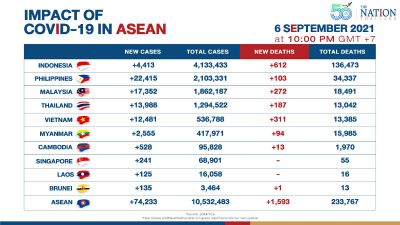
Asean reported 74,233 new cases on Monday, lower than Sunday’s 78,170, while deaths rose to 1,593 from the previous day’s 1,509.

The number of Covid-19 cases crossed 10.53 million and the death toll to 233,797.

The Philippines will lift a stay-at-home order in Metro Manila from this Wednesday as it trials “granular lockdowns” in a bid to rein in the coronavirus cases and revive the economy. The lighter restrictions in the national capital, which accounts for about a third of the country’s economy, will enable many hard-hit businesses to reopen and spur local tourism. Based on the government’s guidelines, restaurants will be allowed to accept diners and beauty salons are permitted to operate — albeit at reduced capacity.

Meanwhile, Vietnam’s capital Hanoi extended Covid-19 restrictions on Monday for a further two weeks, as authorities launched a plan to conduct tests on the city’s 8 million people to try to curb a climb in infections. Hanoi, which has ordered people to stay home and halted all non-essential activities since July, has divided the city into “red”, “orange” and “green” zones based on infection risk. People residing in the red zone must undergo Covid-19 testing three times per week, while those in other zones would be tested every five to seven days by either a RT-PCR or rapid antigen test.

Published : September 07, 2021

U.S. daily COVID-19 infections up over 300 pct from last Labor Day #SootinClaimon.Com

#SootinClaimon.Com : ขอบคุณแหล่งข้อมูล : หนังสือพิมพ์ The Nation.

https://www.nationthailand.com/international/40005800

U.S. daily COVID-19 infections up over 300 pct from last Labor Day


Daily COVID-19-related deaths are twice as high a year ago, said USA Today, citing data from the Johns Hopkins University.

 Daily COVID-19 infections are more than four times what the United States was seeing on Labor Day last year, or a 316 percent increase, USA Today reported on Monday.

Daily COVID-19-related deaths are twice as high, said the report, citing data from the Johns Hopkins University.

Hospitalizations are also up by 158 percent compared to Labor Day weekend a year ago, according to data from the Department of Health and Human Services, it said.

Related Stories

The massive number of hospitalizations is causing numerous states across the nation to run short on the number of ICU beds available to patients, said the report.

“Blame the highly contagious Delta variant and a swath of Americans refusing easily accessible vaccines that most of the developing world is furiously scrambling to obtain,” it said. 

Published : September 07, 2021

Britains COVID-19 cases top 7 mln #SootinClaimon.Com

#SootinClaimon.Com : ขอบคุณแหล่งข้อมูล : หนังสือพิมพ์ The Nation.

https://www.nationthailand.com/international/40005799

Britains COVID-19 cases top 7 mln


Britain reported another 41,192 COVID-19 cases in the latest 24-hour period, bringing the national caseload to 7,018,921, official figures showed. The coronavirus-related death toll in the country rose by 45 to 133,274. Britain has recorded more than 7 million COVID-19 cases since the start of the pandemic, according to the latest official data released on Monday.

The country reported another 41,192 cases in the latest 24-hour period, bringing the national caseload to 7,018,921, official figures showed.

The coronavirus-related death toll in the country rose by 45 to 133,274. These figures only include the deaths of people who died within 28 days of their first positive test.

The latest data came as a final decision on whether to vaccinate healthy children aged between 12 and 15 — to be signed off by the chief medical officers of Britain’s all four nations — is expected this week, according to the Department of Health and Social Care (DHSC).

The vaccines minister, Nadhim Zahawi, has said parental consent will be required if the government decides all 12 to 15-year-olds should be offered the jab.

However, a senior doctor has suggested that a school nurse or general practitioner (GP) could assess whether a child is capable of consenting to having the vaccine, even if their parents oppose it.

“Some children as young as 12 should be allowed to overrule their parents on whether they have the COVID vaccine,” Dr. David Strain was quoted by Sky News as saying.

Previously, Britain’s vaccine advisory body, the Joint Committee on Vaccination and Immunisation (JCVI), has issued the advice that children aged 12 to 15 with medical conditions should receive two COVID-19 vaccine doses, but that healthy children in this age group should still not receive the vaccine.

Related Stories

The JCVI’s decision on healthy children was based on concerns over an extremely rare side effect of the Pfizer vaccine which causes heart inflammation, according to the BBC.

“This decision will disappoint many, as this age group is particularly socially active — they have more contacts with other people than other age groups other than young adults,” said Dr. Peter English, immediate past chair of the Public Health Medicine Committee of the British Medical Association.

“As such, they are particularly effective as ‘vectors’, transmitting the infection between households. Now that the much more infectious Delta variant is prevalent we will struggle to control the virus with vaccination alone — and we certainly won’t succeed if this age group is unvaccinated,” said the retired consultant in Communicable Disease Control.

More than 88 percent of people aged 16 and over in Britain have had their first vaccine dose and nearly 80 percent have received both, according to the latest figures.

 People walk past a rapid COVID-19 testing center in London, Britain, Aug. 30, 2021. People walk past a rapid COVID-19 testing center in London, Britain, Aug. 30, 2021.
Published : September 07, 2021

13 dead, 500,000 customers out of power in U.S. Louisiana week after Ida #SootinClaimon.Com

#SootinClaimon.Com : ขอบคุณแหล่งข้อมูล : หนังสือพิมพ์ The Nation.

https://www.nationthailand.com/international/40005798

13 dead, 500,000 customers out of power in U.S. Louisiana week after Ida


Up to now, Ida is the deadliest hurricane the United States has seen in four years and the deadliest storm in the Northeast since 2012s Superstorm Sandy.

Thirteen people have died and nearly 500,000 homes and businesses remain out of power as of Monday afternoon in southern U.S. state of Louisiana, one week after Ida’s landfall as a Category 4 hurricane in the coastal state, according to the tracking website PowerOutage.us.

Most residents in New Orleans, the state’s largest city, will have power by Wednesday, but some of the hardest-hit areas may be in the dark until the end of this month, Entergy, the major power provider in the state, estimates.

Ida damaged or destroyed more than 22,000 power poles, 26,000 spans of wire and 5,261 transformers, according to a USA Today report, citing the company as the source.

At the peak, 902,000 customers had lost power, said the report.

Entergy said during the weekend that some 24,000 people were working “around the clock” to restore power.

Related Stories

In another development, the Louisiana Department of Health confirmed the state’s 13th Ida-related death on Sunday. A 74-year-old man in Orleans Parish died from heat during the power outage.

The state’s death toll also includes five nursing home residents evacuated ahead of the hurricane along with hundreds of other seniors to a warehouse, where health officials said conditions became unsafe, said the USA Today report.

In total, at least 17 deaths were blamed on Ida in the three southern U.S. states of Louisiana, Mississippi and Alabama. In the Northeast, Ida’s remnants dumped record-breaking rain and killed at least 50 people in Virginia, New York and Connecticut.

Ida landed on the 16th anniversary of Hurricane Katrina’s destructive strike, tying with 2020’s Hurricane Laura and the Last Island Hurricane of 1856 as the strongest ever to hit Louisiana.

Up to now, Ida is the deadliest hurricane the United States has seen in four years and the deadliest storm in the Northeast since 2012’s Superstorm Sandy, which killed more than 100 people, according to local media reports.

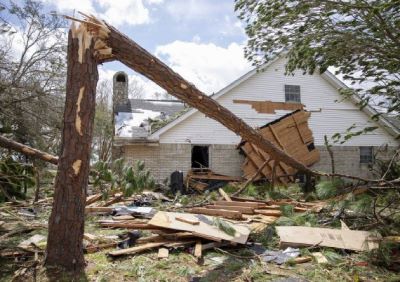
Power line poles are seen downed by Hurricane Ida in Houma, Louisiana, the United States, Aug. 30, 2021.Power line poles are seen downed by Hurricane Ida in Houma, Louisiana, the United States, Aug. 30, 2021. 

Published : September 07, 2021